That line is printed at the foot of the last full page of the formulary, under a table of nineteen proposals, most of them marked with a question mark. It is the last instruction the formulary gives, and it is not an instruction about a point. Keep it in view as you read this article, because this article contains more marked uncertainty than any other in — and the marks are part of the teaching, not a flaw in it.
The notation is closed. Every bracket, prefix, side-word, Roman numeral, × and secs suffix used below was taught once and completely in Table 13 of How a Formula Is Built, "How a Formula Is Built". It is not explained again. Every written rest — the ninety seconds between repeats, the one and a half minutes between the rounds of a Medulla line, the one minute between the numbered parts of a long treatment — stands in Table 8 of that same article with its reason attached. Two spellings recur: ↑|↓ is the Round Arrow, and (½) Ku – 13 secs is one hold of thirteen seconds, not a count of thirteen.
Watch


Twelve pairs, and why they are counted separately
Twelve pairs leave the brain itself, and the number is an address
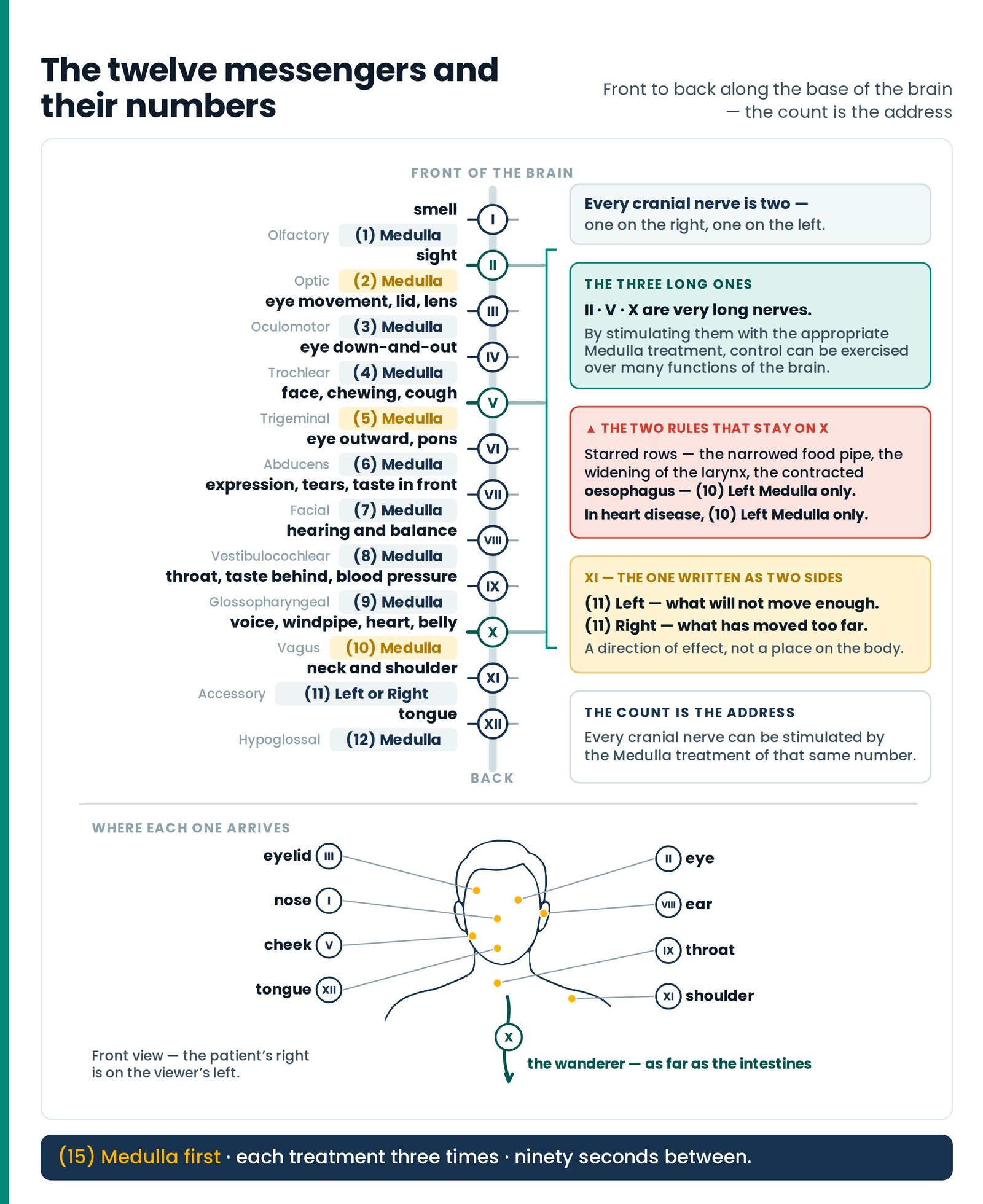
Thirty-one pairs of nerves leave the spinal cord, and you have worked along their territory since Face Down, "Face Down". Before any of them, at the top, twelve pairs leave the brain itself. They do not travel down the cord at all. They come out through small holes in the floor of the skull and go directly to the places they serve — the nose, the eyes, the muscles that move the eyes, the face, the ear, the tongue, the throat, the voice, the shoulder, and one of them the whole length of the belly.
Two things about them must be fixed before anything else.
They are twelve pairs, not twelve nerves. Every cranial nerve is two — one on the right, one on the left. There is a right olfactory nerve and a left one; a right vagus and a left vagus. This sounds like pedantry until the moment a patient's face is paralysed on one side only and you are deciding what to do, and then it is the whole of the matter.
They are numbered, and the numbers are not decorative. They run in order from front to back along the base of the brain, which is why the first is the nerve of smell and the twelfth is the nerve of the tongue. The number is an address.
The discovery
Every cranial nerve answers to the Medulla treatment of its own number
Here is the sentence on which the whole article rests, and it is stated plainly, with its own claim about how unusual it is.
The cranial-nerve discovery
Every cranial nerve can be stimulated by the Medulla treatment of that same number.
(1) Medulla reaches the first cranial nerve, the nerve of smell. (7) Medulla reaches the seventh, the nerve of the face. (10) Medulla reaches the tenth, the great wandering nerve of the chest and belly. The count is the address.
This is a discovery which may seem unbelievable to medical science, and it is offered as a discovery rather than as a deduction — it was arrived at by trying the treatments on many patients and watching what happened, and the reports below are the evidence that was collected. All the work of the brain is done through the cranial nerves. So the question the material then asks is a fair one to ask out loud: can we not say that through the Medulla treatments we can put right many diseases of the brain?
Look back at the nine members of the graded Medulla family in The Medulla Family, "The Medulla Family", and you will see the gaps in it now for what they are. That family runs (2), (4), (6), (8), (10), (12), (15), (20), (30) — nothing at (1), (3), (5), (7), (9), (11). Those six counts were never missing. They are cranial-nerve treatments proper, and they are taught here, in one place, where the nerve they index can be taught with them. The Medulla Family said so explicitly and left them; this article picks them up.
The second discovery — left is not right
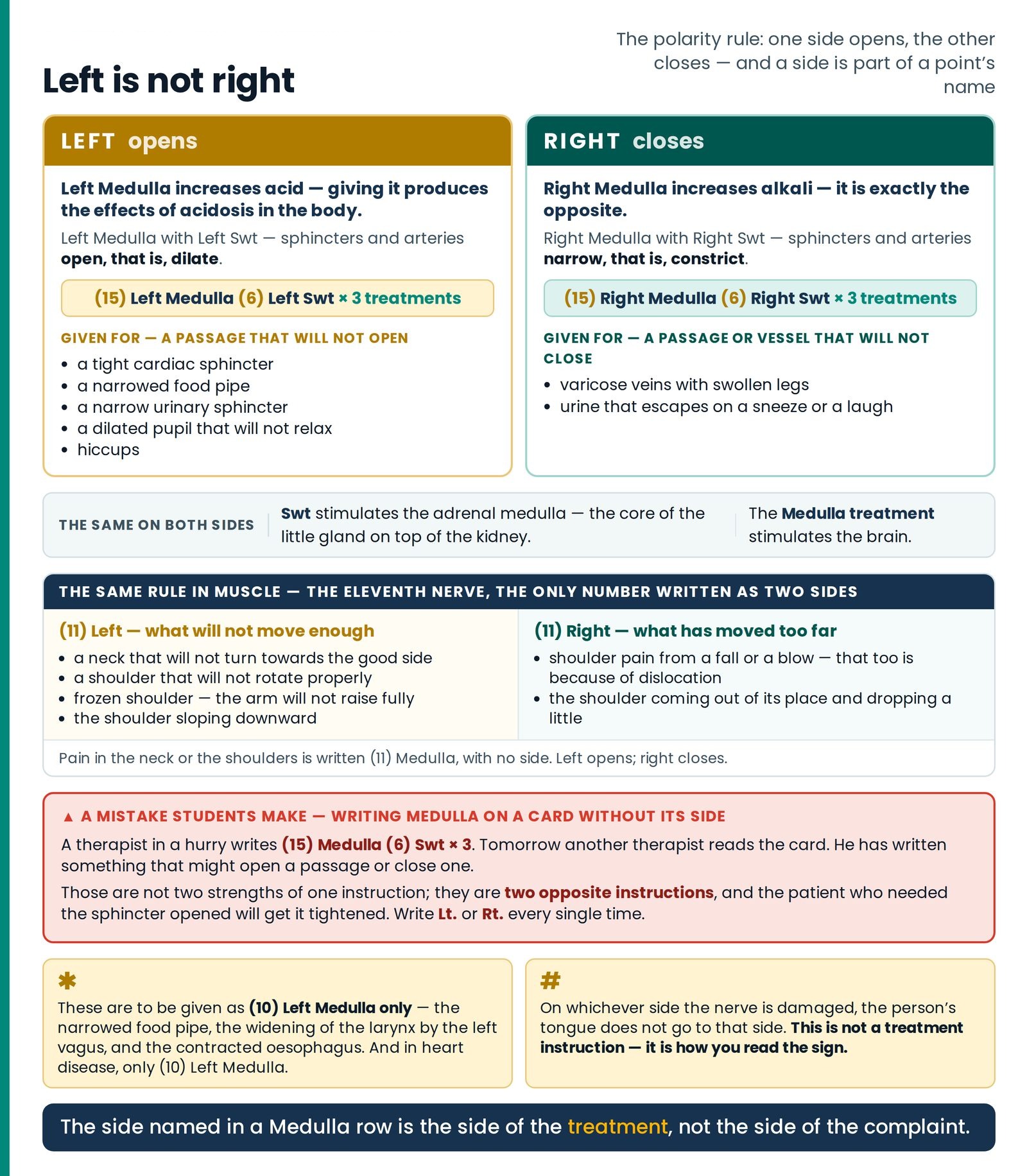
Left increases acid and opens; right increases alkali and closes
The first discovery says which count. The second says which side, and it is the rule several earlier articles have pointed forward to.
The polarity rule
The right and the left Medulla treatments work differently.
Left Medulla increases acid. Giving it produces the effects of acidosis in the body.
Right Medulla increases alkali. It is exactly the opposite.
And joined with Swt, the effect is mechanical and immediately visible:
Left Medulla with Left Swt — sphincters or arteries open, that is, dilate. Left
Right Medulla with Right Swt — sphincters or arteries narrow, that is, constrict. Right
(Swt stimulates the adrenal medulla. The Medulla treatment stimulates the brain.)
Read the parenthesis, because it is doing real work. Two different structures are being addressed by two different points, and they happen to share a word. Swt reaches the adrenal medulla — the core of the little gland that sits on top of the kidney and pours out the chemicals of alarm. The Medulla treatment reaches the brain. One word, two organs; the therapy names both and does not blur them.
Now say what the rule actually gives you, because it is rare and it is valuable. You can choose, deliberately, between opening a narrowed passage and closing a slack one. Not by a different formula. By a different side of the same two points. (Figure 37.1)
What was seen — four patients
A sphincter, two legs and a jetting stream — the rule made visible
These four are the observations the rule was built from. Read them as a set, because together they make the rule visible from both ends.
The cardiac sphincter that would not open. Sri Prakash Verma of Mumbai had a contracted cardiac sphincter — the ring of muscle where the food pipe enters the stomach. He had been operated on some years earlier and even so had not been cured. By the time he met Guruji he had great difficulty swallowing even a very small morsel, so that all the pleasure had gone out of eating. He was given (15) Left Medulla (6) Left Swt × 3 treatments. That same evening he telephoned to say that after many years he had been able to eat properly.
The legs that would not stop swelling. A woman came to the Bandra clinic with swelling in both legs due to varicose veins — vessels whose walls have given up their tone and whose valves no longer hold. Here the requirement is the opposite one: to constrict. She was given (15) Right Medulla (6) Right Swt × 3 treatments, and the swelling in her legs came down immediately.
The stream that struck the wall. At a camp in Madhya Pradesh a sixty-year-old woman said she had a great deal of pain on passing urine. Without any test report at all, Guruji made the estimate that the cause was that the opening of the urinary sphincter was very narrow — and then did the thing that turns a guess into a finding. He asked her a question whose answer only her own body could supply: did the stream come so fast and with such force that the urine struck the wall in front of her? She said yes, that is exactly what happens. A narrow opening makes a fast jet; every gardener with a thumb over a hose knows it. She was given (15) Left Medulla (6) Lt. Swt × 3 treatments. A little while later she passed urine and the trouble had already greatly reduced. After only two days of treatment she obtained complete relief.
That third story is the one to learn from, and not for the formula. The diagnosis was made across the mat, from one question, and then confirmed by the patient's own observation before a hand was laid on her.
The rule that goes before all of them
(15) Medulla first, and every one of them three times
One instruction governs every cranial-nerve treatment in this article without exception.
What is given first, and how often each is repeated
Before all the Medulla treatments of the cranial nerves, it is better to give (15) Medulla.
And all the Medulla treatments of the index tables are to be given three times, at an interval of one and a half minutes — that is, (5) Medulla × 3 treatments, (7) Medulla × 3 treatments, and so on. × 3
The reason for (15) first is taught in full in The Medulla Family, "The Medulla Family", and is not repeated here: (15) Medulla supplies acetyl choline, the transmitter used at the relay station of both automatic nerve systems, so that the message you are about to provoke has something to travel on. Supply the transmitter, then stimulate. The interval of a minute and a half is in Table 8, How a Formula Is Built.
What follows is the article's spine: the twelve nerves in order, each with what it carries, how its trouble shows itself across the mat, and the treatment that indexes it. Read it once through as a story about a head, and afterwards use the index tables in Part three as a working reference. The two are not the same teaching. This part tells you what the nerve is. The tables tell you every complaint that has been assigned to it. (Figure 37.2)
Three of the twelve are singled out before the list begins, and it is worth knowing why.
The three long ones
Cranial nerves number 2, 5 and 10 are very long nerves. By stimulating them with the appropriate Medulla treatment, control can be exercised over many functions of the brain.
That is the reason those three numbers appear more often in the index than all the others together. The second runs back from the eye deep into the brain; the fifth spreads over the whole face and into the lining of the brain itself; the tenth leaves the skull and does not stop until it has reached the intestines. A long nerve passes many doors.
I — The olfactory nerve: smell
A clear nose that smells nothing — and nobody complains of it
What it carries. Smell, and nothing else. It is the shortest of the twelve and the only one that goes straight into the old floor of the brain without a relay.
How the trouble shows. The nose is not blocked, and yet no smell, scent or fragrance can be detected through it. This is called loss of smell — anosmia — and its cause is that cranial nerve number one is not working. Almost nobody complains of it. You have to ask. Ask every patient with a head complaint whether they can smell their own food cooking, and you will find these people at a rate that will surprise you.
Given as. (1) Medulla, three treatments at an interval of a minute and a half. That is the whole of it, and it is what was given in the hall in Delhi. Seated × 3
II — The optic nerve: sight
The retina as a chemical workshop, and the longest reach in the index
What it carries. Sight. And, in this therapy's reading, a great deal more, because it is one of the three long ones and because the retina at its far end is not a passive film but a sheet of working nerve cells.
How the trouble shows. Seeing little; not seeing at all; whiteness over the covering of the eye; double vision of certain kinds; the balance going wrong; a child who cannot hold posture; the flat face and the slow start of Parkinson's disease.
Given as. (2) Medulla. Its uses reach further than any other number in the index, and the reason given is precise: this treatment is inferred to act like the second cranial nerve and to stimulate the neurons of the retina, which make GABA, acetylcholine, dopamine and other neurotransmitters. The retina, in other words, is being used as a chemical workshop as well as a camera.
Four observations belong to it, each from a different place:
Sri Rohinton of Bandra had the covering of his eyes — the sclera — entirely white, and could not see at all. He had been taking treatment for some years. Along with the other treatments to set the abdomen, he was given (2) Medulla × 12 treatments + Brodmann's area 17 & 18 ghisai. After some months the whiteness of his eyes had reduced and he began to see slightly — a little hazily. His treatment is still going on. That last sentence stands as it is written. It is not a cure and it is not offered as one.
(2) Medulla × 6 treatments has been seen to be of great benefit to children who have illnesses arising from disorders of the cerebellum, and has brought considerable relief to Parkinson's patients. At centres across the country the effect has been seen to be the same in many patients.
(2) Medulla × 6 treatments is also good for patients of rheumatoid arthritis.
At the Aurobindo Ashram at Pondicherry, (2) Medulla × 6 treatments was given to a child with CP — cerebral palsy — and within a few days he began to get up and sit.
And one formula of three parts, for a named disease of the retina:
Retinitis pigmentosa
I — (2) Medulla × 12 · II — (3) Necklace · III — Formula Number Four
For retinitis pigmentosa the above treatment is very good.
Retinitis pigmentosa is a slow, inherited decay of the light-sensitive cells at the back of the eye; it takes the side vision first and narrows what is left. Necklace is taught in Seated I — Brain, Medulla, Neck, "Seated — I"; Formula Number Four in Setting the Stomach, "Setting the Stomach".
One more, because it is the sort of thing a therapist must be ready to be asked about. After giving (2) Medulla × 12 treatments to a patient at the Bandra clinic, the pain of Pan and the whole 45° pain in the chest above the nipples went away after a single treatment. (This pain is often found in problems of the mitral valve of the heart.) Nobody had set out to treat a chest. It is recorded because it happened.
III — The oculomotor nerve: most of the eye's movement, and the lens
Four eye muscles, the upper lid, the lens and the pupil
What it carries. Four of the six muscles that move the eyeball, the muscle that lifts the upper lid, and the small muscles inside the eye that adjust the lens and narrow the pupil.
How the trouble shows. The eyelid hangs down — ptosis. The eyes will not stay open, or will not stay shut. The pupil turns outward, which is one of the ways a squint appears. The pupil is dilated and there is double vision. The lens will not adjust from far to near. A patient with MS — multiple sclerosis — at the Bandra clinic was seeing double; he was given (3) Medulla × 3 treatments, and after some days of treatment he began to see clearly — that is, the double vision stopped.
Given as. (3) Medulla.
IV — The trochlear nerve: one muscle, downward and outward
One muscle, and the movement you use going down a staircase
What it carries. One single muscle, the superior oblique, which pulls the eye down and outward — the movement you use going down a staircase.
How the trouble shows. The eye sits down and outward and there is double vision because of it. The material also records that in Chennai one patient was found to benefit for fits and cramps from (4) Medulla, and gives (4) Medulla for the mid brain.
Given as. (4) Medulla.
V — The trigeminal nerve: the whole face, and the first half of a swallow
Every sensation of the face, the chewing muscles, and the coughs
What it carries. More than any other nerve in the head. Every sensation of the face — forehead, eyelid, eyebrow, temple, cheek, nose, lip, gum, tooth, jaw, the front two-thirds of the tongue, the scalp, and the lining of the brain itself. And the muscles of chewing. It is the second of the three long ones.
How the trouble shows. Pain on the face, or no sensation on it. Migraine. Trigeminal neuralgia — the lightning pain that goes through one side of a face. Toothache of every kind. Sinus trouble. Dry, lifeless hair. A jaw that will not chew, or turns to one side. And almost every kind of cough, for which it is the chief treatment in the whole index.
Given as. (5) Medulla. It appears in the tables more often than any other number.
Two of its duties belong to the swallow, and they are worth stating here because they divide the act between the nerves:
The fifth nerve and the ninth, in one mouthful
The work of cranial nerve number five is to carry the bolus — the mouthful — from the front backwards; whereas the work of closing the epiglottis belongs to cranial nerve number nine.
Two nerves, two halves of one second. The fifth pushes the food to the back of the throat. The ninth shuts the lid over the windpipe so that it goes down the right tube.
VI — The abducens nerve: outward
One muscle, the pons — and infertility from a low body temperature
What it carries. One muscle, the lateral rectus, which turns the eye outward.
How the trouble shows. The eye will not turn outward. The pupil sits crooked up and outward and there is double vision from it. And the nerve is the one that names the pons, the swelling of brain stem it comes from.
Given as. (6) Medulla. This is the number The River — Heparin, "The River", flagged forward to this article, and here is its whole territory: the lateral rectus and the inferior oblique, the pons, the double vision that comes from an eye sitting up and out — and one further use, recorded among the closing observations:
(6) Medulla in infertility
If infertility in women is due to the temperature of the body being low, then benefit has been seen from giving (6) Medulla + Raman treatment. Their menses used to come scantily.
Two findings named, not one: a low body temperature and scanty menses. Neither alone selects this treatment.
And the honest note attached to this number and to the tenth, which is not to be smoothed away:
VII — The facial nerve: expression, tears, and taste from the front
Everything the face does, and the whistle that cannot be faked
What it carries. The muscles of expression — every muscle that makes a face a face. The tear glands. The sublingual and submaxillary salivary glands under the tongue and the jaw. The taste of the front two-thirds of the tongue. And one tiny muscle in the middle ear.
How the trouble shows. Paralysis of one side of the face. The mouth pulling to the good side, which is how Bell's palsy looks. The eyelid that will not close. No wrinkles appearing on the forehead when the patient is asked to look surprised. The inability to whistle — a test worth remembering because it takes one second and cannot be faked. Tears failing, or tears flowing and never stopping. And the flat, expressionless face of Parkinson's disease.
Given as. (7) Medulla.
Taste is a two-way street, and both ways are treated
The number five nerve carries the message of taste from the brain to the tongue, whereas the number seven nerve carries the message from the tongue to the brain. So for problems relating to taste we must stimulate both (5) Medulla and (7) Medulla.
Learn that as the model for a whole class of decisions in this article. Where a function needs two nerves, the treatment needs two numbers. Giving one of them and calling the treatment complete is the commonest error in this part of the formulary.
VIII — The vestibulocochlear nerve: hearing and balance
Two things in one bundle, and the road to the temporal lobe
What it carries. Two things in one bundle: hearing, from the spiral organ in the inner ear; and balance, from the three little loops of fluid beside it.
How the trouble shows. Deafness. Bells ringing in the ears. Vertigo — giddiness, because of a disturbance of the semicircular canals inside the ear — with the nausea and vomiting that come with it. A patient who cannot stand with the eyes shut.
Given as. (8) Medulla, which the index also gives for all problems of the ear, without qualification — and for a set of things deeper in the brain that sit along the same nerve's road: the temporal lobe, the cerebellum, the red nucleus, the formation of serotonin, and the RAS, the arousal system, when its disturbance has put a person into coma.
IX — The glossopharyngeal nerve: the throat, taste from the back, and the blood pressure
The throat, the epiglottis, and the sensors that watch the blood
What it carries. The muscles and the lining of the pharynx — the throat behind the mouth. The closing of the epiglottis. Taste from the back third of the tongue. The tonsils. The parotid salivary glands in front of the ears. The middle ear and the Eustachian tube. And two things nobody expects of a throat nerve: the sensors that watch the blood pressure in the carotid arteries, and the sensors that watch the oxygen in the blood.
How the trouble shows. Difficulty swallowing. A dry mouth at mealtimes. Loss of taste at the back of the tongue. Hiccups. Trouble with blood pressure. Breathlessness where oxygen is short.
Given as. (9) Medulla.
Two recorded observations:
In the ashram, Shri Pankit Shah ji got hiccups at the time of the evening meal on 1st December 2006. After giving (9) Medulla, he obtained relief from the hiccups at once, without drinking any water. Since then it has been tried successfully on many students.
A patient in Chennai was given (5) Medulla + (9) Medulla × 3 treatments + Katka — and he obtained great relief immediately in the irritation, the soreness of the throat. There was difficulty in swallowing and dryness inside the mouth; that too was put right.
X — The vagus nerve: the wanderer
From the voice to the intestines, with two rules that never come off
What it carries. Its name means the wanderer, and it earns it. The larynx and the voice. The trachea and bronchi. The heart's rate. And then it leaves the chest and supplies every part of the digestive system except the descending colon, and reaches as far as the upper part of the ureter. It is the third and longest of the three long ones.
How the trouble shows. A heavy voice; hoarseness; a voice with no sweetness in it. A food pipe that has contracted. Difficulty speaking. Bronchitis in which the breathing out is the difficult half. A fast heart.
Given as. (10) Medulla — with two rules attached that never come off it.
XI — The accessory nerve: the neck and the shoulder
Two large muscles, no sensation, and left and right in separate rows
What it carries. Two large muscles and no sensation at all: the sternocleidomastoid, the strap that runs from behind the ear to the collarbone and turns the head; and the trapezius, the great diamond that shrugs and steadies the shoulder blade. It also shares the pharynx and larynx with the tenth.
How the trouble shows. The neck will not turn. The shoulder will not rotate, or will not raise the arm fully — frozen shoulder. The shoulder slopes downward on one side. A shoulder that has dropped a little out of place after a fall. And, at the far end of breathlessness, the strap muscles being pressed into service as accessory muscles of respiration — which is what you are looking at when a very breathless patient's neck stands out in cords.
Given as. (11) Medulla — and this is the one number in the whole index where left and right are written into separate rows for the same region, which is the polarity rule appearing not as chemistry but as mechanics. The seven rows are set out in Part three and they repay reading twice: what will not move enough is (11) Left; what has moved too far is (11) Right.
XII — The hypoglossal nerve: the tongue
The muscles of the tongue, and how to read the side it goes to
What it carries. The muscles of the tongue, and nothing else. The twelfth cranial nerve is responsible for voluntary tongue movements.
How the trouble shows. The tongue repeatedly going to one side — and there is a rule for reading which side: on whichever side the nerve is damaged, the person's tongue does not go to that side, or cannot be turned that way. A voice that has gone. A heavy voice — thick speech. Difficulty in the last stage of swallowing.
Given as. (12) Medulla — which the index also gives for fits which come during sleep, or shortly after waking from sleep, for stimulating the hippocampus, and, with (2), for the basal ganglia.
The twelve in one table
The whole of Part two on one page, with the rule beneath it
Table 2 — The twelve messengers, their number, their errand and their treatment Seated × 3
| # | The nerve | What it carries | The trouble you will meet | Treatment |
|---|---|---|---|---|
| I | Olfactory | Smell | Anosmia — a clear nose that smells nothing; almost never complained of | (1) Medulla |
| II | Optic | Sight; and the retina's own chemicals | Blindness of any kind; seeing little; cerebellar illness in children; Parkinson's; cerebral palsy; RA | (2) Medulla |
| III | Oculomotor | Four eye muscles, the upper lid, the lens and the pupil | Ptosis; eyes that will not open or shut; squint outward; dilated pupil with double vision; lens will not adjust | (3) Medulla |
| IV | Trochlear | The superior oblique — down and outward | The eye down and outward with double vision; mid brain; fits and cramps | (4) Medulla |
| V | Trigeminal | All sensation of the face; the muscles of chewing; the dura | Migraine; trigeminal neuralgia; toothache; sinus; jaw; almost every kind of cough; the bolus going backward | (5) Medulla |
| VI | Abducens | The lateral rectus — outward | The pupil crooked up and outward with double vision; the pons; infertility from low body temperature, with Raman | (6) Medulla |
| VII | Facial | Expression; tears; the sublingual and submaxillary saliva; taste from the front | Bell's palsy; the mouth pulling to the good side; the eyelid that will not close; no whistle; no wrinkles; Parkinson's flat face | (7) Medulla |
| VIII | Vestibulocochlear | Hearing and balance | Deafness; ringing; vertigo; giddiness with nausea; all problems of the ear; the RAS in coma; serotonin | (8) Medulla |
| IX | Glossopharyngeal | The pharynx; the epiglottis; taste from the back third; parotid saliva; the BP and oxygen sensors | Difficulty swallowing with loss of taste; dry mouth; hiccups; BP; breathlessness from low oxygen | (9) Medulla |
| X | Vagus | Larynx, trachea, bronchi, heart, and the gut to the descending colon | Difficulty swallowing with a heavy voice; hoarseness; contracted food pipe; bronchitis; fast heart | (10) Medulla — starred rows Left only; heart patients Left only ▲ Take care |
| XI | Accessory | The sternocleidomastoid and the trapezius; with X, the pharynx and larynx | Neck will not turn; frozen shoulder; shoulder sloping or dislocated; the neck cords of extreme breathlessness | (11) Left for what will not move; (11) Right for what has moved too far |
| XII | Hypoglossal | The muscles of the tongue | The tongue going to one side; a voice that has gone; thick speech; fits in sleep | (12) Medulla |
And before every one of them, (15) Medulla. And every one of them three times, ninety seconds apart.
These are the tables the student will come back to for years. They are set out region by region, exactly as they are given, and they are the reference half of this article: Part two tells you what a nerve is; these tables tell you every complaint that has been assigned to it. Do not read them straight through the first time. Read the heading of each, note what kind of complaint it collects, and come back when a patient puts one of those complaints in front of you.
Three rules govern every row in every one of them, and they are not repeated inside the tables: (Figure 37.8)
(15) Medulla first, before any cranial-nerve Medulla treatment.
Three treatments, at an interval of one and a half minutes. × 3
Where a row is starred, it is (10) Left Medulla only. Left ▲ Take care
The nose and the breathing
Two rungs of one complaint — the ninth nerve and the eleventh
Table 3 — Problems of the nose and breathing, and their Medulla treatments
| Point or condition | Treatment |
|---|---|
| Where the nose begins — the root of the nose | (5) Medulla |
| The mucous membrane of the nose | (5) Medulla |
| The skin of the nose | (5) Medulla |
| Problems of the sensation of the nose and the pharynx | (7) Medulla |
| Difficulty in breathing — to increase the respiratory activity when there is a shortage of oxygen, by way of the chemoreceptors of the carotid bodies | (9) Medulla |
| When the difficulty in breathing is extreme, and the accessory muscles of respiration — that is, the sternocleidomastoid muscles — are to be used | (11) Medulla |
| Sinus problems — the maxillary sinus | (5) Medulla |
| Loss of smell — anosmia | (1) Medulla |
All the above treatments are to be given three times at an interval of one and a half minutes — that is, (5) Medulla × 3 treatments, (7) Medulla × 3 treatments, and so on. × 3
Read the fifth and sixth rows together and you have a small clinical staircase. Breathlessness because oxygen is short is a chemical problem and the ninth nerve carries the sensor that detects it. Breathlessness so extreme that the neck muscles are recruited is a mechanical problem, and the eleventh nerve owns those muscles. Two different rungs of the same complaint, two different numbers.
The eyes
Six muscles, three nerves, and the finding that chooses the number
The eye is moved by six small muscles, and three different cranial nerves share them. Which is why three different Medulla numbers appear in the next table, and why the number you need is chosen not by the word squint but by which way the eye is actually pointing. Watch the patient's eyes before you decide.
Table 4 — The six muscles of the eye and their Medulla treatments
| The movement | The muscle | Treatment |
|---|---|---|
| Turning the pupils inward | Medial rectus | (3) Medulla |
| Turning the pupils upward | Superior rectus | (3) Medulla |
| Turning the pupils downward | Inferior rectus | (3) Medulla |
| Turning the pupils down and outward | Superior oblique | (4) Medulla |
| Turning the pupils up and outward | Inferior oblique | (6) Medulla |
| Turning the pupils outward | Lateral rectus | (6) Medulla |
Table 5 — Other problems of the eyes and their Medulla treatments
| Point or condition | Treatment |
|---|---|
| Blindness — of any kind whatever | (2) Medulla |
| Seeing little, or not seeing | (2) Medulla |
| Problems of the neurons of the retina | (2) Medulla |
| To increase the flow of tears | (7) Medulla |
| The tear glands — the lacrimal glands | (7) Medulla |
| The lacrimal nerve of the tear glands | (5) Medulla |
| The sac of the tear glands — the lachrymal sac | (5) Medulla |
| The eyes remaining shut | (3) Medulla |
| Pain coming in the eye, or sensation not remaining | (5) Medulla |
| Conjunctivitis — (6) Adr × 3 treatments is also to be given | (5) Medulla |
| Problems of the cornea or the conjunctiva | (5) Medulla |
| Redness and constant watering — (6) Adr is also to be given | (5) Medulla |
| Problem in the adjustment of the lens | (3) Medulla |
| Constriction of the ciliary muscles of the iris, by which the lens is adjusted for different kinds of light | (3) Medulla |
| The pupil turning outward — as happens in squint | (3) Medulla |
| Dilation of the pupil, because of which there is double vision | (3) Medulla |
| The pupil becoming crooked up and outward, because of which there is double vision | (6) Medulla |
| The ball of the eye remaining down and outward, because of which there is double vision | (4) Medulla |
| Problems of the eyelids | (5) Medulla |
| The eyelids remaining fallen — drooping of the eyelids, ptosis | (3) Medulla |
| Not being able to close the eyelids properly — (Bell's palsy) | (7) Medulla |
| Problems of the frontal sinus | (5) Medulla |
Three rows of that table say double vision and each gives a different number. That is not a contradiction; it is a diagnostic instrument. Look at where the eye is sitting. Dilated pupil — (3). Crooked up and outward — (6). Down and outward — (4). The complaint the patient gives you is the same word every time; the finding is different every time, and the finding chooses.
The ear
Five numbers for one organ, and the row that is the safety net
Table 6 — Ear problems and their Medulla treatments
| Point or condition | Treatment |
|---|---|
| Sensations of the inner or outer part of the ear | (5) Medulla |
| The voice, or the acoustic meatus — the doorway of the organ of hearing | (5) Medulla |
| The outer part of the ear | (5) Medulla |
| Deafness — (the hearing area of the cerebrum) | (8) Medulla |
| Vertigo — giddiness — because of a disturbance of the semicircular canals inside the ear | (8) Medulla |
| To stimulate the spiral Organ of Corti inside the ear | (8) Medulla |
| For all problems of the ear | (8) Medulla |
| Bells ringing in the ears | (8) Medulla |
| Inflammation in the ear — (6) Adr is also to be given | (8) Medulla |
| The outer part of the ear, hearing, and carrying sensation to the brain from the cranial fossa of the posterior part of the dura mater | (10) Medulla |
| The ear — relating to the middle ear and the Eustachian tube | (9) Medulla |
| Problems of the middle ear — the stapedial motor nerve | (7) Medulla |
Five different numbers appear in a table about one organ. That is not untidiness; it is the ear's actual wiring. The outside of the ear is felt by the fifth and by the tenth. The middle ear belongs to the seventh and the ninth. The inner ear — hearing and balance, the two things people mean when they say "my ear" — is the eighth. And the row that says for all problems of the ear, (8) Medulla is the safety net beneath the rest: when you cannot tell which part of the ear is at fault, that is the row you use.
The brain and the forehead
The longest reference table: from migraine to the RAS in coma
Table 7 — Brain and forehead problems and their Medulla treatments
| Point or condition | Treatment |
|---|---|
| For headache — migraine | (5) Medulla |
| The skin of the upper part of the head | (5) Medulla |
| Absence of sensation in the scalp, the upper part of the forehead | (5) Medulla |
| The skin of the temple | (5) Medulla |
| Pain coming in the sides of the head — the temples | (5) Medulla |
| The maxillary sensory nerve goes as far as the dura mater | (5) Medulla |
| Silhouette or wrinkles not appearing on the forehead | (7) Medulla |
| Ataxia — cerebellar ataxia; serotonin is necessary to stimulate the legs | (2), (8) Medulla |
| The brain — from the front to the back | (2) Medulla |
| Balance or posture going wrong because of a problem of the ears or the eyes | (2) Medulla, (8) Medulla |
| The body's balance, posture and coordination of movement not being right | (2) Medulla |
| Problems of the basal ganglia | (2), (12) Medulla — both are useful |
| Problems of the cerebellum | (2), (8) Medulla — both are useful |
| Cerebellum — the vestibulocochlear nerve | (8) Medulla |
| Problems of the cerebellum due to a deficiency of GABA | (2) Medulla |
| Dopamine, acetylcholine, GABA — the retinal neurons | (2) Medulla |
| The temporal lobe of the cerebral cortex | (8) Medulla |
| Giddiness coming, or the nausea and vomiting caused by it | (8) Medulla |
| Vertigo — because of a disturbance of the semicircular canals of the inner ear | (8) Medulla |
| The formation of serotonin | (8) Medulla |
| When the RAS is disturbed a person can go into coma. To put that right | (8) Medulla |
| Mid brain | (4) Medulla |
| Mid brain, medial geniculate body, red nucleus | (8) Medulla |
| Pons — the abducent nerve | (6) Medulla |
| Pons, trigeminal ganglion, spinal, principal and mesencephalonic nucleus | (5) Medulla |
| Medulla oblongata — the glossopharyngeal nerve | (9) Medulla |
| Fits which come during sleep, or shortly after waking from sleep | (12) Medulla |
| To stimulate the hippocampus | (12) Medulla |
Three notes are printed beneath that table and belong with it:
For the maintenance of posture and balance, impulses of cranial nerve #2 from the eyes, along with impulses from the semicircular canals of the ears carried by cranial nerve #8, are necessary. That is why two numbers stand in the balance rows, and why you give both.
Control of equilibrium is a combined function of portions of the cerebellum and the reticular substance of the medulla, pons and mesencephalon.
And the discovery already met in Part two: (2) Medulla × 6 treatments stimulates the retinal neurons' GABA, acetylcholine, dopamine and several other neurotransmitters.
The neck and the shoulders
Seven ordinary complaints, sorted into two heaps by the polarity rule
This is the short table, and it is the most instructive one in the article, because it is the polarity rule written out as seven ordinary shoulder complaints.
Table 8 — Neck and shoulder problems, and the side that is given Left Right
| Point or condition | Treatment |
|---|---|
| Not being able to turn the neck towards the good side | (11) Left Medulla |
| Pain in the neck or the shoulders | (11) Medulla |
| Not being able to rotate the shoulder properly | (11) Left Medulla |
| Frozen shoulder — not being able to raise the arm fully | (11) Left Medulla |
| The shoulder sloping downward | (11) Left Medulla |
| Pain in the shoulder — the kind that comes from a fall or a blow; that too is because of dislocation | (11) Right Medulla |
| The shoulder coming out of its place and dropping a little — shoulder dislocation | (11) Right Medulla |
Sort those seven rows into two heaps and the rule falls out of them.
Reading the eleventh nerve's two sides
Left is given where something will not move enough: a neck that will not turn, a shoulder that will not rotate, an arm that will not rise, a shoulder that has lost its lift and sags. Left opens.
Right is given where something has moved too far: a joint that has come out of its place, a shoulder dropped by a fall. Right closes.
This is the same rule as the cardiac sphincter and the varicose vein, stated in muscle instead of in plumbing. Once you have seen it here, you will find you can predict the side for a complaint you have never met, and then check yourself against the table.
The face and the mouth
Eight doors into one list: what the face feels, and what the face does
The longest table in the formulary runs across four pages. It is set out here in eight groups, so that a therapist can find a row in the time a patient takes to describe a complaint. Nothing has been left out and nothing has been combined; the groups are only doors into one list.
Table 9 — Swallowing Seated × 3
| Point or condition | Treatment |
|---|---|
| For swallowing — to take the bolus, the mouthful, backwards | (5) Medulla |
| For swallowing — to open and close the epiglottis, by way of the cricothyroid and arytenoid muscles | (10) Medulla |
| For swallowing — for the muscles of the tongue | (12) Medulla |
| To close the epiglottis | (9) Medulla |
| To remove a problem in swallowing — in swallowing food | (9) Medulla |
| To remove difficulty in swallowing — because of narrowing of the food pipe | (10) Medulla * Left |
| To open the oesophagus — the food pipe — if it has contracted | (10) Medulla * Left |
Two instructions decide between the two commonest rows of that group, and they are worth learning as a pair, because they are a diagnosis made from one extra question:
Which nerve, when swallowing is hard
If, with difficulty in swallowing, taste does not come — that will be put right by (9) Medulla.
But if, with difficulty in swallowing, the voice is heavy — that will be put right by (10) Medulla.
One complaint, two answers, and the question that separates them takes four seconds: and how is your taste? and how is your voice?
Behind it: cranial nerves 5, 9, 10, 11 and 12 together look after the work of swallowing, and the motor impulses that cause swallowing are transmitted by the 5th, 9th, 10th and 12th. The larynx and the pharynx are both controlled by cranial nerves 10 and 11, while the pharynx is also controlled by cranial 9. Both of those organs are necessary for swallowing food and for the voice to come out correctly.
Table 10 — The voice and the larynx
| Point or condition | Treatment |
|---|---|
| To bring back a voice that has gone | (12) Medulla |
| To correct a heavy voice — thick speech | (12) Medulla |
| To bring sweetness into the voice | (10) Medulla |
| To remove hoarseness — roughness — in the voice | (10) Medulla |
| To remove difficulty in speaking — to widen the larynx, the voice-box, by way of the left vagus | (10) Medulla * Left |
| The muscles of the larynx | (10) Medulla |
| The mucous membrane of the larynx | (10) Medulla |
| Contraction of the muscles of the pharynx and larynx | (10), (11) Medulla |
| It contracts the smooth muscles of the trachea and bronchi — for bronchitis | (10) Medulla |
Table 11 — The face
| Point or condition | Treatment |
|---|---|
| Paralysis of one side of the face | (7) Medulla |
| The expressions of the face, by which a person's face contracts or lights up according to the emotions | (7) Medulla — and this should be used in Parkinson's disease |
| The mouth turning towards the good side — as happens in Bell's palsy | (7) Medulla |
| The mouth becoming crooked, in which all the muscles of one side are paralysed | (7) Medulla |
| Not being able to whistle | (7) Medulla |
| Silhouette or wrinkles not appearing on the forehead or the eyebrow | (7) Medulla |
| Pain on the face, or the sensation or absence of sensation | (5) Medulla |
| Pain on the temple, or the sensation or absence of sensation | (5) Medulla |
| Pain in the eyebrow, or no sensation there | (5) Medulla |
| Trigeminal neuralgia | (5) Medulla |
| Problem in the cheekbone | (5) Medulla |
| The skin and mucous membrane of the cheeks | (5) Medulla |
Notice what that table does with one face. Everything that the face feels is the fifth. Everything the face does is the seventh. Sensation and movement, two nerves, side by side over the same cheek. When a patient's face droops but she can still feel your finger on it, you are looking at the seventh; when she feels nothing but the face moves normally, you are looking at the fifth.
Table 12 — The jaw, the teeth and the gums
| Point or condition | Treatment |
|---|---|
| Problems of the muscles of chewing | (5) Medulla |
| For every problem of the teeth | (5) Medulla |
| Problems of the gums | (5) Medulla |
| Problems of the lips | (5) Medulla |
| The soft part inside the jaw | (5) Medulla |
| Problems of the muscles of the jaw — from the motor root not working | (5) Medulla |
| The jaw turning towards the paralysed side, and the patient not being able to chew properly | (5) Medulla |
| Problem of the upper or lower part of the jaw | (7) Medulla |
Table 13 — The tongue, the mouth and taste
| Point or condition | Treatment |
|---|---|
| The mucous membrane of the front two-thirds of the tongue | (5) Medulla |
| Not experiencing sensation in the tongue | (5) Medulla |
| Not experiencing pain or touch sensation on the mouth | (5) Medulla |
| Movement of the muscles of the tongue | (12) Medulla |
| Paralysis of one side of the tongue — the tongue repeatedly going to one side | (12) Medulla # |
| Problems of the palate inside the mouth | (5), (9) Medulla |
| Contraction of the muscles of the palate | (10) Medulla |
| Taste — the posterior third of the tongue | (9) Medulla |
| The experience of taste — the chorda tympani | (7) Medulla |
| The experience of taste — from the front two-thirds of the tongue | (7) Medulla |
Table 14 — Saliva
| Point or condition | Treatment |
|---|---|
| If the mouth has gone dry — to bring saliva | (7), (9) Medulla |
| To increase saliva — from the parotid glands | (9) Medulla |
| To increase saliva — from the sublingual and submaxillary glands | (7) Medulla |
| The salivary glands — the visceral motor nerve | (7) Medulla |
Ptyalin is found in greater quantity in the saliva of the parotid glands. And it is the 9th cranial nerve that stimulates the parotid glands, not the seventh. That sentence is printed as a footnote, and it is a correction — the kind of small, exact self-correction that tells you somebody checked.
Table 15 — The pharynx and the tonsils
| Point or condition | Treatment |
|---|---|
| Control of the muscles of the pharynx | (9) Medulla |
| The mucous membrane of the pharynx | (9) Medulla |
| Sensation from the pharynx | (7), (9) Medulla |
| To stimulate the nerves of the tonsils | (9) Medulla |
Table 16 — The blood pressure and the carotid sensors
| Point or condition | Treatment |
|---|---|
| Control of BP by the nerves of Hering | (9) Medulla |
| Control of BP — by way of the carotid sinus | (9) Medulla |
| Problems of the carotid arteries and the carotid bodies | (9) Medulla |
Two marks travel with the face-and-mouth list and must be carried wherever a row from it is copied onto a card:
The coughs
Nine kinds of cough identified across a mat, with no instrument at all
For almost every kind of cough, (5) Medulla has proved useful. Then nine kinds are distinguished, and the descriptions are worth learning because they are how a cough is identified across a mat without any instrument at all.
Table 17 — The coughs, and their treatment
| The cough | Treatment |
|---|---|
| Dry cough | (5) Medulla |
| A very forceful cough | (5) Medulla |
| The cough of asthma | (5) Medulla |
| The cough that comes because of an aortic aneurysm — because of pressure on the left recurrent laryngeal nerve | (5) Medulla |
| Bronchial cough — which comes on turning over in bed or on getting up in the morning, in which the phlegm is grey in colour, frothy and foul-smelling; the cough comes first with soreness and difficulty, but later comes more easily; a great deal of phlegm coming, or thin phlegm coming | (5) Medulla |
| The cough that comes because of diphtheria in the larynx | (5) Medulla |
| The metallic cough of laryngitis — a cough that comes with a scraping sound | (5) Medulla |
| Pulmonary cough, which is hard and comes with pain — as happens in pneumonia; at the beginning of TB it comes with soreness | (5) Medulla |
| Whooping cough — pertussis — in which the face turns red with coughing and coughing | (5) Medulla |
Perhaps for such a cough (10) Medulla will also be beneficial, because it looks after the laryngeal nerve.
That perhaps is not an editor's softening. It is written as a perhaps, and it stays one. So does the line that closes the whole cough section, printed by itself under a rule: in the detailed knowledge of the functions of (6) Medulla and (10) Medulla, some further discovery remains to be made.
This is the most unusual page in the whole formulary, and a student should be told what it is before reading a line of it. Every row below prefixed with a question mark is not an instruction. It is a hypothesis — a piece of reasoning forward from the anatomy just set out, saying this ought to follow; somebody should look.
Table 18 — Proposals for further research, exactly as they stand
| Proposal | Treatment |
|---|---|
| ? Kidney stone — the vagus nerve goes as far as the upper part of the ureter | (10) Medulla |
| ? For hiccups — if it is because the epiglottis is not closing properly; this is to be tried on motor neurone patients, and on children whose saliva keeps dribbling from the mouth | (9) Medulla |
| ? If tears keep flowing excessively from the eyes, to reduce them — this stimulates the muscles of the tear glands, so it must also control the quantity of tears? | (7) Medulla |
| ? If tears keep flowing excessively from the eyes, to reduce them — because this stimulates the paranasal sinuses | (5) Medulla |
| ? For hair that is dry and lifeless — it carries sensation from the skin of the upper part of the forehead | (5) Medulla |
| ? Bronchitis — in which there is difficulty in breathing out; the vagus nerve constricts the bronchi | (10) Right Medulla Right |
| ? Perhaps it will calm the hyperactivity of the brain — will it help in autism? (it works in the medulla oblongata) | (8) Medulla |
| ? Bell's palsy — from the motor root not working, the jaw will turn towards the paralysed side | (5) Medulla |
| ? No expression on the face — not being able to express feeling — for Parkinson's patients | (7) Medulla |
| ? Sores inside the cheeks, in those who repeatedly bite their cheeks with their own teeth | (5) Medulla |
| ? Perhaps it will calm the medulla oblongata and the hyperactivity of the brain | (8) Medulla |
| ? To stop vomiting | (8) Medulla |
| ? To reduce snoring — the bronchial motor nerve contracts the muscles of the palate | (10) Medulla |
| ? Not being able to keep the eyes or the eyelids open — for myasthenia gravis? | (3) Medulla |
| ? Every kind of toothache — the unbearable pain that comes after a tooth is extracted | (5) Medulla |
| In Chennai, one patient was found to benefit for fits and cramps | (4) Medulla |
| Dryness of the mouth — because ptyalin is not being formed at mealtimes | (9) Medulla |
| Bleeding from the gums, or pain in the gums | (5) Medulla |
| To detect taste — it carries sensation from the tongue | (5) Medulla |
And then the line that governs the table:
What the question marks mean
Wherever there is a ? question mark above, it is an indication that this is my own thinking, on which other people can now do research.
Read that twice, and notice where it sits. It is the last substantive instruction in the whole formulary, at the end of a lifetime's work. It could have been a claim. Instead it separates, in print, what has been observed from what is suspected, and hands the second category to the reader.
That is the structure of a scientific programme: a body of observations, a set of derived hypotheses, an open invitation. The habit is the thing to take from this page. Mark your own question marks. Say out loud which of your conclusions you have seen and which you think ought to follow. And then go and look.
Observe also that the last four rows of that table carry no question mark. They are not proposals; they are things that happened and were written down. The marks are used accurately, row by row, and a student must read them that way — a ? row is not to be given as a settled treatment, and an unmarked row is not to be discounted because of the company it keeps.
The last observations
Hiccups twice over, incontinence, and a thought about reading glasses
Eight further notes close the formulary. Four of them have already been given in their places above — the Pondicherry child with cerebral palsy, the Chennai throat, (6) Medulla with Raman in infertility, and Shri Pankit Shah's hiccups on the 1st of December 2006. Four remain.
For hiccups, benefit may also be had from (15) Left Medulla (6) Lt. Swt × 3 treatments. Two different answers to one complaint, both written down: the ninth nerve, which owns the epiglottis; and the polarity pair, which opens what is in spasm. Neither cancels the other. A therapist meeting a patient with intractable hiccups has two things to try and an order to try them in.
No control over urine. As age increases, it happens to some people that with a sneeze, or with laughing hard, urine comes away by itself. This is found especially in middle-aged women, because by that age the muscles below their navel have become loose. The material puts it beside a second thing, which is the observation that makes the treatment obvious: this problem is just like the passing of urine in children while lying in bed. It is called incontinence, and it happens in women too.
Card: the Incontinence treatment {{x3}}
(15) Right Medulla (6) Right Swt × 3 treatments + Piles triangle
For · No control over urine — leaking with a sneeze or with hard laughter; especially middle-aged women, because by that age the muscles below the navel have become loose. The same picture as bed-wetting in children
Why the right side · By this treatment the opening for urine will narrow. A slack passage is to be closed, and the right side closes Right
Why the Piles triangle · By the Piles triangle the muscles around the pelvis will tighten — especially the muscles of the anus and of the urinary sphincter — by which control over urine will come
Rounds · Three treatments, an interval of a minute and a half between them × 3
Points taught in · Medulla and Swt — Seated I — Brain, Medulla, Neck · Face Down; Triangle for Piles — Face Down, "Face Down", with its own indication and its bar in those passing little urine ▲ Take care
Set this card beside the Madhya Pradesh camp in Part one and the polarity rule is complete in a single organ. A narrow urinary sphincter with a jetting stream — (15) Left Medulla (6) Lt. Swt. A slack one that leaks — (15) Right Medulla (6) Right Swt. The same two points. Opposite sides. Opposite complaints.
And the last question of the formulary, which is about spectacles.
The dilated pupil, and a thought about reading glasses
? If the pupil of the eye is dilated — that is, widened — then perhaps it is because the muscles are tight, that is, stiff. To relax them, (15) Left Medulla (6) Lt. Swt should be given.
(I think that the main reason why people need spectacles after the age of 40 is that their eyes cannot relax.)
By giving this treatment daily we may perhaps be able to postpone the need for spectacles for a good many years.
And a fact offered in support of it: a salt solution of acetylcholine is used to produce contraction of the pupil after cataract surgery — so perhaps (15) Medulla will for this reason also help to constrict the pupil, since (15) Medulla is the acetyl choline treatment.
Every hedge in that paragraph is Guruji's own: perhaps, I think, we may perhaps. They stay. It is a chain of reasoning offered openly as reasoning — a mechanism guessed at, a treatment derived from the guess, a supporting fact from elsewhere, and a claim that is large and is marked as unproven. Do not repeat it to a patient as a finding. Do, if you wish, keep a record.
The whole index in reverse — number by number
Sorted by the count, so you can look up what a treatment covers
Everything above sorted the other way round: by the Medulla number, so that you can look up what a treatment covers before you give it. This is the table to photocopy.
Table 19 — Each Medulla number and the territory the index gives it
| Number | Cranial nerve | Its territory in the index |
|---|---|---|
| (1) | Olfactory | Loss of smell — anosmia |
| (2) | Optic | Blindness of any kind; seeing little or not seeing; the neurons of the retina; the retina's dopamine, acetylcholine and GABA; the brain from front to back; balance and posture; ataxia; the cerebellum; the basal ganglia (with (12)); GABA deficiency in the cerebellum; rheumatoid arthritis; retinitis pigmentosa (with Necklace and Formula Number Four); Parkinson's; cerebral palsy |
| (3) | Oculomotor | Medial, superior and inferior rectus; the adjustment of the lens; the ciliary muscles of the iris; the pupil turning outward in squint; a dilated pupil with double vision; ptosis; the eyes remaining shut; ? myasthenia gravis |
| (4) | Trochlear | Superior oblique; the eye remaining down and outward with double vision; the mid brain; fits and cramps (one Chennai patient) |
| (5) | Trigeminal | Sensation of the face, nose, sinuses, teeth, gums, lips, cheeks, tongue, jaw, temple, scalp, eyebrow and eyelids; the muscles of chewing; migraine; trigeminal neuralgia; the dura mater; conjunctivitis and the cornea; the bolus moving backward; the palate (with (9)); almost every kind of cough |
| (6) | Abducens | Lateral rectus and inferior oblique; the pupil crooked up and outward with double vision; the pons; infertility in women from low body temperature (with Raman) |
| (7) | Facial | Facial expression; paralysis of one side of the face; Bell's palsy; eyelids that will not close; whistling; wrinkles on forehead and eyebrow; tears and the lacrimal glands; the sublingual and submaxillary glands; taste from the front two-thirds; the stapedial motor nerve; sensation of the nose and pharynx |
| (8) | Vestibulocochlear | Deafness; ringing in the ears; vertigo and the semicircular canals; the Organ of Corti; all problems of the ear; the temporal lobe; the cerebellum; mid brain, medial geniculate body and red nucleus; the formation of serotonin; the RAS and coma; giddiness with nausea and vomiting; ? autism and hyperactivity of the brain; ? vomiting |
| (9) | Glossopharyngeal | The muscles and mucous membrane of the pharynx; closing the epiglottis; difficulty swallowing with loss of taste; taste from the posterior third; the tonsils; the middle ear and Eustachian tube; parotid saliva and ptyalin; control of BP by Hering's nerve and the carotid sinus; the carotid arteries and bodies; breathlessness when oxygen is short; the medulla oblongata; hiccups; the palate (with (5)) |
| (10) | Vagus | The muscles and mucous membrane of the larynx; hoarseness and sweetness of the voice; opening and closing the epiglottis; narrowing of the food pipe — Left only; widening the larynx by the left vagus — Left only; opening a contracted oesophagus — Left only; the muscles of the palate; the trachea and bronchi in bronchitis; the auricle, hearing and the posterior fossa dura; ? the ureter in kidney stone; ? snoring; ? bronchitis as (10) Right ▲ Take care |
| (11) Left | Accessory | A neck that will not turn towards the good side; a shoulder that will not rotate; frozen shoulder; the shoulder sloping downward Left |
| (11) Right | Accessory | Shoulder pain from a fall or a blow, which is from dislocation; the shoulder coming out of place and dropping a little Right |
| (11) (side not written) | Accessory | Pain in the neck or the shoulders; the sternocleidomastoids as accessory muscles of respiration; the pharynx and larynx (with (10)) |
| (12) | Hypoglossal | The muscles of the tongue in swallowing; movement of the tongue; paralysis of one side of the tongue; bringing back a voice that has gone; a heavy voice — thick speech; fits during sleep or shortly after waking; the hippocampus; the basal ganglia (with (2)) |
| (15) | — | Given before all the Medulla treatments of the cranial nerves. With Left Swt — the cardiac sphincter, oesophageal stenosis, a narrow urinary sphincter, hiccups, ? the dilated pupil. With Right Swt — varicose veins with leg swelling, incontinence |
| (20) | — | Dopamine; given in ADK; and the open question — for problems of the kidneys, will (20) Medulla also be beneficial? |
What this completes
Up to twelve an address; above that, a count where an effect was found
| Count | In the graded family of The Medulla Family? | In the cranial-nerve index of this article? |
|---|---|---|
| (1) | — | Yes — olfactory |
| (2) | Yes | Yes — optic |
| (3) | — | Yes — oculomotor |
| (4) | Yes | Yes — trochlear |
| (5) | — | Yes — trigeminal |
| (6) | Yes | Yes — abducens |
| (7) | — | Yes — facial |
| (8) | Yes | Yes — vestibulocochlear |
| (9) | — | Yes — glossopharyngeal |
| (10) | Yes ▲ Take care | Yes — vagus |
| (11) Left / (11) Right | — | Yes — accessory, and the only number written as two sides in its own rows |
| (12) | Yes | Yes — hypoglossal |
| (15) | Yes | Not a nerve — acetyl choline, and the opening of every cranial-nerve treatment |
| (20) | Yes | Not a nerve — dopamine |
| (30) | Yes ▲ Take care | Not a nerve — prostaglandins |
Read the two right-hand columns together and the whole Medulla system is finally in one view. Up to twelve, the number is an address — the cranial nerve of that number, doing that nerve's work. Above twelve, the number is simply the count at which an effect on a chemical was found. The therapy marks that change itself and does not blur it; neither should you.
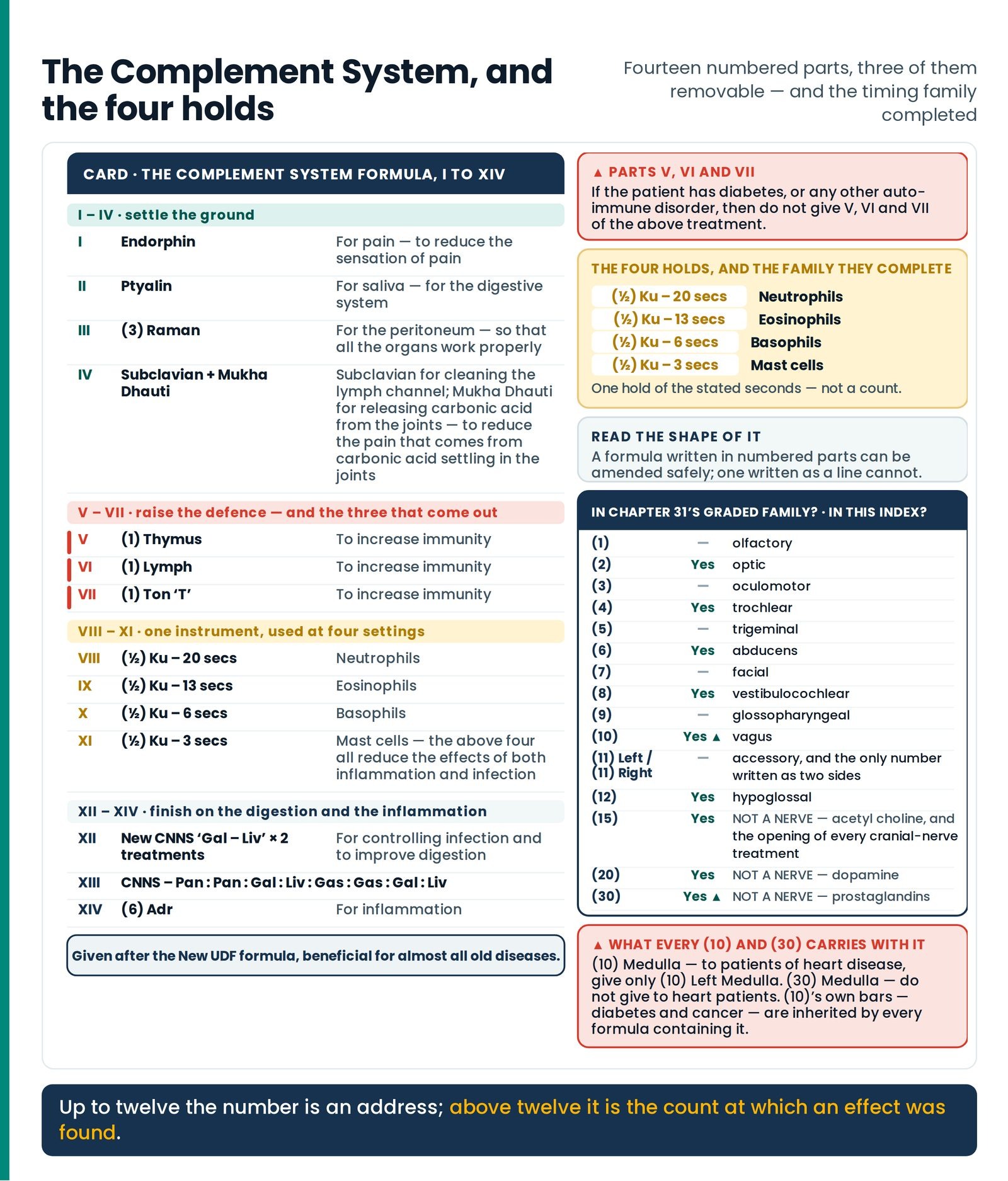
The immune system has a part to it that is older than antibodies and works without being taught: a cascade of proteins circulating in the blood, sitting idle until something marks a germ, and then firing one after another, each one switching on the next, until the germ is punctured or flagged for eating. It is called the complement system because it completes the work of the body's other defences.
The formula named after it is the longest in the formulary — fourteen numbered parts — and it is the one that draws together almost everything has taught. Giving the Complement System after the New UDF formula is beneficial for almost all old diseases. That sentence is the reason it stands at the end: it is what you give to the patient who has been ill for years and whose defences have simply run down.
And it is worth saying at once what that sentence does and does not settle. It settles the order — the Complement System comes after a UDF formula, never before one. It does not name which formula: "the New UDF formula" is named only here, and no formula in the UDF family carries that name. The family is taught whole in Clearing the Ash, "Clearing the Ash" — the seed, the modification, the improved and comprehensive treatments, the two written for diabetics, the simplest, OLD UDF, the four matched to symptoms, and the heaviest — and the formula is chosen there, for the patient in front of you, by what they present with. No formula of that name is given here, and none is invented to fill the gap.
Part · Given · What it is for
I · Endorphin · For pain — to reduce the sensation of pain
II · Ptyalin · For saliva — for the digestive system
III · (3) Raman · For the peritoneum — so that all the organs work properly
IV · Subclavian + Mukha Dhauti · Subclavian for cleaning the lymph channel; Mukha Dhauti for releasing carbonic acid from the joints — to reduce the pain that comes from carbonic acid settling in the joints
V · (1) Thymus · To increase immunity ▲ Take care
VI · (1) Lymph · To increase immunity ▲ Take care
VII · (1) Ton 'T' · To increase immunity ▲ Take care
VIII · (½) Ku – 20 secs · Neutrophils
IX · (½) Ku – 13 secs · Eosinophils
X · (½) Ku – 6 secs · Basophils
XI · (½) Ku – 3 secs · Mast cells — the above four all reduce the effects of both inflammation and infection
XII · New CNNS 'Gal – Liv' × 2 treatments · For controlling infection and to improve digestion
XIII · CNNS – Pan : Pan : Gal : Liv : Gas : Gas : Gal : Liv · —
XIV · (6) Adr · For inflammation
Card: the Complement System formula {{6s}}
Given after the New UDF formula, this is beneficial for almost all old diseases.
Read the shape of it once and it stops being a list of fourteen things. (Figure 37.3)
I to IV settle the ground. Pain down, saliva and digestion up, the peritoneum provoked so that every abdominal organ works, and the lymph channel cleaned with the joints emptied of their carbonic acid.
V to VII raise the defence — and are the three that come out where the defence is already turned round on its owner.
VIII to XI are one instrument used at four settings. The same half Ku, held for four different lengths of time, each named for a different white cell.
XII to XIV finish on the digestion and the inflammation, because that is where every treatment in this therapy finishes.
The four holds, and the family they complete
(½) Ku – 20 secs — neutrophils. (½) Ku – 13 secs — eosinophils. (½) Ku – 6 secs — basophils. (½) Ku – 3 secs — mast cells.
The above four all reduce the effects of both inflammation and infection.
Note what kind of dose this is. It is one hold, of the stated number of seconds — not a count of twenty or thirteen or six or three. (½) Ku – 3 secs is the shortest single application anywhere in the formulary.
Table 21 — The whole (½) Ku timing family, complete at last
| Timing | Named for | Taught in |
|---|---|---|
| (½) Ku – 3 secs | Mast cells | This article |
| (½) Ku – 6 secs | Basophils — and, as mast cells assist in producing heparin, the recommended opening of every heparin formula | The River — Heparin, "The River" |
| (½) Ku – 13 secs | Eosinophils | This article |
| (½) Ku – 20 secs | Neutrophils — to fight infection; to raise WBC, RBC and monocytes; for infection or inflammation in the intestines of those who have had UDF for many years | Clearing the Ash, "Clearing the Ash" |
| (½) Ku – 40 secs | The pineal gland — melatonin; disorders of brain, speech or CSF; MND, MS; excellent for cerebral atrophy | Water and Salt, "Water and Salt" |
| (½) Ku – 60 secs / 80 secs | These also stimulate the pineal gland. Research on them is continuing | Water and Salt, "Water and Salt" |
Lay that table out and something rather beautiful appears. The shorter the hold, the smaller and quicker the cell it is named for; the longer the hold, the deeper into the brain the treatment is said to reach. Three seconds to the mast cell sitting in a tissue waiting to fire; forty to eighty seconds to a gland the size of a grain of rice in the middle of the head. One point, one position, one pair of hands — and the entire dose is a number of seconds. There is no clearer demonstration anywhere in this therapy that time is part of the prescription.
The slowest river in the body
Two or three litres a day against the blood's twelve thousand
Blood has a pump. Lymph has none. That single fact explains most of what follows.
The two circulations, in numbers
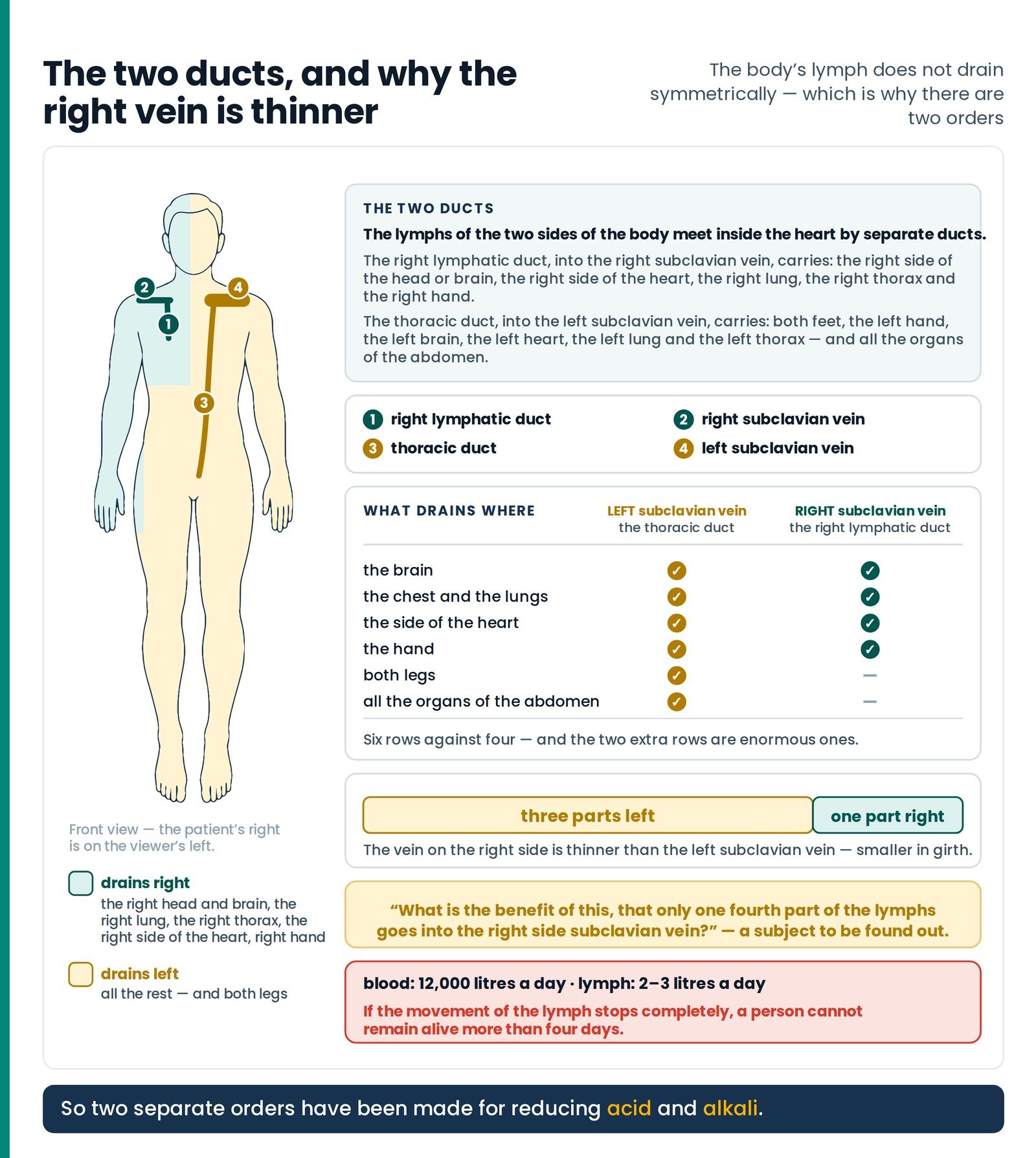
In twenty-four hours, 12,000 litres of blood comes out of the heart — and in the same day the same quantity comes back into it.
In twenty-four hours, the lymph of the whole body goes back only two or three litres.
What the lymph carries is the reason it is slow: the heavy proteins, the lipids, and the WBCs and lymphocytes of the body — the defensive army of our body. Heavy freight moves slowly.
And the consequence, stated flatly: if any blockage comes in the lymph nodes so that the movement of the lymph stops completely, a person cannot remain alive more than four days.
The Maunish treatments
Treat the drainage station, and the finger lets go
These treatments were made by an old student of Guruji's, Shri Mauneesh Vyas ji, and they are a simple way of provoking the lymph nodes.
Whenever there is an infection in any part of the hand or foot, or an injury is taken, then within a short while there can be swelling along with severe pain in the lymph nodes.
What they are for, and the finding behind them
If the trouble is in the hand, the pain will be at the place of the armpits — कच्छ.
If the injury is in the foot, the pain will be in that part of the groins — that is, where we place the foot for the Pan treatment.
And the rule that makes this a treatment rather than an observation: until that place is set right, the pain of the finger, or of the hand or foot, will also not be put right.
By this treatment, immediate relief is obtained from this kind of swelling and pain.
That is a piece of clinical reasoning worth sitting with for a moment, because it explains a great many failures. A man cuts his finger; the cut heals; the finger goes on hurting. The therapist works the finger, the hand, the forearm. Nothing. The finger is not where the trouble is any more — the drainage station for that finger is. Treat the armpit and the finger lets go.
Two treatments that stand on these same pages belong to another article and are not repeated here. The Ulta Kidney Clear formula — the reversed order of the kidney codes, its four graded strengths, the seven qualifying findings by which it is selected, and the substitution of Th + Ch where there is pain along with the stone — is taught whole in Water and Salt, "Water and Salt", together with the two observations of Shri Anil Bhalerao ji of Pune, the note on pneumonia and the kidneys, and the open question about (20) Medulla and the kidneys that is left standing there. LSTF, the Left Side Treatment Formula, with the four steps of reasoning that produced it and the Adr/Thrd compromise stated with its cost, is also Water and Salt's. Where a formula in this article asks for either of them, turn there; nothing about them is restated here.
Why there are two orders, and not one
Three quarters of the lymph drains up the left side
Here is the anatomy on which the two Mauneesh orders rest.
The two ducts, and the two subclavian veins
The lymphs of the two sides of the body meet inside the heart by separate ducts.
The right lymphatic duct, into the right subclavian vein, carries: the right side of the head or brain, the right side of the heart, the right lung, the right thorax and the right hand.
The thoracic duct, into the left subclavian vein, carries: both feet, the left hand, the left brain, the left heart, the left lung and the left thorax — and all the organs of the abdomen.
So two separate orders have been made for reducing acid and alkali.
Table 22 — What drains where
| Into the left subclavian vein — the thoracic duct | Into the right subclavian vein — the right lymphatic duct |
|---|---|
| The lymphs of the left brain | The lymphs of the right brain |
| The lymphs of the left chest and lungs | The lymphs of the right chest and lungs |
| The lymphs of the left side of the heart | The lymphs of the right side of the heart |
| The lymphs of the left hand | The lymphs of the right hand |
| The lymphs of both legs | — |
| The lymphs of all the organs of the abdomen | — |
Count the rows. Six against four, and the two extra rows are enormous ones — both legs, and every organ in the belly. So the two sides are not mirror images, and neither are the veins they empty into. (Figure 37.4)
The subclavian veins on the two sides are not alike. The vein on the right side is thinner than the left subclavian vein — that is, smaller in girth. And the reason given is exactly the table above: the flow of lymph in the veins of the two sides is not equal.
And then the question is left open, in its own words: it is a subject to be found out — what is the benefit of this, that only one fourth part of the lymphs goes into the right side subclavian vein. It is not answered. It stands as a question, and this wiki leaves it standing.
The Subclavian treatment
The ring-finger check that decides whether it is the right treatment
This is a new treatment, which is given to provoke the lymphs of the body — that is, the lymphatic system — through the subclavian veins, which are on both sides of the neck. The method itself — the thumb along the inner side of the collarbone, out to the shoulder, into the hollow below towards the neck, then back along the edge of the neck to the start, the circuit three times — is taught in Seated I — Brain, Medulla, Neck, "Seated — I", together with the rule that governs the whole front of the neck. It is not repeated here.
What belongs here is the check that decides whether this is the right treatment at all, and what its failure tells you.
That is diagnosis by treatment, used honestly: a defined trial, a defined endpoint, a defined next step if the endpoint is not reached. Notice that it does not take weeks. Two treatments, and then you know.
What is inside a lymph node
In the fetal stage — that is, in the child in the mother's womb — along with the liver and the spleen, the lymph nodes also make some blood.
In the lymph nodes there are the following:
Interleukin number two — these make T-helper cells
Natural killer cells
Gamma globulin, which the plasma cells make, whose molecular weight is from one and a half lakh to nine lakh. The heavier they are, the greater is their capacity to finish germs.
These three are so powerful that they can finish even cancer cells, and they can end every kind of infection.
And one more piece of anatomy, because it joins this part of the article to the next.
The peritoneum as a sanitary system
The peritoneum has covered almost all the glands of the abdomen from all sides — except the pancreas, the spleen and the kidneys, which it covers from the front.
And so that the infection of one gland should not spread to another, this peritoneum puts that infectious material — that is, the thing filled with germs — into the lymph, where the infection is finished by the three cells mentioned above.
Read that and the Raman treatment stops being a shoulder manoeuvre and becomes what it is: the treatment that provokes the membrane which does the sanitation of the entire abdomen. That is why it appears in the Complement System as part III, so that all the organs work properly, and why it is the fallback when the ring fingers do not clear.
By these two treatments the organs of the digestive system can be set, one by one. You have given them a hundred times by now — (20) TF (6) NNS stands at the front of New Star Modified and in the fourth part of the Oxygen-Hormonal treatment and in half the formulas of — and you have given them at a count you were handed without explanation. Here is the explanation. Each toe answers to a named organ, and the ten toes are a keyboard.
One rule governs the whole arrangement: the toes of one foot answer to the organs of the opposite side of the abdomen.
Table 23 — The toes of the LEFT foot, and the organs they provoke Left
| Toe of the left foot | The organ or region it provokes |
|---|---|
| Big toe (बड़ा अंगूठा) | Draws out the pain of Gas below the sternum in the chest |
| First toe (पहली उंगली) | The right part of the pancreas — that is, the head of the pancreas; from this, more hormones will come out |
| Middle toe (बीच वाली उंगली) | The gall bladder, and the right part of the chest inside the ribs |
| Third toe (तीसरी उंगली) | The liver, the middle part of the ascending colon, and the intestine of the right part of the navel |
| Smallest toe (सब से छोटी उंगली) | The right ovary / testis, the appendix, and the beginning part of the ascending colon |
Table 24 — The toes of the RIGHT foot, and the organs they provoke Right
| Toe of the right foot | The organ or region it provokes |
|---|---|
| Big toe | Draws out the pain directly above the navel — this will work like Gas 'I' |
| First toe | The tail part of the pancreas; from this, more digestive enzymes will come out |
| Middle toe | The spleen, the left part of the chest, and the last part of the transverse colon |
| Third toe | The middle part of the descending colon, the left part of the navel, and the mucous membrane of the whole body |
| Smallest toe | The left ovary or testis, and the sigmoid colon |
| The smallest toe of both feet together | Draws out — that is, reduces — the pain of the WD below the navel Both sides |
Two things in those tables repay a second look. (Figure 37.5)
The first toes are the two halves of one gland. Left first toe, the head of the pancreas, from which more hormones will come out. Right first toe, the tail, from which more digestive enzymes will come out. One organ, two ends, two different products — and two different toes. It is the most precise correspondence in the therapy.
The third toe of the right foot carries something that is not an abdominal organ at all: the mucous membrane of the whole body. Every wet lining in the body — nose, mouth, gut, airway, bladder — sitting on one toe beside the descending colon. Learn it, because it is the row you will reach for in complaints nobody would think to bring to a foot.
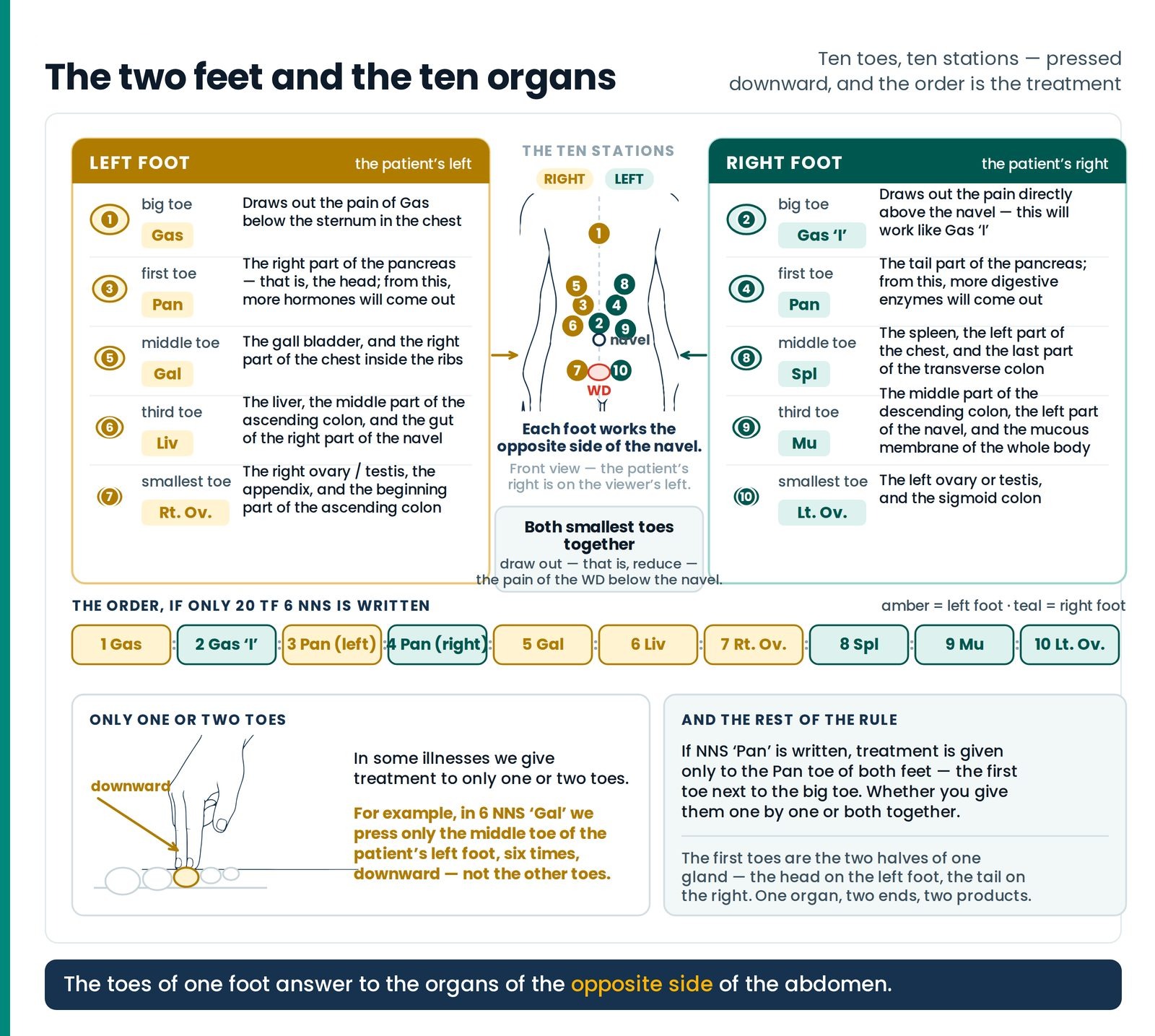
The order of treatment
Ten toes in one running order, alternating and then settling
For both the TF and the NNS treatments there is one and the same order, which can change according to the formula and the need.
If only 20 TF 6 NNS is written, then treatment is to be given to all the toes, in this order:
One order for both treatments
Gas : Gas 'I' : Pan (left) : Pan (right) : Gal : Liv : Rt. Ov. ; Spl : Mu : Lt. Ov.
In different treatments the order is changed.
In some illnesses we give treatment to only one or two toes. For example, in 6 NNS 'Gal' we press only the middle toe of the patient's left foot, six times, downward — not the other toes.
But if NNS 'Pan' is written, then treatment is to be given only to the Pan toe of both feet — that is, the first toe next to the big toe. Whether you give them one by one or both together.
Table 25 — The standard TF / NNS running order, decoded
| Order | As written | Which toe | Foot | The organ named |
|---|---|---|---|---|
| 1 | Gas | Big toe | Left | Gas below the sternum |
| 2 | Gas 'I' | Big toe | Right | Directly above the navel |
| 3 | Pan (बाया, left) | First toe | Left | Head of pancreas |
| 4 | Pan (दाहिना, right) | First toe | Right | Tail of pancreas |
| 5 | Gal | Middle toe | Left | Gall bladder |
| 6 | Liv | Third toe | Left | Liver, mid ascending colon |
| 7 | Rt. Ov. | Smallest toe | Left | Right ovary / testis, appendix |
| 8 | Spl | Middle toe | Right | Spleen |
| 9 | Mu | Third toe | Right | Descending colon, left of the navel |
| 10 | Lt. Ov. | Smallest toe | Right | Left ovary / testis, sigmoid colon |
The order is not foot by foot — it alternates, and then settles. Gas on the left, Gas 'I' on the right; Pan left, Pan right; and only then does it run down one foot and afterwards the other. It is organised by organ logic, not by the convenience of the therapist's hands. The two gas stations first, then the two halves of the pancreas, then the biliary and hepatic group, then the spleen and the left colon, with the two gonadal stations placed at the end of each foot's run.
And notice that nothing new has been introduced. Pan, Gal, Liv, Mu, Spl, Rt. Ov., Lt. Ov., Gas, WD — the whole abdominal vocabulary you learned supine in The Front of the Body I, "The Front of the Body — I". What has changed is only the place from which the same organs are addressed. A student who knows the abdominal set already knows this one; it is the same alphabet written in a different hand.
When the order changes
An omission is an instruction: two altered orders, each with its reason
Two altered orders are given, each with its reason.
Give in the following order: Gas : Gas 'I' : Pan (left) : Pan (right) : Gal : Liv : Spl : Mu : Lt. Ov. — and then give Spl : Mu : Lt. Ov. a second time.
Mild constipation — one station is taken out
Rt. Ov. is not to be given, because it will reduce alkali and increase acid.
That is the whole reasoning, and it is an example of the rule that an omission is an instruction. The station is not skipped for time. It is removed because of what it would do to the body's direction, and what is added in its place — a second pass down the left colon, exactly the stretch that has to move — is added for the same reason.
For correcting digestion — a different order altogether
Written as: Pan : Pan : Gal : Liv : Gas : Gas : Gal : Liv
Given as: Pan (left) : Pan (right) : Gal : Liv : Gas : Gas 'I' : Gal : Liv
Read the two lines together, because the second is how the first is decoded, and the decoding is not optional: the repeated Pan means left then right, and the repeated Gas means Gas then Gas 'I'. Eight stations, not ten — the two gonadal stations and the spleen and Mu are absent altogether, and Gal and Liv are given twice, once before the gas stations and once after.
Table 26 — The three orders side by side
| Step | Standard | Mild constipation | For digestion |
|---|---|---|---|
| 1 | Gas | Pan (left) | |
| 2 | Gas 'I' | Pan (right) | |
| 3 | Pan (left) | Gal | |
| 4 | Pan (right) | Liv | |
| 5 | Gal | Gas | |
| 6 | Liv | Gas 'I' | |
| 7 | Rt. Ov. | omitted ▲ Take care | Gal |
| 8 | Spl | Liv | |
| 9 | Mu | — | |
| 10 | Lt. Ov. | — | |
| 11 | — | Spl again | — |
| 12 | — | Mu again | — |
| 13 | — | Lt. Ov. again | — |
What is given after them
TF, then NNS, then NAN or FAN — the architecture of Part Four
TF, then NNS, then NAN or FAN
By giving the TF and NNS treatments one after the other, the stomach and the intestines will begin to be set right, from which the power of digestion will increase. Proteins will begin to be digested properly, from which amino acids will also begin to be formed in the right quantity.
After these, the normal NAN / FAN treatment should be given, so that — digestion and absorption being correct — all the glands obtain their raw materials properly and they work properly.
That is the whole architecture of in three sentences, and it is why these two treatments sit at the front of so many formulas. NAN and FAN are taught in Setting the Stomach, "Setting the Stomach".
ONS and NNS — the difference, and two pictures for it
A bag shaken once, and the remote control of a TV
When each is enough
ONS is a general treatment, which sets all the organs of the abdomen at one and the same time.
When, because of travel or other causes, the navel is slightly upset, then this alone is enough to set the body right.
But when some one particular organ is spoiled, then to set it right completely this alone is not enough.
Giving ONS first and then NNS will give more benefit.
By NNS we can set right, even by itself, whichever organ has gone wrong, in a subtle or fine way. And if we wish, we can set several organs one after another.
And the two images given for them are so good that they should be used with patients word for word.
For ONS — suppose we have a bag in which several things have been tightly packed, filled solidly. Because of some journey or jolting, the things inside have shifted a little here and there. If there has not been too much upheaval, then if we catch the corner of the bag and shake it gently once or twice, that alone may be enough to settle each of them back into its own place. ONS's work is of this kind.
For NNS — its work is like the remote control of a TV, by which each channel can be finely tuned.
Table 27 — ONS and NNS compared
| ONS — Old Nabhi Set | NNS — New Nabhi Set | |
|---|---|---|
| What it does | Sets all the organs of the abdomen at one and the same time | Sets right whichever organ has gone wrong, in a subtle or fine way; or several organs one after another |
| The image | Catching the corner of a tightly packed bag and shaking it gently once or twice | The remote control of a TV — each channel finely tuned |
| When it is enough alone | When the navel is slightly upset, from travel or other causes | When one particular organ is spoiled |
| Order when both are used | ONS first, then NNS — this gives more benefit | — |
Mauneesh — the alkali and the acid orders
One position, one manoeuvre, and only the order of the limbs changes
These are the two treatments the two lymph ducts were explained for. Nothing about the manoeuvre changes between them. Only the order of the four limbs changes — and the order is the whole instruction. (Figure 37.6)
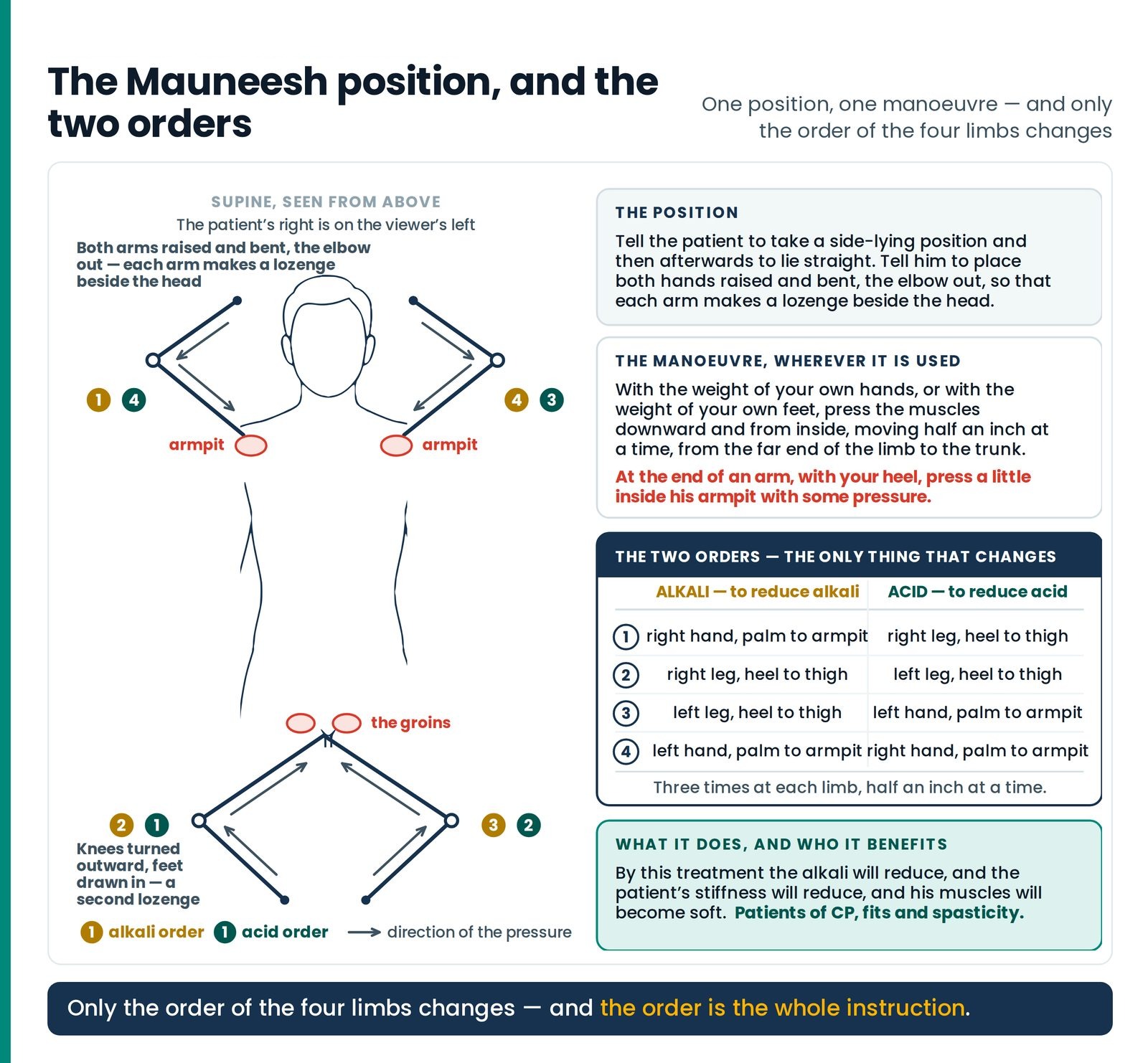
The Mauneesh acid treatment — to reduce acid
Do exactly as above — the same position, the same half-inch steps, the same downward and inward pressure, the same three applications, the same heel inside the armpit at the end of an arm.
But in this, take first the right leg, then the left leg, then the left hand, and finally at the end the right hand — then the patient's quantity of acid will reduce.
Table 28 — The two Mauneesh orders
| Step | Alkali treatment — to reduce alkali | Acid treatment — to reduce acid | Applications | Direction |
|---|---|---|---|---|
| 1 | Right hand — palm → armpit Right | Right leg — heel → thigh Right | 3 times, half an inch at a time | Downward and inward, toward the trunk |
| 2 | Right leg — heel → thigh Right | Left leg — heel → thigh Left | 3 times, half an inch at a time | Downward and inward |
| 3 | Left leg — heel → thigh Left | Left hand — palm → armpit Left | 3 times, half an inch at a time | Downward and inward |
| 4 | Left hand — palm → armpit Left | Right hand — palm → armpit Right | 3 times, half an inch at a time | At the end of an arm, the heel presses a little inside the armpit |
Set those two columns beside the drainage table in Part six and the design of them becomes visible. The left duct carries both legs and the whole abdomen; the right duct carries only the right upper quarter. So a sequence that ends on the left hand finishes by emptying into the great duct, and a sequence that ends on the right hand finishes by emptying into the small one. Which of the two you want decides which order you give. Two separate orders have been made for reducing acid and alkali, and that is what they are made of.
Folded Legs — what it is actually doing
Pressure on the bladder, and a kidney that sorts rather than sieves
The manoeuvre is taught in The Front of the Body II, "The Front of the Body — II" — both heels close to the buttocks, the patient's thumbs closed inside the palms and the fists placed beside the navel with the closed palms facing downward, the legs lifted and folded from the knees toward the chest, and the fists pressed downward and inward into the abdomen with the thighs on the out-breath, held only as long as the patient is comfortable. It is not repeated here. What belongs here is the reason, which is more interesting than the movement.
Why Folded Legs is a kidney treatment
By this treatment, pressure comes upon the urinary bladder, the uterus and so on — from which the flow of blood into the kidneys increases very greatly; and from this the pain of Liv° – Mu° goes out.
That is: the kidneys become quite clean and begin to work well. Which means they will now clean the blood still better, and will throw out in greater quantity the unwanted chemicals that have risen in the blood, and will not let out the chemical that is deficient.
In this way the body will get much benefit: strength will increase, the capacity to work will increase, and the patient will begin to feel healthy.
Read the third paragraph carefully, because it contains the best one-line definition of a working kidney anywhere in this wiki. A kidney is not a drain. It is a sorting office — it must throw out more of what is in excess and hold back what is short, in the same pass, from the same fluid. Most people, patients included, think of the kidney as a sieve. It is nothing of the sort; a sieve cannot tell the difference between two things it is letting through.
And Folded Legs carries its own bar, which travels with the point: if there is inflammation in the abdomen, do not give it.
Raman — the treatment of the peritoneum
A sure-shot treatment of the peritoneum, in three written forms
Raman treatment — by this we provoke the peritoneum.
This is a rāmbāṇ — a sure-shot — treatment, which has the capacity to end many of the body's pains. It is useful in all problems of the uterus and the testes.
The hands, the six-second lift, the slow release and the five or six easy breaths that follow are taught in Seated I — Brain, Medulla, Neck, "Seated — I". The gate that must be passed before it is added to (4) Medulla clockwise with T1/T2 — the check of Liv° and Mu°, and the rule that Left Raman goes with pain at Mu° or the left ring finger and Right Raman with pain at Liv° or the right ring finger — is taught in The Medulla Family, "The Medulla Family". Neither is repeated. What belongs here is what has changed, and what the three written forms are for.
A rule that has moved
Earlier it was thought that Raman treatment should not be given to those whose alkali has increased; but now some change has come in this thinking.
That sentence is left standing exactly as it is. It is not a correction and it is not a retraction — it says that a bar that once existed is now not held as firmly as it was, and it does not say where the boundary now lies. Read it as a live question, treat the kidney codes as the gate as before, and write down what you see.
What has been seen since. By giving right Raman alone — Rt. Raman Only — the pains of the right side can be ended: from the right shoulder up to the fingers of the right hand, the right chest, the right part of the forehead and so on. These pains often come from the increase of alkali.
Whereas by left Raman — Lt. Raman — the pain of the left side, or the pain of the fourth finger of the left hand, can also be ended. These pains often come from the increase of acid.
Table 29 — Raman: the three ways it is written Seated 6 sec × 3
| As written | Given | What it is for |
|---|---|---|
| Raman | Both sides Both sides | The peritoneum; many of the body's pains; all problems of the uterus and the testes |
| Rt. Raman Only | Right side alone Right | Right-sided pain — right shoulder to the fingers of the right hand, the right chest, the right part of the forehead. These pains often come from the increase of alkali |
| Lt. Raman | Left side alone Left | Left-sided pain; the pain of the fourth finger of the left hand. These pains often come from the increase of acid |
| (4) Medulla clockwise T1/T2 + Raman | Preceded by four Medulla clockwise at T1/T2 | Cervical nerves C1–C8 — the forehead, the shoulders, the arms, the elbows, the wrists and the fingers of the hands: for the pains of all these parts this is good. Thoracic nerves T1–T12 — pain of both sides of the chest, pain of the mitral valve, pain of the spleen, and problems of the lungs and the heart. Beneficial in the upper part of the diaphragm too — therefore for stopping hiccups and for hiatus hernia, both. And in boys, when the testes do not come down — cryptorchidism — for that too this treatment has proved quite beneficial |
Look at what the fourth row does. Adding four Medulla clockwise at T1/T2 in front of Raman turns a peritoneal treatment into a treatment of two whole nerve territories — every cervical nerve and every thoracic nerve, which is to say the entire upper half of the body's wiring. That is why it reaches a mitral valve and a hiccup and an undescended testis in the same breath.
Feather Touch — the lightest treatment there is
Found at an airport gate, and tested by powder that must not move
Then, after many months of study, here is what was discovered about the treatment, and what its secret is, in Guruji's own words:
Why it is called Feather Touch, and how it is said to work
"In the old days — and even today in many mosques — the mullah applies to the patients who come a bunch of fans made of peacock feathers, and from that they get benefit. In this treatment too our touch is so light; that is why we have given it the name feather touch.
There are many ways of provoking a muscle or a gland — of these I have chosen one whose name is impulse. The speed of the impulse is 600 km per hour, according to which in one minute it will flow ten kilometres, or in six seconds one kilometre, and in one hundredth of a second it will flow 1.60 metres. The length of an ordinary person from head to foot is around 1.6 metres. When we pass the hand over the forehead or over the face, the impulse that will issue will reach the foot in 1/100 of a second.
This is the reason that when we touch some place very softly, on the back part of the body or on the skin with powder applied, with the tip of the finger, then all the hairs of the body stand up. Which means that the blood flow has been increased right up to the capillaries inside. Doing this at least three times properly provokes all the muscles inside, from the skin to the bones, so that whatever gland is not working properly, or whatever muscle has pain — all will be set right. It has been found that no defect of any kind will remain in them."
That is a complete piece of reasoning: a chosen mechanism, an arithmetic of it, an observable consequence, and a claim about what the observable consequence means. The hairs standing up is the test. It is visible from three feet away, it cannot be faked by a patient, and it is the only sign in this treatment that anything is happening at all — because by design nothing else is. (Figure 37.7)
This is the treatment for the patient who can be given nothing else. No weight, no jerk, no position that must be held, no bone under a heel. A newborn; a woman in the last weeks of pregnancy; a man whose bones break at a knock; a patient in the acute days after a stroke; somebody in too much pain to bear a palm. For every one of them the rest of the atlas closes and this one entry stays open. It is very beneficial in paralysis, stiffness, pains and in all diseases of the brain — which is why it closes the article on the brain.
The formulary sorts its own formulas into three families by where they came from: those built from the therapy's own original logic; those built on the facts of physiology; and the कुदरती देन — kudratī den, the gifts of nature. All three are taught side by side, with the four naming classes, in How a Formula Is Built, "How a Formula Is Built", and are not repeated here.
One line of that classification belongs to this article, and it is worth ending on.
Where the Medulla treatments sit
All the Medulla treatments are counted among the gifts of nature.
So is Lactic acid. So is (6) Adr, and Left and Right Swt, and Thymus Chest, and Formula 4, and (2) Para and (4) Para, and the Old Star and New Star treatments.
That is a statement about kind of ground. These were not designed from a theory and they were not derived from a textbook of physiology. They were found — tried, watched, recorded, and handed on — and the classification says so in public rather than dressing them up as deductions.
Everything in this article that carries a Medulla number therefore rests on the third kind of ground. Which is precisely why the question marks on page after page of it are honest and not embarrassing: a body of observation is exactly the sort of thing that generates hypotheses, and a man who says so is telling you how to read him.
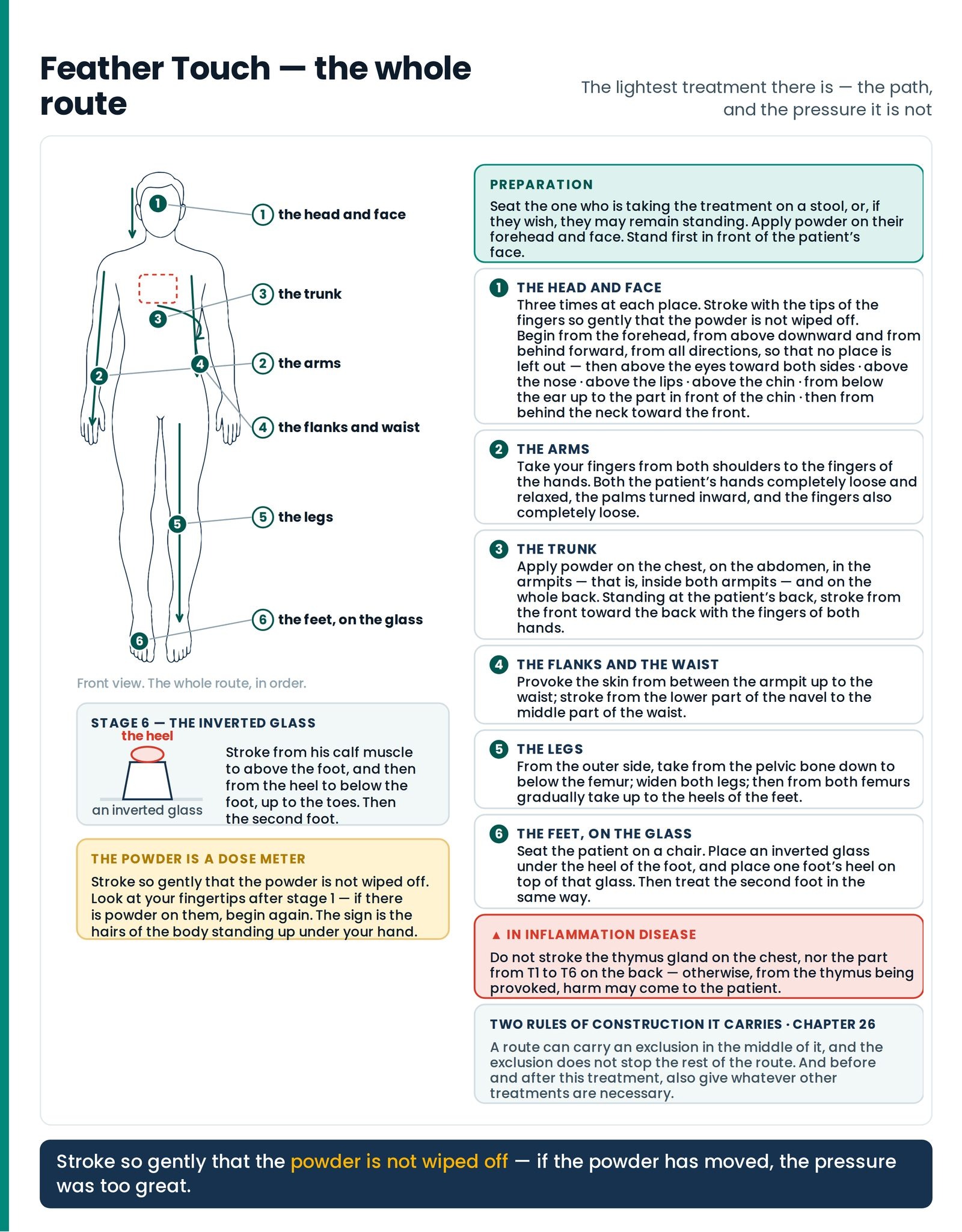
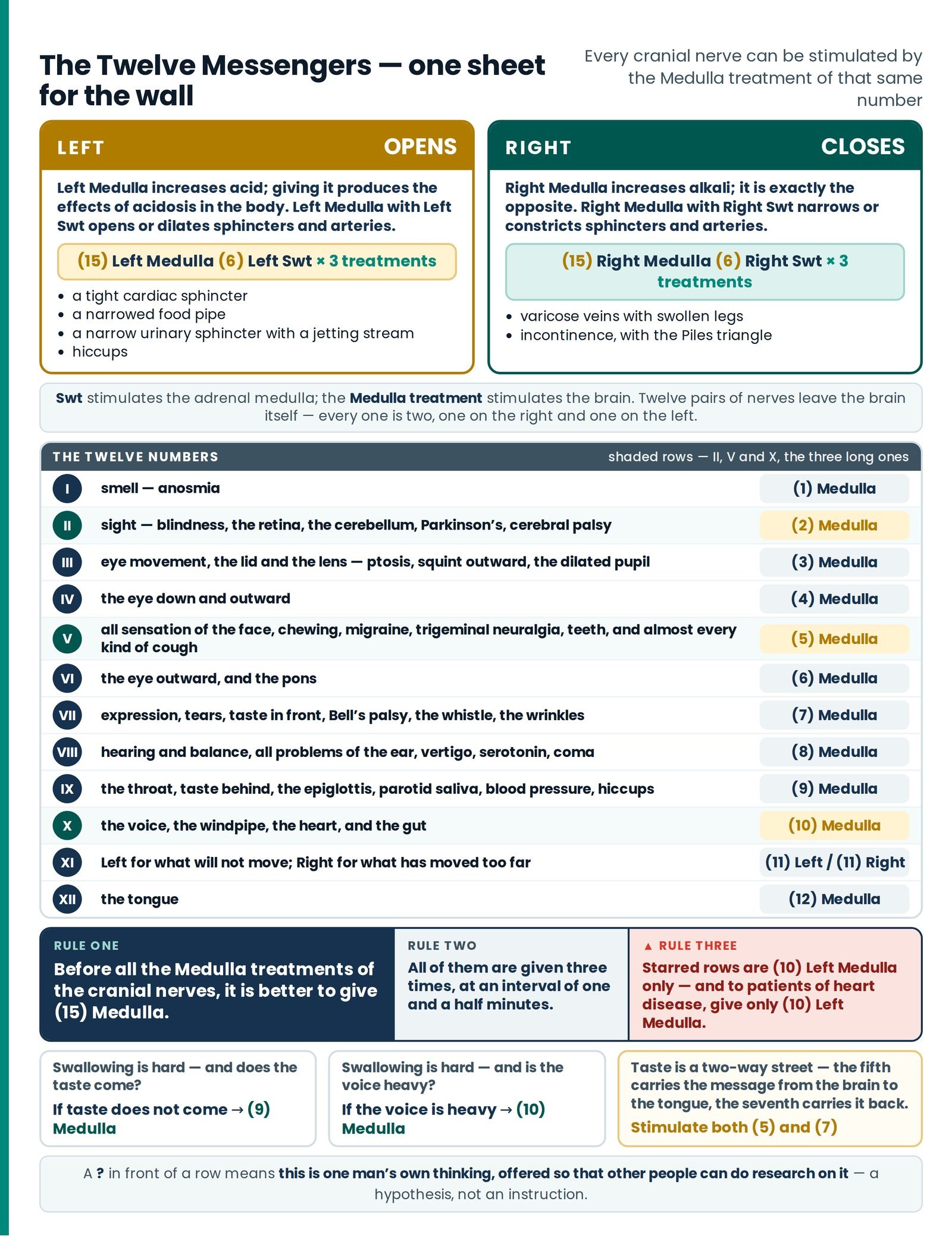
The formulary closes
This is the last page of . A hundred and thirteen formulas stand behind you, and every point they are built from stands behind those. It is worth taking one minute to see the whole thing from above.
Table 30 — Where the families of the formulary are taught
| The family | Taught in |
|---|---|
| Reading and writing a formula · the notation · the rests · the four inseparable pairs · the three families and four naming classes | How a Formula Is Built, "How a Formula Is Built" |
| Normal · Fast · Ajay Normal · NAN · FAN · Ulta Normal · Chole · Vater · New Gal · CCK Normal · Formula No. 4 | Setting the Stomach, "Setting the Stomach" |
| ATF and its variants · heavy and light · the calcium-deposit forms · ALTF · the 1,25 DCC family | Correcting the Two Kingdoms, "Correcting the Two Kingdoms" |
| Every generation of UDF · OLD UDF · the (½) Ku treatment · the stomach-setting and CP variants | Clearing the Ash, "Clearing the Ash" |
| APR in three classes · Jeevan Dhara heavy and light · the HCl formula | APR — Abdominal Pain, "Releasing the Belly" |
| The graded Medulla series (2) to (30) · the erythropoietin formulas · Medulla clockwise with T1/T2 | The Medulla Family, "The Medulla Family" |
| ITF · the injury formula and its substitutions · the viral formulas | Fire and Swelling, "Fire and Swelling" |
| The whole heparin family, P. to Anti-F. · Multi Heparin · (½) Ku – 6 secs | The River — Heparin, "The River" |
| B₁₂ · Folic and Pure Folic · Black · Pure Genes · New Genes · Large Folic Black | Vitamin and Gene Formulas, "The Missing Links" |
| Kidney Clear, Mild and Ulta · Anil Sharma · Angiotensin #2 · ADK · Vasopressin · the Multivitamin formulae · Angina and Athero · the Oxygen and Oxygen-Hormonal treatments · LSTF · Round Normal · Lactic Acid Conversion · (½) Ku – 40/60/80 secs | Water and Salt, "Water and Salt" |
| Old Star · the WD variant · New Star · New Star Modified · All-joints ghisai · the Alkaline Star · the five-stage rebuild · rheumatoid arthritis | The Stiffening Joint, "The Stiffening Joint" |
| The polarity rule · the twelve cranial nerves and the complete Medulla index · the Complement System · Subclavian and the lymph · TF and NNS · Maunish · Mauneesh · Folded Legs · Raman · Feather Touch · Incontinence · (½) Ku – 13 and – 3 secs | This article |
And the formulary closes the way a good teacher closes a course — not with a claim, but with a request. The learned reader is asked to send back the errors found in the teaching, and any corrections that may be needed. That request is made in the same breath as the thanks, and it belongs to the same habit of mind as the question marks: a man setting down sixty years of work and, on the last page, asking to be corrected.
Take that habit with you into . You have the whole formulary now. What you do not yet have is the other twenty-three hours.
Questions students ask
1. I am eighteen and I have only just learned the names of the twelve nerves. Do I have to memorise all of these tables? No, and nobody has. Memorise three things and you can use the rest as a reference for the rest of your life: the polarity rule, the twelve numbers with one word each, and the three standing rules — (15) first, three times, ninety seconds apart. The tables are a dictionary. Nobody memorises a dictionary; they learn to look things up quickly, and that comes from using it, not from staring at it.
2. I am a physician. The claim that a pressure at the nape stimulates a named cranial nerve is a very large one. How should I hold it? Hold it exactly as it is offered. It is presented as a discovery — arrived at by giving the treatments and watching, not deduced from anatomy — and the classification of formulas puts every Medulla treatment among the gifts of nature, meaning the observational ground and not the physiological one. The reports here are uncontrolled, unblinded and mostly single cases, and they are written down as such. That is a legitimate stage of knowledge, and it is the stage this material claims to be at. The invitation printed at the end is to test it.
3. Why is the left side the one that opens? It feels arbitrary. It is not derived; it is reported. What the material gives is the observation — Left Medulla increases acid and Right Medulla increases alkali, and joined with the Swt of the same side the one dilates and the other constricts — and then four patients in whom the prediction held. The rule is used because it works and is stated as such, not because a mechanism has been worked out for it. That is an honest position and you may say so to anyone who asks.
4. My patient's shoulder is on the right and the table says (11) Left Medulla for frozen shoulder. I keep wanting to give the right. Everybody does, for about a month. Say the sentence out loud before you touch the patient: "Left, because I want it to open." The side in a Medulla row names a direction of effect — opening or closing — not a place on the patient's body. The seven rows of that table sort perfectly into those two heaps, and once you have sorted them yourself on paper, the confusion goes.
5. I work in a village and have no laboratory. How much of this article can I actually use? Nearly all of it. Look at the Madhya Pradesh camp: a diagnosis of a narrow urinary sphincter made with no test report at all, from one question about the force of the stream. Look at the four-second face examination: eyebrows, eyelids, teeth, whistle. Look at the ring-finger check before Subclavian. This is a article of bedside findings. The one place a report genuinely helps is in deciding whether a facial palsy is a nerve or a brain — and that is a referral, not a laboratory.
6. I am a retired man learning this to help my family. Is there anything here I should simply not attempt? Yes. Anything carrying a jerk, and anything in a heart patient. In this article specifically: leave (10) Medulla alone in anyone with heart disease unless you are certain you are giving (10) Left, and leave parts V, VI and VII of the Complement System out entirely unless you know the person is neither diabetic nor carrying an autoimmune disease — and know here means you have seen the bag of medicines, not that you asked. Feather Touch is the one treatment in this article you may give almost anybody, with its two cautions honoured.
7. Why does (5) Medulla appear so often? It seems to be the answer to everything. Because the fifth nerve is almost everything on a face. It carries every sensation of the forehead, eyelid, eyebrow, temple, cheek, nose, lip, gum, tooth, jaw, the front of the tongue and the lining of the brain, plus the muscles of chewing — and it is one of the three nerves specifically named as very long. A long nerve passes many doors. The index is not being lazy; it is describing a genuinely enormous territory.
8. I gave (7) Medulla for a taste problem and nothing happened. What did I do wrong? You gave half of it. The fifth carries the message of taste from the brain to the tongue; the seventh carries it from the tongue to the brain, and the instruction is to stimulate both. This is the commonest error in the article, and the same trap is set for swallowing, for the pharynx and larynx, and for vomiting. Before giving a single number, ask whether the function has one owner or several.
9. A housewife's question: my mother-in-law's hiccups will not stop and I have found two different treatments in this article. Which do I give? Both are written down, and they are different in kind. (9) Medulla is the nerve treatment — the ninth owns the epiglottis, and Shri Pankit Shah's hiccups stopped with it at once, without a sip of water. (15) Left Medulla (6) Lt. Swt × 3 treatments is the polarity treatment — it opens what is in spasm, and the diaphragm's upper part is also reached by (4) Medulla clockwise T1/T2 with Raman. Try the nerve first, because it is simplest, and keep a note of which worked. That note is worth more than this answer.
10. Why is there a whole treatment for a sense of smell nobody complains about? Because nobody complains about it. Three doctors in a hall of seven hundred had lost it for years and had never mentioned it to themselves. A therapy that only treats what is complained of will never find those three. Ask every patient with a head complaint whether they can smell their own kitchen; it costs four seconds and occasionally it opens a door.
11. I do not believe the 600-kilometres-an-hour figure. May I still give Feather Touch? Yes, and you are not required to believe any particular arithmetic to give a treatment honestly. What the treatment asks of you is practical: the powder unwiped, at least three passes, the whole route, the patient's fingers loose, and the hairs rising under your hand as the sign that something has been reached. Those are the things that decide whether you have given it properly. The reasoning is offered openly as reasoning, and you may keep your own view of it.
12. What should I do with the question-marked rows? Exactly what the last line of the formulary asks: research on them. Pick one. Choose something you can actually measure — snoring, dry mouth, tearing, smell — take honest before-and-after notes on twenty patients, and write down the failures as carefully as the successes. And say the word "perhaps" to the family every single time, because if you do not, a failed hypothesis will be remembered as a failed therapy.
Questions patients ask
"You are pressing the back of my neck. My problem is my eye." Yes. The nerves that work your eye do not begin in your eye — they come out of the brain, and they all pass the place where my hands are. Think of a bundle of wires leaving a fuse box: the lamp is in another room, but the switch is here. I am working at the switch.
"The doctor said this facial paralysis will get better on its own. So why come to you?" Many do get better on their own, and I hope yours is one of them. What I can offer is work on the nerve that moves your face while that recovery is happening, and the ordinary treatment your stomach and your kidneys are asking for, which nobody has looked at. Keep seeing your doctor. Nothing I do replaces that, and if your face is not moving better in the time he has given you, he needs to know.
"Is it dangerous? You are working so close to my throat." There is a rule in this therapy about the front of the neck, and it is that we do not work there at all. Everything I give you is at the back of the neck and along the collarbone, and it is pressure and release — no rotation, no jerk, no pulling. If anything I do is uncomfortable, say so at the moment it happens, not afterwards.
"My sugar is only borderline. The camp man gave tablets, that is all." Then it counts, and I need to know about it — not because it is something to be ashamed of but because three parts of one of the treatments I would otherwise give you must come out for anybody with diabetes. Please bring me every strip and bottle in your house next time, including the ones you have stopped taking. That is not a test. It is how I avoid giving you something that would set you back.
"You are doing so little. Can that possibly be doing anything?" It is meant to be that light. If I press hard enough for you to notice it, I have given the wrong treatment — the powder on your skin is there to tell me so. Watch the hairs on your arm in a minute or two; when they stand up, that is the sign that the thing I am aiming at has been reached.
"My son snores terribly. Your book has a treatment for it, doesn't it?" It has an idea for it, and I want to be straightforward about the difference. Somebody reasoned that a certain treatment ought to help snoring and wrote it down as a suggestion for others to test — it has never been properly tested. I am happy to try it, and I would like you to tell me honestly whether anything changes. But I am not going to promise you a result I do not have.
"How long will this take?" I will tell you two things and both of them honestly. Where a treatment is the right one, you will usually feel something in the first session or two — several of the people this article is built from felt it the same evening. And where a long-standing thing is being put right, it takes weeks and it moves in steps, with flat patches in between that mean nothing. If six sessions have changed nothing at all, I will re-examine you rather than repeat myself.
"Will my sense of smell ever come back? It has been years." I do not know, and anybody who tells you they do know is guessing. What I can tell you is that this has come back in people who had lost it for years, and that the treatment for it is short, simple and harmless. We will try it, and you will tell me — with a bar of soap in your hand — whether anything has changed.
Words used here
| Hindi | English | Neurotherapy code / usage |
|---|---|---|
| क्रैनियल नर्व (krainiyal narv) | Cranial nerve | The twelve pairs leaving the brain itself. Every one is two — one right, one left. Indexed by (1) to (12) Medulla |
| मेडूला (meḍūlā) | Medulla | Two different structures share the word: Swt stimulates the adrenal medulla; the Medulla treatment stimulates the brain |
| बायाँ / दायाँ (bāyā̃ / dāyā̃) | Left / right | Part of a point's identity. Left Medulla increases acid and opens; Right Medulla increases alkali and closes. Written Lt. / Rt. on every card |
| लसीका (lasīkā) | Lymph | 2–3 litres a day against the blood's 12,000. No pump. Three quarters drains up the left side |
| कच्छ (kacch) | The armpit | Where the pain shows when the infection or injury is in the hand — the Maunish finding |
| रामबाण (rāmbāṇ) | A sure-shot remedy — Rāma's arrow | The word used of the Raman treatment |
| नाभि सेट (nābhi seṭ) | Navel setting | ONS — Old Nabhi Set, the whole abdomen at once. NNS — New Nabhi Set, one organ finely. ONS first, then NNS |
| बड़ा अंगूठा (baṛā aṅgūṭhā) | The big toe | Left big toe → Gas below the sternum. Right big toe → works like Gas 'I', above the navel |
| उंगली (uṅglī) | Finger / toe | TF — Toe Fingers. Ten toes, ten stations, pressed downward |
| अनामिका (anāmikā) | The ring finger — the fourth | Both of them checked before Subclavian. If both hurt, the gate is open; if they do not clear after two treatments, the answer is Raman |
| कुदरती देन (kudratī den) | A gift of nature | The family every Medulla treatment belongs to — found, not designed |
| फोल्डेड लेग्ज़ | Folded Legs | Pressure on the bladder and uterus → blood flow into the kidneys increases greatly → the pain of Liv°–Mu° goes |
| — | Bolus | The mouthful, as a ball. Taken backwards by the fifth nerve; the lid shut by the ninth |
| — | Sphincter | A ring of muscle guarding a passage. Left opens it; right closes it |
| — | Anosmia | Loss of smell in a clear nose — (1) Medulla |
| — | Ptosis | A drooping eyelid — (3) Medulla |
| — | Stenosis | A narrowing. Of the food pipe: (10) Left Medulla only |
| — | Cryptorchidism | The testes not coming down in boys — (4) Medulla clockwise T1/T2 + Raman |
| — | Complement system | The self-firing part of the body's defence. The formula named for it runs I to XIV |
| — | ? | A hypothesis, not an instruction. This is my own thinking, on which other people can now do research |