- How it is given
- Seated I — Brain, Medulla, Neck
- What it is used for
- Each Point in Use · Cranial Nerve and Brain Formulas
Watch

From Seated I — Brain, Medulla, Neck
Subclavian — सब क्लेवियन ट्रीटमेंट
With the soft part of your thumb, pressing at many points on the inner side of the shoulder bone on both sides, go out as far as both shoulders.
Then from there, go into the hollow below, towards the neck, in the same way.
Finally, coming along the edge of the neck, return to the first place.
Repeat the whole process three times.
| Patient's position | Seated; the therapist in front Seated |
|---|---|
| Where the hands are placed | The soft part of the thumb, at many points on the inner side of the shoulder bone, out as far as both shoulders; then into the hollow below, towards the neck; then along the edge of the neck back to the first place Both sides |
| Duration and repetitions | Many closely spaced thumb-pressures; the whole process three times × 3 |
| What it is for | Named for the subclavian region; no separate indication is given here. Its place in the lymph formulas is in Cranial Nerve and Brain Formulas; its indications and precautions in Each Point in Use |
Read it as a circuit, not as three points: a closed loop from the inner end of the collarbone out to the shoulder, into the hollow beneath the bone and back inward towards the neck, then up the edge of the neck to where it began — both sides, three times round. (Figure 18.5)
What lies beneath. The name is literal, and that is the reason for the care. Under the collarbone the great vessels of the arm cross the first rib, and with them the cords of nerves on their way to the shoulder, the elbow and the hand; deeper and further in, the very top of the lung rises into the root of the neck, higher than most students expect.
From Cranial Nerve and Brain Formulas
The Subclavian treatment
The ring-finger check that decides whether it is the right treatment
This is a new treatment, which is given to provoke the lymphs of the body — that is, the lymphatic system — through the subclavian veins, which are on both sides of the neck. The method itself — the thumb along the inner side of the collarbone, out to the shoulder, into the hollow below towards the neck, then back along the edge of the neck to the start, the circuit three times — is taught in Seated I — Brain, Medulla, Neck, "Seated — I", together with the rule that governs the whole front of the neck. It is not repeated here.
What belongs here is the check that decides whether this is the right treatment at all, and what its failure tells you.
That is diagnosis by treatment, used honestly: a defined trial, a defined endpoint, a defined next step if the endpoint is not reached. Notice that it does not take weeks. Two treatments, and then you know.
What is inside a lymph node
In the fetal stage — that is, in the child in the mother's womb — along with the liver and the spleen, the lymph nodes also make some blood.
In the lymph nodes there are the following:
Interleukin number two — these make T-helper cells
Natural killer cells
Gamma globulin, which the plasma cells make, whose molecular weight is from one and a half lakh to nine lakh. The heavier they are, the greater is their capacity to finish germs.
These three are so powerful that they can finish even cancer cells, and they can end every kind of infection.
And one more piece of anatomy, because it joins this part of the article to the next.
The peritoneum as a sanitary system
The peritoneum has covered almost all the glands of the abdomen from all sides — except the pancreas, the spleen and the kidneys, which it covers from the front.
And so that the infection of one gland should not spread to another, this peritoneum puts that infectious material — that is, the thing filled with germs — into the lymph, where the infection is finished by the three cells mentioned above.
Read that and the Raman treatment stops being a shoulder manoeuvre and becomes what it is: the treatment that provokes the membrane which does the sanitation of the entire abdomen. That is why it appears in the Complement System as part III, so that all the organs work properly, and why it is the fallback when the ring fingers do not clear.
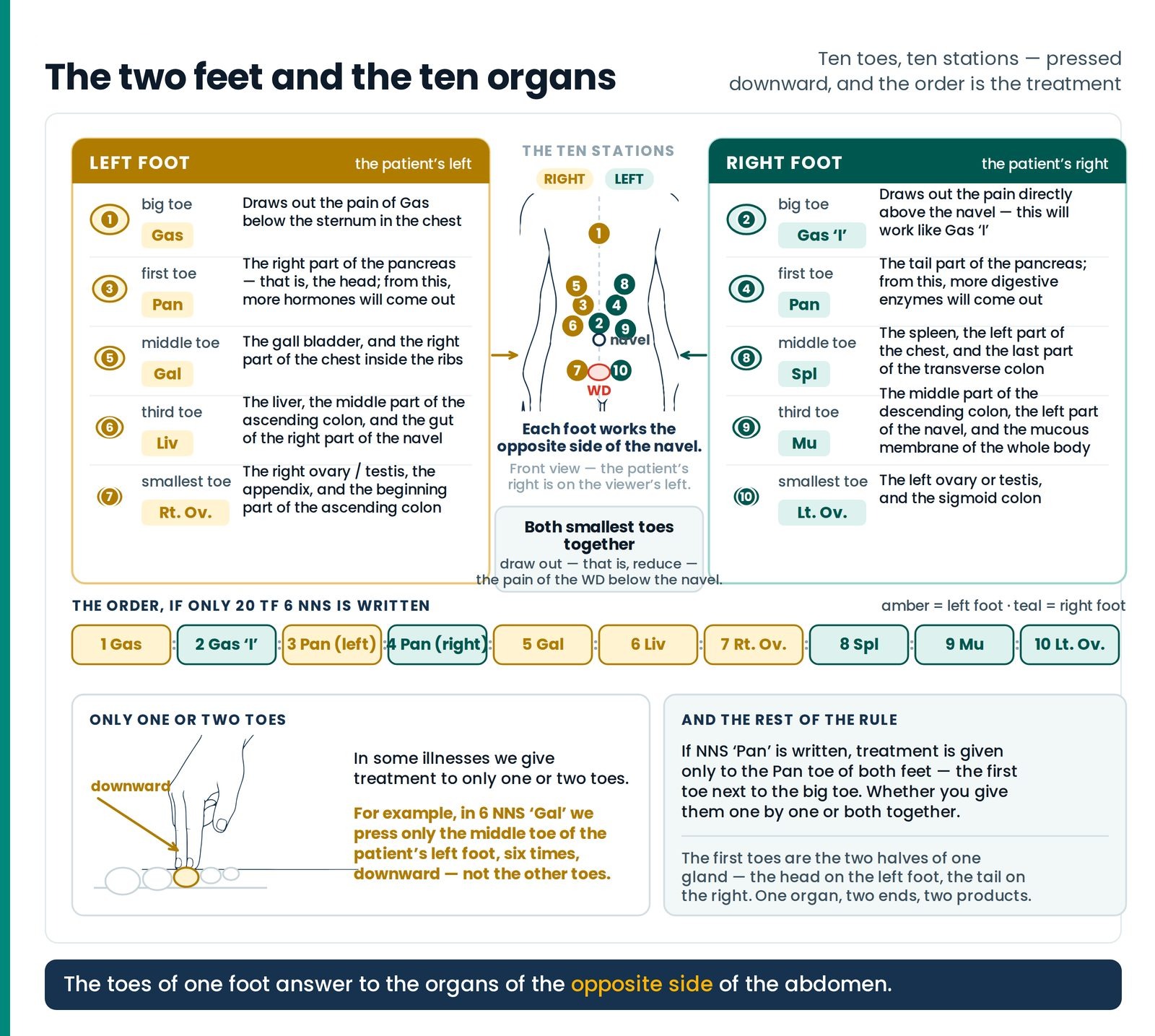
By these two treatments the organs of the digestive system can be set, one by one. You have given them a hundred times by now — (20) TF (6) NNS stands at the front of New Star Modified and in the fourth part of the Oxygen-Hormonal treatment and in half the formulas of — and you have given them at a count you were handed without explanation. Here is the explanation. Each toe answers to a named organ, and the ten toes are a keyboard.
One rule governs the whole arrangement: the toes of one foot answer to the organs of the opposite side of the abdomen.
Table 23 — The toes of the LEFT foot, and the organs they provoke Left
| Toe of the left foot | The organ or region it provokes |
|---|---|
| Big toe (बड़ा अंगूठा) | Draws out the pain of Gas below the sternum in the chest |
| First toe (पहली उंगली) | The right part of the pancreas — that is, the head of the pancreas; from this, more hormones will come out |
| Middle toe (बीच वाली उंगली) | The gall bladder, and the right part of the chest inside the ribs |
| Third toe (तीसरी उंगली) | The liver, the middle part of the ascending colon, and the intestine of the right part of the navel |
| Smallest toe (सब से छोटी उंगली) | The right ovary / testis, the appendix, and the beginning part of the ascending colon |
Table 24 — The toes of the RIGHT foot, and the organs they provoke Right
| Toe of the right foot | The organ or region it provokes |
|---|---|
| Big toe | Draws out the pain directly above the navel — this will work like Gas 'I' |
| First toe | The tail part of the pancreas; from this, more digestive enzymes will come out |
| Middle toe | The spleen, the left part of the chest, and the last part of the transverse colon |
| Third toe | The middle part of the descending colon, the left part of the navel, and the mucous membrane of the whole body |
| Smallest toe | The left ovary or testis, and the sigmoid colon |
| The smallest toe of both feet together | Draws out — that is, reduces — the pain of the WD below the navel Both sides |
Two things in those tables repay a second look. (Figure 37.5)
The first toes are the two halves of one gland. Left first toe, the head of the pancreas, from which more hormones will come out. Right first toe, the tail, from which more digestive enzymes will come out. One organ, two ends, two different products — and two different toes. It is the most precise correspondence in the therapy.
The third toe of the right foot carries something that is not an abdominal organ at all: the mucous membrane of the whole body. Every wet lining in the body — nose, mouth, gut, airway, bladder — sitting on one toe beside the descending colon. Learn it, because it is the row you will reach for in complaints nobody would think to bring to a foot.
Also explained in
- Why there are two orders, and not one Cranial Nerve and Brain Formulas
The right lymphatic duct, into the right subclavian vein, carries: the right side of the head or brain, the right side of the heart, the right lung, the right thorax and the right hand.
- The neck, the shoulder and the arm Each Point in Use
Subclavian trt.
- What this article hands to the next Seated I — Brain, Medulla, Neck
The anterior-neck rule of The Front of the Body II governs this whole article — and the front border of the big strap muscle is the fence for Subclavian, Neck Clockwise and Necklace.
- What this completes Cranial Nerve and Brain Formulas
Part · Given · What it is for I · Endorphin · For pain — to reduce the sensation of pain II · Ptyalin · For saliva — for the digestive system III · (3) Raman · For the peritoneum — so that all the organs work properly IV
- Feather Touch — the lightest treatment there is Cranial Nerve and Brain Formulas
Three quarters of it drains up the left side, which is why there are two Mauneesh orders and why the right subclavian vein is the thinner one.
- Introduction Seated I — Brain, Medulla, Neck
Give Endorphin, Subclavian, Neck Clockwise, Ptyalin and Necklace with their exact stations, counts and rounds — and say, for each, where the hand must not go.
- The three lanes of the nape — Medulla, Mesencephalon, Dorsal Seated I — Brain, Medulla, Neck
It does not govern Endorphin, Subclavian, Ptyalin or Necklace, each of which states its own count in its own entry.
- Mukha Dhauti — मुख धौती Seated I — Brain, Medulla, Neck
Three views sharing one style — from behind, Necklace, Endorphin and Raman on one nape; from the side, the big strap muscle as the front fence with Neck Clockwise behind it and the forbidden triangle tinted in front of i
- Introduction Cranial Nerve and Brain Formulas
Explain how lymph moves and why it is slow, give the Subclavian treatment, perform the ring-finger check that decides whether it is the right treatment at all, and know what the check tells you when it fails.
- Raman — the treatment of the peritoneum Cranial Nerve and Brain Formulas
Raman provokes the peritoneum, the membrane that sanitises the whole abdomen — and it is the treatment written against many of the body's pains, and the one the Subclavian protocol falls back on when knee pain, slipped d
- The formulary closes Cranial Nerve and Brain Formulas
· Multi Heparin · (½) Ku – 6 secs The River — Heparin, "The River" B₁₂ · Folic and Pure Folic · Black · Pure Genes · New Genes · Large Folic Black Vitamin and Gene Formulas, "The Missing Links" Kidney Clear, Mild and Ulta · Anil Sharma · Angiotensin #2 ·
- Questions students ask Cranial Nerve and Brain Formulas
Look at the ring-finger check before Subclavian.
- The master list — every treatment point, by the position the patient is placed in The Shorthand
Code Full name / Hindi Where it is taught in this wiki Medulla Medulla oblongata Seated I — Brain, Medulla, Neck; graded series, The Medulla Family Mesencephalon Midbrain Seated I — Brain, Medulla, Neck Dorsal Dorsal (thoracic) Seated I — Brain, Medulla, Neck Raman (proper name) Seated I — Brain, Medulla, Neck · Cranial Nerve and Brain Formulas Mukha Dhauti मुख
- The notation, complete How a Formula Is Built
The Ulta prefix Ulta Normal · Ulta Kidney Clear "ulta Normal" The named formula with its order turned about, for a stated purpose and a limited period The plus sign Th + Ch · Lu + Sh · Subclavian + Mukha Dhauti "Thymus