Two articles ago you learned how a formula is built. One article ago you learned what to do about the food that comes out looking as it went in. This article is about pain in the belly, and about the treatments made to release it — the three classes of APR, both generations of each, the formula the elderly ask for by name, and the acid treatment that closes the abdominal group.
The notation is closed. Every bracket, quoted letter, glyph, underline, colon and treatments suffix in this article was taught once and completely in Table 13 of How a Formula Is Built, "How a Formula Is Built". Nothing is explained again here. Every written rest is in Table 8 of that same article, with the reason given for it. If a line will not read, go back to those two tables; that is what they are for.
Watch


Where this article begins
Formula No. 4, and the grading that decides what you give tomorrow
a little earlier this one closes the digestive family. It carries Formula No. 4 — (10) Medulla (4) Thrd 'P' (20) ↑\|↓ (8) Pan — so named because it cures the number-four pain of the abdomen, that is, intense pain. The formula itself, with its eye-disease indications and its own caveat, belongs to Setting the Stomach, "Setting the Stomach". The card notation that gave it its name — the old scale from one, next to nothing, to four, so much pain that the patient cries out even before the hand touches, and its replacement by Pan⁺⁺⁺⁺ over ⁺⁺, because numbers come before the point in a formula as well and a therapist could muddle the number of the pain with the number of the point — is taught whole in Uncommon Problems, "Points for Uncommon Problems", and recorded in Table 13 of How a Formula Is Built.
Why that matters here is the reason it was invented. With the pains graded before and after, it was known at once in which points, and how much, benefit the patient obtained from that day's treatment; the therapist could decide whether to give the same treatment tomorrow or another; and — a thing worth saying plainly — the patient obtained a great deal of reassurance. Everything in this article is judged that way. You will be grading Mu, Liv, Gas and Gal before and after, every day, and the grades are how you will know which of the three classes you have in front of you and whether you may move on.
APR — the abdominal-pain-releasing treatments
Releasing, not relieving — the four observations it was built on
The very foundation stone of this therapy is to check the pains around the navel and treat accordingly. So it is no surprise at all that within a few years of beginning, Guruji had attained formidable skill in removing abdominal pains of every kind. And as success grew, patients began to come from many provinces, with different habits and different ways of living — and most of them had a complaint of abdominal pain.
By then he already knew the thing that makes this therapy difficult to write down: a person falls ill because of his own habits, so even when the disease is one and the same, people of different habits and different ways will have to be given different treatments. That is a true statement and an inconvenient one. It means there can be no single answer.
Even so, he wanted to make one treatment that could be applied to the greatest number of people. Hold both halves of that sentence. The therapy knows that one treatment cannot be right for everybody, and it sets out to build the one that is right for the most. What follows is the record of that attempt, including the places where it did not work and had to be changed — which is the most useful thing in the article.
The reasoning, step by step
Four observations were laid end to end, and the formula fell out of them.
How APR was reasoned out
One.
There will be intense pain in the abdomen or at the navel when there has been infection in one or several parts of the GIT — the gastro-intestinal tract, that is, the food canal. Old infection turns into inflammation — so what we have to correct is the inflammation.
Two. This pain is also an indicator that the stomach and the intestines are not getting enough blood — so they will not be able to work properly. Whatever food is inside them will be thrown out without being digested or absorbed.
Three. Now the work of the large intestine is to absorb water from the digested food and throw out the rest of the refuse. When it too does not get enough blood, it also cannot do its work properly — from which the refuse thrown out will have a greater quantity of water in it. And that is what is called diarrhoea.
Four. So to treat loose motions, the motility of the abdomen — that is, the movement — has to be stopped. This is the work of the sympathetic nervous system, which gets it done through the adrenal medulla. We provoke the adrenal medulla with (6) Swt.
And two findings of this therapy's own, which supply the rest:
When (30) Medulla or (6) Adr is given, it immediately stops inflammation. By this the pain of the Mu point goes out at once, or becomes very much less.
By changing the order in which the abdominal organs are provoked, the motility of the intestines also changes — which is done with the Ulta Normal formula.
Say it in a kitchen. A pipe has been damaged, and the wall around the damage is swollen and angry. Two things are wrong at once: the swelling, and the fact that everything is now rushing through too fast to be of any use. You calm the swelling first and slow the rush second, and only then do you ask the household to start cooking again. That is the whole architecture of APR, in the order the parts are given.
The first version of APR
The first treatment was made for correcting loose motions or diarrhoea when they occur along with pain, and it has three parts, each with its purpose written beside it. (Figure 30.1)
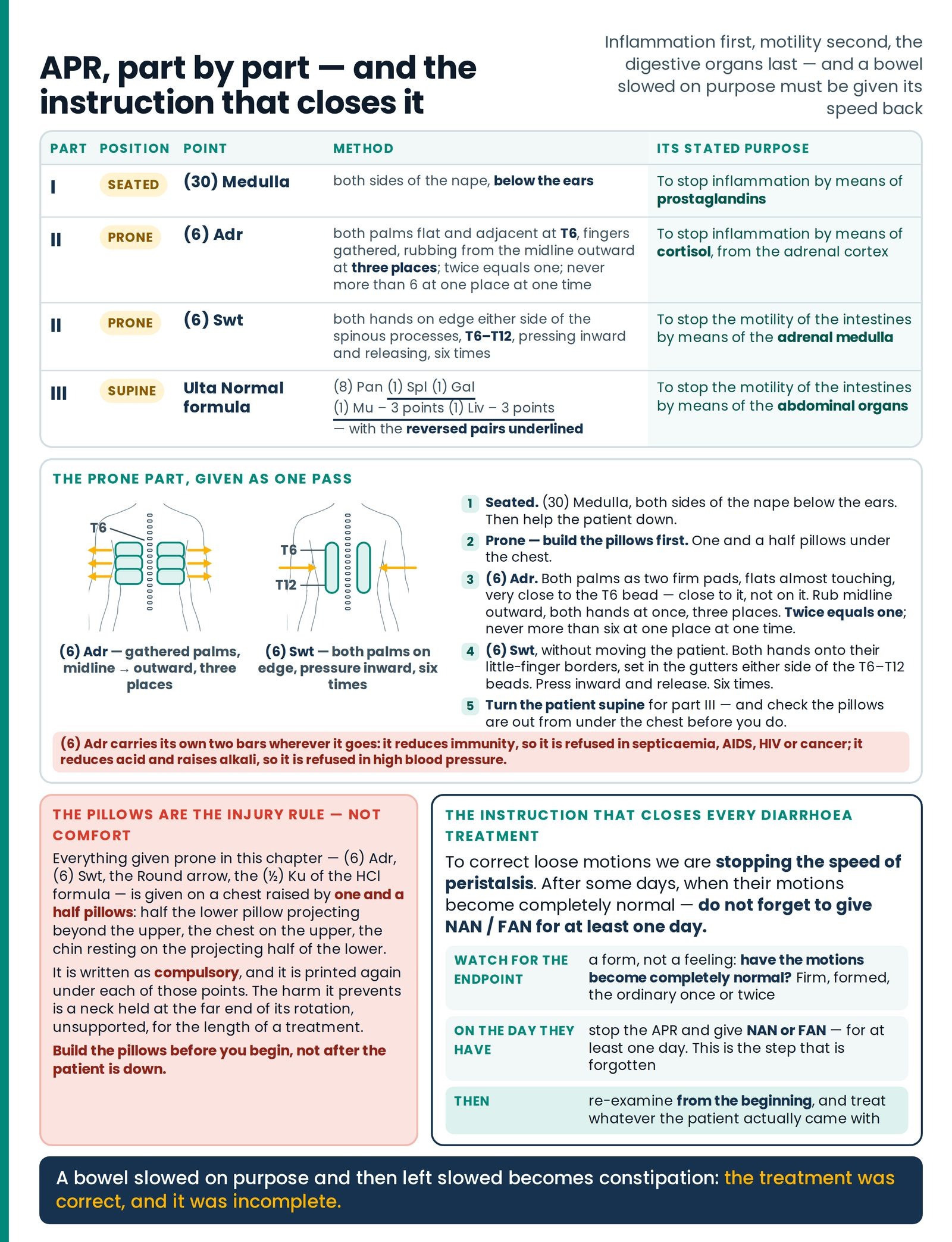
| What it is for | Loose motions or diarrhoea occurring together with abdominal pain |
|---|---|
| The shape of it | Inflammation first, motility second, the digestive organs last — and the organs only in the reversed order |
| Points taught in | Medulla — Seated I — Brain, Medulla, Neck · Adr and Swt — Face Down · Pan, Gal, Spl, Liv, Mu — The Front of the Body I · the Ulta Normal formula — Setting the Stomach |
| Carried with (6) Adr | (6) Adr reduces immunity — so it is not given in septicaemia, AIDS, HIV or cancer, where immunity is already reduced. It reduces acid and raises alkali — so it is not given in high blood pressure ▲ Take care |
| Compulsory with prone position | One and a half pillows under the chest — half the lower pillow sticking out, the chest on the upper, the chin on the lower ▲ Take care |
Three things in that card deserve to be said aloud.
The Medulla number is part of the point. (30) Medulla is not a strong (10) Medulla. The whole graded series — (2), (4), (6), (8), (10), (12), (15), (20) and (30) — is a set of different treatments given at one site, each with its own work and its own bars, and it is taught in The Medulla Family, "The Medulla Family". The written prohibitions you already carry attach to (10) Medulla — not in diabetes, not in cancer; in heart patients, (10) Left Medulla only — and they are inherited by every formula that contains it. Read the number on the card before you decide which rule you are standing under.
(6) Adr carries its own two bars wherever it goes, and it goes into both of the diarrhoea classes below. It reduces immunity, so it is refused where immunity is already low; it reduces acid and raises alkali, so it is refused in high blood pressure. That is the pattern of every caution in this therapy: this point raises or lowers X; therefore withhold it where more or less of X is harmful. The reason is the memory hook.
(6) Swt is written without a side, and that is deliberate. Both palms stand on edge, pressure running inward toward the beads. Lt. Swt and Rt. Swt are different instructions with a different hand arrangement and a different direction of pressure, and they are not what this formula asks for.
Why one treatment was not enough — the three classes
Count the loose motions: more inflammation-work, later organ-work
Many patients obtained great benefit from that treatment. The abdominal pain also went out and the loose motions also stopped. And then a pattern appeared in the failures, which is where the interesting part of this article begins.
Those whose motions were fewer benefited from the above treatment. Those who had more loose motions did not have their loose motions stopped by it — that is, it did not make much difference to them.
Why so? And what is to be done about it? The answer, when it came, was not a new point.
The insight that split the formula into classes
For those who have more loose motions, it means the effect of the infection is stronger in them — that is, there will be more inflammation in their body.
And therefore: until the inflammation is finished, there is no meaning in provoking the other organs of the abdomen.
So the treatments for finishing the inflammation must be given more, and the other organs provoked afterwards.
That single sentence — until the inflammation is finished there is no meaning in provoking the other organs — is the reasoning behind every difference you are about to read. Nothing new is added in the heavier class. The anti-inflammatory parts are given more, and the digestive part waits.
From years of experience, abdominal pains taken as symptoms were then divided into three chief kinds, with a different treatment made for each.
Notice what is doing the dividing: the number of loose motions, and nothing else. Not the name of the illness, not a report, not how long it has gone on. A therapist who can count and can ask a plain question has already chosen the class. That is what it means to make a thing simple enough to teach away. (Figure 30.2)
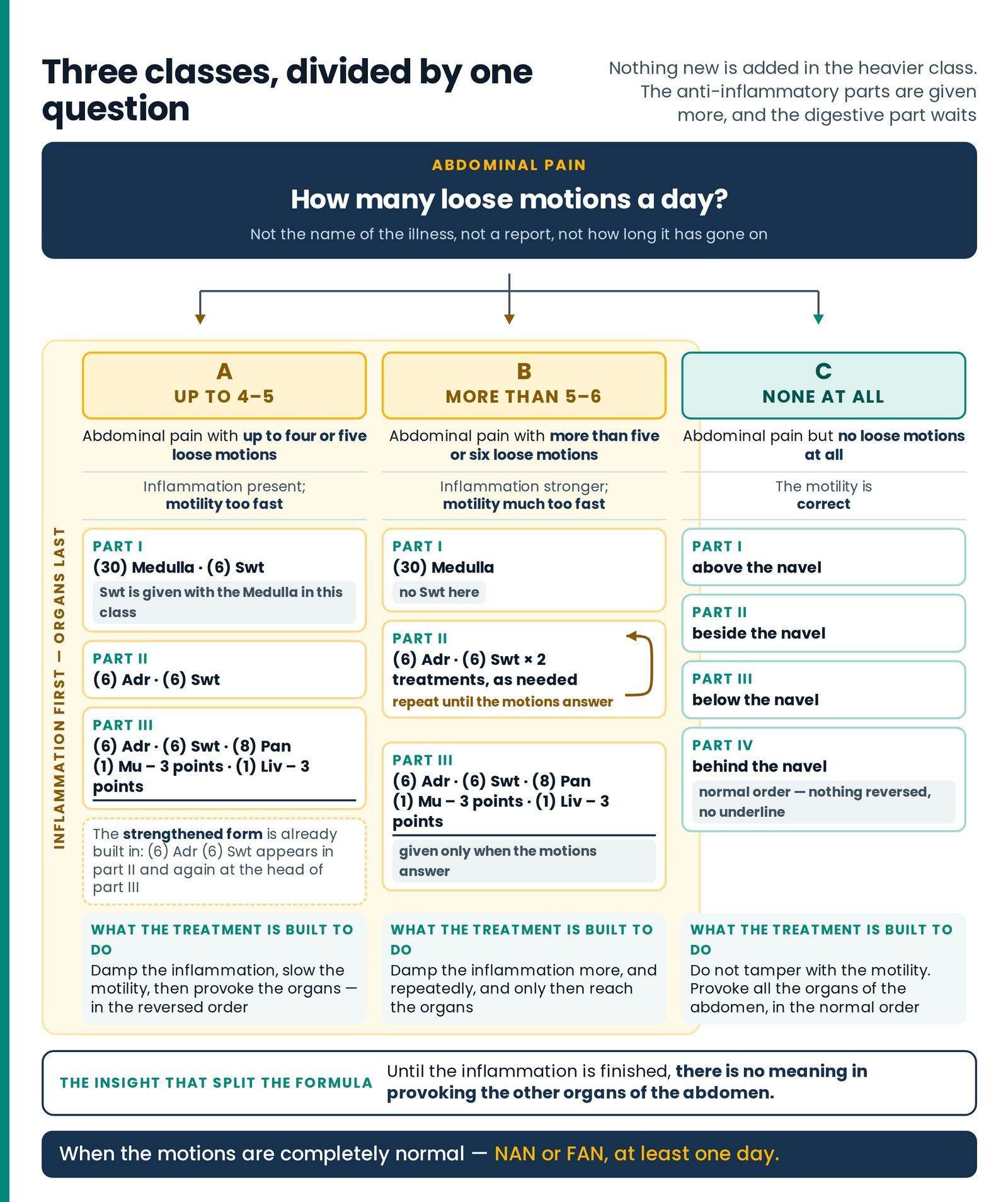
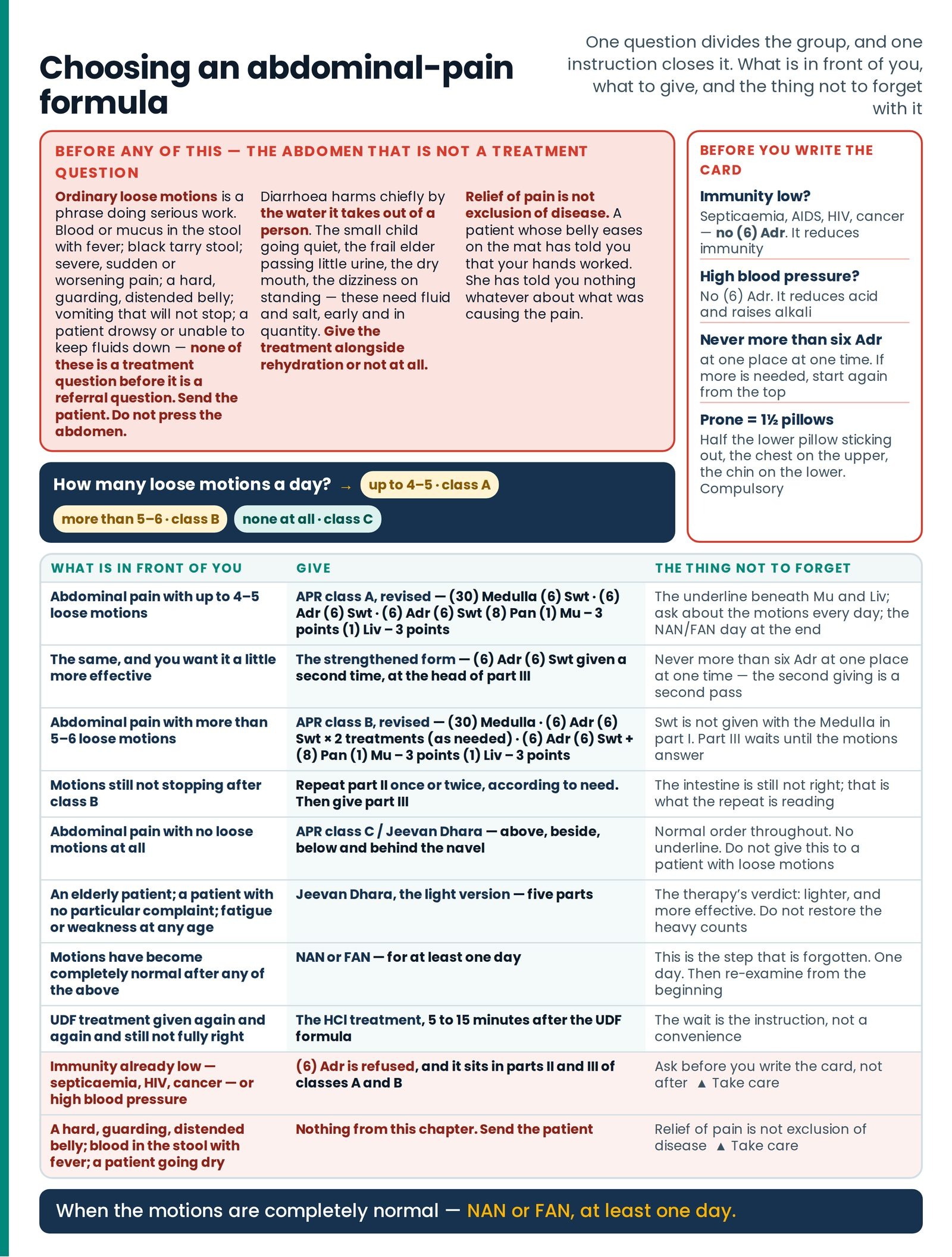
Class A — abdominal pain with up to 4–5 loose motions
Table 3 — Card: APR class A, the first version Seated Prone Supine 6 sec
| Written | I (30) Medulla (6) Swt · II (6) Adr (6) Swt · III Ulta Normal formula — (8) Pan (1) Spl (1) Gal (3) Mu (3) Liv |
|---|---|
| Who it is for | Abdominal pain with up to four or five loose motions |
| Part I | (30) Medulla Seated — inflammation. Then (6) Swt Prone — motility. Swt is given with the Medulla in this class |
| Part II | (6) Adr then (6) Swt Prone — cortisol, then motility again |
| Part III | The Ulta Normal formula Supine . A line is ruled beneath (1) Spl (1) Gal, and beneath (3) Mu (3) Liv — the reversed pairs |
| The counts in part III | Here they are written (3) Mu (3) Liv — not the (1) … – 3 points form of the standard Ulta Normal. Give what is written on the card in front of you |
| Prohibitions carried | Those of (6) Adr — not where immunity is already low; not in high blood pressure ▲ Take care |
| Closes with | The NAN / FAN instruction below — not optional |
And there is a strengthened form of the same class, for when more is wanted.
Class A, made a little more effective
If this is to be made a little more effective, then give (6) Adr (6) Swt a second time, in this manner —
I. (30) Medulla (6) Swt II. (6) Adr (6) Swt III. (6) Adr (6) Swt + Ulta Normal formula
The anti-inflammatory pair is now given twice, and the second giving is carried into part III, immediately before the abdominal organs are touched. Nothing else changes.
Class B — abdominal pain with more than 5–6 loose motions
Table 4 — Card: APR class B, the first version Seated Prone Supine 6 sec
| Written | I (30) Medulla · II (6) Adr (3) Swt × 2 treatments · III (6) Adr (3) Swt + Ulta Normal formula |
|---|---|
| Who it is for | Abdominal pain with more than five or six loose motions |
| Part I | (30) Medulla alone Seated . Swt is not given with the Medulla in this class — the absence is the instruction |
| Part II | (6) Adr then (3) Swt Prone — Swt is halved to three, and the whole part is given twice |
| Part III | (6) Adr (3) Swt again, then the Ulta Normal formula Supine |
| The stopping rule | See the panel below — part III waits on the stools |
| Prohibitions carried | Those of (6) Adr — not where immunity is already low; not in high blood pressure ▲ Take care |
| Closes with | The NAN / FAN instruction below |
Look at what has actually changed between A and B, because it is a short list and it is the whole lesson. Swt is taken out of part I. Swt is halved in parts II and III. Part II is repeated. The abdominal organs are reached only at the third part, and only when the stools allow it. More inflammation-work, later organ-work — exactly as the teaching above predicted.
The halving of Swt to three is written as it stands. Note, without resolving anything, that (3) Swt has other uses of its own in the atlas, and that the revised generation below puts it back to six.
The revision — Gal and Spl taken out of an inflamed abdomen
Nothing added, nothing strengthened — two points taken out, and why
Benefit was certainly being obtained from those treatments. But even in that, some patients would be met with who did not get full relief.
And then came the thought that changed the whole group, and it came from asking what the points in part III actually do.
Why two points were removed
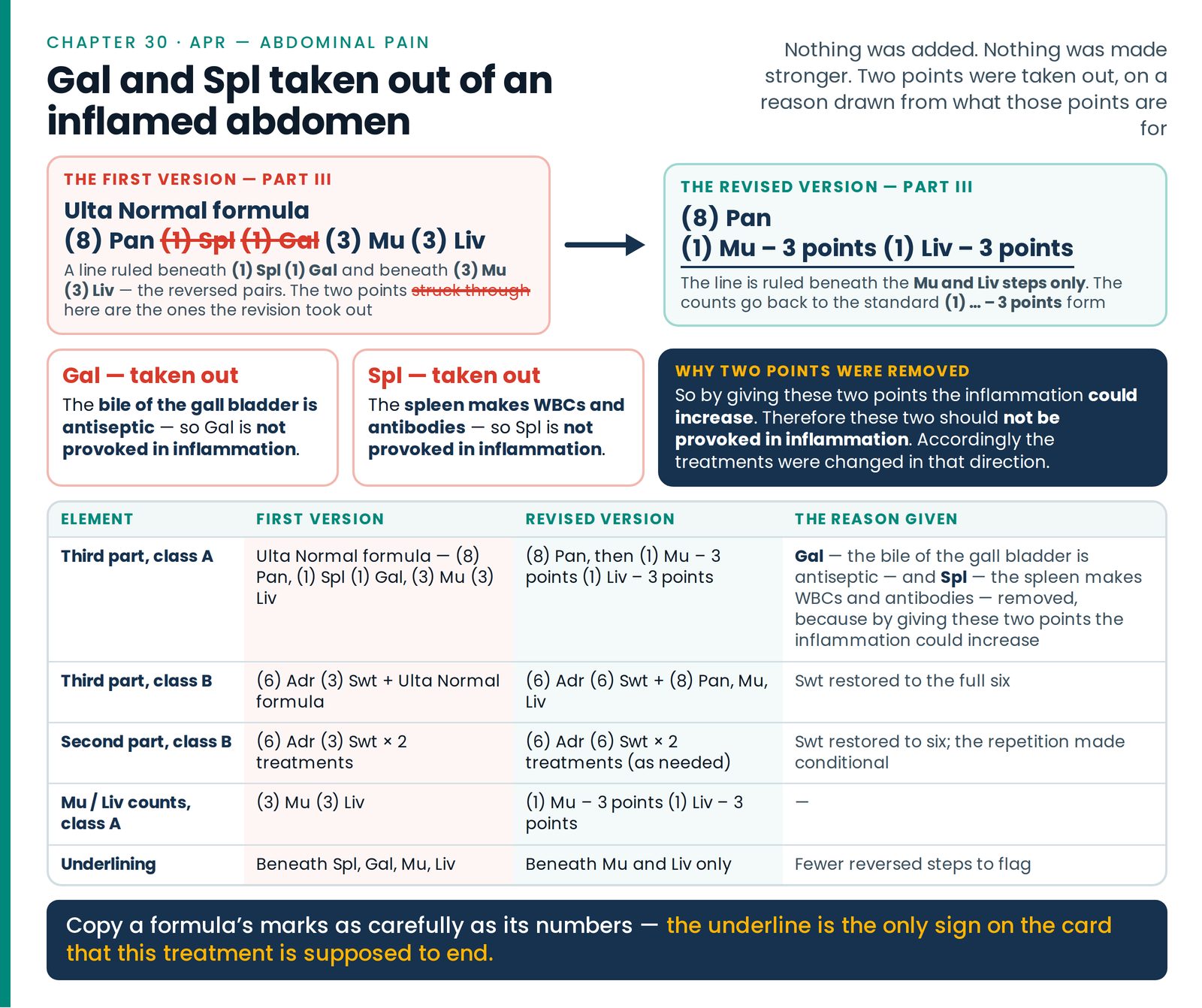
The bile of the gall bladder is antiseptic. The spleen makes WBCs and antibodies.
So by giving these two points — Gal and Spl — the inflammation could increase.
Therefore these two should not be provoked in inflammation. Accordingly the treatments were changed in that direction.
Sit with that for a moment, because it is the most instructive piece of formula-building in this wiki. Nothing was added. Nothing was made stronger. Two points were taken out, on a reason drawn from what those points are for — and the patients who had not been getting full relief began to get it. (Figure 30.3)
This is what it means to say that an omission is an instruction.
Table 5 — Card: APR class A, revised Seated Prone Supine
| Written | I (30) Medulla (6) Swt · II (6) Adr (6) Swt · III (6) Adr (6) Swt (8) Pan (1) Mu – 3 points (1) Liv – 3 points |
|---|---|
| Who it is for | Abdominal pain with up to four or five loose motions |
| What has gone | Gal and Spl — both of them, entirely |
| What has stayed | (8) Pan, and the reversed Mu before Liv |
| The underline | A line is ruled beneath the Mu and Liv steps. Here the order of Liv and Mu is the reverse of normal, which is why the line is there |
| The counts | Back to the standard form — (1) Mu – 3 points, (1) Liv – 3 points |
| The strengthened form | Already built in: (6) Adr (6) Swt now appears in part II and at the head of part III |
| Prohibitions carried | Those of (6) Adr ▲ Take care |
Table 6 — Card: APR class B, revised Seated Prone Supine 6 sec
| Written | I (30) Medulla · II (6) Adr (6) Swt × 2 treatments (as needed) · III (6) Adr (6) Swt + (8) Pan (1) Mu – 3 points (1) Liv – 3 points |
|---|---|
| Who it is for | Abdominal pain with more than five or six loose motions |
| What has gone | Gal and Spl |
| What has come back | Swt restored to the full six in parts II and III |
| What has changed in the repeat | The repetition of part II is now written as needed — the stopping-and-repeating rule above governs it |
| The underline | Beneath the Mu and Liv steps |
| Prohibitions carried | Those of (6) Adr ▲ Take care |
The instruction that closes every diarrhoea treatment
A bowel slowed on purpose is given its speed back: NAN or FAN, one day
This one is yours to learn by heart, because it is the single most forgotten line in the abdominal group, and forgetting it undoes a good part of what the treatment achieved.
Keep in mind
To correct loose motions we are stopping the speed of peristalsis.
After some days, when their motions become completely normal — do not forget to give NAN / FAN for at least one day.
Read the two sentences as one. The first says what you have been doing on purpose. The second says what you must do to stop doing it.
NAN and FAN are the digestion-and-absorption pair of Setting the Stomach. NAN is the Normal formula followed by Ajay Normal, given as one treatment. FAN is the Fast treatment followed by Ajay Normal. Their written forms, their indications, the optional (10) Medulla before FAN and the prohibitions each carries are taught in full in Setting the Stomach, "Setting the Stomach", and are not repeated here. What belongs here is when to give one, and why.
Why the therapy builds its slowing treatments this way is worth saying once, because it recurs. A treatment that deliberately slows the bowel is prescribed together with the treatment that undoes it. The Ulta Normal formula carries the same architecture in Setting the Stomach — ask about the motions daily, and as soon as the stool is formed like a banana, stop and give the Normal formula for at least one day. Here the same duty is written at the end of the whole APR group, and the antidote named is NAN or FAN. The underline is the visual interrupt; the closing instruction is the exit.
The third kind — abdominal pain without loose motions
The motility is correct, so go round the navel instead of slowing it
It is not always the case that every patient will have loose motions along with abdominal pain. There are some who have only abdominal pain, and no complaint at all about their motions. For them, some change is needed in the line of thinking.
Why class C is built the other way round
If there is no problem with the motions, it means the motility of the intestine is correct. So it must not be tampered with.
We have only to provoke all the organs of the abdomen — and this therapy is famous for that work.
Everything follows from those two sentences. No Adr, no Swt, no Medulla, nothing reversed and nothing underlined. A bowel that is working is left alone, and the work is done entirely by bringing blood to the organs.
And here is where the story that opened this article turns into a formula. From many years of experience, Guruji had found out which organs of the body, on being pressed, take out the pain of which part of the abdomen. He had reached the position where, at anyone's wish or asking, he could take out the pain of any specified place in the abdomen, announcing it beforehand as a challenge. And the best part of it is that he made that knowledge so simple, and taught it to so many people, that anyone at all will be able to do this work.
So he found a very simple way.
The thought that became class C
If the blood circulation is increased above the navel, below it, in front of it and behind it — on all sides — then the pain will come out of itself.
Is that not a marvellous thought? It replaces a memorised table of which point empties which corner with a single instruction: supply the whole sphere. You do not have to know where the pain is. You have to go round it. (Figure 30.4)
Table 8 — Card: APR class C — abdominal pain with no loose motions Supine Side-lying Prone 6 sec
| Part | The region it is given to provoke | ||
|---|---|---|---|
| I | (6) Gas Only (6) Gas 'I' | The part above the navel | |
| II | (3) Gal (3) Spl (7) Liv (5) Mu | The right and left parts above the navel | |
| III | (8) Pan (6) WD (8) Ch. Only (20) ↑\ | ↓ | The part below the navel |
| IV | (7) Liv° (7) Mu° (8) Ch. Only (20) ↑\ | ↓ | The kidneys and the part behind the navel |
| Who it is for | Abdominal pain with no loose motions at all | |
|---|---|---|
| What it does | From this treatment the abdominal pain comes out at once | |
| Its other effect | Given to the elderly, and to those who have no particular complaint, it produces an immediate freshness and briskness | |
| Order | Normal throughout. Gal before Spl, Liv before Mu. Nothing is reversed, because nothing is meant to be slowed — and so there is no underline anywhere in this formula | |
| Two inseparable pairs, both honoured | Gas Only → Gas 'I' in part I; (8) Ch. Only → (20) ↑\ | ↓ at the close of parts III and IV. See Table 14 of How a Formula Is Built |
| Points taught in | Gas Only, Gas 'I', Gal, Spl, Liv, Mu, Pan, WD, Liv°, Mu° — The Front of the Body I · Ch. Only — The Front of the Body II · Round arrow ↑\ | ↓ — Face Down |
| Its second name | Jeevan Dhara — see below |
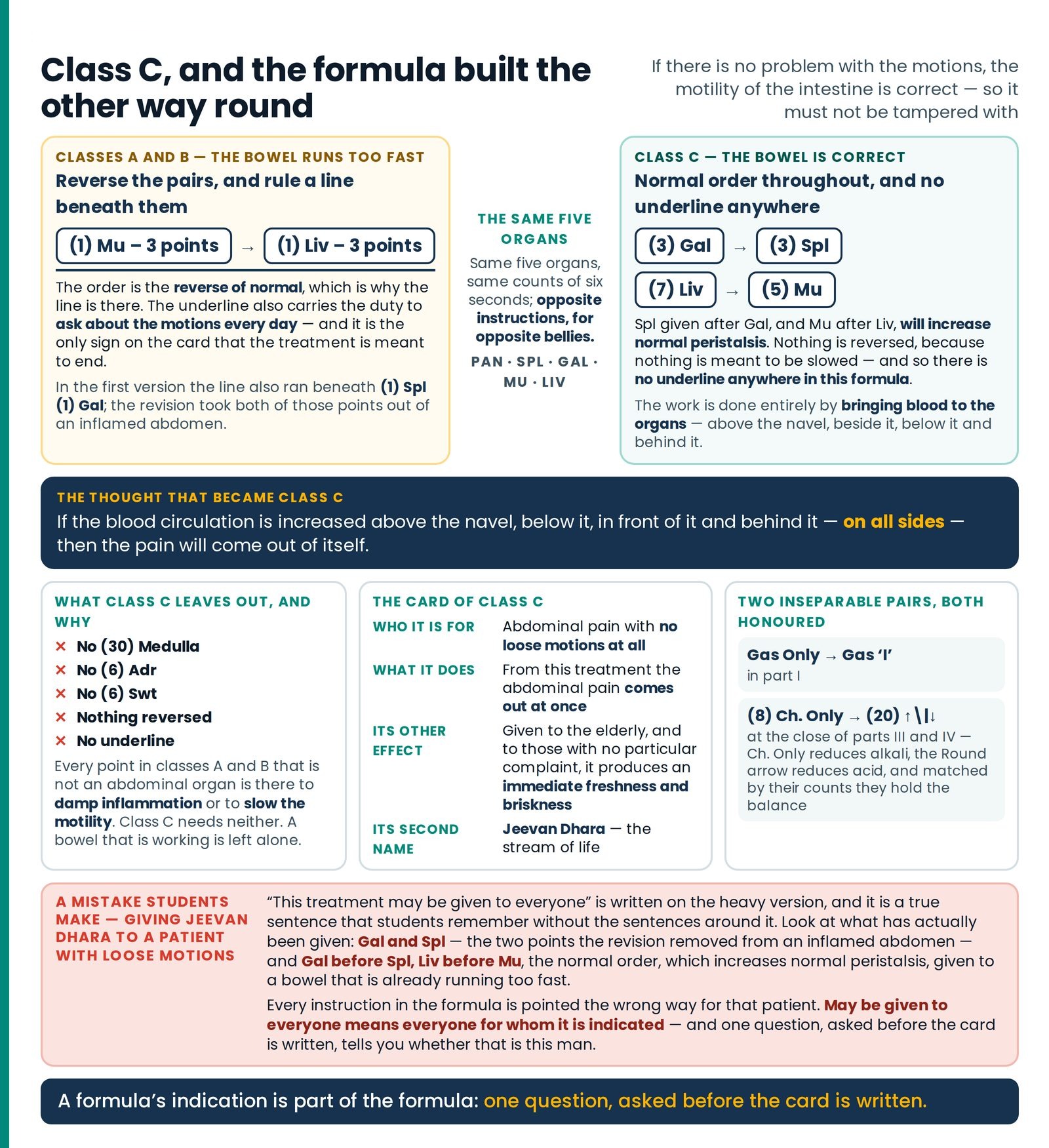
Look at the pairing at the end of parts III and IV, because it is a rule you already hold. (8) Ch. Only is balanced by (20) ↑\|↓ — Ch. Only reduces alkali, the Round arrow reduces acid, and matched by their counts they hold the balance the formula has set. That is one of the four inseparable pairs of How a Formula Is Built, and here it appears twice in one formula, closing two parts in succession. The acid-and-alkali pair itself belongs to Water and Salt, "Water and Salt"; what matters here is that you never write the first of them without the second.
Jeevan Dhara — the stream of life
The formula its patients named, in two versions — and the lighter wins
From this treatment the abdominal pain comes out at once. And something else happened that nobody had gone looking for. Given to the elderly, and to people with no particular complaint at all, it produced an immediate freshness and briskness. Many women to whom this treatment was given began to say that they had received a new life.
So the treatment acquired a second name, and it is the name everybody now uses.
This is a very effective treatment which gives benefit to persons of any age. In it, all the organs around the navel are provoked in one order. Especially to people of greater age, after this treatment is given, it feels as though they have obtained new life — on account of which this name was given to it.
There are two versions, and the therapy is candid about which it prefers.
The older, heavy version
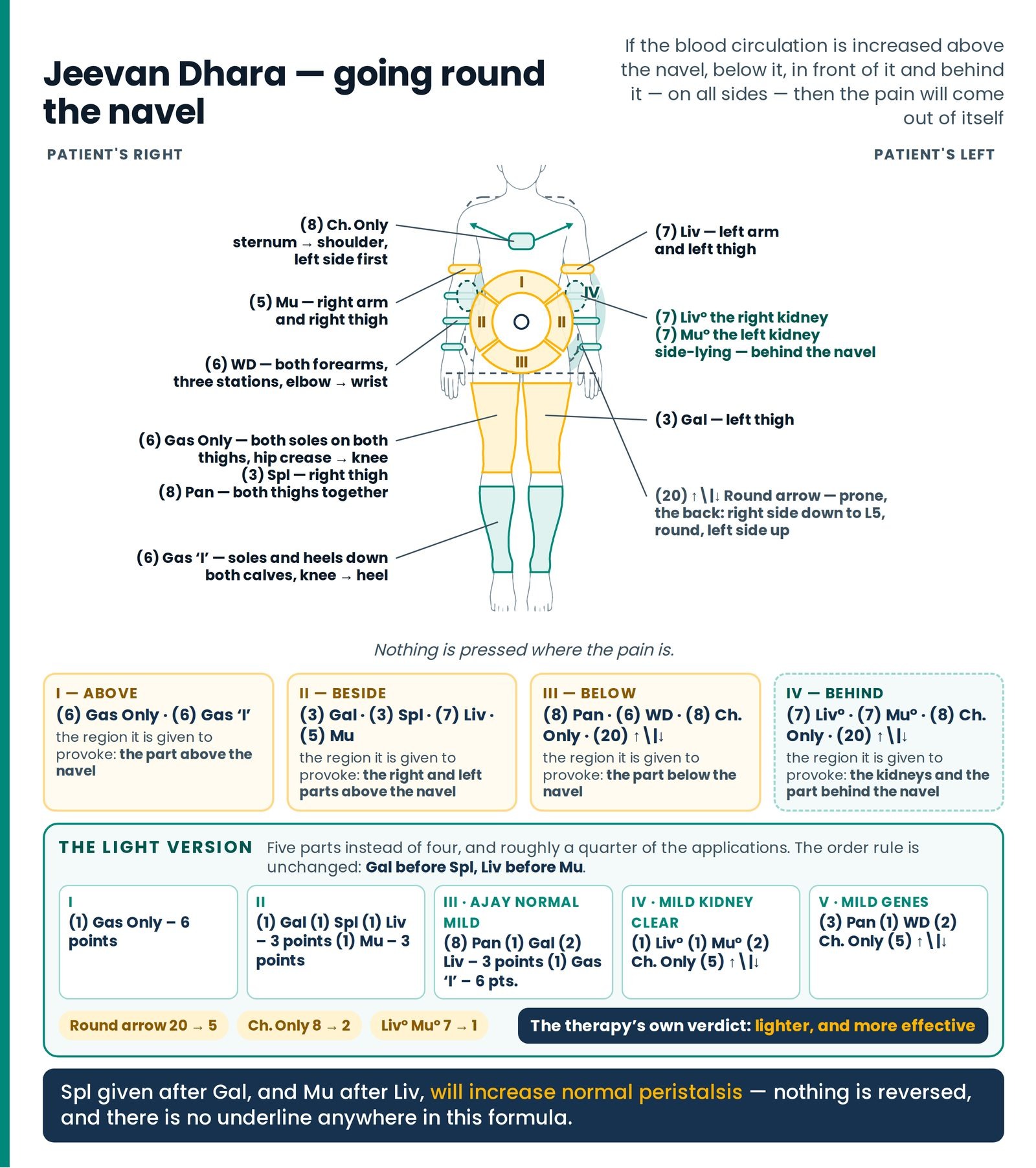
Table 9 — Card: Jeevan Dhara, the heavy version Supine Side-lying Prone 6 sec
| Written | I (6) Gas Only (6) Gas 'I' · II (3) Gal (3) Spl (7) Liv (5) Mu · III New Genes formula — (8) Pan (6) W.D (8) Ch. Only (20) ↑\ | ↓ · IV (7) Liv° (7) Mu° (8) Ch. Only (20) ↑\ | ↓ |
|---|---|---|---|
| Step 1 | (6) Gas Only Supine Both sides — both soles on both thighs, hip crease → knee | ||
| Step 2 | (6) Gas 'I' Supine Both sides — soles and heels down both calves, knee → heel | ||
| Step 3 | (3) Gal Left — right sole down the left thigh | ||
| Step 4 | (3) Spl Right — left sole down the right thigh | ||
| Step 5 | (7) Liv Left — left arm and left thigh | ||
| Step 6 | (5) Mu Right — right arm and right thigh | ||
| Step 7 | (8) Pan Both sides — both thighs together. The New Genes formula begins here | ||
| Step 8 | (6) W.D Both sides — both forearms, three stations each, elbow → wrist | ||
| Step 9 | (8) Ch. Only — sternum → shoulder, left side first; three sweeps equal one | ||
| Step 10 | (20) ↑\ | ↓ Prone — right side down to L5, round, left side up | |
| Step 11 | (7) Liv° Side-lying — the right kidney | ||
| Step 12 | (7) Mu° Side-lying — the left kidney | ||
| Step 13 | (8) Ch. Only — as step 9 | ||
| Step 14 | (20) ↑\ | ↓ — as step 10 | |
| The order rule | Spl is given after Gal, and Mu after Liv — which will increase normal peristalsis | ||
| Who it may be given to | This treatment may be given to everyone | ||
| Note | Part III is the New Genes formula, which belongs whole to Vitamin and Gene Formulas, "The Missing Links" |
Fourteen stations, four positions, and well over a hundred six-second applications. This is the version the therapy itself calls heavy.
The order rule, stated where it matters most
Spl given after Gal, and Mu after Liv, will increase normal peristalsis.
That is the normal order — the same order as the Normal formula, and the exact opposite of what the diarrhoea classes above are doing with their underlines.
Hold the two halves of this article against each other and the logic is complete. Where the bowel is running too fast, reverse the pairs and rule a line beneath them. Where the bowel is correct, give them in the normal order and increase the peristalsis that is already right. Same five organs, same counts of six seconds; opposite instructions, for opposite bellies.
The present, lighter version
Nowadays this same treatment has been made lighter, and it is more effective. It can also be given to a patient of any age to remove fatigue or weakness in the body. (Figure 30.5)
Table 10 — Card: Jeevan Dhara, the present light version Supine Side-lying Prone 6 sec
| Part | Written | ||
|---|---|---|---|
| I | — | (1) Gas Only – 6 points | |
| II | — | (1) Gal (1) Spl (1) Liv – 3 points (1) Mu – 3 points | |
| III | Ajay Normal Mild | (8) Pan (1) Gal (2) Liv – 3 points (1) Gas 'I' – 6 pts. | |
| IV | Mild Kidney Clear formula | (1) Liv° (1) Mu° (2) Ch. Only (5) ↑\ | ↓ |
| V | Mild Genes formula | (3) Pan (1) WD (2) Ch. Only (5) ↑\ | ↓ |
| Who it is for | Persons of any age. Abdominal pain without loose motions; the elderly; those with no particular complaint; and fatigue or weakness in the body at any age | |
|---|---|---|
| Part I | One application at each of six or more stations, both thighs — not six applications at one place | |
| Part II | Gal before Spl, Liv before Mu — the order rule unchanged from the heavy version | |
| Part III | The Ajay Normal pattern in its mild form. Gas 'I' has moved here, out of part I | |
| Part IV | The Kidney Clear formula in its mild form — Water and Salt, "Water and Salt", owns it whole | |
| Part V | The Genes formula in its mild form — Vitamin and Gene Formulas, "The Missing Links", owns it whole | |
| The pair, twice | (2) Ch. Only closed by (5) ↑\ | ↓ in part IV, and again in part V |
| The therapy's own verdict | Lighter, and more effective |
Table 11 — Jeevan Dhara: heavy version against light version
| Heavy version | Light version | |
|---|---|---|
| Parts | Four | Five |
| Named sub-formulas | New Genes formula, inside part III | Ajay Normal Mild, Mild Kidney Clear, Mild Genes — each named and given a part of its own |
| Opening | (6) Gas Only + (6) Gas 'I' | (1) Gas Only – 6 points only; Gas 'I' moved into part III |
| Second-part counts | (3) Gal (3) Spl (7) Liv (5) Mu | (1) each, with Liv and Mu taken as 3 points |
| Round arrow | (20), given twice | (5), given twice |
| Ch. Only | (8), given twice | (2), given twice |
| Kidney work | (7) Liv° (7) Mu° | (1) Liv° (1) Mu° |
| Order rule | Gal→Spl, Liv→Mu, which will increase normal peristalsis | Unchanged |
| Stated indication | Abdominal pain; freshness and briskness; new life in the elderly | The same, plus fatigue or weakness in the body at any age |
| The therapy's own verdict | "the heavy treatment" | "lighter, and more effective" |
The counts fall by something like three-quarters — the Round arrow from twenty applications to five, Ch. Only from eight to two, the kidney points from seven each to one each — and the result reported is not nearly as good. It is better. That deserves a sentence, because it cuts against the instinct every new therapist has.
A formula that got weaker and got better
The body answers a signal, not a load.
Past a certain point more pressure adds nothing, and in an old or tired body it takes something away: a fourteen-station treatment through four positions exhausts the person receiving it, and an exhausted patient is not a well-supplied one.
This is the plainest illustration in the wiki of a principle stated at the very beginning of — the count is part of the treatment, and more is a different treatment, not a stronger one. A therapist who "improves" the light version by restoring the heavy counts has not given a better Jeevan Dhara. He has given the version that was replaced.
The problem that remained
Results that faded in old disease, and the question that widened
The abdominal-pain formulas worked, and the therapy grew, and the growing brought the next question with it.
The sentence that opened the next enquiry
As Neurotherapy became popular, the number of patients went on growing. Good results were coming in all of them — but in old, chronic diseases it was seen that the results came only after many days, and often, after a few days, the effect of the treatment was next to nothing.
Read that twice. It is a therapy writing down, in its own manual, that its own treatments faded in exactly the patients it most wanted to help. Nothing that came next was made out of confidence; it was made out of that sentence.
So the question was widened until it was no longer a question about a formula at all. When a human being is born, he is usually born healthy. One child in lakhs is ill on emerging from the mother's womb or even before it; generally children remain healthy for months or many months, and later fall ill from various causes. Why, then, do diseases come into the body at all?
The answer that came back is the doctrine of undigested food — the chemistry of the body, the three kinds of chemical it runs on, the two ways a missing chemical can be supplied, and the reason the whole system rests on the digestion and absorption of proteins and fats. That is taught whole, in order, in Clearing the Ash, "Clearing the Ash", together with every generation of the UDF formulas, the simplest treatment, OLD UDF read point by point, the (½) Ku treatment and the four symptom-matched formulas. It is not repeated here.
What belongs here is the relation between the two articles, and it is worth a line. APR releases a pain. UDF asks why the pain kept coming back. The first is what you give the person in front of you this afternoon; the second is what you give them so that this afternoon does not repeat itself every four months. A therapist who has only the first will be busy and will not get very far.
The HCl treatment formula
Six parts for the stomach's acid, given after UDF and never instead
The abdominal group closes with one more entry, and it sits at the far end of the road the last two articles have walked. It was made for a particular failure: it was seen in some patients that the UDF treatment has to be given again and again, and even then the problem does not get fully right. So this treatment was made, which works especially to increase the stomach's HCl acid.
Its place in a session, and the chain of purposes behind it — the UDF formula first, the wait of five to fifteen minutes, the HCl treatment second, and any further treatment last — is taught with its walkthrough in Clearing the Ash, "Clearing the Ash". What belongs here is the formula itself, as a formulary entry: its six parts in order, what each is aimed at, who it is for, and what travels with it.
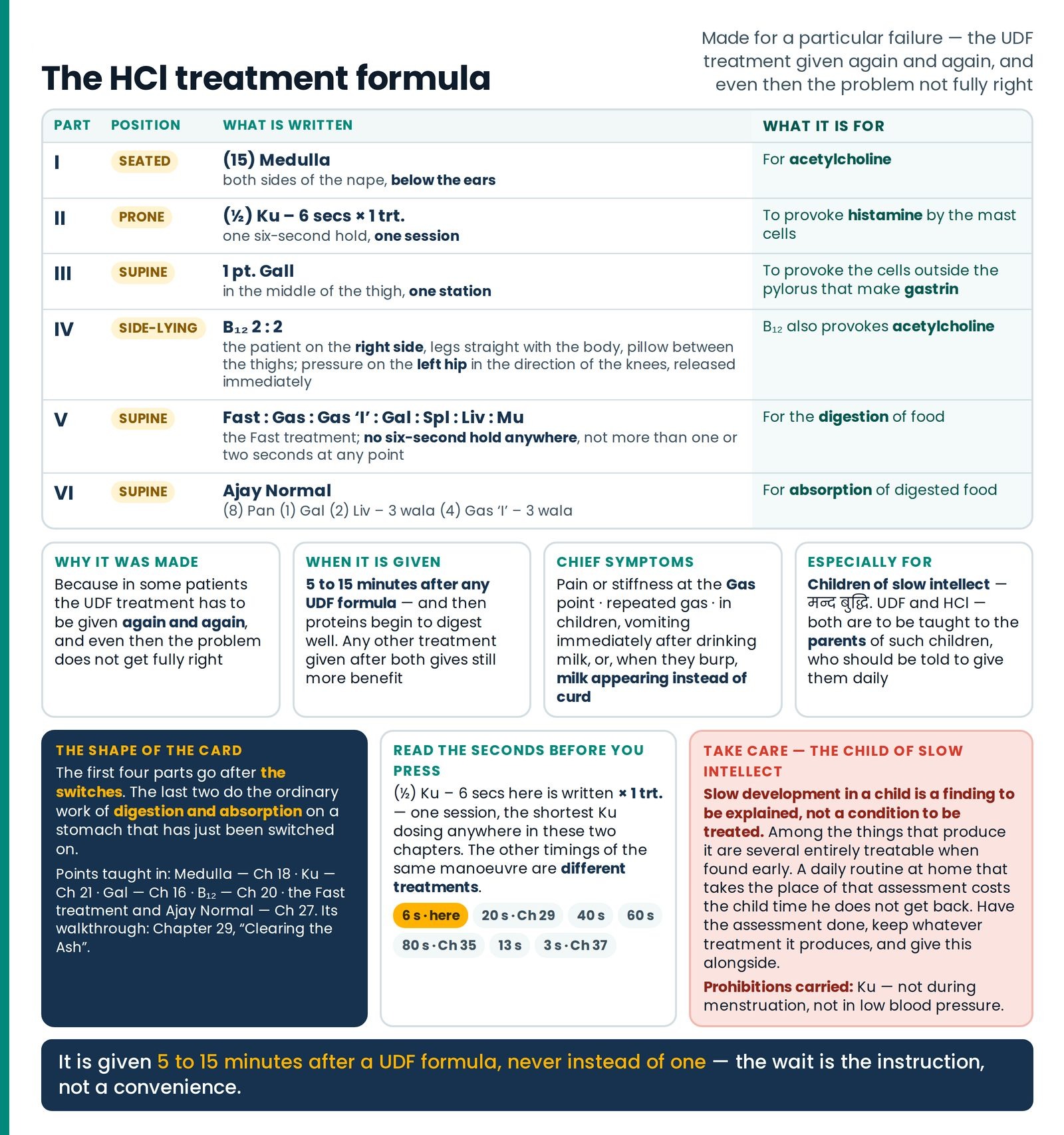
The shape of the card is worth naming even though the reasoning belongs next door. The first four parts go after the switches; the last two do the ordinary work of digestion and absorption on a stomach that has just been switched on. Note also that (½) Ku – 6 secs here is written × 1 trt. — one session, the shortest Ku dosing anywhere in these two articles. The other timings of the same manoeuvre are different treatments: (½) Ku – 20 secs belongs to the UDF formulas of Clearing the Ash; (½) Ku – 40, 60 and 80 seconds belong to Water and Salt, "Water and Salt"; and the 13-second and 3-second timings belong to Cranial Nerve and Brain Formulas, "The Twelve Messengers". Read the seconds before you press. (Figure 30.6)
All the formulas of these three articles can be used to improve the working style of the stomach and the intestines. Ahead we shall see other formulas, which improve the work of other glands. (Figure 30.7)
Choosing, at the mat
What is in front of you, what to give, and the thing not to forget
Three patients
A bar that bit mid-course, a formula half-working, and a heavy version
At a glance
What the figures of this chapter have to show, and why
Questions students ask
1. I am nineteen and new. Why is the belly given its own group of formulas when everything else is arranged by disease? Because the pains around the navel are where this therapy begins. The very foundation stone is to check the pains around the navel and treat accordingly — so the abdomen is not one region among many, it is the reading instrument. A group of formulas aimed at it directly is the natural first thing to build, and historically it is what was built first. See also → The Navel Speaks First, "The Navel Speaks First".
2. Four or five motions, or more than five or six — what about a patient with exactly five? Use the class the patient's day actually looks like, and say why you chose it on the card. Five loose motions that are watery and leave him weak behave like class B; five that are soft and stop by afternoon behave like class A. And you have the safer instrument in your hands anyway: class B's own rule tells you to look at the stools before advancing to part III. Choose, look, and let the looking correct you.
3. Why is Swt in part I of class A but not in part I of class B? Because the classes are built on a stated principle: in the patient with more loose motions the inflammation is stronger, and until it is finished there is no meaning in provoking the other organs. So class B's opening is inflammation alone, and the motility work starts at part II, where it is given twice. The absence is the instruction — copy it as carefully as you would copy a count.
4. I am a doctor. What is actually being claimed by "stopping the motility"? Three separable things, and they are worth keeping apart. An observation — that this sequence is followed by fewer and firmer stools in patients with acute pain and diarrhoea. A protocol — fixed points, fixed counts, a fixed order, with a criterion for advancing. And a mechanism — that pressure over T6–T12 raises sympathetic outflow to the gut by way of the adrenal medulla, and that provoking the abdominal points against the peristaltic order slows transit. The first you can test at the mat this week by counting stools. The third is a hypothesis, and the therapy states it as its reasoning rather than as a finding.
5. My teacher gave the Ulta Normal formula as part III and my notes say (8) Pan (1) Mu – 3 points (1) Liv – 3 points. Which is right? Both are written, and they are two generations. The first version's part III is the Ulta Normal formula; the revised version's part III has Gal and Spl taken out for the reason given — the antiseptic bile and the antibody-making spleen. The revision was made because some patients were not getting full relief. Older versions are printed beside their successors in this therapy and they are not errors; know which one you are giving and know why.
6. The counts in class A's first version say (3) Mu (3) Liv, but the Ulta Normal formula I learned says (1) Mu – 3 points. Has something been mistyped? It is written as it stands, and the revised generation returns to (1) Mu – 3 points (1) Liv – 3 points. Give what is written on the card in front of you, and if you are the one writing the card, write which generation it is. The difference between an application and a station is in Table 13 of How a Formula Is Built and it is not a small one.
7. I am sixty-eight and learning this to treat my wife. The heavy Jeevan Dhara is beyond me physically. Have I lost anything by giving the light one? Nothing at all — you have gained. The therapy's own verdict on the light version is lighter, and more effective, and it is the version now given. Learn it as the formula and treat the heavy one as its history. And note the light version's extra indication, which is probably the one you will use most: fatigue or weakness in the body, at any age.
8. I work alone in a village. If I forget the NAN or FAN day, how bad is it? Bad enough to be worth a note on the card on day one. You will have spent a week deliberately slowing the peristalsis; NAN or FAN is what puts it back, and it takes one day. The patient who was not given it comes back a fortnight later constipated and blaming the treatment, and she is not wholly wrong. Write the ending when you write the beginning. See also → Weeks, Not Sessions, "Weeks, Not Sessions".
9. Can I give Jeevan Dhara to somebody who is perfectly healthy? That is one of the things it is for. Given to those who have no particular complaint it produces an immediate freshness and briskness, and the heavy version carries the line this treatment may be given to everyone. What you may not do is give it to somebody with loose motions, because the whole reasoning of class C is that the motility is correct and must not be tampered with — and the formula contains both of the points the revision withheld from an inflamed belly.
- 10. Why does class C have no Medulla, no Adr and no Swt at all? Because it has no inflammation to damp and no motility to slow. Every point in classes A and B that is not an abdominal organ is there for one of those two jobs, and class C needs neither. What is left is the pure form of the thing this therapy is famous for: provoke all the organs of the abdomen, on all four sides of the navel.
11. Is the HCl treatment part of this article or the last one? It belongs to both and it is printed here as a formulary card because it closes the abdominal group. It is given 5 to 15 minutes after a UDF formula, never instead of one, and where it sits in a session, together with the reasoning behind its first four parts, is taught in Clearing the Ash, "Clearing the Ash". What you should carry from here is the card: six parts, the chief symptoms, the children it is especially for, and the Ku restriction.
12. (30) Medulla — is that not an enormous number? Am I pressing for three minutes? No. Thirty applications of six seconds each, released between, at both sides of the nape — and the number is a selector, not a strength. (30) Medulla is a different treatment from (20), from (15), from (10), given at the same site. What each number is for is The Medulla Family, "The Medulla Family", and the prohibitions written against (10) Medulla are written against that one. Read the number before you read the point.
Questions patients ask
"You are pressing my back and my legs. My pain is in my stomach." Yes — and I am not going to press your stomach, because that is not where the work is done. The organs inside your belly are supplied by nerves and vessels that can be reached from the back and from the limbs, and that is the route this therapy uses. It has a second advantage you will appreciate: a sore belly is not made sorer. If the pain leaves while my hands are nowhere near it, that is the treatment working exactly as it is meant to.
"Will this stop my loose motions today?" Often it eases very quickly — many people get up from the first treatment and say the twisting has gone. Whether the motions stop today I will not promise you. What I will do is count them with you tomorrow, and the day after, and the counting decides what I give you next. And I want you to do one thing that matters more than anything I do: keep drinking. Water with a little salt and sugar in it, all day. If you cannot keep it down, or if you feel faint standing up, we stop and you see a doctor today.
"Why do you keep asking about my stools? It is embarrassing." Because it is the one thing that tells me the truth about how the treatment is going, and because your answer decides what I do tomorrow. I am not asking out of curiosity, and I will ask in one sentence: how many times, and what shape. Some people find it easier to tell me once, twice, three times and loose, soft, formed. That is all I need, and I need it every day until we stop.
"My motions are normal now. Can I stop coming?" Almost. One more day. What we have been doing is deliberately slowing your bowel down so that it had time to take the water out, and there is one treatment whose job is to put the ordinary movement back. It takes a single session. If we skip it, there is a fair chance you come back in a fortnight with the opposite complaint, and I would rather you did not. Come tomorrow, and then I will examine you again from the beginning.
"My mother is seventy. Is she too old for this?" Not at all — this particular treatment was very largely made for people her age, and it is the one older people ask for by name. But I will give her the lighter form, which is the better one, and I will not put her through more than she needs. If she is tired when she gets up, I have given too much, and I will say so and reduce it. A treatment she needs help to stand up from has taken more than it gave.
"Should I stop my tablets while I take this treatment?" No — not one of them and not the dose, and please bring me the strip so that I can read the names. Some of what I do is decided by what you take: there are treatments in this group I must not give to somebody being treated for blood pressure, and I would only know that from the strip. Nothing here replaces a tablet. If your doctor later finds your numbers have changed, that is his decision to make and I would be glad of it.
"Is this the same as the nabhi setting my grandmother used to do?" It grew from the same soil, and I will not pretend it is identical. The old navel-setting of the households is one of the parents of this therapy and it is named as such openly. What has been added since is the part you are getting: a written order of points, a fixed count of seconds, a reason given for each step, and rules about when a treatment must stop. Your grandmother's hands knew something real. This is that knowledge written down so that it can be taught.
Words used here
| Hindi | English | Neurotherapy code / usage | |
|---|---|---|---|
| पेट दर्द ठीक करने के उपचार | Abdominal pain releasing treatment | APR — the group of three classes, each in two generations | |
| पेट दर्द (peṭ dard) | Abdominal pain | The symptom the whole group is divided by — together with the number of loose motions | |
| दस्त / पतले दस्त (dast) | Loose motions, diarrhoea | Up to 4–5 → class A · more than 5–6 → class B · none at all → class C | |
| — | Motility | The movement of the food canal. In loose motions it is stopped — that is, slowed — by the sympathetic system through the adrenal medulla | |
| — | Peristalsis | The ordinary wave of the bowel. Gal before Spl and Liv before Mu will increase normal peristalsis; reversed and underlined, they slow it | |
| — | (30) Medulla | Seated, both sides of the nape below the ears. Stops inflammation by means of prostaglandins | |
| एड्रेनल | Adrenal | (6) Adr — prone, gathered palms very close to the T6 bead, three places, middle outward, twice equals one. Stops inflammation by means of cortisol from the adrenal cortex. Not where immunity is low; not in high blood pressure; never more than 6 at one place at one time | |
| स्वेट | Sweat | (6) Swt — prone, both palms on edge either side of the T6–T12 beads, pressure inward. Stops the motility of the intestines by means of the adrenal medulla. Written without a side | |
| उल्टा (ultā) | Reversed | The Ulta Normal formula — part III of the first generation of classes A and B. Setting the Stomach | |
| — | The underline | A line ruled beneath Mu and Liv: their order is the reverse of normal. It carries the duty to ask about the motions every day | |
| — | Gal removed | The bile of the gall bladder is antiseptic — so Gal is not provoked in inflammation | |
| — | Spl removed | The spleen makes WBCs and antibodies — so Spl is not provoked in inflammation | |
| — | × 2 treatments, as needed | The stopping-and-repeating rule of class B: if the motions do not stop, the intestine is still not right — repeat part II once or twice, then give part III | |
| — | NAN / FAN | NAN = Normal then Ajay Normal; FAN = Fast then Ajay Normal. When the motions become completely normal, do not forget to give NAN / FAN for at least one day. Setting the Stomach | |
| जीवन धारा (jīvan dhārā) | The stream of life | Jeevan Dhara — the second name of APR class C, given by the women who received it and said they had received a new life | |
| — | The four sides | Class C provokes above the navel, beside it, below it and behind it — if the blood circulation is increased on all sides, the pain will come out of itself | |
| — | Ajay Normal Mild | Part III of the light Jeevan Dhara — (8) Pan (1) Gal (2) Liv – 3 points (1) Gas 'I' – 6 pts. | |
| — | Mild Kidney Clear | Part IV of the light Jeevan Dhara — (1) Liv° (1) Mu° (2) Ch. Only (5) ↑\ | ↓. Water and Salt |
| — | Mild Genes | Part V of the light Jeevan Dhara — (3) Pan (1) WD (2) Ch. Only (5) ↑\ | ↓. Vitamin and Gene Formulas |
| — | New Genes formula | Part III of the heavy Jeevan Dhara — (8) Pan (6) W.D (8) Ch. Only (20) ↑\ | ↓. Vitamin and Gene Formulas |
| — | HCl treatment | (15) Medulla · (½) Ku – 6 secs × 1 trt. · 1 pt. Gall · B₁₂ 2 : 2 · Fast · Ajay Normal. Given 5 to 15 minutes after any UDF formula | |
| मन्द बुद्धि (manda buddhi) | Slow intellect | UDF and HCl are both to be taught to the parents of such children, who should be told to give them daily | |
| — | (½) Ku – 6 secs | One six-second hold. In the HCl treatment, × 1 treatment — one session. Not during menstruation; not in low blood pressure | |
| — | Formula No. 4 | (10) Medulla (4) Thrd 'P' (20) ↑\ | ↓ (8) Pan — named for the number-four pain of the abdomen. Setting the Stomach |