- How it is given
- The Front of the Body I
- What it is used for
- Each Point in Use
Watch

(1) Gas 'I' – 6 points — (1) Gas 'I' – 6 वाला
Read this aloud as "one gas eye – six points". The 'I' indicates the intestine.
With your soles and heels, on both the patient's calves, from the knees down to the heels, give pressure at at least six places. At each place press for six seconds and release.
| Patient's position | Supine, legs straight Supine |
|---|---|
| Where the feet are placed | Soles and heels on both calves, at least six places from the knees down to the heels Both sides |
| Duration and repetitions | 6 seconds at each place, working downward 6 sec |
| What it is for | Increases blood circulation in the intestines, reduces intestinal gas, and increases the absorption of nutrients |
This is one of the few entries in the supine atlas that names the heel as part of the contact — soles and heels. That is no licence to substitute the heel for the mid-sole elsewhere; and where a treatment does name it, the general rule still governs how it is laid: weight over a broad surface, not on a single point.
What lies beneath. The thigh you already know. The calf is the two-headed muscle that bulges when you rise on your toes, over a flatter, deeper muscle beneath; a vein and a nerve run just under the skin down the middle. Deepest of all are the wide, slow-flowing veins inside the calf muscle itself — and those are why this point, alone in the article, needs a look before it is touched.
From Correcting the Two Kingdoms
The Gas 'I' ladder, and what a dose can decide
One point, four counts — and nine seconds turns (6) into (9)
This last section of the article is a different kind of teaching, and it belongs here rather than anywhere else because it is the plainest demonstration in the wiki of the thing the two kingdoms have been telling you all along: the same point, at two different counts, is two different treatments — and they can pull in opposite directions.
In our intestines there are 100 million — that is, ten crore — neurons, which are called enteric neurons, that is the neurons of the intestines. And these neurons too make, in smaller quantity, the very same chemicals that are made in larger quantity in the brain. In this therapy it has been seen that from the Gas 'I' point the intestines can be stimulated.
Dopamine, in the therapy's own account
Dopamine is a chemical which is made in the part of the brain named the basal ganglia. Besides this it is also made in the adrenal medulla.
After being made, it is changed into norepinephrine according to the body's need.
It is made in the body from the exchange of the tyrosine amino acid. The work of changing one thing into another in the body is called metabolism, that is cayāpacaya. Tyrosine amino acid is found in the protein of milk named casein. So for it to be made properly, milk should be digested properly; and for the metabolism of tyrosine, vitamin C and folic acid are needed. All this will happen only when the digestive system works properly.
One chief work of dopamine is to carry messages from the brain to certain other parts. That is why it is called a neuro-transmitter. Its property is to carry the message of stopping the unwanted movements of the limbs — which is why it is called an inhibitory neuro-transmitter, that is, a stopping neuro-transmitter.
Notice where that paragraph ends up. Tyrosine comes from the protein of milk; the protein of milk must be digested; and the metabolism of tyrosine needs vitamin C and folic acid, which must be absorbed. A article that began at the kidneys has arrived back at the stomach, which is where Setting the Stomach said every article of this Part would end up.
Now the table the ladder was inferred from. It describes what the drug dopamine does when it is put into a patient's blood in a hospital, and it is given here because it is the reasoning the therapy used — nothing whatever is administered in this treatment.
Table 31 — The effect of the drug dopamine on the body
| The quantity of the drug * | Its effect on the body |
|---|---|
| 2 to 5 µgm per minute | Widens the internal diameter of the arteries of the kidney and the intestines. If the flow of blood inside the kidneys increases, the systolic BP will fall |
| 5 to 15 µgm per minute | The contractile power of the heart will increase; blood will come out in greater quantity and with greater speed, from which the BP will rise |
| More than 15 µgm per minute | In this quantity it stimulates the α-adrenergic receptors, from which all the blood vessels of the body contract. This is given to patients of Parkinson's disease, and to those who have extremely low BP because of shock |
* The total quantity of the drug is calculated according to the weight of the patient and is put into the blood. Whatever the patient's weight may be, the drug is to be put up for that many minutes.
Shock is what it is called when, from any cause whatever, the quantity of blood reaching the heart from the venous blood, that is from the veins, becomes so little that the tissues do not get sufficient oxygen for their normal working. (A microgram, µgm, is the ten-lakhth part of one gram.)
Read down the middle column and the thing that matters jumps out. The same chemical lowers the blood pressure at a small dose and raises it at a larger one. Not works less at the small dose — works the other way. That is the fact the ladder was built on.
How the ladder was inferred, step by step
The inference.
When a Parkinson's patient is benefiting from (12) Gas 'I', then from (6) Gas 'I' less dopamine should be made, which might perhaps reduce high BP.
The test. From that inference, when (6) Gas 'I' was given to a patient of high BP, that person's systolic BP came down. From then on, for many years, (6) Gas 'I' is given to high BP patients to reduce systolic BP, from which they get great benefit — and the inference drawn is that this treatment is working like the dopamine dosage of 2–5 µgm/kg/min.
The next thought, and what happened to it. After this the thought came that when (6) Gas 'I' reduces high BP, then from (9) Gas 'I' perhaps more dopamine will be made, from which BP will rise — which we could use in the treatment of low BP. But patients of low BP come only occasionally, so we could not test this on many patients.
That last sentence is left exactly as it stands. A prediction was made, the patients to test it on did not come in sufficient numbers, and the therapy says so rather than filling the gap.
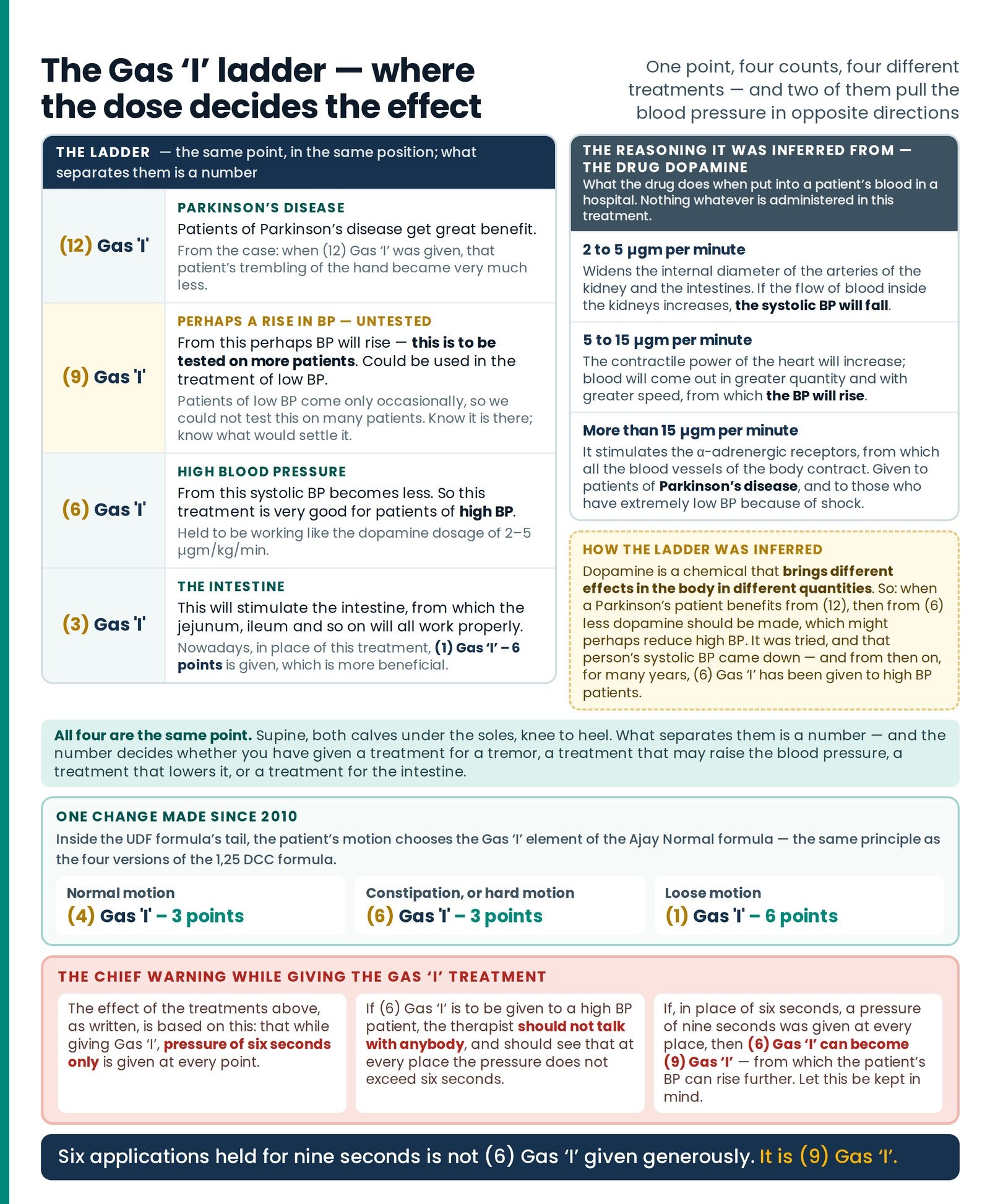
All four are the same point, in the same position, with the patient supine and both calves under the soles, knee to heel. What separates them is a number — and the number decides whether you have given a treatment for a tremor, a treatment that may raise the blood pressure, a treatment that lowers it, or a treatment for the intestine. There is nothing else in the wiki where so much rides on the count alone, which is why what follows is written as a warning rather than as a note. (Figure 28.6)
From The Medulla Family
(12) Gas 'I' works like (20) Medulla
Two points, two families, one errand — dopamine
The last thing this article owes you is a promise made back in the atlas, and it turns out to be the neatest illustration in of what a formula family actually is.
Gas 'I' is not a Medulla. It is a point on the calves, in the digestive group, with a dose ladder of its own — (3), (6), (9), (12) — and the reasoning that built that ladder, beginning with a Parkinson's patient whose tenderness was at Gas 'I' and whose trembling eased when it was given, is taught in full in Correcting the Two Kingdoms, "Correcting the Two Kingdoms". It is not repeated here.
What is taught here is the sentence that joins the two families.
The equivalence, with its context
(12) Gas 'I' is given in Parkinson's disease to produce dopamine. It works like (20) Medulla.
Two points. Two families. Two positions — one supine at the calves, one seated at the nape. One errand: dopamine.
And the reason there can be two is the reason this therapy keeps giving: in our intestines there are enteric neurons, and those neurons make, in smaller quantity, the very same chemicals that are made in larger quantity in the brain. So a chemical the therapy wants can sometimes be asked for at the head and sometimes at the gut, and the two requests are for the same thing.
Table 18 — Two points, one errand Seated Supine
| (20) Medulla | (12) Gas 'I' | |
|---|---|---|
| Family | The Medulla family — this article | The Gas family — The Front of the Body I · Setting the Stomach · Correcting the Two Kingdoms |
| Where | Both sides of the neck below the ears Seated | Down the calves Supine |
| Position | Seated | Supine |
| What it is given for | Parkinson's disease; raised prolactin; fits; pneumonia in children; with (8) Medulla, height | Parkinson's disease — to produce dopamine |
| Held to act on | Dopamine, by way of the substantia nigra | Dopamine, by way of the enteric neurons of the intestine |
| The relation | — | It works like (20) Medulla |
| Its own bar | (see the card above) | Gas 'I' increases small intestinal motility, so it is not given if there are loose motions — and that bar governs the whole Gas 'I' family, not this count alone ▲ Take care |
| Its own warning about the clock | The count is the treatment — Table 2 | Six seconds only at every point. If nine seconds is given at every place, (6) Gas 'I' can become (9) Gas 'I' — the ladder's own warning, Correcting the Two Kingdoms 6 sec |
Why this matters in practice, and not only as a curiosity. A bar on one of the two does not bar the other. A Parkinson's patient with loose motions cannot have (12) Gas 'I'; he can have (20) Medulla. A Parkinson's patient who cannot be seated — too weak, too unsteady — can have the Medulla work lying down, which is expressly allowed, or can have the calf work instead. Knowing that two roads reach one place is what lets a therapist keep treating when one road closes.
Two numbers that look alike on two cards are not a rule
A student who has read Correcting the Two Kingdoms carefully meets a second set of paired numbers there — 8 against 20, and 4 against 10 — in the balance between Ch. Only and the Round arrow, and sooner or later concludes that (8) Medulla and (20) Medulla must balance one another too, or that (4) and (10) are a matched pair.
They are not. Those proportions belong to a different pair of points entirely, with a different logic, and that pair is one of the four inseparable pairs established in How a Formula Is Built — (8) Ch. Only with (20) ↑|↓. The formula they belong to, and the acid-and-alkali balance they strike, are Water and Salt's, whole.
In the Medulla family, (8) and (20) are given together — for height, because dopamine and serotonin both increase the secretion rate of growth hormone. That is a partnership, not a balance, and it has nothing to do with the other pair beyond a coincidence of arithmetic. Two numbers that look alike on two different cards are not a rule.
Also explained in
- Gas 'I' — the jejunum and ileum point The Navel Speaks First
Gas 'I' is the small-bowel point as Gas is the gastro-duodenal one; read the I as intestine and the pair keeps itself straight.
- The gall bladder, the stomach and the intestines Each Point in Use
able 4 — GAL, GAS ONLY and GAS 'I' Point and variant What it is used for When it must not be used Notes Gal — TF 'Gal', (1) Gal, (3) Gal and so on Pain in the right front of the chest.
- Introduction The Front of the Body I
Eleven names and their variants — Pan, Gal, Spl, Liv, Mu, Gas Only, Gas 'I', Liv°, Mu°, Const, Dys, WD — account between them for more time on the mat than everything in Seated I — Brain, Medulla, Neck to 24 together.
- The two gas points The Front of the Body I
as Only on both thighs, Gas 'I' on both calves — six places at least Figure 16.5 The two gas points.
- W D — White Discharge The Front of the Body I
Gas Only is the thigh form and Gas 'I' the calf form, the 'I' for intestine; at least six places each; never interchangeable.
- Questions students ask The Front of the Body I
My senior gives Gas 'I' with the heel and I was taught never to use the heel.
- How to read this article Each Point in Use
Where Gas Only must be given to a constipated patient, Gas 'I' must be given with it — and if the constipation is severe, (2) S4, S5 as well.
- The exclusions that are same-session, not permanent Each Point in Use
Give this And with it, always The reason as given Th + Ch Armpits, without fail Printed as a standing instruction above the entry Gas Only in constipation, piles or fistula Gas 'I' — and (2) S4, S5 too if the constipatio
- The standing rules of every supine treatment The Front of the Body I
For Pan, Liv, Mu, Liv°, Mu°, Gas Only and Gas 'I' — and the same caution applies for WD, Rt.
- Why the map crosses The Front of the Body I
Gas 'I' — the small intestine, coiled around the navel — is given on the calves, further down the same limb.
- The bowel points — MU, CONST, DYS Each Point in Use
6 sec → The Front of the Body I The Front of the Body — I — where all of these points are taught in full → The Body's Own Pharmacy The Body's Own Pharmacy — why every gland draws on what digestion delivers → What the Bowel Tells You What the Bowel Te
- The points of generation Each Point in Use
On gentle inward pressure around the navel he was tender at Pan and at Gas 'I'.
- The low back, the sacrum and the tail bone Each Point in Use
If motions come less, or if the flow in the menses is less, it is also useful for increasing them It is not to be given to those who pass too much urine ▲ Take care The point that is given with Gas 'I' where the constip
- At a glance Each Point in Use
Gas 'I' alongside Gas Only in constipation, piles or fistula — and (2) S4, S5 too if the constipation is severe.