- How it is given
- Seated I — Brain, Medulla, Neck
- What it is used for
- Seated I — Brain, Medulla, Neck · The Stiffening Joint · Cranial Nerve and Brain Formulas
Watch


From Seated I — Brain, Medulla, Neck
The lift and the breath — Raman and Mukha Dhauti
Six held seconds three times — and a breath she takes home
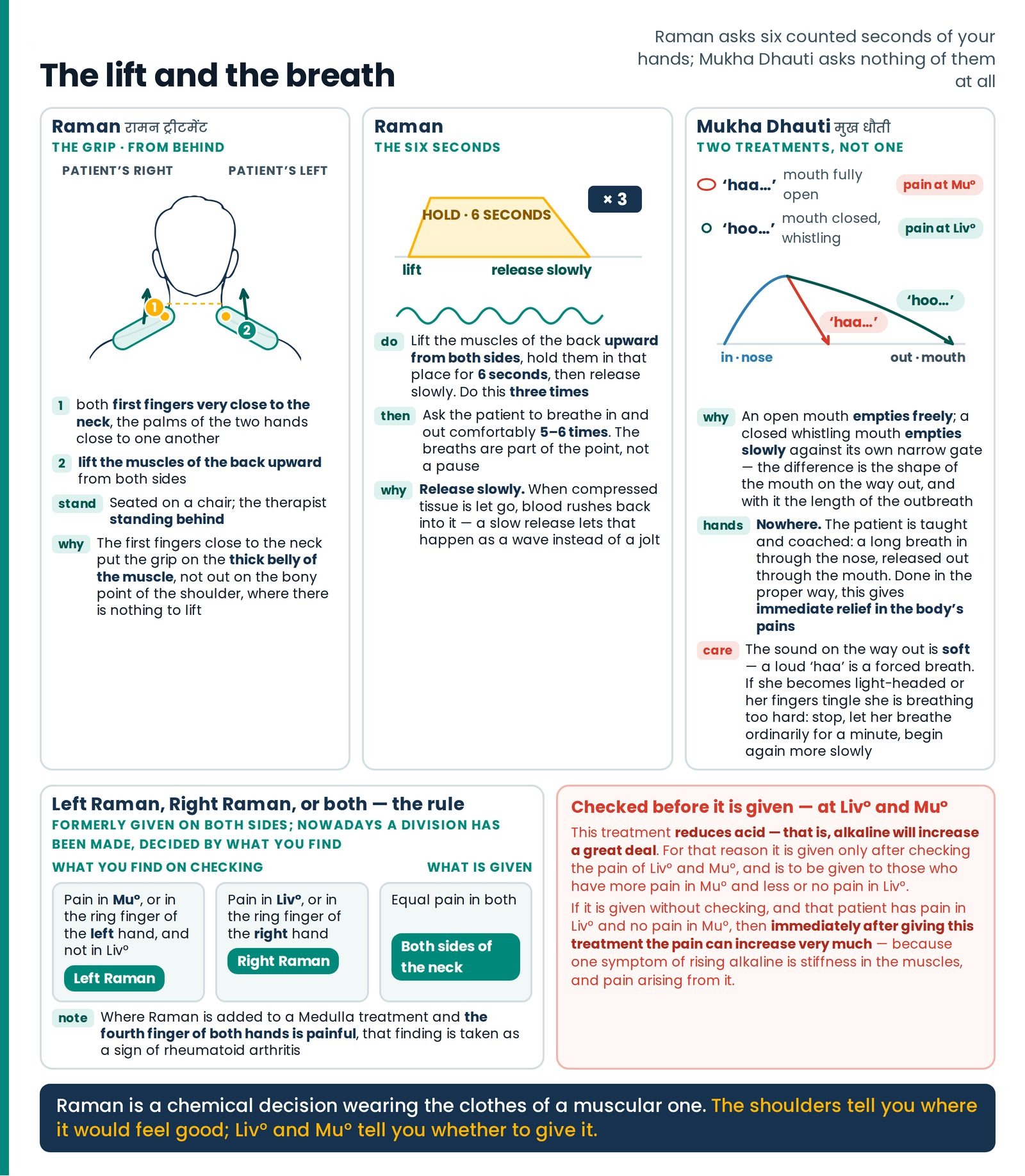
Two treatments follow that are not thumb-points at all. The first lifts a handful of muscle and holds it for a counted six seconds; the second asks nothing of the therapist's hands and everything of the patient's breath. (Figure 18.4)
Place both hands onto the shoulders from behind, in such a way that both first fingers are very close to the neck and the palms of the two hands are close to one another.
Then lift the muscles of the back upward from both sides, and hold them in that place for 6 seconds, then release slowly.
Do this three times.
After this, ask the patient to breathe in and out comfortably 5–6 times.
| Patient's position | Seated on a chair; the therapist standing behind Seated |
|---|---|
| Where the hands are placed | Both hands over the tops of the shoulders from behind, both first fingers very close to the neck, the palms of the two hands close to one another; the muscles of the back lifted upward from both sides Both sides |
| Duration and repetitions | Lift and hold for 6 seconds, then release slowly; three times. Then the patient breathes in and out comfortably 5–6 times 6 sec × 3 |
| What it is for | A treatment in its own right, closed by the 5–6 easy breaths |
What lies beneath. The handful is the great fan of muscle running from the base of the skull out to the point of the shoulder, with a deeper muscle under it that lifts the shoulder blade.
Three things in the instruction do real work. The first fingers close to the neck put the grip on the thick belly of the muscle rather than out on the bony point of the shoulder, where there is nothing to lift. And release slowly matters more than it looks: when compressed tissue is let go, blood rushes back into it, and a slow release lets that happen as a wave instead of a jolt. The breaths are part of the point, not a pause — five or six easy ones after the third lift are what turn a squeeze into a settling.
From The Stiffening Joint
Why Mukha Dhauti is given, and to whom
The left finger that comes back in a few hours, and the dose for it
Now understand to whom, how and why Mukha Dhauti is to be done, because it is not an extra for everybody.
The finding that calls for it
It is to be done because we have found that in RA patients some people feel very good immediately after our treatment, but within a few hours the pain returns in the joints.
Then it has been seen that the pain returns in the ring finger of their left hand — from which we understand that every few hours the acid increases.
One reason for this can be that the haemoglobin of RA patients remains lower than normal. When haemoglobin is low, sufficient oxygen will not reach the tissues.
b. So: Mukha Dhauti is to be done by those who, along with joint pain, have much pain at Mu°, or at the middle joint of the ring finger of the left hand — but not as much pain in the same finger of the right hand.
That last clause is the selection rule and it is a comparison, not a threshold. Left worse than right. A patient with both fingers equally sore is not the patient this is written for; a patient whose right finger is the worse one is emphatically not, and you will see why at the head of the Alkaline Star.
And read the chain of reasoning in the first two paragraphs, because it is a good piece of clinical thinking regardless of what one makes of the chemistry. The relief does not hold. It stops holding after a few hours. The finger that comes back is the same finger every time — the left one. Therefore something is rising again on a cycle of hours, and it is rising on the acid side. A therapist who notices which thing returns, and when, has learned something a therapist who only notices it came back has not.
Table 10 — Card: Mukha Dhauti dosing for RA Seated Left
| Who it is for | Those who, along with joint pain, have much pain at Mu° or at the middle joint of the LEFT ring finger — but not as much pain in the same finger of the right hand |
|---|---|
| Position | Seated on a chair |
| The breath | Normal breath in through the nose; immediately, throw it out forcefully through the mouth |
| Set | Ten times together |
| Rest between sets | One minute — very necessary |
| Rounds | Ten rounds, at most fifteen — that is, 100 to 150 times |
| The heavier opening | Up to 150 times for the first one or two days, morning and evening, if there is very much pain in the left ring finger |
| Monitoring | Go forward while repeatedly checking the pain of the finger |
| Stopping rule | Stop as soon as the pain of the left ring finger goes |
| The reason for the rest and for the stopping rule | If too much acid goes out at once, then for some time the alkali will increase, and the body may perhaps not be able to bear it |
| What it is doing | The carbonic acid trapped inside the joints goes out of the body through the breath, as carbon dioxide — and relief is had from the pains |
| The rest in the table | Table 8, How a Formula Is Built |
Also explained in
- July 2006 — the Star formulas are broken apart and rebuilt The Stiffening Joint
Supine Left Prone Stage II — Mukha Dhauti.
- What this article hands to the next Seated I — Brain, Medulla, Neck
Mukha Dhauti is two treatments, not one.
- The patient for whom no treatment could be given The Stiffening Joint
From the ashram's own morning yoga class, where after the fast-paced exercises a special kriyā called Mukha Dhauti is done — in which one is told to bend forward and throw the breath out forcefully.
- Questions students ask The Stiffening Joint
The Mukha Dhauti you do not do at all; you sit with him and count while he does it, and you stop him when his finger stops hurting.
- What this completes Cranial Nerve and Brain Formulas
Part · Given · What it is for I · Endorphin · For pain — to reduce the sensation of pain II · Ptyalin · For saliva — for the digestive system III · (3) Raman · For the peritoneum — so that all the organs work properly IV
- Introduction Seated I — Brain, Medulla, Neck
Coach Mukha Dhauti in both its forms, and say which form is chosen by which finding.
- Raman — रामन ट्रीटमेंट Seated I — Brain, Medulla, Neck
The work went to the digestive block and to water, with the acid–alkali correction her findings called for, and Mukha Dhauti was taught on the first day in its closed-mouth whistling form, because the pain was at Liv°.
- Subclavian — सब क्लेवियन ट्रीटमेंट Seated I — Brain, Medulla, Neck
→ The Two Kingdoms The Two Kingdoms — Liv-zero and Mu-zero, and what their tenderness means → The Educated Hand The Educated Hand — how the tenderness that decides Raman is elicited → The Navel Speaks First The Navel Speaks First — the
- Introduction The Stiffening Joint
Teach Mukha Dhauti to a patient for the pains of RA — the dose, the rest, the stopping rule, and the reason for each.
- The Alkaline Star Formula The Stiffening Joint
One sheet routing a joint-pain patient from three findings taken in under a minute to the formula that answers them: two equally weighted columns read against each other across four bands, the two exclusions in a red bar
- The two directions, symptom by symptom The Two Kingdoms
But it is not always so: a chief cause of fits and CP in children is an increase of alkali How readily corrected Many diseases and symptoms may appear from it — but they are easy to set right Fewer in number — but they d
- The fourth cause: what long constipation does to the lining What the Bowel Tells You
The points which reduce the symptoms of acidity are Mukha Dhauti · Raman treatment · Round Arrow · Adr · Left Chest Only.
- The master list — every treatment point, by the position the patient is placed in The Shorthand
Code Full name / Hindi Where it is taught in this wiki Medulla Medulla oblongata Seated I — Brain, Medulla, Neck; graded series, The Medulla Family Mesencephalon Midbrain Seated I — Brain, Medulla, Neck Dorsal Dorsal (thoracic) Seated I — Brain, Medulla, Neck Raman (proper name) Seated I — Brain, Medulla, Neck · Cranial Nerve and Brain Formulas Mukha Dhauti मुख
- The rests How a Formula Is Built
Without the interval the CO₂ will not come out fully and the full benefit of the ghisai will not be had Inside a repeated manoeuvre One minute, then two minutes Mukha Dhauti Ten times, then rest one minute, then ten time