Watch


Twelve pairs, and why they are counted separately
Twelve pairs leave the brain itself, and the number is an address
Thirty-one pairs of nerves leave the spinal cord, and you have worked along their territory since Face Down, "Face Down". Before any of them, at the top, twelve pairs leave the brain itself. They do not travel down the cord at all. They come out through small holes in the floor of the skull and go directly to the places they serve — the nose, the eyes, the muscles that move the eyes, the face, the ear, the tongue, the throat, the voice, the shoulder, and one of them the whole length of the belly.
Two things about them must be fixed before anything else.
They are twelve pairs, not twelve nerves. Every cranial nerve is two — one on the right, one on the left. There is a right olfactory nerve and a left one; a right vagus and a left vagus. This sounds like pedantry until the moment a patient's face is paralysed on one side only and you are deciding what to do, and then it is the whole of the matter.
They are numbered, and the numbers are not decorative. They run in order from front to back along the base of the brain, which is why the first is the nerve of smell and the twelfth is the nerve of the tongue. The number is an address.
The discovery
Every cranial nerve answers to the Medulla treatment of its own number
Here is the sentence on which the whole article rests, and it is stated plainly, with its own claim about how unusual it is.
The cranial-nerve discovery
Every cranial nerve can be stimulated by the Medulla treatment of that same number.
(1) Medulla reaches the first cranial nerve, the nerve of smell. (7) Medulla reaches the seventh, the nerve of the face. (10) Medulla reaches the tenth, the great wandering nerve of the chest and belly. The count is the address.
This is a discovery which may seem unbelievable to medical science, and it is offered as a discovery rather than as a deduction — it was arrived at by trying the treatments on many patients and watching what happened, and the reports below are the evidence that was collected. All the work of the brain is done through the cranial nerves. So the question the material then asks is a fair one to ask out loud: can we not say that through the Medulla treatments we can put right many diseases of the brain?
Look back at the nine members of the graded Medulla family in The Medulla Family, "The Medulla Family", and you will see the gaps in it now for what they are. That family runs (2), (4), (6), (8), (10), (12), (15), (20), (30) — nothing at (1), (3), (5), (7), (9), (11). Those six counts were never missing. They are cranial-nerve treatments proper, and they are taught here, in one place, where the nerve they index can be taught with them. The Medulla Family said so explicitly and left them; this article picks them up.
The second discovery — left is not right
Left increases acid and opens; right increases alkali and closes
The first discovery says which count. The second says which side, and it is the rule several earlier articles have pointed forward to.
The polarity rule
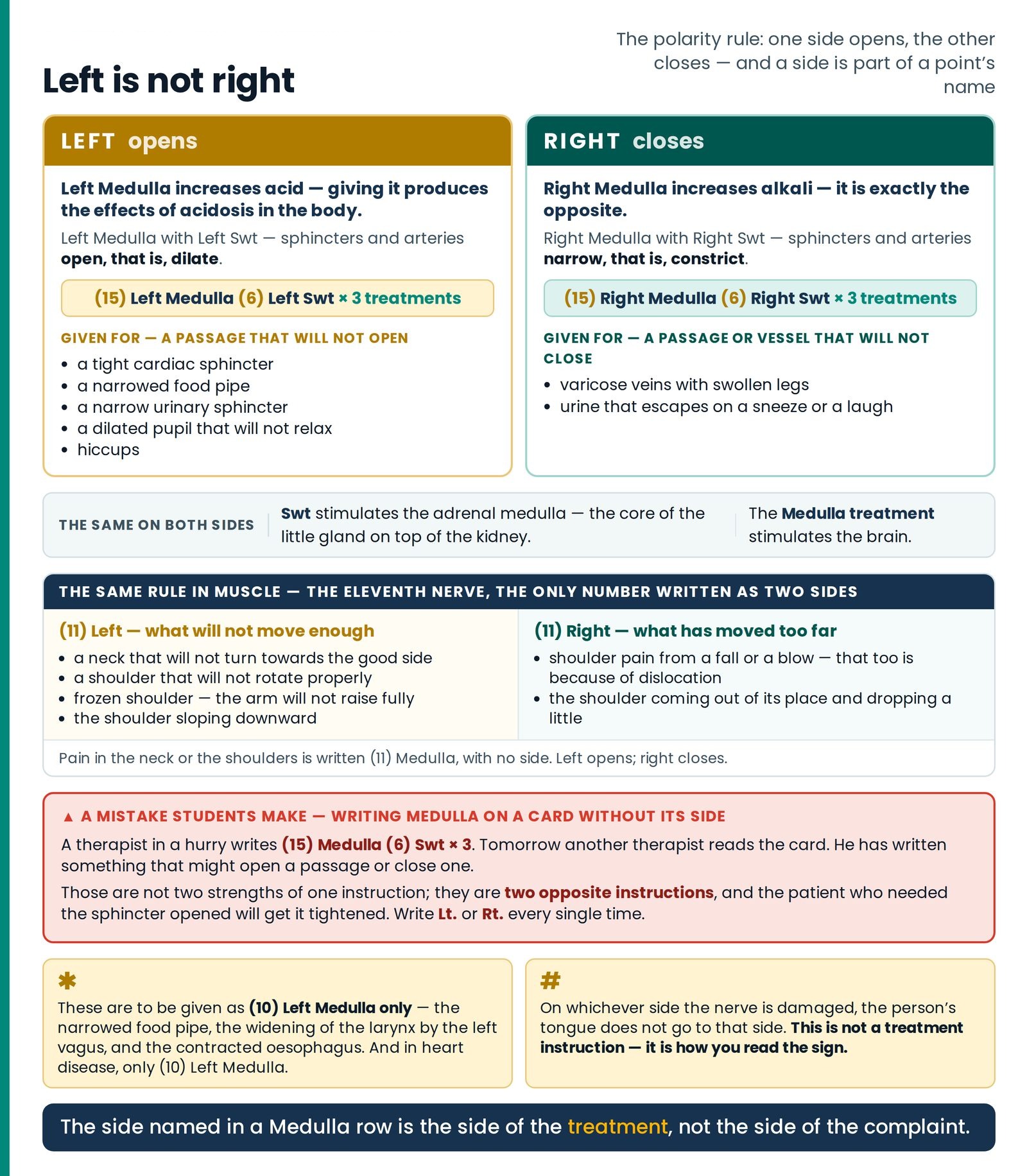
The right and the left Medulla treatments work differently.
Left Medulla increases acid. Giving it produces the effects of acidosis in the body.
Right Medulla increases alkali. It is exactly the opposite.
And joined with Swt, the effect is mechanical and immediately visible:
Left Medulla with Left Swt — sphincters or arteries open, that is, dilate. Left
Right Medulla with Right Swt — sphincters or arteries narrow, that is, constrict. Right
(Swt stimulates the adrenal medulla. The Medulla treatment stimulates the brain.)
Read the parenthesis, because it is doing real work. Two different structures are being addressed by two different points, and they happen to share a word. Swt reaches the adrenal medulla — the core of the little gland that sits on top of the kidney and pours out the chemicals of alarm. The Medulla treatment reaches the brain. One word, two organs; the therapy names both and does not blur them.
Now say what the rule actually gives you, because it is rare and it is valuable. You can choose, deliberately, between opening a narrowed passage and closing a slack one. Not by a different formula. By a different side of the same two points. (Figure 37.1)
What was seen — four patients
A sphincter, two legs and a jetting stream — the rule made visible
These four are the observations the rule was built from. Read them as a set, because together they make the rule visible from both ends.
The cardiac sphincter that would not open. Sri Prakash Verma of Mumbai had a contracted cardiac sphincter — the ring of muscle where the food pipe enters the stomach. He had been operated on some years earlier and even so had not been cured. By the time he met Guruji he had great difficulty swallowing even a very small morsel, so that all the pleasure had gone out of eating. He was given (15) Left Medulla (6) Left Swt × 3 treatments. That same evening he telephoned to say that after many years he had been able to eat properly.
The legs that would not stop swelling. A woman came to the Bandra clinic with swelling in both legs due to varicose veins — vessels whose walls have given up their tone and whose valves no longer hold. Here the requirement is the opposite one: to constrict. She was given (15) Right Medulla (6) Right Swt × 3 treatments, and the swelling in her legs came down immediately.
The stream that struck the wall. At a camp in Madhya Pradesh a sixty-year-old woman said she had a great deal of pain on passing urine. Without any test report at all, Guruji made the estimate that the cause was that the opening of the urinary sphincter was very narrow — and then did the thing that turns a guess into a finding. He asked her a question whose answer only her own body could supply: did the stream come so fast and with such force that the urine struck the wall in front of her? She said yes, that is exactly what happens. A narrow opening makes a fast jet; every gardener with a thumb over a hose knows it. She was given (15) Left Medulla (6) Lt. Swt × 3 treatments. A little while later she passed urine and the trouble had already greatly reduced. After only two days of treatment she obtained complete relief.
That third story is the one to learn from, and not for the formula. The diagnosis was made across the mat, from one question, and then confirmed by the patient's own observation before a hand was laid on her.
The rule that goes before all of them
(15) Medulla first, and every one of them three times
One instruction governs every cranial-nerve treatment in this article without exception.
What is given first, and how often each is repeated
Before all the Medulla treatments of the cranial nerves, it is better to give (15) Medulla.
And all the Medulla treatments of the index tables are to be given three times, at an interval of one and a half minutes — that is, (5) Medulla × 3 treatments, (7) Medulla × 3 treatments, and so on. × 3
The reason for (15) first is taught in full in The Medulla Family, "The Medulla Family", and is not repeated here: (15) Medulla supplies acetyl choline, the transmitter used at the relay station of both automatic nerve systems, so that the message you are about to provoke has something to travel on. Supply the transmitter, then stimulate. The interval of a minute and a half is in Table 8, How a Formula Is Built.
What follows is the article's spine: the twelve nerves in order, each with what it carries, how its trouble shows itself across the mat, and the treatment that indexes it. Read it once through as a story about a head, and afterwards use the index tables in Part three as a working reference. The two are not the same teaching. This part tells you what the nerve is. The tables tell you every complaint that has been assigned to it. (Figure 37.2)
Three of the twelve are singled out before the list begins, and it is worth knowing why.
The three long ones
Cranial nerves number 2, 5 and 10 are very long nerves. By stimulating them with the appropriate Medulla treatment, control can be exercised over many functions of the brain.
That is the reason those three numbers appear more often in the index than all the others together. The second runs back from the eye deep into the brain; the fifth spreads over the whole face and into the lining of the brain itself; the tenth leaves the skull and does not stop until it has reached the intestines. A long nerve passes many doors.
I — The olfactory nerve: smell
A clear nose that smells nothing — and nobody complains of it
What it carries. Smell, and nothing else. It is the shortest of the twelve and the only one that goes straight into the old floor of the brain without a relay.
How the trouble shows. The nose is not blocked, and yet no smell, scent or fragrance can be detected through it. This is called loss of smell — anosmia — and its cause is that cranial nerve number one is not working. Almost nobody complains of it. You have to ask. Ask every patient with a head complaint whether they can smell their own food cooking, and you will find these people at a rate that will surprise you.
Given as. (1) Medulla, three treatments at an interval of a minute and a half. That is the whole of it, and it is what was given in the hall in Delhi. Seated × 3
II — The optic nerve: sight
The retina as a chemical workshop, and the longest reach in the index
What it carries. Sight. And, in this therapy's reading, a great deal more, because it is one of the three long ones and because the retina at its far end is not a passive film but a sheet of working nerve cells.
How the trouble shows. Seeing little; not seeing at all; whiteness over the covering of the eye; double vision of certain kinds; the balance going wrong; a child who cannot hold posture; the flat face and the slow start of Parkinson's disease.
Given as. (2) Medulla. Its uses reach further than any other number in the index, and the reason given is precise: this treatment is inferred to act like the second cranial nerve and to stimulate the neurons of the retina, which make GABA, acetylcholine, dopamine and other neurotransmitters. The retina, in other words, is being used as a chemical workshop as well as a camera.
Four observations belong to it, each from a different place:
Sri Rohinton of Bandra had the covering of his eyes — the sclera — entirely white, and could not see at all. He had been taking treatment for some years. Along with the other treatments to set the abdomen, he was given (2) Medulla × 12 treatments + Brodmann's area 17 & 18 ghisai. After some months the whiteness of his eyes had reduced and he began to see slightly — a little hazily. His treatment is still going on. That last sentence stands as it is written. It is not a cure and it is not offered as one.
(2) Medulla × 6 treatments has been seen to be of great benefit to children who have illnesses arising from disorders of the cerebellum, and has brought considerable relief to Parkinson's patients. At centres across the country the effect has been seen to be the same in many patients.
(2) Medulla × 6 treatments is also good for patients of rheumatoid arthritis.
At the Aurobindo Ashram at Pondicherry, (2) Medulla × 6 treatments was given to a child with CP — cerebral palsy — and within a few days he began to get up and sit.
And one formula of three parts, for a named disease of the retina:
Retinitis pigmentosa
I — (2) Medulla × 12 · II — (3) Necklace · III — Formula Number Four
For retinitis pigmentosa the above treatment is very good.
Retinitis pigmentosa is a slow, inherited decay of the light-sensitive cells at the back of the eye; it takes the side vision first and narrows what is left. Necklace is taught in Seated I — Brain, Medulla, Neck, "Seated — I"; Formula Number Four in Setting the Stomach, "Setting the Stomach".
One more, because it is the sort of thing a therapist must be ready to be asked about. After giving (2) Medulla × 12 treatments to a patient at the Bandra clinic, the pain of Pan and the whole 45° pain in the chest above the nipples went away after a single treatment. (This pain is often found in problems of the mitral valve of the heart.) Nobody had set out to treat a chest. It is recorded because it happened.
III — The oculomotor nerve: most of the eye's movement, and the lens
Four eye muscles, the upper lid, the lens and the pupil
What it carries. Four of the six muscles that move the eyeball, the muscle that lifts the upper lid, and the small muscles inside the eye that adjust the lens and narrow the pupil.
How the trouble shows. The eyelid hangs down — ptosis. The eyes will not stay open, or will not stay shut. The pupil turns outward, which is one of the ways a squint appears. The pupil is dilated and there is double vision. The lens will not adjust from far to near. A patient with MS — multiple sclerosis — at the Bandra clinic was seeing double; he was given (3) Medulla × 3 treatments, and after some days of treatment he began to see clearly — that is, the double vision stopped.
Given as. (3) Medulla.
IV — The trochlear nerve: one muscle, downward and outward
One muscle, and the movement you use going down a staircase
What it carries. One single muscle, the superior oblique, which pulls the eye down and outward — the movement you use going down a staircase.
How the trouble shows. The eye sits down and outward and there is double vision because of it. The material also records that in Chennai one patient was found to benefit for fits and cramps from (4) Medulla, and gives (4) Medulla for the mid brain.
Given as. (4) Medulla.
V — The trigeminal nerve: the whole face, and the first half of a swallow
Every sensation of the face, the chewing muscles, and the coughs
What it carries. More than any other nerve in the head. Every sensation of the face — forehead, eyelid, eyebrow, temple, cheek, nose, lip, gum, tooth, jaw, the front two-thirds of the tongue, the scalp, and the lining of the brain itself. And the muscles of chewing. It is the second of the three long ones.
How the trouble shows. Pain on the face, or no sensation on it. Migraine. Trigeminal neuralgia — the lightning pain that goes through one side of a face. Toothache of every kind. Sinus trouble. Dry, lifeless hair. A jaw that will not chew, or turns to one side. And almost every kind of cough, for which it is the chief treatment in the whole index.
Given as. (5) Medulla. It appears in the tables more often than any other number.
Two of its duties belong to the swallow, and they are worth stating here because they divide the act between the nerves:
The fifth nerve and the ninth, in one mouthful
The work of cranial nerve number five is to carry the bolus — the mouthful — from the front backwards; whereas the work of closing the epiglottis belongs to cranial nerve number nine.
Two nerves, two halves of one second. The fifth pushes the food to the back of the throat. The ninth shuts the lid over the windpipe so that it goes down the right tube.
VI — The abducens nerve: outward
One muscle, the pons — and infertility from a low body temperature
What it carries. One muscle, the lateral rectus, which turns the eye outward.
How the trouble shows. The eye will not turn outward. The pupil sits crooked up and outward and there is double vision from it. And the nerve is the one that names the pons, the swelling of brain stem it comes from.
Given as. (6) Medulla. This is the number The River — Heparin, "The River", flagged forward to this article, and here is its whole territory: the lateral rectus and the inferior oblique, the pons, the double vision that comes from an eye sitting up and out — and one further use, recorded among the closing observations:
(6) Medulla in infertility
If infertility in women is due to the temperature of the body being low, then benefit has been seen from giving (6) Medulla + Raman treatment. Their menses used to come scantily.
Two findings named, not one: a low body temperature and scanty menses. Neither alone selects this treatment.
And the honest note attached to this number and to the tenth, which is not to be smoothed away:
VII — The facial nerve: expression, tears, and taste from the front
Everything the face does, and the whistle that cannot be faked
What it carries. The muscles of expression — every muscle that makes a face a face. The tear glands. The sublingual and submaxillary salivary glands under the tongue and the jaw. The taste of the front two-thirds of the tongue. And one tiny muscle in the middle ear.
How the trouble shows. Paralysis of one side of the face. The mouth pulling to the good side, which is how Bell's palsy looks. The eyelid that will not close. No wrinkles appearing on the forehead when the patient is asked to look surprised. The inability to whistle — a test worth remembering because it takes one second and cannot be faked. Tears failing, or tears flowing and never stopping. And the flat, expressionless face of Parkinson's disease.
Given as. (7) Medulla.
Taste is a two-way street, and both ways are treated
The number five nerve carries the message of taste from the brain to the tongue, whereas the number seven nerve carries the message from the tongue to the brain. So for problems relating to taste we must stimulate both (5) Medulla and (7) Medulla.
Learn that as the model for a whole class of decisions in this article. Where a function needs two nerves, the treatment needs two numbers. Giving one of them and calling the treatment complete is the commonest error in this part of the formulary.
VIII — The vestibulocochlear nerve: hearing and balance
Two things in one bundle, and the road to the temporal lobe
What it carries. Two things in one bundle: hearing, from the spiral organ in the inner ear; and balance, from the three little loops of fluid beside it.
How the trouble shows. Deafness. Bells ringing in the ears. Vertigo — giddiness, because of a disturbance of the semicircular canals inside the ear — with the nausea and vomiting that come with it. A patient who cannot stand with the eyes shut.
Given as. (8) Medulla, which the index also gives for all problems of the ear, without qualification — and for a set of things deeper in the brain that sit along the same nerve's road: the temporal lobe, the cerebellum, the red nucleus, the formation of serotonin, and the RAS, the arousal system, when its disturbance has put a person into coma.
IX — The glossopharyngeal nerve: the throat, taste from the back, and the blood pressure
The throat, the epiglottis, and the sensors that watch the blood
What it carries. The muscles and the lining of the pharynx — the throat behind the mouth. The closing of the epiglottis. Taste from the back third of the tongue. The tonsils. The parotid salivary glands in front of the ears. The middle ear and the Eustachian tube. And two things nobody expects of a throat nerve: the sensors that watch the blood pressure in the carotid arteries, and the sensors that watch the oxygen in the blood.
How the trouble shows. Difficulty swallowing. A dry mouth at mealtimes. Loss of taste at the back of the tongue. Hiccups. Trouble with blood pressure. Breathlessness where oxygen is short.
Given as. (9) Medulla.
Two recorded observations:
In the ashram, Shri Pankit Shah ji got hiccups at the time of the evening meal on 1st December 2006. After giving (9) Medulla, he obtained relief from the hiccups at once, without drinking any water. Since then it has been tried successfully on many students.
A patient in Chennai was given (5) Medulla + (9) Medulla × 3 treatments + Katka — and he obtained great relief immediately in the irritation, the soreness of the throat. There was difficulty in swallowing and dryness inside the mouth; that too was put right.
X — The vagus nerve: the wanderer
From the voice to the intestines, with two rules that never come off
What it carries. Its name means the wanderer, and it earns it. The larynx and the voice. The trachea and bronchi. The heart's rate. And then it leaves the chest and supplies every part of the digestive system except the descending colon, and reaches as far as the upper part of the ureter. It is the third and longest of the three long ones.
How the trouble shows. A heavy voice; hoarseness; a voice with no sweetness in it. A food pipe that has contracted. Difficulty speaking. Bronchitis in which the breathing out is the difficult half. A fast heart.
Given as. (10) Medulla — with two rules attached that never come off it.
XI — The accessory nerve: the neck and the shoulder
Two large muscles, no sensation, and left and right in separate rows
What it carries. Two large muscles and no sensation at all: the sternocleidomastoid, the strap that runs from behind the ear to the collarbone and turns the head; and the trapezius, the great diamond that shrugs and steadies the shoulder blade. It also shares the pharynx and larynx with the tenth.
How the trouble shows. The neck will not turn. The shoulder will not rotate, or will not raise the arm fully — frozen shoulder. The shoulder slopes downward on one side. A shoulder that has dropped a little out of place after a fall. And, at the far end of breathlessness, the strap muscles being pressed into service as accessory muscles of respiration — which is what you are looking at when a very breathless patient's neck stands out in cords.
Given as. (11) Medulla — and this is the one number in the whole index where left and right are written into separate rows for the same region, which is the polarity rule appearing not as chemistry but as mechanics. The seven rows are set out in Part three and they repay reading twice: what will not move enough is (11) Left; what has moved too far is (11) Right.
XII — The hypoglossal nerve: the tongue
The muscles of the tongue, and how to read the side it goes to
What it carries. The muscles of the tongue, and nothing else. The twelfth cranial nerve is responsible for voluntary tongue movements.
How the trouble shows. The tongue repeatedly going to one side — and there is a rule for reading which side: on whichever side the nerve is damaged, the person's tongue does not go to that side, or cannot be turned that way. A voice that has gone. A heavy voice — thick speech. Difficulty in the last stage of swallowing.
Given as. (12) Medulla — which the index also gives for fits which come during sleep, or shortly after waking from sleep, for stimulating the hippocampus, and, with (2), for the basal ganglia.