- Category
- Digestion, stomach and bowel
- What is given
- Triangle, Round Normal, Round Arrow; ATF; (1)/(2) Acid
- What must come first
- If UDF is to be given, after Gas Only give Gas 'I'
- What is barred
- (10) Medulla · Gas Only · Dys. Triangle for piles not to those who pass little urine. Bleeding from the back passage is never assumed to be piles, at any age
- Explained in
- What the Bowel Tells You
Watch


Piles, fissure, fistula and prolapse — one family, not four diseases
Loose flesh-muscles, the Triangle for Piles, and bleeding to refer
The four are one family
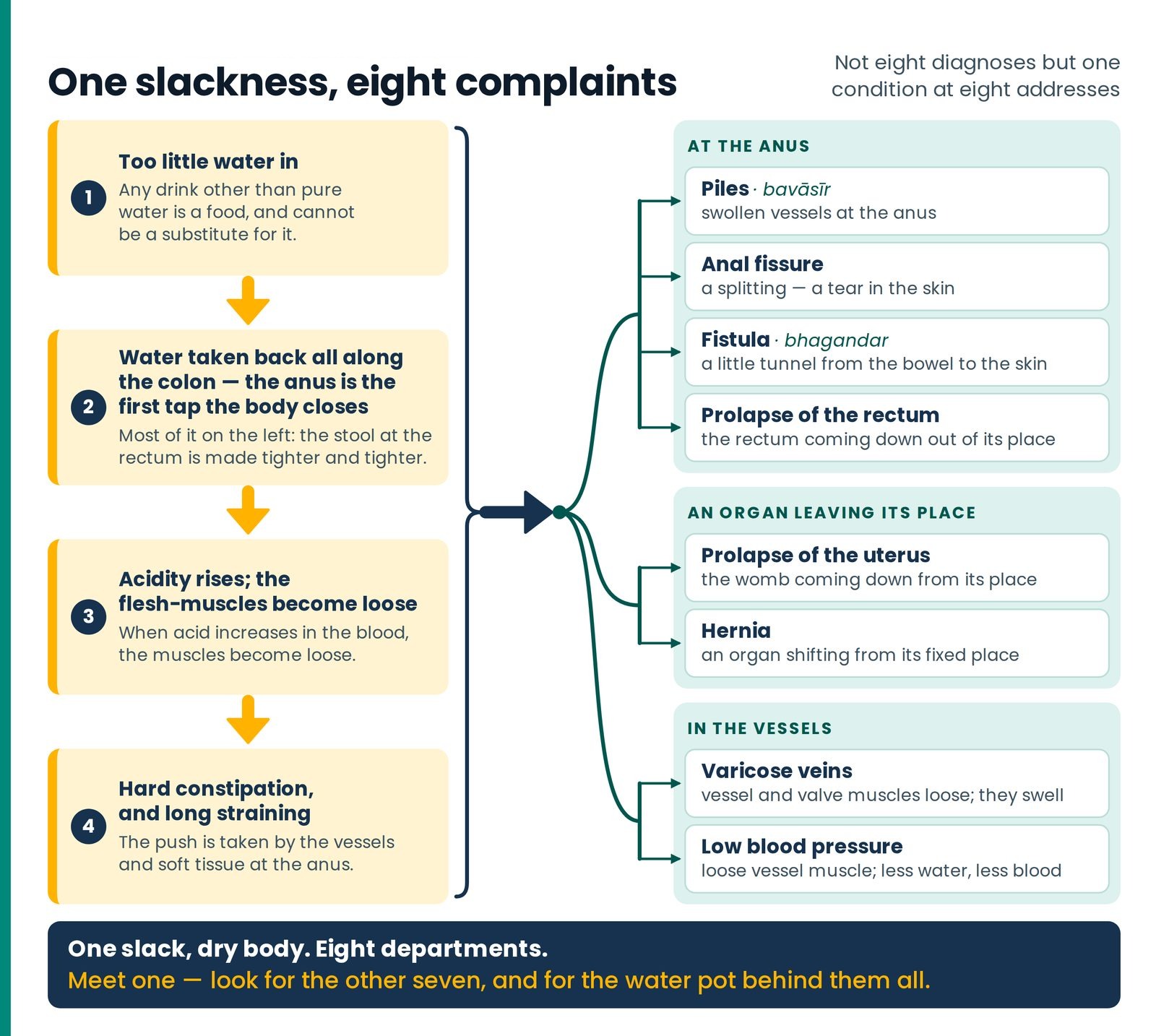
Piles, anal fissure, fistula and prolapse of the rectum are all four diseases of acid, and one chief cause of them is hard constipation.
They appear together on the acidic side of the chart under one heading — hard constipation and the diseases connected with it — in the same list as blocked nose, dry cough, burning yellow urine, dry itchy eyes, pimples, dandruff, hair falling or greying early, dry skin, warts and psoriasis. One chief aspect of acidity is deficiency of water in the body, and these are the symptoms that appear on the organs that get rid of things.
So when a patient shows you one member of this family, do not treat the member. Look for the constipation standing behind it, and for the water pot standing behind that.
Three conditions carry pain at Mu° with them: prolapse of the rectum — the rectum coming down from its place; prolapse of the uterus — the womb coming down from its place; and hernia — an organ shifting from its fixed place and entering inside some other organ or part.
The family is larger than the anus
These are three different diseases. But there is one thing common among all three: they all occur because the flesh-muscles have become loose.
And two more, in the blood vessels, which have also come only because the flesh-muscles became loose — one chief cause of that being acidity:
Varicose veins, the blue veins. Varicose means to swell up. Because the muscles of the vessels and of their valves become loose, a fault comes into them and they swell easily.
Low blood pressure. When the muscle of the vessels becomes loose the pressure will be less; and because of the deficiency of water the volume of the blood will be less. From both these causes together the blood pressure goes down.
Now read your patient again. Piles, a hernia repaired at forty, blue veins on both calves, a pressure always called "on the low side", a bowel that opens every third day with force — not five diagnoses, but one slack, dry body described five times by five departments. (Figure 10.2)
The treatment named for this family is the Triangle for Piles — so named because it is given for piles, and given across the triangle of the sacrum. It strengthens the muscles of the pelvis, and tightens the sphincters — of the urinary bladder, of the uterus, of the anal opening and so on.
Therefore, besides piles, it gives benefit in: anal fissure · fistula · prolapse of the rectum. It is also beneficial for control of urine in children and in the elderly — give it to children who wet the bed — and in women for prolapse of the uterus and for controlling excessive bleeding in the menses.
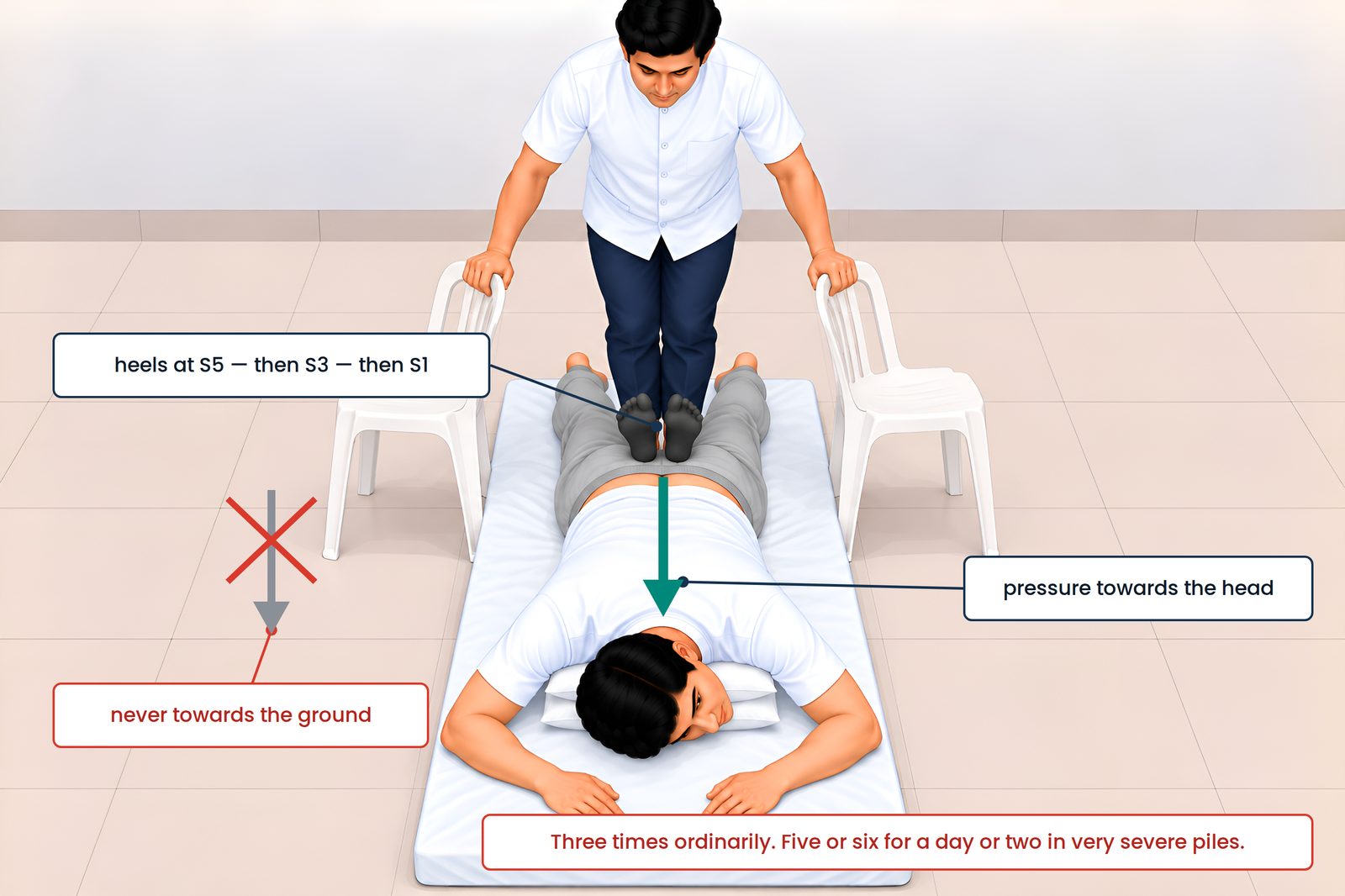
Two details of its giving are the instruction itself and must never be dropped: the pressure is in the direction of the head, and never in the direction of the ground — the chairs are placed so that this is what happens — and for an ordinary person three times is enough, but for very severe piles one may give five or six times for a day or two at first. Prone (Figure 10.3)
What is given, and what it strengthens
▲ Take care Do not give it to those who pass little urine.
Its neighbour on the same sacrum, S4–S5, is the exact opposite of the Triangle treatment: the heels draw and press the muscles inward and downward instead of jerking them upward, and it is given ordinarily twice — for obstructed urine, for high blood pressure, and to increase a scanty flow in the menses. Two treatments, one square of bone, opposite directions, opposite indications. The direction is not a detail of technique. It is the treatment. Both are taught in Face Down, "Face Down".
From Face Down
TRIANGLE FOR PILES — ट्रायंगल फॉर पाईल्स
This is given for piles (बवासीर). That is why it has been given this name.
Method:
As per the figure, stand with the feet on the ground between the waist and the thigh. First place the heel of one foot on their hip near the tail bone — that is, the last end of the spinal column.
Then, taking the full weight of the body on the hands with the support of the chairs, place both heels above the hip, near the S5 bead (at the place marked 1 in the figure).
Simultaneously pressing with the heels in the direction of the head, with one jerk push the muscles below upward.
Then change the position of your heels, placing them slightly outward, near the S3 bead, and give an upward jerk.
Finally, do the same near the S1 bead.
Repeat as many times as needed.
In the symbol above, the numbers '1', '2', '3' on the sides of the triangle show where to start and where to finish; but the number '3' written in the middle of the upper line shows how many times to repeat.
For an ordinary person three times is enough, but for very severe piles one may give 5–6 times for a day or two at first — then the middle number will change to 5 or 6.
Besides piles, it also gives benefit in anal fissure, fistula and prolapse of the rectum. It is also beneficial for control of urine in children and in the elderly, and in women for prolapse of the uterus and for controlling excessive bleeding in menstruation.
| Patient's position | Prone, 1½ pillows; the therapist standing with the feet on the ground between the waist and the thigh, the full weight of the body on the hands with the support of the chairs Prone |
|---|---|
| Where the feet are placed | First the heel of one foot near the tail bone — the last end of the spine. Then both heels above the hip, near the S5 bead (place 1); slightly outward, near S3 (place 2); near S1 (place 3) |
| Duration and repetitions | At each place, pressing with the heels in the direction of the head, with one jerk push the muscles below upward. Three times is enough for an ordinary person; for very severe piles, 5–6 times for a day or two — the middle number then changes to 5 or 6. Repeat as many times as needed |
| Direction | Place the chairs so that the pressure is in the direction of the head, and not in the direction of the ground ▲ Take care |
| What it is for | Piles (बवासीर); anal fissure, fistula, prolapse of the rectum; control of urine in children and the elderly; in women, prolapse of the uterus and excessive bleeding in menstruation |
The three stations trace the shape of the bone — a triangle standing on its point: place 1 low and close to the midline at S5, place 2 further out at S3, place 3 highest and widest at S1. The first placement, one heel near the tail bone, is a settling, not a treatment. Then every station is one jerk, upward — a single quick lift of the tissue toward the head, both heels together, after which the heels are moved. You do not jerk twice from the same place. (Figure 21.6)
Reading the triangle symbol — numbers on the sides, and the number in the middle
The glyph is an inverted triangle with numbers on it, and they mean two different things depending on where they sit.
'1', '2', '3' on the sides show where to start and where to finish — the three heel stations, in order.
'3' in the middle of the upper line shows how many times to repeat.
So the middle number is a dose, and it changes: three times is enough for an ordinary person, but in very severe piles one may give 5–6 times for a day or two — and then the middle number will change to 5 or 6 on the card. The side numbers never change, because there are always three stations. The raised dose is written for a day or two, not for a course.
What lies beneath. The heel sits on the back plate of the sacrum, over the origin of the great buttock muscle and the flat tendon of the long back muscles; the small holes through which the sacral nerves reach the buttock lie in rows under the stations. The nerves running to bladder and back passage come off the same levels but turn forward, where no heel follows. The upward vector is coherent — but coherent is not demonstrated, and both words should be used. And one fact, because patients ask: the cushions inside the back passage are normal anatomy, and piles are what happens when the tissue anchoring them gives way.
Fistula · anal fissure · descent of the rectum · piles
Blocked: (10) Medulla · Gas Only · Dys ▲ Take care
| Blocked | The reason as it is given | Given instead |
|---|---|---|
| Gas Only, (10) Medulla | All four of these are diseases of acid, and one chief cause of them is hard constipation. From these two points the acid of the stomach will increase three times, and the trouble will increase | Triangle, Round Normal, Round Arrow and so on |
| Dys | Carried from the constipation reasoning — the Dys point stops the movement of the intestine | — |
And again: if UDF treatment is to be given, then after Gas Only give Gas 'I'; otherwise constipation will increase.
One further bar rides on the substitution itself, and must be written on the card with it. Triangle for piles is what these patients are sent to — and Triangle for piles is not given to those who pass little urine, because it tightens the sphincters of the bladder, the uterus and the anal opening.
Also explained in
- Two bodies, read as this article teaches What the Bowel Tells You
tailor operated twice for piles, and a boy who had stopped going A CASE FROM PRACTICE The tailor who had been operated twice A composite case, assembled to teach the reasoning rather than taken from one patient's file.
- At a glance What the Bowel Tells You
he Triangle for Piles, and the bowel interview on one sheet WHAT TO CARRY AWAY Constipation is not a disease; it is a symptom, indicating improper functioning of the digestive tract, and the large intestine shows its fa
- Introduction What the Bowel Tells You
She was forty-four, she made blouses to order, and she had been operated on twice for piles.
- Reading the stool What the Bowel Tells You
On the hard end: constipation, piles, fissure at the anus, fistula, pimples, dandruff and scaling, hair falling or greying before its time, prolapse of the uterus or of the rectum.
- Questions patients ask you What the Bowel Tells You
"It's piles.
- Straining, posture, and the act of passing stool What the Bowel Tells You
The pressure of a long forced push is taken by the vessels and the soft tissue at the anus — the mechanical half of how piles arise, how a tear becomes a fissure, and how the rectum is pushed down out of its place.
- The questions to ask, and how to ask them What the Bowel Tells You
Alternating hard and soft indicates improper dietary habits — the hard motions from too little roughage or water, the soft ones indicating undigested food from poor digestion "Does it come out easily, or do you have to p
- Recording it, so that improvement can be shown What the Bowel Tells You
Const is tender whenever there is constipation — so a silent Const in a patient claiming constipation is itself a finding, and sends you back to look at the outlet The family · Ask once, write once: piles · fissure · fis
- The cord Treating Women
The family is one of the chief signs of acidosis in this therapy's reading, sitting in the same column as constipation, piles, fistula and fissure, and beside the row that says the muscles become soft and loose in acidos
- What this article hands to the next Face Down
Plate — Triangle for piles: the chairs, the stations and the direction · PLATE — AND THE PROMPT TO REDRAW IT Caption: The patient lies face down with the 1½ pillows under the chest — half the lower pillow projecting
- The low back, the sacrum and the tail bone Each Point in Use
Triangle for piles Prone This strengthens the muscles of the pelvis, and tightens the sphincters of the urinary bladder, of the uterus, of the anal opening and so on.
- The last observations Cranial Nerve and Brain Formulas
(15) Right Medulla (6) Right Swt × 3 treatments + Piles triangle For · No control over urine — leaking with a sneeze or with hard laughter; especially middle-aged women, because by that age the muscles below the navel ha
- Lighter formulas exist, and they are named The Child, the Elder and the Frail
Chest only within the first few sneezes; Triangle for piles for control of urine (4) Pan to increase appetite and height Jeevan Dhara, light version, for fatigue or weakness at any age; single points for instant relief J
- The master list — every treatment point, by the position the patient is placed in The Shorthand
Parkhoo Left Parkhoo On the Side Folic Folic acid On the Side · Vitamin and Gene Formulas Thia Thiamine (B₁) On the Side B₁₂ Cobalamin On the Side · Vitamin and Gene Formulas Nia Niacin (B₃) On the Side Right and left Vitamin formation Vitamin formation, both sides On the Side Fluid or alkali Flui