That is the whole article in one sentence, and it will take thirty pages to earn. Two directions, two named formulas, and a body that can be pushed past the middle by the very treatment that was correct for it yesterday. The Two Kingdoms taught you to read which direction a patient is in. This article teaches you what to do about it, and — harder — when to stop doing it.
The notation is closed. Every bracket, ring, quoted letter, underline, plus sign, glyph and Roman numeral in this article was taught once, completely, in Table 13 of How a Formula Is Built, "How a Formula Is Built". Nothing is explained again here. Every written rest — the ninety seconds between two treatments of the Acid formula, the ninety seconds between the rounds of the Alkali formula — is in Table 8 of the same article, with the reason given for it.
Watch


The two kingdoms, and the two families of treatment
Mu° sends you left, Liv° sends you right — and each has its own family
A short recall, and then we go to work.
The patient's condition today is read from the pain points around the navel, and three of them carry this article: Gas, Liv° and Mu°. Diseases that come from a deficiency of water in the body or the blood are the diseases of acidosis, and in most such people pain is found at Mu°. Diseases that come from an increase of water in the blood or in some part of the body are the diseases of alkalosis, and in most such people pain is found at Liv°. Many diseases belong to neither family and come from the disorder of one organ or one system, for which other methods of treatment have been adopted. Acidosis produces many symptoms, and they are easy to set right; alkalosis produces fewer, and they do not get right easily — to correct them takes considerable effort and time.
Up to about thirty or thirty-five years of age, most people have pain at Mu° and get the diseases of acidosis; with increasing age the diseases of alkali begin to come. But remember that it will not always be so: a chief cause of fits and CP in children is an increase of alkali. The complete two-column picture — the stool, the nose, the cough, the menses, the headache, the muscle, the thyroid, the side of the body that hurts, and the sixteen other rows that go with them — is taught in full in The Two Kingdoms, "The Two Kingdoms", and is not repeated here.
Two further findings from that examination decide a great deal of what follows, and they are worth stating separately because students run them together.
What pain at Gas is telling you, and why it is not the same finding as pain at Mu°
When there is pain in the Gas point, it tells us that the circulation of blood in the stomach is reduced, because of which hydrochloric acid cannot be made properly and there will be indigestion. Such people feel little hunger.
Some people have pain in Mu° but not in the Gas point. Some people can have pain in both Gas and Mu°.
Record them as two findings, not one. Mu° sends you towards the acid family. Gas sends you towards the stomach and, as you will see when ALTF is reached, it is the finding that can make a patient's alkali look raised when it is not.
And the chemistry the therapy attaches to it, in one paragraph, because the names will recur. The acidity of the blood is not the acid of the stomach. The stomach's acid is hydrochloric acid, and it occurs only in the stomach, never in the blood. In the blood several acids are dissolved which maintain its acidity — amino acids, uric acid, lactic acid, folic acid, carbonic acid, and in the disease of diabetes the keto acids, which are a chief cause of acidosis in a diabetic patient. To balance all of these it is necessary that bicarbonate ions should come out from the kidneys at the right time and in the right quantity. Each of those acids is tied to an organ — the stomach's blood supply behind the amino acids, the liver behind uric acid and therefore behind a great many joint pains, the respiratory system behind lactic and carbonic acid — and the whole table is set out in The Two Kingdoms.
Now the part of the chart that belongs to the formulary rather than to diagnosis: its last row. Once the direction is known, a matched family of treatment is waiting for it, and the two families are mirror images — left-sided work for one, right-sided work for the other.
Table 1 — The two matched families of treatment
| To reduce acidosis Left | To reduce alkalosis Right | ||
|---|---|---|---|
| The named formula | ATF — Acid treatment formula — this article | ALTF — Alkali treatment formula — this article | |
| What must come first | Nothing, except the examination | The UDF treatment — Clearing the Ash, "Clearing the Ash" | |
| The Raman treatment | Left Raman — Seated I — Brain, Medulla, Neck | Right Raman — Seated I — Brain, Medulla, Neck | |
| The chest | Left Chest only — The Front of the Body II | Right Chest only — The Front of the Body II | |
| The spine | Round arrow ↑\ | ↓ — Face Down | — |
| The adrenal | Adr — Face Down | — | |
| The sacrum | — | (½) Ku – 40 secs / 60 secs / 80 secs — Face Down | |
| Vitamin formation | Left Vitamin formation — On the Side | Right Vitamin formation — On the Side | |
| Also | — | In some people alkali is also reduced by Th + Ch, thymus with chest — The Front of the Body II | |
| The governing bar | If there is no pain in Mu°⁺⁺⁺, then ATF is not to be given ▲ Take care | Even when there is pain in Liv°, do not give ALTF first. First give the UDF formula ▲ Take care |
Look at the column headings before you look at the entries. Every acid-reducing treatment in that list is left; every alkali-reducing treatment is right. That is not a mnemonic somebody invented afterwards; it follows from the observation on which the whole system rests — the left kidney filters most of the acid, that is, reduces the acidity of the blood, and the right kidney reduces most of the symptoms of increased alkali. Provoke the left kidney by way of Mu° and the symptoms of acidosis ease; provoke the right by way of Liv° and the diseases of alkalosis ease. Side, in this article more than any other, is part of the identity of a point and never a detail of technique. (Figure 28.1)
Acidosis and alkalosis are the two root causes from which other diseases are formed. That is why two separate treatments were made for them, and why setting one or the other right can set many symptoms right at one and the same time. It is also why the two bars in the last row of that table exist. A formula powerful enough to correct a root cause is powerful enough to carry a body past the middle, and the woman at Chandigarh is the proof of it.
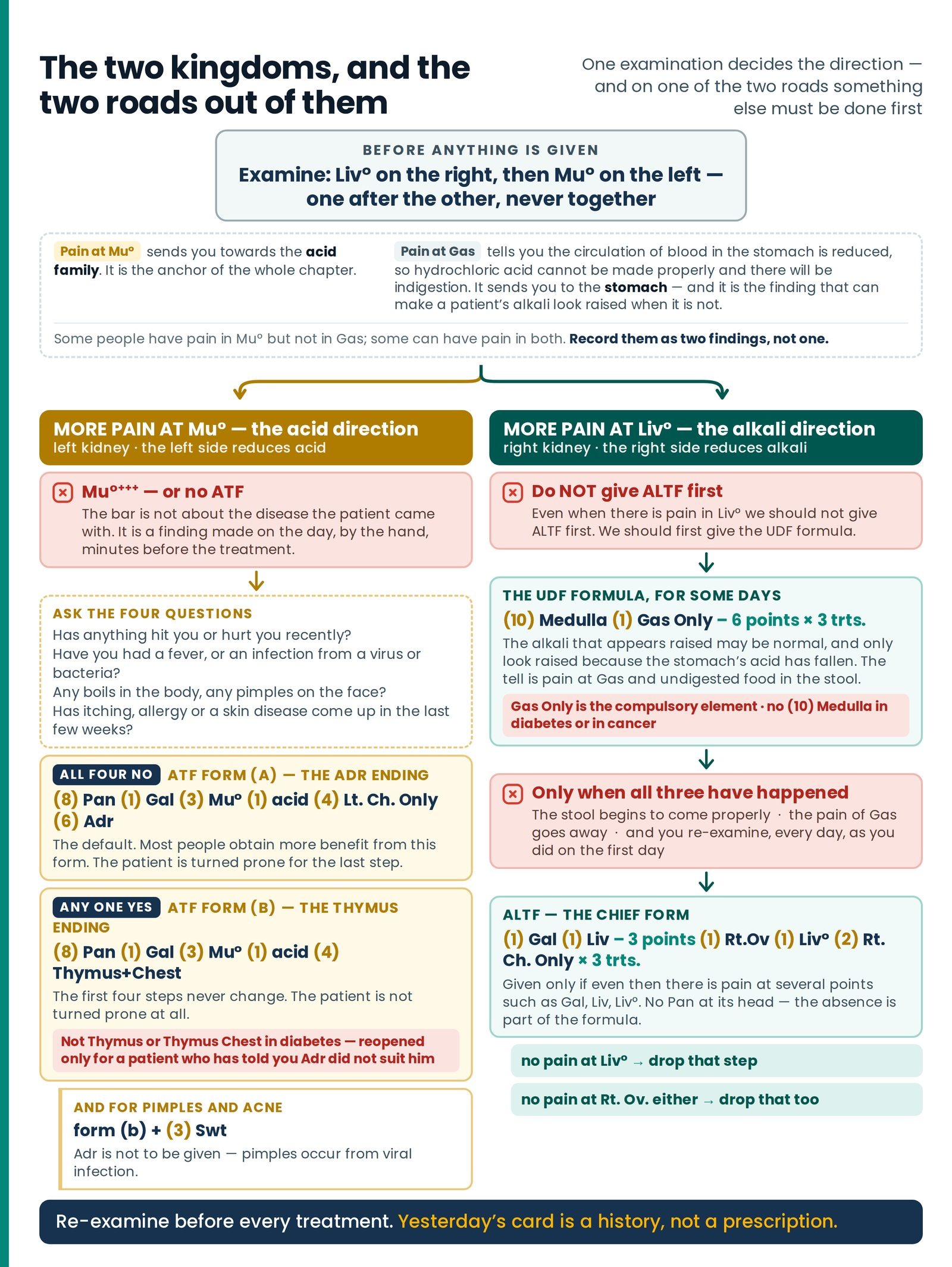
The Acid Treatment Formula — when it is given at all
No pain at Mu°, no ATF — and the finding is made on the day, by the hand
The increase of acid in the blood is called acidosis, and it is the root cause of many different symptoms and diseases. ATF is the chief treatment for setting them right. Before a single count of it is given, the gate.
In such people there is more pain in the ring finger of the left hand than in the right; there is often pain in the organs of the left side of the body and not in the organs of the right; and some of them also have pain in the acid point. Those three are confirmations, not substitutes — the anchor is Mu°.
What follows is the picture ATF was written for, assembled over sixty years of unbroken tapasyā and the experience of lakhs of patients. It is given here as the formula's indication, in the six groups in which it is set down. The same material read the other way round — as a way of recognising the acid direction in a patient who has not yet been examined — is The Two Kingdoms, and a student who has both readings will use either better.
Table 2 — The picture ATF is written for, in its six groups
| What is found | ||
|---|---|---|
| 1. The consequences of a deficiency of water — appearing on the intestine, nose, hair, skin and the other organs of excretion | Hard constipation and the diseases connected with it — piles, that is bavāsīr; fissure, a splitting around the anus, called anal fissure; fistula, that is bhagandar, anal fistula · blocked nose; dry cough, or cough with yellow thick phlegm · passing yellow-coloured urine with burning · redness of the eyes and itching in them, because of dryness in the tear glands · pimples or blemishes on the face — pimples, acne or black heads; for these there is a variant of the formula, below · falling of the hair; dandruff or scaling; the hair going white at an early age · drying of the skin; warts or moles; allergy; psoriasis | |
| 2. The three that fall out of place — in these, pain has been found at Mu° | Prolapse of rectum — the rectum coming down from its place · prolapse of uterus — the womb coming down from its place · hernia — an organ shifting from its fixed place and entering inside some other organ or part. These are three different diseases, but one thing is common among all three: they all occur because the flesh-muscles have become loose | |
| and two more of the same family, in the blood vessels | Varicose veins, that is blue veins — varicose means to swell up; because the muscles of the vessels and of their valves become loose, a fault comes into them, from which they easily swell · low BP. When the muscle of the vessels becomes loose the pressure will be less; and because of the deficiency of water the volume of the blood will be less. From both these causes the BP goes down | |
| 3. The gland that runs slow | When acid increases in the blood the muscles become loose. For the secretion of any gland to come out properly the muscles around it must contract properly; if they are loose, the contraction will not happen properly and that gland will be hypo | |
| 4. Bone and joint, first kind — wearing away | Diseases in which the joints or bone wear away, called degeneration — rheumatism (vāt rog); cervical spondylitis, swelling in the beads of the neck; lumbar spondylitis, swelling in the vertebrae of the waist | |
| 5. Bone and joint, second kind — calcium in the wrong place | Calcium deposited between the bones or the joints — Bamboo spine, that is ankylosing spondylitis; Spur, a bone growing outward. For these there is a pair of altered orders, below | |
| 6. What travels with Mu° pain | Pain in the joints without cause · headache, often near the temples — this is called migraine · ulcer, that is sores, in the stomach or the duodenum |
The thyroid chain, and the sentence it produces
Group 3 is worth following all the way, because it is the therapy's own explanation of why one formula relieves so many complaints at once.
One chief gland of the body is the thyroid, which looks after metabolism — cayāpacaya, the body's exchange of one thing for another. We may say that this is the chief mistrī, the master craftsman, without whose order or supervision the other glands and organs will not work properly. All the functions of the GIT depend on the thyroid gland.
When the thyroid works less, digestion will not be proper; the motility of the intestines will not be right; the residue reaches the large intestine very late; and that person gets hard constipation. When the gland works less the T₃ and T₄ hormones do not come out in the right quantity, and two chief symptoms may be seen — in children, very hard constipation, and mental dullness (manda buddhi) can also occur; in women, menses coming before the date, or more flow in the menses. When such a condition lasts for years, the quantity of T₃ and T₄ in the blood becomes very much less than normal, and it is then called hypothyroidism — one chief indicator of which is that the quantity of TSH also rises.
And from group 4, the sentence to carry out of this section: whatever disease has come because of degeneration, or is connected with it, we can set right by giving ATF.
ATF in both its forms
Four steps that never change; four questions that choose the ending
There are two chief forms of the ATF formula — one in which Adr is given, and another in which Thymus Chest is given. But they have separate uses. The first four steps are identical in both. The whole clinical decision is about the ending.
Table 3 — Card: Acid Treatment Formula (ATF), form (a) — the Adr version Supine Side-lying Prone 6 sec
| Written | (8) Pan (1) Gal (3) Mu° (1) acid (4) Lt. Ch. Only (6) Adr |
|---|---|
| Family | Built from the therapy's own logic. Named for the condition it corrects — acidosis |
| Positions, in order | Supine for steps 1–3 and 5 Supine → side-lying for step 4 Side-lying → prone for step 6 Prone |
| Step 1 | (8) Pan — both thighs together, the soft mid-sole on the upper third of each Both sides . To quieten the acid of the chyme in the duodenum by means of the digestive enzymes of the pancreas |
| Step 2 | (1) Gal — therapist's right sole on the patient's left thigh, hip crease → knee Left . The bile of the gall bladder will also quieten the acid of the chyme |
| Step 3 | (3) Mu° — the left-kidney code beside the navel; single station, hand contact high at the shoulder Left . To take out the pain of this point |
| Step 4 | (1) acid — the Acid point, side-lying Side-lying . To take out the pain of this point |
| Step 5 | (4) Lt. Ch. Only — the left chest only, without the thymus Left . From Left Chest Only carbon dioxide will come out, and it has been seen that from this too the pain of Mu° goes — that is, from this too the acid will be reduced |
| Step 6 | (6) Adr — the adrenal point, patient prone Prone . Will finish inflammation in the body, whether it be in the intestine or in another place, and will also reduce the acid of the blood |
| Which form this is | The default. Most people have been found to obtain more benefit from this first formula — the one that has Adr |
| What it is for | The whole acid picture of Table 2 — the consequences of deficiency of water; the three that fall out of place and the two vessel diseases; the gland running hypo; whatever disease has come because of degeneration or is connected with it; the joint pain without cause, the migraine at the temples, the ulcer of the stomach or duodenum |
| Given only when | There is more pain in Mu°, and no pain in Liv° or very little indeed. No Mu°⁺⁺⁺, no ATF ▲ Take care |
| In a diabetic patient | Giving Loveleen Sulta ulta along with ATF will give further benefit |
| If the patient says Adr did not suit them | Then understand that they ought to be given Thymus or Thymus Chest — form (b) |
| The rest | Where ATF is given once or twice a day, it is given with a gap of ninety seconds in between — Table 8, How a Formula Is Built |
| Points taught in | Pan, Gal, Mu° — The Front of the Body I; acid — On the Side, "On the Side"; Lt. Ch. Only — The Front of the Body II; Adr — Face Down, "Face Down"; Loveleen and Sulta Ulta — The Front of the Body II |
Table 4 — Card: Acid Treatment Formula (ATF), form (b) — the Thymus + Chest version Supine Side-lying 6 sec
| Written | (8) Pan (1) Gal (3) Mu° (1) acid (4) Thymus+Chest |
|---|---|
| Positions, in order | Supine Supine → side-lying for step 4 Side-lying → supine for step 5. The patient is not turned prone at all |
| Steps 1 to 4 | Identical to form (a) — (8) Pan, (1) Gal, (3) Mu°, (1) acid, with the same glosses |
| Step 5 | (4) Thymus+Chest — the thymus with the chest, taken together as one step. Replaces both step 5 and step 6 of form (a) |
| What the ending does | By giving Thymus Chest, if there is pain anywhere in the body, or allergy from infection, that will be reduced |
| Given when | Pain at Mu° plus any one of the four circumstances of Table 5 |
| Also | In some people alkali too is reduced by Th + Ch — which is why it appears in the alkali column of Table 1 as well |
| Prohibition | Do not give Thymus or Thymus Chest to patients of diabetes — with the qualification printed beside it, below ▲ Take care |
| The rest | As form (a) — ninety seconds between treatments where two are given in a day |
| Points taught in | Pan, Gal, Mu° — The Front of the Body I; acid — On the Side; Thymus, Chest and Th + Ch — The Front of the Body II, "The Front of the Body — II" |
Table 5 — The four circumstances that select form (b)
| If there has been an injury (mār lagā ho) | If there has been an infection from some virus or bacteria |
|---|---|
| If there are pimples on the face or boils in the body | If itching, allergy or a skin disease has appeared recently |
Read that box as a single idea rather than four. Every one of the four names a body in which something is already being fought — a bruise, a fever, a boil, a rash that came up last week. In those bodies the formula does not push the adrenal; it recruits the thymus. In every other body with Mu° pain, the ending is Lt. Ch. Only and Adr. That is the entire decision, and the first four steps never change.
Table 6 — Choosing between the two forms of ATF
| Form (a) — with Adr | Form (b) — with Thymus + Chest | |
|---|---|---|
| The ending | (4) Lt. Ch. Only + (6) Adr | (4) Thymus+Chest |
| The default | Yes — most people obtain more benefit from this | Given in the four circumstances of Table 5 |
| Give it when | Pain at Mu°, without the features opposite | Pain at Mu° plus injury · viral or bacterial infection · pimples on the face or boils in the body · recently appeared itching, allergy or skin disease |
| Position | The patient is turned prone for the last step | The patient is not turned |
| Diabetes | Give Loveleen Sulta ulta along with ATF for further benefit | Do not give Thymus or Thymus Chest to patients of diabetes — but it is not the case that every diabetic patient will be harmed by Thymus; that too is not so |
| If Adr did not suit the patient | — | Then understand that they ought to be given Thymus or Thymus Chest |
| Recorded alongside | — | There are also such examples that on giving Thymus Chest their blood sugar too came down |
The variant kept for acne
Form (b) with (3) Swt added — and Adr expressly left out
Pimples occur because of viral infection. Therefore do not give Adr in the treatment of pimples. Form (b) is used instead, and one step is added to it. (Figure 28.2)
Table 7 — Card: ATF for pimples and acne Supine Side-lying Prone 6 sec
| Written | (8) Pan (1) Gal (3) Mu° (1) acid (4) Thymus+Chest (3) Swt |
|---|---|
| Positions, in order | Supine Supine → side-lying for step 4 Side-lying → supine for step 5 → prone for step 6 Prone |
| Steps 1 to 5 | ATF form (b), entire and unchanged — (8) Pan, (1) Gal, (3) Mu°, (1) acid, (4) Thymus+Chest |
| Step 6 | (3) Swt — the sweat-gland point, patient prone Prone . Added in order to provoke the sweat glands |
| The exclusion, stated | Adr is not to be given, because pimples occur from viral infection |
| What it is for | Pimples or blemishes on the face — pimples, acne or black heads — one of the items of group 1 in Table 2, which is why the base formula is ATF at all |
| Prohibition it inherits | Everything attached to Thymus and Thymus Chest — not to patients of diabetes, with the qualification of the box above ▲ Take care |
| Points taught in | As ATF form (b); Swt — Face Down, "Face Down" |
Three things about that card repay a second reading.
It is a worked example of how a variant is made. The trunk is left exactly as it stands, the ending is chosen by the condition, and one targeted step is added at the end. Nothing is rearranged, nothing is removed, no count in the first four steps is touched. When you meet a condition for which no formula is written, this is the shape the therapy uses, and rule 5 of sequence in How a Formula Is Built is what permits it — with the doorframe attached.
The exclusion is the instruction, and it is doubly written. Adr is not merely absent from this line; the therapy says do not give Adr, and gives the reason. An omission in this wiki is always an instruction, and where the therapy takes the trouble to say the omission out loud, a therapist who restores the point because the line looks unfinished has not tidied a prescription. He has given a different one.
And the honest clinical note beside it. Acne is, in this therapy, one of the dryness complaints of the acid column, and this is the formula written for it. It is also a condition that has treatments of its own that work well — and one pattern in particular ought to send a young woman to a doctor rather than back to the mat: acne that persists into adult life alongside irregular periods, or with unusual hair growth, deserves assessment. Say so, and go on treating.
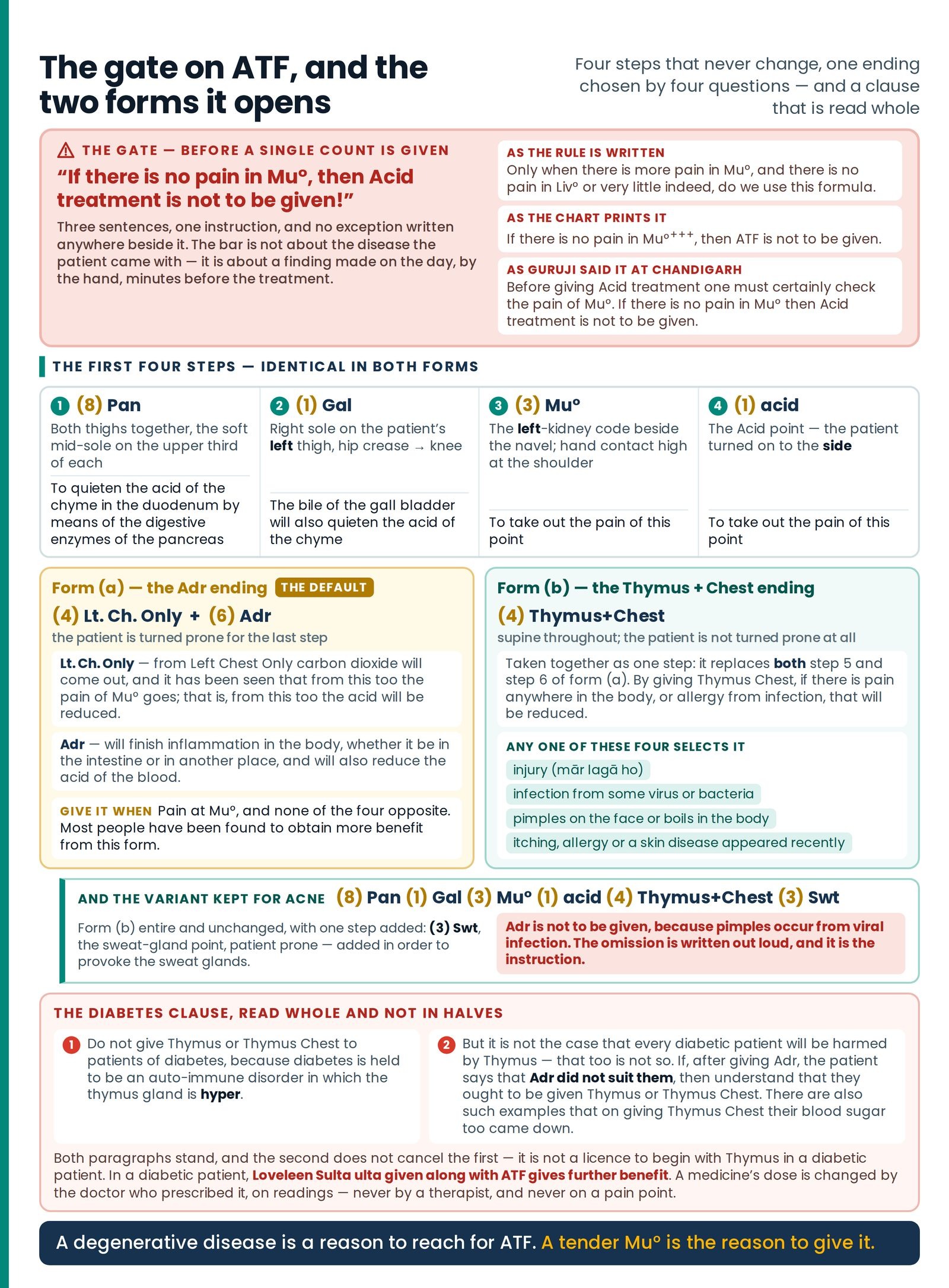
Heavy and light treatment
Three counts cut to a third, because a spoiled gland is provoked less
Everything you have been given so far is the light treatment. There was an earlier generation, heavier at three of its steps, and it is set down here for information — not because it has been withdrawn, but because knowing what was reduced, and why, teaches you more about dosing than any rule could.
For some years now Guruji has been giving only the light treatments given above, from which good results have been found. But until a decade ago he used to give the heavy treatments below, from which too there was benefit.
Why the doses came down — the reason, exactly as it was arrived at
One day it came into Guruji's mind that a gland which is already spoiled should first be provoked less, so that it slowly begins to work. After some days, if there is need, they can be given the heavy treatment, that is more stimulation.
The light treatment can be given to all patients. But it is to be given especially to those who have severe or chronic disease — that is, in whom many of the glands are either spoiled or working less. Such as cancer, hepatitis, cirrhosis, rheumatoid arthritis, and so on.
And where the idea came from: the pulse-polio campaign. The dose of polio drops is very mild indeed. The effect of the first dose lasts only some weeks, but the effect of the second dose remains for many months. So instead of giving one heavy treatment, it is better to give two or three light treatments.
Read that as a piece of clinical discipline rather than as history. A man who has taught a formula for twenty years, and whose patients have done well on it, has gone back to his own established sequences and cut three of their counts to roughly a third. It is a great deal harder to reduce your own doses than to raise them, and a student who understands why this page exists will be slower to add an extra application to a formula "because the patient is strong".
Table 8 — Card: Normal Ajay Normal formula (the old, heavy form) Supine
| Written | I (8) Pan (3) Gal (3) Spl (7) Liv (5) Mu · II (8) Pan (3) Gal (7) Liv (6) Gas 'I' |
|---|---|
| What it is | The two parts given as one treatment, in that order — the Roman numerals of Table 13, How a Formula Is Built |
| Position | Supine throughout Supine |
| I · Step 1 | (8) Pan — both thighs together Both sides |
| I · Step 2 | (3) Gal — left thigh, hip → knee Left |
| I · Step 3 | (3) Spl — right thigh, hip → knee Right |
| I · Step 4 | (7) Liv — left arm + left thigh Left |
| I · Step 5 | (5) Mu — right arm + right thigh Right |
| II · Step 1 | (8) Pan — both thighs together Both sides |
| II · Step 2 | (3) Gal — left thigh Left |
| II · Step 3 | (7) Liv — left arm + left thigh Left |
| II · Step 4 | (6) Gas 'I' — both calves Both sides |
| Its successors | Part I is the Normal formula; part II is the heavy ancestor of the Ajay Normal formula, whose modern light form is (8) Pan (3) Gal (7) Liv (6) Gas 'I' – 3 points — Setting the Stomach |
| Status | Given here for information. What is given nowadays is the light form |
| Points taught in | Pan, Gal, Spl, Liv, Mu, Gas 'I' — The Front of the Body I |
Table 9 — Card: Acid Treatment Formula (the old, heavy form), both versions Supine Side-lying Prone 6 sec
| Written, form a | (8) Pan (3) Gal (7) Mu° (3) acid (4) Ch. Only (6) Adr |
|---|---|
| Written, form b | (8) Pan (3) Gal (7) Mu° (3) acid (4) Thymus+Chest |
| Positions, in order | As the light forms — supine Supine , side-lying for the acid point Side-lying , prone for Adr Prone |
| Step 1 | (8) Pan — both thighs together Both sides . Unchanged in every version, old and new |
| Step 2 | (3) Gal — left thigh Left . Three passes, against one in the light form |
| Step 3 | (7) Mu° — the left-kidney code Left . Seven, against three in the light form |
| Step 4 | (3) acid — the Acid point, side-lying Side-lying . Three, against one in the light form |
| Step 5, form a | (4) Ch. Only — the chest, with no side stated. The light form specifies Lt. Ch. Only |
| Step 6, form a | (6) Adr — adrenal, prone Prone . Unchanged |
| Step 5, form b | (4) Thymus+Chest — unchanged; replaces steps 5 and 6 |
| The order | The same six steps in the same order as the light form. Only three counts and one side have altered |
| Who it was for, and who the light form is for | The heavy treatment was the earlier practice. The light treatment can be given to all patients, and especially to those with severe or chronic disease — cancer, hepatitis, cirrhosis, rheumatoid arthritis |
| Points taught in | As the light forms |
Table 10 — Old (heavy) and new (light) ATF, side by side
| Step | Old — heavy | New — light | What changed |
|---|---|---|---|
| 1 | (8) Pan | Nothing | |
| 2 | (3) Gal | (1) Gal | The old is three times |
| 3 | (7) Mu° | (3) Mu° | The old is more than double |
| 4 | (3) acid | (1) acid | The old is three times |
| 5, form a | (4) Ch. Only | (4) Lt. Ch. Only | Same count; the new one has a side |
| 6, form a | (6) Adr | Nothing | |
| 5, form b | (4) Thymus+Chest | Nothing |
That table is the most instructive thing here. The architecture did not change; the dose did. The opening step and both endings were left exactly where they were, and the reduction fell on the three middle steps — Gal, Mu° and acid — which are the steps aimed at the acid itself. A designer who cuts precisely the loaded part of his own sequence and leaves the frame alone knew which parts of it carried the weight.
And one change is not a dose at all. (4) Ch. Only became (4) Lt. Ch. Only. A step that had been the chest became a step that is the left chest, and in a article whose whole logic is left-for-acid and right-for-alkali, that is a correction of a different kind. What it means is taken up in full under the 1,25 DCC formula, where the therapy states plainly what the two sides of Ch. Only are now known to do differently.
The treatment given to a patient in coma
A formula defined by what it leaves out: no Mu°, both kidneys spoiled
What follows is not a formula for general use. It is a stripped ATF, given to one patient in one extreme condition, and it is taught here for one reason: it is the clearest example in of a formula altered for the organ state of the patient in front of you.
Table 11 — Card: (8) Pan (1) Gal (2) acid (4) Lt. Ch. Only treatment Supine Side-lying 6 sec × 3
| Written | (8) Pan (1) Gal (2) acid (4) Lt. Ch. Only |
|---|---|
| Positions, in order | Supine Supine → side-lying for step 3 Side-lying → supine for step 4 |
| Step 1 | (8) Pan — both thighs together Both sides . The unchanged opening of every ATF version |
| Step 2 | (1) Gal — left thigh, hip → knee Left |
| Step 3 | (2) acid — the Acid point, side-lying Side-lying . Two — neither the old form's three nor the light form's one |
| Step 4 | (4) Lt. Ch. Only — the left chest only Left . Closes the formula; no Adr, no Thymus+Chest |
| The omission that defines it | Mu° was not given — because both his kidneys were spoiled, on account of which his creatinine was greatly raised |
| How many times it was given | Twice |
| What was recorded | The pH changed from pH 7.32 to pH 7.4 |
| Points taught in | Pan, Gal — The Front of the Body I; acid — On the Side; Lt. Ch. Only — The Front of the Body II |
When calcium has gone where calcium should not be
Two complete orders, Thymus or Adrenal — give one, never both
Group 5 of Table 2 named a family: calcium deposited between the bones or the joints — bamboo spine, spur. For those patients the ordinary ATF endings are not enough, and the reason is stated in one line.
Those who have deposits of calcium between the joints or in the tissues need both Thymus and Adrenal. For them a new order was made — and it is two orders, not one.
Table 12 — Card: the calcium-deposit order, version I Supine Side-lying 6 sec
| Written | (8) Pan (3) Gal (7) Liv (4) acid (4) Thymus+Chest |
|---|---|
| Positions, in order | Supine Supine → side-lying for step 4 Side-lying → supine for step 5 |
| Step 1 | (8) Pan — both thighs together Both sides |
| Step 2 | (3) Gal — left thigh, hip → knee Left . The heavy-version count |
| Step 3 | (7) Liv — left arm + left thigh, taken together Left . Liv, not Mu° — a Normal-family step enters ATF here |
| Step 4 | (4) acid — the Acid point, side-lying Side-lying . Four — the highest count this point is given anywhere in this article |
| Step 5 | (4) Thymus+Chest — thymus with chest, as one step. This supplies the Thymus half of the stated requirement |
| What it is for | Deposits of calcium between the joints or in the tissues — Bamboo spine, that is ankylosing spondylitis; Spur, a bone growing outward |
| Prohibition it inherits | Everything attached to Thymus and Thymus Chest — not to patients of diabetes, with the qualification of the box above ▲ Take care |
| Points taught in | Pan, Gal, Liv — The Front of the Body I; acid — On the Side; Thymus + Chest — The Front of the Body II |
Table 13 — Card: the calcium-deposit order, version II Supine Side-lying Prone 6 sec
| Written | (8) Pan (3) Gal (7) Liv (4) Mu° (3) acid (10) Adr |
|---|---|
| Positions, in order | Supine Supine → side-lying for step 5 Side-lying → prone for step 6 Prone |
| Step 1 | (8) Pan — both thighs together Both sides |
| Step 2 | (3) Gal — left thigh Left . As version I |
| Step 3 | (7) Liv — left arm + left thigh Left . As version I |
| Step 4 | (4) Mu° — the left-kidney code Left . Restored, at four — neither the heavy form's seven nor the light form's three |
| Step 5 | (3) acid — the Acid point, side-lying Side-lying . Three, against four in version I |
| Step 6 | (10) Adr — adrenal, prone Prone . Ten — the heaviest adrenal dose in this article. This supplies the Adrenal half of the stated requirement |
| What it is for | The same family — calcium deposited between the joints or in the tissues |
| Who obtained benefit from this treatment | Some Parkinson's patients · those CP children who have hard constipation · those in whose flesh-muscles stiffness comes because of age |
| Points taught in | As version I; Adr — Face Down, "Face Down" |
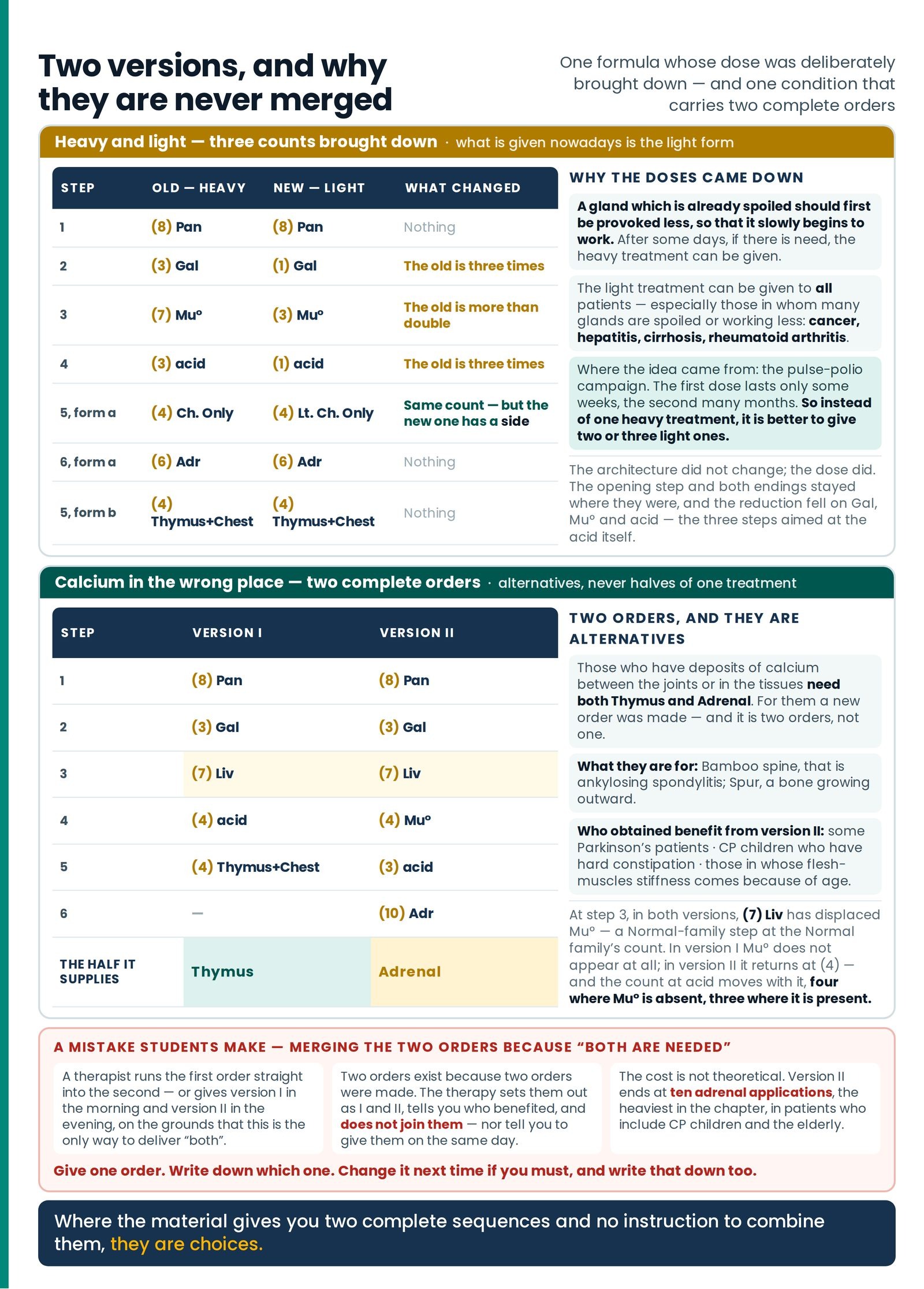
Two things must be said about that pair, and the first is the one students get wrong.
They are alternatives, not halves of one treatment. The requirement is written as both Thymus and Adrenal, and a reader in a hurry concludes that the two orders are to be run one after the other, or that they can be spliced into a single line ending … (4) Thymus+Chest (10) Adr. Neither is written anywhere. What is written is two complete orders, each with its own counts at acid, each ending in one of the two elements. A therapist who merges them has invented a formula with thirty-five applications and two endings, and has done it in a patient with bone disease. (Figure 28.3)
And the second: look at step 3. In both versions Mu° has been displaced from its usual place by (7) Liv — a step out of the Normal family, at the Normal family's count. In version I Mu° does not appear at all; in version II it returns at step 4, at (4). That is the therapy rearranging the acid formula around a different target, and the counts at acid move with it — four where Mu° is absent, three where it is present. Copy the counts as carefully as the codes.
The Alkali Treatment Formula — and the question that must be answered first
UDF before ALTF: the alkali may only look raised because the acid fell
Cross the navel and everything reverses. Those who have the diseases or symptoms of alkalosis — if we check their Liv°, that is the point of the right kidney, it will be found that there is more pain in Liv°, and in them there is less pain in Mu°, that is the point of the left kidney. For such patients a formula was made which reduces the pains of the organs of the right side — that is, Gal, Liv, Liv°, Rt. Ov. and so on. Then it was seen that from it the symptoms of alkalosis come to an end, and therefore it was given the name Alkali Treatment Formula (ALTF).
If the article stopped there, ALTF would be the mirror of ATF and you would give it wherever Liv° was the tender point. It does not stop there, and what follows is the shrewdest single piece of reasoning in the formulary.
Why a patient's alkali may only appear to be raised
Then it occurred to Guruji that it may also be that the alkaline which appears increased in the patient is in reality normal. But because the quantity of acid in his stomach is less, his alkaline will appear greater even though it is normal.
How you catch it: on checking such people there is often pain in the Gas point as well, and on asking it will be found that undigested food comes in that patient's stool.
What that means: the flow of blood in his stomach is not sufficient, from which hydrochloric acid is not being made in the proper quantity, from which the proteins will not be digested properly.
So the finding at Liv° is real and the reading taken from it may still be wrong — not because the point lied, but because the other side of the balance has fallen. Correct the missing acid first, and see what is left.
That is a habit of mind worth more than any formula here. A quantity can look too big because the thing it is being compared with has got smaller. The therapy noticed it, gave it a test you can perform with your hands and one question, and then wrote a rule that forbids you to treat the sign until the artefact has been excluded.
Now the chain the therapy sets out for why the stomach's acid matters so much — because a student who has it can explain to a patient, in half a minute, why a therapist working on alkali is asking about his stools.
What the stomach's acid is for
When hydrochloric acid is made properly in the stomach, only then will the stomach's pH go to 3 or below.
At that very pH, pepsin will be made from pepsinogen in the stomach, which will digest some of the protein of the food.
Afterwards, in the duodenum and jejunum, the pancreas's enzymes trypsin and chymotrypsin, and the other enzymes of the intestines, will digest those proteins further — only after which those proteins will be fit to be absorbed in the ileum. And that digested matter, in which there are nutrients — nourishing elements — and electrolytes, is sent to the liver and to the other cells, to be of use to all the cells.
If hydrochloric acid is not made properly, then many hormones and enzymes of the body will not be made, and from that big diseases will certainly come.
And the second thing: because the stomach's acid goes from pH 3 down to 1, from being so strongly acid no virus and so on can stay alive. If acid is not made in the stomach in the right quantity, then bacteria or virus too will remain alive.
To correct UDF, the formula first used was this one.
Table 15 — Card: the first UDF formula Seated Supine 6 sec × 3
| Written | (10) Medulla (1) Gas Only – 6 points × 3 treatments |
|---|---|
| Positions, in order | Seated for step 1 Seated → supine for step 2 Supine |
| Step 1 | (10) Medulla — seated, the nape, both sides below the ears Seated . Given to provoke the vagus nerve, which will provoke many organs of the digestive system and will increase the stomach's acid threefold |
| Step 2 | (1) Gas Only – 6 points — both thighs, the Gas Only thigh form, six stations in one pass Both sides . From this we provoke the stomach, so that HCl, pepsin and so on are made properly |
| The rounds | × 3 treatments — the whole sequence is one round, performed with its rest and repeated, three rounds in all. Table 13 and Table 8, How a Formula Is Built |
| What it does | By giving the UDF formula the hydrochloric acid in the stomach will increase. And it has been found that from this alone the symptoms of alkali are at once reduced in many patients |
| The compulsory element | After the above treatment, several new UDF formulas have been made, in which other points have been added for different kinds of patients. But in all UDF formulas the chief and compulsory thing is — Gas Only |
| The tail of every UDF formula | At the end of all UDF formulas, after the Fast treatment, the Mild Ajay Normal formula is to be given — in which from (8) Pan the digestive enzymes of the pancreas will come out, and from Gas 'I' absorption will increase. Both of these are very necessary for improving the digestive process |
| The prohibition, in its own ruled box | To patients of diabetes and of cancer, (10) Medulla is not to be given in the UDF formula ▲ Take care |
| Where the UDF family is taught whole | Clearing the Ash, "Clearing the Ash" — every generation of the UDF formulas, the simplest treatment, OLD UDF point by point, the (½) Ku treatment, and the stomach-setting and CP variants |
| Points taught in | Medulla — Seated I — Brain, Medulla, Neck; Gas Only, Gas 'I', Pan — The Front of the Body I |
Four things in that card are the whole of what this article needs from UDF, and each of them will be developed in Clearing the Ash.
Gas Only is compulsory and (10) Medulla is not. In every generation of the UDF formula ever made, whatever else was added for whatever kind of patient, Gas Only is there. And the one element that is withheld — in diabetes, in cancer — is the Medulla step. Learn the pair together: the mandatory element and the withheld element sit side by side in the shortest UDF formula there is.
The prohibition is the standing one. (10) Medulla is not given to patients of diabetes or of cancer; to heart patients only (10) Left Medulla is given. That caution was established with its reasoning in How a Formula Is Built and is inherited by every formula that contains the point — here, and in Chole, Vater, CCK Normal and Formula No. 4 in Setting the Stomach. It is applied, not re-argued.
The inseparable pair is visible in it. Gas Only is followed by Gas 'I' — and where the constipation is severe, (2) S4, S5 goes with the Gas 'I'. That pairing is one of the four established in How a Formula Is Built and it governs the UDF formulas as it governs the digestive ones.
And the diseases it is written for are not small. Undigested food has been found in the motion of almost all the patients of these diseases: fits, cancer, rheumatoid arthritis, pain in the whole body, AIDS, idiopathic scoliosis, hypothyroidism or hyperthyroidism, lumps in the whole body, and so on. And all the patients of these diseases get immediate relief from the treatment of UDF.
When ALTF is finally given
When, after giving the UDF formula for some days, the motion — that is the stool — begins to come properly and the pain of Gas goes away, if even then they have pain in several points such as Gal, Liv, Liv° and so on, only then is the ALTF formula to be given.
Read that sentence as four conditions and a gate, because that is how it must be used at the mat.
There are several forms of the ALTF formula, which benefit different kinds of patients. The one below gives benefit to almost everybody, and is especially very good for those patients who have more pain in the glands on the right side of the navel, while there is less pain in the glands on the left side of the navel.
Table 16 — Card: Alkali Treatment Formula (ALTF), the chief form Supine 6 sec × 3
| Written | (1) Gal (1) Liv – 3 points (1) Rt.Ov (1) Liv° (2) Rt. Ch. Only × 3 trt. |
|---|---|
| Family | Built from the therapy's own logic. Named for what it was seen to do — after this treatment the raised blood pressure begins to come down, from which we understand that the alkali is reduced |
| Position | Supine throughout Supine |
| What is absent from the opening | No Pan. ALTF is the one formula in this article that does not open with the pancreatic step. The absence is part of the formula |
| Step 1 | (1) Gal — therapist's right sole on the patient's left thigh, hip crease → knee Left |
| Step 2 | (1) Liv – 3 points — left arm + left thigh, three paired stations in one pass Left |
| Step 3 | (1) Rt. Ov. — the right ovary point Right |
| Step 4 | (1) Liv° — the right-kidney code beside the navel Right . The diagnostic point of alkalosis, now treated |
| Step 5 | (2) Rt. Ch. Only — the right chest only Right . The mirror of the Lt. Ch. Only of ATF |
| The rounds | × 3 treatments — given once or twice a day, with a gap of ninety seconds in between each treatment. Table 8, How a Formula Is Built |
| Given only after | The UDF formula — see the gate above ▲ Take care |
| What it is for | The alkali picture of Tables 17 and 18 below |
| The reasoning attached to the name | From the increase of the quantity of alkali, the volume of blood in the body will increase, from which the patient's blood pressure will also increase. And if acid increases, then because the volume of the blood is reduced, the patient's blood pressure may become less than normal, which is called low BP. After giving the treatment of ALTF, the raised blood pressure begins to come down |
| Points taught in | Gal, Liv, Liv° — The Front of the Body I; Rt. Ov. and Rt. Ch. Only — The Front of the Body II |
And then the two reduced forms, which are the therapy's own discipline made visible.
Table 17 — Card: ALTF, reduced form 1 — where there is no pain at Liv° Supine 6 sec × 3
| Written | (1) Gal (1) Liv – 3 points (1) Rt.Ov (2) Rt. Ch. Only × 3 treatments |
|---|---|
| Given when | There is pain in Gal, Liv and so on, but there is no pain in Liv° — then this treatment is enough |
| What changed | (1) Liv° is omitted. Everything else is unaltered, including the rounds and the rest |
Table 18 — Card: ALTF, reduced form 2 — where there is no pain at Liv° and none at Rt. Ov. Supine 6 sec × 3
| Written | (1) Gal (1) Liv – 3 points (2) Rt. Ch. Only × 3 treatments |
|---|---|
| Given when | There is no pain in Rt. Ov. either |
| What changed | Both (1) Rt. Ov. and (1) Liv° are omitted. The skeleton remains: Gal, the three-station Liv, the right chest |
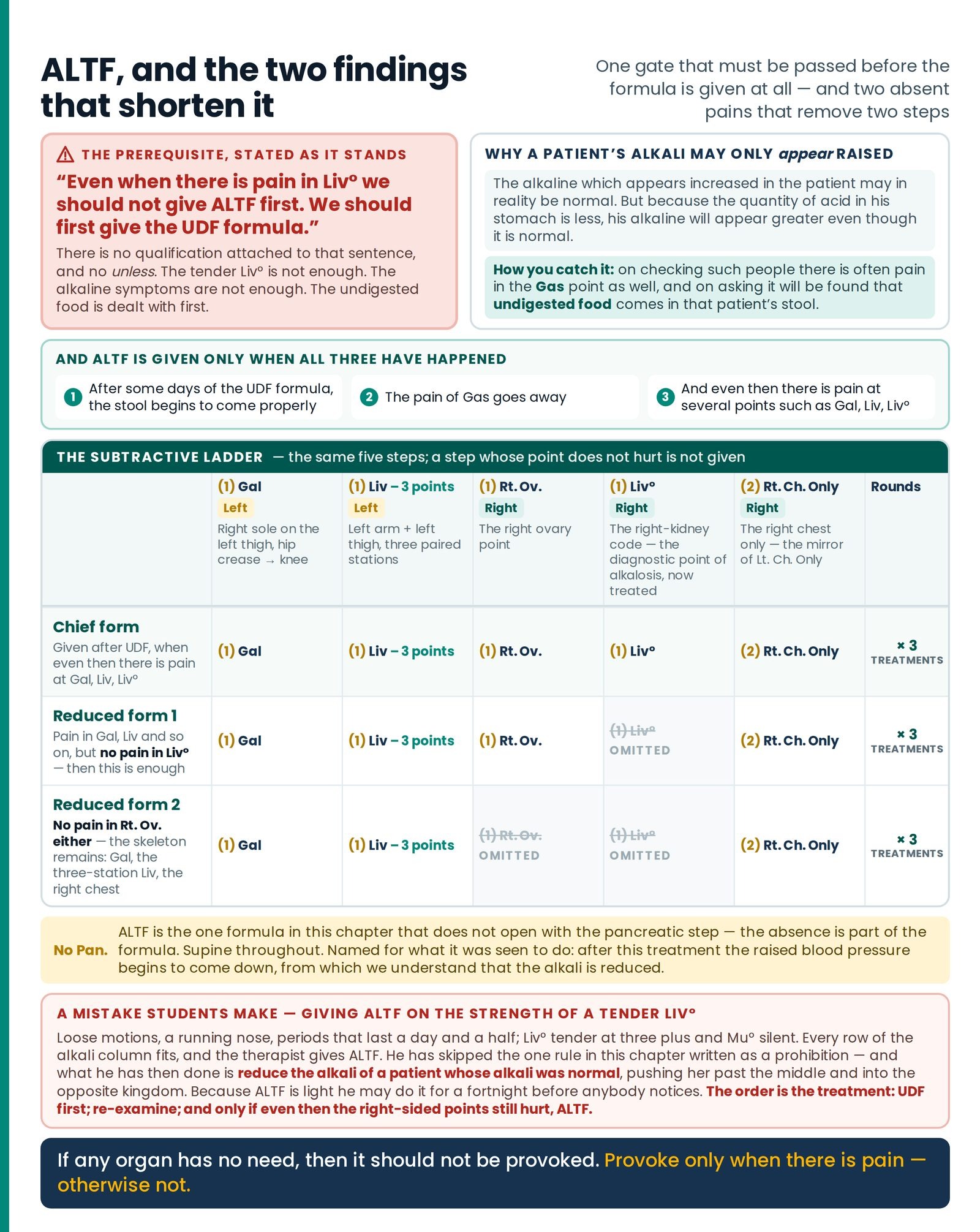
The sentence that governs all three forms
Such different treatments were made because, if any organ has no need, then it should not be provoked. Provoke only when there is pain — otherwise not.
That is the plainest statement of this therapy's internal discipline anywhere in , and once you see it you will find it everywhere. It is the same principle as the bar on ATF where Mu° is quiet; the same principle as the day-by-day dose of the max. rule in Setting the Stomach; the same principle as the omission of Mu° in the coma case; and the same principle that produced these three cards instead of one.
The dose is set by the finding. A point that does not hurt is not treated.
Notice how little ALTF is. Five steps at counts of one and two, against the eight, three and six of the acid formula — a light treatment for the family the therapy itself calls the harder one to correct. That is not a contradiction; it is the same instinct as the light-treatment reform two sections back, arriving at a formula that was built light from the beginning. (Figure 28.4)
Table 20 — ALTF: the chief symptoms for which it is given — first check the pain of Liv°
| Pain in Liv° · pain in the ring finger of the right hand Right | Running of the nose |
|---|---|
| Very little flow in the menses, or flow coming for only a day or two and then stopping | Loose motions (dast) |
| Pain in the upper or back part of the head | Pain in the organs of the right side of the body Right |
Table 21 — ALTF: the chief diseases and symptoms for which it is given
| Fits or convulsions, that is attacks of trembling | Epilepsy, mirgī |
|---|---|
| Spasticity, that is the muscles becoming stiff | CP, cerebral palsy |
| HBP — high blood pressure | Cancer (karkarog) |
| Tumour, fibroid, cyst | Stammering or lisping (haklānā yā tutlānā), and so on |
The 1,25 DCC family
A formula built out of physiology — sun, liver, parathyroid, kidney
This is a unique formula in which Guruji, having practised the facts of physiology, has converted them, in his own unique style, into a medicine-free treatment. It is given in order to increase the quantity of calcium in the blood. Along with this, it also helps in improving the functions of the kidneys, and in the digestion and absorption of all the necessary elements.
Everything else in this article was built from observation and then explained. This one was built the other way round: a chain of physiology was read, organ by organ, and a point was found for each organ in the chain. It is the clearest worked example in the wiki of a formula assembled deliberately, and it is worth learning the chain before the formula, because once you have the chain the formula cannot be forgotten.
From eating curd, milk, spinach, radish (mūlī), onion (kāndā, that is pyāz) and, among fruits, banana, a great deal of calcium is obtained. Its absorption is done by the villi of the ileum, and from there it mixes into the blood. But in the ileum its absorption will happen only if there is a sufficient quantity of 1,25 DCC in the blood. Otherwise the whole of the calcium will go out in the stool.
And there is one more matter. Suppose the quantity of calcium in the blood is correct but 1,25 DCC is not there. Then, when the contents of the blood are filtered in the kidneys, their tubules will not reabsorb the calcium, and the calcium of the blood will keep going out through the urine.
What 1,25 DCC does, and what happens when it is missing
1,25 DCC raises the quantity of calcium in the blood by acting upon two different organs.
One — the intestine. It acts upon the cells of the villi of the ileum, so that they absorb calcium and phosphate. For this it causes a special kind of calcium binding protein to be prepared in the cells of the intestine, useful for delivering calcium inside the cytoplasm of the cell.
Two — the kidney. It acts upon the tubules of the kidneys so that they reabsorb calcium and do not let calcium go out through the urine — and in its place let phosphate go out.
If 1,25 DCC is not present in the blood, 90% of the calcium of the food will go out with the motion and the remaining 10% will go out through the urine.
And inside that first job is a piece of timing which is a dosing instruction, and the only one of its kind in this article.
The forty-eight hours, and what follows from them
To prepare the calcium binding protein, 1,25 DCC takes about two days.
But even after the 1,25 DCC has gone, this protein remains inside the cells for several weeks, so the effect on intestinal calcium absorption lasts many days.
Since this protein takes 48 hours to be formed, if 1,25 DCC is to be given a second time it should be given leaving one day in between.
That sentence is written about the hormone, and it is the reason the formula that provokes the hormone is not a formula you give every single morning without thinking. A therapist who gives it daily because daily is his habit is asking a cell to begin a two-day job afresh every twenty-four hours.
How 1,25 DCC is made in the body
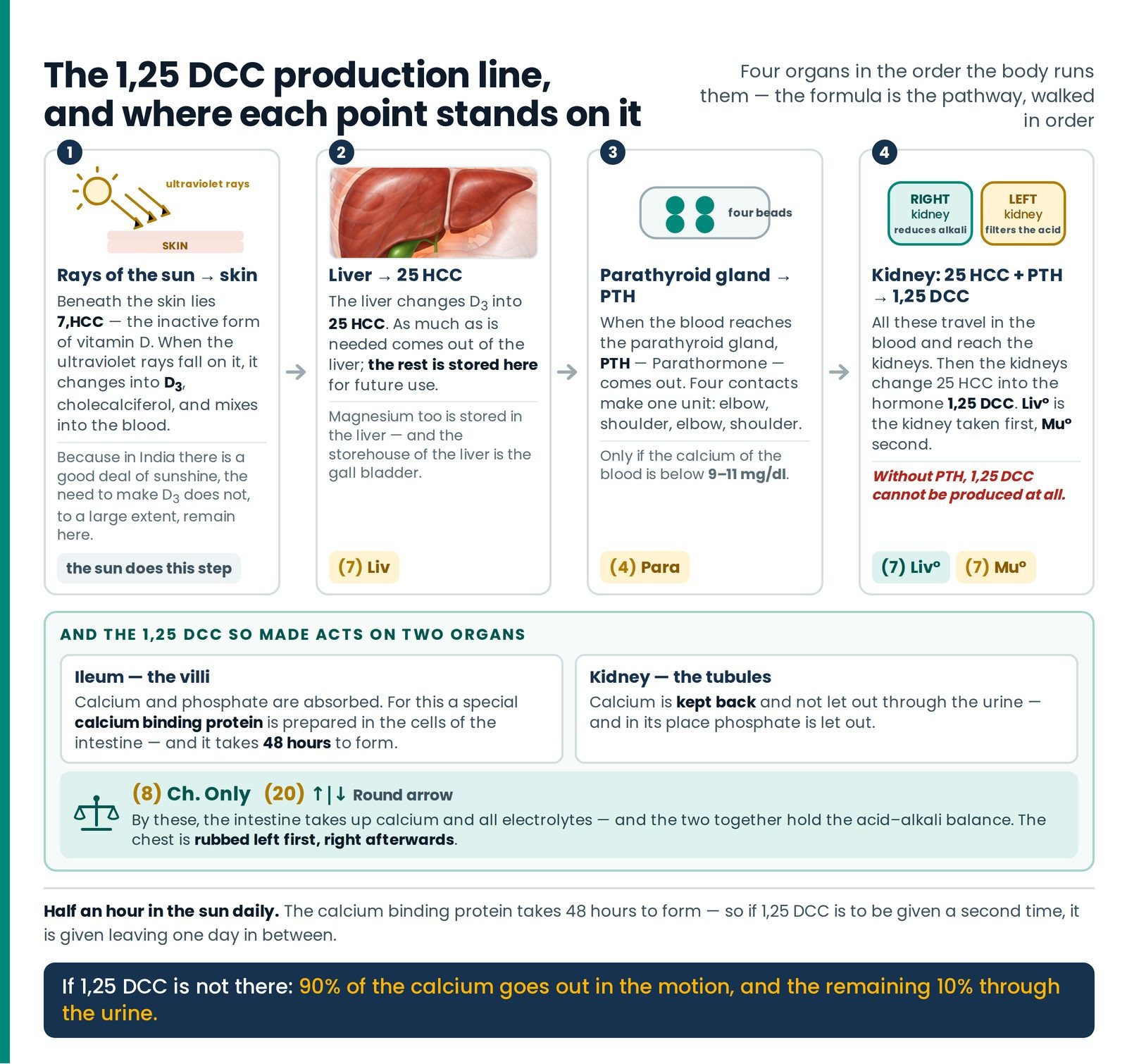
In the absorption and use of calcium, vitamin D has an important place. Beneath our skin a chemical named 7-hydroxycholecalciferol (7,HCC) lies deposited — the inactive form of vitamin D. When the ultraviolet rays of the sun's light fall on it, it changes into D₃, that is cholecalciferol, and mixes into the blood. (Figure 28.5)
When this blood reaches the liver, the liver changes it into 25 HCC (25-hydroxycholecalciferol), another form of vitamin D. In this form, as much vitamin D as is needed will come out of the liver, and the rest remains stored in the liver itself for future use.
When this blood reaches the parathyroid gland, and if the quantity of calcium in the blood is less than 9–11 mg/dl, a hormone named Parathormone (PTH) comes out of the parathyroid gland. All these things travel in the blood and reach the kidneys. Then the kidneys change 25 HCC into the hormone named 1,25 DCC. But for this work, the presence of PTH is essential. Without PTH, 1,25 DCC cannot be produced at all.
Table 22 — In brief: the making of 1,25 DCC, in four steps
| The step | What happens | |
|---|---|---|
| 1 | Rays of the sun → skin | 7,HCC (7-hydroxycholecalciferol) is changed into D₃ |
| 2 | 7,HCC → by way of the blood → liver | 25 HCC (25-hydroxycholecalciferol) |
| 3 | 25 HCC → by way of the blood → parathyroid gland | PTH will come out |
| 4 | 25 HCC + PTH → by way of the blood → kidney | 1,25 DCC |
The chief point of all is that sunlight is extremely necessary for the strength of the bones. This is the very reason why those who work in the fields or in the sun rarely get osteoporosis or other troubles of the bones. In cities people often shy away from the sun, and so their bones do not become strong; and if at some time they have to lift a heavy load, then all sorts of diseases of the bones come to them. If one makes it a habit to take, every day, ten to fifteen minutes of the gentle rays of the morning sun on the beads of the spine, it will be extremely beneficial for health.
How the formula was assembled
Because in India there is a good deal of sunshine, the need to make D₃ does not, to a large extent, remain here. From the facts above we understand that only if the liver, PTH and the kidneys work properly will 1,25 DCC be made — otherwise not.
On that basis the first formula was made, in which the liver, the parathyroid gland and the kidneys are stimulated in order.
Table 23 — Card: Pure 1,25 DCC Supine 6 sec
| Written | (7) Liv (4) Para (7) Liv° (7) Mu° |
|---|---|
| Family | Built from the therapy's own logic, out of the physiology of a pathway. Named after the hormone; nothing whatever is administered |
| Position | Supine throughout Supine |
| Step 1 | (7) Liv — left arm + left thigh, taken together Left . The liver will change D₃ into 25 HCC |
| Step 2 | (4) Para — the parathyroid point; four contacts make one unit — elbow, shoulder, elbow, shoulder, six seconds at each Left . Stimulating the parathyroid gland, it will make PTH |
| Step 3 | (7) Liv° — the right-kidney code beside the navel Right . Kidney, first side |
| Step 4 | (7) Mu° — the left-kidney code beside the navel Left . Kidney, second side — to change 25 HCC into 1,25 DCC |
| What was seen | After only a few days of treatment the quantity of calcium in the blood increases |
| Its character | This formula is very powerful. By this formula, in the intestines only calcium will be absorbed |
| How often it is used | Very little indeed — see the use of Pure 1,25 DCC, below |
| Points taught in | Liv, Liv°, Mu° — The Front of the Body I; Para — The Front of the Body II, "The Front of the Body — II" |
Read the four steps against the four steps of Table 22 and the formula disappears into its own reasoning. Liver, parathyroid, kidney, kidney — the production line, provoked in the order in which the body runs it. Nothing is arbitrary and nothing is decorative, and a student who can recite the pathway can write this card from memory for the rest of his life.
Later, from his own singular experience, and in order to make this formula still more effective, Guruji mixed into it two more points — (8) Ch. Only and (20) ↑|↓.
Table 24 — Card: the 1,25 DCC formula (the ordinary form) Supine Prone 6 sec
| Written | (7) Liv (4) Para (7) Liv° (7) Mu° (8) Ch. Only (20) ↑\ | ↓ |
|---|---|---|
| What it is | This is called the 1,25 DCC formula. Generally, to the majority of patients, this very formula is given | |
| Positions, in order | Supine for steps 1–5 Supine → prone for step 6 Prone | |
| Steps 1 to 4 | Pure 1,25 DCC, entire and unchanged — (7) Liv, (4) Para, (7) Liv°, (7) Mu° | |
| Step 5 | (8) Ch. Only — the chest without the thymus. We first rub on the left side of the chest and afterwards rub on the right side Left Right . Chest Only controls the air element (vāyu tattva) | |
| Step 6 | (20) ↑\ | ↓ — Round arrow; the thumb-edge down one side of the spinous processes and up the other, without lifting the finger, patient prone Prone . For stimulating the 31 pairs of nerves of the spine; and from it acid is also reduced |
| What the two added points do together | In several patients it has been seen that from Ch. Only alkali is reduced — that is, from this the symptoms of acid increase. But if (8) Ch. Only and (20) ↑\ | ↓ are given together, then the two together maintain the balance of acid–alkali |
| What it now absorbs | From this treatment it was seen that it will absorb not only calcium but every kind of electrolyte | |
| What the patient must do | To take full benefit the patient should remain in the sun for at least half an hour daily | |
| How often | Bearing in mind that the calcium binding protein takes 48 hours to be formed — if it is to be given a second time it should be given leaving one day in between | |
| What is checked before it is given | How much pain there is in Liv° and Mu° — and whether the stool that comes in the patient's motion is medium or hard. See the four versions below | |
| Points taught in | As Pure 1,25 DCC; Ch. Only — The Front of the Body II; Round arrow ↑\ | ↓ — Face Down, "Face Down" |
Table 25 — Why each element of the 1,25 DCC formula is given
| Element | Why it is given | |
|---|---|---|
| Rays of the sun | To change the chemical of the skin into vitamin D₃ (cholecalciferol) | |
| (7) Liv | The liver will change D₃ into 25 HCC | |
| (4) Para | Stimulating the parathyroid gland, it will make PTH | |
| (7) Liv° (7) Mu° | To stimulate the kidneys, to change 25 HCC into 1,25 DCC | |
| (8) Ch. Only (20) ↑\ | ↓ | By these, the intestine takes up calcium and all electrolytes |
| Left Chest Only | The pain of Mu° is reduced — that is, it reduces the symptoms of acidosis | |
| Right Chest Only | The pain of Liv° is reduced — that is, it reduces the symptoms of alkalosis |
The last two rows are printed as a note, and they are the most useful two lines in the article for a therapist who has been paying attention.
The two sides of Ch. Only, and what that settles
Nowadays it has been found that the treatments of the two sides of Chest Only work differently.
From Left Chest Only, the pain of Mu° is reduced — that is, it reduces the symptoms of acidosis.
From Right Chest Only, the pain of Liv° is reduced — that is, it reduces the symptoms of alkalosis.
Now go back two sections. The light form of ATF specifies (4) Lt. Ch. Only where the heavy form said only Ch. Only — and ATF is the acid formula, so the left chest is exactly the side it wants. ALTF ends at (2) Rt. Ch. Only — the alkali formula, and the right chest is exactly the side it wants. The lateralisation that looked like a small revision on page 267 is the same discovery arriving in its proper place.
And notice the word the therapy uses to date it. Nowadays. It is written as a thing that has come to be known, in a book of settled instructions, and it is left standing exactly as it is.
Two notes travel with (8) Ch. Only and must not be separated from it. It is not a still press but a rub, and the left side is rubbed first and the right side afterwards — which, given what the two sides are now known to do, means the acid-reducing side is given first and the alkali-reducing side second. And the pairing with (20) ↑|↓ is a balance mechanism, not two points that happen to sit together: each on its own pushes the internal environment one way, and together they hold it where the rest of the formula has put it. The balance pair, in all its counts and variants, belongs to Water and Salt, "Water and Salt"; rule 2 and rule 3 of sequence, which govern the order in which the two are given, are How a Formula Is Built.
The magnesium preface
Then it was learnt from physiology that for calcium to be absorbed properly, the binding — that is, the joining — of magnesium with it is necessary. Magnesium is stored in the liver. And the storehouse of the liver is the gall bladder. So the treatment was changed in this manner.
Table 26 — Card: the 1,25 DCC formula with the magnesium preface Supine Prone 6 sec
| Written | I (3) Gal (7) Liv — for the binding of magnesium · II the 1,25 DCC formula → (7) Liv (4) Para (7) Liv° (7) Mu° (8) Ch. Only (20) ↑\ | ↓ |
|---|---|---|
| What the Roman numerals mean | Part one, then part two, as one treatment, in that order | |
| I · Step 1 | (3) Gal — right sole down the patient's left thigh, hip crease → knee Left . For the binding of magnesium | |
| I · Step 2 | (7) Liv — left arm + left thigh together Left . Magnesium is stored in the liver | |
| II | The 1,25 DCC formula entire, beginning again at (7) Liv | |
| Why Gal opens it | Magnesium is stored in the liver, and the storehouse of the liver is the gall bladder | |
| What it is for | Everything the 1,25 DCC formula is for, with the absorption of calcium made proper by the magnesium binding | |
| Points taught in | Gal, Liv — The Front of the Body I; the rest as above |
Note that Liv is given in part I and again at the head of part II, and the counts differ — (3) Gal (7) Liv first, then the formula's own (7) Liv. That is not a printing accident and it is not an invitation to economise by giving Liv once. Part I is a preface with its own purpose; part II is the formula. Where the therapy writes two parts, two parts are given.
Intrinsic factor, and vitamin B₁₂
From this treatment the patients began to feel very well, saying that digestion and absorption had improved. Then a further thought: for the absorption of vitamin B₁₂ it is necessary that intrinsic factor be made in the stomach; only then, on reaching the ileum, will vitamin B₁₂ be stored in the liver. Otherwise the enzymes of the stomach and the intestine will digest it — that is, finish it off.
The stock of vitamin B₁₂ in the liver lasts five to six years. If someone has symptoms of vitamin B₁₂ deficiency, it means that for several years it has not been getting stored in his body. And for intrinsic factor to be made properly, the blood circulation in the stomach must be proper; in this therapy, for that we give Gas Only.
Table 27 — Card: the three-part sequence for combined calcium and vitamin B₁₂ deficiency Supine Prone 6 sec
| Written | I (1) Gas Only – 6 points · II (3) Gal (7) Liv · III the 1,25 DCC formula → (7) Liv (4) Para (7) Liv° (7) Mu° (8) Ch. Only (20) ↑\ | ↓ |
|---|---|---|
| Given to | Those who have a deficiency of both calcium and vitamin B₁₂ — in order to take the greatest benefit from the 1,25 DCC formula, it has been found better to give the treatment in this manner | |
| Part I | (1) Gas Only – 6 points — both thighs, six stations in one pass Both sides . To stimulate the stomach — for making intrinsic factor | |
| Part II | (3) Gal (7) Liv Left . For the magnesium stored in the liver — only by joining with magnesium will the absorption of calcium be proper | |
| Part III | The 1,25 DCC formula entire | |
| What the whole sequence is for | The absorption of calcium and B₁₂ and all such nutritive elements | |
| Where B₁₂ is taught whole | Vitamin and Gene Formulas, "The Missing Links" — B₁₂, folic and pure folic acid, the deficiency picture, and the gene formulas | |
| Points taught in | Gas Only — The Front of the Body I; the rest as above |
Three parts, and each of them is a door the calcium and the B₁₂ have to pass. Part I opens the stomach so that intrinsic factor is made and the B₁₂ survives the journey. Part II fetches the magnesium without which the calcium will not bind. Part III is the pathway itself. Read it downwards and it is a supply chain; read it upwards and it is a list of the three places a deficiency can be manufactured in a person who is eating perfectly well.
Calcium, the thyroid, and why a thin bone is not a simple thing
The quantity of calcium in the plasma should ordinarily be from 9.00 to 11.00 mg/dl. If there is an extreme deficiency of calcium, even the heart can fail. So that this may not happen, when the need arises the PTH of the parathyroid gland will tell the osteoclasts to take calcium out of the bones and put it into the plasma.
When the quantity of calcium goes above 11.00 mg/dl, from the thyroid gland a hormone named calcitonin will come out, which will tell the osteoblasts to put that excess calcium into the bones.
Calcium is found in milk, curd, paneer, jaggery (gur) and sesame (til) — more in black sesame. In banana, calcium is less and potassium is more.
What calcitonin does and does not govern
Note that calcitonin has no control over PTH. The control of calcitonin is only over osteoclasts and osteoblasts.
This effect too is found more in growing children. From the effect of calcitonin, within a few hours of calcium becoming deficient in the blood, PTH comes out in heavy quantity, which negates the effect of calcitonin.
Hypothyroidism means T₃ and T₄ being low — and this work of the thyroid gland depends upon the pituitary gland. The work of calcitonin depends only upon the quantity of calcium.
From calcitonin working less, osteoporosis will occur, in which the bones become hollow.
And where the quantity is high: when the calcium in the blood is more than 11 mg/dl, the parathyroid gland will stop the intestine and the osteoclasts from absorbing any more calcium from the bones, and will let calcium go out through the urine.
Now the loop that brings the whole article back to the thyroid chain of Table 2, and it closes in a way students find satisfying.
If the quantity of calcium in the blood is less than 9 mg/dl, the muscles cannot work properly. And for all the glands to work properly, and to send out their secretion regularly, the muscles beside them must work properly. If the T₃ and T₄ hormones of the thyroid do not come out in the proper quantity it is called hypothyroidism — and because of the deficiency of calcium in the blood the thyroid gland will be unable to work properly, so this too can be a chief cause of hypothyroidism.
On this inference Guruji thought that those who have hypothyroidism will benefit from the 1,25 DCC formula. Especially those children who have symptoms of mental slowness (mand buddhi) because of hypothyroidism have benefited greatly. In the treatment of such children this thinking is singular and matchless.
The balance rule, and the four versions chosen by the stool
In this formula, (20) ↑|↓ has been given along with (8) Ch. Only. Here is the observation that makes the rest of this section possible.
The balance rule — a proportion, not a list
It has been seen that from Ch. Only alkali becomes less — that is, the symptoms of acid increase — whereas from Round Arrow acid becomes less, that is the symptoms of alkali increase.
Not only that: to balance (20) ↑|↓, (8) Ch. Only is needed, whereas to balance (4) Ch. Only, (10) ↑|↓ is sufficient.
Since neurotherapy treats not the disease but the condition of the body, this observation has been used in a remarkable way: the two counts are deliberately unbalanced in one direction or the other according to what the patient's body needs today.
Twice the chest, twice the spine. Because the rule is stated as a proportion, the four versions that follow are not four things to memorise. They are derivable — and a therapist who has the proportion can check any card he is handed.
And before the treatment is given at all, two things are checked. One should check how much pain there is in Liv° and Mu°. And along with this one should ask the patient whether the stool that comes in his motion is medium or hard. During sixty years of tapasyā it was found that one and the same formula does not apply to all patients. Changing the treatment according to the condition of the patient will give greater benefit.
Table 28 — The four versions of the 1,25 DCC formula, selected by the form of the stool
| The stool | What it means | The formula | What changed | |||
|---|---|---|---|---|---|---|
| Banana-like, and the stomach clear daily — ordinarily people's motion is like this | Ordinary | (7) Liv (4) Para (7) Liv° (7) Mu° (8) Ch. Only (20) ↑\ | ↓ | The standard formula | ||
| Very hard indeed, and coming in small small pieces, like a goat's motion, coming after one or two days, or coming only with great difficulty — severe constipation; such people have pain in Mu° | There is a great deal of acid in the body. We have to reduce the acid further, and must not reduce the alkali too much | (7) Liv (4) Para (7) Liv° (7) Mu° (4) Ch. Only (20) ↑\ | ↓ | Chest cut from (8) to (4), spine left at (20) — when we give (4) Ch. Only the acid will not increase so much | ||
| Medium — cow-dung-like | The alkali has increased somewhat | (7) Liv (4) Para (7) Mu° (7) Liv° (20) ↑\ | ↓ (8) Ch. Only — Ulta 1,25 DCC | Mu° is given first and Liv° afterwards; and (20) ↑\ | ↓ is given first and (8) Ch. Only afterwards. Counts unchanged. A line is ruled underneath so that the therapist keeps in mind that here the order has been changed | |
| Coming three or four times in the day, and the stool very thin | The alkali has increased a good deal. In the treatment we have to increase the acid more | (7) Liv (4) Para (7) Mu° (7) Liv° (10) ↑\ | ↓ (8) Ch. Only | Order reversed as above, and the spine cut from (20) to (10) — *when we give (20) ↑\ | ↓ the acid will be reduced more, but when we give (10) ↑\ | ↓ the acid will not be reduced so much* |
And the explanation printed with that last version, which must travel with it because it is the therapy breaking its own balancing rule deliberately and saying so:
To balance (10) ↑|↓ one ought to give (4) Ch. Only only. By giving (8) Ch. Only, the alkali will be reduced more in comparison with (4) Ch. Only — which is necessary for patients who have thin stools.
That bracket is worth more than the formula it sits beside. A rule is stated; a case arrives in which the rule must be broken; the break is made on purpose, in a stated direction, for a stated reason, and it is written down beside the line so that nobody mistakes it for an error. That is what a working rule looks like in the hands of somebody who made it.
What the 1,25 DCC formula is used for
Table 29 — In brief: the uses of the 1,25 DCC formula
| To increase the quantity of calcium in the blood | Osteoporosis — the becoming hollow of bone |
|---|---|
| If there is bleeding in excessive quantity in the menses | Mental slowness (mand buddhi) and hypothyroidism |
| Those who get cramps at the time of sleeping — this can often happen in high BP patients | To improve the stomach and the digestive system — especially if there is pain in both Liv° and Mu°, and along with indigestion there is also pain in the waist or in the calves; then this formula is very beneficial indeed |
The last entry is the one you will use most often, and it is worth reading twice because it names a combination rather than a disease: pain at both kidney points, indigestion, and aching in the waist or the calves. That is a picture, not a diagnosis, and it is the kind of thing a patient describes in one breath while apologising for mentioning three things at once.
Pure 1,25 DCC, and where it leads
As has been written above, Pure 1,25 DCC is a very powerful and strong treatment. So it is used very little indeed. But there is one formula built directly out of it.
Table 30 — Card: Pure Genes formula Supine Side-lying 6 sec
| Written | (7) Liv (4) Para (7) Liv° (7) Mu° (8) Lt Parkhoo |
|---|---|
| What it is | Pure 1,25 DCC with vitamin B₁₂ mixed into it. If vitamin B₁₂ is mixed into Pure 1,25 DCC, then its name is Pure Genes formula |
| Steps 1 to 4 | Pure 1,25 DCC, entire and unchanged — (7) Liv, (4) Para, (7) Liv°, (7) Mu° |
| Step 5 | (8) Lt Parkhoo — the left Parkhoo, the vitamin B₁₂ station Left . It is this that makes the formula "Genes" |
| What it is for | By means of this formula the disorders of the genes — genetic disorders — can be corrected |
| How often it is used | This formula too is not generally used, because it is very much strong, that is, effective. It is used only in genetic disorders, that is diseases connected with the genes |
| Where the gene family is taught whole | Vitamin and Gene Formulas, "The Missing Links" — Pure Genes, New Genes, Pure and Large Folic Black, and the WD that follows Pan inside New Genes |
| Points taught in | As Pure 1,25 DCC; Lt. Parkhoo — On the Side, "On the Side" |
Two formulas named Pure, and both of them carry the same warning in the same words: very powerful; used very little indeed. That is a class of treatment, not two coincidences. Where the therapy calls a formula Pure, it means the pathway has been provoked without the balancing pair at the end — no Ch. Only, no Round arrow — and rule 3 of sequence tells you exactly what that costs. A formula that ends without a balance is a formula that leaves the patient somewhere. Give the ordinary form unless you have been taught otherwise by somebody who knows why.
The Gas 'I' ladder, and what a dose can decide
One point, four counts — and nine seconds turns (6) into (9)
This last section of the article is a different kind of teaching, and it belongs here rather than anywhere else because it is the plainest demonstration in the wiki of the thing the two kingdoms have been telling you all along: the same point, at two different counts, is two different treatments — and they can pull in opposite directions.
In our intestines there are 100 million — that is, ten crore — neurons, which are called enteric neurons, that is the neurons of the intestines. And these neurons too make, in smaller quantity, the very same chemicals that are made in larger quantity in the brain. In this therapy it has been seen that from the Gas 'I' point the intestines can be stimulated.
Dopamine, in the therapy's own account
Dopamine is a chemical which is made in the part of the brain named the basal ganglia. Besides this it is also made in the adrenal medulla.
After being made, it is changed into norepinephrine according to the body's need.
It is made in the body from the exchange of the tyrosine amino acid. The work of changing one thing into another in the body is called metabolism, that is cayāpacaya. Tyrosine amino acid is found in the protein of milk named casein. So for it to be made properly, milk should be digested properly; and for the metabolism of tyrosine, vitamin C and folic acid are needed. All this will happen only when the digestive system works properly.
One chief work of dopamine is to carry messages from the brain to certain other parts. That is why it is called a neuro-transmitter. Its property is to carry the message of stopping the unwanted movements of the limbs — which is why it is called an inhibitory neuro-transmitter, that is, a stopping neuro-transmitter.
Notice where that paragraph ends up. Tyrosine comes from the protein of milk; the protein of milk must be digested; and the metabolism of tyrosine needs vitamin C and folic acid, which must be absorbed. A article that began at the kidneys has arrived back at the stomach, which is where Setting the Stomach said every article of this Part would end up.
Now the table the ladder was inferred from. It describes what the drug dopamine does when it is put into a patient's blood in a hospital, and it is given here because it is the reasoning the therapy used — nothing whatever is administered in this treatment.
Table 31 — The effect of the drug dopamine on the body
| The quantity of the drug * | Its effect on the body |
|---|---|
| 2 to 5 µgm per minute | Widens the internal diameter of the arteries of the kidney and the intestines. If the flow of blood inside the kidneys increases, the systolic BP will fall |
| 5 to 15 µgm per minute | The contractile power of the heart will increase; blood will come out in greater quantity and with greater speed, from which the BP will rise |
| More than 15 µgm per minute | In this quantity it stimulates the α-adrenergic receptors, from which all the blood vessels of the body contract. This is given to patients of Parkinson's disease, and to those who have extremely low BP because of shock |
* The total quantity of the drug is calculated according to the weight of the patient and is put into the blood. Whatever the patient's weight may be, the drug is to be put up for that many minutes.
Shock is what it is called when, from any cause whatever, the quantity of blood reaching the heart from the venous blood, that is from the veins, becomes so little that the tissues do not get sufficient oxygen for their normal working. (A microgram, µgm, is the ten-lakhth part of one gram.)
Read down the middle column and the thing that matters jumps out. The same chemical lowers the blood pressure at a small dose and raises it at a larger one. Not works less at the small dose — works the other way. That is the fact the ladder was built on.
How the ladder was inferred, step by step
The inference.
When a Parkinson's patient is benefiting from (12) Gas 'I', then from (6) Gas 'I' less dopamine should be made, which might perhaps reduce high BP.
The test. From that inference, when (6) Gas 'I' was given to a patient of high BP, that person's systolic BP came down. From then on, for many years, (6) Gas 'I' is given to high BP patients to reduce systolic BP, from which they get great benefit — and the inference drawn is that this treatment is working like the dopamine dosage of 2–5 µgm/kg/min.
The next thought, and what happened to it. After this the thought came that when (6) Gas 'I' reduces high BP, then from (9) Gas 'I' perhaps more dopamine will be made, from which BP will rise — which we could use in the treatment of low BP. But patients of low BP come only occasionally, so we could not test this on many patients.
That last sentence is left exactly as it stands. A prediction was made, the patients to test it on did not come in sufficient numbers, and the therapy says so rather than filling the gap.
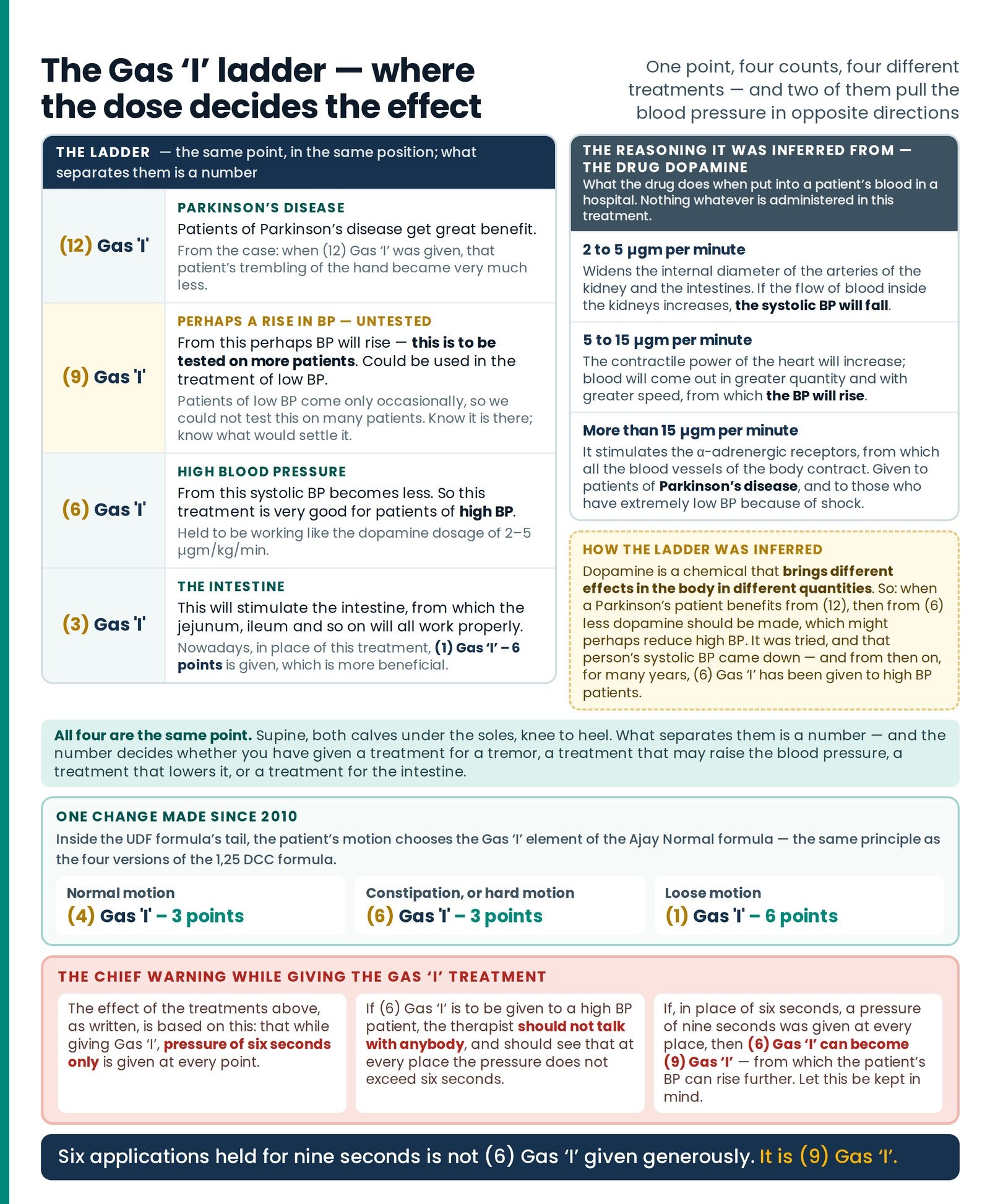
All four are the same point, in the same position, with the patient supine and both calves under the soles, knee to heel. What separates them is a number — and the number decides whether you have given a treatment for a tremor, a treatment that may raise the blood pressure, a treatment that lowers it, or a treatment for the intestine. There is nothing else in the wiki where so much rides on the count alone, which is why what follows is written as a warning rather than as a note. (Figure 28.6)
One change made since 2010
Since 2010, while giving the UDF formula, the following changes are to be made in the Ajay Normal formula according to the motion. It is the same principle as the four versions of the 1,25 DCC formula — the stool chooses the count — and it is placed here rather than in Clearing the Ash because the element that changes is a rung of the ladder you have just learned.
Table 33 — The 2010 modification of the Ajay Normal formula inside UDF, by the patient's motion
| The patient's motion | The Gas 'I' element to give |
|---|---|
| Normal motion | (4) Gas 'I' – 3 points |
| Constipation, or hard motion | (6) Gas 'I' – 3 points |
| Loose motion | (1) Gas 'I' – 6 points |
Three notes on that small table, and then the article turns to choosing.
It belongs to the UDF formula. The Ajay Normal formula is the tail of every UDF sequence — at the end of all UDF formulas, after the Fast treatment, the Mild Ajay Normal formula is to be given — and this modification governs the Gas 'I' element inside that tail. The whole family, generation by generation, is Clearing the Ash, "Clearing the Ash".
Read the counts against the ladder. Constipation gets six; loose motion gets one, at six stations. The same numbers you have just met at the Gas 'I' point, chosen by the same kind of finding as everything else in this article — what the stool looks like this week.
And a note on where the rest of the stomach work lives. Some other formulas for setting the stomach right — Chole, Vater, New Gal and the rest of the later generation — are taught in Setting the Stomach, "Setting the Stomach", and the two articles are meant to be used together. A patient whose Gas point is tender and whose food comes through undigested may need work from both.
Choosing between them
The chapter read backwards, from the finding to the formula
Thirteen formulas and variants, one system, and a patient in front of you. The question is never which is the strongest acid formula — it is which kingdom is this patient in today, and has anything been left undone that must come first. The table below is the article read backwards, from the finding to the formula. (Figure 28.7)
Table 34 — From the finding to the formula
| What you have found | The formula it points to | The thing to check before you give it |
|---|---|---|
| More pain at Mu°, none or very little at Liv°; left ring finger; left-sided complaints; the dryness picture; degeneration | ATF form (a) — (8) Pan (1) Gal (3) Mu° (1) acid (4) Lt. Ch. Only (6) Adr | No Mu°⁺⁺⁺, no ATF. And re-examine every single day |
| The same, plus injury · viral or bacterial infection · pimples on the face or boils in the body · recently appeared itching, allergy or skin disease | ATF form (b) — the same first four steps, ending (4) Thymus+Chest | Not Thymus in diabetes — with the qualification attached to that bar |
| The same, and the patient is diabetic | ATF form (a), with Loveleen Sulta ulta given along with it | The medicines stay exactly as the doctor set them; sugar is checked |
| The patient has told you that Adr did not suit them | Thymus or Thymus Chest — form (b) | This is the one circumstance in which the diabetes bar is reopened. Write down that you reopened it |
| Mu° pain with pimples, acne or black heads | ATF for pimples — form (b) + (3) Swt | Adr is not to be given |
| A patient with severe or chronic disease — cancer, hepatitis, cirrhosis, rheumatoid arthritis — in whom many glands are spoiled or working less | The light treatment, and two or three light treatments in place of one heavy one | Everything else that such a diagnosis demands, which a light dose does not cover |
| Calcium deposited between the joints or in the tissues — bamboo spine, spur | Calcium-deposit order I or order II | They are alternatives. Give one; write down which |
| More pain at Liv°, less at Mu°; the alkali picture | Not ALTF yet | Gas tenderness, and the stool question. UDF first |
| Liv° tender and Gas tender, and undigested food in the stool | The UDF formula — (10) Medulla (1) Gas Only – 6 points × 3 trts., with the Fast treatment and Mild Ajay Normal as its tail | No (10) Medulla in diabetes or in cancer. Gas Only is the compulsory element — Clearing the Ash |
| After some days of UDF: the stool coming properly, Gas pain gone — and even then pain at Gal, Liv, Liv° | ALTF, chief form — (1) Gal (1) Liv – 3 points (1) Rt.Ov (1) Liv° (2) Rt. Ch. Only × 3 trts. | Ninety seconds between the treatments |
| The same, but no pain at Liv° | ALTF reduced form 1 | If any organ has no need, it should not be provoked |
| The same, and no pain at Rt. Ov. either | ALTF reduced form 2 | The same sentence, twice over |
| Calcium to be raised; osteoporosis; heavy menses; mand buddhi with hypothyroidism; cramps at night; or pain at both Liv° and Mu° with indigestion and aching waist or calves | The 1,25 DCC formula — version chosen by the stool, Table 28 | Half an hour in the sun daily; and leave a day in between if it is to be given a second time |
| Osteoporosis, and somebody has suggested (4) Para | The full 1,25 DCC formula — never (4) Para alone | The bar is against the word separately, and the bones may not bear pressure |
| Deficiency of both calcium and vitamin B₁₂ | The three-part sequence — (1) Gas Only – 6 points · (3) Gal (7) Liv · the 1,25 DCC formula | Nothing extra; the parts are given in order |
| Genetic disorders | Pure Genes — Pure 1,25 DCC + (8) Lt Parkhoo | It is very much strong and not generally used — Vitamin and Gene Formulas |
| Parkinson's disease, with pain at Gas 'I' | (12) Gas 'I' | Six seconds at every place |
| High blood pressure, systolic to be brought down | (6) Gas 'I' | Do not talk while giving it. Nine seconds turns it into (9) Gas 'I' and the BP can rise |
| The intestine to be stimulated — jejunum, ileum | (1) Gas 'I' – 6 points, which nowadays is given in place of (3) Gas 'I' and is more beneficial | — |
| A patient who has had an adverse effect from any treatment of ours — as at Chandigarh | One treatment of NAN or FAN — Setting the Stomach | Examine again from the beginning, and write down what happened |
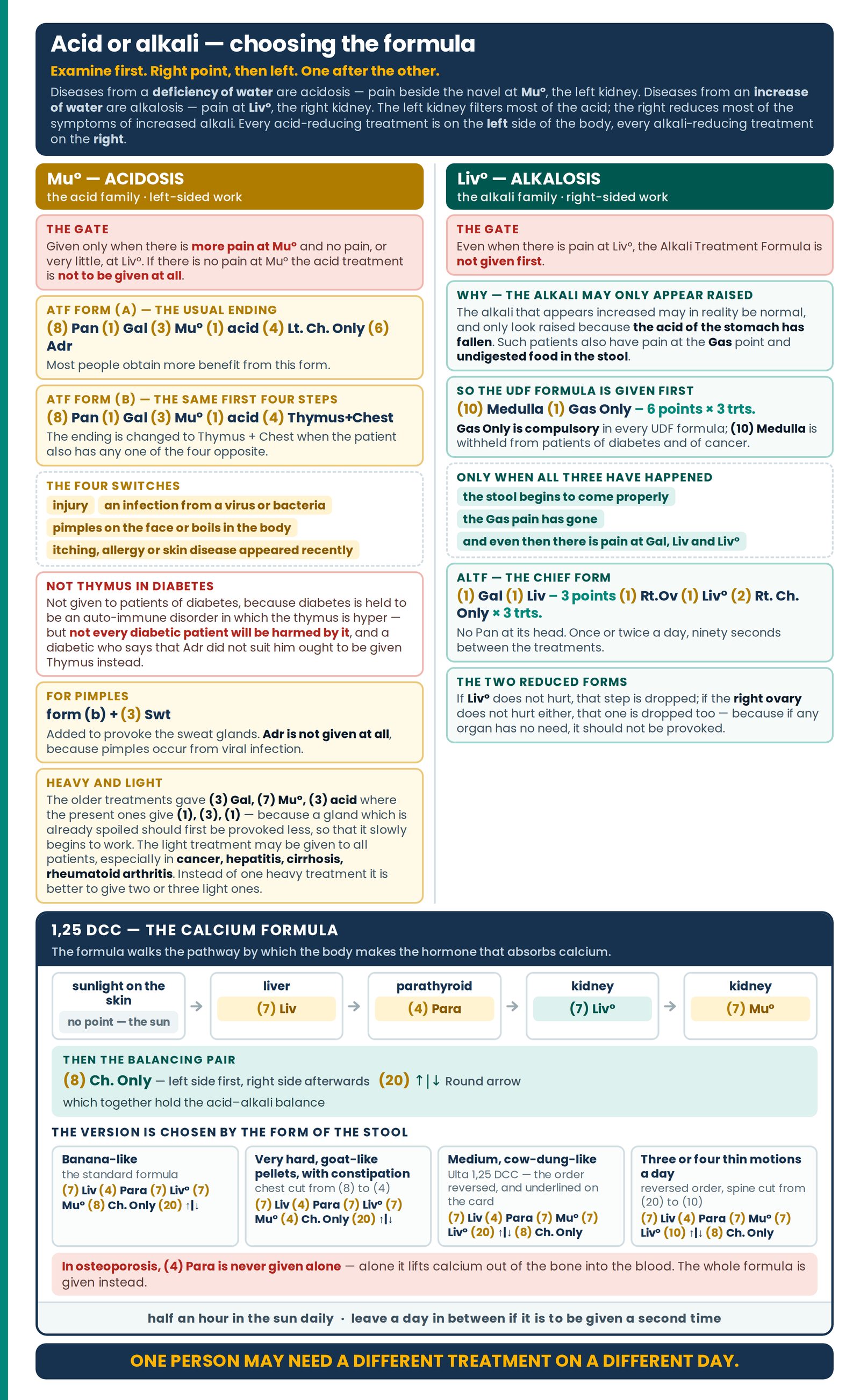
At a glance
Two figures, one poster and one plate — what to study before the test
Questions students ask
1. I am nineteen and new to the formulary. Mu° is tender at two plus and Liv° at one plus. Do I give ATF? Read the rule as it is written and you will answer your own question: ATF is used when there is more pain in Mu° and there is no pain in Liv° or very little indeed — and the chart states it with a grade, Mu°⁺⁺⁺. Two plus against one plus is not a clear picture; it is a picture in the middle. Do the digestive work of Setting the Stomach, write both grades down, and look again tomorrow. A therapist who can say not today is worth two who always have something to give.
2. I am a physician. What exactly is being asserted about acid and alkali here? Three separable things, and they should be kept apart. An observation: tenderness at two named sites beside the navel sorts patients into two clinical patterns — dry against wet, tight against loose, scanty against copious — that hang together and change from day to day. A set of sequences which, given to one pattern and not the other, are reported to change the pattern, sometimes within a session. And a naming convention, in which those two patterns are called acidosis and alkalosis. The first two are what you can examine at the mat. The third is the therapy's own vocabulary, and it is not the arterial blood gas on your ward. Keep the sign; be careful what you call it in a letter to a hospital.
3. Why does ALTF have no Pan at the start when everything else in this article does? Because the formula was built to reduce the pains of the organs of the right side — Gal, Liv, Liv°, Rt. Ov. — and Pan is the both-thighs opening of the digestive family. The absence is part of the formula, and it is one of the things that tells you ALTF is not simply ATF mirrored. Copy a formula's absences as carefully as its numbers.
4. I am a housewife treating my family. My husband's Liv° hurts and he has loose motions. May I just give ALTF? It is only six or eight presses. Its lightness is exactly the trap. No — not first. Check his Gas point and ask him whether anything comes out in the stool looking as it went in: tomato seeds, spinach leaves, whole chana. If the answer is yes, his alkali may not be raised at all; it may only look raised because his stomach is not making its acid, and what he needs is the UDF work first. Give ALTF only if, after some days, the stool comes properly, the Gas pain has gone, and the right-side points still hurt.
5. Both the calcium-deposit orders are for the same patients. May I give one in the morning and the other in the evening, since he needs both Thymus and Adrenal? No. Two complete orders are written, and nowhere is there an instruction to combine them or to give both in a day. Where the material gives you two complete sequences and no instruction to combine them, they are choices. Version II ends at ten adrenal applications — the heaviest in the article — and the patients named for these orders are stiff, elderly or children with CP. Give one, write down which, and reconsider next time with the finding in front of you.
6. I work in a village and have no laboratory. The 1,25 DCC section is full of numbers — 9 to 11 mg/dl, pH 7.32, creatinine. Am I supposed to have those? No. You are supposed to know that they exist, so that you can say to a family: there is a blood test that would settle this, and it is worth doing. A therapist who can name the test that would answer a question is not less of a therapist for not owning the machine — he is more useful than one who has never heard of it. What you must have is the referral and the habit of using it.
7. What actually changed between the heavy and the light treatment? It looks like the same formula. It is the same formula. The same six steps in the same order, with the opening and both endings untouched. Three counts came down — Gal from three to one, Mu° from seven to three, acid from three to one — and one step acquired a side, Ch. Only becoming Lt. Ch. Only. The reduction fell precisely on the steps aimed at the acid itself. The reason is one sentence: a gland which is already spoiled should first be provoked less, so that it slowly begins to work.
8. I am sixty-six and learning this for my own household. Why is the sun in a formula? Because the first step of the chain the formula follows happens in your skin, not in your hands. A chemical lying under the skin is changed by the sun's rays into the raw form of vitamin D; the liver makes the next form; the parathyroid gland adds its hormone; and only then do the kidneys make the finished thing that lets calcium cross the wall of your intestine. The formula provokes the last three organs. The sun does the first step and nothing else can do it for you — ten to fifteen minutes of the gentle morning sun on the beads of the spine, and half an hour daily while the treatment is running.
9. The Gas 'I' warning says not to talk. Surely that is about concentration in general? It is about arithmetic. Six seconds at every place is what makes (6) Gas 'I' the treatment it is. Hold each place for nine seconds instead and you have not given a slightly generous (6); you have given (9) Gas 'I' — which is the rung the therapy says may raise the blood pressure, in a patient you were treating to lower it. Talking is simply the commonest way a six-second count becomes a nine-second one. If you cannot count and talk at once, do not talk.
10. Every article tells me to re-examine daily. Is that not excessive for a patient who is clearly doing well? It is written for exactly that patient. The woman at Chandigarh was doing clearly well — she said so herself, and the queue had heard her say it. The treatment that had corrected her acid on Monday corrected it again on Tuesday, past the middle and into the opposite kingdom, and she wept from pain she had not arrived with. The patient who is doing well is the patient whose body has changed most since you last examined it.
11. If (4) Para lifts calcium out of the bone, how can the same point be part of the formula for osteoporosis? Because a point in a formula is not the point alone. Given separately by itself it lifts calcium from the bone into the blood, and that is the action wanted where bone has grown at an unwanted place. Inside the 1,25 DCC formula it maintains the calcium of the blood by means of PTH — the hormone whose presence the kidneys require before they can make 1,25 DCC at all — with Liv ahead of it and the two kidney points behind it. The bar is written against the word separately, and a rule about how a thing is delivered rather than whether it is delivered is a more sophisticated rule than it looks.
12. (9) Gas 'I' is written with "perhaps" and "this is to be tested". Am I allowed to use it? Your duty at such a sentence is neither to act on it nor to ignore it. It marks a place where a reason has been thought out and the result has not yet been seen, and it is printed among settled instructions precisely so that nobody mistakes one kind of sentence for the other. The therapy says plainly why it could not settle the question — patients of low BP come only occasionally. Know it is there; know what would settle it; and if you are ever one of the people who tries it, write down what happened, including the times nothing happened. See also → The Record That Shows the Truth, "The Record That Shows the Truth".
Questions patients ask
1. "You are pressing my left thigh and my left side for a problem in my bones. What has one to do with the other?" The place I press is not the place that is unwell — it is the place from which that organ can be reached. In this therapy, pressure on the left side of the body relieves what is happening on the right of the navel and the other way about, and the two points beside your navel that I check first stand for your two kidneys. Your kidneys are part of how your body keeps its calcium. I am not pressing your bones. I am working on the road that supplies them.
2. "Last week you gave me one treatment and today you have given me a different one. Have you changed your mind about my illness?" No — I have changed it about your body, which is not the same thing. This therapy treats the condition a person is in on the day, and that condition genuinely does move. Last week one point beside your navel was painful; today it is quiet and another is tender. If I gave you last week's treatment today I would be treating the person you were, and there is a well-known case in this work of a woman who was harmed by exactly that kindness.
3. "My blood test says my calcium is normal. Why are you treating me for calcium?" Good — and that report matters; I am glad you brought it. What a normal calcium tells us is that the level in your blood is being held where it should be. It does not tell us what it is costing your body to hold it there, and it does not tell us how well the calcium in your food is getting across the wall of your intestine. What I am going by is the tenderness I found on you, which you did not know was there, and what happens to your symptoms over the next few weeks. If anything changes in your picture, I will send you back for another opinion — and please keep taking whatever your doctor has given you.
4. "I have diabetes. Somebody said this treatment can bring the sugar down. Should I reduce my medicine?" Please do not, and please do not let anyone but your own doctor change it. It is true that on some patients this work has been followed by the sugar coming down, and that is a good thing — but it is exactly why your readings matter more now, not less. Keep taking what you have been prescribed, keep checking, and keep something sweet in your pocket. Take your readings to your doctor and let him decide whether a dose should change. A therapist who tells you to cut your medicine is telling you something he has no way of knowing.
5. "I have been told my bones are thin. My neighbour got a treatment for her bone spur and says it is very good. Can I have the same?" No, and I am glad you asked before somebody gave it to you. There is a point in this work which, given on its own, draws calcium out of the bones and into the blood. For your neighbour, whose trouble is a bone growing where it should not, that is precisely what is wanted. For you it is the opposite of what is wanted. What you are given is the whole formula, in which that same point does a different job because of what stands before and after it — and I will also be careful about how much pressure goes anywhere near your spine.
6. "Why are you asking me about my stool every time I come? It is embarrassing." I know, and I am sorry — but it is the most useful question I have. The shape of it tells me how long your food has spent travelling through you, which is something no report will tell me and you can tell me in three words. It decides which version of your treatment I give today: one for a stool like a banana, another for hard little pieces, another for a soft one. If it helps, you need only tell me which of those it is like.
7. "You are sending me for a scan, but you also say the treatment will help. Which is it?" Both, and they are not in competition. The scan answers a question I cannot answer with my hands — what is this lump, exactly — and that question has a deadline. The treatment I give works on how your body is functioning, and it can run alongside anything. What I will not do is let this work become the reason a question goes unanswered for six months. Go for the scan, come back with it, and we will carry on.
8. "Is my acid high, then? Should I stop eating sour things?" The word acid here is not the acid in your stomach and it is not something measured in a lab report. It is the name this therapy gives to a whole pattern — dry skin, hard stool, a blocked nose, a headache at the temples, tenderness at a particular spot beside your navel — that tends to travel together. It is a direction, not a reading. The rules about food during treatment are a separate matter and I will give them to you in writing. See also → Food as Medicine, "Food as Medicine".
Words used here
| Hindi | English | Neurotherapy code / usage | |
|---|---|---|---|
| — | Acidosis | The family of diseases arising from a deficiency of water; pain at Mu°; corrected by ATF and the other left-sided work | |
| — | Alkalosis | The family arising from an increase of water; pain at Liv°; corrected by ALTF and the other right-sided work — after the UDF formula | |
| — | Mu° · Liv° | The left and right kidney codes beside the navel. The left kidney filters most of the acid; the right reduces most of the symptoms of increased alkali | |
| — | ATF | Acid Treatment Formula. Form (a) (8) Pan (1) Gal (3) Mu° (1) acid (4) Lt. Ch. Only (6) Adr · form (b) the same four steps ending (4) Thymus+Chest | |
| — | ALTF | Alkali Treatment Formula. (1) Gal (1) Liv – 3 points (1) Rt.Ov (1) Liv° (2) Rt. Ch. Only × 3 trt. — no Pan | |
| — | Th + Ch | Thymus + Chest, given as one step. Not to patients of diabetes, with its qualification | |
| फुंसी / मुँहासे (phunsī / muṁhāse) | Pimples, acne, black heads | ATF form (b) + (3) Swt; Adr is not given | |
| भारी / हल्का उपचार | Heavy / light treatment | The older and the present generations of ATF. Two or three light treatments in place of one heavy one | |
| — | UDF | UnDigested Food in stools — tomato or bhindī seeds, spinach, methī, dhaniyā or curry leaves, whole groundnut, gram, peas or corn. The prerequisite of ALTF — Clearing the Ash | |
| — | Gas Only | The compulsory element of every UDF formula, in every generation | |
| — | 1,25 DCC | 1,25-dihydroxycholecalciferol — a steroid hormone, made from cholesterol, whose work is the absorption of calcium | |
| — | Pure 1,25 DCC | (7) Liv (4) Para (7) Liv° (7) Mu° — very powerful; used very little indeed. In the intestines only calcium will be absorbed | |
| — | The 1,25 DCC formula | Pure 1,25 DCC + (8) Ch. Only (20) ↑\ | ↓ — absorbs every kind of electrolyte; half an hour in the sun daily |
| उल्टा (ultā) | Reversed | Ulta 1,25 DCC — Mu° before Liv°, the arrow before the chest, underlined — for the cow-dung-like stool | |
| केले जैसा · बकरी जैसा · गोबर जैसा | Banana-like · goat-like · cow-dung-like | The stool forms by which the version of the 1,25 DCC formula is chosen | |
| — | PTH | Parathormone, from the parathyroid gland. Without PTH, 1,25 DCC cannot be produced at all | |
| — | Calcitonin | From the thyroid, above 11 mg/dl; tells the osteoblasts to put calcium into the bones. It has no control over PTH | |
| — | Pure Genes | Pure 1,25 DCC + (8) Lt Parkhoo — for genetic disorders; very much strong — Vitamin and Gene Formulas | |
| — | Gas 'I' ladder | (12) Parkinson's · (9) perhaps BP will rise — to be tested · (6) systolic BP down · (3), for which (1) Gas 'I' – 6 points is nowadays given instead | |
| गोंद (gond) | Edible gum | Gives greater strength to the bones; the gond laddu fed to women after delivery | |
| — | Degenerative / proliferative | Eating away / growing. Degeneration stands in the acid column — whatever disease has come because of degeneration we can set right by giving ATF |