Watch


How this article differs from Each Point in Use — read this first
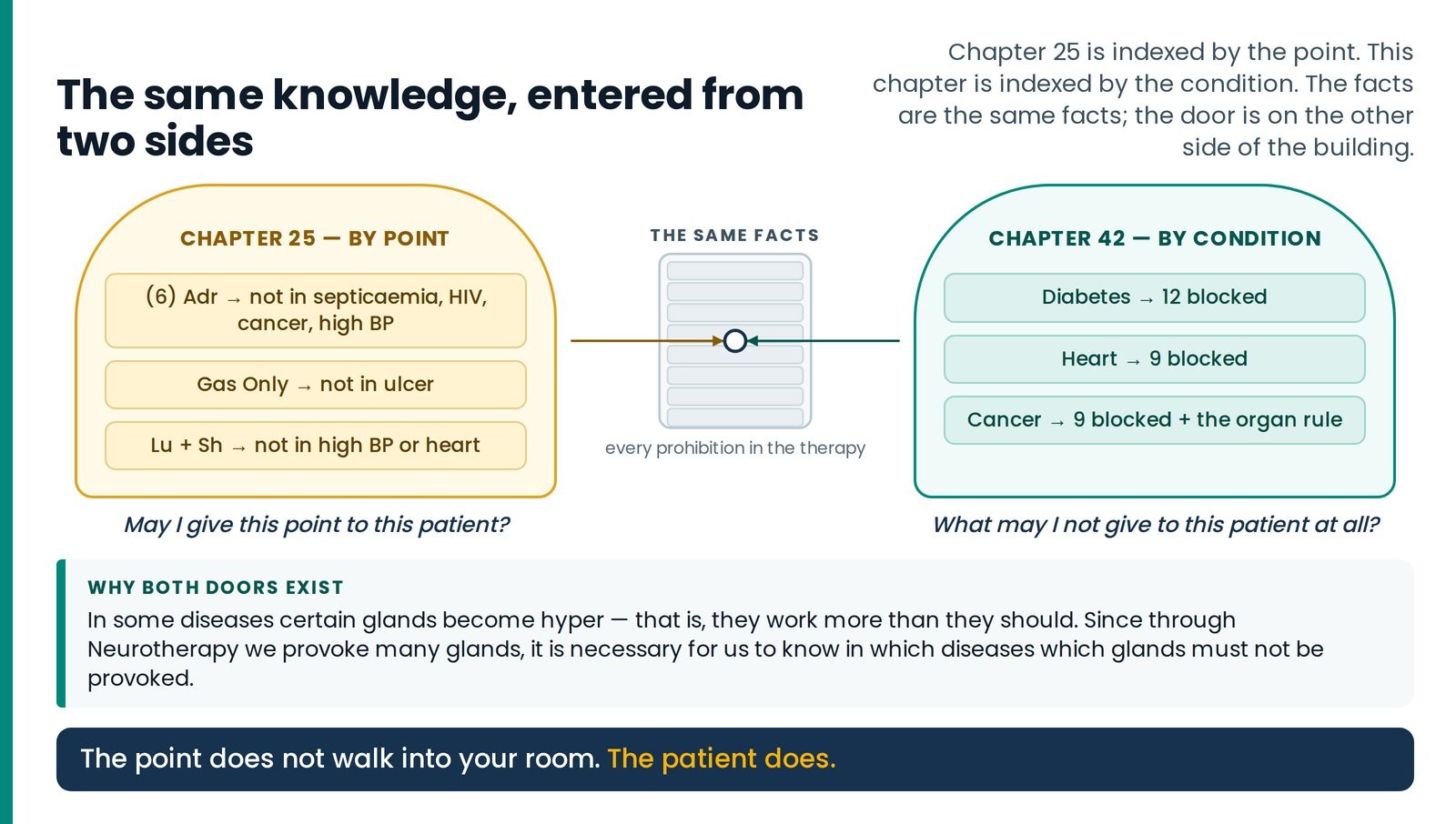
Chapter 25 is indexed by the point; this one by the condition
Each Point in Use is indexed by point. This article is indexed by condition. The facts are the same facts; the door is on the other side of the building.
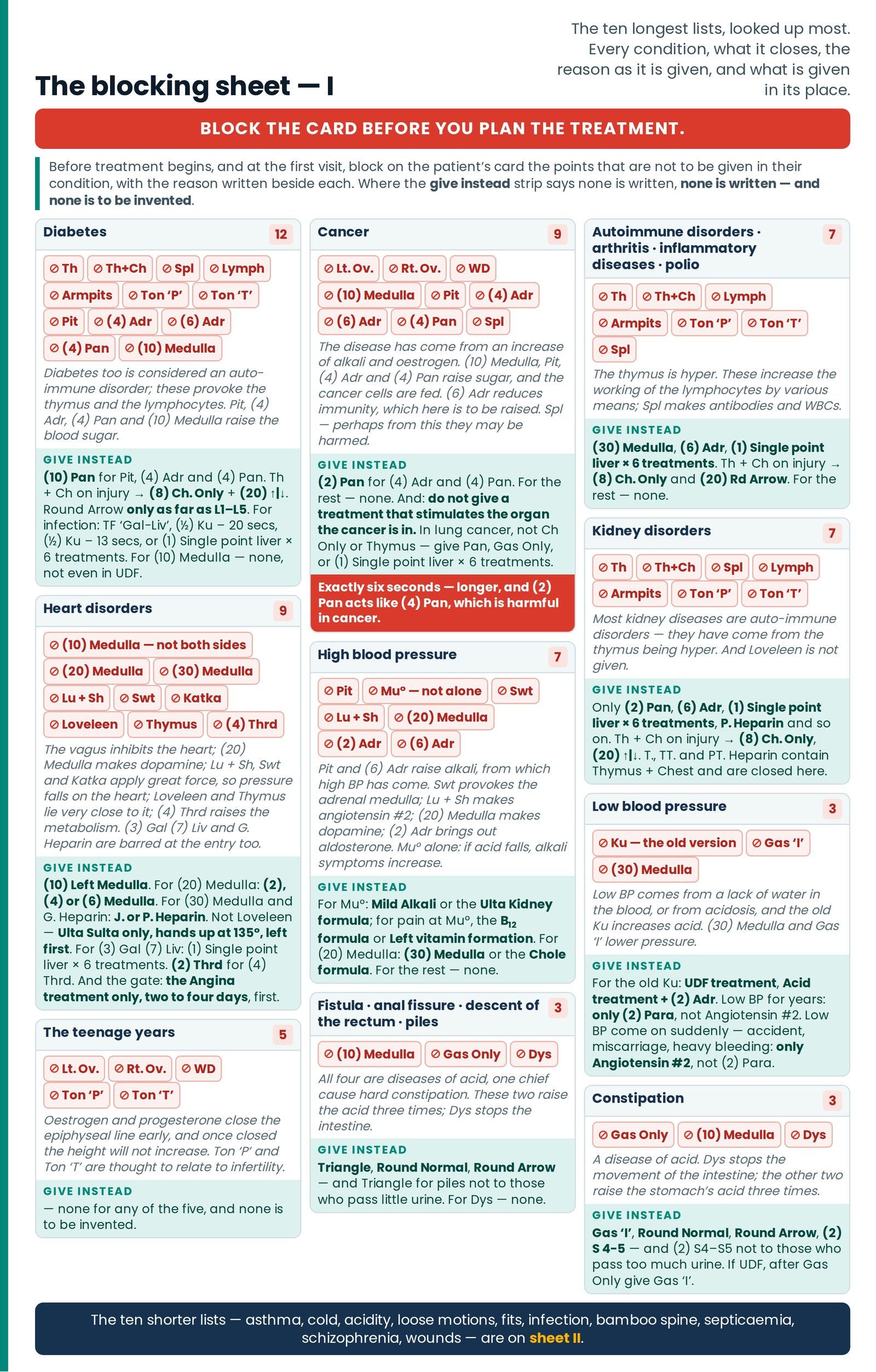
That is not a tidy distinction, it is the difference between a article you read and a article you use. In Each Point in Use, "Each Point in Use", you look up (6) Adr and learn what it is for and who must not have it. That is the right shape for a student who is learning the atlas, and the wrong shape entirely for a therapist with a patient on the mat. The patient does not arrive as a point. She arrives as a woman of fifty-one with diabetes, a thyroid on tablets, one kidney that was operated on nine years ago, and a knee — and what that therapist needs, in the four minutes before treatment begins, is not twenty point entries read one after another. It is one entry, headed with her condition, carrying everything that is shut off and everything that opens in its place. (Figure 42.1)
So the two articles divide cleanly and neither repeats the other.
| Each Point in Use | This article | |
|---|---|---|
| Indexed by | The point | The condition |
| Question it answers | May I give this point to this patient? | What may I not give to this patient at all? |
| Used | While learning, and while checking one decision | Before the first treatment, with the card open |
| Holds | Every point's indications, its own prohibitions, the notes attached to it | Every condition's blocked list, its reasons, its substitutions — and every bar the rest of the wiki laid down, gathered |
| Same-session exclusions | The paired treatments that pull against each other — Table 21 there | Re-indexed by the finding in front of you today, and when the bar lifts |
Wherever a point is named here, its own full entry stands in Each Point in Use and the cross-reference is given. Nothing is taught twice in full. What is done here — and done nowhere else in this wiki — is the inversion: every prohibition in the therapy, sorted by the person it protects.
Why a therapy that stimulates must know what is already overworking
Read the reasoning that produced this article, because it is honest and it is the whole argument.
In some diseases certain glands become hyper — that is, they work more than they should. Since through Neurotherapy we provoke many glands, it is necessary for us to know in which diseases which glands must not be provoked.
That is the entire premise, and notice what follows from it. A prohibition here is almost never this will hurt her. It is this will give her more of the very thing she already has too much of. A thyroid point in a body whose metabolism is already racing. A sugar-raising point in a body that cannot manage its sugar. A point that suppresses immunity in a body whose immunity has already failed.
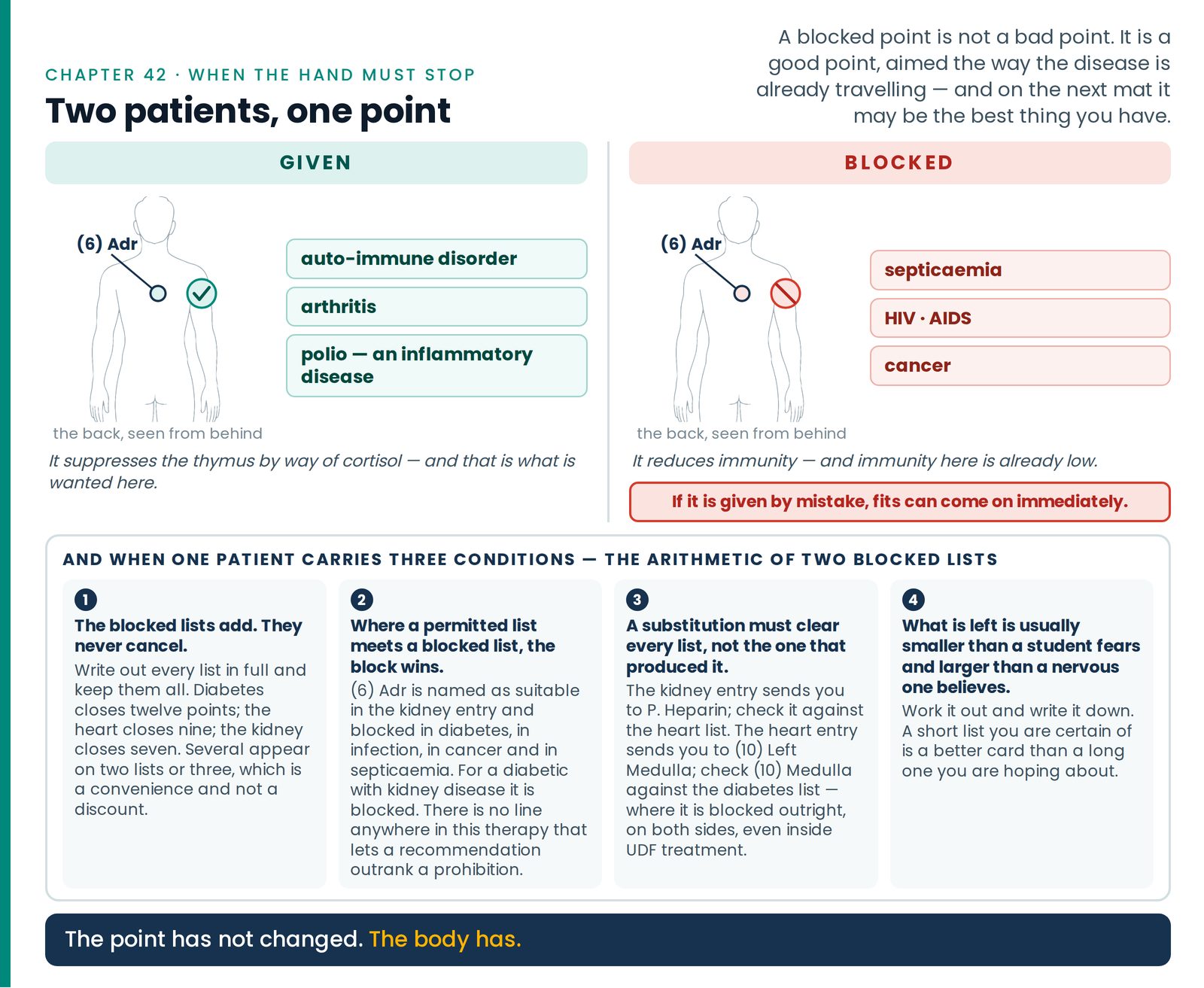
So a blocked point is not a dangerous point. It is a good point, aimed the way the disease is already travelling. The same point, in the patient on the next mat, may be the best thing you have.
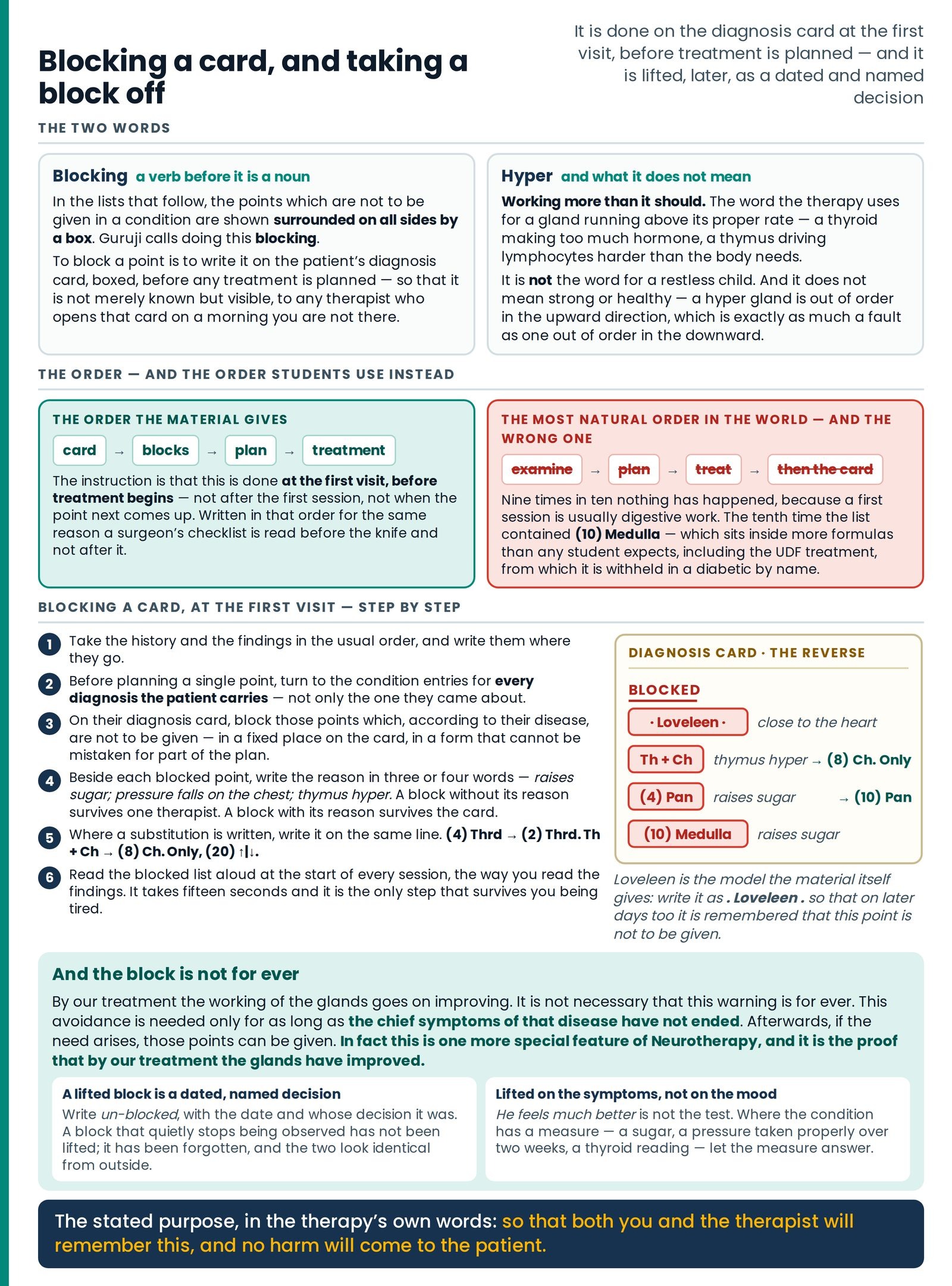
What blocking is
A verb before it is a noun — the boxed point, written before the plan
And the block is not for ever
It lifts when the chief symptoms end, and the lifting is itself a result
This is the sentence students most often miss, and it changes the whole character of the article. (Figure 42.2)
When a block comes off — and what lifting it proves
By our treatment the working of the glands goes on improving. It is not necessary that this warning is for ever.
This avoidance is needed only for as long as the chief symptoms of that disease have not ended. Afterwards, if the need arises, those points can be given.
In fact this is one more special feature of Neurotherapy, and it is the proof that by our treatment the glands have improved.
Read the last line twice. The therapy is not merely tolerating its own restrictions; it treats the day a block can be lifted as a clinical result — as good evidence of improvement as any number on a slip of paper. A card that carried twelve blocked points in January and carries four in November has recorded something.
Two working consequences follow, and both belong on the card rather than in the memory.
A lifted block is a dated, named decision. Write un-blocked, with the date and whose decision it was, exactly as you would write a change of formula. A block that quietly stops being observed has not been lifted; it has been forgotten, and the two look identical from outside.
And a block is lifted on the chief symptoms of the disease having ended, which is a clinical judgement and not a mood. He feels much better is not the test the sentence sets. The chief symptoms of that disease have not ended is. Where the condition has a measure — a sugar, a pressure taken properly over two weeks, a thyroid reading — let the measure answer, because it is the honest reading of the instruction and because it protects you.
The master index
Every condition the therapy warns about, and the points each one closes
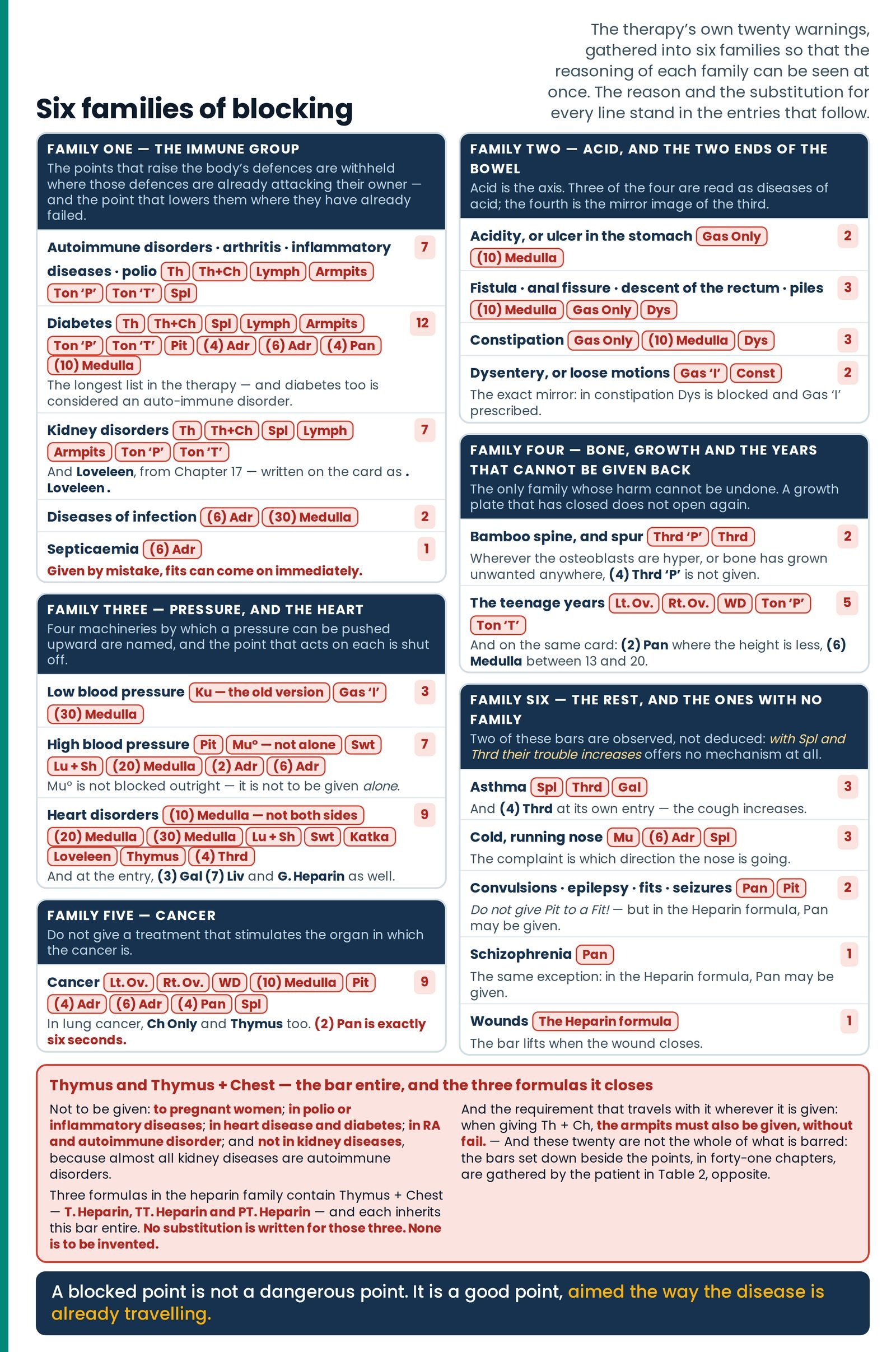
This is the page to photograph and keep. Every condition named in the therapy's own warnings, with the points blocked in it. The reasons, the substitutions and the qualifying detail follow, condition by condition, in the rest of this article — and this table is no substitute for them, because a bar without its context is half an instruction. (Figure 42.3)
The entries follow the therapy's own order of teaching, gathered into six families so that the reasoning of each family can be seen at once. Every bar carries the reason given for it. Where a reason is given as a perhaps, it is written as a perhaps. Where no reason is given, the bar stands bare and none is invented.
Family one — The immune group
Defences not raised where they already attack, nor lowered where they failed
Five conditions sit together here because one idea runs through all five: the points that raise the body's defences are withheld where those defences are already attacking their owner, and the point that lowers them is withheld where they have already failed. Learn the family and you have learnt most of the individual lists.
Autoimmune disorders · arthritis · inflammatory diseases · polio
Blocked: Th · Th+Ch · Lymph · Armpits · Ton 'P' · Ton 'T' · Spl ▲ Take care
| Blocked | The reason as it is given | Given instead |
|---|---|---|
| Th, Th+Ch, Lymph, Armpits, Ton 'P', Ton 'T' | Auto-immune disorders are those diseases in which the thymus becomes hyper. These points increase the working of the lymphocytes by various means, which is harmful in both auto-immune disorder and inflammation | — |
| Th + Ch, where there has been an injury | As above | Give (8) Ch. Only and (20) Rd Arrow in place of Th+Ch |
| Spl | Spl makes antibodies and WBCs. So it is not given in auto-immune disorder | — |
And what these patients are given: (30) Medulla, (6) Adr, and (1) Single point liver × 6 treatments.
Arthritis is also considered an auto-immune disorder — and therefore carries this whole list.
And one line is kept exactly as it stands, because it is a record of practice changing: nowadays Spl has begun to be given in inflammatory diseases. It was not given before. Read it as it is written. The bar on Spl in autoimmune disorder is not touched by it; what has changed is the inflammatory half.
Diabetes
Blocked: Th · Th+Ch · Spl · Lymph · Armpits · Ton 'P' · Ton 'T' · Pit · (4) Adr · (6) Adr · (4) Pan · (10) Medulla ▲ Take care
The longest list in the therapy, and the one a village therapist will use most often.
| Blocked | The reason as it is given | Given instead | |
|---|---|---|---|
| Th, Th+Ch, Lymph, Armpits, Ton 'P', Ton 'T' | Diabetes too is considered an auto-immune disorder. All these points provoke the working of the thymus and the lymphocytes by various means | — | |
| Th + Ch, on injury | As above | Give (8) Ch. Only (20) ↑\ | ↓ in place of Th + Ch |
| Spl | It will provoke the working of the WBCs, which is harmful in auto-immune diseases | — | |
| Pit, (4) Adr, (4) Pan | They raise sugar | (10) Pan may be given | |
| (10) Medulla | From it the quantity of blood sugar will increase. Therefore it is not given even in UDF treatment | — | |
| The Full Round Arrow — modified, not abandoned | Giving the Full Round Arrow will provoke both the thymus and the adrenal gland. So that the patient is not harmed by one or the other | Round Arrow is to be given only as far as L1–L5 |
And the treatment written for the diabetic who is (6) Adr's own best case: many people have benefited from (6) Adr, because it suppresses the thymus by way of cortisol. Giving such people Lt. Ov. treatment brings the sugar under control quickly — Lt. Ov. will make oestrogen, which will inhibit the thymus.
And immediately beside it, in the therapy's own italics: *but some people do not feel well after being given (6) Adr; then perhaps giving them Thymus may be of benefit.* That sentence is preserved exactly as it stands. It is an instruction that the patient's own report outranks the scheme, and it is not to be tidied.
For infection in a diabetic patient, in place of the viral formula one may give — TF 'Gal-Liv', or (½) Ku – 20 secs, or (½) Ku – 13 secs, or (1) Single point liver × 6 treatments.
Kidney disorders
Blocked: Th · Th+Ch · Spl · Lymph · Armpits · Ton 'P' · Ton 'T' · Spl ▲ Take care
| Blocked | The reason as it is given | Given instead | |
|---|---|---|---|
| Thymus and its group | Most of these are auto-immune disorders — that is, they have come from the thymus being hyper. So Thymus is not given | — | |
| Th + Ch, where there has been an injury | As above | In place of Th + Ch give (8) Ch. Only (20) ↑\ | ↓ |
These are to be given only (2) Pan, (6) Adr, (1) Single point liver × 6 treatments, P. Heparin and so on.
And one bar reaches this patient from another article and must be carried here: Loveleen is not given to kidney patients or to heart patients — and on the card of such a patient it is written . Loveleen . in that form, so that on later days too it is remembered.
Notice the architecture doing the work in the permitted list. P. Heparin is named as suitable, and T., TT. and PT. Heparin are not — because those three contain Thymus + Chest, and Thymus + Chest is blocked here. The patient who needs the heparin family and has a kidney disease is a patient for the forms without a thymus in them.
Diseases of infection
Blocked: (6) Adr · (30) Medulla ▲ Take care
Two lines, and they are the exact mirror of the autoimmune entry. There, (30) Medulla and (6) Adr are what the patient is given and the thymus group is shut off. Here the same two lists have changed places. Nothing has been contradicted: in one disease the defences are attacking their owner and must be damped; in the other they are losing and must be raised. The direction of the disease chooses the direction of the treatment, and the points are the same points.
Septicaemia
Blocked: (6) Adr ▲ Take care
If it is given by mistake, fits can come on immediately. There is no other sentence in this wiki quite like it. Almost every bar in this article describes a harm that arrives slowly — a sugar that climbs over a week, an inflammation that worsens over days, a height that is quietly lost over years. This one describes something that happens in the room, while your foot is still on the patient. (Figure 42.4)
It is also the sentence that tells you what kind of patient is being described. A body in which bacteria have got into the blood in very large quantity is not a body that has come for a course of treatment. How that patient is recognised, and what is done with them, is Part five of this article.
Family two — Acid, and the two ends of the bowel
Acid is the axis, and the fourth entry is the mirror of the third
Four conditions, one model, and a symmetry so exact that a student who learns two of them has learnt all four. Acid is the axis. Three of the four are read as diseases of acid, and the same two points are shut off in all three for the same stated reason. The fourth is the mirror image of the third.
Acidity, or ulcer in the stomach
Blocked: Gas Only · (10) Medulla ▲ Take care
| Blocked | The reason as it is given | Given instead |
|---|---|---|
| Gas Only, (10) Medulla | From Gas Only and (10) Medulla the acid of the stomach will increase three times, and the trouble will increase | Acid Treatment formula, Normal, Ajay Normal, Round Normal and so on |
And the sequencing rule that travels with Gas Only everywhere: if UDF treatment is to be given, then after Gas Only one must give Gas 'I'; otherwise constipation can occur.
Fistula · anal fissure · descent of the rectum · piles
Blocked: (10) Medulla · Gas Only · Dys ▲ Take care
| Blocked | The reason as it is given | Given instead |
|---|---|---|
| Gas Only, (10) Medulla | All four of these are diseases of acid, and one chief cause of them is hard constipation. From these two points the acid of the stomach will increase three times, and the trouble will increase | Triangle, Round Normal, Round Arrow and so on |
| Dys | Carried from the constipation reasoning — the Dys point stops the movement of the intestine | — |
And again: if UDF treatment is to be given, then after Gas Only give Gas 'I'; otherwise constipation will increase.
One further bar rides on the substitution itself, and must be written on the card with it. Triangle for piles is what these patients are sent to — and Triangle for piles is not given to those who pass little urine, because it tightens the sphincters of the bladder, the uterus and the anal opening.
Constipation
Blocked: Gas Only · (10) Medulla · Dys ▲ Take care
| Blocked | The reason as it is given | Given instead |
|---|---|---|
| Dys | Constipation is a disease of acid. The Dys point stops the movement of the intestine. So from it the constipation will increase further | — |
| Gas Only, (10) Medulla | The acid of the stomach will increase three times. And constipation will increase | Gas 'I', Round Normal, Round Arrow, (2) S 4-5 and so on |
And the sequencing rule a third time: if UDF treatment is to be given, then after Gas Only give Gas 'I'; otherwise constipation will increase. It is written three times in three entries. Write it three times on three cards.
And the bar riding on the substitution: (2) S4–S5 is not to be given to those who pass too much urine, because it opens the sphincters and is given to increase urine.
Dysentery, or loose motions
Blocked: Gas 'I' · Const ▲ Take care
| Blocked | The reason as it is given | Given instead |
|---|---|---|
| Gas 'I' | Gas 'I' increases the motility of the intestine. So there will be still more loose motions | Gas khali and Swt |
| Const | Const corrects constipation. So those who have loose motions are not to be given Const | — |
Hold this entry beside the one above it. In constipation, Dys is blocked and Gas 'I' is prescribed. In loose motions, Gas 'I' is blocked and Const is blocked too. Neither point has changed what it does; the bowel has changed which way it needs pushing. This is the plainest demonstration in the therapy that a prohibition belongs to a body and not to a point.
Family three — Pressure, and the heart
Four ways a pressure can be pushed up, and the point for each shut off
Low blood pressure
Blocked: Ku (old version) · Gas 'I' · (30) Medulla ▲ Take care
| Blocked | The reason as it is given | Given instead |
|---|---|---|
| Ku — the old version | This comes from a lack of water in the blood, or from acidosis. From the old Ku treatment acid increases. So the old Ku is not given | UDF treatment, Acid treatment + (2) Adr and so on |
| (30) Medulla, Gas 'I' | They lower high blood pressure. So they are not to be given to low-BP patients | — |
And four further instructions belong to this entry whole, each with the detail that qualifies it.
The heparin caution, with its hedge intact. From Heparin treatment the diastolic BP falls. So perhaps giving it to low-BP patients could lower the BP still further. So give it thoughtfully, if there is need. That is not a bar. It is a think first, written as one, and it is to be carried as one.
The two kinds of low blood pressure, which are treated in opposite ways. This is the sharpest distinction in the whole article and it turns entirely on how the low pressure arrived.
| Which patient | What is given | What is not given |
|---|---|---|
| Those who have had low BP for years | Only (2) Para | The Angiotensin #2 formula is not given |
| Those in whom low BP came on suddenly — because of an accident, a miscarriage, or heavy bleeding in menstruation | Only the Angiotensin #2 formula | (2) Para is not given |
And the Swt note, with its perhaps: from Swt the adrenal medulla is provoked, so BP will rise. Perhaps it will be of benefit for low BP. Written as a possibility, carried as a possibility.
High blood pressure
Blocked: Pit · Mu° · Swt · Lu + Sh · (20) Medulla · (2) Adr · (6) Adr ▲ Take care
| Blocked | The reason as it is given | Given instead |
|---|---|---|
| Pit | Pit increases alkali. And high BP has come precisely from an increase of alkali | — |
| Swt | Swt will provoke the adrenal medulla, from which BP will rise further | — |
| Mu° — not to be given alone | Because if acid falls, the symptoms of alkali will increase | In its place give Mild Alkali or the Ulta Kidney formula. And if there is pain at the Mu° point, giving the B₁₂ formula or Left vitamin formation will bring relief |
| Lu + Sh | We give it in order to make angiotensin #2 by way of the converting enzyme, from which BP will rise | — |
| (20) Medulla | From it dopamine will be made, whose effect will make the heart contract more forcefully, so blood will come out in greater quantity and with greater pressure. So BP will rise | In its place give (30) Medulla or the Chole formula |
| (2) Adr | From it aldosterone will come out, whose effect will make the kidney hold on to salt, from which BP will rise further | — |
| (6) Adr | Giving (6) Adr will lower acid and raise alkali. So it is not given | — |
Read that column downward before you move on. Four separate machineries by which a blood pressure can be pushed upward are named — the fright chemicals of the adrenal medulla, the converting enzyme and angiotensin, dopamine acting on the force of the heartbeat, and aldosterone making the kidney hold on to salt — and the point believed to act on each one is shut off. Whether or not one agrees with every step, that is a therapy reasoning about its own mechanisms rather than reciting a list, and it is worth saying so to a doctor who asks what this article is.
Note also that Mu° is not blocked outright. It is not to be given alone — a bar on the point standing by itself, with two named replacements and a written remedy for the pain that prompted it. Copy the whole line onto the card, not the first three words.
Heart disorders
Blocked: (10) Medulla · (20) Medulla · (30) Medulla · Lu + Sh · Swt · Katka · Loveleen · Thymus · (4) Thrd ▲ Take care
| Blocked | The reason as it is given | Given instead |
|---|---|---|
| (10) Medulla — not on both sides | The vagus nerve inhibits the heart — that is, it slows its rate. Nowadays (10) Left Medulla is given | (10) Left Medulla Left |
| (20) Medulla | From it dopamine will be made, which increases cardiac contractility and output. Those who already have heart trouble will be burdened further by this | (2) Medulla, (4) Medulla or (6) Medulla may be given |
| (30) Medulla, and G. Heparin | Blocked together in one line | In their place give J. Heparin or P. Heparin |
| Lu + Sh, Swt, Katka | In all three of these, when giving them, physical pressure — that is, a good deal of force — is applied, so pressure will fall on the heart; therefore they are not given | — |
| Swt, again | Swt will provoke the adrenal medulla, from which BP will rise. Therefore it is not given | — |
| Loveleen, Thymus | The place of the Loveleen and Thymus treatments is very close to the heart. So from those treatments the heart can be troubled | Not giving Loveleen, give only Ulta Sulta — but with the hands kept up at 135° |
| (3) Gal (7) Liv | It improves the digestion of fats, from which the quantity of cholesterol in the blood will increase, which will increase the trouble in heart diseases | (1) Single point liver × 6 treatments |
| (4) Thrd | From (4) Thrd the metabolism — chayāpachaya — will increase, from which a burden will fall on the heart and the trouble can increase | In place of (4) Thrd, (2) Thrd is given |
This entry contains two of the most instructive rules in the wiki, and both are instructions rather than exceptions.
Sulta Ulta in angina — the angle and the order are the treatment
Two things are said about the chest in a heart patient, and both are true because each carries its own qualifying detail.
Loveleen and Thymus are withheld, because the place of those treatments is very close to the heart, and from them the heart can be troubled.
And Sulta Ulta is given. Sulta takes out the pain at the front of the chest; Ulta takes out the pain of the back behind the chest. For those who have angina or heart disease, keeping both arms extended — not parallel to the shoulders, but a little upward, at 135° — and giving it, the pain of the chest, or the suffocation that is felt in it, will end.
And the order: it is not necessary to give both sides at the same time. Give the left side first and the right afterwards. Left then Right
The angle is not a comfort adjustment and the order is not a convenience. Arms at 135° rather than parallel to the shoulders change what the chest wall does under the hand; one side at a time, left first, is how the instruction is written and how it is given. Strip either detail away and you no longer have the treatment that was described.
(10) Left Medulla names the half that may be given
(10) Medulla is not to be given on both sides, because the vagus nerve inhibits the heart — that is, it slows its rate. Nowadays (10) Left Medulla is given.
Read that as literally as it is written. It does not withhold the treatment from a heart patient. It names the half that may be given — and side is part of the identity of a point, not a detail of technique. (10) Medulla and (10) Left Medulla are two entries, and a card carrying the second has not been given a reduced version of the first.
The bars attaching to (10) Medulla are inherited by every formula that contains it and by no formula that does not.
And the gate before the formula. A heart patient for whom the Vater formula is intended does not receive it first. Patients of heart disease must first be given the Angina treatment only. After two to four days of that, when their health improves a little, the Vater treatment may be given — and then in its cardiac form.
Family four — Bone, growth and the years that cannot be given back
The only bars in the chapter whose harm cannot be undone
Bamboo spine, and spur
Blocked: Thrd 'P' · Thrd ▲ Take care
| Blocked | The reason as it is given |
|---|---|
| Thrd 'P', Thrd | Bamboo spine comes because of the deposition of calcium between the bones, whereas spur comes because of the bone growing in an unwanted form. Thrd 'P' through the osteoblasts, and Thrd through calcitonin, will increase calcium in the bones — so the disease will increase |
Two points, two named mechanisms of bone building, and a disease of too much bone being built. It is one of the cleanest arguments in the therapy: the levers by which bone is laid down are identified, and in a disease of excessive laying-down neither lever is pulled.
And the same bar in its other wording, from the point's own entry, which reaches further than the two named diseases: in a disease in which the osteoblasts are hyper — bamboo spine, or spur, or where bone has grown unwanted anywhere in the body — (4) Thrd 'P' is not given. That last clause matters, because it covers the patient whose report says calcification at a shoulder or a heel and who has never heard either of the two names.
The teenage years
Blocked: Lt. Ov. · Rt. Ov. · WD · Ton 'P' · Ton 'T' ▲ Take care
| Blocked | The reason as it is given |
|---|---|
| Lt. Ov., Rt. Ov. | Oestrogen and progesterone provoke the epiphyseal line to close early. If it has closed, after that the height will not increase. Therefore those whose height is low are not to be given Lt. Ov. and Rt. Ov. |
| WD | It provokes the genital organs, so from that too perhaps oestrogen will be made |
| Ton 'P', Ton 'T' | The parotid glands at the side of the cheek have some kind of relation with the testes. Because when, in the disease called mumps — kanphūl — the parotid glands swell, during that disease in some boys the testes disappear, after which they are not able to become fathers. Therefore it is thought that Ton (P) and Ton (T) have some relation with infertility. So to those young people — especially to women, up to the age of bearing children — Ton (P) and Ton (T) are not given |
No substitute is named for any of the five, and none is to be invented.
Two further bars belong to the same growing body and are written elsewhere, and both must go on the card together with these. (2) Pan is not given to a child whose height is less, or who is taking treatment to increase height — it stops growth hormone; (4) Pan or (10) Pan may be given instead. And (6) Medulla is withheld from a boy or girl between 13 and 20 who is being treated for height — somatostatin stops growth hormone — unless there is special need.
This is the only family of bars in the article whose harm cannot be undone. A sugar that rose comes down. An inflammation that flared settles. A growth plate that has closed does not open again. Write these blocks in the same ink as the others and treat them as a different order of thing.
Family five — Cancer
Nine points closed, and one portable question about the organ
Blocked: Lt. Ov. · Rt. Ov. · WD · (10) Medulla · Pit · (4) Adr · (6) Adr · (4) Pan · Spl ▲ Take care
| Blocked | The reason as it is given | Given instead |
|---|---|---|
| Lt. Ov., Rt. Ov., WD | The disease of cancer has come because of an increase of alkali and oestrogen. It has been found that Lt. Ov. makes oestrogen in greater quantity and Rt. Ov. in lesser quantity; WD provokes the genital organs, from which the quantity of oestrogen can increase. Therefore these three are not given | — |
| (10) Medulla | It provokes the digestive system by way of the vagus nerve. From this the sugar in the blood can rise, from which the cancer cells will get nourishment and the disease can increase | — |
| Pit | From Pit both alkali and sugar increase | — |
| (4) Adr, (4) Pan | They increase sugar | In their place give (2) Pan — and see the six-second rule below |
| (6) Adr | Adr will reduce the thymus and immunity. In this disease immunity is to be increased | — |
| Spl | By Spl we provoke the spleen, which stops inflammation. Perhaps from this they may be harmed. So do not give | — |
And the rule that is worth more than the list.
Do not stimulate the organ the cancer is in
Do not give a treatment that stimulates the organ in which the cancer is — for example, in cancer of the pancreas, do not give (2) Pan.
This is the most portable sentence in the article. It is not a list to memorise; it is a question to ask, and it works for organs that appear in no table anywhere: what is the name of the organ this cancer is in, and which point in my plan is aimed at that organ?
And its worked example, given in full: in lung cancer, do not give Ch Only or Thymus. In their place one may give 'Pan', or 'Gas Only', or (1) Single point liver × 6 treatments.
Note what has happened there. The general rule barred the chest points because the cancer is in the chest; the entry then names three substitutes that are nowhere near it. That is the pattern to copy when your patient's cancer is somewhere the tables do not mention.
And one line preserved exactly as it stands, hedge and all: on Spl in cancer — nowadays it is not given in cancer. The nowadays is part of the sentence and stays in it.
Family six — The rest, and the ones with no family
Five entries, two of them observed rather than reasoned out
Asthma
Blocked: Spl · Thrd · Gal ▲ Take care
| Blocked | The reason as it is given | Given instead |
|---|---|---|
| Spl, Thrd | With Spl and Thrd their trouble increases | — |
| Gal | Gal can increase inflammation in the lungs. So Gal, Spl and Thrd are not given | — |
| (4) Thrd, at its own entry | In asthma the cough increases, so do not give | — |
With other treatments, they will benefit from (1) Single point liver × 6 treatments.
Two of those three bars are of the rarest and most valuable kind: observed, not deduced. With Spl and Thrd their trouble increases offers no mechanism at all. Nobody worked it out; somebody watched it happen and wrote it down. Follow that kind exactly, and keep the same sort of record yourself.
And note what is not blocked, and is in fact given for breathing. (6) Left Swt, to open any sphincter, valve or duct that is narrowed, is given for those with difficulty breathing in asthma; Stretch and Electrical Waves are both named as excellent for asthma and breathing difficulties. An asthma card is not an empty card.
Cold, running nose
Blocked: Mu · (6) Adr · Spl ▲ Take care
| Blocked | The reason as it is given | Given instead |
|---|---|---|
| Mu | It is not to be given, because already more mucus is coming out of the nose | (4) Down Arrow will be of benefit |
| (6) Adr | Giving (6) Adr lowers acid and opens the blocked nose. Giving these will make the nose run more | — |
| Spl | Giving Spl also makes the nose run more in some people. Do not give them Spl | — |
Notice the precision of the second row, because a careless reader will miss it. The entry distinguishes a blocked nose from a running one, and blocks accordingly. Mu is given for a blocked nose and withheld in a running one. (6) Adr opens a blocked nose — which is why it is on the list here, where the nose is already running. The complaint is not "cold". The complaint is which direction the nose is going.
And the third row carries its own hedge — in some people. It is an individual observation, not a universal law, and the instruction attached to it is: do not give them Spl — them, the ones in whom you have seen it.
Convulsions · epilepsy · fits · seizures
Blocked: Pan · Pit ▲ Take care
| Blocked | The reason as it is given | The exception, written |
|---|---|---|
| Pan, Pit | This disease comes from an increase of alkali. Pan and Pit both increase alkali. So they are not given | But in the Heparin formula, 'Pan' may be given |
That line, exclamation mark and all, is how this therapy fixes its most important bar in a student's head, and it works. Say it aloud to yourself the first hundred times you write a card for a patient with epilepsy.
And the exception is as exact as the bar. Pan is barred in Normal treatment and permitted inside the Heparin formula — not because the bar has been softened, but because that is the instruction as it is written. It is the same exception granted in schizophrenia, and it appears in both entries.
One further bar reaches this patient from the atlas and must go on the same card. Electrical Waves was formerly given in fits. But now several other good treatments have come for fits. Therefore it is not given. Carried exactly: this is a practice that changed, not a danger that was discovered.
Schizophrenia
Blocked: Pan ▲ Take care
| Blocked | The reason as it is given | The exception, written |
|---|---|---|
| Pan | On being given 'Pan', some patients began to hear the sound of bells in the ear. So 'Pan' is not given in Normal treatment | But in the Heparin formula 'Pan' may be given |
One line, one observation, one withdrawal. Somebody gave a point, a patient reported something new, the point was taken off the list, and the fact was written down where other therapists would find it. That is what a safety record looks like when a tradition keeps one honestly, and it deserves to be recognised as such rather than read past.
And two things about the patient rather than the point. A person with these symptoms may experience a close position, an intimate posture, or pressure applied by a foot as frightening rather than merely uncomfortable. Explain before you touch, ask before each region, and stop instantly at any distress. And never frame improvement as evidence that an antipsychotic can be reduced.
Wounds
Blocked: the Heparin formula ▲ Take care
| Blocked | The reason as it is given |
|---|---|
| Heparin treatment | It is not to be given, because heparin prevents the blood from clotting, so the wound will not heal quickly |
The shortest entry in the article and one of the best reasoned. A clot is not the obstacle to healing; it is the scaffolding on which healing is built — the first thing a body does to a wound, and the mesh on which everything that follows is laid. A treatment aimed at keeping blood from clotting is aimed at the first stage of the repair.
And it is time-limited in its own terms. The heparin family's blow treatments are written for after the wound has dried — T. Heparin for the ordinary blow, TT. Heparin for the deeper or older blow and the haematoma, at ten to fifteen days once the serum has dried. The bar is on the open wound, and it lifts when the wound closes.
Do not work over or immediately around an open wound, a fresh incision, a graft or a burn. And send, rather than treat, a wound that is spreading red, increasingly painful, discharging pus, or accompanied by fever — and any wound in a diabetic foot that is not healing.
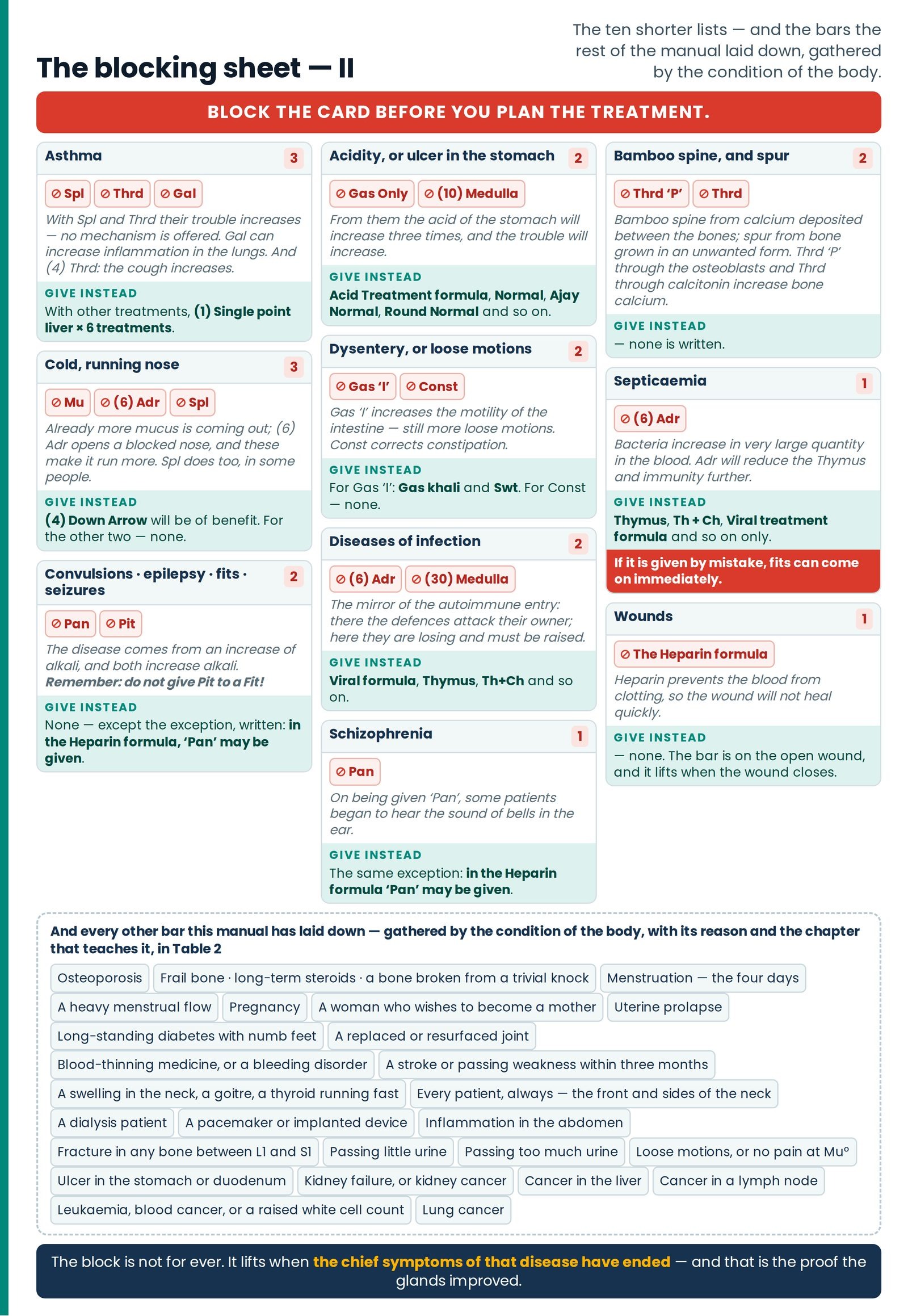
The twenty entries above are the therapy's own list of warnings. They are not the whole of what is barred. Across forty-one articles, bars have been set down one at a time, each beside the point it belongs to, where it belongs. Scattered, they are unusable at the mat. Gathered and sorted by the patient, they become the second half of this article's index. (Figure 42.7)
Each is given here with the condition that triggers it, the reason as it stands, and the article that teaches it. The point's own full entry is always elsewhere; this is the finding aid. (Figure 42.8)
Table 2 — Barred by a condition of the body
| The condition | What is withheld | The reason as it is given | Taught in |
|---|---|---|---|
| Osteoporosis | The foot, as the tool — the whole treatment is given with the hand only | Printed among the precautions before any treatment: small children, very weak persons, and any patient with osteoporosis are to be treated with the hand only | The Child, the Elder and the Frail |
| Osteoporosis | Shukla | For osteoporosis patients this treatment may perhaps increase the pain — so do not give them this treatment | Uncommon Problems · Each Point in Use |
| Osteoporosis | (4) Para given separately, by itself | Given alone it will lift calcium from the bone and put it into the blood. They must be given the full 1,25 DCC formula | The Front of the Body II · Correcting the Two Kingdoms |
| Osteoporosis · frail bone · long-term steroids · a bone broken from a trivial knock | Every jerk in the atlas — Katka, Motor neuron point, P point, the Pradeep jerk and its full-weight stage, Abdomen setting where a spinal bone has already crumbled | A jerk cannot be graded and cannot be withdrawn once begun | The Low Back · Knee, Leg, Foot · Uncommon Problems |
| Menstruation — the four days | Every treatment, except for the four named complaints of the menses themselves | No reason is given, and none is to be invented | Between Two Sessions · Treating Women |
| Menstruation | Ku — every form | No reason is given. None is to be invented | Face Down · Each Point in Use · Treating Women |
| A heavy menstrual flow | Every heparin formula | Heparin does not let the blood clot, so the flow will be still greater | The River — Heparin · Treating Women |
| Pregnancy | Thymus, Thymus + Chest | After giving this the babies begin to move about vigorously, from which it may be judged that the baby must be experiencing discomfort | The Front of the Body II · Each Point in Use · Treating Women |
| Pregnancy | Any treatment from which the child may have trouble; and the jerk points | Stated as the governing rule of the season | Treating Women |
| A woman who wishes to become a mother | Ton 'P' | At the point's own entry, no reason at all. Elsewhere: from this there may perhaps be some adverse effect on conception; it is also not proven that it prevents conception, therefore do not call it a contraceptive treatment. Research is to be done | Uncommon Problems · Each Point in Use · Treating Women |
| Uterine prolapse | Gas Only, (10) Medulla | Prolapse being read as a disease of acid — the acid of the stomach will increase three times | From Findings to a Plan · The Front of the Body I · Treating Women |
| Long-standing diabetes with numb feet | Body weight through any foot treatment — BOF, Big Toe Gas, the foot stage of the calf ghisāī | Sustained loading damages tissue whether or not it is felt, and in that foot the alarm is gone | Knee, Leg, Foot |
| A replaced or resurfaced joint | Body-weight compression and every jerk, permanently | Ask — people forget to mention a joint they have had for nine years | Knee, Leg, Foot |
| Blood-thinning medicine, or a bleeding disorder | Deep work and every jerk | Deep work leaves a bruise at pressure an ordinary patient does not notice | Knee, Leg, Foot · Uncommon Problems |
| A stroke, or a passing weakness, numbness or loss of vision, within three months | All neck work | For these patients there is no version of neck pressure that is acceptable | The Front of the Body II · Seated I — Brain, Medulla, Neck |
| A swelling in the neck, a goitre, a thyroid running fast | All neck work | Pressure there can squeeze the airway and push hormone into the blood | The Front of the Body II |
| Every patient, always | Pressure on the front or the sides of the neck, by foot or by hand, in any treatment, whatever a card says | At the fork of the great artery lies a patch of pressure sensors; squeeze it and you tell the brain a lie | The Front of the Body II · Seated I — Brain, Medulla, Neck |
| A dialysis patient | Pressure on the arm carrying the fistula, and abdominal work where a peritoneal catheter is in place | The access is the patient's lifeline and is not loaded, rubbed or used for a blood pressure cuff | Practice; see also Before You Touch Anyone |
| A pacemaker or implanted device | Work over the device site | — | Practice; see also Before You Touch Anyone |
| Inflammation in the abdomen | Folded legs | But if there is inflammation in the abdomen, do not give | Each Point in Use |
| Fracture in any bone between L1 and S1 | L3, 4, 5 | If there is a fracture in any bone between L1 and S1, it is not to be given | The Low Back · Each Point in Use |
| Passing little urine | Triangle for piles; and Gal | The Triangle tightens the sphincters. For Gal, the line attached is: this is a matter of experience | On the Side · Face Down · Each Point in Use |
| Passing too much urine | (2) S4 – S5 | It relaxes and opens the sphincters, and is given to increase urine | Face Down · Each Point in Use |
| Loose motions, or no pain at Mu° | (1) Acid / (2) Acid | Stated as written, at the point's own entry | On the Side · Each Point in Use |
| Ulcer in the stomach or duodenum | Gas Only | Do not give to those who have an ulcer in the stomach or duodenum | The Front of the Body I · Each Point in Use |
| Kidney failure, or kidney cancer | Mu° and Liv° — do not stimulate them | The instruction is do not provoke — उकसाना — rather than do not treat the patient | On the Side · Each Point in Use |
| Cancer in the liver | Liv — otherwise the point that may be given in any disease | But if there is cancer in the liver, do not give it | The Front of the Body I · Each Point in Use |
| Cancer in a lymph node | Lymph | If there is cancer in the lymph node, do not give | The Front of the Body II · Each Point in Use |
| Leukaemia, blood cancer, or a raised white cell count | Gal | Stated at the point's own entry | The Front of the Body I · Each Point in Use |
| Lung cancer | Ch. Only, Thymus | The organ rule — and three substitutes are named | The Front of the Body II · Each Point in Use |
When one patient carries three conditions
This is the ordinary case, not the difficult one. A man of sixty with diabetes, a heart condition and a kidney that has been failing for two years is not unusual in any clinic in India, and his card is where this article earns its place.
1. The blocked lists add. They never cancel. Write out every list in full and keep them all. Diabetes closes twelve points; the heart closes nine; the kidney closes seven. Several appear on two lists or three, which is a convenience and not a discount.
2. Where a permitted list in one entry meets a blocked list in another, the block wins. (6) Adr is named as suitable in the kidney entry and blocked in the diabetes entry and again in infection, in cancer and in septicaemia. For a diabetic with kidney disease it is blocked. There is no line anywhere in this therapy that lets a recommendation outrank a prohibition.
3. A substitution must clear every list, not the one that produced it. The kidney entry sends you to P. Heparin; check P. Heparin against the heart list before you write it. The heart entry sends you to (10) Left Medulla; check (10) Medulla against the diabetes list — where it is blocked outright, on both sides, even inside UDF treatment.
4. What is left is usually smaller than a student fears and larger than a nervous one believes. Work it out and write it down. A short list you are certain of is a better card than a long one you are hoping about.
Some bars in this wiki do not say never. They say not today, or not with that — and they are the hardest kind to hold, because the point is not forbidden to the patient at all. It is forbidden in that company, and next week it may be exactly what is wanted. (Figure 42.5)
Each Point in Use holds these as pairs of treatments, in its Table 21, which is where a student learning the atlas needs them. Here they are re-entered from the other side — by the finding sitting in front of you today — with the column that only this article can carry: when the bar lifts.
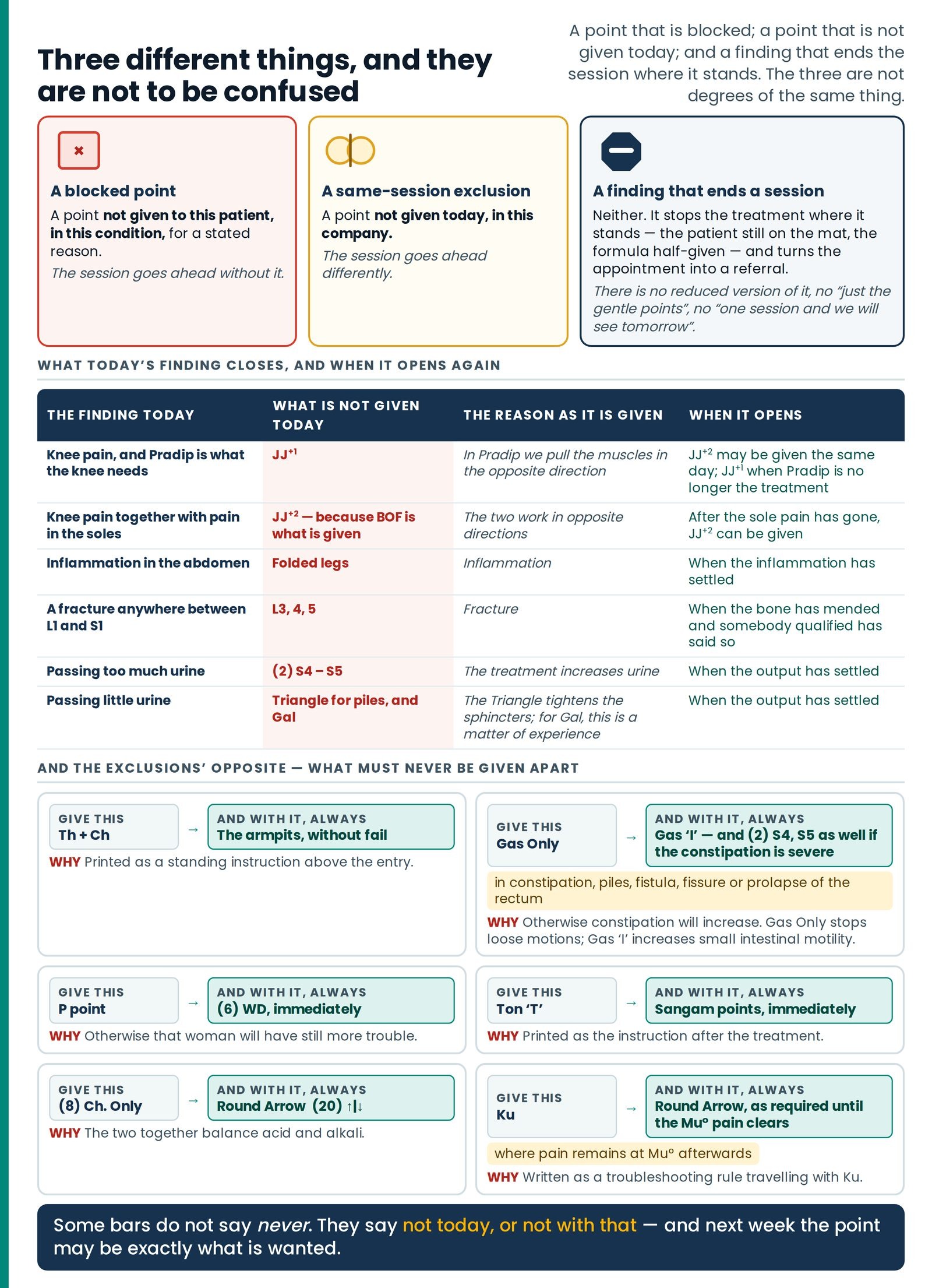
And the exclusions' opposite — the treatments that must never be separated. These are same-session rules of the other kind: not do not give both, but do not give one without the other.
Everything so far has been about what you write before a treatment. This part is about what happens during one, and it is the part of the article that will one day matter more than all the rest of it together.
Three different things, and they are not to be confused
A blocked point is a point not given to this patient, in this condition, for a stated reason. The session goes ahead without it.
A same-session exclusion is a point not given today, in this company. The session goes ahead differently.
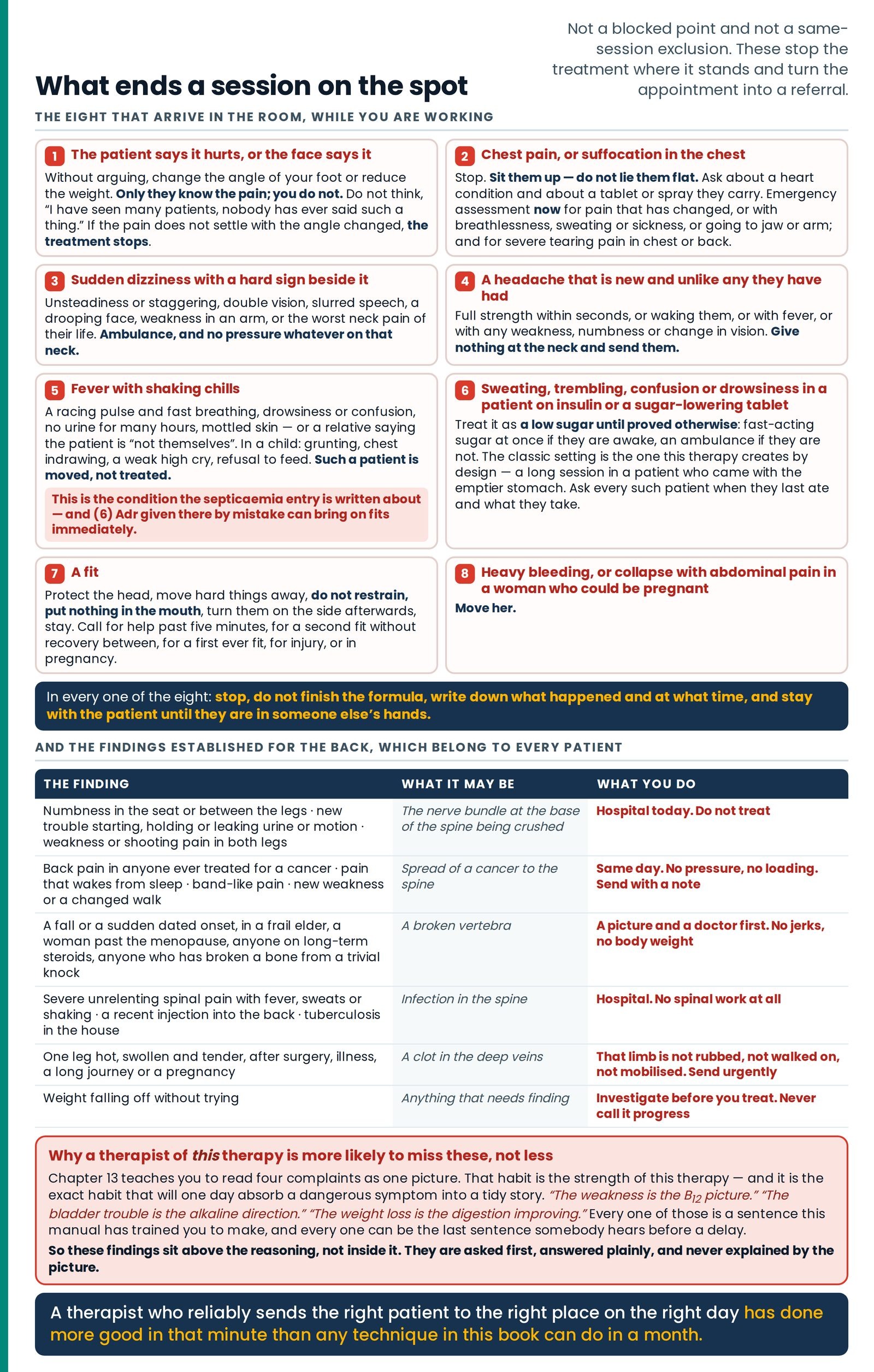
A finding that ends a session is neither. It stops the treatment where it stands — the patient still on the mat, the formula half-given — and turns the appointment into a referral. There is no reduced version of it, no "just the gentle points", no "one session and we will see tomorrow".
The findings that were established for the back, and belong to every patient
Six findings from Chapter 22, listed where a therapist looks for them
The Low Back set these out for the low back, because the low back is where the commonest complaint in a clinic and the most dangerous one arrive wearing the same clothes. They are not repeated here in full and they are not weakened here. They are listed so that a therapist reading the safety article finds them where they look for them, and each names the article that teaches it.
| The finding | What it may be | What you do |
|---|---|---|
| Numbness in the seat or between the legs · new trouble starting, holding or leaking urine or motion · weakness or shooting pain in both legs | The nerve bundle at the base of the spine being crushed | Hospital today. Do not treat |
| Back pain in anyone ever treated for a cancer · pain that wakes from sleep · band-like pain · new weakness or a changed walk | Spread of a cancer to the spine | Same day. No pressure, no loading. Send with a note |
| A fall or a sudden dated onset, in a frail elder, a woman past the menopause, anyone on long-term steroids, anyone who has broken a bone from a trivial knock | A broken vertebra | A picture and a doctor first. No jerks, no body weight |
| Severe unrelenting spinal pain with fever, sweats or shaking · a recent injection into the back · tuberculosis in the house | Infection in the spine | Hospital. No spinal work at all |
| One leg hot, swollen and tender, after surgery, illness, a long journey or a pregnancy | A clot in the deep veins | That limb is not rubbed, not walked on, not mobilised. Send urgently |
| Weight falling off without trying | Anything that needs finding | Investigate before you treat. Never call it progress |
And the findings that arrive in the room
The eight that stop a session while your foot is still on the patient
These are the ones this article must add, because they do not belong to a back and they are not part of a history. They happen while you are working. (Figure 42.6)
The last thing this article has to teach is not a list. It is a sentence said out loud, across a mat, to somebody who came to you for help.
Not everybody who comes to you can be treated by you. That is true of every therapy and every physician who ever lived, and the therapists who get into trouble are not the ones who know too few points. They are the ones who cannot say the sentence.
The boundary of the work, stated plainly
We use no medicine of any kind, and if a patient is already taking some medicine or tablet, we do not even tell them to stop it.
Treatment goes on alongside it.
When the complaint has gone entirely, the patient is told to say to their own doctor: "Now I have no pain at all — must I still take the tablets in the same quantity?" Then the doctor himself tells them what to do.
We do not advise anyone to reduce medicine without the doctor's opinion.
This is not timidity. It is the shape of the work. Prescribing and un-prescribing belong to the person who prescribed. What belongs to you is to treat well, record what changes, and send the patient back to that person with something worth reading.
How to say it
Early, sitting, dressed — the day named, and a note they can hand over
Five rules, and they are all about the patient's dignity rather than your comfort.
Say it early, sitting, and with them dressed. Nobody should receive this news lying on a mat with their clothing arranged for treatment. If you know at the history, say it at the history.
Say what you found, not what you fear. "You have told me two things that I do not treat around." Not "this could be something serious" — which tells them nothing and frightens them completely.
Name the timescale out loud. Today means today. Patients hear "see a doctor" as "see a doctor sometime", and the gap between those two has cost people a great deal. Say the day. Say the hour if it is that kind of finding.
Give them something to carry. A short written note: what they told you, what you found, what you did not do, and the date. It converts an anxious patient repeating a half-remembered conversation into a patient handing over a document.
And do not discharge them. "This is not me sending you away. Come straight back when they have seen you, and we will go on." A patient who feels dismissed goes to somebody who will not ask the questions — and that, not your refusal, is what harms them.
Questions students ask
1. I am nineteen and this article frightens me. Am I going to hurt somebody? Not if you write the card before you plan the treatment, which takes four minutes and is the whole of the discipline. Notice also what the article actually says: almost every bar is a point aimed the wrong way for one body, not a dangerous act. The frightening article is the one that does not exist — a therapy that stimulates glands and has never written down which glands are already overworking. This one has, in twenty entries, with reasons.
2. I am a retired bank manager learning this for my wife, who has diabetes and a thyroid problem. Do I need to know all twenty conditions? No. You need to know hers, completely — the twelve blocked in diabetes with their reasons and substitutions — and you need to know that a second condition adds a second list. Read the rest once so you know what is in the article, and look up what you meet. A reference is for looking things up in; that is not a weakness in you.
3. If (6) Adr is given in autoimmune disease and blocked in infection, what do I do for an autoimmune patient who catches an infection? You follow the standing rule: the block wins. For as long as the infection is there, (6) Adr is off. The infection entry names what is given instead — Viral formula, Thymus, Th + Ch — but check each of those against his autoimmune list, where the thymus group is itself blocked. That is not a trap; it is the arithmetic of two conditions, and it is why this article exists.
4. I am a physician. Which of these prohibitions would you defend to me, and which would you not? I would separate three kinds. The mechanical ones transfer without argument: Lu + Sh, Swt and Katka withheld in heart disease because a good deal of physical force is applied and pressure will fall on the heart; the six-second limit on (2) Pan; Round Arrow stopped at L5; (10) Left Medulla. The endocrine reasoning is often exact in its targets — oestrogen and the epiphyseal line, cortisol and the thymus, dopamine and cardiac contractility, aldosterone and sodium, heparin and the first stage of wound repair — whether or not you accept that a foot on a back moves them. And some of the models are pre-modern, cancer as a disease of alkali among them. This wiki does not ask you to accept the third to use the first. It asks you to notice that the targets are the right targets.
5. I practise in a village with no laboratory. How do I know whether my patient's diabetes or heart disease is "under control" enough to lift a block? You mostly do not, and that is the honest answer. So you lift blocks rarely, late, one at a time, and never on how the patient feels alone. Where a measure exists and can be got — a sugar at the nearest town, a pressure taken properly over two weeks — get it. Where it cannot, leave the block on. A block left on costs a patient one point. A block lifted wrongly costs them something else. See also → Reading the Reports, "Reading the Reports".
6. My teacher gives Thymus to a diabetic patient who did not do well on (6) Adr. Is he wrong? He is following a sentence that is printed in this therapy in its own italics: but some people do not feel well after being given (6) Adr; then perhaps giving them Thymus may be of benefit. Carry it as it is written — with its some, its perhaps and its may. It is not a general permission to give Thymus in diabetes, and it does not cancel the bar for the patients it does not describe. Ask him which patients he has done it in and what he watched for; that is the useful conversation.
7. Nobody taught me the word "blocking" in my class — we said "contraindications". Does it matter? Only in one way, and it is worth having. Contraindication is a fact about a point. Blocking is a thing you do with a pen, at a particular moment, in a particular place on a card. The word carries the action inside it, which is why this therapy chose it. Use whichever word your centre uses, and do the action either way.
- 8. Why does this article repeat the Gas Only → Gas 'I' rule three separate times? Because it appears three separate times where it is taught, and it appears three times because three different conditions need it and a therapist will only look up one of them. That is what a reference does. A rule written once, in the entry the reader did not turn to, has not been written.
9. What do I do when the material gives a bar and no substitution — like Th + Ch in a kidney patient who needs it? You do not invent one. You take the question to whoever supervises your practice, and until it is answered the card is not written. This wiki will not fill that gap for you, and a therapist who fills it themselves has stopped practising this therapy and started practising their own. See also → The River — Heparin, "The River".
10. I have a patient who is blocked for so much that I do not know what is left. Is there any point treating him? Work it out on paper rather than in your head, and you will usually find more than you feared. Even the patient with the four longest lists on one card keeps the digestive work, the single-point liver, the ghisāī of the neck and back, the physical points that carry no jerk, Feather touch, Vasanti, Sangam. And The Hand That Heals's whole argument still holds: the abdomen is where the raw materials come from, and almost nothing in this article closes the abdomen.
11. Should I tell the patient which points are blocked? Tell them that some are and why, in one sentence, in plain words — "Because of your heart, three or four of the treatments we use are not for you; I have written them down so nobody gives them by mistake." Do not read them the list of codes; it means nothing and it worries people. What it buys you is enormous: a patient who understands that you are keeping a written safety list will tell you about the second condition they had not thought worth mentioning.
12. I am a housewife treating my family at home. If somebody in my house has one of the eight findings in Part five, what am I actually supposed to do? Exactly what a therapist in a centre does, and you have one advantage over them: you know this person. Stop, do not finish what you were doing, and take them to be seen — today when the article says today. Do not argue them out of it and do not let them argue you. Write on a piece of paper what you saw and at what time, and hand it over at the hospital. You do not need a qualification to do any of that.
Questions patients ask
1. "You keep saying you cannot do this and cannot do that. Is your treatment even going to work on me?" The list of things I will not do is long because I have written it down, not because there is little left. Every therapy has these; most do not put them on the card where you can see them. What I am not going to give you are the few treatments that would push your condition the way it is already going. What I am going to give you is everything else, and with your condition that is a great deal. Judge me on what changes, not on the length of my list.
2. "My sugar has been normal for three months. Can you give me those treatments now?" Possibly, and that is genuinely good news, because it means your glands are working better — which is what we were trying to do. But I take those restrictions off one at a time, and only when the main symptoms of the condition have really ended, not on a good few weeks. Bring me the reading from your doctor. When I do take one off, I will write it on your card with the date, so that there is no confusion later.
3. "My doctor says my tests are all normal. So why are you refusing to treat me today?" The two are separate things and both can be true. Your tests being normal is good and worth having. What I am acting on is not a test — it is something you told me a few minutes ago, and it is one of a small number of things I do not work around, whatever the reports say. It may well turn out to be nothing much. The only way to find out is for somebody to look, today. Then I will treat you properly.
4. "You are sending me away. Have you given up on me?" No, and I want to be clear about that because it is the part people take home. I am sending you to somebody who can do one thing I cannot — look inside you. That is not the end of your treatment with me; it is one appointment in the middle of it. I am writing down what we have done, what has improved and what I found today, so you do not have to remember any of it. Come straight back when they have seen you.
5. "Since I started coming here I feel wonderful. Can I stop my tablets?" I am very glad, and I am not the person to answer that — genuinely not, not out of politeness. We use no medicine here and we never tell anybody to stop theirs. What you do is go to the doctor who gave them to you and say exactly this: "I have no trouble at all now — must I still take the same quantity?" That decision is his. And if he reduces something, tell me, because it changes what I watch for.
6. "My neighbour got a treatment here for her knees and you will not give it to me. Why is she more important?" She is not, and it is not the same knee. Every card here carries a short list of treatments that are not for that person, because of some other condition they have. Hers says one thing; yours says another. It is the reason you are both being treated for a knee and not getting the same half-hour. If I gave you her treatment I would be treating her, and she is not the one on the mat.
- 7. "My son has a fever and is shivering, but he has an appointment today. Can you just do the usual?" Not today. A fever with shivering is one of the things I stop for, in anybody, and I would rather be wrong about it than right too late. Take him to be seen this morning. His course does not lose anything — we pick it up the day after he is cleared, and nothing we have done so far is wasted.
Words used here
| Hindi | English | Neurotherapy code / usage |
|---|---|---|
| ब्लॉकिंग / रोकना (blocking) | Blocking | Writing on the diagnosis card, boxed, the points not to be given in this patient's condition — done before treatment is planned |
| हाइपर (hyper) | Working more than it should | Of a gland: the state in which a stimulating point becomes harmful |
| चेतावनी (chetāvanī) | Warning | The condition entries of this article |
| कर्क रोग (kark rog) | Cancer | 9 blocked; and do not stimulate the organ the cancer is in |
| डायाबीटीस | Diabetes | 12 blocked; considered an autoimmune disorder; Round Arrow L1–L5 only |
| हृदय की बीमारियाँ | Heart disorders | 9 blocked; (10) Left Medulla Left ; (2) Thrd for (4) Thrd; Sulta Ulta at 135°, left first |
| किडनी की बीमारियाँ | Kidney disorders | Blocked as autoimmune; Loveleen also withheld — written . Loveleen . |
| फिट् / मिरगी (phiṭ / mirgī) | Fits, epilepsy | Pan and Pit blocked — do not give Pit to a Fit — but Pan permitted inside the Heparin formula |
| सेप्टीसीमिया | Septicaemia | (6) Adr blocked — if it is given by mistake, fits can come on immediately |
| अस्थमा | Asthma | Spl, Thrd, Gal blocked; (1) Single point liver × 6 treatments given |
| कब्ज (kabz) | Constipation | Gas Only, (10) Medulla, Dys blocked |
| दस्त / लूज़ मोशन (dast) | Loose motions, dysentery | Gas 'I' and Const blocked — the exact mirror of constipation |
| बवासीर (bavāsīr) | Piles | With fistula, fissure and rectal descent: read as diseases of acid |
| भगन्दर (bhagandar) | Fistula | As above |
| घाव (ghāv) | Wound | The Heparin formula blocked until the wound has dried |
| बैम्बू स्पाइन / स्पर | Bamboo spine / spur | Thrd 'P' and Thrd blocked — osteoblasts and calcitonin |
| तरुण अवस्था (taruṇ avasthā) | The teenage years | Lt. Ov., Rt. Ov., WD, Ton 'P', Ton 'T' blocked — the epiphyseal line |
| कनफूल (kanphūl) | Mumps | The observation behind the Ton 'P' / Ton 'T' reasoning |
| चयापचय (chayāpachaya) | Metabolism | Raised by (4) Thrd; the reason (2) Thrd replaces it in heart disease |
| गड़बड़ी (gaṛbaṛī) | A disturbance | What follows if (2) Pan is held longer than six seconds 6 sec |
| उकसाना (uksānā) | To provoke, to stimulate | The verb of every bar in this article — do not provoke, not do not treat |
| सावधानी (sāvdhānī) | Precaution | The general word; blocking is its written form |