That is the claim, and this article is the answer to it: every formula ever made for correcting undigested food in the stool, in the order they were made, with every count, every rest, every substitution and every prohibition attached.
The notation is closed. Every bracket, ring, quoted letter, half-sign, colon, Roman numeral and seconds-suffix in this article was taught once, completely, in Table 13 of How a Formula Is Built, "How a Formula Is Built". Nothing is explained again here. Every written rest — the ten seconds inside a count of 2, 4, 4; the minute between stations; the ninety seconds between rounds — is in Table 8 of the same article, with the reason given for it.
Watch


Where this article begins
The abdomen chapters are the road; one thing from them belongs here
Before the ash, the fire. The pages immediately before this article belong to the abdomen and its pains, and they are needed here only as the road that led to UDF.
Formula No. 4 — (10) Medulla (4) Thrd 'P' (20) ↑|↓ (8) Pan, named because it cures the number-four pain of the abdomen — belongs to the digestive family and is taught with its eye-disease indications in Setting the Stomach, "Setting the Stomach". The card notation that gave it its name — the old number scale from one, next to nothing, to four, so much pain that the patient cries out even before the hand touches, written above the point before treatment and below it afterwards; and the replacement of those numbers by Pan⁺⁺⁺⁺ over ⁺⁺, because numbers come before the point in a formula as well and a therapist could muddle the number of the pain with the number of the point — is taught whole in Uncommon Problems and recorded in Table 13 of How a Formula Is Built.
APR, the abdominal-pain-releasing treatments, are APR — Abdominal Pain, "Releasing the Belly": the three classes of abdominal pain divided by the number of loose motions; the first version and the revised version; the removal of Gal and Spl from an inflamed abdomen, because the bile of the gall bladder is antiseptic and the spleen makes WBCs and antibodies; and the instruction that closes them — when the motions become completely normal, do not forget to give NAN / FAN for at least one day.
Jeevan Dhara, the stream of life, in which all the organs around the navel are provoked in one order and after which the elderly say they have received a new life — heavy version and present light version both — is APR — Abdominal Pain as well.
One thing from that stretch of the road belongs here rather than there, because it is the reason this article exists at all.
The problem that remained
As Neurotherapy became popular, the number of patients went on growing. Good results were coming in all of them — but in old, chronic diseases it was seen that the results came only after many days, and often, after a few days, the effect of the treatment was next to nothing.
Read that twice. It is a therapy reporting, in its own manual, that its own treatments stopped working in exactly the patients it most wanted to help. Nothing in this article was made out of confidence. It was made out of that sentence.
So the question was widened until it was no longer a question about a formula. When a human being is born, he is usually born healthy. One child in lakhs is ill on emerging from the mother's womb, or even before it. Generally children remain healthy for some months or many months after birth, and later fall ill from various causes. Why, then, do diseases come into the body at all?
The answer that came back is the doctrine of this article, and the formulas are built on it.
Why a therapy of the hands should touch the body's chemistry at all
Provoke the body's own glands rather than supply the chemical
A student who cannot answer this cannot explain the first thing about UDF to a patient, so it is worth four paragraphs.
In our body, sleeping or waking, at every moment, every function runs under the supervision of some organ or other. Even if we merely lie down, the running of the breath, the beating of the heart and the smooth flowing of the blood all run under the control of the brain. But the brain does nothing alone. It sends messages, in due order, to several other organs, and those organs, obeying the command of the message, complete the work as wished.
When we do physical labour, many kinds of changes arise inside the body at once. To rise from lying to sitting, or to stand, different messages issue continuously from the brain for the movement of every organ. To send oxygen — प्राण-वायु, prāṇa-vāyu — by the blood into the hands and feet, the heart must beat a little faster than it did lying down; and care must also be taken that, on account of this faster beating, the blood pressure does not rise too much. All of that happens twenty-four hours a day, outside our understanding and without our control — involuntarily, that is, of its own accord.
To keep the coordination of all these things, several different kinds of chemicals keep being released, which keep watching at all times that no kind of imbalance arises anywhere inside the body.
Table 1 — The three kinds of chemical, and where each one comes from
| Name | Where it issues from | What it does |
|---|---|---|
| Neuro-transmitter | The brain | Provokes or restrains several organs at one and the same time, for different tasks |
| Hormone | Certain special glands of the body, mixing into the blood | Provokes or restrains other organs to work |
| Enzyme | — | Digests many things in the body, or helps in their metabolism, that is, exchange |
So the coordination of every function in the body will happen properly only when these chemicals are released at the right time and in the right quantity. If even one of them falls short, the coordination of the organs is spoiled. Even then, the organs that keep watch over them make considerable effort so that no effect falls upon the working system of the body — and for some years they succeed in this. But when the quantity of these chemicals becomes rather too much or too little, then indeed they take the form of disease in the body.
The two ways of supplying a missing chemical
The first way is to give medicine from outside.
This is the very way that allopathy and some other systems have adopted. By this the body does get the necessary chemicals — but in some people their side effects can also occur, because the body does not easily let foreign things come inside, and begins to fight against them.
The second way is that, if we know the secret of provoking the body's own glands, then through that medium too this work can be done. This is the very work that Neurotherapy does, and in it considerable success has been obtained.
And then the chain that makes digestion, of all things, the foundation of that second way.
Whatever food we eat, vegetarian or non-vegetarian, is made of only three elements — carbohydrates (कारबोहाइड्रेट्स), that is sweet substances; proteins (प्रोटीन्स), such as pulses, grains and so on; and fats (फैट्स), that is ghee, oil and so on. All the foodstuffs of the world come within these three. But these substances cannot enter our blood as they are. They are broken down by the chemical reactions of the secretions of the mouth, the stomach, the pancreas, the liver and the small intestine, and only then absorbed and sent into the blood. When these elements reach every cell by way of the blood, each cell takes what it needs according to its requirement and makes whatever chemicals it has to make.
Now the joint on which everything turns. All the enzymes, all the neuro-transmitters and many of the hormones of the body are made from mixtures of different amino acids. Those amino acids are formed after proteins are properly digested in the stomach and the intestines, and they can reach the blood only when they are absorbed by the intestines. Some hormones are made not from proteins but from cholesterol — these are the steroid hormones. Cholesterol is made by the liver when fats are digested, and afterwards the liver itself makes bile from that cholesterol, which again helps in the digestion of fats.
The sentence the whole article rests on
If the digestion and absorption of proteins and fats in the body are proper, and if all the glands work properly, then no deficiency of any chemical will arise in the body.
And therefore: if proteins or fats are not digested properly, or their absorption is not proper, then a deficiency of many enzymes and hormones will come into the body, which will become the cause of diseases coming.
Which leaves one practical question, and it is the question a therapist can actually answer at the mat: how are we to find out whether the proteins in this person's body are digesting properly or not?
The stool as the readout
Food in its own shape or colour means proteins are not digesting
After being swallowed, a chemical process takes place upon every particle of food. So it follows that after that chemical process the shape and the appearance of the thing eaten ought to change.
Over six decades, after questioning more than one lakh patients, it was found that the patients of almost all old, chronic diseases definitely admitted that in their motion — the stool — some one or another of the following things is seen in its original shape or colour:
the seeds or the skins of tomato, brinjal or bhindī, lady's finger
the grains of chana, matar or groundnut
the leaf of coriander, curry leaf, spinach or methi
the raw pieces of carrot or beetroot salad
the mustard, cumin and the other things used in the taḍkā, the tempering
On reflecting a little it will be understood that all the things written above — whether in the form of leaves or in the form of vegetables — are all only different forms of protein.
This has been discussed with many doctors. All of them say the same thing: that the coming of undigested food in the motion is natural, and that it has no connection with any disease. Some say it happens because the food is not chewed properly. But Guruji proves, and stands by the claim, that it is not so. If anything at all is seen undigested in the motion, it means the proteins are not digesting properly. Often such people also say their stool is soft. Some say that to clear the stomach they have to go two or three times a day, or more.
The hen, the marble, and the three functions of the stomach's acid
In the feed given to a hen, marble powder is specially put, so that the outer layer of the egg becomes strong — because she has the capacity to digest marble.
In the same way, in the stomach of a healthy human being an acid called hydrochloric acid is prepared, which is harsher even than the acid that cleans drains, and which can digest every hard object. Whatever has been eaten, its form must change in that fierce acid — whether he has chewed it or has not chewed it.
The chief functions of that acid are three.
First — the acid is so fierce and harsh that no virus or bacteria can remain alive in it.
Second — only after the fierce acid has come out will the enzyme called pepsin come out in the stomach, which begins the work of digesting proteins.
Third — the food that comes from the stomach is acid-laden; when it goes into the duodenum, if its pH is not below 4.5 then the hormone secretin will not be made, which provokes the liver to send bile, which helps in digesting ghee and oil. So the stomach's acid should be very harsh indeed.
The working of the stomach is now so widely known that a child who has passed the tenth standard can recite it. So why the debate?
It is precisely here that the depth of the enquiry shows. After digestion and absorption, whatever residue is left is thrown out of the body as stool. So — when so many chemical processes are going on inside the body, can anything of the food still be seen inside the stool in its original, that is its former, form? If acid and pepsin come out in the proper quantity, then whatever has been eaten, its form and its colour will certainly change — whether he chewed it or did not chew it.
In those people in whom the skins of tomato, or pieces of carrot or beetroot, are appearing in the stool in their natural colour or their own shape, the acid of the stomach, or the enzymes of the intestines, have not even this much effect upon the food substances that they could at least change the colour. Which means those secretions are not being made in the right quantity, or in the proper concentration. And if the stomach's acid is not in the right quantity or of the proper pH, then proteins will not digest properly — and any germ that comes in with the food can easily get inside the blood.
All the enzymes of the body, the chemicals of the brain, and — with the exception of the steroid hormones — all the other hormones are made from proteins only. When some proteins do not digest properly, then whatever chemicals are to be made from them, their deficiency will come into the body; and because of that deficiency the balance of the body will be spoiled, and diseases will certainly come.
The liver's reserve, and why nobody falls ill on the first day
Even if there is a shortage of some proteins in the food, the liver of a healthy person makes several amino acids — these are called the non-essential amino acids — which it goes on making according to the need, at the right time and in the right quantity.
It is only because of this wonderful capacity of the body that even when the digestive system is not in order we do not fall ill at once, and are able to get free quickly from small ailments.
But when, through wrong habits and wrong eating and drinking, illnesses come again and again, then this capacity keeps on diminishing — and the body begins to become the victim of great diseases.
The bedside method
Five findings and no laboratory — the stool, the tongue, the curd
If the stomach's acid is right, then hunger will be felt properly, food will digest properly, and no disease can easily come into the body. This same capacity is called जठराग्नि — jaṭharāgni — in Yoga. And this is the very reason the therapy says that one should not drink water or cold drinks along with food, so that the acid of the stomach does not become quietened.
Second, the food that comes acid-laden from the stomach, when it goes into the duodenum, the first part of the small intestine — only if the pH of those secretions is below 4.5 will secretin be made, which provokes the liver to make bile, which is necessary to help in digesting fats. If secretin is not made, the digestion of fats too can be spoiled.
Third, remember that the chemicals of the digestive system itself are also made from proteins. If some proteins do not digest properly, then in the end the digestive enzymes too will not be made properly, from which the digestive action goes on becoming more and more spoiled. In this way a kind of vicious cycle goes on forming.
And if bacteria or a virus remains alive in someone's stomach or intestines, we should understand that his stomach's acid is less, or is not being made. Such people too must be getting UDF.
Now the part a therapist uses with his hands.
The chief aspect of the treatment, and the sign that carries it
We do not give treatment for any one disease; rather we treat according to the condition of the body on that day.
And to find out the condition of the body each day, the method is the sensation of pain at certain specially chosen places around the navel.
Chief among these is the part below the bone in the middle of the chest — the sternum — the region called in English the solar plexus.
In any disease of the stomach there is pain in the part between the solar plexus and the navel. Pain in that part indicates that the blood flow is not right in some parts of the stomach and the intestine.
Such people often say they have soft stool three or four times a day. Some have to go to the motion immediately after eating. This is an indicator that their digestive power is weak, on account of which they will certainly have UDF.
It is a separate matter that they will never have peeped inside the latrine to see what the motion is like. But if you explain to them the importance of this and tell them to observe, then the very next day they will come and say — yes, undigested food is seen in the motion.
Some people have small or large scratches or lines on the tongue. Here a popular saying is worth keeping in mind — the face is the reflection of the mind; the tongue is the mirror of the intestines.
Having lines on the tongue indicates that inside the intestines too there will be such scratches, on account of which they cannot absorb nutrients properly.
If the patient is a small child, ask the mother one question: when the child vomits after drinking milk, does milk come out as milk, or as curd — दही?
If milk comes out as milk, it means that hydrochloric acid is not being made in the child's stomach — otherwise the milk would not have come as milk; it would have come out having become curd.
The infant's curd test
This means that the child has UDF.
For acid to be made properly, histamine, acetylcholine and gastrin are required. So if the acid is not being made, it means that one of these three, or all of them, are not working properly. Hold those three names. They are the reason the HCl treatment at the end of this article is built the way it is.
The three levels
The problem of UDF is solved from three levels, for which there are several kinds of UDF formulas. Every formula in this article works in one or more of these three ways, and a student who knows the three can look at any unfamiliar UDF sequence and say what each part of it is for. (Figure 29.1)

By all these specific means, the production of the body's hormones and chemicals improves, and the repair of cells and tissues and the other maintenance and protective functions receive promotion.
When UDF comes
UDF can come to anyone at any age.
To small children UDF comes for the first time when their teeth are coming out. In small children after a certain age it begins to come when the child has eaten some odd or unsuitable thing, or when his liver is becoming weak. It will often be seen that a few days after UDF appears in the motion, the child may get pain in the stomach or the head, or fever, for a day or two. If jaundice — पीलिया — also came in childhood, then its effect remains upon the liver for many years.
The coming of fever indicates that the liver needs rest for a few days. A white layer-like coating appears on the child's tongue. At that time hunger is not felt.
In grown persons UDF often begins to come in those days when they eat irregularly or without limit. The common example is eating at parties or at weddings, on other people's insistence, even when there is no hunger. In such a condition, keeping a fast afterwards for a day or two is the best remedy.
What the patient must do, while you do your part
Change the system of food first — the patient's half runs with yours
During a fast the body gets time for its internal repair, and it soon begins to become well.
One more chief cause of UDF is today's system of agricultural production. Artificial fertilisers such as urea, and pesticides, are being used for crops in excessive quantity. After eating that crop, those chemicals go inside our body and spoil not only our digestive system but our immunity as well. Along with this, there is another ill effect: for some years it appears that the earnings are increasing, but in the long term it is harmful — because from it the fertile power, the productive capacity of the earth, keeps decreasing, which will prove harmful for the coming generations.
When such is the condition throughout the country, a question may arise: what can anybody do about this? Here the therapy makes a practicable request. Those big people who have their own land should use natural manure in at least some part of it; and whenever a birthday or other auspicious occasion comes in the family, they should give the crop grown from that land as a gift to the other members of the family and to friends. From this, awareness towards such crops and towards health will gradually be built up in people's minds, and a taste will be created for returning in the direction of our ancient agricultural method — which was beneficial for the whole of society.
Some people hold that the coming of UDF is not in itself any disease, and therefore one should not be frightened by it. It is true that this is not any disease. The coming of UDF only indicates that whatever has been eaten, the body is unable to digest it. But if this is ignored, then this same thing later becomes the root of diseases.
Guruji has found that the cause of the world's greatest diseases is the coming of UDF itself.
And then the instruction students most often forget, because it is inconvenient.
UDF first, the disease second
In old diseases UDF comes first, whatever the patient came with
Since the food, drink and manner of living of all people is not the same, one and the same treatment will not apply to all patients. After a deep study of the working style of the digestive system, different kinds of treatments for correcting UDF were made, for patients of different tendencies. The whole of the rest of this article is those treatments.
But before the first of them, the rule that orders the entire course of a chronic case.
Where the UDF treatment stands in a course of treatment
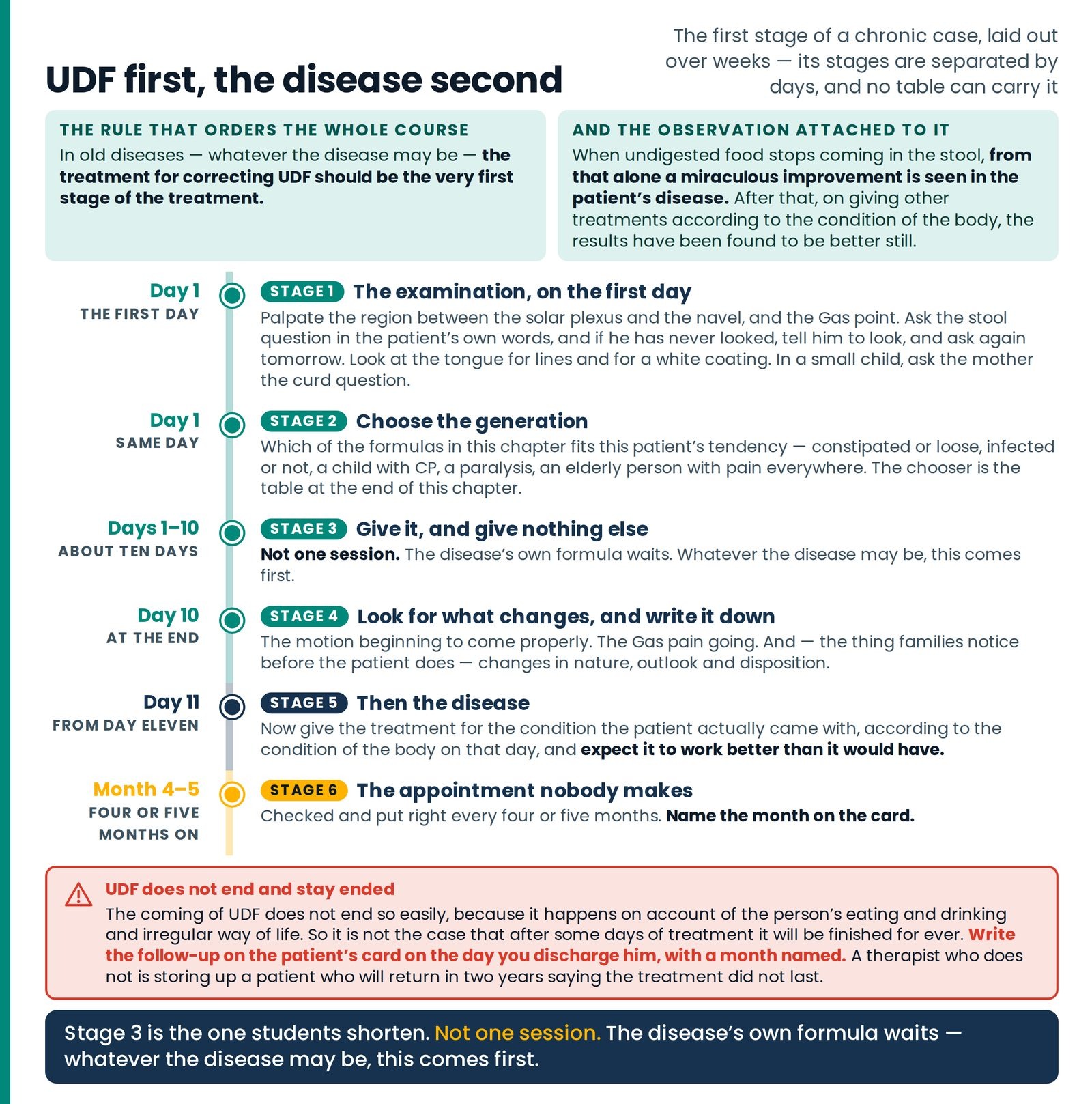
In old diseases — whatever the disease may be — the treatment for correcting UDF should be the very first stage of the treatment.
And the observation attached to it: it has been seen that when undigested food stops coming in the stool, from that alone a miraculous improvement is seen in the patient's disease. After that, on giving other treatments according to the condition of the body, the results have been found to be better still.
That is the rule Dr. Krishnamurthy Jalihal put into practice, and the story at the head of this article is what he found when he did. (Figure 29.2)
In which diseases UDF is found
A list of examples, not a boundary — and four names that cannot wait
Patients of all old diseases often get undigested food in the motion. The list is given as examples, not as a boundary:
fits · cancer · AIDS · psoriasis · lumps all over the body · extreme fatigue · IBS, irritable bowel syndrome · osteoporosis · Hepatitis B · RA-positive · idiopathic rickets · rheumatoid arthritis · idiopathic scoliosis · idiopathic Parkinson's disease · eczema and other skin disorders · hypo- or hyper-thyroidism · aches and lumps in many parts of the body · bamboo spine, that is ankylosing spondylitis · deformity of bones, that is, bones becoming crooked, and so on.
That is why Guruji says that the coming of UDF is the root cause of all the great diseases.
What "undigested food is coming" is taken to mean
Two mechanisms: proteins not digested, and germs not killed
If in the motion the food is seen just undigested — that is, comes as it was — then it means that in the stomach the acid, which is called hydrochloric acid, its quantity is less. This can also happen because of drinking water or soft drinks in between while eating food.
If the pH of the acid in the stomach does not go down to 3 or below, then pepsin will not be made, and proteins will not digest. If proteins do not digest, then many hormones and enzymes of the body will not be able to be made.
And there is one more reason. In fierce acid, bacteria and viruses cannot remain alive. If the quantity of acid in the stomach is less, then the bacteria or viruses that are in the food can easily reach up to the intestines, and from there can get into the blood.
Two mechanisms, then, and every formula in this article answers one or both: proteins not digested and germs not killed. Hold the pair, because the second is why a treatment for undigested food contains a sustained hold aimed at infection.
Since people are of different tendencies, many kinds of UDF formulas have been made. They are given below in the order they were made, so that you can see how the family developed — and, at the end, a table for choosing between them.
Generation one — the seed
(10) Medulla (6) Gas Only — two steps, and everything is built on them
The whole family grew out of a line of two steps, and that line has to be learned exactly as it was first made, because every change afterwards is only legible against it.
Table 3 — Card: the earliest and most basic UDF formula Seated Supine Both sides
| Written | (10) Medulla (6) Gas Only |
|---|---|
| Step 1 | (10) Medulla — seated, the nape, both sides below the ears Seated . Given to provoke the vagus nerve, which provokes many organs of the digestive system and increases the stomach's acid threefold |
| Step 2 | (6) Gas Only — supine Supine , the soft middle of the sole on both thighs, hip crease → above the knee Both sides . Six applications. Gas Only improves the blood supply to the stomach, so that HCl and pepsin are properly secreted |
| What it is for | UDF. The first and most important requirement is to stimulate the production of hydrochloric acid in the stomach, and this formula does it from two directions at once — from the brainstem downward, and from the thigh inward |
| What was found | This treatment was found to greatly improve protein digestion, in almost all patients |
| The prohibition | (10) Medulla is not to be given to patients of diabetes or of cancer; to heart patients only (10) Left Medulla ▲ Take care |
| Where it stands | The seed. What follows is this formula with things added to it — and, in the patient for whom (10) Medulla is barred, with that step lifted out |
| Points taught in | Medulla — Seated I — Brain, Medulla, Neck, "Seated — I"; Gas Only — The Front of the Body I, "The Front of the Body — I" |
Generation two — the modification, and the principle inside it
Milder stimulations, repeated often, beat one strong dose
The seed was later modified, and the modification is the form most students meet first. What was changed is small here and large in the reasoning.
Milder stimulations, repeated often
Milder stimulations, repeated often, were found to be more effective than one strong dose.
That is not a remark about Gas Only. It is a statement about dose, reached by treating patients and watching what happened, and it is why so much of this formulary is written as a small number given across days rather than a large number given once.
Watch the principle being applied in the notation itself. (6) Gas Only is six applications at the point, in one sitting. (1) Gas Only – 6 Points is one application carried across six stations — and then the whole of it given again, × 2 treatments. Less at any one place; more often.
Table 4 — Card: the modified UDF formula Seated Supine Both sides × 3
| Written | (10) Medulla (1) Gas Only – 6 Points × 2 treatments |
|---|---|
| Step 1 | (10) Medulla — seated Seated , as in the seed formula and for the same reason: the vagus nerve |
| Step 2 | (1) Gas Only – 6 points — supine Supine , both thighs, hip crease → above the knee, six stations in one pass Both sides |
| What changed from the seed | (6) Gas Only became (1) Gas Only – 6 Points, and the whole is given × 2 treatments — milder stimulations, repeated often, were found to be more effective than one strong dose |
| The rounds | × 2 treatments — two sessions, with the written rest between rounds: Table 8, How a Formula Is Built |
| In a stubborn case | × 3 treatments, in stubborn cases where the pain in Gas is more than usual × 3 . The count rises on that finding and not otherwise |
| What it does | The hydrochloric acid in the stomach will increase; and from this alone the symptoms of alkali are at once reduced in many patients |
| The prohibition | (10) Medulla — not in diabetes, not in cancer; heart patients, (10) Left Medulla only ▲ Take care |
| Taught in full in | Correcting the Two Kingdoms, "Correcting the Two Kingdoms", where it is the prerequisite of ALTF |
Hold both cards in the eye at once, because everything that follows is these two steps with things added to them. And two facts about them govern every generation to come.
The compulsory element, and the withheld element
In all UDF formulas the chief and compulsory thing is — Gas Only.
Several new UDF formulas have been made since the first one, in which other points have been added for different kinds of patients; Gas Only is in every one of them.
And one element is withheld from whole classes of patient rather than from individuals: (10) Medulla. The reasoning for the withholding, given in its own ruled box, is on page 318 of this article and belongs to the point itself.
Why those two out of the whole atlas? Because the two of them together are the formula. Gas Only raises the blood supply in the stomach; (10) Medulla provokes the whole digestive system through the vagus; and these two together further increase the stomach's acid, from which pepsin's work will be good and the digestion of proteins will be done well. The acid is what UDF is about. Gas Only reaches it from below and (10) Medulla from above. One of the two carries a prohibition, so the other one carries the formula — and that is why the compulsory element and the withheld element sit side by side.
Generation three — the improved treatment, in four stages
Ku arrives for immunity, Pan for the pancreatic enzymes
This too was later improved upon. Two things came into the formula that had never been in it before, and both of them return again and again in the members that follow: the sacral hold for immunity, and the pancreas.
Table 5 — Card: the improved UDF treatment Seated Prone Supine 6 sec
| Written | I (15) Medulla · II (½) Ku – 20 seconds × 2 treatments · III (½) Ku – 6 seconds × 2 treatments · IV [ (10) Medulla (8) Pan (1) Gas Only – 6 Points ] × 2 treatments |
|---|---|
| Stage I | (15) Medulla — seated Seated , both sides of the nape below the ears. The formula opens on the chemistry and not on the abdomen, as OLD UDF does too |
| Stage II | (½) Ku – 20 secs, × 2 treatments — prone Prone , 1½ pillows under the chest, both heels turned to face each other, the therapist seated between the feet, the middle of the sole on the last end of the spine; one hold of twenty seconds in each of two sessions |
| Stage III | (½) Ku – 6 secs, × 2 treatments — the same manoeuvre held six seconds, in each of two sessions |
| Stage IV | The whole of (10) Medulla (8) Pan (1) Gas Only – 6 Points stands inside square brackets, and the bracketed unit is given × 2 treatments. (10) Medulla seated Seated ; (8) Pan both thighs together Both sides ; (1) Gas Only – 6 points both thighs, six stations in one pass Supine Both sides |
| Why Ku is here | Ku has been added to increase the body's immunity |
| Why Pan is here | Pan is given for the pancreatic enzymes, to aid protein digestion |
| The line under (8) Pan | (8) Pan is written with a line ruled beneath it. What that line instructs a therapist to do is taught in The Shorthand, "The Shorthand", and recorded in Table 13 of How a Formula Is Built — it is not repeated here |
| The Roman numerals | Each stage follows the one before it after the written rest — Table 8, How a Formula Is Built, which gives every rest in the therapy and the reason for each |
| Prohibitions | (10) Medulla — not in diabetes, not in cancer; heart patients, (10) Left Medulla only. Ku — not during menstruation, not in low blood pressure ▲ Take care |
| Points taught in | Medulla — Seated I — Brain, Medulla, Neck; Ku — Face Down, "Face Down"; Pan, Gas Only — The Front of the Body I |
Two stages of Ku at two different timings are the first appearance of a habit that runs through the rest of this article, and Table 15 below sets out every timing the family uses and what belongs to which formula.
And one treatment stands on its own beside this one, made of nothing but the hold:
The hold given by itself
Another excellent treatment, which takes care of both infection and inflammation, is (½) Ku – 20 secs × 6 treatments — one twenty-second hold in each of six sessions, and nothing else.
It is the same dosing that opens the simplest treatment and the same that carries the infection or inflammation formula, where the reasoning behind it — the monocytes, the granulocytes, the ACTH — is set out in full.
Generation four — the comprehensive treatment, in six stages
Two stages added at the end to reach the small intestine
The treatments above do indeed serve the purpose admirably well. What was wanted next was a treatment that reached further down the tube: a comprehensive treatment to stimulate the stomach, the accessory organs of digestion, PLUS the small intestine. So two stages were added to the end of the improved treatment, and nothing before them was disturbed.
Table 6 — Card: the comprehensive UDF treatment Seated Prone Supine 6 sec
| Written, stages I–III | I (15) Medulla · II (½) Ku – 20 seconds × 2 treatments · III (½) Ku – 6 seconds × 2 treatments |
|---|---|
| Written, stages IV–VI | IV (10) Medulla (8) Pan (1) Gas Only – 6 Points × 2 treatments · V (1) Gal (1) Spl (1) Liv (1) Mu · VI (8) Pan (1) Gal (2) Liv – 3 points (1) Gas 'I' – 6 Points |
| Stages I–IV | Exactly as in the improved treatment above, with the line still ruled beneath (8) Pan at stage IV — The Shorthand and Table 13 of How a Formula Is Built |
| Stage V | (1) Gal Left , (1) Spl Right , (1) Liv Left , (1) Mu Right — one application each, supine Supine , in normal order, with no line ruled beneath any pair. How a Formula Is Built for the five rules of sequence |
| Stage VI | (8) Pan both thighs together Both sides ; (1) Gal left thigh Left ; (2) Liv – 3 points left arm and left thigh Left — (2) Liv – 3 points is the same thing as (6) Liv; The Front of the Body I, "The Front of the Body — I"; (1) Gas 'I' – 6 points down both calves, knee → heel, six stations Both sides |
| What it adds | The stomach, the accessory organs of digestion, PLUS the small intestine — and therefore it improves the absorption of nutrients |
| Stated indication | An excellent remedy for patients with either infection or inflammation · abdomen problems · arthritis · knee pain · or pain due to cervical spondylosis — accompanied by UDF in the stools. That last clause is the condition on the whole list and travels with it |
| The Roman numerals | Each stage after the written rest — Table 8, How a Formula Is Built |
| Prohibitions | (10) Medulla — not in diabetes, not in cancer; heart patients, (10) Left Medulla only. Ku — not during menstruation, not in low blood pressure ▲ Take care |
| Points taught in | Medulla — Seated I — Brain, Medulla, Neck; Ku — Face Down; Pan, Gas Only, Gal, Spl, Liv, Mu, Gas 'I' — The Front of the Body I |
Look at stage VI and you are looking at the closing sequence of half the formulas still to come in this article — Pan, Gal, Liv, Gas 'I' — the absorption tail, arriving here for the first time.
The two treatments written for diabetics
What a barred point looks like when it is taken out properly
(10) Medulla is barred in diabetes. The bar and the reasoning behind it are established in Setting the Stomach, "Setting the Stomach", and are inherited by every formula that contains the point; this article applies the bar and does not argue it again.
That leaves the question every therapist meets on his second diabetic patient: if half the compulsory pair cannot be given, what is given? The answer is the other half — and most patients usually have pain in Gas in any case, which is where the treatment would have gone first.
Table 7 — Card: the basic treatment for diabetics Supine Both sides
| Written | (1) Gas Only – 6 Points × 2 treatments |
|---|---|
| The single step | (1) Gas Only – 6 points — supine Supine , the soft middle of the sole on both thighs, hip crease → above the knee, six stations in one pass Both sides |
| The rounds | × 2 treatments — two sessions, with the written rest between rounds: Table 8, How a Formula Is Built |
| Stated indication | The basic treatment for diabetics |
| What it is | The modified formula of generation two with (10) Medulla lifted out of it. Compare the two cards line by line and that is the whole of the difference |
| What it is for | The compulsory element doing its own work: blood supply to the stomach, so that HCl and pepsin are properly secreted |
| Prohibitions | None attached to Gas Only. That is exactly why Gas Only is the compulsory element ▲ Take care |
And beside it, a longer treatment for the same patient — and for a good many others.
Table 8 — Card: the eight-stage treatment for diabetics and for poor digestion Seated Side-lying Prone Supine 6 sec
| Written, stages I–IV | I (3) Necklace · II (3) Raman Trt · III (2) Rt. Parkhoo (2) Lt. Parkhoo · IV (8) Rt. Parkhoo (8) Lt. Parkhoo |
|---|---|
| Written, stages V–VIII | V (½) Ku – 20 sec. × 2 Trts. · VI (½) Ku – 6 sec. × 2 Trts. · VII (1) Gas only – 6 Pts. · VIII (8) Pan (1) Gal (2) Liv – 3 Pts. (1) Gas 'I' – 6 Pts. |
| Stated indication | Useful for diabetics, and for all those who have poor digestion. Some of them may have pain or tenderness at Gal or at Liv, in addition to the pain at Gas |
| Stage I — (3) Necklace | Seated Seated , the therapist behind; the manner of it is given in full with the body-pain formula at Table 21 below, and the point in Seated I — Brain, Medulla, Neck, "Seated — I" |
| Stage II — (3) Raman | Seated Seated ; both hands over the tops of the shoulders from behind, the muscles lifted, six seconds, three times, then five or six easy breaths. Seated I — Brain, Medulla, Neck |
| Stages III and IV | The double Parkhoo pass — (2) each, then (8) each; side-lying Side-lying , knees drawn very close to the chest, pillow between them, two equal one. Light first, heavy after. On the Side, "On the Side" |
| Stages V and VI | Both Ku timings, two sessions each — twenty seconds × 2 treatments, then six seconds × 2 treatments Prone |
| Stage VII | (1) Gas only – 6 Pts. — the compulsory element, supine, both thighs, six stations Supine Both sides |
| Stage VIII | (8) Pan Both sides , (1) Gal Left , (2) Liv – 3 points Left — the same thing as (6) Liv, The Front of the Body I — and (1) Gas 'I' – 6 points down both calves Both sides : the absorption tail |
| The Roman numerals | Each stage after the written rest — Table 8, How a Formula Is Built |
| Its twin | The same eight stages are the formula for body pain, brain disease and paralysis — Table 21 below — where stage VII reads (10) Medulla (1) Gas only – 6 Pts. (1) Gas 'I' – 6 Points |
| Prohibitions | Ku — not during menstruation, not in low blood pressure ▲ Take care . The (10) Medulla bar does not arise here, because the point is not in the formula |
| Points taught in | Necklace, Raman — Seated I — Brain, Medulla, Neck; Parkhoo — On the Side; Ku — Face Down; Gas Only, Pan, Gal, Liv, Gas 'I' — The Front of the Body I |
Set the two cards side by side and read stage VII across, because this is the clearest example in the wiki of how a formula is fitted to a patient who cannot be given one of its points.
Seven of the eight stages are identical. Necklace, Raman, the light Parkhoo pass, the heavy Parkhoo pass, the twenty-second Ku twice, the six-second Ku twice, and the whole of the closing stage VIII — all of them stand exactly as they stand in the formula for body pain, brain disease and paralysis. Only stage VII is different. There it reads (10) Medulla (1) Gas only – 6 Pts. (1) Gas 'I' – 6 Points. Here it reads (1) Gas only – 6 Pts. alone: (10) Medulla, which is barred in diabetes, is not written — and the (1) Gas 'I' – 6 Points that closed that stage is not written here either. Gas 'I' is given once in this formula, at stage VIII, and not twice.
That is what a barred point looks like when it has been taken out properly. Nothing was substituted for it and nothing was added to compensate for it. The stage that carried two points and a closing step now carries the compulsory element by itself, and the seven stages around it are untouched.
What the review of the points adds
Every point used against UDF has been met in this article as the formulas used it, and most of what the family says about each one has already been given — (15) Medulla for acetyl choline, (10) Medulla for the vagus and the threefold acid, Gas Only for HCl, histamine, pepsin and gastrin, Pan for the pancreatic enzymes, Gas 'I' for the small intestine, (½) Ku for the basophils and mast cells and so for immunity, infection and inflammation. Four entries in that review say something that has not been said yet, and they are worth having.
Table 9 — What the point-by-point review adds
| Point | The organ stimulated, and the purpose |
|---|---|
| Necklace | The ganglia leaving the skull — and it reduces pain |
| Raman treatment | The peritoneum, the serous membranes and so on — and thus it benefits the whole body |
| Rt. Parkhoo / Lt. Parkhoo | Stimulates the absorption of B₁₂ and niacin, folic acid and thiamine. B₁₂ and folic acid are necessary for proper blood formation. Niacin and thiamine are required for the proper working of the smooth muscles of the stomach and the intestines |
| Gal, Spl, Liv, Mu | Increases the blood supply to the liver, gall bladder and spleen, and to different areas of the mesenteric arteries and the colon — and thus improves digestion and absorption |
Two of those four are worth a second's thought at the mat. Necklace reduces pain — which is why the heaviest formula of this family, the one written for pain in the body, opens on it. And the four organ points reach the mesenteric arteries and the colon, not only the three organs they are named for; that is the anatomical reason a set of one-application steps across the thighs and arms can change what a patient's bowel does.
Generation five — the simplest treatment
Three techniques, and not one of them on the abdomen
The next formula made is the shortest of the complete protocols, and — this is the surprising part — none of its three techniques is on the abdomen at all.
Table 10 — Card: the simplest UDF treatment Prone Supine
| Written | I (½) Ku – 20 secs × 6 treatments · II Big Toe Gas × 6 treatments · III (10) Organ clearance + Sacral clearance (L1–L5) |
|---|---|
| Position | Prone for I and III Prone ; the patient lying for II, the therapist standing supported on the chairs |
| Step I — (½) Ku – 20 secs | One press, held exactly twenty seconds, then released comfortably. Prone, 1½ pillows under the chest, both heels turned to face each other; the therapist sits between the patient's feet and places the middle part of the sole, with normal pressure, on the last end of the spinal column. × 6 treatments is a count of sessions — one hold today, one tomorrow, six sessions in all |
| Step II — Big Toe Gas | The therapist's heel on the patient's big toe; standing on both feet together, or on one foot at a time; normally 6 or 12 seconds. × 6 treatments — again a count of sessions. Its stated purpose here is written beside it: to increase HCl in the stomach |
| The caution on step II | Place your foot in such a way that it does not pinch the patient's skin ▲ Take care |
| Step III — (10) Organ clearance | Prone with 1½ pillows under the chest, or seated on a chair; the therapist sitting on the patient's left side. The palm flat on the back, fingers pointing toward the side of the body, big thumb toward the head. First the vertical strokes, rubbing lightly over and around the spinal column from above downward, and then, without lifting the hand, from below upward; then the horizontal strokes, from right to left and from left to right. Begin from behind the neck and descend at very small intervals. (10) means ten times at every place |
| Step III, continued — Sacral clearance (L1–L5) | The same hand, the same two-direction stroke, confined to L1–L5 — joined to the Organ clearance by the + sign, that is, given as one step with it |
| What it is for | UDF, in the plainest form: level 3 by the Ku, level 1 by the Big Toe Gas, and the whole back cleared |
| Points taught in | Ku — Face Down, "Face Down"; Big Toe Gas — Knee, Leg, Foot, "The Knee, the Leg and the Foot"; Organ clearance and the sacral levels — Face Down and The Low Back, "The Low Back" |
Generation six — OLD UDF
Seven parts, sixteen steps, and the patient turned four times
After this, having considered many aspects, the following treatment was made, which has proved quite useful. It is called UDF पुरानी — OLD UDF — and the word old is the generation marker, not a comment: older versions stand beside their successors in this therapy, and they are not errors. Table 13, How a Formula Is Built.
It is the longest single prescription you have met so far: seven parts, sixteen steps, four positions, and the patient is turned four times.
Table 11 — Card: OLD UDF Seated Side-lying Prone Supine 6 sec
| Written, parts I–V | I (15) Medulla · II (2) Rt Parkhoo (2) Lt Parkhoo · III (8) Rt Parkhoo (8) Lt Parkhoo · IV (½) Ku – 20 secs × 4 treatments · V (10) Medulla (1) Gas खाली – 6 वाला |
|---|---|
| Written, parts VI–VII | VI (1) Gal (1) Spl (1) Liv – 3 वाला (1) Mu – 3 वाला · VII Ajay Normal → (8) Pan (1) Gal (2) Liv – 3 वाला (1) Gas ' I ' – 6 वाला |
| The order of positions | Seated (I) Seated → side-lying, left then right (II, III) Side-lying → prone (IV) Prone → seated again (V, first step) Seated → supine for everything after (V second step, VI, VII) Supine |
| What it is for | UDF in a patient of any ordinary tendency — the general-purpose member of the family before the symptom-matched formulas were made |
| The compulsory pair | Present, in part V: (10) Medulla with (1) Gas Only – 6 points |
| The prohibition it inherits | (10) Medulla is not given to patients of diabetes or of cancer; in heart patients only (10) Left Medulla ▲ Take care |
| The prohibition on Ku | Ku is not given to women during menstruation, and not to those with low blood pressure ▲ Take care |
| What may follow it | Large Folic Black — see below — Vitamin and Gene Formulas, "The Missing Links" |
Table 12 — OLD UDF, step by step
| Part | Step | Point | Count | Position and placement |
|---|---|---|---|---|
| I | 1 | Medulla | (15) | Seated Seated ; both sides of the nape, below the ears |
| II | 2 | Rt. Parkhoo | (2) | Side-lying on the left Side-lying , chest turned inward, knees very close to the chest, one or two pillows between the knees so the upper knee is not below the level of the waist. Foot or hand, press and release alternately at both points of the right hip, at the edge of the femur. Two equals one — once above and once below is one application |
| II | 3 | Lt. Parkhoo | (2) | Side-lying on the right Side-lying ; otherwise exactly as step 2, at both points of the left hip |
| III | 4 | Rt. Parkhoo | (8) | As step 2. The pair is given a second time, heavier |
| III | 5 | Lt. Parkhoo | (8) | As step 3 |
| IV | 6 | (½) Ku – 20 secs | × 4 treatments | Prone Prone , 1½ pillows under the chest, heels facing each other, therapist sitting between the feet; middle of the sole on the last end of the spine, held twenty seconds, released comfortably. Four sessions, one hold each |
| V | 7 | Medulla | (10) | Seated again Seated , as step 1 |
| V | 8 | Gas Only – 6 points | (1) | Supine Supine ; soft middle of the sole on both thighs, hip crease → above the knee, six stations in one pass Both sides . Gas खाली is simply the Hindi for Gas Only |
| VI | 9 | Gal | (1) | Supine; right sole down the left thigh Left |
| VI | 10 | Spl | (1) | Left sole down the right thigh Right |
| VI | 11 | Liv – 3 points | (1) | Left arm and left thigh, three paired stations in one pass Left |
| VI | 12 | Mu – 3 points | (1) | Right arm and right thigh, three paired stations Right |
| VII | 13 | Pan | (8) | Both thighs together Both sides — Ajay Normal begins here |
| VII | 14 | Gal | (1) | Left thigh Left |
| VII | 15 | Liv – 3 points | (2) | Left arm and left thigh Left |
| VII | 16 | Gas 'I' – 6 points | (1) | Soles and heels down both calves, knee → heel, six stations Both sides |
Reading OLD UDF point by point
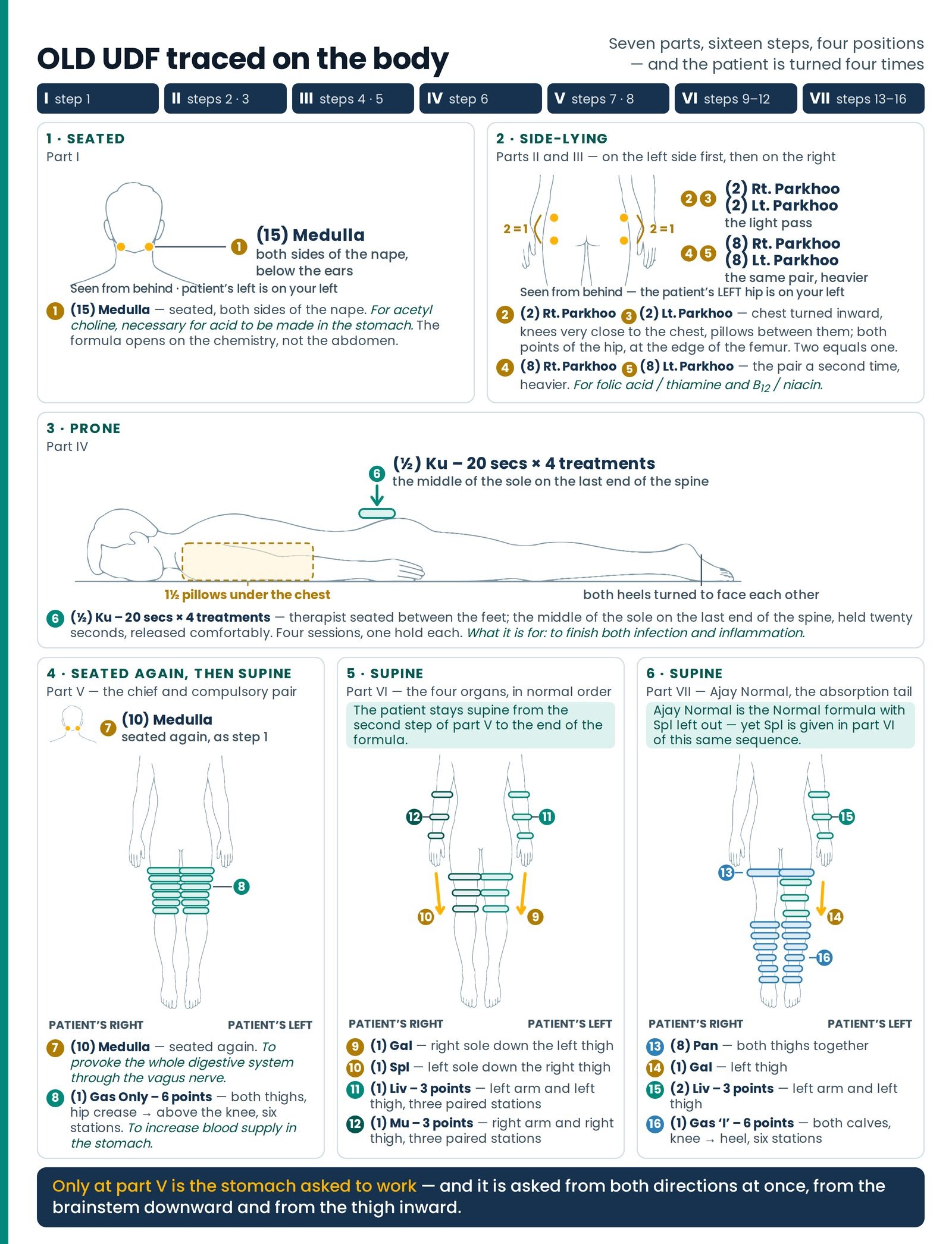
This is the part of the article to read twice. Not because the formula is hard — the counts are small and the order is plain — but because a student who can say what every step of one long formula is doing can read any formula in the wiki. The rest is vocabulary.
Take it part by part, and at each step ask the two questions that matter: what is this for, and why is it here and not somewhere else? (Figure 29.3)
Part I — (15) Medulla. What it is for: acetyl choline, which is necessary for acid to be made in the stomach.
Three names were given on page 314 as the things required for acid to be made: histamine, acetylcholine and gastrin. The formula opens by going after one of them. That is the first thing to notice about OLD UDF — it opens on the chemistry, not on the abdomen.
Why fifteen and not ten? Because ten is the other Medulla in this formula and it does a different job. Fifteen opens; ten, at part V, provokes the whole digestive system through the vagus. The number in front of the point is part of the point's identity in this family, and the Medulla series is graded for exactly this reason.
Why first? Because the patient is seated when he arrives, before he is laid down for anything. Position order and clinical order agree here, which is not an accident — a formula that turns the patient four times has been written so that the turns fall where the clinical logic wants them anyway.
Parts II and III — (2) then (8) Rt. Parkhoo and Lt. Parkhoo. What they are for: folic acid / thiamine & B₁₂ / niacin.
Two hips, four vitamins, two passes. The right hip carries folic acid and thiamine; the left carries B₁₂ and niacin. And the reasoning attached, which is worth learning as written because it names exactly what each vitamin is doing in a digestive formula:
Why niacin and thiamine are in a treatment for undigested food
Niacin and thiamine play an important role in the digestive system.
Niacin is necessary for the secretions of the glands to be properly made and released. From a deficiency of niacin there will be weakness in the muscles, the capacity of the glands to work will decrease, and inflammation comes in the mouth and in the intestines.
Thiamine is necessary for the smooth muscles of the stomach. For the smooth muscles of the stomach and of the pylorus to work in the right way, metabolized glucose is needed — for which thiamine is necessary.
Read that and the placement explains itself. Part I went after the signal that tells the stomach to make acid. Parts II and III go after the machinery that has to receive the signal: the glands that must secrete, and the muscle of the stomach wall and of the pylorus — the gate at the stomach's outlet, through which everything must eventually pass. Signal first, machinery second.
Why the pair twice, at (2) and then at (8)? The counts themselves answer it: a light pass, then a heavy one. It is the therapy's own standing principle, stated in Correcting the Two Kingdoms — a gland which is already spoiled should first be provoked less, so that it slowly begins to work. Here it is built into a single sitting, and in later generations of this same family the double pass appears and disappears depending on how much work is wanted at the hips. When you see (2) then (8) at the same point, you are looking at light-before-heavy, not at a repetition.
And notice the position rule that the count depends on. Parkhoo is not the Folic, Thia, B12 or Nia treatment, though it is given at the same hips. For Parkhoo, the chest is turned inward and the knees are drawn very close to the chest, with a pillow between them — especially compulsory for those whose thighs are very thin — so that the pressure lands at the edge of the femur bone. For the four vitamin points, the chest stays normal and the knees stay straight with the body. Same hip, different body, different point.
Part IV — (½) Ku – 20 secs × 4 treatments. What it is for: to finish both infection and inflammation.
Here the formula stops being about digestion for a moment and goes after the second of the two mechanisms — germs not killed. Why a treatment for undigested food should contain a sustained sacral hold aimed at infection is the subject of the next section of this article, and it is the most closely argued passage in the whole UDF family.
Note what the notation is telling you. – 20 secs means one press, held exactly twenty seconds, then released — no six-second count anywhere in this step. × 4 treatments means four sessions. So part IV is not a step of today's session in the way the others are. It is a thread running through four days of them.
Part V — (10) Medulla, then (1) Gas Only – 6 points. What they are for: to provoke the whole digestive system through the vagus nerve; and to increase blood supply in the stomach.
This is the heart of the formula, and it is the pair that is compulsory everywhere.
The chief pair, in its own words
Among all these points the chief are (10) Medulla and Gas Only. These two together will further increase the stomach's acid, from which pepsin's work will be good, and the digestion of proteins will be done well.
Why here, in the middle, and not at the opening? Because of what has already been done. The acetylcholine signal has been provoked. The glands and the stomach's muscle have been addressed at the hips. The infection and inflammation have been taken in hand. Only now is the stomach asked to work — and it is asked from both directions at once, from the brainstem downward and from the thigh inward.
And the prohibition that travels with (10) Medulla, in its own ruled box:
Part VI — (1) Gal (1) Spl (1) Liv – 3 points (1) Mu – 3 points. What it is for: the digestive system.
Four organs, one application each, in normal order — Gal before Spl, Liv before Mu. That order is not decoration. The therapy's own rule, stated in the Jeevan Dhara formula, is that giving Spl after Gal and Mu after Liv will increase normal peristalsis; reverse them and you are deliberately slowing the bowel, which is why the reversed pairs are written with a line ruled beneath them wherever they occur. There is no underline anywhere in OLD UDF. Read that absence: this formula is not trying to slow anything down.
Part VII — Ajay Normal → (8) Pan (1) Gal (2) Liv – 3 points (1) Gas 'I' – 6 points. What it is for: absorption.
Everything before this part has been about making something — acid, secretions, muscle tone, blood supply. This part is about getting it in. (8) Pan brings out the digestive enzymes of the pancreas; Gas 'I', down both calves, provokes the jejunum and ileum, by which the absorption of digested things takes place properly.
And the detail students walk past: Ajay Normal is the form of the Normal formula in which Spl is left out, and the omission is the formula. Yet Spl is given in part VI of this very sequence. Both facts stand as written. The spleen point is used in OLD UDF, and the closing absorption sequence is simply the version that does not contain it.
And what may be given after the whole of it.
Large Folic Black, given after this treatment
After this treatment, if Large Folic Black is given, then immediately after the treatment the black colour of the face is reduced by 25%.
And the next morning, in the motion, the first 1 inch of stool will be black — which means that toxins are coming out by way of the rectum.
The formula itself, and the whole Black family, belong to Vitamin and Gene Formulas, "The Missing Links".
Table 13 — The stated purpose of every part of OLD UDF, at a glance
| Part | What is given | What it is for |
|---|---|---|
| I | (15) Medulla | Acetyl choline, which is necessary for acid to be made in the stomach |
| II, III | (2) then (8) Rt. Parkhoo, Lt. Parkhoo | Folic acid / thiamine & B₁₂ / niacin — niacin for the secretions of the glands to be made and released; thiamine for the smooth muscles of the stomach and the pylorus, through metabolized glucose |
| IV | (½) Ku – 20 secs × 4 treatments | To finish both infection and inflammation |
| V | (10) Medulla | To provoke the whole digestive system through the vagus nerve |
| V | (1) Gas Only – 6 points | To increase blood supply in the stomach |
| V | the two together | The chief pair — they further increase the stomach's acid, so pepsin's work is good and proteins digest well |
| VI | (1) Gal (1) Spl (1) Liv – 3 points (1) Mu – 3 points | The digestive system |
| VII | Ajay Normal | Absorption |
| after | Large Folic Black | Face 25% less black at once; first inch of stool black next morning — toxins coming out by way of the rectum |
Why (½) Ku – 20 seconds is given in a treatment for undigested food
The white cells, the ACTH, and the seconds that are the dose
This is the question part IV of OLD UDF raises, and it is answered at length because the answer governs six of the formulas still to come.
When someone gets UDF, then in his body there will be infection in a great many organs. And from this treatment it has been found that wherever in the whole body there is infection or inflammation — whether it be in the kidney or in the intestines — all are put right.
To explain how that happens, the functions of the WBCs — the white cells of the blood — were studied closely, and the inference drawn from them is set out below. It is a theory, and it is offered as one.
In our body there are many cells to fight infection, which fight infection in different ways. Chief among them are monocytes and granulocytes.
Table 14 — The white cells, and what each is held to do
| Cell | What it does |
|---|---|
| Monocytes | Cannot work in the blood — they can remain alive only 8 to 10 hours in the ECF, the extracellular fluid. But when they come out through the pores of the capillaries and enter into tissue, they can remain alive even up to ten years. When any infection occurs, monocytes come out from the tissues and fight the antigen, and themselves die. But before dying they kill at least 20 to 50 antigens. These will work in both — whether it be infection or inflammation |
| Granulocytes | Of three kinds — neutrophils, eosinophils and basophils |
| Neutrophils | Very powerful inside the blood. They can kill even cancer-like cells in the blood |
| Eosinophils | They make a highly reactive form of oxygen — a very powerful form — which will finish every kind of bacteria. This works like ozone, that is, pure oxygen. But they can work only inside the blood. They cannot enter inside the tissues |
| Basophils | Their quantity in the blood is 0–1%, that is, very little indeed. But Neurotherapy gets much benefit from this. When the body cannot combat some infection, then it changes into inflammation. When we give the Ku treatment, then it must be provoking, through the hypothalamus, the pituitary gland to make ACTH — which will provoke the adrenal gland to make cortisol, to stop that inflammation |
And then the sentence that makes the whole passage a piece of clinical humility rather than a claim.
What (½) Ku – 20 seconds is held to do
(½) Ku – 20 seconds — after giving it, whether it provokes the granulocytes, or the monocytes, or the ACTH — that is the body's work to see.
From this treatment, whether there is infection or inflammation in the body, it will be finished.
Read the first sentence again. The therapy does not claim to know which of the three routes the treatment takes. It names three possibilities, declines to choose between them, and hands the choosing back to the body. That is how the instruction stands, and it is not to be tidied into a mechanism.
Eosinophils, asthma, and a treatment named in passing
Attached to the note on eosinophils is a second observation with a formula in it, and it is easy to miss.
Eosinophils destroy parasitic organisms. They release chemicals that cause bronchoconstriction in asthma — that is, narrowing of the airways. From infection in the lungs, eosinophils increase.
And therefore: for bronchial asthma, that is bronchitis — the treatment is (6) Right Swt.
Right, not left.
The seconds, and what the suffix is doing
(½) Ku is a named half-form of the point, not half a count, and the number written after it is seconds of a single sustained press — not applications. Table 13, How a Formula Is Built. The manoeuvre is always the same; only the number changes.
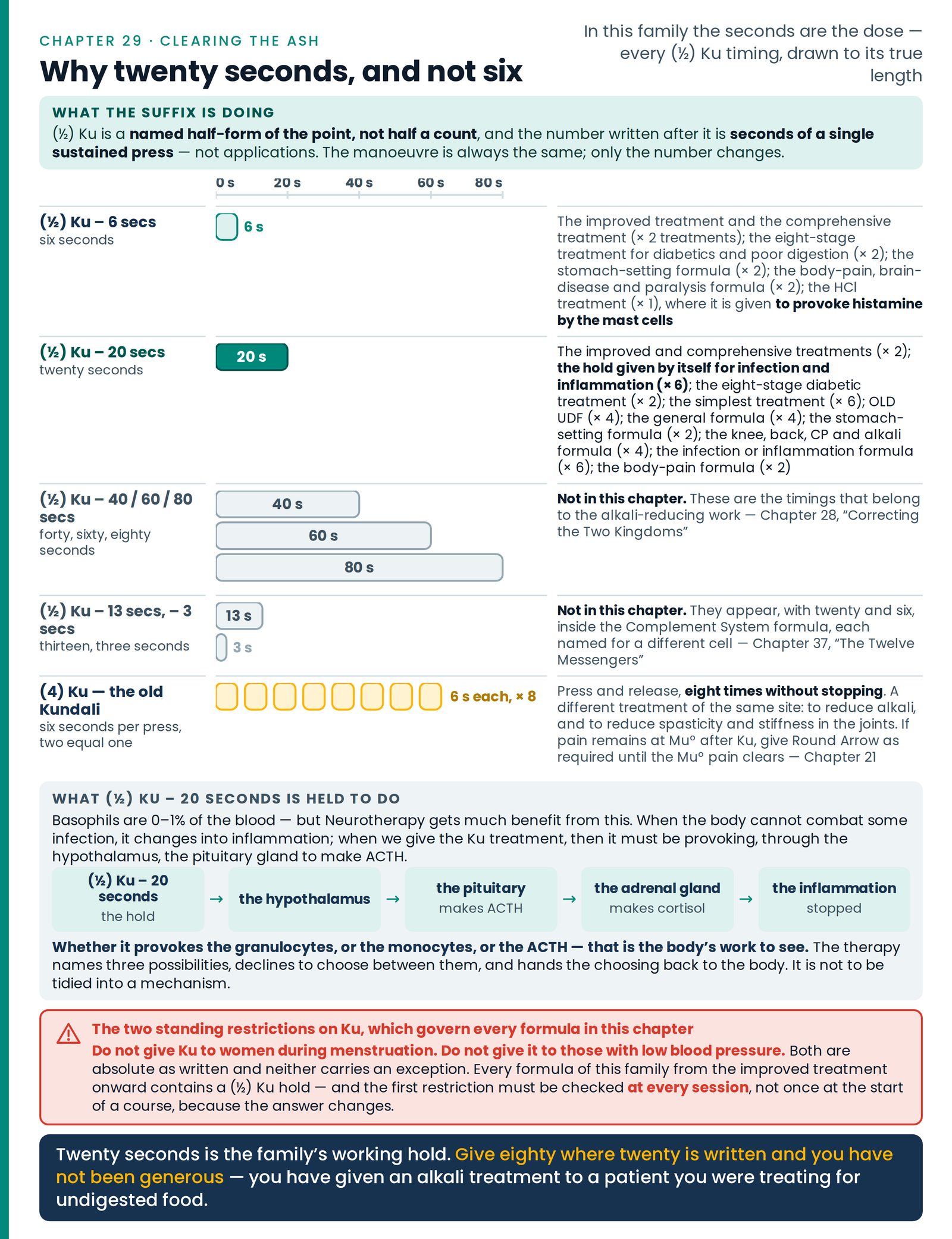
The point to carry away is that the seconds are the dose. Twenty seconds is the UDF family's working hold; six seconds is what is added when a second, shorter provocation is wanted in the same course; and the longer holds belong to another family of treatment altogether. Give eighty seconds where twenty is written and you have not been generous — you have given an alkali treatment to a patient you were treating for undigested food. (Figure 29.4)
Generation seven — the symptom-matched formulas
One spine, four formulas, and a closing step set by the bowel
Up to here the family has one general-purpose member. From here it splits, and the split is made on the patient's tendencies — what his bowel does, whether there is infection, whether he is a child with CP, whether his alkali has increased.
Before any of them, the rule that governs all four.
The rule that governs the whole group
Along with UDF, different formulas have been made for correcting different symptoms. In every formula, the presence of (10) Medulla and Gas Only is necessary and compulsory.
Some of the chief formulas among them are given below, which bring benefit to everybody.
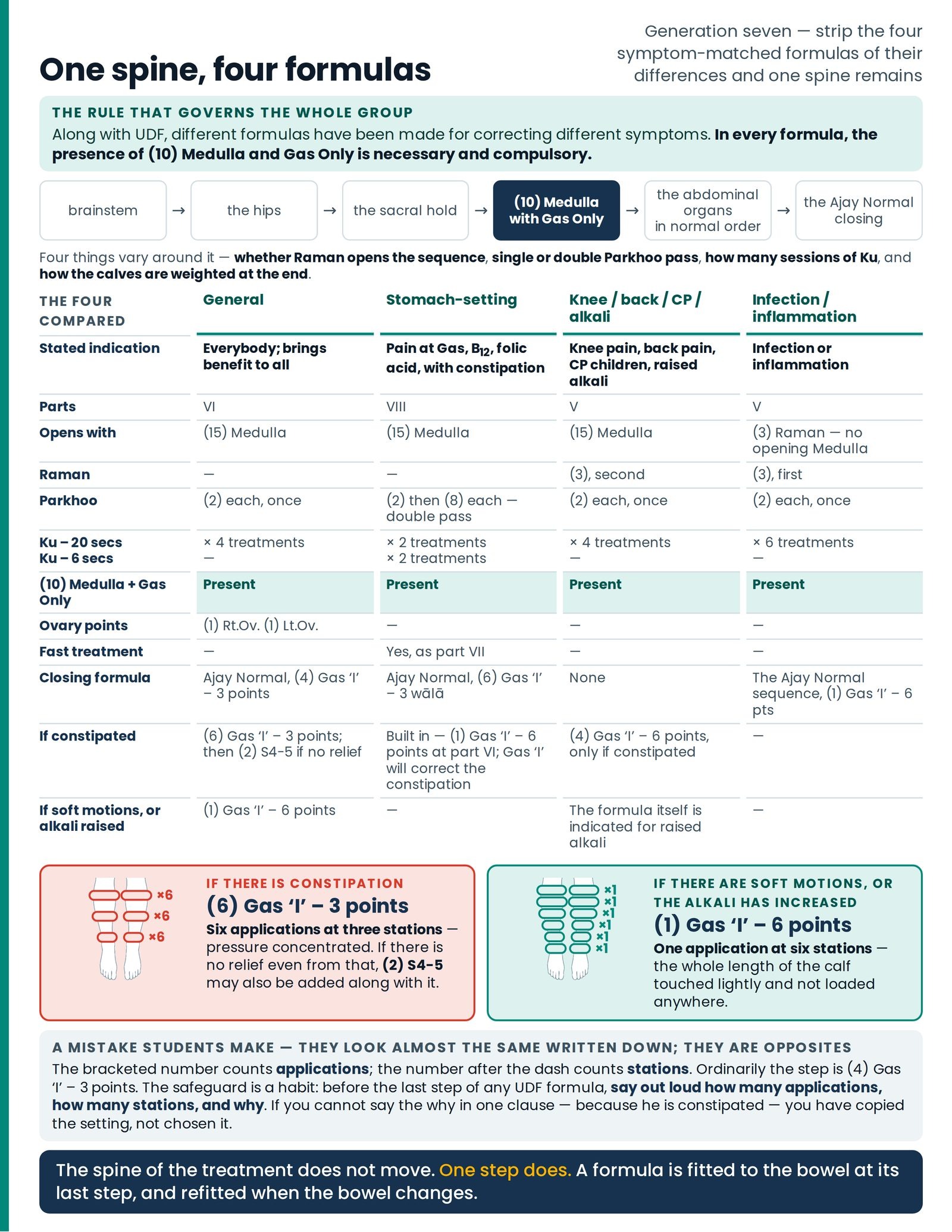
Strip the four formulas of their differences and one spine remains, always in this order: brainstem → the hips → the sacral hold → (10) Medulla with Gas Only → the abdominal organs in normal order → the Ajay Normal closing. Four things vary around it — whether Raman opens the sequence, whether the Parkhoo pass is single or double, how many sessions of Ku, and how the calves are weighted at the end. Learn the spine and the four formulas become four small decisions rather than four lists. (Figure 29.5)
The general UDF formula
Table 16 — Card: the general UDF formula Seated Side-lying Prone Supine 6 sec
| Written | I (15) Medulla · II (2) Rt Parkhoo (2) Lt Parkhoo · III (½) Ku – 20 secs × 4 treatments · IV (10) Medulla (1) Gas Only – 6 points · V (1) Gal (1) Spl (1) Liv – 3 points (1) Mu – 3 points (1) Rt.Ov. (1) Lt.Ov. · VI Ajay Normal → (8) Pan (1) Gal (2) Liv – 3 points (4) Gas 'I' – 3 points |
|---|---|
| Stated indication | Everybody. It is the member of the group written to bring benefit to all |
| Part I | (15) Medulla, seated Seated |
| Part II | (2) Rt Parkhoo, then (2) Lt Parkhoo, side-lying Side-lying , two equal one. Given once only — there is no heavy (8) pass in this formula |
| Part III | (½) Ku – 20 secs, × 4 treatments — four sessions, one twenty-second hold each Prone |
| Part IV | The compulsory pair — (10) Medulla Seated , then (1) Gas Only – 6 points Supine Both sides |
| Part V | Gal Left , Spl Right , Liv – 3 points Left , Mu – 3 points Right , one application each, normal order; then (1) Rt. Ov. Right and (1) Lt. Ov. Left — the ovary points, which are in no other formula of this group |
| Part VI | Ajay Normal, closing on (4) Gas 'I' – 3 points — four applications at three calf stations |
| Substitution — constipation | Those who have constipation are to be given (6) Gas 'I' – 3 points. If there is no relief even from that, then (2) S4-5 may also be added along with it ▲ Take care |
| Substitution — soft motions or raised alkali | Those who have soft motions, or whose alkali has increased, are to be given (1) Gas 'I' – 6 points |
| Prohibitions | (10) Medulla — not in diabetes, not in cancer; heart patients, (10) Left Medulla only. Ku — not during menstruation, not in low blood pressure ▲ Take care |
| Points taught in | Medulla — Seated I — Brain, Medulla, Neck; Parkhoo — On the Side; Ku, S4, S5 — Face Down; Gas Only, Gas 'I', Gal, Spl, Liv, Mu, Pan — The Front of the Body I; Rt. Ov., Lt. Ov. — The Front of the Body II |
Three things have changed from OLD UDF, and each one is a decision you can now read.
The heavy Parkhoo pass has gone. (2) each, once. Less work at the hips, because this formula is written for everybody rather than for a patient with a long chronic disease behind him.
The ovary points have arrived. (1) Rt. Ov. and (1) Lt. Ov., at the end of the organ part. They are in none of the other three formulas of this group.
The closing calf step has become adjustable, and this is the part that must be learned exactly, because it is where the formula is fitted to the patient's bowel.
The three settings of the closing Gas 'I' step
One step, three forms, chosen by what the patient's bowel is doing.
Ordinarily — (4) Gas 'I' – 3 points. Four applications at three stations down the calves.
If there is constipation — (6) Gas 'I' – 3 points. Six applications at three stations. And if there is no relief even from that, (2) S4-5 may also be added along with it — the sacral pair, given as one step naming two adjacent stations.
If there are soft motions, or the alkali has increased — (1) Gas 'I' – 6 points. One application at six stations, down both calves.
Notice what is being traded. Constipation gets more applications over fewer stations — pressure concentrated. A loose bowel gets one application over more stations — the whole length of the calf touched lightly and not loaded anywhere.
That last instruction completes one of the four inseparable pairs of this therapy. Gas Only calls for Gas 'I', and where the constipation is severe, (2) S4, S5 goes with the Gas 'I'. The pair was established in How a Formula Is Built and promised forward from Each Point in Use; here it is, doing its work inside the general UDF formula, with the condition that triggers the third element written beside it.
The stomach-setting formula
This one is also for 'setting' the stomach, and its indication is exact. Give it to those who have pain at Gas, at B₁₂ and at folic acid, and who also have constipation.
Table 17 — Card: the stomach-setting formula Seated Side-lying Prone Supine 6 sec
| Written | I (15) Medulla · II (2) Rt Parkhoo (2) Lt Parkhoo · III (8) Rt Parkhoo (8) Lt Parkhoo · IV (½) Ku – 20 secs × 2 treatments · V (½) Ku – 6 secs × 2 treatments · VI (10) Medulla (1) Gas Only – 6 points (1) Gas 'I' – 6 points · VII Fast treatment · VIII Ajay Normal (8) Pan (1) Gal (3) Liv (6) Gas 'I' – 3 wala |
|---|---|
| Stated indication | Pain at Gas, at B₁₂ and at folic acid, together with constipation |
| Parts II and III | The double Parkhoo pass — (2) each, then (8) each. Light, then heavy. Restored from OLD UDF |
| Parts IV and V | Both timings of the sacral hold, across two sessions each. (½) Ku – 20 secs × 2 treatments, and (½) Ku – 6 secs × 2 treatments. This is the only formula of the four that uses the six-second hold |
| Part VI | The compulsory pair, plus (1) Gas 'I' – 6 points — and the instruction attached to that third step: Gas 'I' will correct the constipation |
| Part VII | The Fast treatment entire — written out here as Gas only, Gas 'I', Gal, Spleen, Liv, Mu, WD. No six-second hold is counted anywhere in it: do not stay more than one or two seconds at any point, changing the place continually, the places so close together that pressure comes at about eighteen to twenty places. Setting the Stomach, "Setting the Stomach" |
| Part VIII | Ajay Normal, closing on (6) Gas 'I' – 3 wala — six applications at three calf stations, the constipation setting. Liv here is written plain, (3) Liv |
| Gas 'I' appears twice | Once in part VI at six stations, once in part VIII at three — which is this formula's answer to the constipation |
| Prohibitions | As for every formula in this group ▲ Take care |
The shape of it is worth saying aloud: this is the longest formula in the group, and everything added to it is added for the bowel. The heavy hip pass, both Ku timings, a Gas 'I' at part VI that is not in the others, the whole Fast treatment as a block, and a closing step weighted to the calves. A student who understands why each addition is there will never need to memorise the list.
For knee pain, back pain, CP children, and those whose alkali has increased
Table 18 — Card: the knee, back, CP and raised-alkali formula Seated Side-lying Prone Supine 6 sec
| Written | I (15) Medulla · II (3) Raman treatment · III (2) Rt Parkhoo (2) Lt Parkhoo · IV (½) Ku – 20 secs × 4 treatments · V (10) Medulla (1) Gas Only – 6 points + if there is constipation, then (4) Gas 'I' – 6 points |
|---|---|
| Stated indication | Knee pain · back pain · CP children · those whose alkali has increased |
| Part II — (3) Raman treatment | Seated Seated , the therapist standing behind. Both hands over the tops of the shoulders from behind, both first fingers very close to the neck, the palms of the two hands close to one another; the muscles of the back lifted upward from both sides. Lift and hold for six seconds, then release slowly; three times. Then the patient breathes in and out comfortably five or six times. Seated I — Brain, Medulla, Neck, "Seated — I" |
| Part III | The light pass only — (2) each |
| Part V | The compulsory pair; and only if there is constipation, (4) Gas 'I' – 6 points — four applications at six stations |
| What it does not have | No Ajay Normal closing. This is the only formula of the group that stops without one. The absence is the formula |
| Prohibitions | As for every formula in this group; and for a child with cerebral palsy, the further cautions below ▲ Take care |
Two things make this formula different, and both are readable from the card.
Raman has arrived, and it has arrived second. It is the first formula of the family to place it after the opening Medulla. In the two formulas that come after this one, Raman moves to the front and the opening Medulla is dropped.
And there is no absorption tail. The general and the stomach-setting formulas both end on Ajay Normal, which is the absorption step. This one ends at the compulsory pair. It is the shortest formula of the four, and the calves are added only for a costive bowel.
If there is infection or inflammation
Table 19 — Card: the infection or inflammation formula Seated Side-lying Prone Supine 6 sec
| Written | I (3) Raman Treatment · II (2) Rt. Parkhoo (2) Lt. Parkhoo · III (½) Ku – 20 sec. × 6 Treatments · IV (10) Medulla (1) Gas Only – 6 Pts (1) Gas 'I' – 6 Points · V (8) Pan (1) Gal (2) Liv – 3 Pts (1) Gas 'I' – 6 Pts |
|---|---|
| Stated indication | Infection or inflammation |
| Part I | (3) Raman opens it. This formula alone has no opening (15) Medulla |
| Part II | The light Parkhoo pass — (2) each |
| Part III | (½) Ku – 20 secs × 6 treatments — six sessions, the heaviest Ku dosing anywhere in this article, matching the very first and simplest UDF treatment |
| Part IV | The compulsory pair, plus (1) Gas 'I' – 6 points |
| Part V | The Ajay Normal sequence, printed here without its label, closing again on (1) Gas 'I' – 6 points |
| Gas 'I' appears twice | Once at the end of part IV, once at the end of part V — both at one application, six stations |
| Prohibitions | As for every formula in this group ▲ Take care |
The dosing tells you what this formula thinks it is doing. Six sessions of the twenty-second hold — the hold the therapy attaches to infection and inflammation — against four in the general formula and two in the stomach-setting one. The Ku is the treatment here; everything else is the UDF family's ordinary spine.
The four compared
Generation eight — the heaviest formula, and the widest indication
Necklace first; and the HCl treatment 5 to 15 minutes after
The family closes with one more formula and one appendix. The formula is the heaviest of the set, and its indication is the widest anywhere in this article.
Table 21 — Card: body pain, brain disease, paralysis — शरीर में दर्द, ब्रेन की बीमारियाँ, पैरालाइसिस Seated Side-lying Prone Supine 6 sec
| Written | I (3) Necklace · II (3) Raman Treatment · III (2) Rt. Parkhoo (2) Lt. Parkhoo · IV (8) Rt. Parkhoo (8) Lt. Parkhoo · V (½) Ku – 20 sec. × 2 Trts. · VI (½) Ku – 6 sec. × 2 Trts. · VII (10) Medulla (1) Gas only – 6 Pts. (1) Gas 'I' – 6 Points · VIII (8) Pan (1) Gal (2) Liv – 3 Pts. (1) Gas 'I' – 6 Pts. |
|---|---|
| Stated indication | Pain in the body · diseases of the brain · paralysis |
| Part I — (3) Necklace | Seated Seated ; the therapist behind, the left hand resting on the patient's head with light pressure so the forehead does not move. The tip of the right thumb at the edge of the skull bone, the other four fingers pointing upward and open, pressing at many closely spaced points from behind the left ear across as far as the right ear. Three times at every point; three rounds; from right to left. It relaxes the muscles just below the bone at the lower back of the skull, so that there is no obstruction in the coming and going of impulses between the brain and the rest of the body. Seated I — Brain, Medulla, Neck, "Seated — I" |
| Part II — (3) Raman | As in the previous formula — and named here as the treatment for the peritoneum |
| Parts III and IV | The double Parkhoo pass — (2) each, then (8) each Side-lying |
| Parts V and VI | Both Ku timings, two sessions each — twenty seconds × 2 treatments, then six seconds × 2 treatments Prone |
| Part VII | The compulsory pair, plus (1) Gas 'I' – 6 points |
| Part VIII | The Ajay Normal sequence, printed without its label, closing again on (1) Gas 'I' – 6 points |
| Gas 'I' appears twice | At the end of part VII and at the end of part VIII |
| The only formula opening on Necklace | Every other UDF formula opens on (15) Medulla or on (3) Raman. This one and its diabetic twin reach the base of the skull first |
| Its diabetic twin | The same eight stages, with (10) Medulla absent from part VII and Gas 'I' given once instead of twice — Table 8 above, the treatment for diabetics and for all those who have poor digestion |
| Prohibitions | As for every formula in this article ▲ Take care |
Two notes attached to it, and both are worth carrying.
Raman is named here for the peritoneum — the smooth membrane that lines the abdominal cavity and wraps the organs inside it, the way a cloth lining wraps the inside of a bag. That is the only place in the UDF family where Raman's target is named, and it explains why a treatment given at the shoulders belongs in a set of abdominal formulas at all. Seated I — Brain, Medulla, Neck owns the point.
And the symptom list — the therapy's own account of what the UDF formulas are good for.
The chief symptoms for which the UDF formulas are beneficial
Pain at the Gas point · heaviness in the abdomen · gas · nausea · headache together with heaviness in the abdomen — and so on.
Learn that list exactly as it is written, because it is the honest core of the article. The disease list on page 317 is what the family is aimed at over months. This is what a patient reports, and what changes first.
The HCl treatment formula
It was seen in some patients that the UDF treatment has to be given again and again, and even then the problem does not get fully right. So this treatment was made, which works especially to increase the stomach's HCl acid.
Table 22 — Card: the HCl treatment formula Seated Prone Side-lying Supine 6 sec
| Step | What it is for | |
|---|---|---|
| I | (15) Medulla Seated — both sides of the nape, below the ears | For acetylcholine |
| II | (½) Ku – 6 secs × 1 trt. Prone — one six-second hold, one session | To provoke histamine by the mast cells |
| III | 1 pt. Gall Supine — in the middle of the thigh, one station | To provoke the cells outside the pylorus that make gastrin |
| IV | B₁₂ 2 : 2 Side-lying — the patient on the right side, legs straight with the body, chest normal, pillow between the thighs; press on the left hip in the direction of the knees, and release immediately | B₁₂ also provokes acetylcholine |
| V | Fast : Gas : Gas 'I' : Gal : Spl : Liv : Mu Supine — the Fast treatment; no six-second hold anywhere, not more than one or two seconds at any point, eighteen to twenty closely spaced places | For the digestion of food |
| VI | Ajay Normal (8) Pan (1) Gal (2) Liv – 3 wala (4) Gas 'I' – 3 wala Supine | For absorption of digested food |
| Chief symptoms | Pain or stiffness at the Gas point · repeated gas · in children, vomiting immediately after drinking milk, or, when they burp, milk appearing instead of curd |
|---|---|
| Especially for | It is especially very beneficial for children of slow intellect — मन्द बुद्धि. UDF and HCl — both are to be taught to the parents of such children, who should be told to give them daily |
| Prohibitions | Ku — not during menstruation, not in low blood pressure ▲ Take care |
| Points taught in | Medulla — Seated I — Brain, Medulla, Neck; Ku — Face Down; Gal — The Front of the Body I; B₁₂ — On the Side; the Fast treatment and Ajay Normal — Setting the Stomach |
Look at what the first four steps have in common, because it is the most exactly reasoned formula in this article. Three things are needed for acid to be made: histamine, acetylcholine and gastrin. Part I goes after acetylcholine. Part II goes after histamine. Part III goes after gastrin — at the cells outside the pylorus, the gate at the stomach's outlet, which is precisely where the therapy places them. Part IV returns to acetylcholine by a second route. Four steps, three chemicals, one target: the acid. Then parts V and VI are the ordinary work of digestion and absorption, done on a stomach that has just been switched on.
And the sentence that closes the family. All the formulas above can be used to improve the working style of the stomach and the intestines. Ahead we shall see other formulas, which improve the work of other glands.
The whole family, and how to choose within it
Thirteen treatments and their companion, and the table that chooses
Thirteen treatments and their companion, made in this order, each one answering something the one before it could not. (Figure 29.6)
Table 23 — The generations of the UDF formulas, in the order they were made
| Generation | The formula | What it added, and why |
|---|---|---|
| One | The seed — (10) Medulla (6) Gas Only | The earliest and most basic. (10) Medulla provokes the vagus nerve; Gas Only improves the blood supply to the stomach for the proper secretion of HCl and pepsin. It was found to greatly improve protein digestion in almost all patients |
| Two | The modification — (10) Medulla (1) Gas Only – 6 Points × 2 treatments | Six applications at the point became one application across six stations, given twice — because milder stimulations, repeated often, were found to be more effective than one strong dose. × 3 treatments in stubborn cases where the pain in Gas is more than usual. Taught in Correcting the Two Kingdoms as the prerequisite of ALTF |
| Three | The improved treatment — four stages | Ku added to increase the body's immunity, at both of its timings; (8) Pan added for the pancreatic enzymes, to aid protein digestion; and the whole of stage IV bracketed and given twice |
| Four | The comprehensive treatment — six stages | Stages V and VI added, so that the treatment reaches the stomach, the accessory organs of digestion PLUS the small intestine; it improves the absorption of nutrients, and is given for infection or inflammation, abdomen problems, arthritis, knee pain and cervical spondylosis where there is UDF in the stools |
| Four · diabetic | The basic treatment for diabetics — (1) Gas Only – 6 Points × 2 treatments | The compulsory element standing alone, because (10) Medulla is barred in diabetes — and because most patients usually have pain in Gas |
| Four · diabetic | The eight-stage treatment for diabetics and for poor digestion | Necklace and Raman open it, the double Parkhoo pass and both Ku timings follow, and stage VII carries Gas Only with (10) Medulla taken out and nothing put in its place |
| Five | The simplest treatment — (½) Ku – 20 secs × 6 · Big Toe Gas × 6 · (10) Organ clearance + Sacral clearance (L1–L5) | The shortest of the complete protocols, and the one that attacks the infection side of UDF with a sustained sacral hold and nothing else. Nothing on the abdomen at all |
| Six | OLD UDF — seven parts, sixteen steps | The long general-purpose treatment: the vitamin work at the hips, the light-then-heavy double pass, the Ku thread across four sessions, the compulsory pair in the middle, the four organs in normal order, and an absorption tail |
| Seven | The general formula | OLD UDF made lighter and fitted to the bowel: single Parkhoo pass, the ovary points added, and a closing Gas 'I' with three settings — ordinary, constipated, loose |
| Seven | The stomach-setting formula | For pain at Gas, B₁₂ and folic acid with constipation: the double Parkhoo pass restored, both Ku timings, the whole Fast treatment as a block, and Gas 'I' twice over |
| Seven | The knee, back, CP and raised-alkali formula | Raman arrives. The shortest of the group, and the only one with no absorption tail — the calves added only if the patient is constipated |
| Seven | The infection or inflammation formula | Raman moves to the front and the opening Medulla is dropped. The Ku goes to six sessions, the heaviest dosing in the article |
| Eight | Body pain, brain disease, paralysis | The heaviest: Necklace at the base of the skull, Raman for the peritoneum, the double Parkhoo pass, both Ku timings, and Gas 'I' twice |
| Appendix | The HCl treatment | Not a UDF formula but its companion — given 5 to 15 minutes after one, going after all three of the chemicals that make acid |
Read that table downward and you can watch a therapist thinking. The dose goes milder and more frequent at the second step and never goes back. The opening moves — Medulla, then Medulla with Raman, then Raman alone, then Necklace before either. The hips go light, then heavy again where more is wanted. The Ku arrives at the third generation, gains its second timing there, and afterwards moves between two sessions and six. The tail grows: first nothing after the stomach, then the four organs, then the absorption sequence. And the last step of the formula becomes a dial rather than a number. Nothing in the middle ever changes: (10) Medulla with Gas Only, every time — except where (10) Medulla is barred, and there Gas Only stands alone and carries the formula by itself.
One name this article does not answer to
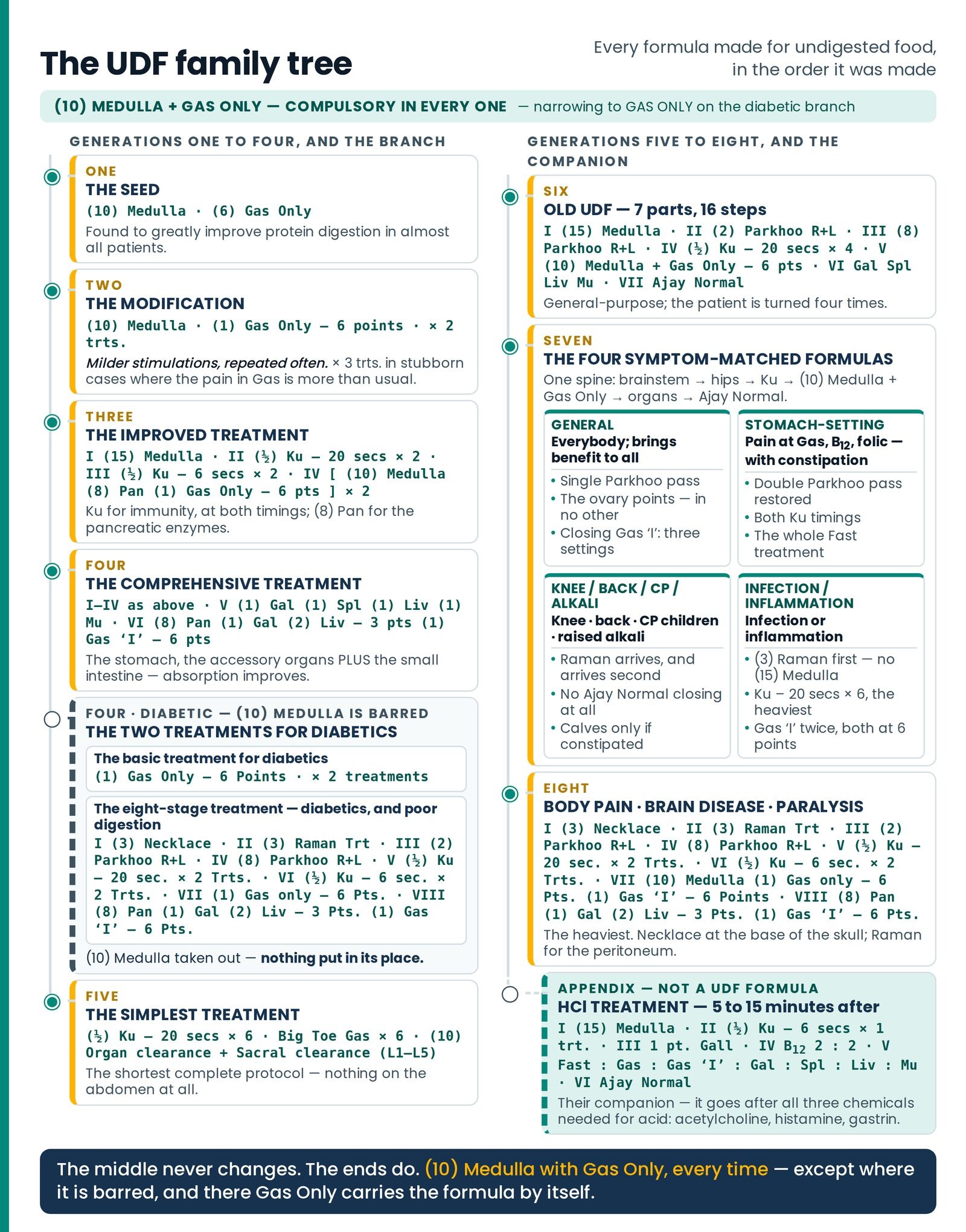
There is a name a student will meet in and will come back here to look up, and they should be told plainly that they will not find it. The Complement System formula — the fourteen-part treatment at the very end of the formulary — carries this instruction with it: giving the Complement System after the New UDF formula is beneficial for almost all old diseases.
That is the only place the phrase "the New UDF formula" appears, and no formula in this family is called by that name. The thirteen above are named by what they do or by the patient they were made for — the seed, the modification, the improved and the comprehensive treatments, the two written for diabetics, the simplest, OLD UDF, the four matched to symptoms, and the heaviest. Which of them the instruction means is not said, and it is not for a therapist to decide by guessing.
What the instruction does carry is its order, and the order is the part a therapist acts on: the Complement System comes after a UDF formula and not before one. That is the order this whole article has been teaching — the ash cleared first, the defences raised afterwards. No method is given here for a formula of that name, and none is supplied; choose the UDF formula for the patient in front of you by Table 24 below. (Figure 29.7)
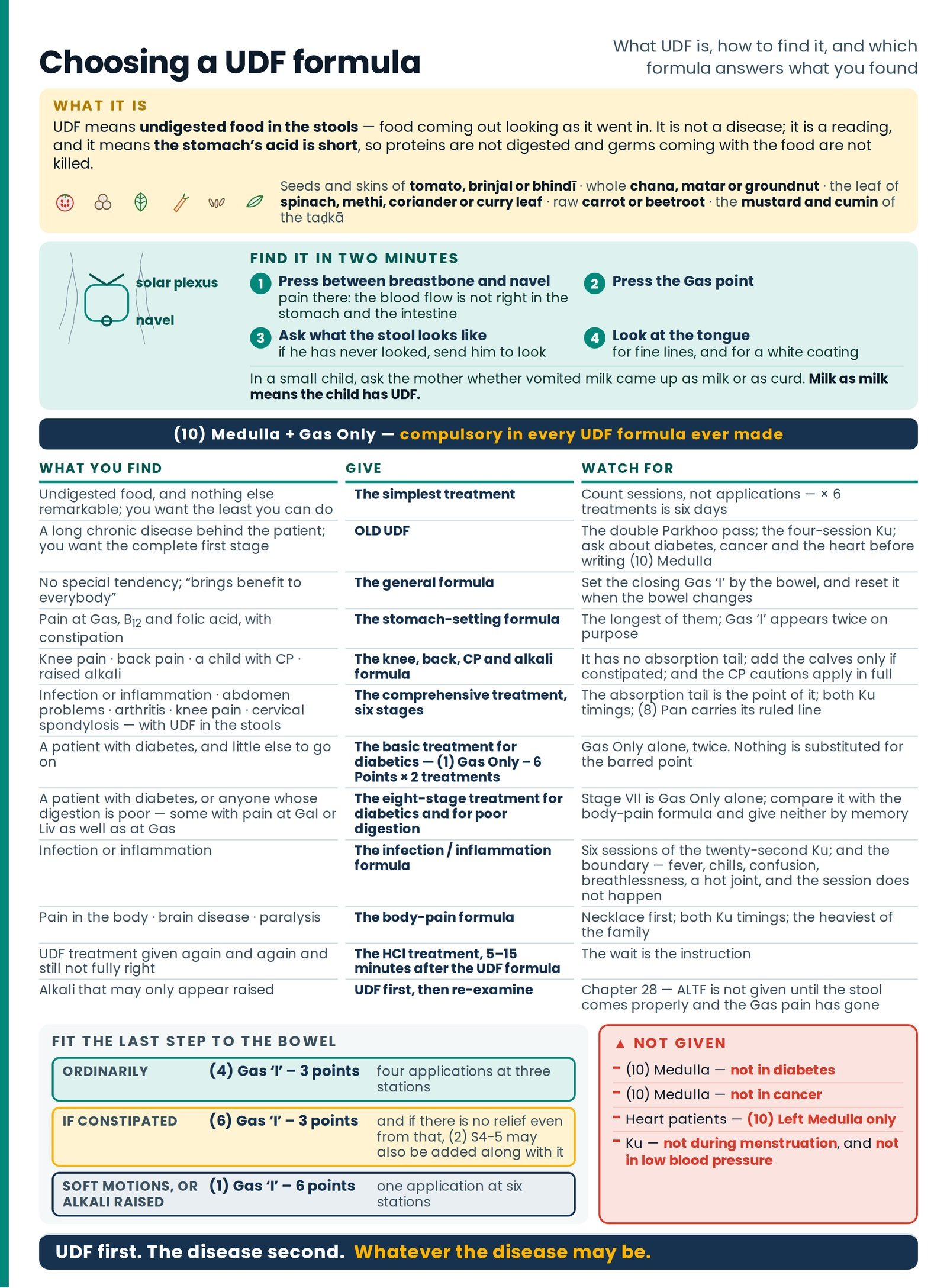
Questions students ask
1. I am seventeen and this is my first formulary article. This many formulas is a lot. Which one do I actually learn first? Learn the seed first, because it is two steps and everything else is built on it — (10) Medulla (6) Gas Only, and then what was done to it: milder stimulations, repeated often, were found to be more effective than one strong dose. Then learn OLD UDF, and learn it the way this article reads it — not as sixteen steps but as seven purposes: the acid signal, the vitamin machinery, the infection, the compulsory pair, the four organs, the absorption. Once you can say what each part is for, the rest of the family is OLD UDF with things moved. The simplest treatment takes ten minutes to learn afterwards, and the four symptom-matched formulas take an evening.
2. A doctor in my family says visible food in stool is normal and I should stop frightening people. What do I say? Say what the therapy itself says, without exaggerating it. It is true that this is not any disease. The coming of UDF only indicates that whatever has been eaten, the body is unable to digest it — and the position taken here is that if this is ignored, this same thing later becomes the root of diseases. That is a claim about what follows over years, not a claim that the patient is ill today. Do not tell anybody they are sick because of a tomato skin. And do not let a disagreement about a sign stop you from sending a patient who is losing weight, passing pale greasy stools that will not flush, or becoming anaemic — that person needs a doctor and a diagnosis, not a formula.
3. Why does a treatment for undigested food contain a hold on the sacrum? Because the therapy holds that when someone gets UDF, then in his body there will be infection in a great many organs — the acid being short, germs that come in with the food are not killed. (½) Ku – 20 secs is given to finish both infection and inflammation, and the reasoning offered is about the white cells: the monocytes that live for years in tissue, the neutrophils inside the blood, the eosinophils that make a highly reactive form of oxygen, and the basophils by which the Ku treatment is held to provoke the hypothalamus and pituitary to make ACTH, and so the adrenal to make cortisol. And the therapy's own honest close: whether it provokes the granulocytes, or the monocytes, or the ACTH — that is the body's work to see.
4. I am a retired schoolmaster and I keep confusing (6) Gas 'I' – 3 points with (1) Gas 'I' – 6 points. Is there a trick? Not a trick — a habit. Say the step aloud in two clauses before you give it: "six applications, three stations — because he is constipated." The bracket is always applications; the number after the dash is always stations. Table 13, How a Formula Is Built. And the clinical sense underneath it will hold the two apart better than any trick: a costive bowel gets pressure concentrated in fewer places; a loose one gets the whole length of the calf touched lightly and loaded nowhere.
5. I work in a village and cannot send anyone for a stool test. Am I working blind? No. The therapy's whole bedside method was built for exactly your situation. Pain between the solar plexus and the navel. Pain at Gas. What the stool looks like. Lines on the tongue. Milk or curd in an infant. Those five cost you nothing and no equipment. What you must have is the referral — the knowledge of which findings belong to a doctor and the willingness to say so. A therapist who can name the test he cannot do is worth more than one who has never heard of it. See also → Reading the Reports, "Reading the Reports".
6. If (10) Medulla is barred in diabetes and cancer, and it is half the compulsory pair, what is left of the formula? Gas Only is left, and Gas Only is the element the therapy calls chief and compulsory. That is precisely why it is the compulsory one: it carries no prohibition. Give the formula with part V reduced to Gas Only, and give the rest of the sequence unchanged. You have not given a crippled formula; you have given the formula as it stands for that patient. The withheld element is withheld by the condition, not by your judgement.
7. I am a physician. What exactly is being asserted here? Three separable things, and they are worth keeping apart. An observation — that patients with long-standing chronic disease very commonly report visible food residue in stool and tenderness in the epigastrium. A protocol — a set of manual sequences, given in a fixed order with fixed counts, reported to change both. And a mechanism — that surface pressure raises gastric perfusion and acid output, and that a shortfall of gastric acid propagates into a general failure of protein-derived signalling molecules. The first is what you can verify at the mat this week. The third is a hypothesis, and the therapy's own symptom list — pain at Gas, heaviness in the abdomen, gas, nausea, headache with heaviness — is the modest and testable end of it.
8. The article says (15) Medulla is for acetylcholine and (10) Medulla is for the vagus. Are they not the same nerve? They sit at the same site and they are given for different purposes, and in this therapy the number in front of the point is part of the point's identity. Fifteen opens the formula, for the chemical. Ten sits in the middle, to provoke the whole digestive system. Do not substitute one for the other because they look alike on the card. The whole graded series — (2), (4), (6), (8), (10), (12), (15), (20), (30) — and what each of them is for, is The Medulla Family, "The Medulla Family".
9. A woman came for her fourth session and told me she had started her period. I had already laid her prone. What do I do? You thank her, you help her up, and you do not give the Ku. Then you give what remains of the formula that does not contain it — in most of these sequences that is everything except one part — and you tell her plainly why, so that she tells you next time without being asked. The restriction is written without exception. See also → Treating Women, "Treating Women".
10. Why does the infection formula have no (15) Medulla when every other one does? Because it opens on (3) Raman instead. That is the formula's own construction and the absence is part of it — as the missing absorption tail is part of the knee-and-back formula, and the absence of Spl is what makes Ajay Normal what it is. Copy a formula's absences as carefully as its numbers. A student who "restores" the opening Medulla because the other formulas have it has written a different prescription.
11. My patient's undigested food stopped in eight days and he wants to stop. Has it worked? It has begun to work, and he should be told the true shape of it. The coming of UDF does not end so easily, because it happens on account of the person's eating and drinking and irregular way of life. Finish the course; then give the treatment for whatever he actually came with; then write a month four or five ahead on his card for the UDF to be checked again. The patients who come back two years later saying the treatment did not last are, almost always, the ones nobody gave that date to.
12. Is the HCl treatment a UDF formula or not? Not one — its companion. It was made because in some patients the UDF treatment has to be given again and again, and even then the problem does not get fully right. It is given 5 to 15 minutes after any UDF formula above, never instead of one, and its first four steps go after the three things needed for acid to be made. And the instruction that follows it is worth having: any other treatment given after both gives still more benefit — so the day's third treatment goes last, not first.
Questions patients ask
"The doctor says there is nothing wrong with my stomach. Why are you treating it?" He is right about what he tested. He tested whether there is a disease of your stomach, and there is not, and that is genuinely good news. What I am checking is different — how well your stomach is working, which is not the same question as whether it is diseased. If food is coming out of you looking the way it went in, your stomach is working below its best. That is not an illness and I am not going to call it one. It is something that can be improved, and improving it usually makes everything else I do for you work better.
"So all my problems are because of my stools?" No, and I would not want you to leave thinking that. What I am saying is narrower. When food is not being broken down properly, the body has less of the raw material it builds its own chemicals from — and over years that shows. So we put that right first, and then we treat what you actually came with. It is the order that matters, not a single explanation for everything.
"Do I have to look at it? It is disgusting." Once, and then you will not need to again. Look tomorrow morning and tell me one thing: whether anything is there in the shape it went in — a tomato skin, a whole chana, a curry leaf. That is all. Most people have never looked, and almost everybody who looks for the first time comes back the next day with an answer. After that I will not ask you again for months.
"Should I stop my medicines during this treatment?" No. Not one of them, and not the dose. Nothing I do here replaces a tablet, and anything you stop on your own can hurt you in a way I could not fix. If at some point your doctor finds your numbers have changed, that is his decision to act on, and I would be glad of it. Bring me the list of what you take, so that I know what I am working alongside.
"My Ayurveda doctor talks about āma. Is this the same thing?" They point at the same picture and they are not the same system, so I will not pretend one is the other. Both say the digestive fire can be weak; both say that what is left behind when it is weak causes trouble over time; both say you do not fix it by stimulating the appetite first. Where they differ is what is done about it. Keep taking whatever he has given you and tell him you are doing this — there is nothing here that works against him.
"My son is six and does not speak properly. Will this cure him?" I will not promise you that, and you should be careful of anyone who does. What I can tell you is what this treatment is for and what has been seen: it is given for the digestion, and it is said to be especially beneficial for children who are slow, and I will teach you both formulas so you can give them at home every day. But first I want two things done that I cannot do — his hearing tested and his thyroid checked — because if either of those is the reason, it can be treated, and it is best treated early. Do those, keep whatever his doctors give him, and we will work alongside it.
"Why are you pressing my hip when my problem is my stomach?" Because of what those two places on your hip are for in this work. They are the points we use for the vitamins that the digestive system needs to do its job — one of them so that the glands can make and release their juices, another so that the muscle of the stomach and its outlet can work properly. Your stomach is not short of pressure. It is short of what it needs to work. So we go where that is reached from.
"Can I eat normally during this?" Not quite normally, and this part is genuinely yours to do. Do not drink water or cold drinks with your meals — it quietens the very acid we are trying to raise. Eat only when you are actually hungry. Take more raw and live food — sprouted grains, fresh fruit juice, salad. If you can manage a proper fast under someone trained, that is best of all, but do not attempt one alone. The full rules are Food as Medicine, "Food as Medicine", and I will write out the short version for you.
Words used here
| Hindi | English | Neurotherapy code / usage |
|---|---|---|
| अनपचा खाना (anpachā khānā) | Undigested food | UDF — Un Digested Food in stools. Food seen in the motion in its original shape or colour. Not a disease — a reading of the stomach's acid |
| मोशन / लैट्रिन | Motion, stool | The readout. Soft stool three or four times a day, or a motion immediately after eating, indicates weak digestive power |
| जठराग्नि (jaṭharāgni) | The digestive fire | The Yogic name for the same capacity the therapy calls the stomach's acid. Provoked by viparīta karaṇī, agnisāra and nāḍī-śuddhi prāṇāyāma |
| दही (dahī) | Curd | The infant's test. If vomited milk comes up as milk and not as curd, hydrochloric acid is not being made — the child has UDF |
| — | Solar plexus | The part below the bone in the middle of the chest. In any disease of the stomach there is pain between the solar plexus and the navel |
| — | Idiopathic | The proper cause of why this disease came is not known. Idiopathic rickets, scoliosis, Parkinson's disease |
| खाली (khālī) | Only, empty | Gas खाली is simply the Hindi for Gas Only |
| — | The seed formula | (10) Medulla (6) Gas Only — the earliest and most basic. (6) Gas Only is six applications; (1) Gas Only – 6 Points is one application at six stations |
| — | Milder stimulations, repeated often | More effective than one strong dose. The principle that turned the seed into (10) Medulla (1) Gas Only – 6 Points × 2 treatments |
| — | The diabetic treatments | (1) Gas Only – 6 Points × 2 treatments; and the eight-stage treatment from (3) Necklace, which is the body-pain formula with (10) Medulla not written at stage VII |
| — | Gas Only | The chief and compulsory thing in all UDF formulas. Both thighs, hip crease → above the knee. Increases blood supply in the stomach |
| — | (10) Medulla | Provokes the whole digestive system through the vagus nerve. Not in diabetes, not in cancer; heart patients, (10) Left Medulla only |
| — | The compulsory pair | (10) Medulla with Gas Only — together they further increase the stomach's acid, so pepsin works well and proteins digest |
| — | (½) Ku – 20 secs | One press at the last end of the spine, held twenty seconds, released comfortably. To finish both infection and inflammation. Not during menstruation; not in low blood pressure |
| — | (½) Ku – 6 secs | The six-second hold. In the HCl treatment, given to provoke histamine by the mast cells |
| — | (4) Ku, the old Kundali | A different treatment of the same site — six seconds, two equal one, so (4) Ku is press and release eight times without stopping. Reduces alkali, spasticity and joint stiffness |
| — | Rt. / Lt. Parkhoo | The two points of the hip at the edge of the femur; two equals one. Knees drawn to the chest, pillow between them. For folic acid / thiamine & B₁₂ / niacin |
| — | Raman | Both hands over the shoulders from behind, muscles lifted, six seconds, three times, then five or six easy breaths. In the UDF family, named for the peritoneum |
| — | Necklace | Right thumb-tip at the edge of the skull bone, many closely spaced points, behind the left ear across to the right, three times each, three rounds, right to left |
| — | Gas 'I' | Down both calves, knee → heel. Provokes the jejunum and ileum for absorption. (6) – 3 points for constipation · (1) – 6 points for soft motions or raised alkali |
| — | (2) S4-5 | Added along with Gas 'I' when there is no relief even from the constipation setting |
| — | Ajay Normal | The absorption tail of the UDF formulas — the Normal formula with Spl omitted. Setting the Stomach |
| — | Fast treatment | Gas only, Gas 'I', Gal, Spleen, Liv, Mu, WD — not more than one or two seconds at any point, eighteen to twenty closely spaced places |
| — | OLD UDF | The generation marker, not a criticism. Seven parts, sixteen steps, four positions |
| — | Large Folic Black | Given after OLD UDF: the black of the face reduced by 25% at once; the first 1 inch of stool black next morning — toxins coming out by way of the rectum. Vitamin and Gene Formulas |
| — | HCl treatment | Given 5 to 15 minutes after any UDF formula. Goes after acetylcholine, histamine and gastrin |
| मन्द बुद्धि (manda buddhi) | Slow intellect | UDF and HCl are both to be taught to the parents of such children, who should be told to give them daily |
| पीलिया (pīliyā) | Jaundice | If it came in childhood, its effect remains upon the liver for many years |
| तड़का (taḍkā) | Tempering | The mustard and cumin of the tempering, seen whole in the motion, is UDF |