- Part of
- Heart, blood and circulation
Watch


From Cranial Nerve and Brain Formulas
Why there are two orders, and not one
Three quarters of the lymph drains up the left side
Here is the anatomy on which the two Mauneesh orders rest.
The two ducts, and the two subclavian veins
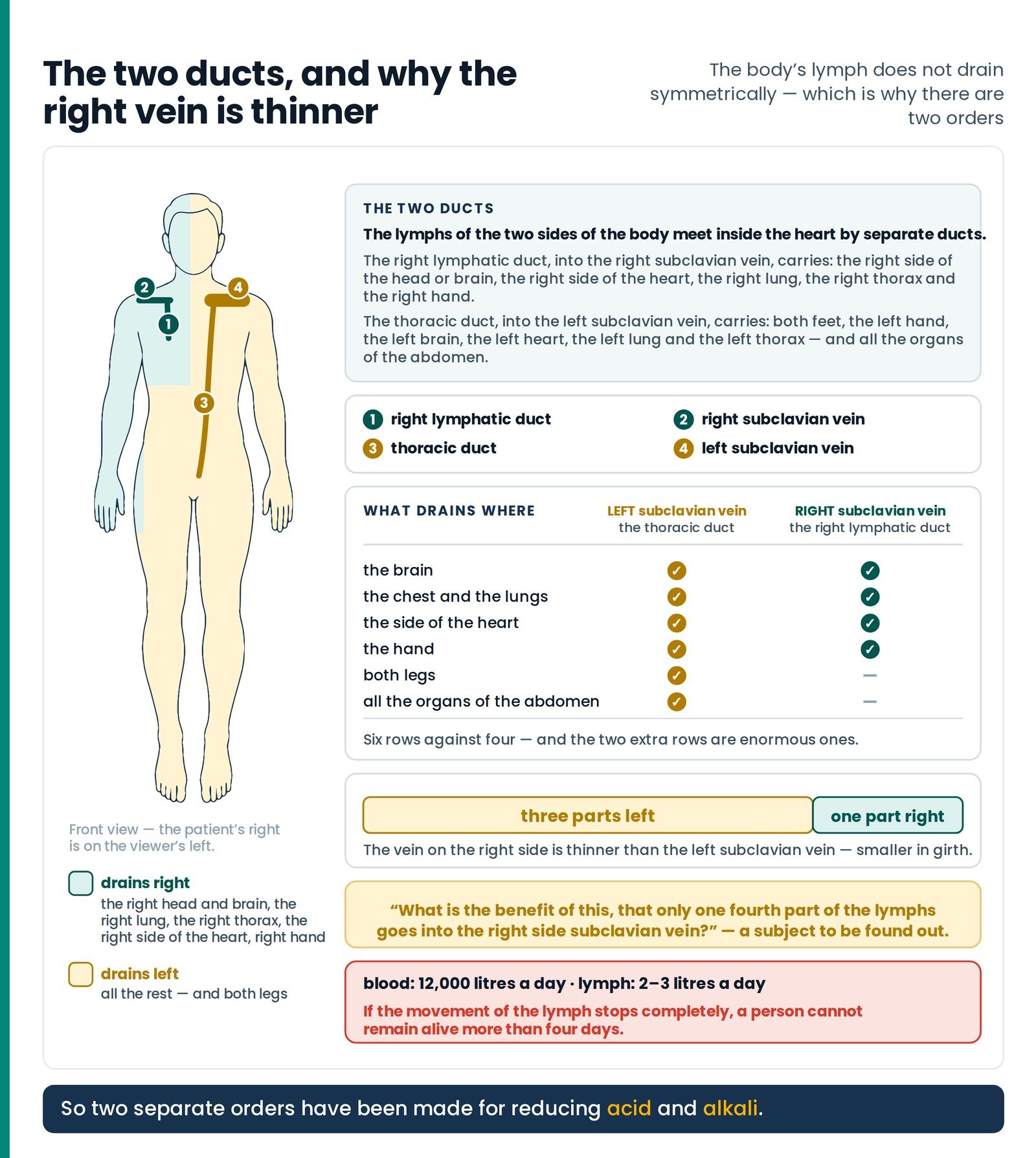
The lymphs of the two sides of the body meet inside the heart by separate ducts.
The right lymphatic duct, into the right subclavian vein, carries: the right side of the head or brain, the right side of the heart, the right lung, the right thorax and the right hand.
The thoracic duct, into the left subclavian vein, carries: both feet, the left hand, the left brain, the left heart, the left lung and the left thorax — and all the organs of the abdomen.
So two separate orders have been made for reducing acid and alkali.
Table 22 — What drains where
| Into the left subclavian vein — the thoracic duct | Into the right subclavian vein — the right lymphatic duct |
|---|---|
| The lymphs of the left brain | The lymphs of the right brain |
| The lymphs of the left chest and lungs | The lymphs of the right chest and lungs |
| The lymphs of the left side of the heart | The lymphs of the right side of the heart |
| The lymphs of the left hand | The lymphs of the right hand |
| The lymphs of both legs | — |
| The lymphs of all the organs of the abdomen | — |
Count the rows. Six against four, and the two extra rows are enormous ones — both legs, and every organ in the belly. So the two sides are not mirror images, and neither are the veins they empty into. (Figure 37.4)
The subclavian veins on the two sides are not alike. The vein on the right side is thinner than the left subclavian vein — that is, smaller in girth. And the reason given is exactly the table above: the flow of lymph in the veins of the two sides is not equal.
And then the question is left open, in its own words: it is a subject to be found out — what is the benefit of this, that only one fourth part of the lymphs goes into the right side subclavian vein. It is not answered. It stands as a question, and this wiki leaves it standing.
Also explained in
- The Renin–Angiotensin System, in plain words Water and Salt
First — it is a very powerful vaso-constrictor: under its influence all the blood vessels immediately constrict, that is, narrow.
- The knee and the lower limb Each Point in Use
BOF — Bottom of Feet Above the heel, at the back, there is something like a band, through which pass the blood vessels of the feet and toes, the nerves that control movement, and the tendons — the ropes that keep the bon
- The second river, which has no pump The Body's Own Pharmacy
The flow of blood is dependent chiefly on the state of relaxation of the muscles — both the small muscles in the walls of the blood vessels themselves and the ordinary muscles of the body around them.
- (1) Gas 'I' – 6 points — (1) Gas 'I' – 6 वाला The Front of the Body I
The calf is the two-headed muscle that bulges when you rise on your toes, over a flatter, deeper muscle beneath; a vein and a nerve run just under the skin down the middle.
- Piles, fissure, fistula and prolapse — one family, not four diseases What the Bowel Tells You
And two more, in the blood vessels, which have also come only because the flesh-muscles became loose — one chief cause of that being acidity: Varicose veins, the blue veins.
- Why a chemical made by a pair of hands might reach the brain when an injection cannot The River — Heparin
Heparin should be given, in order to heal the wound inside the blood vessels of that place.
- Why the arms must stay down Between Two Sessions
But if we keep the hands or arms above the level of the shoulder for a long time — as happens when sleeping with them under the head — then the pressure of the clavicle bones will fall on those blood vessels, on account
- What travels with each direction The Two Kingdoms
Three — the two diseases of the blood vessels.
- Two bodies, read as this article teaches What the Bowel Tells You
Asked about because of the family reading and not because she mentioned them: blue veins on both calves since her second pregnancy, and a blood pressure called "low, but normal for you" for twenty years.
- Liv — the liver point The Front of the Body I
At the front of the elbow is a shallow hollow, and under the skin lie the tendon of the big arm muscle, the main artery of the arm and the median nerve, barely covered; behind the inner knob — the "funny bone" — the ulna
- W D — White Discharge The Front of the Body I
At the elbow, the hollow in front with the arm's main artery and median nerve close under the skin and the ulnar nerve in its groove behind the inner knob.
- The rule that governs the head end The Front of the Body II
At the front of the neck, under thin skin, lie the windpipe and the voice box, and on each side of them runs the great artery carrying blood to the brain.
- Lymph — the lymph point (लिम्फ) The Front of the Body II
It is the fluid that has leaked out of the smallest blood vessels into the tissues, and it has to be collected up and returned — several litres of it a day — through its own separate set of thin-walled channels, against
- The standing rules of every seated treatment Seated I — Brain, Medulla, Neck
Deep at the top of the neck, an artery on each side leaves its bony tunnel, turns a sharp corner across the back of the topmost vertebra, and passes into the skull to supply the back of the brain.