- How it is given
- Seated I — Brain, Medulla, Neck
- What it is used for
- Each Point in Use · Cranial Nerve and Brain Formulas
Watch

From Seated I — Brain, Medulla, Neck
The lift and the breath — Raman and Mukha Dhauti
Six held seconds three times — and a breath she takes home
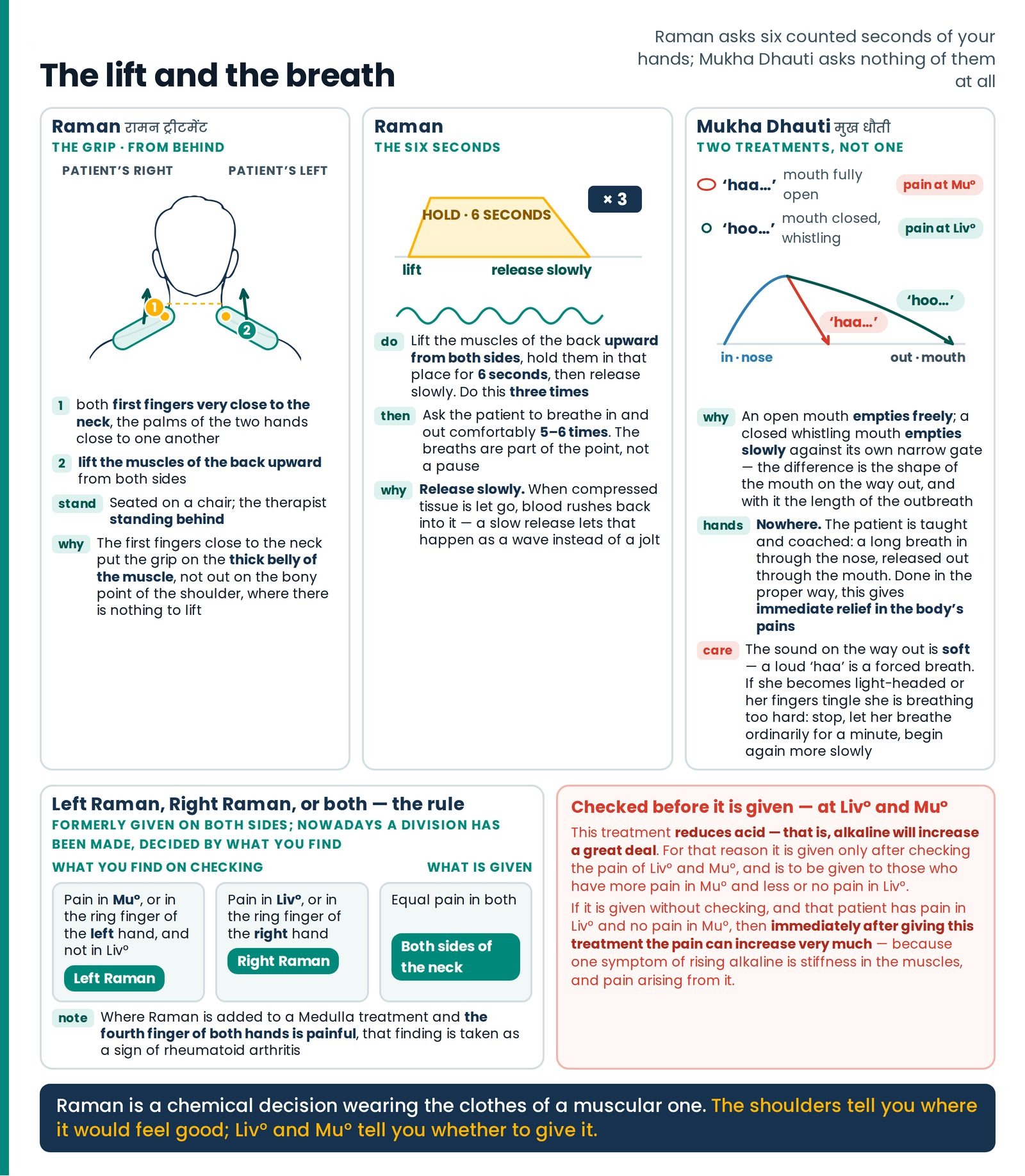
Two treatments follow that are not thumb-points at all. The first lifts a handful of muscle and holds it for a counted six seconds; the second asks nothing of the therapist's hands and everything of the patient's breath. (Figure 18.4)
Place both hands onto the shoulders from behind, in such a way that both first fingers are very close to the neck and the palms of the two hands are close to one another.
Then lift the muscles of the back upward from both sides, and hold them in that place for 6 seconds, then release slowly.
Do this three times.
After this, ask the patient to breathe in and out comfortably 5–6 times.
| Patient's position | Seated on a chair; the therapist standing behind Seated |
|---|---|
| Where the hands are placed | Both hands over the tops of the shoulders from behind, both first fingers very close to the neck, the palms of the two hands close to one another; the muscles of the back lifted upward from both sides Both sides |
| Duration and repetitions | Lift and hold for 6 seconds, then release slowly; three times. Then the patient breathes in and out comfortably 5–6 times 6 sec × 3 |
| What it is for | A treatment in its own right, closed by the 5–6 easy breaths |
What lies beneath. The handful is the great fan of muscle running from the base of the skull out to the point of the shoulder, with a deeper muscle under it that lifts the shoulder blade.
Three things in the instruction do real work. The first fingers close to the neck put the grip on the thick belly of the muscle rather than out on the bony point of the shoulder, where there is nothing to lift. And release slowly matters more than it looks: when compressed tissue is let go, blood rushes back into it, and a slow release lets that happen as a wave instead of a jolt. The breaths are part of the point, not a pause — five or six easy ones after the third lift are what turn a squeeze into a settling.
From Seated I — Brain, Medulla, Neck
Raman — रामन ट्रीटमेंट
Formerly Raman was given on both sides of the neck. Nowadays a division has been made into Left Raman and Right Raman, decided by what you find:
What you find on checking · What is given
Pain in Mu°, or in the ring finger of the left hand, and not in Liv° · Left Raman Left
Pain in Liv°, or in the ring finger of the right hand · Right Raman Right
Equal pain in both · Given on both sides of the neck Both sides
Left Raman, Right Raman, or both — the rule
Further experience will make it understood.
The ring finger earns its place there. Where Raman is added to a Medulla treatment and the fourth finger of both hands is painful, that finding is taken as a sign of rheumatoid arthritis — and the pain of that finger used to go. The formula in which Raman sits with the Medulla work and Thoracic T1/T2 is in The Medulla Family, "The Medulla Family"; its place among the lymph and cranial-nerve formulas is in Cranial Nerve and Brain Formulas, "The Twelve Messengers".
From Cranial Nerve and Brain Formulas
Raman — the treatment of the peritoneum
A sure-shot treatment of the peritoneum, in three written forms
Raman treatment — by this we provoke the peritoneum.
This is a rāmbāṇ — a sure-shot — treatment, which has the capacity to end many of the body's pains. It is useful in all problems of the uterus and the testes.
The hands, the six-second lift, the slow release and the five or six easy breaths that follow are taught in Seated I — Brain, Medulla, Neck, "Seated — I". The gate that must be passed before it is added to (4) Medulla clockwise with T1/T2 — the check of Liv° and Mu°, and the rule that Left Raman goes with pain at Mu° or the left ring finger and Right Raman with pain at Liv° or the right ring finger — is taught in The Medulla Family, "The Medulla Family". Neither is repeated. What belongs here is what has changed, and what the three written forms are for.
A rule that has moved
Earlier it was thought that Raman treatment should not be given to those whose alkali has increased; but now some change has come in this thinking.
That sentence is left standing exactly as it is. It is not a correction and it is not a retraction — it says that a bar that once existed is now not held as firmly as it was, and it does not say where the boundary now lies. Read it as a live question, treat the kidney codes as the gate as before, and write down what you see.
What has been seen since. By giving right Raman alone — Rt. Raman Only — the pains of the right side can be ended: from the right shoulder up to the fingers of the right hand, the right chest, the right part of the forehead and so on. These pains often come from the increase of alkali.
Whereas by left Raman — Lt. Raman — the pain of the left side, or the pain of the fourth finger of the left hand, can also be ended. These pains often come from the increase of acid.
Table 29 — Raman: the three ways it is written Seated 6 sec × 3
| As written | Given | What it is for |
|---|---|---|
| Raman | Both sides Both sides | The peritoneum; many of the body's pains; all problems of the uterus and the testes |
| Rt. Raman Only | Right side alone Right | Right-sided pain — right shoulder to the fingers of the right hand, the right chest, the right part of the forehead. These pains often come from the increase of alkali |
| Lt. Raman | Left side alone Left | Left-sided pain; the pain of the fourth finger of the left hand. These pains often come from the increase of acid |
| (4) Medulla clockwise T1/T2 + Raman | Preceded by four Medulla clockwise at T1/T2 | Cervical nerves C1–C8 — the forehead, the shoulders, the arms, the elbows, the wrists and the fingers of the hands: for the pains of all these parts this is good. Thoracic nerves T1–T12 — pain of both sides of the chest, pain of the mitral valve, pain of the spleen, and problems of the lungs and the heart. Beneficial in the upper part of the diaphragm too — therefore for stopping hiccups and for hiatus hernia, both. And in boys, when the testes do not come down — cryptorchidism — for that too this treatment has proved quite beneficial |
Look at what the fourth row does. Adding four Medulla clockwise at T1/T2 in front of Raman turns a peritoneal treatment into a treatment of two whole nerve territories — every cervical nerve and every thoracic nerve, which is to say the entire upper half of the body's wiring. That is why it reaches a mitral valve and a hiccup and an undescended testis in the same breath.
Also explained in
- Raman — the check that must be made before it is added The Medulla Family
ind the pain at Liv° and Mu° first; the finding names the side Raman is a treatment in its own right, and its hands, its six-second lift, its slow release and its five or six easy breaths are taught in Seated I — Brain, Medulla, Neck, "Seate
- What this article hands to the next Seated I — Brain, Medulla, Neck
Raman: both hands from behind, first fingers very close to the neck, palms close together, lift the muscles of the back from both sides, hold 6 seconds, release slowly, three times — then 5–6 easy breaths.
- The Subclavian treatment Cranial Nerve and Brain Formulas
If this does not happen, then it should be understood that all these pains should go with the Raman treatment.
- The neck, the shoulder and the arm Each Point in Use
Given in paralysis to reduce pain, and to relax the body (the anterior-neck rule governs it) ▲ Take care Raman trt.
- Introduction Seated I — Brain, Medulla, Neck
Give Raman with its six-second hold, three repetitions and closing breaths, and check Liv° and Mu° before you give it, choosing Left, Right or both by the rule.
- Mukha Dhauti — मुख धौती Seated I — Brain, Medulla, Neck
Three views sharing one style — from behind, Necklace, Endorphin and Raman on one nape; from the side, the big strap muscle as the front fence with Neck Clockwise behind it and the forbidden triangle tinted in front of i
- Subclavian — सब क्लेवियन ट्रीटमेंट Seated I — Brain, Medulla, Neck
→ The Two Kingdoms The Two Kingdoms — Liv-zero and Mu-zero, and what their tenderness means → The Educated Hand The Educated Hand — how the tenderness that decides Raman is elicited → The Navel Speaks First The Navel Speaks First — the
- Thoracic T1/T2 — the station at the base of the neck Seated I — Brain, Medulla, Neck
The Medulla Family, "The Medulla Family", gives it in full: the clockwise Medulla, the addition of T1/T2, the regions that combination is credited with, and the further addition of Raman when the fourth finger of both hands is p
- Two cases from the reference Each Point in Use
Raman, which is excellent for problems of the uterus.
- Introduction Cranial Nerve and Brain Formulas
Give the Maunish lymph-node treatments, the Mauneesh alkali and acid orders, Folded Legs, Raman in its three written forms, and Feather Touch whole, from the forehead to the inverted glass under the heel.
- VI — The abducens nerve: outward Cranial Nerve and Brain Formulas
This is the number The River — Heparin, "The River", flagged forward to this article, and here is its whole territory: the lateral rectus and the inferior oblique, the pons, the double vision that comes from an eye sitting up and
- The twelve in one table Cranial Nerve and Brain Formulas
he whole of Part two on one page, with the rule beneath it Table 2 — The twelve messengers, their number, their errand and their treatment Seated × 3 # The nerve What it carries The trouble you will meet Treatment I
- The last observations Cranial Nerve and Brain Formulas
Four of them have already been given in their places above — the Pondicherry child with cerebral palsy, the Chennai throat, (6) Medulla with Raman in infertility, and Shri Pankit Shah's hiccups on the 1st of December 200
- The whole index in reverse — number by number Cranial Nerve and Brain Formulas
Table 19 — Each Medulla number and the territory the index gives it Number Cranial nerve Its territory in the index (1) Olfactory Loss of smell — anosmia (2) Optic Blindness of any kind; seeing little or not seeing; the