- Part of
- Bones, joints and muscles
Watch


From Placing the Patient
The station rule — no empty space between joints
Three places ordinarily — but the rule is the bare space, not the count
Most treatments are given not at one spot but at a series running down a limb, and the places are called stations. Students want a number; the therapy gives one, then tells you the number is not the instruction.
How many places, and the rule that decides it
For Gas, Gas I, Gal, Spl, Liv, Mu, Lt. Ov., Rt. Ov. and WD, three places is enough for an ordinary person — but this depends on the length of the patient's thigh and the width of the therapist's foot.
The main issue is that no space should be left empty from one joint to the other joint.
a. For a tall patient, four places may be enough for an ordinary therapist — but if the therapist is a young child, then even five places may be needed, and that too is correct. b. For a very small child, even two places may be enough. c. This is a matter of experience.
And where both feet are on the patient: while giving WD and Pit, keep equal weight on both soles → pay attention to this. Both sides
Nobody tells a painter how many strokes; they tell him not to leave bare wood. Lay each contact where the last ended, work from the upper joint to the lower, and count afterwards — deciding the stations before any weight goes down, and writing the number you used on the card.
From The Stiffening Joint
The new method of diagnosis for joint pain
Both at the same time, the same squeeze — and let them answer
Since the success of this treatment, a new method of diagnosis has been started for patients with joint pain or sandhi vāta, which every therapist is to adopt.
Table 7 — The ring-finger sign and its recording
| Finding | How it is elicited | How it is written |
|---|---|---|
| Intense pain, left ring finger, middle joint | Both middle joints squeezed at the same time between the therapist's thumb and first finger; the patient says which hand has more pain | Lt. 4ᵗʰ ⁺⁺⁺⁺ Left |
| Intense pain, right ring finger, middle joint | as above | Rt. 4ᵗʰ ⁺⁺⁺⁺ Right |
| Lesser degrees of pain | as above | ⁺⁺⁺ or ⁺⁺, according to what is found |
| A blood report is available | Read it | the date of the report, then RA positive — or ANA where that is what is positive |
The grading marks are the ones you already use everywhere else on a diagnosis card, and they mean here exactly what they mean there: what you found, not what you will give. An empty box is not examined; a minus is examined and silent.
And note the value of the negative. A therapist who squeezes both ring fingers of a patient with trembling hands, finds nothing, and writes it down has not wasted thirty seconds. He has removed a question from the case.
From The Stiffening Joint
The full protocol for joint pain and RA
Three parts: the medulla and T1/T2, the formula, then every joint
The best results have been got in the following order. (Figure 36.4)
Table 8 — Card: the full protocol for joint pain and RA Seated Supine Prone 6 sec
| Written | I — (4) Medulla Clockwise + T1/T2; + if there is pain in the neck, also do Neck ghisai. II — the New Star Modified formula: (3) ONS (20) TF (6) NNS (6) Gal (6) WD (½) Ku – 40 seconds (20) ↑\ | ↓. Afterwards — the ghisai of all the joints, in order |
|---|---|---|
| Part I, step 1 — (4) Medulla, clockwise | Seated. Gather your fingers together into a pad — this is not the thumb glide of the rest of the Medulla family. Rotate the pad clockwise on the muscles of the neck, coming from the ear down to the shoulder, worked from above downward in various directions. Begin from the left side and go across to the right. Four, by this lane's count Seated Left Right | |
| Part I, step 2 — T1/T2 | Without moving the patient. Find the prominent bead at the base of the neck; the next two beads down are T1 and T2. That is the station. No count is written for the station itself — the treatment governs it. Light hands Seated | |
| Part I, step 3 — Neck ghisai, conditional | Only if there is pain in the neck. Four stages in order: first, with light hands, the muscles at the front of the neck and the muscles at the back; then the muscles of the right and left sides; then the necklace-like treatment; finally the muscles attached to the shoulder blade Seated ▲ Take care | |
| Part II | The New Star Modified formula, entire, exactly as Table 4 — ONS, TF, NNS, Gal, WD, the forty-second (½) Ku, the Round Arrow | |
| Part III | All joints ghisai — fingers to shoulder, every joint, very very light, one minute between joints | |
| The rule inside part I | Clockwise is a different hand action, not an adverb. Four ordinary downward strokes are (4) Medulla, which is not (4) Medulla clockwise | |
| What must not be given | The Ku bars — not in menstruation, not in low blood pressure. The anterior-neck rule governs Neck ghisai absolutely: glide, never thrust; no rotation, no traction, no leverage ▲ Take care | |
| Points taught in | (4) Medulla clockwise with T1/T2 — The Medulla Family, "The Medulla Family" · Neck Clockwise and T1/T2 — Seated I — Brain, Medulla, Neck, "Seated — I" · Neck ghisai — Seated II — Face, Jaw, Ear, Sinus · Each Point in Use |
Two notes on part I, both of which a student will otherwise get wrong.
The Medulla here is the one member of its family with a direction. (4) Medulla is given clockwise, with T1/T2, and is credited with the neck's own territories — the C1–C4 group, which carries the chest, the mitral valve, the spleen and the upper diaphragm, and the C5–C8 group, which is the arm written out from the shoulder to the fingertips. In a article about pain in the joints of the arm, that is not an ornament at the front of the formula. It is the road the arm's pain travels on.
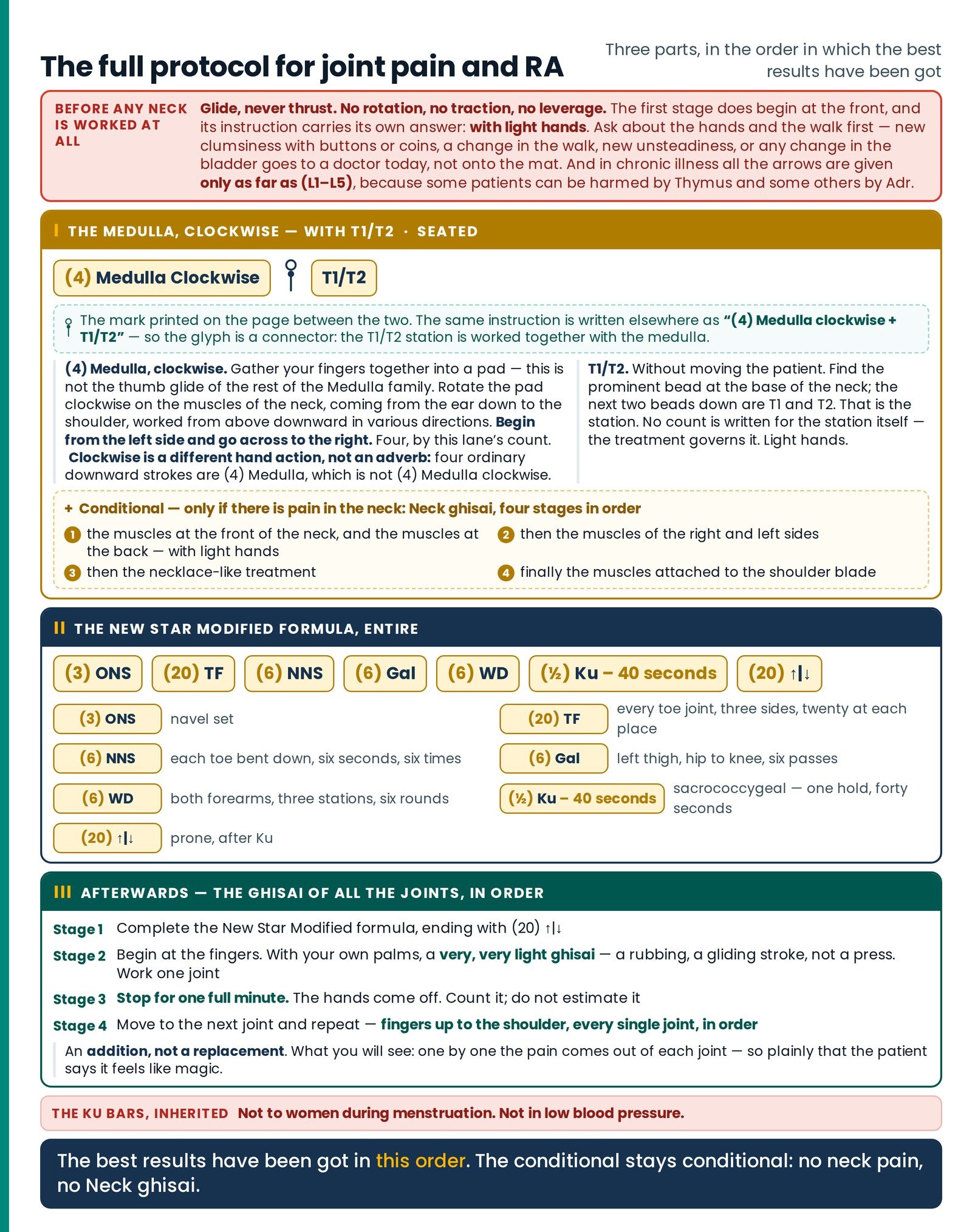
And the conditional stays conditional. If there is pain in the neck, then also do Neck ghisai. No neck pain, no Neck ghisai. A conditional addition is a gate, not decoration, and the habit of giving it anyway because it seems to belong is how formulas quietly stop being formulas.
Also explained in
- July 2006 — the Star formulas are broken apart and rebuilt The Stiffening Joint
Written on the card: the date of the report, then RA negative; and beneath it, in the therapist's own words, pain both ring finger middle joints, left worse, four plus — "RA hai".
- Why it works — the secret of it The Stiffening Joint
And we have found that because of acidosis too, pain can come in the joints.
- B A F A — Both Arms, Both Forearms The Front of the Body II
aking full support of the chairs and carrying your body weight on your palms, stand near their shoulder joints, so placed that both your heels are inside the armpit and the weight is directed downward.
- PRADEEP — the pillow, the jerk, the walks and the stand Knee, Leg, Foot
In week ten she went backwards, and it took two sessions to learn why: a cousin had told her curd and tamarind were "cooling and good for joints", and she had gone back to both, daily, after eight weeks off them.
- The sign The Stiffening Joint
great deal of pain at the middle joint of both ring fingers Such patients did indeed have pain in many fingers and joints — but not everyone's pain was the same.
- The patient whose report is normal Reading the Reports
Mild but real swelling of the small joints.
- What is done The Stiffening Joint
he All-joints ghisai — an addition after the formula, not a part of it This treatment is another mark of long practice, and it is given after the New Star Modified, not instead of any part of it.
- Questions students ask The Stiffening Joint
A substantial minority of people with genuine rheumatoid arthritis are seronegative, and the classification rests on the pattern of joints, the symmetry, the duration and the inflammatory markers together.
- Who is called an RA patient The Stiffening Joint
The अनामिका (anāmikā), the ring finger, has three joints: the big knuckle where the finger meets the palm, a middle joint halfway along, and a small joint near the nail.
- LEFT CALF MUSCLE GHISAI — three stages, three tools Knee, Leg, Foot
Then with the side of your thumb, rub along the inner side of the foot from the heel to the joint of the big toe, 6 times, and from that joint to the tip of the toe, 6 times — see 7, 8 in the picture.
- Why the chemical points come first Knee, Leg, Foot
And keep one distinction the words knee problems hide: a worn joint, a torn cartilage, a snapped ligament, a cap that tracks badly, a hip sending its pain down to the knee, and a hot infected joint are six different thin
- The rests How a Formula Is Built
By this, digestion and absorption improve Between two formulas Five minutes the Inflammation formula, then (3) ONS (20) TF (6) NNS After a gap of five minutes, the abdomen-setting sequence is given Between one joint and
- Why Mukha Dhauti is given, and to whom The Stiffening Joint
It is to be done because we have found that in RA patients some people feel very good immediately after our treatment, but within a few hours the pain returns in the joints.
- The knee sequence, said aloud Knee, Leg, Foot
The therapist stands between the patient's legs, looking at the knee, his weight hanging from two chairs, both feet placed on either side of the joint and not on it.