- How it is given
- Seated II — Face, Jaw, Ear, Sinus
- What it is used for
- Each Point in Use
Watch

From Seated II — Face, Jaw, Ear, Sinus
The face — the facial point, the teeth and the jaw
The arrow on the card, and the points you hand the patient
From Seated II — Face, Jaw, Ear, Sinus
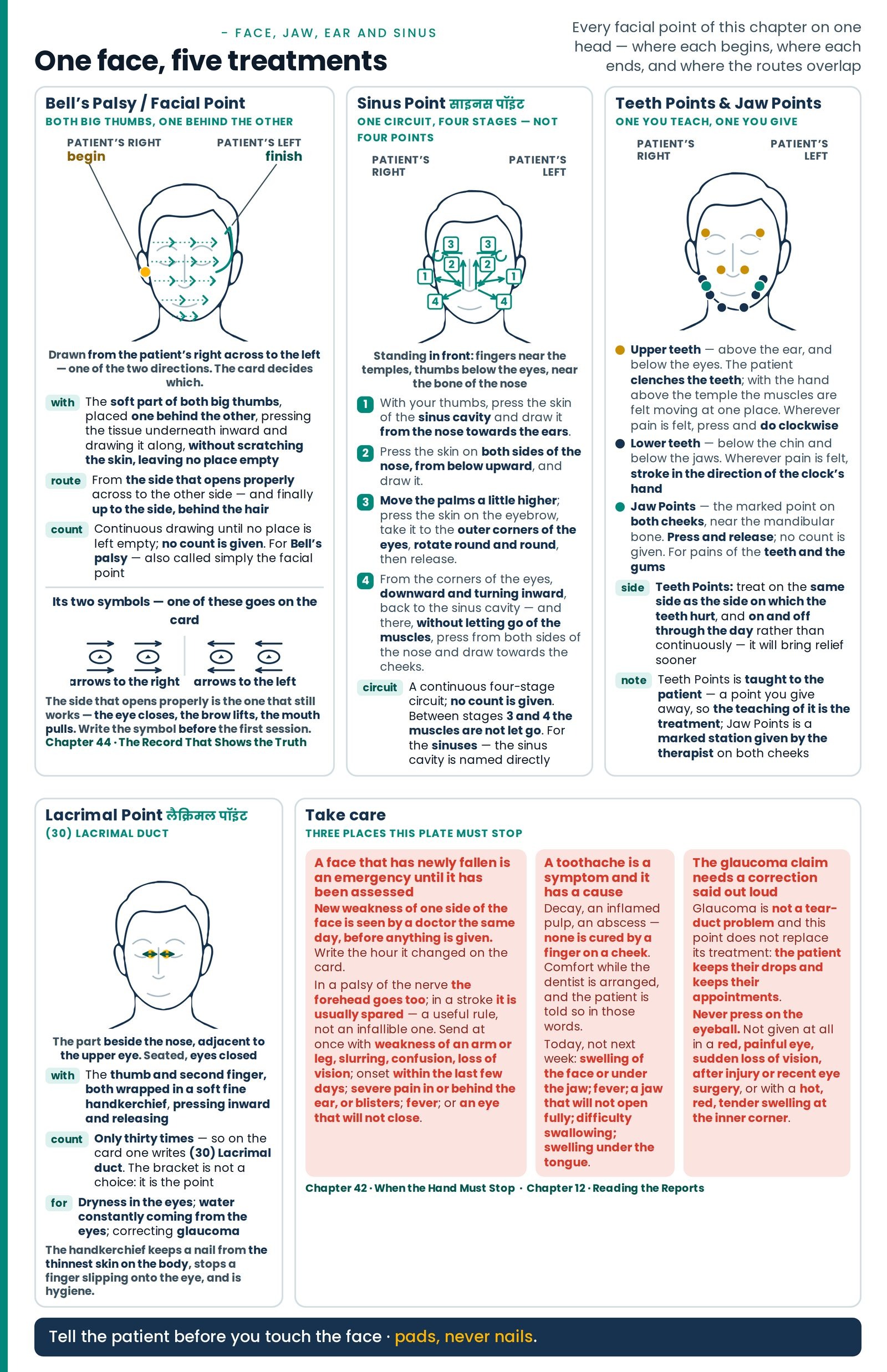
Bell's Palsy / Facial Point
This treatment is to be given with the soft part of the big thumbs of your hands. Placing both thumbs one behind the other, and without scratching the skin, press the tissue underneath inward and go on drawing it along, leaving no place empty. (Figure 19.4)
In this way, from the side that opens properly, draw the tissue across to the other side, and finally bring it up to the side, behind the hair.
Its symbols are: two eye-with-arrow marks pointing to the right, or two eye-with-arrow marks pointing to the left.
Looking at the patient, whichever of the two is appropriate should be written on the sign card, so that the therapist knows from which side it is to be done and no mistake occurs.
| Patient's position | Seated Seated |
|---|---|
| Where the hands are placed | The soft part of both big thumbs, placed one behind the other, pressing the tissue underneath inward and drawing it along without scratching the skin, leaving no place empty — from the side that opens properly across to the other side, and finally up to the side, behind the hair Both sides |
| Duration and repetitions | Continuous drawing until no place is left empty; no count is given. The direction is chosen for each patient and written on the sign card as a symbol |
| What it is for | Bell's palsy; also called simply the facial point |
The two symbols are the laterality, and they are why the card exists. Write the symbol before the first session, not after.
"The side that opens properly" is the side that still works — where the eye closes, the brow lifts and the corner of the mouth pulls. The draw begins there and travels across to the weak side.
Both thumbs, one behind the other — not side by side. The leading thumb presses the tissue inward and moves it; the second follows in the same track a little behind, keeping what has been picked up from slipping back. Without scratching the skin is part of the method: soft thumb, no nail, and a word to the patient before each track.
What lies beneath. The face is the one place in the body where muscles are anchored into the skin rather than onto bone, which is why dragging the skin loads the muscle bellies instead of sliding over them. So the treatment loads real muscle; whether it reaches a nerve whose injury sits inside a bony canal in the skull has not been shown. Offer it alongside medical care, never in place of it.
Also explained in
- What this article hands to the next Seated II — Face, Jaw, Ear, Sinus
Bell's Palsy / Facial Point: both big thumbs one behind the other, pressing the tissue inward without scratching the skin, leaving no place empty — from the side that opens properly across to the other side, finishing up
- Introduction Seated II — Face, Jaw, Ear, Sinus
Give Bell's Palsy from the correct side and write the direction on the card as a symbol, so the next therapist works the same way.
- Questions students ask Seated II — Face, Jaw, Ear, Sinus
How do I decide the direction for the facial point when the weakness is slight? By which side opens properly — where the eye closes, the brow lifts and the mouth pulls; you draw from there across to the weaker side.
- The points of immunity Each Point in Use
For Bell's palsy — paralysis of the face — for herpes zoster (shingles, नागिन), for septicaemia, for HIV, for viral fever, and for diseases caused by bacteria.
- The head and the face Each Point in Use
ammering, speech, ear, eye and teeth — and the side crosses Table 18 — The head, the face, the ear and the eye Point What it is used for When it must not be used Notes Bell's palsy Seated For a person whose mouth is twi
- Every symbol, and how to say it in words The Shorthand
(Figure 14.2) Table 10 — The written symbols and their names (first plate) Symbol (described) Code Full name A small circle flanked by inward-leaning strokes — \ ° / Back Arrow Back Arrow, or Blood supply to lungs Two
- The master list — every treatment point, by the position the patient is placed in The Shorthand
Code Full name / Hindi Where it is taught in this wiki Medulla Medulla oblongata Seated I — Brain, Medulla, Neck; graded series, The Medulla Family Mesencephalon Midbrain Seated I — Brain, Medulla, Neck Dorsal Dorsal (thoracic) Seated I — Brain, Medulla, Neck Raman (proper name) Seated I — Brain, Medulla, Neck · Cranial Nerve and Brain Formulas Mukha Dhauti मुख
- Why a chemical made by a pair of hands might reach the brain when an injection cannot The River — Heparin
The hypothalamus treatment — the very first Medulla treatment that was obtained Seated Steps 2–4 The parent sequence, unchanged The addition (6) Adr may be given along with it: there will be much benefit in the inflamma
- Layer three — the selection table The River — Heparin
Heparin (medulla) (6) Medulla + parent; ± (6) Adr The lowest Medulla count Headache; face, neck, shoulder pain; brain disease; meningitis; hydrocephalus; encephalitis; eye disease; Bell's palsy; cranial nerve VI; memory;
- Where this leads The River — Heparin
= (6) Medulla, the brain, meningitis, hydrocephalus, Bell's palsy, cranial nerve VI.
- VII — The facial nerve: expression, tears, and taste from the front Cranial Nerve and Brain Formulas
The mouth pulling to the good side, which is how Bell's palsy looks.
- The twelve in one table Cranial Nerve and Brain Formulas
he whole of Part two on one page, with the rule beneath it Table 2 — The twelve messengers, their number, their errand and their treatment Seated × 3 # The nerve What it carries The trouble you will meet Treatment I
- The eyes Cranial Nerve and Brain Formulas
Table 4 — The six muscles of the eye and their Medulla treatments The movement The muscle Treatment Turning the pupils inward Medial rectus (3) Medulla Turning the pupils upward Superior rectus (3) Medulla Turning the pu
- The face and the mouth Cranial Nerve and Brain Formulas
Table 10 — The voice and the larynx Point or condition Treatment To bring back a voice that has gone (12) Medulla To correct a heavy voice — thick speech (12) Medulla To bring sweetness into the voice (10) Medulla To rem