The ring-finger check that decides whether it is the right treatment
This is a new treatment, which is given to provoke the lymphs of the body — that is, the lymphatic system — through the subclavianveins, which are on both sides of the neck. The method itself — the thumb along the inner side of the collarbone, out to the shoulder, into the hollow below towards the neck, then back along the edge of the neck to the start, the circuit three times — is taught in Seated I — Brain, Medulla, Neck, "Seated — I", together with the rule that governs the whole front of the neck. It is not repeated here.
What belongs here is the check that decides whether this is the right treatment at all, and what its failure tells you.
That is diagnosis by treatment, used honestly: a defined trial, a defined endpoint, a defined next step if the endpoint is not reached. Notice that it does not take weeks. Two treatments, and then you know.
Key teaching
What is inside a lymph node
In the fetal stage — that is, in the child in the mother's womb — along with the liver and the spleen, the lymph nodes also make some blood.
In the lymph nodes there are the following:
Interleukin number two — these make T-helper cells
Natural killer cells
Gamma globulin, which the plasma cells make, whose molecular weight is from one and a half lakh to nine lakh. The heavier they are, the greater is their capacity to finish germs.
These three are so powerful that they can finish even cancer cells, and they can end every kind of infection.
And one more piece of anatomy, because it joins this part of the article to the next.
Key teaching
The peritoneum as a sanitary system
The peritoneum has covered almost all the glands of the abdomen from all sides — except the pancreas, the spleen and the kidneys, which it covers from the front.
And so that the infection of one gland should not spread to another, this peritoneum puts that infectious material — that is, the thing filled with germs — into the lymph, where the infection is finished by the three cells mentioned above.
Read that and the Raman treatment stops being a shoulder manoeuvre and becomes what it is: the treatment that provokes the membrane which does the sanitation of the entire abdomen. That is why it appears in the Complement System as part III, so that all the organs work properly, and why it is the fallback when the ring fingers do not clear.
By these two treatments the organs of the digestive system can be set, one by one. You have given them a hundred times by now — (20) TF (6) NNS stands at the front of New Star Modified and in the fourth part of the Oxygen-Hormonal treatment and in half the formulas of — and you have given them at a count you were handed without explanation. Here is the explanation. Each toe answers to a named organ, and the ten toes are a keyboard.
One rule governs the whole arrangement: the toes of one foot answer to the organs of the opposite side of the abdomen.
Table 23 — The toes of the LEFT foot, and the organs they provoke Left
Toe of the left foot
The organ or region it provokes
Big toe (बड़ा अंगूठा)
Draws out the pain of Gas below the sternum in the chest
First toe (पहली उंगली)
The right part of the pancreas — that is, the head of the pancreas; from this, more hormones will come out
Middle toe (बीच वाली उंगली)
The gall bladder, and the right part of the chest inside the ribs
Third toe (तीसरी उंगली)
The liver, the middle part of the ascending colon, and the intestine of the right part of the navel
Smallest toe (सब से छोटी उंगली)
The right ovary / testis, the appendix, and the beginning part of the ascending colon
Table 24 — The toes of the RIGHT foot, and the organs they provoke Right
Toe of the right foot
The organ or region it provokes
Big toe
Draws out the pain directly above the navel — this will work like Gas 'I'
First toe
The tail part of the pancreas; from this, more digestive enzymes will come out
Middle toe
The spleen, the left part of the chest, and the last part of the transverse colon
Third toe
The middle part of the descending colon, the left part of the navel, and the mucous membrane of the whole body
Draws out — that is, reduces — the pain of the WD below the navel Both sides
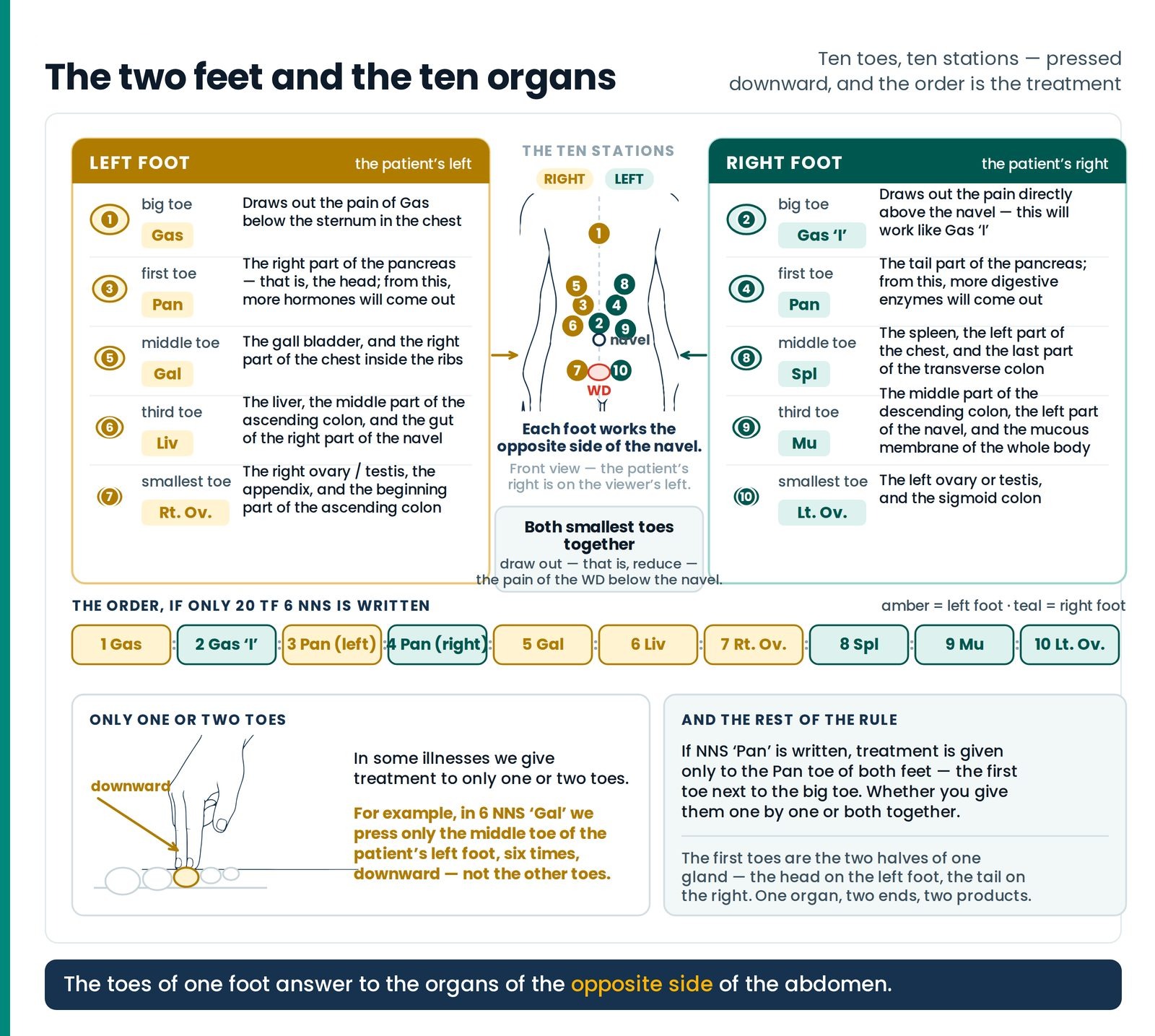
Two things in those tables repay a second look. (Figure 37.5)
The first toes are the two halves of one gland. Left first toe, the head of the pancreas, from which more hormones will come out. Right first toe, the tail, from which more digestive enzymes will come out. One organ, two ends, two different products — and two different toes. It is the most precise correspondence in the therapy.
The third toe of the right foot carries something that is not an abdominal organ at all: the mucous membrane of the whole body. Every wet lining in the body — nose, mouth, gut, airway, bladder — sitting on one toe beside the descending colon. Learn it, because it is the row you will reach for in complaints nobody would think to bring to a foot.
The two feet and the ten organs. The ten toe stations as two keyboards — which toe, which organ, which foot — with the standard running order printed once beneath them, the crossing rule shown against a traced trunk, and the page's own small pictogram of a hand pressing a single toe redrawn at size.
From Findings to a Plan From Findings to a Plan — a defined trial with a defined endpoint and a defined next step
Vitamin and Gene Formulas The Missing Links — the folic acid and B12 points whose pains should clear with the fingers
The order of treatment
Ten toes in one running order, alternating and then settling
For both the TF and the NNS treatments there is one and the same order, which can change according to the formula and the need.
If only 20 TF 6 NNS is written, then treatment is to be given to all the toes, in this order:
Key teaching
One order for both treatments
Gas : Gas 'I' : Pan (left) : Pan (right) : Gal : Liv : Rt. Ov. ; Spl : Mu : Lt. Ov.
In different treatments the order is changed.
In some illnesses we give treatment to only one or two toes. For example, in 6 NNS 'Gal' we press only the middle toe of the patient's left foot, six times, downward — not the other toes.
But if NNS 'Pan' is written, then treatment is to be given only to the Pan toe of both feet — that is, the first toe next to the big toe. Whether you give them one by one or both together.
The order is not foot by foot — it alternates, and then settles. Gas on the left, Gas 'I' on the right; Pan left, Pan right; and only then does it run down one foot and afterwards the other. It is organised by organ logic, not by the convenience of the therapist's hands. The two gas stations first, then the two halves of the pancreas, then the biliary and hepatic group, then the spleen and the left colon, with the two gonadal stations placed at the end of each foot's run.
And notice that nothing new has been introduced. Pan, Gal, Liv, Mu, Spl, Rt. Ov., Lt. Ov., Gas, WD — the whole abdominal vocabulary you learned supine in The Front of the Body I, "The Front of the Body — I". What has changed is only the place from which the same organs are addressed. A student who knows the abdominal set already knows this one; it is the same alphabet written in a different hand.
When the order changes
An omission is an instruction: two altered orders, each with its reason
Two altered orders are given, each with its reason.
Give in the following order: Gas : Gas 'I' : Pan (left) : Pan (right) : Gal : Liv : Spl : Mu : Lt. Ov. — and then give Spl : Mu : Lt. Ov. a second time.
Key teaching
Mild constipation — one station is taken out
Rt. Ov. is not to be given, because it will reduce alkali and increase acid.
That is the whole reasoning, and it is an example of the rule that an omission is an instruction. The station is not skipped for time. It is removed because of what it would do to the body's direction, and what is added in its place — a second pass down the left colon, exactly the stretch that has to move — is added for the same reason.
Key teaching
For correcting digestion — a different order altogether
Written as: Pan : Pan : Gal : Liv : Gas : Gas : Gal : Liv
Given as: Pan (left) : Pan (right) : Gal : Liv : Gas : Gas 'I' : Gal : Liv
Read the two lines together, because the second is how the first is decoded, and the decoding is not optional: the repeated Pan means left then right, and the repeated Gas means Gas then Gas 'I'. Eight stations, not ten — the two gonadal stations and the spleen and Mu are absent altogether, and Gal and Liv are given twice, once before the gas stations and once after.
Table 26 — The three orders side by side
Step
Standard
Mild constipation
For digestion
1
Gas
Pan (left)
2
Gas 'I'
Pan (right)
3
Pan (left)
Gal
4
Pan (right)
Liv
5
Gal
Gas
6
Liv
Gas 'I'
7
Rt. Ov.
omitted ▲ Take care
Gal
8
Spl
Liv
9
Mu
—
10
Lt. Ov.
—
11
—
Spl again
—
12
—
Mu again
—
13
—
Lt. Ov. again
—
What is given after them
TF, then NNS, then NAN or FAN — the architecture of Part Four
Key teaching
TF, then NNS, then NAN or FAN
By giving the TF and NNS treatments one after the other, the stomach and the intestines will begin to be set right, from which the power of digestion will increase. Proteins will begin to be digested properly, from which amino acids will also begin to be formed in the right quantity.
After these, the normal NAN / FAN treatment should be given, so that — digestion and absorption being correct — all the glands obtain their raw materials properly and they work properly.
That is the whole architecture of in three sentences, and it is why these two treatments sit at the front of so many formulas. NAN and FAN are taught in Setting the Stomach, "Setting the Stomach".
ONS and NNS — the difference, and two pictures for it
A bag shaken once, and the remote control of a TV
Key teaching
When each is enough
ONS is a general treatment, which sets all the organs of the abdomen at one and the same time.
When, because of travel or other causes, the navel is slightly upset, then this alone is enough to set the body right.
But when some one particular organ is spoiled, then to set it right completely this alone is not enough.
Giving ONS first and then NNS will give more benefit.
By NNS we can set right, even by itself, whichever organ has gone wrong, in a subtle or fine way. And if we wish, we can set several organs one after another.
And the two images given for them are so good that they should be used with patients word for word.
For ONS — suppose we have a bag in which several things have been tightly packed, filled solidly. Because of some journey or jolting, the things inside have shifted a little here and there. If there has not been too much upheaval, then if we catch the corner of the bag and shake it gently once or twice, that alone may be enough to settle each of them back into its own place. ONS's work is of this kind.
For NNS — its work is like the remote control of a TV, by which each channel can be finely tuned.
Table 27 — ONS and NNS compared
ONS — Old Nabhi Set
NNS — New Nabhi Set
What it does
Sets all the organs of the abdomen at one and the same time
Sets right whichever organ has gone wrong, in a subtle or fine way; or several organs one after another
The image
Catching the corner of a tightly packed bag and shaking it gently once or twice
The remote control of a TV — each channel finely tuned
When it is enough alone
When the navel is slightly upset, from travel or other causes
When one particular organ is spoiled
Order when both are used
ONS first, then NNS — this gives more benefit
—
Mauneesh — the alkali and the acid orders
One position, one manoeuvre, and only the order of the limbs changes
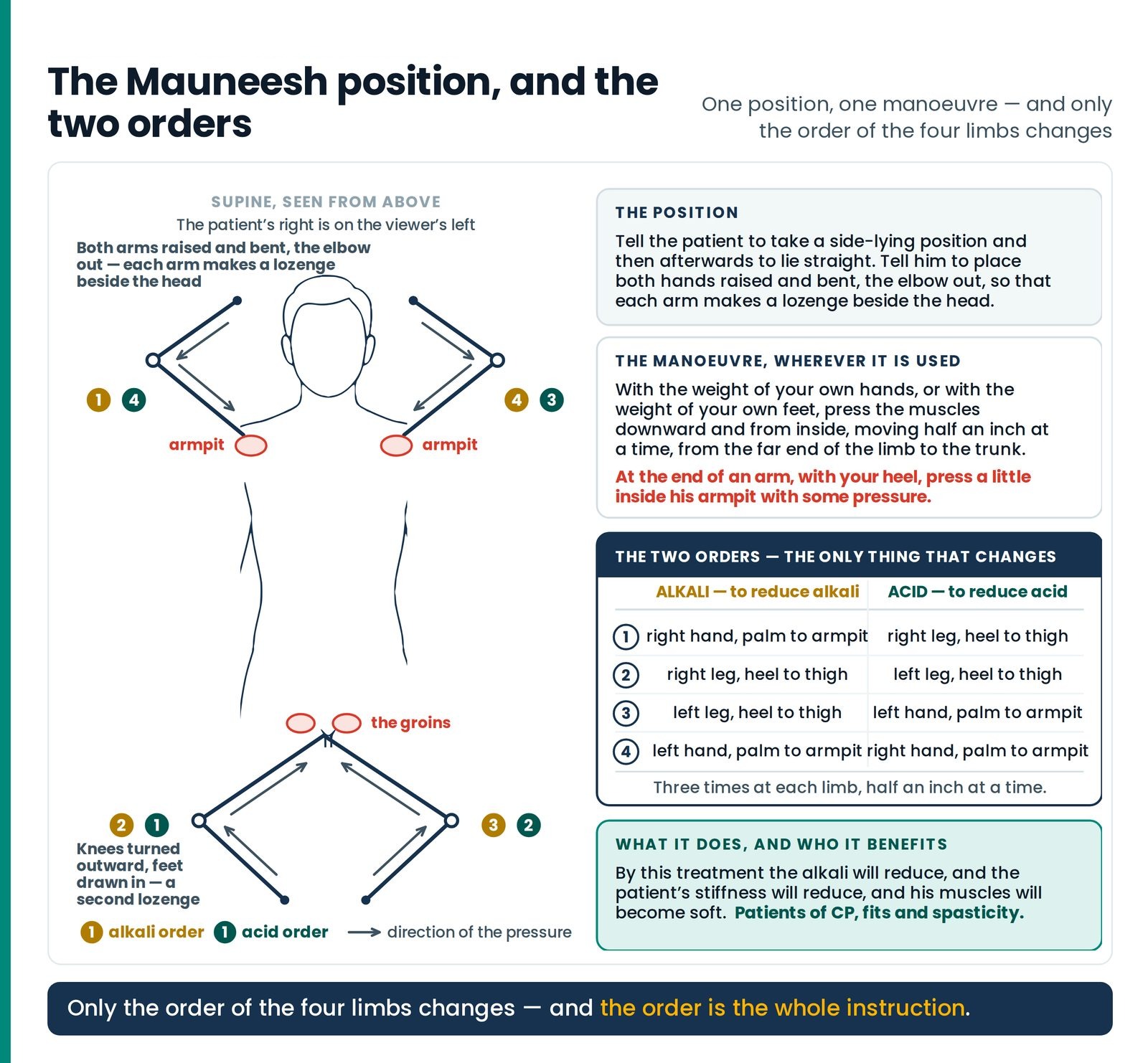
These are the two treatments the two lymph ducts were explained for. Nothing about the manoeuvre changes between them. Only the order of the four limbs changes — and the order is the whole instruction. (Figure 37.6)
The Mauneesh position, and the two orders. The position redrawn from the page — both arms raised and bent into a lozenge beside the head, the knees turned outward and the feet drawn in below — with the eight arrows of the original running from the far end of every limb toward the trunk, the four contact pads, and the same four limbs numbered twice, once for each order.Key teaching
The Mauneesh acid treatment — to reduce acid
Do exactly as above — the same position, the same half-inch steps, the same downward and inward pressure, the same three applications, the same heel inside the armpit at the end of an arm.
But in this, take first the right leg, then the left leg, then the left hand, and finally at the end the right hand — then the patient's quantity of acid will reduce.
Table 28 — The two Mauneesh orders
Step
Alkali treatment — to reduce alkali
Acid treatment — to reduce acid
Applications
Direction
1
Right hand — palm → armpit Right
Right leg — heel → thigh Right
3 times, half an inch at a time
Downward and inward, toward the trunk
2
Right leg — heel → thigh Right
Left leg — heel → thigh Left
3 times, half an inch at a time
Downward and inward
3
Left leg — heel → thigh Left
Left hand — palm → armpit Left
3 times, half an inch at a time
Downward and inward
4
Left hand — palm → armpit Left
Right hand — palm → armpit Right
3 times, half an inch at a time
At the end of an arm, the heel presses a little inside the armpit
Set those two columns beside the drainage table in Part six and the design of them becomes visible. The left duct carries both legs and the whole abdomen; the right duct carries only the right upper quarter. So a sequence that ends on the left hand finishes by emptying into the great duct, and a sequence that ends on the right hand finishes by emptying into the small one. Which of the two you want decides which order you give. Two separate orders have been made for reducing acid and alkali, and that is what they are made of.
Folded Legs — what it is actually doing
Pressure on the bladder, and a kidney that sorts rather than sieves
The manoeuvre is taught in The Front of the Body II, "The Front of the Body — II" — both heels close to the buttocks, the patient's thumbs closed inside the palms and the fists placed beside the navel with the closed palms facing downward, the legs lifted and folded from the knees toward the chest, and the fists pressed downward and inward into the abdomen with the thighs on the out-breath, held only as long as the patient is comfortable. It is not repeated here. What belongs here is the reason, which is more interesting than the movement.
Key teaching
Why Folded Legs is a kidney treatment
By this treatment, pressure comes upon the urinary bladder, the uterus and so on — from which the flow of blood into the kidneys increases very greatly; and from this the pain of Liv° – Mu° goes out.
That is: the kidneys become quite clean and begin to work well. Which means they will now clean the blood still better, and will throw out in greater quantity the unwanted chemicals that have risen in the blood, and will not let out the chemical that is deficient.
In this way the body will get much benefit: strength will increase, the capacity to work will increase, and the patient will begin to feel healthy.
Read the third paragraph carefully, because it contains the best one-line definition of a working kidney anywhere in this wiki. A kidney is not a drain. It is a sorting office — it must throw out more of what is in excess and hold back what is short, in the same pass, from the same fluid. Most people, patients included, think of the kidney as a sieve. It is nothing of the sort; a sieve cannot tell the difference between two things it is letting through.
And Folded Legs carries its own bar, which travels with the point: if there is inflammation in the abdomen, do not give it.
Raman — the treatment of the peritoneum
A sure-shot treatment of the peritoneum, in three written forms
Raman treatment — by this we provoke the peritoneum.
This is a rāmbāṇ — a sure-shot — treatment, which has the capacity to end many of the body's pains. It is useful in all problems of the uterus and the testes.
The hands, the six-second lift, the slow release and the five or six easy breaths that follow are taught in Seated I — Brain, Medulla, Neck, "Seated — I". The gate that must be passed before it is added to (4) Medulla clockwise with T1/T2 — the check of Liv° and Mu°, and the rule that Left Raman goes with pain at Mu° or the left ring finger and Right Raman with pain at Liv° or the right ring finger — is taught in The Medulla Family, "The Medulla Family". Neither is repeated. What belongs here is what has changed, and what the three written forms are for.
Key teaching
A rule that has moved
Earlier it was thought that Raman treatment should not be given to those whose alkali has increased; but now some change has come in this thinking.
That sentence is left standing exactly as it is. It is not a correction and it is not a retraction — it says that a bar that once existed is now not held as firmly as it was, and it does not say where the boundary now lies. Read it as a live question, treat the kidney codes as the gate as before, and write down what you see.
What has been seen since. By giving right Raman alone — Rt. Raman Only — the pains of the right side can be ended: from the right shoulder up to the fingers of the right hand, the right chest, the right part of the forehead and so on. These pains often come from the increase of alkali.
Whereas by left Raman — Lt. Raman — the pain of the left side, or the pain of the fourth finger of the left hand, can also be ended. These pains often come from the increase of acid.
Table 29 — Raman: the three ways it is written Seated 6 sec × 3
As written
Given
What it is for
Raman
Both sides Both sides
The peritoneum; many of the body's pains; all problems of the uterus and the testes
Rt. Raman Only
Right side alone Right
Right-sided pain — right shoulder to the fingers of the right hand, the right chest, the right part of the forehead. These pains often come from the increase of alkali
Lt. Raman
Left side alone Left
Left-sided pain; the pain of the fourth finger of the left hand. These pains often come from the increase of acid
Cervical nerves C1–C8 — the forehead, the shoulders, the arms, the elbows, the wrists and the fingers of the hands: for the pains of all these parts this is good. Thoracic nerves T1–T12 — pain of both sides of the chest, pain of the mitral valve, pain of the spleen, and problems of the lungs and the heart. Beneficial in the upper part of the diaphragm too — therefore for stopping hiccups and for hiatus hernia, both. And in boys, when the testes do not come down — cryptorchidism — for that too this treatment has proved quite beneficial
Look at what the fourth row does. Adding four Medulla clockwise at T1/T2 in front of Raman turns a peritoneal treatment into a treatment of two whole nerve territories — every cervical nerve and every thoracic nerve, which is to say the entire upper half of the body's wiring. That is why it reaches a mitral valve and a hiccup and an undescended testis in the same breath.
Feather Touch — the lightest treatment there is
Found at an airport gate, and tested by powder that must not move
Then, after many months of study, here is what was discovered about the treatment, and what its secret is, in Guruji's own words:
Key teaching
Why it is called Feather Touch, and how it is said to work
"In the old days — and even today in many mosques — the mullah applies to the patients who come a bunch of fans made of peacock feathers, and from that they get benefit. In this treatment too our touch is so light; that is why we have given it the name feather touch.
There are many ways of provoking a muscle or a gland — of these I have chosen one whose name is impulse. The speed of the impulse is 600 km per hour, according to which in one minute it will flow ten kilometres, or in six seconds one kilometre, and in one hundredth of a second it will flow 1.60 metres. The length of an ordinary person from head to foot is around 1.6 metres. When we pass the hand over the forehead or over the face, the impulse that will issue will reach the foot in 1/100 of a second.
This is the reason that when we touch some place very softly, on the back part of the body or on the skin with powder applied, with the tip of the finger, then all the hairs of the body stand up. Which means that the blood flow has been increased right up to the capillaries inside. Doing this at least three times properly provokes all the muscles inside, from the skin to the bones, so that whatever gland is not working properly, or whatever muscle has pain — all will be set right. It has been found that no defect of any kind will remain in them."
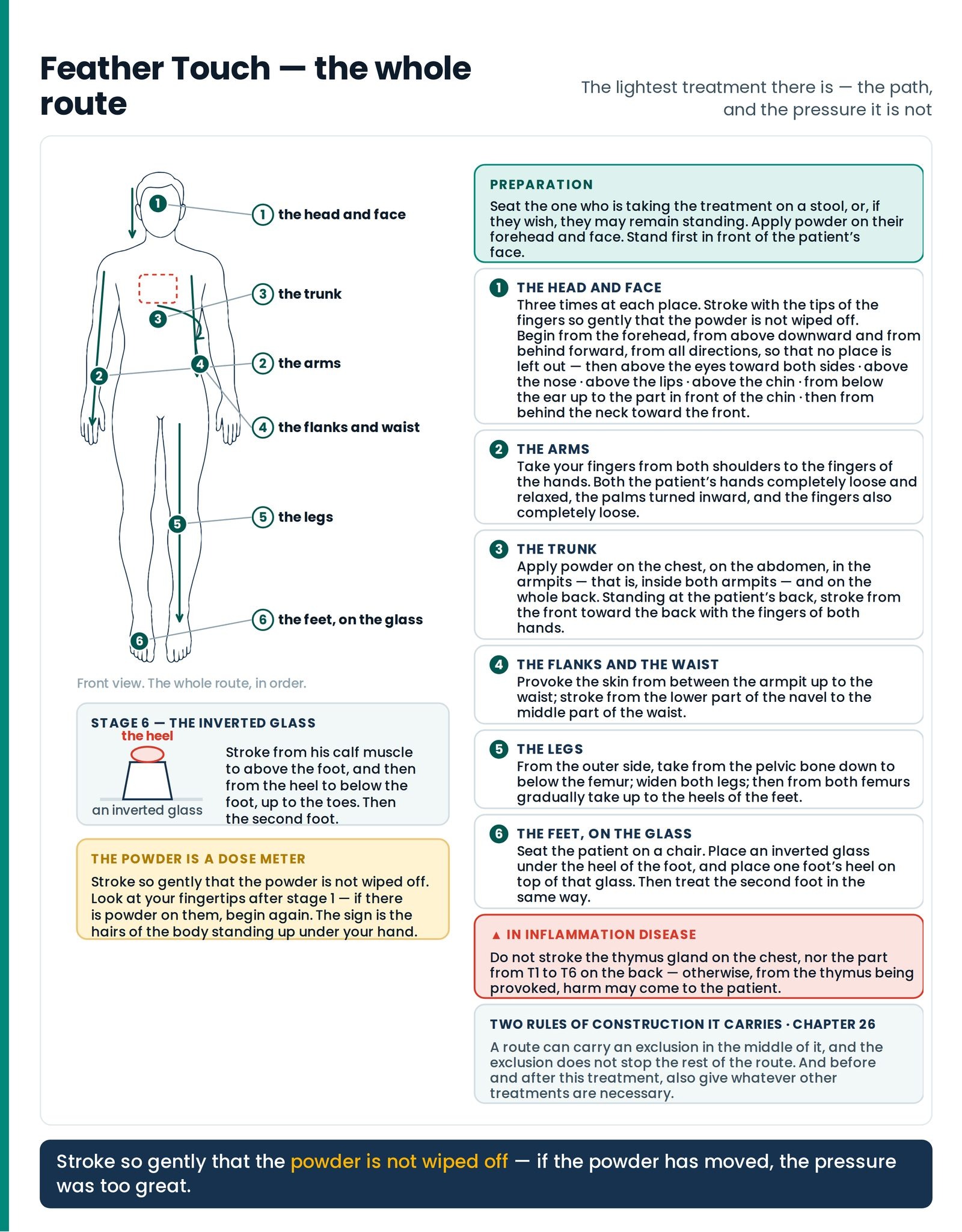
That is a complete piece of reasoning: a chosen mechanism, an arithmetic of it, an observable consequence, and a claim about what the observable consequence means. The hairs standing up is the test. It is visible from three feet away, it cannot be faked by a patient, and it is the only sign in this treatment that anything is happening at all — because by design nothing else is. (Figure 37.7)
This is the treatment for the patient who can be given nothing else. No weight, no jerk, no position that must be held, no bone under a heel. A newborn; a woman in the last weeks of pregnancy; a man whose bones break at a knock; a patient in the acute days after a stroke; somebody in too much pain to bear a palm. For every one of them the rest of the atlas closes and this one entry stays open. It is very beneficial in paralysis, stiffness, pains and in all diseases of the brain — which is why it closes the article on the brain.
The formulary sorts its own formulas into three families by where they came from: those built from the therapy's own original logic; those built on the facts of physiology; and the कुदरती देन — kudratī den, the gifts of nature. All three are taught side by side, with the four naming classes, in How a Formula Is Built, "How a Formula Is Built", and are not repeated here.
One line of that classification belongs to this article, and it is worth ending on.
Key teaching
Where the Medulla treatments sit
All the Medulla treatments are counted among the gifts of nature.
That is a statement about kind of ground. These were not designed from a theory and they were not derived from a textbook of physiology. They were found — tried, watched, recorded, and handed on — and the classification says so in public rather than dressing them up as deductions.
Everything in this article that carries a Medulla number therefore rests on the third kind of ground. Which is precisely why the question marks on page after page of it are honest and not embarrassing: a body of observation is exactly the sort of thing that generates hypotheses, and a man who says so is telling you how to read him.
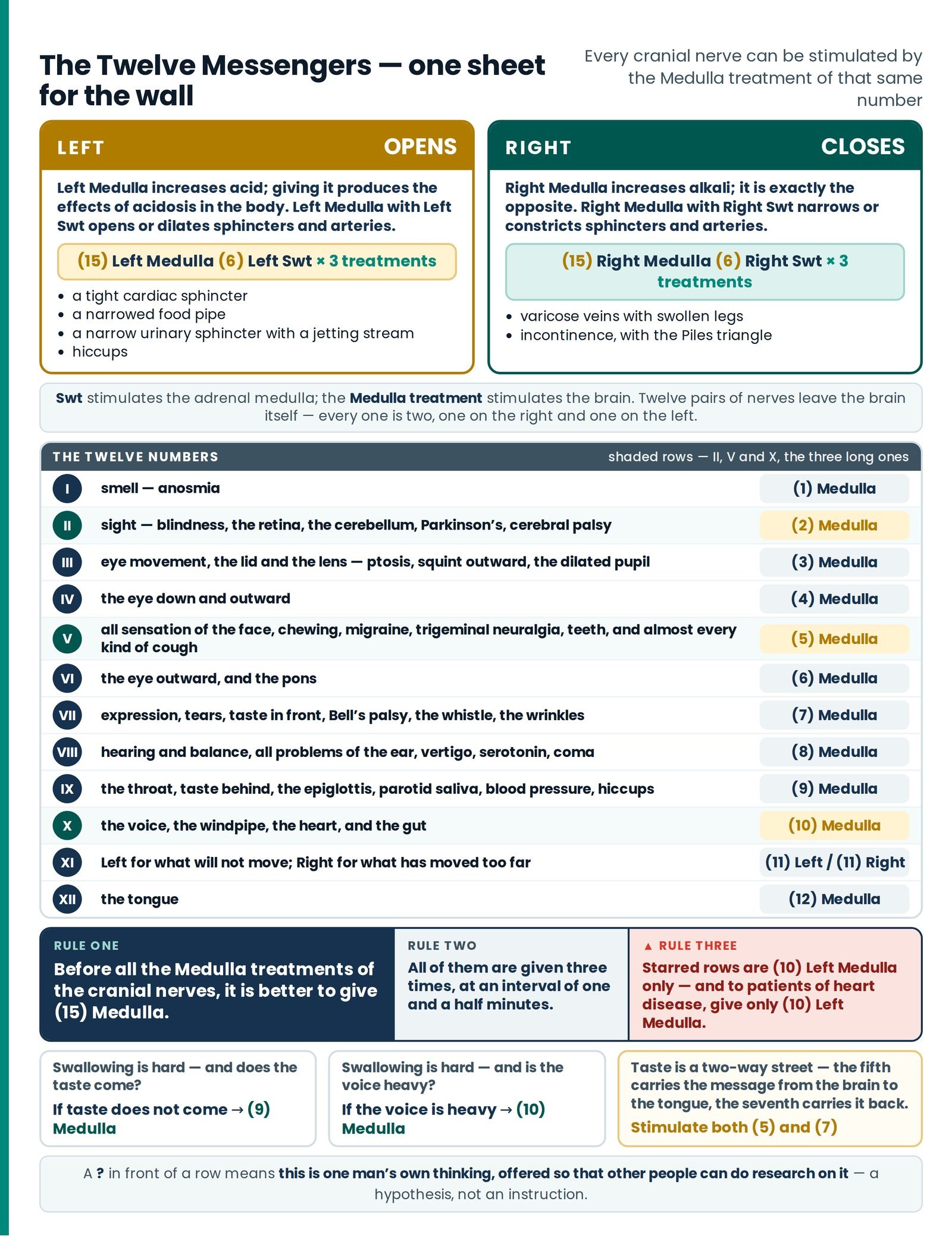
Feather Touch — the whole route. The lightest treatment in the therapy as a route: six numbered stages down one body from the forehead to the heel on the inverted glass, the powder that is the dose meter, the one region the route closes in inflammation disease, and the two rules of construction the instructions carry with them.The Twelve Messengers — one sheet for the wall. The whole cranial-nerve index on one sheet — the polarity rule dominating the top in two facing panels, the twelve numbers as a single numbered list with the three long ones shaded, the three standing rules in one strip, and the two four-second questions that separate the ninth nerve from the tenth.
Ready to begin?
Send COURSE for course details, or your name, age and health issue for a consultation.