- Part of
- Kidneys and urinary system
Watch

From Reading the Reports
Kidney function
If you learn to read one report properly, learn this one — the only page in an ordinary file that will make you withhold a treatment.
What creatinine and urea are
They are waste, made all day by an ordinary working body and removed by the kidneys, which filter the blood as a sieve holds back what should not pass. When the flow of blood inside the kidneys is less than is needed, the kidneys will not be able to filter the blood properly, and there will be an accumulation in the blood of unwanted things like urea and creatinine, from which harm will come to the body.
A raised creatinine is not a disease of creatinine. It is a report that the sieve is not clearing — and the body's own answer to it, which helps to maintain the GFR, the flow of blood inside the kidneys, is taught in Water and Salt, "Water and Salt".
The coma case — a value that removed one station from a formula
A patient lay unconscious, and the treatment given was (8) Pan · (1) Gal · (2) Acid · (4) Lt. Ch. Only — in which Gal was given and Mu° was not given, because both his kidneys were spoiled, on account of which his creatinine was greatly raised. Given twice, the blood's pH changed from 7.32 to 7.4 and he came out of the coma. (Ordinarily a patient goes into coma at pH 7.1, and on its becoming pH 6.8 death occurs.)
The lesson is not the pH. It is the clause in the middle: Mu° was not given, because the creatinine was greatly raised — and the formula still worked.
From Each Point in Use
The two kidneys and the two directions
Liv° reduces alkali, Mu° reduces acid — learn the two as a pair
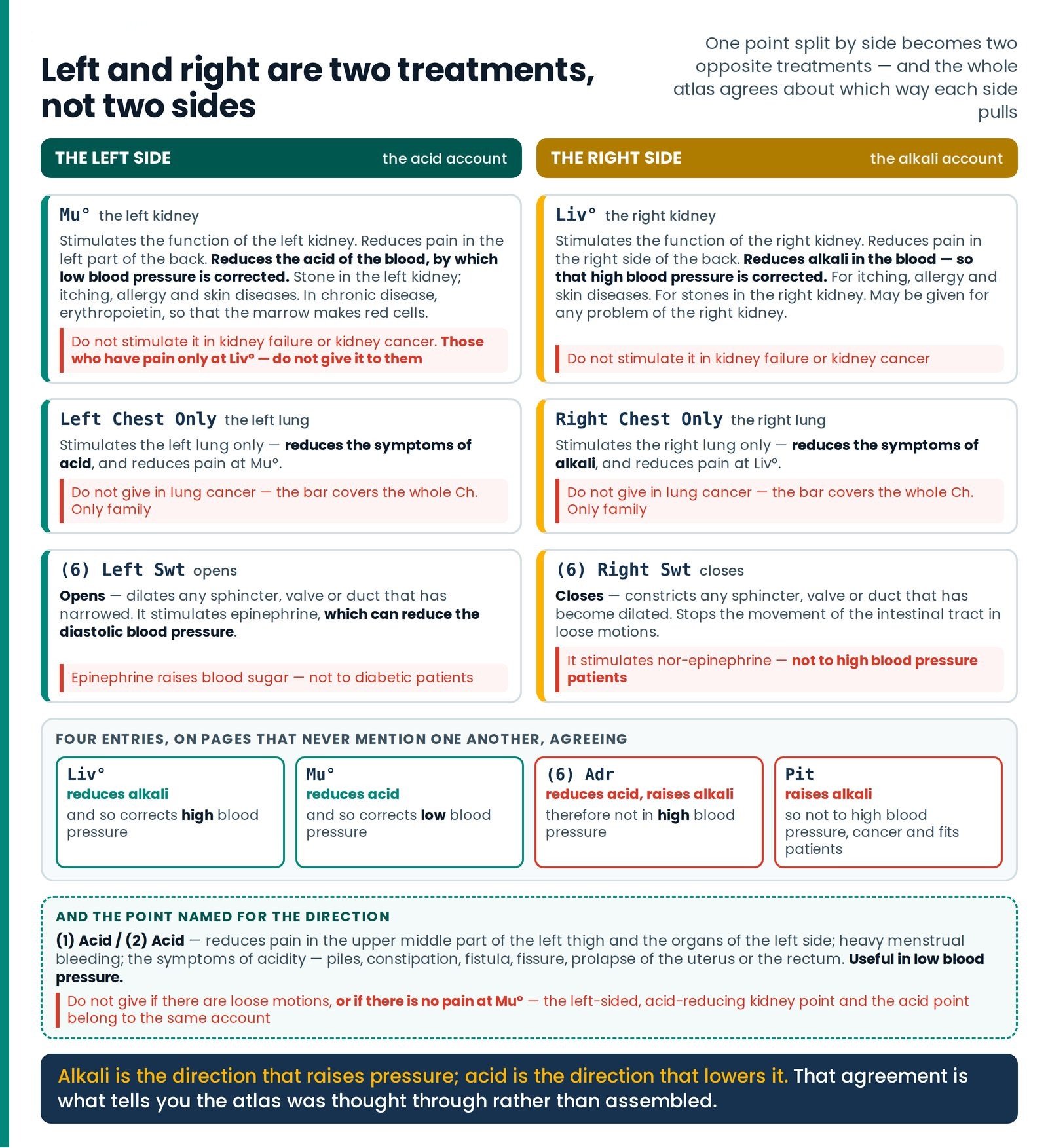
Everything in this therapy that has a left and a right has a reason for it, and nowhere is the reason plainer than here. The left kidney point pulls the body's chemistry one way; the right kidney point pulls it the other. Learn them as a pair or you will learn neither. (Figure 25.3)
Table 7 — LIV°, MU° and ACID
| Point and variant | What it is used for | When it must not be used | Notes |
|---|---|---|---|
| Liv° — the right kidney Right — (1) Liv°, (3) Liv°, (5) Liv°, (7) Liv° | Stimulates the function of the right kidney. Reduces pain in the right side of the back. Reduces alkali in the blood — so that high blood pressure is corrected. For itching, allergy and skin diseases. In intellectually disabled children with pneumonia, and in children with a forehead smaller than normal, it is given within the Kidney Clear formula. For stones in the right kidney. Used in the Alkali formula and the 1,25 DCC formula. May be given for any problem of the right kidney | But do not stimulate it in kidney failure or in kidney cancer ▲ Take care | The verb is stimulate, and it is chosen: this is not merely withholding a treatment but refusing to drive a failing organ harder. |
| Mu° — the left kidney Left — (1) Mu°, (3) Mu°, (5) Mu°, (7) Mu° | Stimulates the function of the left kidney. Reduces pain in the left part of the back. Reduces the acid of the blood, by which low blood pressure is corrected. For stone in the left kidney, itching, allergy and skin diseases. In intellectually disabled children with pneumonia, and in children with a forehead smaller than normal, it is given within the Kidney Clear formula. In chronic diseases it is given to make erythropoietin, which will stimulate the bone marrow to make red blood cells. Used in the Acid formula, the Angiotensin #2 formula and the 1,25 DCC formula | Give for all problems of the left kidney. But do not stimulate it in kidney failure or in kidney cancer. Those who have pain only at Liv° — do not give it to them ▲ Take care | The second bar is a laterality gate: if the finding is on the right, the left is not treated. |
| (1) Acid / (2) Acid Side-lying | Reduces pain in the upper middle part of the left thigh. Relieves pain of the organs of the left side of the body. Reduces heavy menstrual bleeding. For the symptoms of acidity — piles, constipation, fistula, fissure, and prolapse of the uterus or of the rectum from its place. Useful in low blood pressure | Do not give if there are loose motions, or if there is no pain at Mu° ▲ Take care | The second half of the bar is a diagnostic rule as much as a prohibition. Method: |
Set four separate entries beside one another and watch them line up.
The direction the whole system agrees on
Liv° reduces alkali — and so corrects high blood pressure.
Mu° reduces acid — and so corrects low blood pressure.
(6) Adr reduces acid and raises alkali — therefore do not give in high blood pressure.
Pit raises alkali — so do not give to high blood pressure, cancer and fits patients.
All four agree, on pages that never mention one another: alkali is the direction that raises pressure; acid is the direction that lowers it. That agreement is what tells you the atlas was thought through rather than assembled. And it is why Acid is useful in low blood pressure and (1) Acid is refused to a patient with no pain at Mu° — the left-sided, acid-reducing kidney point and the acid point belong to the same account.
From Water and Salt
The Kidney Clear formula
The old single form rebuilt as a staircase of four graded steps
The formula for provoking the kidneys is called the Kidney clear formula, of which there are two kinds — and we have to choose the appropriate formula according to the patient's condition on that day.
Kidney Clear — the earlier form, and the graded form
Earlier it was given as (7) Liv° (7) Mu° (8) Ch. Only (20) ↑|↓; afterwards it was changed into the following form —
I · (1) Liv° · (1) Mu° · (2) Ch. Only · (5) ↑\ · ↓
II · (3) Liv° · (3) Mu° · (4) Ch. Only · (10) ↑\ · ↓
III · (5) Liv° · (5) Mu° · (6) Ch. Only · (15) ↑\ · ↓
IV · (7) Liv° · (7) Mu° · (8) Ch. Only · (20) ↑\ · ↓
Table 21 — Kidney Clear: the old single form and the four graded steps
| Version | Liv° | Mu° | Ch. Only | Round Arrow ↑\ | ↓ |
|---|---|---|---|---|---|
| The earlier single form | 7 | 8 | 20 | ||
| Graded step I — this is Mild Kidney Clear | 1 | 2 | 5 | ||
| Graded step II | 3 | 4 | 10 | ||
| Graded step III | 5 | 6 | 15 | ||
| Graded step IV | 7 | 8 | 20 |
Look down the two right-hand columns. 2 and 5. 4 and 10. 6 and 15. 8 and 20. Every rung is the same two-to-five proportion of — and grade IV is exactly the old single form. The reform did not change the formula; it built a staircase up to it.
Mild Kidney Clear
Mild Kidney Clear → (1) Liv° (1) Mu° (2) Ch. Only (5) ↑|↓
This is graded step I of the Kidney clear formula, and it is also part IV of the light Jeevan Dhara, where it sits between Ajay Normal Mild and Mild Genes. It is the same four steps as grade IV at an eighth of the kidney count and a quarter of the tail, in the same order, with nothing dropped.
It has been owed to this article since APR — Abdominal Pain · The Medulla Family.
Table 22 — Card: the Kidney Clear formula Supine Prone 6 sec Left Right ▲ Take care
| Written | Kidney clear formula → (n) Liv° (n) Mu° (n) Ch. Only (n) ↑\ | ↓ — at grade I, II, III or IV |
|---|---|---|
| Positions, in order | Supine for steps 1–3 Supine → prone for the Round Arrow Prone | |
| Step 1 — Liv° | The right kidney code: single station beside the navel, hand contact high at the shoulder Right . Stimulates the function of the right kidney; reduces alkali in the blood; reduces pain in the right side of the back | |
| Step 2 — Mu° | The left kidney code, given the same way Left . Stimulates the function of the left kidney; reduces the acid of the blood; reduces pain in the left part of the back | |
| Step 3 — Ch. Only | Both soles glide from the chest up to the shoulders, three rubs counting as one, left side first, nothing counted on the return Left Right | |
| Step 4 — ↑\ | ↓ | The Round Arrow: down the right side of the beads to L5, round, and up the left; the pressure falling on the side of the beads each time Prone |
| Why steps 3 and 4 are there at all | Because provoking Liv° – Mu° alone could cause trouble to some patients — so Ch. Only and the Round Arrow are given to make the acid–alkali balance. of this article | |
| Choosing the grade | According to the patient's condition on that day. Begin low in the chronic, the elderly and the frail — a gland which is already spoiled should first be provoked less, which is Correcting the Two Kingdoms's light-treatment reasoning | |
| The substitution | If there is pain along with the stone, then in place of Ch. Only and ↑\ | ↓, give Th + Ch ▲ Take care |
| What it inherits | Liv° — do not stimulate it in kidney failure or kidney cancer. Mu° — do not stimulate it in kidney failure or kidney cancer; those who have pain only at Liv° — do not give it to them. Ch. Only — not in lung cancer. In chronic illness, all the arrows only as far as (L1–L5). Where Th + Ch is substituted, it carries its own bars in full — see the box below ▲ Take care | |
| Points taught in | Liv° and Mu° — The Front of the Body I; Ch. Only and Th + Ch — The Front of the Body II; the Round Arrow — Face Down |
Also explained in
- The Ulta Kidney Clear formula Water and Salt
(Figure 35.7) The kidneys have swapped places.
- What else the Kidney Clear treatments are used for Water and Salt
neumonia, CP children, swelling — and one question left open In the disease called pneumonia, a bad effect falls upon the kidneys.
- Liver, kidney and lung — how the formula was built Water and Salt
Are we to stimulate both kidneys? Answer — No.
- The two kidneys do not work alike The Two Kingdoms
Both kidneys do not work identically.
- Whom the Kidney Clear formula is for — the two-key rule Water and Salt
complaint from one list and a finding from the other — never one alone The Kidney clear treatment is to be given to those who have low back pain, left kidney stone, ringworm (dād), itch (khāj), allergy, psoriasis, or a
- Kidney disorders When the Hand Must Stop
And one bar reaches this patient from another article and must be carried here: Loveleen is not given to kidney patients or to heart patients — and on the card of such a patient it is written .
- At a glance Water and Salt
In pneumonia a bad effect falls upon the kidneys — give the appropriate Kidney clear treatment.
- The article in one table — finding to formula Water and Salt
Only and the Round Arrow, Th + Ch — reading its own bars first ▲ Take care Micro head / micro-cephalus in a child Kidney Clear especially benefits CP children with loose motions three or four times a day Ulta Kidney C
- P. Heparin for a raised diastolic pressure The River — Heparin
The chief work of the kidneys is to filter the blood.
- ADK — the sequence for the patient who once had pneumonia Water and Salt
An increase in the quantity of AT2 helps to maintain the GFR — the flow of blood inside the kidneys — and to keep the excretion of waste things such as creatinine and urea normal.
- The two reasons for the code names The Navel Speaks First
To save patients from such baseless fears, the kidneys were given the nicknames Mu° and Liv°.
- Wounds When the Hand Must Stop
For Gal, the line attached is: this is a matter of experience On the Side · Face Down · Each Point in Use Passing too much urine (2) S4 – S5 It relaxes and opens the sphincters, and is given to increase urine Face Down · Each Point in Use Loose motions, or no p
- The back pain chart The Navel Speaks First
Left Right Table 4 — The back pain chart, label by label Label on the chart Where the arrow lands What lies at that level Cervical pain Nape, base of the neck, midline The seven neck bones and the long muscles either
- How the formula was assembled Correcting the Two Kingdoms
From the facts above we understand that only if the liver, PTH and the kidneys work properly will 1,25 DCC be made — otherwise not.