From Findings to a Plan — Building the Diagnosis
Watch


Where diagnosis ends and treatment begins
Forty findings, one plan — and findings, diagnosis, plan, prescription
Everything in has been an instrument: the map that names the places (The Navel Speaks First, "The Navel Speaks First"), the scale that grades them (The Educated Hand, "The Educated Hand"), the flanks that sort a patient into one of two families (The Two Kingdoms, "The Two Kingdoms"), the fire and the ash (The Fire and the Ash), the bowel (What the Bowel Tells You), the history (The History That Cannot Mislead You), and the folder read until every page had been declared to change the plan or change nothing (Reading the Reports).
You now hold perhaps forty pieces of information about one person. A plan is not forty pieces of information. A plan is one sentence about what is wrong, and one decision about what is done first.
Students find this the hardest hour of the training. Everything before it rewarded thoroughness; this step rewards the opposite — deciding that thirty-six of the forty items are context and four are the plan.
What the whole procedure is for
Check the pain points to determine which part or parts of the body are not functioning to their optimal level. Logically analyse and determine the root cause for the malfunctioning of that organ. Stimulate the diseased organ or organs and restore their normal functioning.
By these steps we not only relieve the symptoms of that particular disease, but also remove the very tendency of the body to develop a diseased state — thus achieving a total cure.
Read the last line twice. Relief of the complaint is a by-product, arriving on the way to something larger: a body no longer disposed to fall ill in that way.
The five steps
Gather, set the direction, name organs, find the root, decide the work
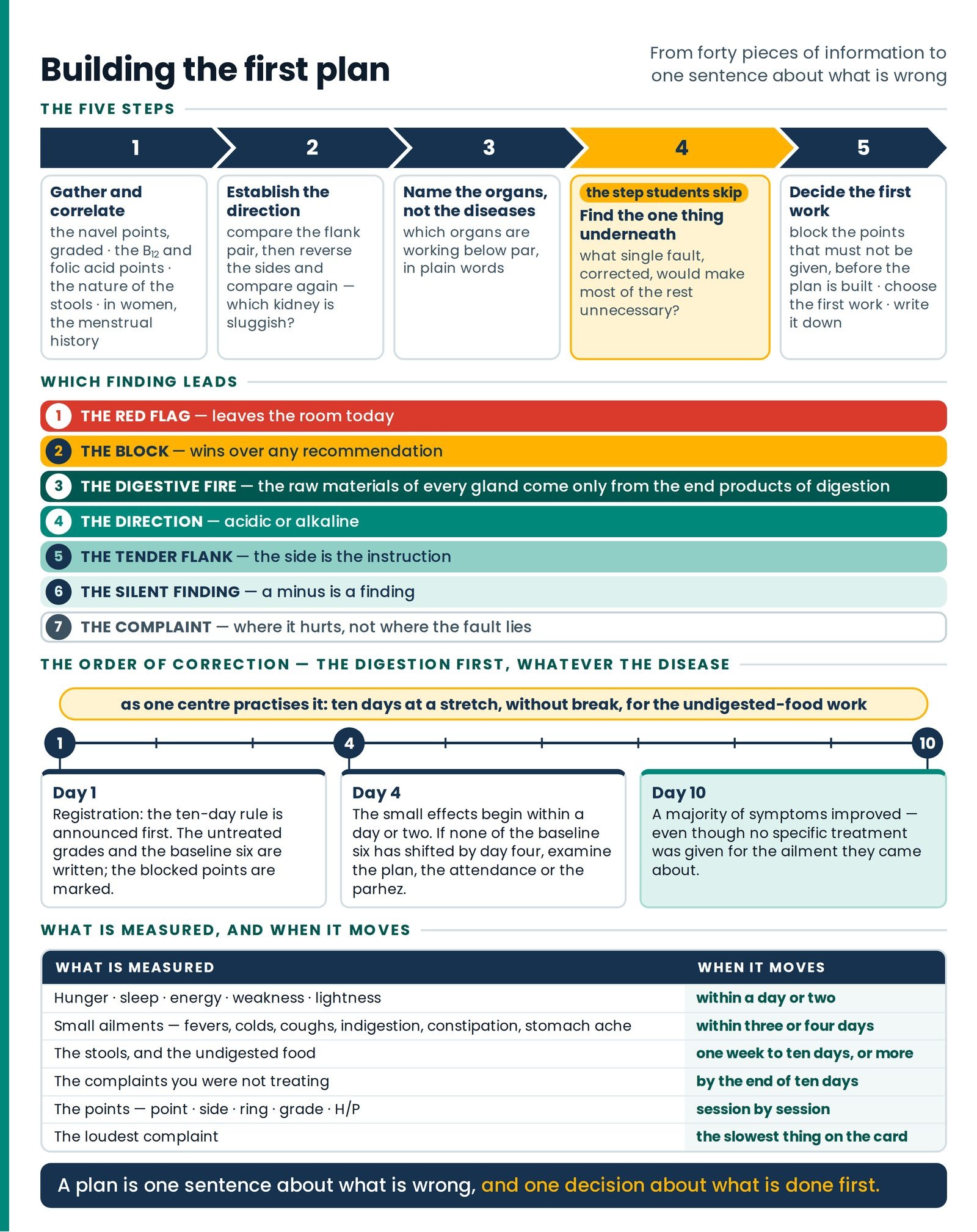
Steps 1 to 3 are collection and sorting; a diligent student learns them in a week. Step 4 is judgement, and the whole of the art: what single thing, if corrected, would make most of the rest unnecessary?
Four problems, or one?
Many names, one root — and the signs that decide it
Many names, one root
In allopathy the names of diseases are attached to the symptoms themselves.
When several symptoms come together, and the same cluster recurs in other people, that cluster is given a name, so that one word brings several symptoms to mind at once and choosing a medicine becomes easy. That is all a disease name is for.
Now watch a body. If food is not digested properly in the stomach, the patient will have sometimes a headache, sometimes gas, sometimes loose motions or vomiting, sometimes burning in the chest — on one day or on different days. Named, the headache is migraine, the burning acidity, the gas flatulence, the loose motions diarrhoea, and for each a different medicine is given.
Although the symptoms are different, the root cause of all of them is one and the same — indigestion. Correct that one root cause, and not only these four but even more diseases or symptoms will be corrected, and they will not recur either.
The general form: all diseases — however many lakhs of names may be given to them — come only from a few among eight to ten glands not working in the proper way. That root appears in different persons as different symptoms, and in one person as different symptoms on different days; but on paying attention it will be found that the root cause is one and the same.
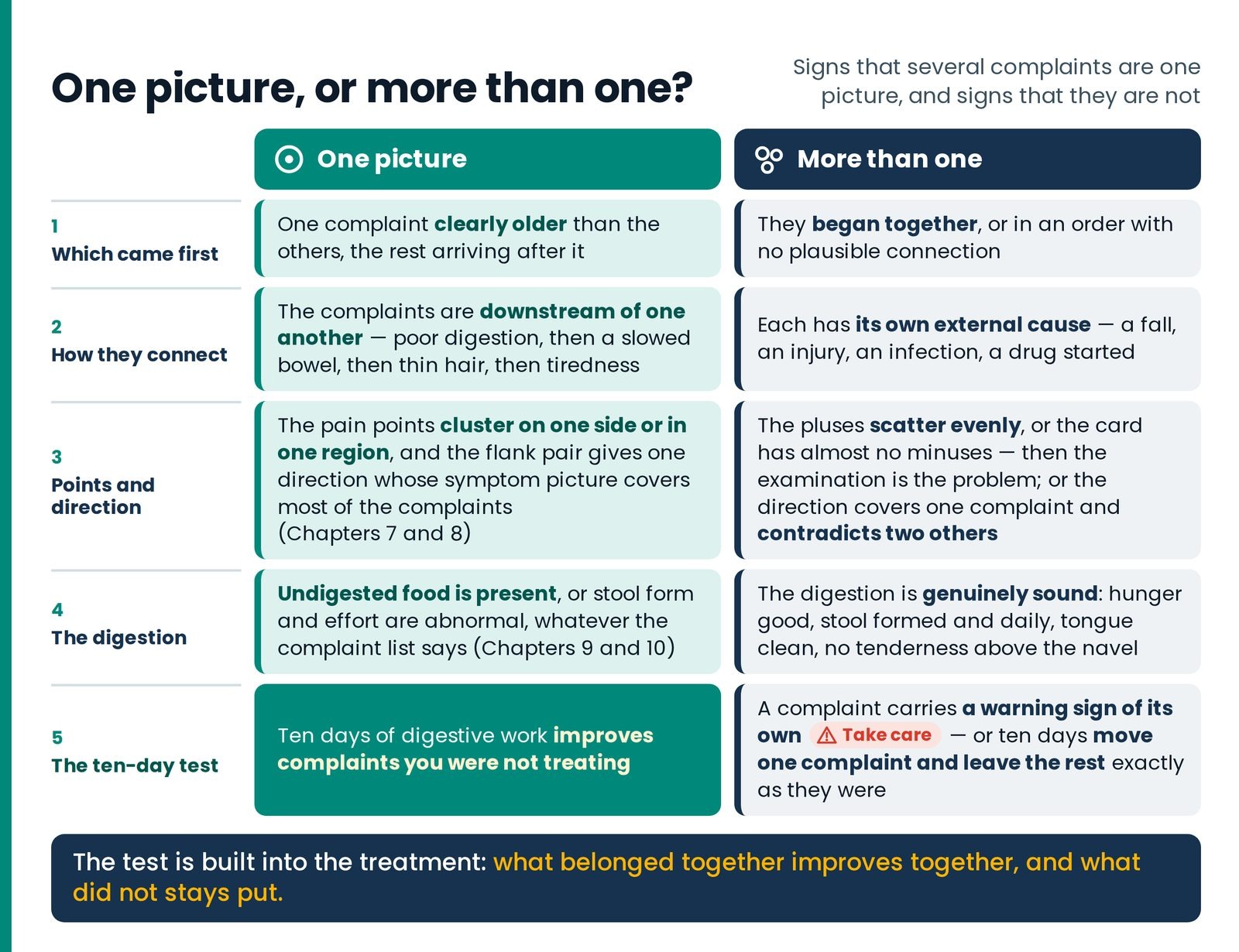
The question asked of every patient with more than one complaint is: are these four problems, or one problem with four faces? It is not answered by intuition. There are signs. (Figure 13.2)
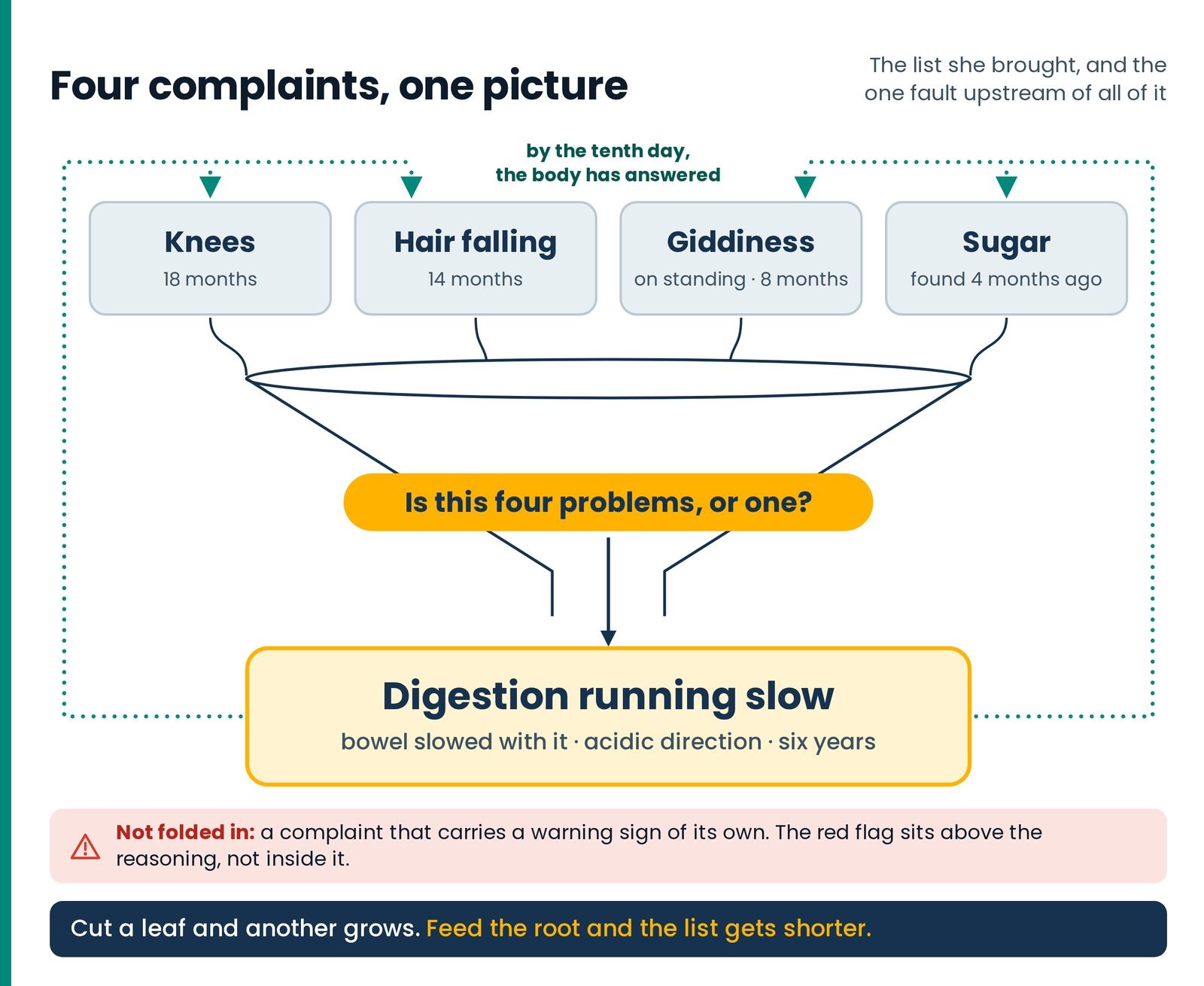
The last row settles arguments, and it is why this therapy can afford confidence here: the test is built into the treatment. You act as though the complaints might be one, give the digestive work, and by the tenth day the body has answered you — what belonged together improves together, and what did not stays put, now visible because the noise has gone. (Figure 13.1)
Which finding leads
The order of precedence, the red flag, and the postmaster's knees
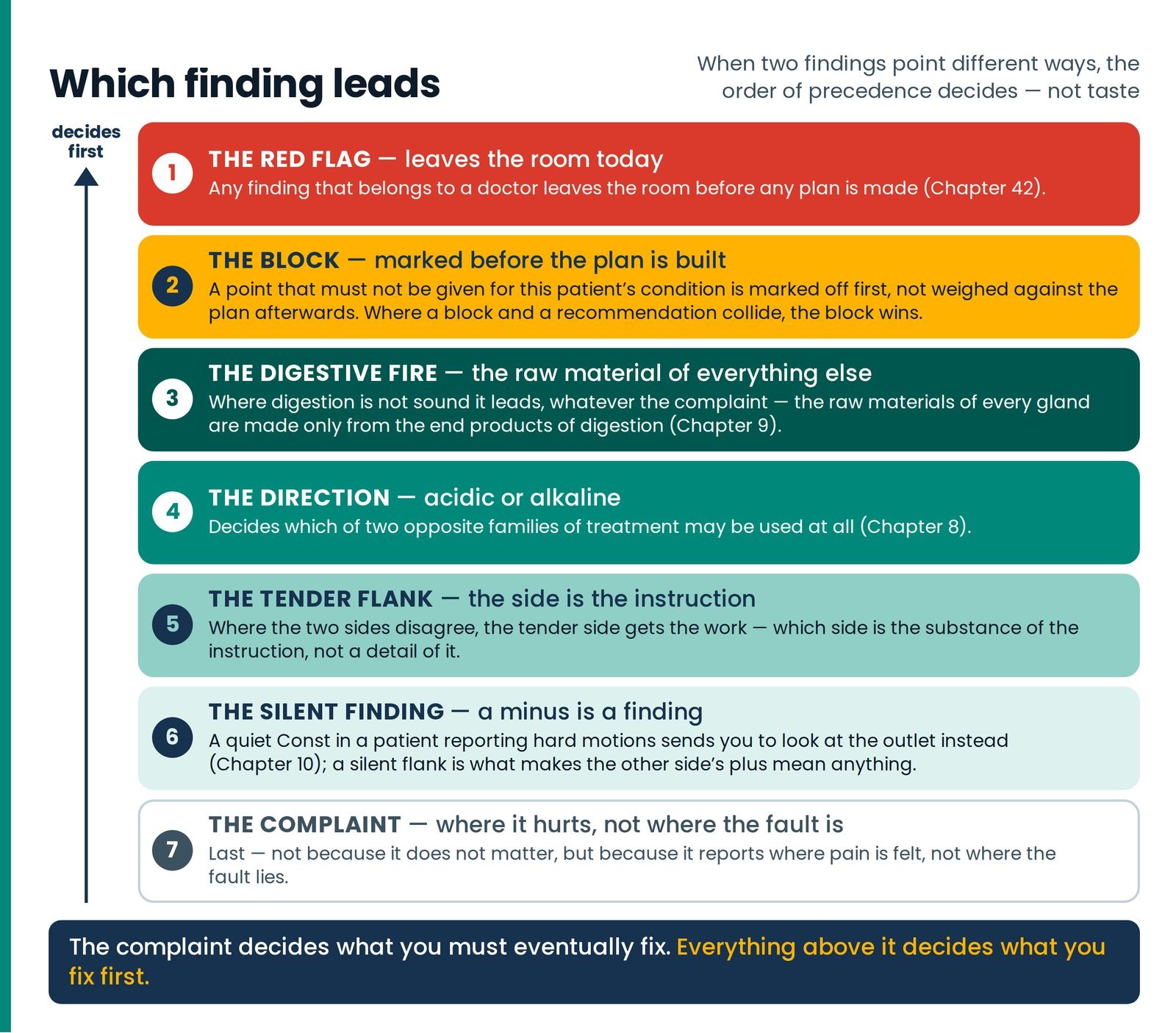
Two findings will point different ways in your second week of practice and go on doing it for the rest of your working life: the complaint says knee and your fingers say stomach. There is an order of precedence, and it is not a matter of taste. (Figure 13.3)
The order of precedence — which finding leads
First: the red flag.
Any finding that belongs to a doctor leaves the room before any plan is made. ▲ Take care
Second: the block. A point that must not be given for this patient's condition is marked off before the plan is built, not weighed against it afterwards. Where a block and a recommendation collide, the block wins.
Third: the digestive fire. Where digestion is not sound it leads, whatever the complaint — the raw materials of every gland are made only from the end products of digestion, so a plan aimed elsewhere is built out of nothing.
Fourth: the direction. Acidic or alkaline decides which of two opposite families of treatment may be used at all (The Two Kingdoms).
Fifth: the tender flank, and the region it belongs to. Where the two sides disagree, the tender side gets the work — and which side is the substance of the instruction, not a detail of it. Left Right
Sixth: the silent finding. A minus is a finding. A quiet Const in a patient reporting hard motions sends you to look at the outlet instead (What the Bowel Tells You); a silent flank is what makes the other side's plus mean anything.
Last: the complaint the patient came with — not because it does not matter, but because it reports where pain is felt, not where the fault lies.
That last line needs saying carefully at the mat, because it can be heard as dismissal. It is not: the complaint decides what you must eventually fix, and everything above it decides what you fix first.
The order of correction
The digestion first, whatever the disease — and the ten days
The digestion is corrected first, whatever the disease
Improper digestion — of proteins mainly, and to a lesser extent of fats — is the root cause of all diseases.
The reason: the raw materials of all the glands are made by the body only from the end products of digestion. Without them the glands cannot produce their chemicals in the correct quantity, and hence all sorts of disorders set in.
Therefore the very first treatment to be given is the one that corrects this tendency — and any treatment which does so brings substantial relief from the present ailment, irrespective of whatever that ailment may be.
Say it to a patient in a kitchen image. One kitchen supplies a hundred households. If it runs at half strength every house is short, and the weakest shows it first. Your knee is the weakest house.
The full order of the work where the right flank is the tender one — the inflammation work while Mu is tender, then the abdominal sequence after a five-minute gap, then the undigested-food work until the stools become normal, and only then, if the flank is still tender, the alkali family — is taught in The Fire and the Ash, "The Fire and the Ash".
The ten days, as one centre practises it
Patients are told, right at the time of their registration on the first day, that it is mandatory that they must come for the first ten days at a stretch, without break, to set their digestive system in good working order.
For those ten days or thereabouts they are given only the treatment for undigested food 6 sec , along with the appropriate Muscle Relaxation Treatment in extreme cases. Afterwards, depending upon their ailments, a further treatment schedule is prescribed.
And the result that convinced them was not the result they were measuring: by the end of the first ten days a majority of the symptoms had been totally alleviated, even though no specific treatment had been given exclusively for the ailment they came about.
The undigested-food work itself may take between one week and ten days, or even more, to bring the stools to normal (The Fire and the Ash).
Three things in that belong in any practice. The rule is announced at registration, so it is never felt as a delay imposed because her case is difficult. Ten days at a stretch, because a course interrupted on day four is not a shorter course but a different one. And the improvement is expected in the complaints you are not treating — which is what you tell the family to watch for.
And say the order out loud on day one, or the day you finally turn to the digestion will look like a change of mind: "For ten days I am going to work on your digestion. I am not ignoring what you came for. Everything I do afterwards for that is built out of what your digestion releases, and if I start at the other end it will help you for a week and then stop."
The first visit
From the door to the door, and why day one is different
Day one is different from every day after it, and the difference is not its length. On day one you are not only treating; you are building the instrument by which every later day will be judged.
Two warnings belong to the patient rather than the therapist, both said in her own language before she lies down. She should not ordinarily feel pain from your pressure. If pain occurs she must tell you at once, and you will change the angle or the manner of placing the foot — and the effect of the treatment is not reduced by this. If she feels pain and does not say so, pain may remain even after the treatment, or weakness may be felt. And: women are not to take treatment for other problems during the menstrual period, though they may come during the menses where the bleeding is excessively heavy, or does not stop, or is very scanty, or where there is pain or clots — all of which can be corrected by the appropriate treatment.
Why day one is different
Because day one is the only day on which the body has not yet been treated.
Everything you write today measures the disease; everything from tomorrow measures the disease plus whatever you did yesterday, and the two can never again be separated.
So on day one, and only on day one, you get the untreated grades at every point; the untreated flank comparison; the baseline six — hunger, sleep, energy, weakness, lightness, and glasses of plain water yesterday, the items this therapy expects to move first and therefore the items that will prove it moved; the bowel as it was; and her own words about what she can no longer do.
A first visit that produced no figures produced no baseline — and a course without a baseline can never be shown to have worked.
The diagnosis card
A first-visit card a stranger could act on next Tuesday
The card is what lets this week be compared with last week, and comparison is the only honest evidence this therapy will ever have. Its test is one question: can a therapist who has never met this patient pick it up next Tuesday and act on it? Here is a first-visit card for the woman in the opening story, in the notation of The Educated Hand.
DIAGNOSIS CARD · first visit
| Name · age · occupation · town | Kamla Devi Sahu · 58 · housewife · Bilaspur |
|---|---|
| Accompanied by · journey | Daughter · 40 minutes by bus · can come 6 days a week |
| Date · time · relative to food | 14.3 · 10.40 a.m. · two hours after a light breakfast |
In her words — "Ghutne. Baal jhad rahe hain. Chakkar aata hai uthne mein. Aur ab sugar bhi aa gaya."
Complaint mapped — Knees 18 months, worse rising from the floor · hair falling 14 months · giddiness on standing 8 months, no fall · sugar found 4 months ago at a camp · cannot sit cross-legged for prayers, the loss she minds.
Baseline six — Hunger 2/5 · Sleep 3/5 · Energy 2/5 · Weakness ++ · Lightness − · Water (glasses yesterday) 3
Digestion and bowel — Tongue coated, thick, white · wind after meals · UDF - ? (asked, not answered; to observe 3 days) · Stool form 2 / 4 · 2 per week · strain ++, 12 minutes sat · incomplete ++ · blood nil · isabgol occasionally, 6 years — longer than any complaint on her list
Head to foot — cold hands ✓ · daytime sleepiness ✓ · dry skin ✓ · night cramps ✓ · breathlessness ✗ · chest pain ✗ · bleeding ✗ · weight loss ✗
The life · the past — Cooks for seven · standing 5–6 hours daily · window closed all night · tension: son's employment · fall onto the right hip, 2011 · 4 home deliveries · no operations
Swallowed — Metformin 500 mg twice daily (Dr. ——, 4 months) · calcium tablet, bought herself, 2 years · churan after dinner, 20 years — she counted neither of the last two as medicine until asked
Findings Left Right
| Point | Side | Ring | Grade | H / P | Note |
|---|---|---|---|---|---|
| Liv° · Mu° | R · L | — | − · +++ | HP | reversed and re-checked |
| Gas | — | 2 | ++ | H | |
| Const · Dys | L · R | 2 | +++ · − | HP | "there is something there" |
| Gal · Spl | R · L | 1 | + · − | P | |
| Pan | — | 2 | ++ | H | |
| Acid · Fluid | L · R | 1 | ++ · − | HP | |
| B₁₂ · FA | R · L | — | − · ++ | P | folic acid point tender |
| Tongue | — | coated, thick, white |
Direction — Acidic. Mu° L +++ HP against Liv° R −; hard infrequent stool; dry skin; cold hands; three glasses of water yesterday.
Reports — Fasting sugar, 4 months, 148 mg/dl — changed nothing today, dated · Knee X-ray, 2 years — changed nothing, said aloud · HbA1c, thyroid and calcium — none; asked for through her own doctor
Diagnosis (organs, direction, duration — not a disease name) Digestion running slow, with probable undigested food; large bowel slowed with it, 6 years; acidic direction; folic acid point tender. Four complaints, one picture. Thyroid to be excluded through her own doctor.
BLOCKED — marked before treatment is planned ▲ Take care Diabetes: Th · Th+Ch · Spl · Lymph · Armpits · Ton 'P' · Ton 'T' · Pit · (4) Adr · (6) Adr · (4) Pan · (10) Medulla Constipation: Gas Only · (10) Medulla · Dys Reasons written beside each. Un-blocking is a dated, named decision. Chief therapist informed of sugar — 14.3.
First work — Digestion first, ten days at a stretch. Undigested-food work — and because she is constipated, after Gas Only, Gas 'I' must be given, otherwise the constipation will increase; and because she is diabetic, (10) Medulla is not given even in the undigested-food work. Parhez: curd, lemon, tamarind. Water to 8 glasses, sitting, not with meals. Window open at night.
Measured — the baseline six; stool form, frequency, effort; Const and Mu° re-pressed every session; "can sit cross-legged", weekly.
Referred · Not answered — Thyroid and HbA1c requested through Dr. ——, 14.3 · UDF - ? outstanding, due day 4
Therapist — initials
Nine blocks, never merged. Four of them carry the weight. The baseline six must be figures, because these move first and without today's figures you cannot prove it. Findings include every point examined, minuses and all. Reports get one line each and the words changed the plan or *changed nothing* (Reading the Reports). And Blocked carries the reason beside each point — which is what lets a block survive a change of therapist. Her own words go in unedited, because her words are evidence and your paraphrase an opinion; the diagnosis line is organs, direction and duration and never a disease name.
From the second visit: three figures and two points, in one line a day — a line a day for six weeks is a graph, six weeks of paragraphs a diary.
The warnings that shape a plan — blocking
The blocked list, its substitutions, and the conductor with a stent
There are some diseases in which certain glands become hyper — that is, they work more than they should. Since through this therapy we provoke many glands, it is necessary to know in which diseases which glands must not be provoked. In the list that follows, for each disease, the points which are not to be given are shown enclosed on all sides by a box. Doing this is called blocking.
Blocking, and why it comes before the plan
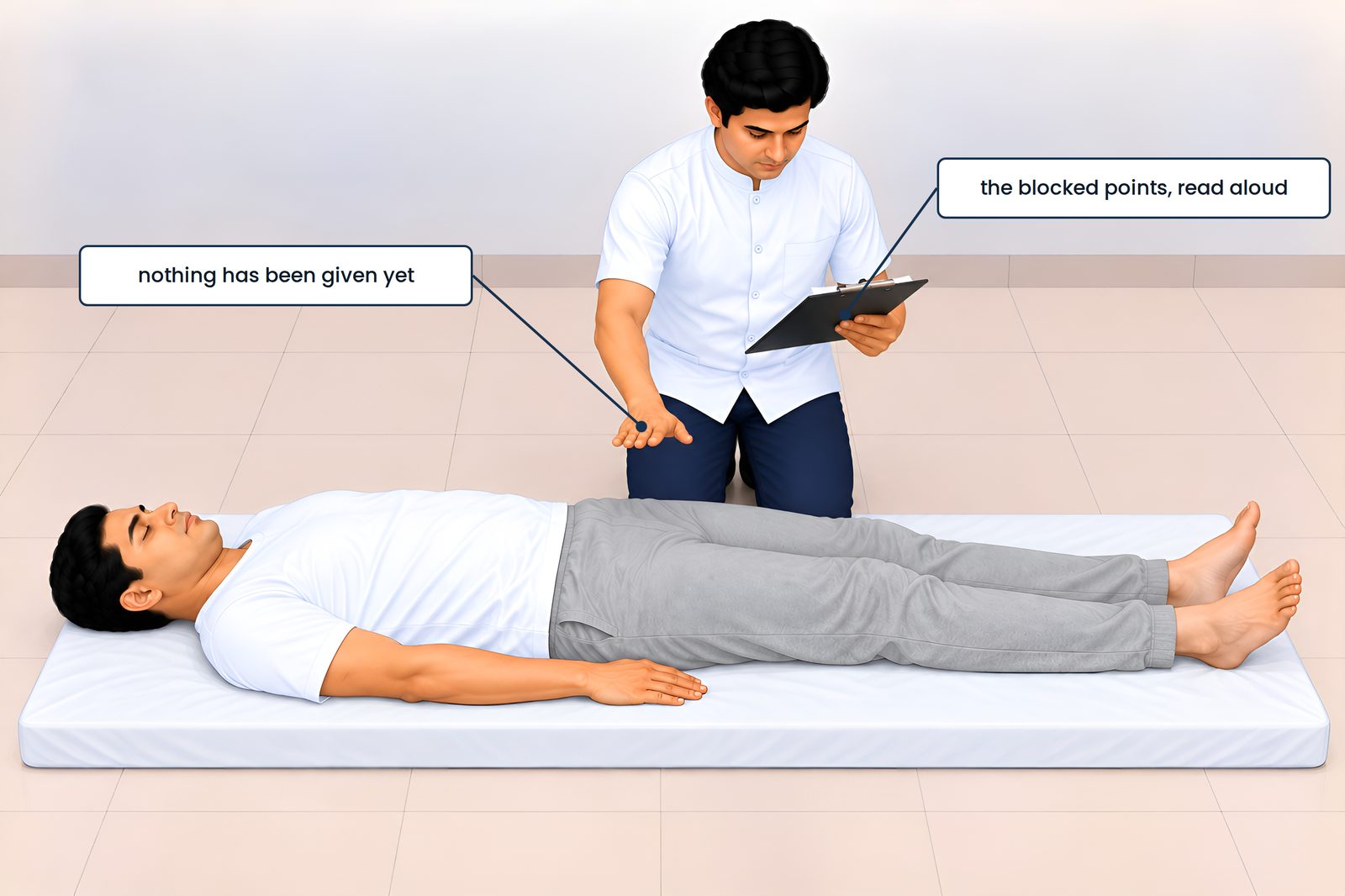
When the patient comes for the first time, then — even before beginning treatment — on their diagnosis card block those points which, according to their disease, are not to be given, so that both you and the therapist will remember this, and no harm will come to the patient.
And the part that surprises students: it is not necessary that this warning is for ever. This avoidance is needed only for as long as the chief symptoms of that disease have not ended. Afterwards, if the need arises, those points can be given. That is a special feature of this therapy, and it is the proof that by our treatment the glands have improved.
The order of those paragraphs is the instruction. A block is not a warning attached to a plan; it is the constraint the plan is built inside. A therapist who plans first and checks afterwards will one day find his plan mostly blocked — and be tempted, with the patient already on the mat, to decide that this block is probably about something else.
Table 2 — The conditions, and the points blocked in each
| Disease or condition | Blocked points |
|---|---|
| Autoimmune disorders, arthritis, inflammation / polio | Th · Th+Ch · Lymph · Armpits · Ton 'P' · Ton 'T' · Spl |
| Asthma | Spl · Thrd · Gal |
| Acidity or ulcer in the stomach | Gas Only · (10) Medulla |
| Fistula, anal fissure, descent of the rectum, piles | (10) Medulla · Gas Only · Dys |
| Bamboo spine and spur | Thrd 'P' · Thrd |
| Low blood pressure | Ku (old version) · Gas 'I' · (30) Medulla |
| High blood pressure | Pit · Mu° · Swt · Lu + Sh · (20) Medulla · (2) Adr · (6) Adr |
| Cancer | Lt.Ov · Rt.Ov · WD · (10) Medulla · Pit · (4) Adr · (6) Adr · (4) Pan · Spl |
| Cold, running nose | Mu · (6) Adr · Spl |
| Constipation | Gas Only · (10) Medulla · Dys |
| Dysentery or loose motions | Gas 'I' · Const |
| Convulsions, epilepsy, fits, seizures | Pan · Pit |
| Diseases of infection | (6) Adr · (30) Medulla |
| Diabetes | Th · Th+Ch · Spl · Lymph · Armpits · Ton 'P' · Ton 'T' · Pit · (4) Adr · (6) Adr · (4) Pan · (10) Medulla |
| Septicaemia | (6) Adr |
| Heart disorders | (10) Medulla · (20) Medulla · (30) Medulla · Lu + Sh · Swt · Katka · Loveleen · Thymus · (4) Thrd |
| Kidney disorders | Th · Th+Ch · Spl · Lymph · Armpits · Ton 'P' · Ton 'T' · Spl |
| Schizophrenia | Pan |
| The teenage years | Lt.Ov. · Rt.Ov. · WD · Ton 'P' · Ton 'T' |
| Wounds | Heparin formula |
When the Hand Must Stop, "When the Hand Must Stop", owns the complete account. What belongs here is smaller: the entries that do not merely forbid but redirect, because those decide what a plan contains.
Two entries show most clearly why context must travel with an instruction. Low blood pressure, twice. Long-standing: only (2) Para, never the angiotensin formula. Sudden, after an accident, a miscarriage or heavy bleeding: only the angiotensin formula, never (2) Para. Strip the qualifying word from either sentence and you have a rule that is right half the time and harmful the other half. The word suddenly is the teaching.
The adrenal points, twice. (6) Adr is given in autoimmune disorder, arthritis and inflammation — those are what it is for — and blocked in infection, septicaemia and cancer, because it reduces the thymus and immunity, and there immunity must not be reduced. The same point, opposite instructions, no contradiction once the condition travels with it. Infectious disorders and inflammatory ones are treated in opposite ways (Fire and Swelling and 25).
Two states block by circumstance rather than by disease. During the menses, no treatment at all is given for four days — except where the flow is excessive, very scanty or painful, when the appropriate treatment is given to reduce it; and where the flow is heavy, heparin treatment is not given, because heparin does not let the blood clot, so the flow will be greater still. In pregnancy, Thymus and Th + Ch are not given, because after them the child begins to kick hard and move about, an indication that it is having some trouble; and in general no treatment of any kind is to be given from which the child may have trouble.
Choosing where to begin
Block, direction, digestion, today's body — then the first formula
Two constraints decide as much as physiology. The days she can actually come: a ten-day course begun on a Thursday, for a woman who cannot travel on Sundays, is a wish and not a plan. And what the household will actually do: a parhez of three items named in her own kitchen and taught to whoever cooks will be kept; avoid sour things will not, because in a Tamil kitchen tamarind is not a sour thing, it is how food tastes (Food as Medicine). (Figure 13.4)
The formulas themselves belong to and are named here and nowhere else; the points belong to ; and the course over weeks belongs to Weeks, Not Sessions, "Weeks, Not Sessions". This article plans the first treatment only — the correct unit, because the condition of the body will have changed by the second week.
When the plan must change
Signs the first approach is failing, and changing one thing at a time
A plan is a hypothesis with a body attached. Sooner or later one of yours will be wrong, and the useful question is not how to avoid that but how quickly you will admit it, and what you will do.
The signs that the first approach is not working
Within three or four days: the small effects have not begun. Hunger, sleep, energy, weakness and lightness ordinarily start to move within a day or two, whatever the disease; if none of the baseline six has shifted by day four, the fault lies in the plan, the attendance or the parhez — one of those three, not the disease, is what to examine. And: the trouble increased after a particular point or formula. In the gap after each formula, ask how she is feeling. If the trouble increases after any point or formula, immediately take the opinion of the chief therapist as to whether the treatment should be changed — and write this clearly on the card, so that in future that point is not given again, or, if it must be given, so that proper caution is taken. ▲ Take care This entry outranks everything else here.
By the end of the first ten days: the stools have not become normal and the undigested food is unchanged; nothing has moved that you were not treating, where the picture really is one picture; and the points have not moved — Const +++ on day one and +++ on day ten, pressed the same way by the same hand, is the plainest failure there is, and it is visible only because a grade was written on day one.
At any time: improvement that began and then stopped — the commonest event in a practice, with most of its causes outside the treatment room.
Be exact about the timing. A therapist should be prepared to say by the end of the first ten days that his first approach has not worked — not on day three, when nothing has had time, and not in week six, by which point the patient has stopped coming. Patients are less alarmed by a therapist who re-examines than by one who repeats himself.
One failure deserves naming on its own. A plan can be right and a picture still be wrong. A schoolgirl of fifteen came with afternoon headaches and a mother's complaint that she was not growing. The findings made one picture in the acidic direction — a long-slowed bowel, undigested food, tender folic acid and B₁₂ points, a heavy irregular flow — and ten days of digestive work moved every one of them. The headaches did not move at all. Nine-tenths of the findings shifting while one complaint stands still is the sign that the complaint was never a face of the same root. Retaking her history about the room, the desk and the water bottle produced what no examination could: she drank nothing at school from eight until two, because the girls' toilet was unusable, and she copied from a neighbour's book because she could not see the board. Water at school, an eye test through the school, and one change to the treatment, not three.
What improvement looks like
What moves first, what moves by day ten, and how it is written
What moves, and when
Within a day or two — the small effects. Hunger improves, sleep improves, energy rises, weakness reduces, the body feels light, life becomes enjoyable.
These are the six you wrote on day one, and they move first in almost every patient whatever the disease. Even where the disease itself is slow to go, those changes matter in themselves, because a body in that state is far less likely to acquire the next disease.
Within three or four days — considerable relief in the small ailments, where fevers, colds, coughs, indigestion, constipation and stomach ache are treated at once and without delay.
By the end of ten days — the complaints you were not treating. Where the picture was one picture, a majority of symptoms improve even though no specific treatment was given for the ailment the patient came about — and families report what is never on the card: the irritability gone, the disposition changed.
Session by session — the points. A point at +++ on the first visit and + on the fourth has told you what no conversation can: if the pain at a place is relieved, the blood supply to that place has been restored.
Over the whole course: for ordinary ailments, a week to ten days; for chronic ailments, about a year or more; kept regularly with the parhez, many diseases are cured in two to four months; for conditions present from birth, some years.
What is written, so that it can be compared: Hunger · Sleep · Energy · Weakness · Lightness each out of five, and water in glasses, yesterday; Stool 2 / 4 with frequency, strain ++, minutes sat, incomplete ++; UDF – Yes (items); the points as point · side · ring · grade · H/P; the flank pair; what she can no longer do, in her own words; and the list of complaints nobody is treating, which is what tells you by day ten whether it really was one picture. (Figure 13.5)
Two warnings about measuring. Do not measure the loudest complaint first — it is the slowest thing on the card, and if it is her only measure she will conclude in week two that nothing is happening. And do not let her scale drift: "better" in week four means better than last week. Read out what she said on day one.
Questions students ask
1. I am nineteen and this is the part I cannot do. I can palpate and take a history — then I sit with the card and nothing comes. Say the five steps out loud, in order, with a pencil in your hand. Most beginners are not failing at judgement; they are trying to do Step 4 while still collecting, which nobody can. Finish gathering, finish sorting, then ask Step 4's question — and write its answer as a full sentence before anything else.
- 2. I have no science at all. What does "the digestion is the root cause" actually mean? Every gland in your body builds its chemicals out of what your digestion releases from food. If the digestion is short, every gland is short, and whatever was already weakest complains first. That is why one slowed digestion does not produce one disease — it produces whichever disease that body is disposed to.
3. I am a physician. What kind of claim is "four complaints, one picture"? A claim about functional symptoms, not about every disease with a name, and it should be stated at that strength. What this article adds is a safeguard: the unifying picture sits below the red flag in the order of precedence, precisely because a good unifying story is what is most likely to absorb a dangerous presentation without alarm.
- 4. I practise in a village. No reports, no laboratory, no second therapist to ask. Can I build a plan? Yes — the examination is the diagnosis, and no step requires a laboratory. What you must have instead is a referral list you know by heart, and the discipline of writing down what you asked for and did not get. When the Hand Must Stop is the article you learn cold.
- 5. A patient has three of the blocked conditions at once. Half my atlas is gone. That is common, and it is the plan telling you what it is. Write all three lists and note where they overlap — the overlaps are the firmest instructions you have — then look at the substitutions, where the plan actually lives. A narrow plan carried out exactly beats a wide one carried out approximately.
- 6. When may I lift a block? When the chief symptoms of that disease have ended — not when the patient feels better, which is a different claim. Write the date, your name, what you went by, and what you expect to see. If you cannot name what you went by, you are not ready to lift it.
- 7. Must I really write all this down? I remember my patients. You remember three things about each: the loudest, the first, and the one you expected — a summary of your own expectations, not a record. And a grade decays in about a minute. The card is not for your memory; it is the instrument that lets this week be compared with last week.
- 8. Am I allowed to be wrong? You are required to be, sooner or later, and this article's architecture assumes it — a baseline you can be measured against, one change at a time so a mistake is visible, and a fixed point at which you re-examine. What you may not do is be wrong invisibly: unrecorded, unmeasured, repeated with growing conviction.
Questions patients ask
- 1. "I have four different problems. Why are you writing so little?" Because I think three of them are coming from the same place, and the card records what I found rather than what you told me — which is shorter, and it is what I will compare against next week. If I am wrong about that, the next ten days will show it plainly, and I will tell you.
- 2. "I came about my knees. Why are you treating my stomach?" Because your knees are repaired out of the same materials as the rest of you, and those materials are released by your digestion. If the digestion is short, the knee gets what is left over — which is why treating the knee alone gives relief that wears off in days. I am not ignoring your knees; I am making sure the work on them holds.
- 3. "How long before I feel something?" In the first day or two you should notice hunger, sleep and energy, and I will ask you about each every visit. Considerable relief in the small troubles usually comes within three or four days. What you actually came about is slower, and I would rather tell you now than have you measure week one against a cure.
- 4. "You have written some things in a box on my card. What are they?" Those are the treatments I must not give you, because of conditions you already have. I write them before I plan anything else, so that neither I nor anyone else who treats you can forget. They are not permanent — when the main trouble settles some can be used again, and that will be a decision I write down with the date.
- 5. "Last time you did something different. Have you changed your mind?" No. Your body was not the same today as on Monday, and this therapy treats the body in front of it rather than the name of a disease. When your motions change, or your sleep changes, the right treatment for that morning changes with them.
6. "My reports are all normal, so is there really anything wrong with me?" Your reports are normal, and that is good news worth having — the things those tests look for have been ruled out. They were not built to show how briskly an organ is working, which is what I find with my hands and what you can tell me by watching your own hunger, sleep and motions. Nothing I found argues with your reports.
- 7. "If it does not work, will you tell me?" Yes, and at ten days rather than ten weeks. That is why I wrote down today's figures — so neither of us has to rely on an impression. If nothing has moved I will examine you again from the beginning, and if I still cannot make sense of it I will say so and tell you who else to see.
Words used here
| Hindi | English | Neurotherapy code / usage |
|---|---|---|
| निदान (nidān) · शिकायत (shikāyat) | Diagnosis · complaint | The first is not a disease name but which organs are below par, in which direction, and for how long; the second is the patient's own words, and is last in the order of precedence |
| निष्कर्ष (nishkarsh) · मूल कारण (mūl kāraṇ) | Finding, conclusion · root cause | Kept in a separate block from what she said; the root is the one fault upstream of several complaints, found at Step 4 |
| — | Blocking · un-blocking | Marking on the card, before treatment is planned, the points not to be given for this patient's conditions, with the reason beside each; and restoring one as a dated, named entry when the chief symptoms have ended |
| परहेज़ (parhez) · क्रम (kram) | Restriction · order | Three items, named in the patient's own kitchen and taught to whoever cooks; and the sequence, which is part of the act — change the order and it is a different treatment |
| — | UDF | Undigested food in the stools; the first work in almost every plan — The Fire and the Ash |
| — | The baseline six | Hunger · Sleep · Energy · Weakness · Lightness · Water — recorded on day one, asked every visit |
| — | Diagnosis card | The whole picture in one place, written so it can be compared next week — The Record That Shows the Truth, the reference pages |