- Part of
- Bones, joints and muscles
Watch


Posture, muscle, and the side that gets less
Why one side is so often short, and the stretch this therapy gives
We come now to a small observation with very large consequences, and it is the one to test on yourself before you finish this page.
Posture is the second great governor of muscle — and therefore of flow
After the state of relaxation of the muscles, the next most important factor influencing the working of the muscles is body posture — a fact which yoga recognises and corrects through the practices called āsana.
In Neurotherapy we hold that the application of pressure on the arms or the legs, over and above its other effects, also mimics the stretching actions found in several of the yogāsanas, and thereby helps to improve the functioning of the muscles.
Now the observation itself, which is the reason posture belongs in a article about chemicals at all.
Most people are not straight
Most persons tend to bend to one side or the other while sitting, while standing, and while walking.
Posture, even at the best of times, is far from ideal.
The consequence is not cosmetic. A body habitually bent to one side is a body in which the structures on that side are compressed for the greater part of every day — and so an organ on that side may not be receiving its proper blood supply for the greater part of the day.
This is why one kidney, and not both, is so often found sluggish; and it is why the first question of the examination is which side is short, not whether a side is short.
Watch people for a week and you will stop doubting it. The clerk with a bag on one shoulder for thirty years. The tailor bent over the machine with the same shoulder dropped since he was seventeen. The mother who carried every child on the same hip. The driver whose left arm rests on the window and whose right hand never leaves the wheel. The woman cooking at a platform built for a man, standing on the outer edge of one foot with the other hip pushed out. (Figure 3.14)
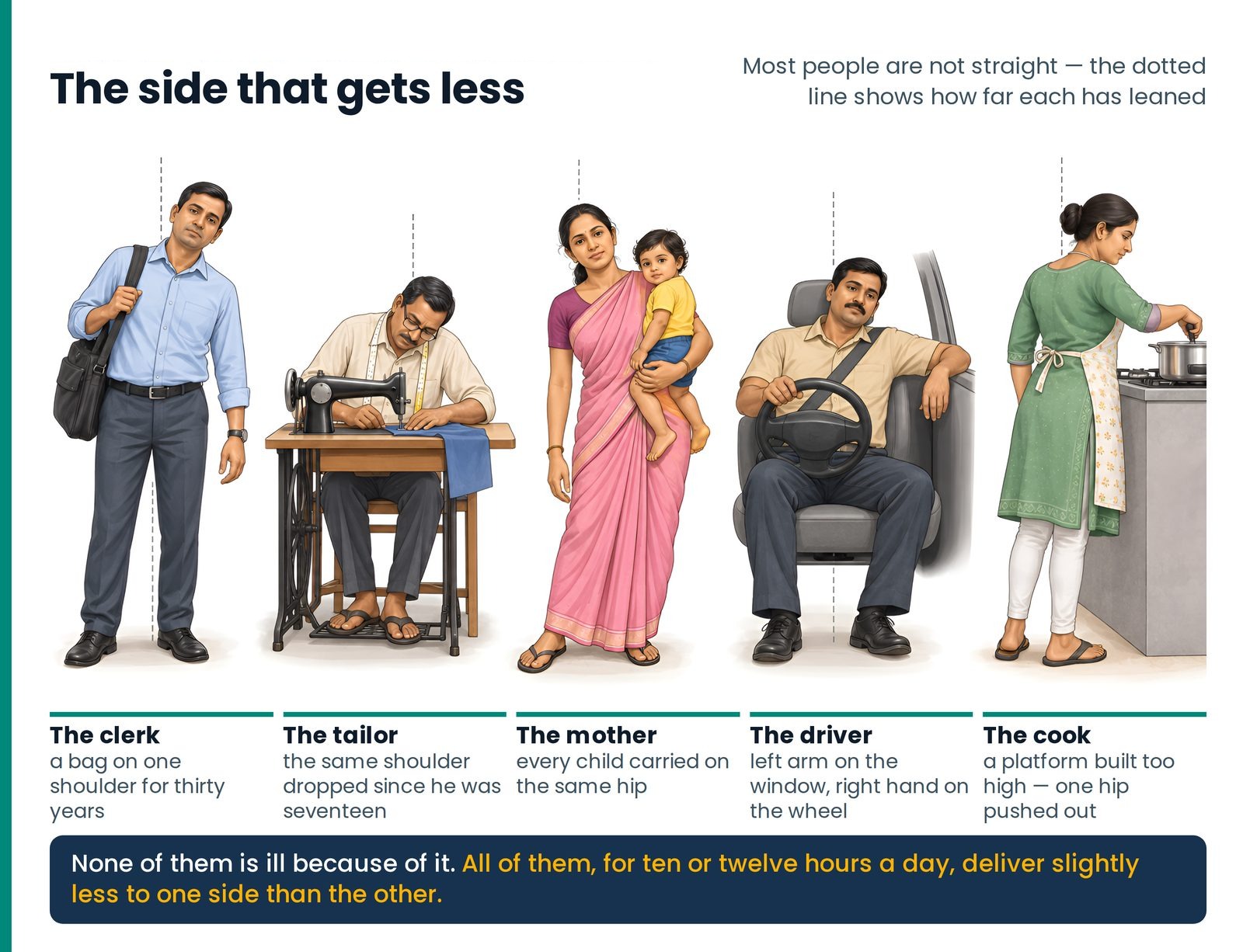
None of them is ill because of it. All of them are, for ten or twelve hours a day, delivering slightly less to one side than the other — and the account has been running for decades.
Two consequences follow, and both are practical.
First, look before you touch. Stand behind a new patient before she lies down and simply look: one shoulder lower, one hip higher, one foot turned further out, the head carried off centre? You are not making a diagnosis from it; you are forming an expectation the hands will confirm or contradict.
Second, understand what your pressure is standing in for.
What yogāsana does for oneself, this therapy does for another
Yogāsana is an ancient and very effective system of India, and India's gift to humankind. By yogāsana the muscles and the nerves are stretched and made flexible, and in that way the body is kept well and free of disease.
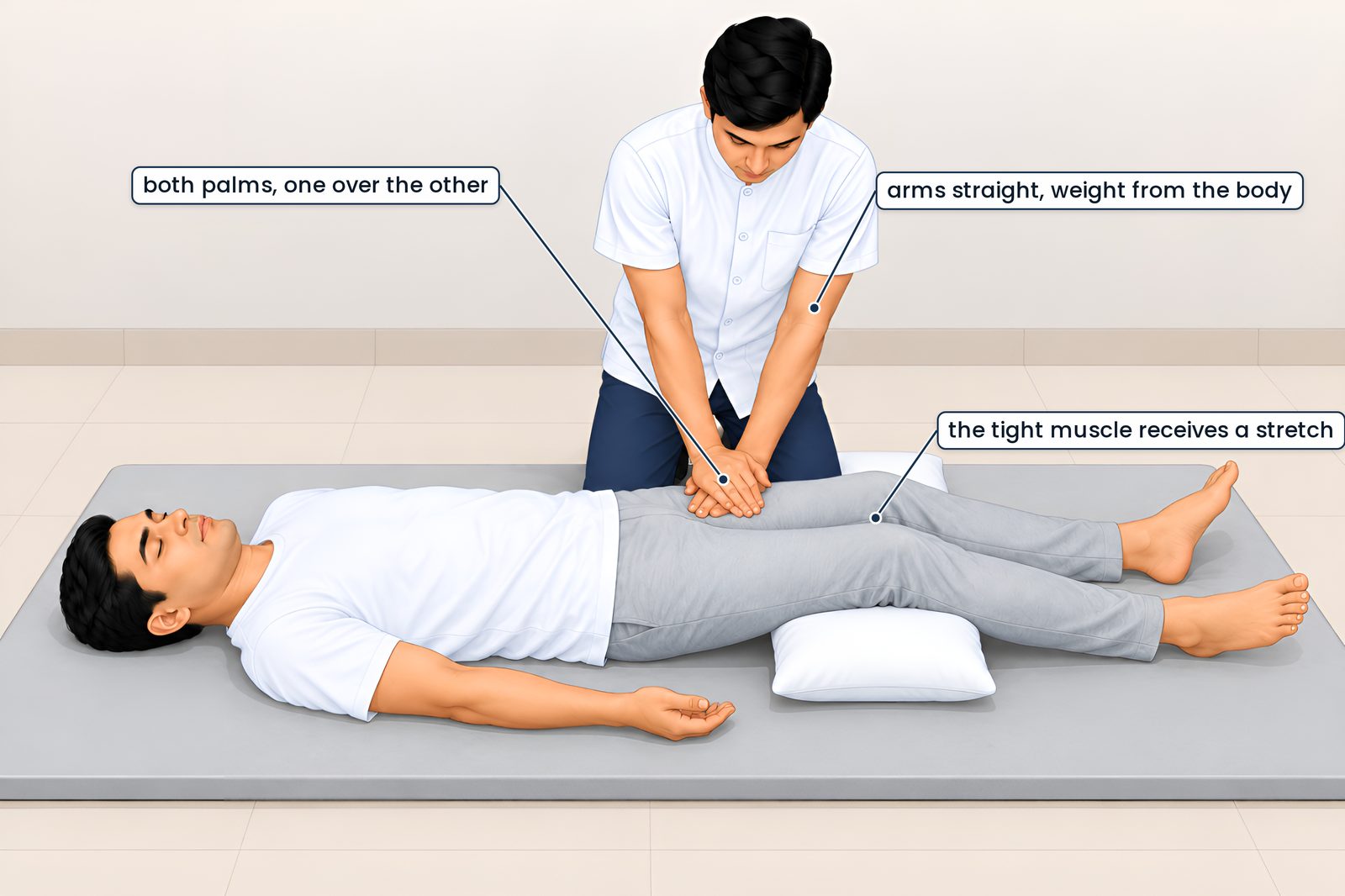
Seen in one way, the work which yogāsana does for oneself is the same work this therapy does for another. When we press with the foot on the thigh or on the arms, the muscles that have become tight or contracted receive a kind of stretch from our pressure, by which they become supple again. (Figure 3.15)
The principal benefit of this is easy to overlook. A patient with paralysis cannot perform a yogāsana. Nor can an intellectually disabled child, nor a very frail elder — and so, on top of everything else they carry, they acquire constipation, indigestion and repeated infections. Through this therapy we are able not only to relieve those, but to bring considerable improvement in their condition.
That is the answer to give when somebody says "then why not just tell people to do yoga?" Tell them to do yoga, by all means, if they can. The therapy exists for the body that cannot make its own stretch, and for the body whose organ is too far gone to be reached by a stretch alone. One heals the organ; the other holds the gain.
From Knee, Leg, Foot
LEFT CALF MUSCLE GHISAI — three stages, three tools
Thumb tips inside, fingertips outside, thumb edge along the foot
On the left leg, done in three stages. Supine Seated Left
- 1. With the tips of both thumbs, pressing firmly into the inner side of the left leg, draw the inner nerves and muscles from below the knee down to the ankle — that is, the heel — towards the heel. Do this 3 times. In the same way, at 3 separate lines from knee to ankle, as in the figure — see 1, 2, 3 in the picture.
- 2. Then with the tips of the remaining four fingers of both hands, do the outer side of the calf at three separate places, three times each — see 4, 5, 6 in the picture.
- 3. Then with the side of your thumb, rub along the inner side of the foot from the heel to the joint of the big toe, 6 times, and from that joint to the tip of the toe, 6 times — see 7, 8 in the picture.
| Patient's position | Follows Giriraj; the left leg as named — the affected side, or both if both knees hurt Left Right |
|---|---|
| Where the hands are placed | 1 — tips of both thumbs, pressing firmly into the inner side of the leg, along 3 separate lines from knee to ankle. 2 — tips of the remaining four fingers of both hands, on the outer side of the calf, at 3 separate places. 3 — the side of the thumb, along the inner side of the foot |
| Direction | 1 — from below the knee down towards the heel. 3 — heel → big-toe joint, then that joint → tip of the toe |
| Duration and repetitions | 3 times on each of the 3 inner lines; 3 times each at the 3 outer places; 6 times heel to the joint of the big toe, and 6 times that joint to the tip of the toe |
| What it is for | Given after Giriraj, as part of the knee sequence |
Two hands, three tools, named separately for a reason. Stage 1 is the tips of both thumbs, pressing firmly. Stage 2 is the tips of the remaining four fingers of both hands — the same two hands turned so that fingers rather than thumbs are the working surface. Stage 3 is the side of your thumb, the flat of its edge, not its tip. Thumb tips inward, fingertips outward, thumb edge along the foot.
The direction in stage 1 is written twice over, because it surprises people. From below the knee down to the ankle — that is, the heel — towards the heel. Downward, away from the knee. Note it, because in a few pages you meet BOF, where the tissue of the same calf is carried towards the knee, away from the heel — a different treatment, with a different name, position, tool, direction and purpose. Each is given as it is written; keep them apart and you will never give either by accident.
The three inner lines and three outer places are stations, not one long sweep — line 1, three strokes; line 2, three; line 3, three; then place 4, place 5, place 6, three each. And stage 3 leaves the calf for the foot, along the inner border, in two separate segments with separate counts: heel to the joint of the big toe, six; that joint to the tip of the toe, six. Not twelve strokes along one line.
From Uncommon Problems
ROCKET POINT — driving the muscles back up
Everything in it travels upward — the arm three times, then the ear
When some blow has been taken on the shoulder, neck or arm, the muscles come down, so that they cannot raise the arm; to drive them up again, this is given.
With the base of your palm, from the wrist of the arm that has the problem, draw the muscles upward and drive them up towards the shoulder. Do this three times.
Then with the tip of the thumb, giving quite strong pressure to the tissue of the back part of the ear, push it upward.
The patient may be given it either seated or lying down.
| Patient's position | Either seated or lying down — both are given, neither preferred Seated Supine |
|---|---|
| Where the hands are placed | 1 — the base of the palm, starting at the wrist of the arm that has the problem, drawing the muscles upward and driving them up towards the shoulder. 2 — the tip of the thumb, on the tissue of the back part of the ear, pushing it upward |
| Pressure | The arm sweep, drawing the muscles as it travels. At the ear, quite strong pressure |
| Duration and repetitions | The arm sweep three times. The ear component is given once, and is not counted × 3 |
| Which side | The arm that has the problem |
| What it is for | When some blow has been taken on the shoulder, neck or arm, the muscles come down, so that they cannot raise the arm — this drives them up again |
Now the name. Everything in this point travels in one direction: up. The palm goes up the arm; the thumb goes up behind the ear; the whole idea named in the first sentence is that something has come down and must be driven up again. The atlas has techniques named for a sound, for a place and for a person. This one is named for a direction of travel — and a rocket is a thing that is entirely about going up. Once you have seen that, the name tells you the treatment.
The tool in stage 1 is the base of the palm — the firm heel of the hand at the wrist, not the fingers and not the flat of the palm — and it starts at the patient's wrist, the far end, and travels to the shoulder. Three times. Stage 2 is a separate action with a separate tool at a completely different place: the tip of the thumb, behind the ear, on the tissue there, pushed upward, with quite strong pressure. It is the only place in this article where those words appear, and they appear about a thumb rather than a foot. Behind the ear you are on the hard knob of bone below and behind the ear lobe — firm bone under the thumb, and the front of the throat nowhere near it.
Also explained in
- IV — The trochlear nerve: one muscle, downward and outward Cranial Nerve and Brain Formulas
ne muscle, and the movement you use going down a staircase What it carries.
- What lactic acid actually does — the story to tell a patient Water and Salt
There the glucose is stored in the muscles in the form of glycogen.
- The face and the mouth Cranial Nerve and Brain Formulas
Table 9 — Swallowing Seated × 3 Point or condition Treatment For swallowing — to take the bolus, the mouthful, backwards (5) Medulla For swallowing — to open and close the epiglottis, by way of the cricothyroid and a
- FRACTURE POINT ('T' + 1-2-3) — two treatments, no pause between The Low Back
Then, drawing and pressing inward the muscles at the side from S1 to S5, keep lifting and pressing your heels up and down.
- What a nerve actually is The Body's Own Pharmacy
It sends blood to the muscles and the brain, quickens the heart, and shuts down digestion, because a body that believes it is about to be chased has no use for a working stomach.
- Satnam — सतनाम Seated II — Face, Jaw, Ear, Sinus
On bringing them to the side, without letting the muscles go loose, use the soft middle part of your thumb to rotate round and round 6 times in the direction of the clock's needle, and 6 times in the opposite direction.
- GIRIRAJ — carrying the thigh back upward Knee, Leg, Foot
This is given to loosen the muscles above and below the knee.
- The cord Treating Women
If the muscles remain loose then any organ will indeed shift from its own place and come to another place.
- Why six seconds — the reasoning in full Six Seconds
The two muscles that take turns.
- Piles, fissure, fistula and prolapse — one family, not four diseases What the Bowel Tells You
oose flesh-muscles, the Triangle for Piles, and bleeding to refer Piles, anal fissure, fistula and prolapse of the rectum are all four diseases of acid, and one chief cause of them is hard constipation.
- b. KNEE CAP FREE — given laid straight, or seated Knee, Leg, Foot
With light pressure, knead the muscles right and left, in the direction of the arrows.
- The knee and the lower limb Each Point in Use
Those muscles that have descended from the waist down into the thigh and the inside of the knee are pulled upward; and those muscles that have climbed up from the calves or the heel are brought downward — Two directions
- The neck, the shoulder and the arm Each Point in Use
In it we relax the muscles all around the neck, in this order: first, with light hands, the muscles at the front of the neck and the muscles at the back; then the muscles of the right and left sides of the neck; then, gi
- The back pain chart The Navel Speaks First
Left Right Table 4 — The back pain chart, label by label Label on the chart Where the arrow lands What lies at that level Cervical pain Nape, base of the neck, midline The seven neck bones and the long muscles either