The notation is closed. Every bracket, prefix, ring, glyph, arrow and secs suffix in this article was taught once and completely in Table 13 of How a Formula Is Built, "How a Formula Is Built", and is not explained again here. Every written rest — the minute between joints, the minute between rounds of breathing, the two minutes before a finger is re-checked — stands in Table 8 of that same article, with its reason attached. Two spellings you will meet on the cards below: ↑|↓ is the Round Arrow, and (½) Ku – 40 secs is a single hold of forty seconds, not a count of forty.
Watch


The complaint, in plain words
A busy kitchen with a small pantry and a narrow back door
A joint is two bones meeting in a wet, closed, well-fed little room. It has a lining that makes the fluid, a cushion of gristle on each bone end, a bag around the whole thing, and a blood supply that is not lavish at the best of times. Everything about a joint that works well depends on things arriving and leaving: food and oxygen arriving, waste leaving. Nothing is stored there. It is a busy kitchen with a small pantry and a narrow back door.
Now slow the deliveries. Nothing dramatic happens on the first day, or the hundredth. What happens is that the room gets a little sour, the movements get a little shorter, and the person begins to arrange their life around not doing certain things. A stiffening joint, in this therapy's reading, is a joint whose supply line and whose drain have both been narrowed for a long time — and the pain is the room's way of reporting it.
That reading is why the first thing tried on these patients was the ordinary work: the formulas for putting the stomach right, because every tissue in the body is rebuilt out of what digestion delivers, and the heparin-family treatments that increase the blood circulation, because those open the road.
That sentence is worth sitting with, because it is the whole reason this article exists. A treatment that helps and does not finish is not a failed treatment. It is an incomplete picture — a signal that something is being added back faster than you are taking it away, or that something is being held somewhere your sequence does not reach.
The two findings that came before any formula
Pain at Gal, and a bad stomach — the ground floor of the chapter
Before any of the thinking, there were two plain observations, made by looking at a great many of these people one after another.
What was found in the joint-pain patients, every time
First: such people always had pain at the Gal point.
Second: their stomach was also bad.
Those two findings are not incidental to the story. They are why the formula that came out of it opens on the digestion and the bile, and why Gal is the point whose count keeps rising through four generations of the family.
Hold onto that. When you meet the finished formula at the end of this article, with its three navel-setting stations and its forty-second sacral hold and its twenty spinal sweeps, it can look like an elaborate machine. It is not. It is the answer to this man's Gal hurts and his stomach is bad, with three further answers bolted on afterwards, each one added because a group of patients was still not getting well.
The thought that came from outside medicine
Told openly rather than tidied away: the planets, and where it led
Here the material does something unusual and worth respecting: it tells you exactly where the idea came from, including the part that a modern reader might find easier if it had been left out.
Guruji's mother taught him from childhood to honour the culture and family tradition of his country. He was himself skilled in reading the hand — palmistry — and had great regard for jyotiṣa and the other old sciences. He has always said that our forebears knew that when a child is born, all the affairs of its life proceed according to the positions of the planets at that time, about which the कुण्डली — the birth chart — is written; and that the effect of those planets falls upon the child's health.
So the thought that came was this: those diseases which for many years do not leave a person — their connection must surely be with the planets.
A student may do what he likes with that sentence. What he may not do is pretend it was not the sentence, because everything that follows is built on it, and the reasoning that follows is careful, physiological and testable at every step. Where an idea comes from is not the same question as whether it works. Ideas in medicine have arrived from dreams, from bad analogies, from plain religious conviction, and have then been judged by what they did at the bedside. This one is told openly instead of being tidied away afterwards, which is a point in the therapy's favour and not against it.
From the pineal gland to the spine — four steps
A message, a road, a traffic jam, and the arrow that clears it
The therapy's own long-standing observation supplied the bridge. In Neurotherapy it has been seen that after giving the treatment called Ku, the activity of the brain increases very much. For years Guruji has therefore said that by the Ku treatment we can stimulate the pineal gland.
From those pieces a decision was taken, and it is stated in one line.
The decision from which the Star family grew
Gal is to be stimulated, the stomach is to be set, and the pineal gland is to be stimulated.
One clause for each of the two findings, and one for the thought.
Then four further thoughts followed, in this order, and they are the reason the formula does not end there.
One. The message of the pineal gland will come out of the brain — and it must reach all the organs through the thirty-one pairs of spinal nerves of the peripheral nervous system, which leave on both sides of the spinal cord, inside the backbone.
Two. It is a common matter that if there is an obstruction anywhere on a road, the traffic will not run properly and there will be a traffic jam, so that goods do not reach at the right time.
Three. In the same way, if there is any unevenness in the alignment of the beads — the vertebrae — the message from the brain will not reach all the organs at the right time or in the right way. So this too has to be put right.
Four. And to set the blood circulation through the beads, a treatment already existed: the Round Arrow, ↑|↓.
Read those four steps as one sentence and the Old Star formula writes itself: set the navel, take the pain out of Gal, stimulate the pineal, then clear the road so that what you have provoked can actually arrive.
The first formula that was made — Old Star
Four steps, twelve minutes — and the name the patients gave it
Several formulas were made on the basis of all these thoughts, and they were given the name Star treatments, because the treatment had been made to correct the effect of the influence of the planets. The one made first of all was this.
Table 1 — Card: the Old Star treatment formula Supine Prone 6 sec
| Written | (3) ONS (3) Gal (4) Ku (20) ↑\ | ↓ |
|---|---|---|
| What it is for | Old joint pain — sandhi vāta — in the patient who has pain at Gal and a bad stomach | |
| Step 1 — (3) ONS | Old Nabhi Set. Supine; the therapist beside the right heel, both big toes gripped, both feet raised slowly to the height of his own standing hands, held six seconds, brought down very slowly. Three times. Given here to set the navel. Supine 6 sec × 3 | |
| Step 2 — (3) Gal | The therapist's right sole on the patient's left thigh, soft middle part of the sole, three (or four) stations from below the hip joint to just above the knee, six seconds at each, moving down without stopping. One full hip-to-knee pass is (1) Gal; here three passes. Given to take out the pain of Gal. Supine Left 6 sec | |
| Step 3 — (4) Ku | The old Kundali. Prone, one and a half pillows under the chest, both heels turned to face each other; the therapist seated between the feet, mid-sole on the last end of the spine. The time is six seconds and the count is two equal one — so (4) Ku is eight presses of six seconds, without stopping. Given to stimulate the pineal gland. Prone 6 sec | |
| Step 4 — (20) ↑\ | ↓ | Round Arrow. Prone; the edge of the big thumb from below the neck down the right side of the column to L5, pressure inward on each bead, then without lifting the finger up the left side to the neck. Twenty. Given to make the nutrients reach all the organs properly through the peripheral nervous system. Prone |
| The technique caution inside step 4 | Take care that each time the pressure falls on the side of the beads ▲ Take care | |
| What must not be given | Ku is not given to women during menstruation, and not to those with low blood pressure. The bar belongs to the point and travels into every formula containing it — Each Point in Use, "Each Point in Use" ▲ Take care | |
| Points taught in | ONS — The Front of the Body II · Gal — The Front of the Body I · Ku — Face Down · Round Arrow — Face Down |
Said aloud to a colleague: lift the feet three times, three passes down the left thigh, eight presses at the tail of the spine, twenty sweeps of the back. Four steps, perhaps twelve minutes, and nothing in it that a therapist did not already own.
Whoever had an old pain, their pain used to lessen at once with this treatment. And then something happened that formulas rarely do: before one's eyes it became so popular — so dear to the people — that it truly became a star, a star indeed. The name had been chosen for the planets. The patients made it mean something else. Later, when many further changes came into the treatment, this first form was given the name Old Star treatment formula, and it is still printed, still taught, and still given.
Why the Round Arrow follows Ku — a rule with a long reach
A step that makes a finding, and a step set behind it to cancel it
One further benefit was found from giving the Round Arrow after Ku, and this is one of the most useful small findings in the whole formulary.
Ku first, Round Arrow after — and the reason
It was seen that giving Ku produced pain at Mu° in some people, and signs of acidosis began to appear in them — whereas the (20) ↑|↓ took the pain of Mu° away.
This fact has been used in many places. That is why you will see that in many formulas (20) ↑|↓ is given after Ku.
Notice what has happened there, because it is a model of how this therapy handles its own side-effects. A step was found to produce an unwanted finding in some patients. It was not denied, not explained away, not made conditional on the therapist's judgement. It was named, and a second step was set immediately behind it whose job is to cancel it. The pairing is the safeguard.
And the rule travels. The point's own entry carries the same instruction from the other direction: if pain remains at Mu° after Ku, give Round arrow as required until the Mu° pain clears.
The WD variant
The connection is from birth, so it must reach the generative organs
Then a second thought followed from the first. Since the planets' connection is from birth, their effect must certainly be upon the generative organs — and in this therapy the generative organs are stimulated by the WD treatment. So the formula was changed.
Table 2 — Card: the WD variant of the Star formula Supine Prone 6 sec
| Written | (3) WD (1) Gal (4) Ku (20) ↑\ | ↓ — and if there is a need, (3) ONS may also be given first |
|---|---|---|
| What changed, and why | WD replaces ONS as the opening, because the planets' connection is from birth and so must reach the generative organs. Gal is cut from three passes to one. The ONS is not abolished — it becomes conditional, given first if there is a need | |
| Step 0 — (3) ONS, conditional | Supine, exactly as in Table 1. Given first only if there is a need — read the condition as carefully as the step Supine × 3 | |
| Step 1 — (3) WD | From the head end: the therapist's feet placed on both sides of the patient's neck, carrying no weight; then brought to the elbows one by one; with the middle part of the soles, pressure on both forearms at once at three places from elbow to wrist, six seconds at each place. That is (1) WD; here three rounds. Keep the weight equal on both soles. Supine Both sides 6 sec | |
| Step 2 — (1) Gal | Right sole, left thigh, one hip-to-knee pass Left 6 sec | |
| Step 3 — (4) Ku | Old Kundali — eight presses of six seconds, without stopping, prone Prone 6 sec | |
| Step 4 — (20) ↑\ | ↓ | Round Arrow, prone, as in Table 1 Prone |
| What must not be given | The Ku bars — not in menstruation, not in low blood pressure ▲ Take care | |
| Points taught in | WD — The Front of the Body I, "The Front of the Body — I" |
Both these treatments began to please all the patients with joint pain. Two formulas, four steps each, and a clinic full of people who had been disappointed everywhere else now getting up off the mat differently.
WD never travels alone after P point
WD is one half of an inseparable pair. Wherever P point is given, (6) WD follows immediately — the two are written as one instruction and are never split.
That pair is not triggered by this article's formulas, which do not contain P point. But a therapist who meets WD here and WD again in New Genes — Vitamin and Gene Formulas, "The Missing Links" — and WD inside the Fast line of the rebuild at the end of this article, should hold the pair in mind as part of the point's identity, not as a rule attached to one formula.
Why Gal was increased and Ku was changed — the New Star
A blocked pipe opened by force, and forty seconds in place of eight presses
But the full benefit did not come, and the patients always had pain in Gal. The same finding that had started everything was still sitting there after treatment, which is the plainest possible message a body can send: you have not yet done enough of the thing you know is needed.
Seeing this, Guruji thought about a blocked pipe. If there is a blockage — an obstruction — in some pipe, then if we release water through it with force, the pipe will open. In the same way, he thought, a greater quantity of bile is needed, so that the flow in the bile duct increases; and if there is any blockage in the ampulla of Vater, it may open.
So (3) Gal was increased and made (6) Gal.
And (4) Ku was changed to (½) Ku – 40 secs, by which patients were found to obtain greater benefit.
That second change is larger than it looks here. (4) Ku and (½) Ku – 40 secs are not two doses of one thing; they are two different treatments performed at one site. The old Kundali is eight presses of six seconds without stopping. The half form is one single hold of forty seconds, and its stated purpose is precisely the one the derivation asked for: to stimulate the pineal gland — for melatonin.
Table 3 — Card: the New Star treatment formula Supine Prone 6 sec
| Written | (6) Gal (6) WD (½) Ku – 40 secs (20) ↑\ | ↓ |
|---|---|---|
| What changed, and why | Gal raised from three passes to six, to force the flow of bile and open any block at the ampulla of Vater. WD raised from three rounds to six. (4) Ku becomes a single forty-second (½) Ku, by which patients were found to obtain greater benefit. And the order of the first two is now Gal before WD | |
| Step 1 — (6) Gal | Right sole on the left thigh, three or four stations hip to knee, six seconds each, six full passes Supine Left 6 sec | |
| Step 2 — (6) WD | Head end; both forearms together, three stations elbow to wrist, six seconds each — six rounds Supine Both sides 6 sec | |
| Step 3 — (½) Ku – 40 secs | Prone, sacrococcygeal, mid-sole, normal pressure — once, held forty seconds, then released comfortably. A single timed hold, not a repeated count Prone | |
| Step 4 — (20) ↑\ | ↓ | Round Arrow, prone — follows Ku, by the rule above Prone |
| What (½) Ku – 40 secs is credited with | The pineal gland — for melatonin; disorders of the brain, speech or CSF such as MND and MS; excellent for cerebral atrophy | |
| Points taught in | (½) Ku timings — Face Down · Water and Salt |
The New Star Modified formula
Three navel-setting stations in front, for the navel never set at all
Because of the success of the treatments above, the number of patients went on increasing. Even so, some such patients were still met with who did not get the full benefit from the treatment above.
After thinking it over, Guruji felt this must be because their navel was not set at all. By that time two further navel-setting treatments had been obtained — TF, that is Toe Fingers, and NNS, that is New Nabhi Set — and so the formula was changed by putting all three navel-setting stations in front of it.
Table 4 — Card: the New Star Modified formula Supine Seated Prone 6 sec
| Written | (3) ONS (20) TF (6) NNS (6) Gal (6) WD (½) Ku – 40 secs (20) ↑\ | ↓ |
|---|---|---|
| Who it is for | Those whose digestion is not right, or whose navel is upset. Chief among the patients it has benefited are those of RA — rheumatoid arthritis — for whom it has proved extremely useful | |
| What changed, and why | Three navel-setting stations — ONS, TF, NNS — placed in front of the New Star, because the patients who did not get the full benefit were judged to be those whose navel was not set at all | |
| Step 1 — (3) ONS | Supine; both big toes gripped, both feet raised slowly to the height of the therapist's own standing hands, held six seconds, lowered very slowly. Three times Supine 6 sec × 3 | |
| Step 2 — (20) TF | Seated at the foot end. At every joint of every toe, rub the three sides — twenty times at each place, counted — so that the nerves under the skin are roused, but never hard enough to make a wound there. Default order: big toe of the LEFT foot → little toe, then the right foot Seated Left Right | |
| Step 3 — (6) NNS | Thumb at each toe joint in order, bending the toe downward toward the sole and staying six seconds. Six times on each toe; left big toe first 6 sec Left Right | |
| Step 4 — (6) Gal | Right sole, left thigh, hip to knee, six passes. Given so that if there is any blockage in the ampulla of Vater, or on the road of the common bile duct, it may be opened Supine Left 6 sec | |
| Step 5 — (6) WD | Head end; both forearms, three stations each, six seconds, six rounds Supine Both sides 6 sec | |
| Step 6 — (½) Ku – 40 secs | Prone, sacrococcygeal — once, held forty seconds Prone | |
| Step 7 — (20) ↑\ | ↓ | Round Arrow, prone, after Ku Prone |
| How often | Formerly this treatment was given only on alternate days. Nowadays, if there is need, it is given even daily. After some days of treatment, as the pain of the fingers goes out completely, two times or once a week may also be enough | |
| What follows it | The All-joints ghisai, below — an addition, not a replacement | |
| What must not be given | The Ku bars — not in menstruation, not in low blood pressure. And the exclusions at the head of the Alkaline Star section, which decide whether this formula is the right one at all ▲ Take care | |
| Points taught in | ONS, TF, NNS — The Front of the Body II, "The Front of the Body — II"; the finger-by-finger tables of TF and NNS belong to Cranial Nerve and Brain Formulas, "The Twelve Messengers" |
Said aloud: lift the feet three times; rub every toe joint twenty times on three sides; bend every toe down six times; six passes of the left thigh; six rounds on both forearms; one forty-second hold at the tail of the spine; twenty sweeps of the back. It takes a good deal longer than the Old Star, and every minute of the difference is navel-setting.
The line of development, in one table
Read the right-hand column downward and you read the patients
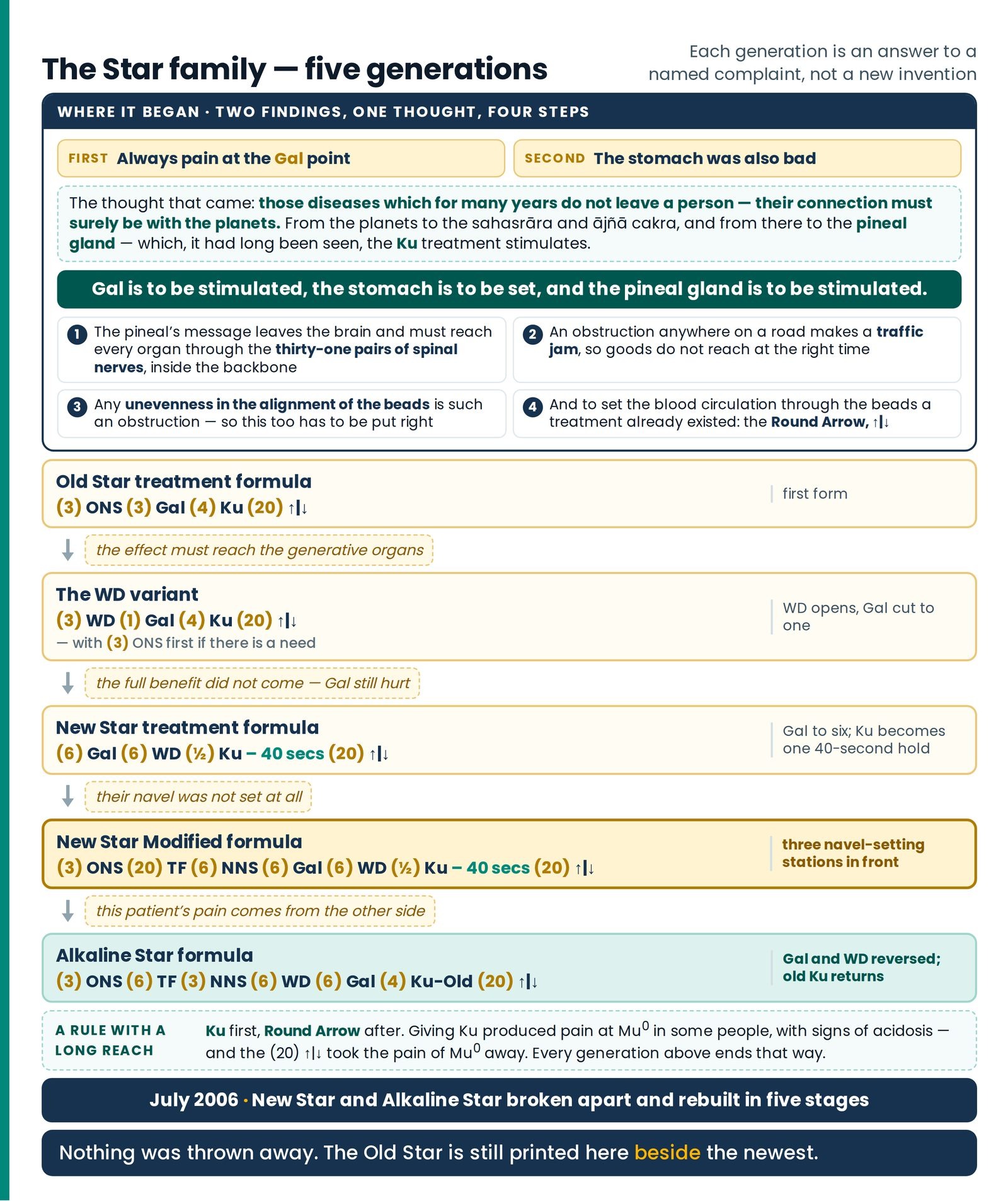
Four generations in a handful of years, each one a named answer to a named failure. Read the right-hand column downward and you are reading a record of what patients were still complaining of.
Table 5 — The Star family compared
| Generation | Written | What changed, and why | Which therapist reaches for it | |
|---|---|---|---|---|
| Old Star treatment formula | (3) ONS (3) Gal (4) Ku (20) ↑\ | ↓ | The first form made. Navel set, Gal pain taken out, pineal stimulated, road cleared | The one who wants the original — four steps, quickly given, and whoever had an old pain, their pain used to lessen at once |
| The WD variant | (3) WD (1) Gal (4) Ku (20) ↑\ | ↓ — with (3) ONS first if there is a need | The planets' connection is from birth, so their effect must reach the generative organs: WD becomes the opening and Gal is cut to a single pass. ONS becomes conditional | The one whose patient's picture points at the generative organs, and whose navel does not demand setting first |
| New Star treatment formula | (6) Gal (6) WD (½) Ku – 40 secs (20) ↑\ | ↓ | The full benefit did not come and Gal still hurt. Gal raised to six to force bile through any block at the ampulla of Vater; WD raised to six; (4) Ku replaced by a single forty-second (½) Ku | The one whose patient's Gal pain survives the older forms |
| New Star Modified formula | (3) ONS (20) TF (6) NNS (6) Gal (6) WD (½) Ku – 40 secs (20) ↑\ | ↓ | Some patients still did not get the full benefit — judged to be those whose navel was not set at all. Three navel-setting stations placed in front | The working formula of this article. For those whose digestion is not right or whose navel is upset — and the one that has proved extremely useful in RA |
| Alkaline Star formula | (3) ONS (6) TF (3) NNS (6) WD (6) Gal (4) Ku-Old (20) ↑\ | ↓ | Gal and WD reversed, the counts of TF and NNS exchanged, and the old Ku given back — because this patient's pain comes from the alkali side and not the acid side | The one facing the right ring finger, or Liv° at three plus — see Part six |
| The July 2006 rebuild | Five stages — see Part six | New Star and Alkaline Star broken apart and re-ordered into one protocol, very effective in all kinds of joint pain | The one who wants both directions addressed in a single visit, with the balance restored afterwards |
Two things are worth noticing about that column of reasons, because they are how this therapy grows.
Every change answered a patient, not an idea. Not one of these generations came from re-reading the theory. Each came from a group of people who were still not well, and each was aimed at the specific thing they still had — the Gal pain that survived, the navel that had never been set, the finger that hurt on the wrong side. (Figure 36.1)
And nothing was thrown away. The Old Star is still printed here beside the newest. That is deliberate, and it is the same habit that has old formulas standing beside their successors all through this wiki. A therapist with a patient who cannot lie prone for long, or a household being taught four steps to give at home, still needs the short form.
What is done
The All-joints ghisai — an addition after the formula, not a part of it
This treatment is another mark of long practice, and it is given after the New Star Modified, not instead of any part of it.
Table 6 — Card: All joints ghisai Seated Both sides
| Where it sits | After the New Star Modified formula, after (20) ↑\ | ↓. An addition, not a replacement |
|---|---|---|
| What is done | A very, very light rubbing with your own palms | |
| Where | Every single joint, from the fingers up to the shoulder, in order | |
| The rest | One minute between one joint and the next — written, timed, and part of the treatment. Table 8, How a Formula Is Built | |
| The reason for the rest | An ordinary person takes one minute to take sixteen breaths, and sixteen breaths are needed for more than about ninety per cent of the carbon dioxide to come out. Without the interval the CO₂ will not come out fully, and the full benefit of the ghisai will not be had | |
| What the patient reports | That the pain comes out of the joints one by one — like magic |
Why it works — the secret of it
Sixteen breaths, one minute, and the acid that leaves on the breath
Guruji has also discovered why and how this happens, and the account is worth learning properly, because it explains a rest and not only a rub.
During metabolism — chayāpachaya, the building up and breaking down that runs inside every cell — the processes inside the cells produce CO₂, carbon dioxide, within them.
Through lack of oxygen, or if the blood circulation in the tissues is low, this carbon dioxide will go on accumulating inside the cells and tissues in the form of H₂CO₃ — carbonic acid — by which the quantity of acid in the tissues will go on increasing. That is what is called metabolic acidosis.
Carbonic acid in the joint, and how it leaves
And we have found that because of acidosis too, pain can come in the joints.
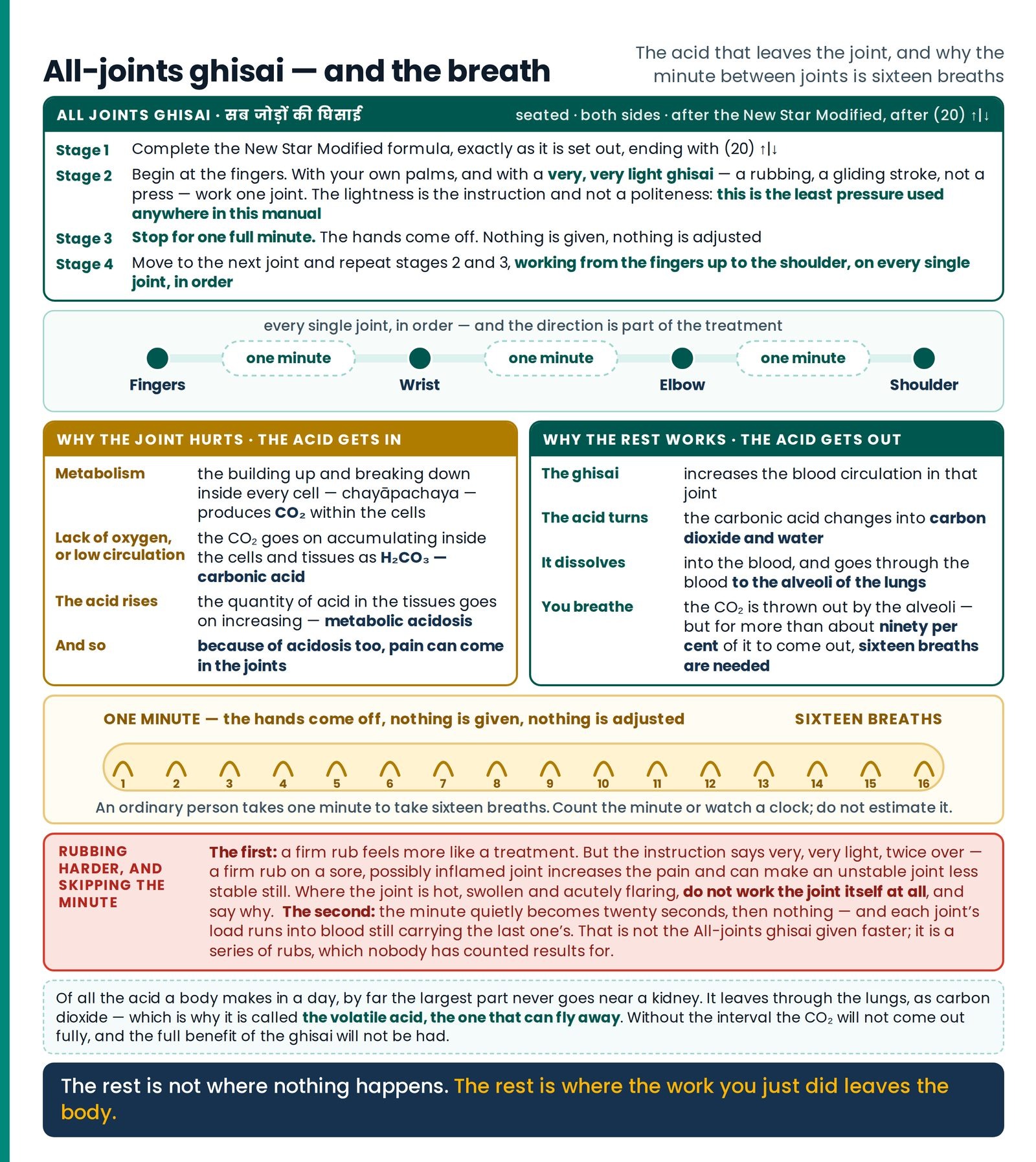
So: if in some way we increase the blood circulation in that joint, then the carbonic acid accumulated there will change into the form of carbon dioxide and water, will dissolve into the blood, and will go through the blood into the alveoli of the lungs. When we breathe, the CO₂ will be thrown out by the alveoli — but for more than about ninety per cent of it to come out, sixteen breaths are needed.
That is why, after giving (20) ↑|↓, the ghisai of each joint is done. And that is why, after the ghisai of each single joint, it is necessary to give an interval of one minute — because an ordinary person takes one minute to take sixteen breaths. If we do not give this interval, the CO₂ will not come out fully, and the full benefit of this ghisai will not be had.
Read that again and notice what kind of instruction it is. Most rests in most therapies are explained by saying the patient needs a moment. This one is explained by arithmetic: a number of breaths, a rate of breathing, and a minute that is the product of the two. The rest is not where nothing happens. The rest is where the work you just did leaves the body. (Figure 36.2)
Say it to a patient in the household's own language: I have just opened the tap in that elbow. The sourness that was sitting in it is now in your blood, on its way to your lungs. Your lungs need about sixteen breaths to blow it out. So we wait one minute, and then I do the next one — because if I hurry, the next joint's load goes into blood that has not finished clearing the last one's.
Before the material turns to rheumatoid arthritis, it stops and explains something larger, because without it the ring-finger sign that follows would look like a trick.
When a patient with a new disease came, the method of diagnosis was to check whether there was pain or not at several fixed places on that patient's body. If the patient had a report, what deficiency the report showed was noted. When the next patient arrived with the same disease, or with the same kind of report, the same points were checked — and among them there would be some points already known from earlier experience, and sometimes pain in some other point that the previous patient had also had. Then it was put together: which kinds of symptoms or diseases are linked with pain at which points of the body.
Doing that again and again, across four decades, one thing came to be known with certainty.
The finding on which the whole diagnostic method rests
However many the diseases or symptoms may be, their effect brings pain in the body at only some eight or ten — or fewer — particular points.
So far there does not seem to be anything special in it. But now comes the real and special thing:
"If one becomes skilled in recognising the pains of those particular points of the body, and in taking them out — then several diseases and symptoms connected with that pain you can cure by that one and the same treatment!"
Can several symptoms be cured by one and the same treatment? Is this a thing to be believed?
Yes indeed. This is the very truth. This method of diagnosis has proved a unique diagnostic tool — and it is for this reason alone that in many Neurotherapy centres across the country, those who have learned this knowledge, even if they are little educated, are obtaining success in the treatment of many kinds of diseases. That is why it is said again and again that there is no other therapy like this one, which is going to prove a boon for the human race; and to prove the truth of that statement, this one reason alone is sufficient.
Two practical consequences follow for you, today, on your own mat.
One: the sign comes before the name. You are about to be taught a bedside test which tells you something about a disease before any laboratory does. That is only possible because somebody spent forty years comparing patients rather than comparing diagnoses.
Two: a shared point groups conditions; it does not make them one condition. Several diseases meeting at one painful point is exactly what makes a single treatment useful across a list — and it is also exactly why a therapist must keep asking what else could this be? A sign that gathers conditions together is priceless for finding them. It is never a licence to stop looking.
This is the article's other half, and four earlier articles have been pointing at it. The Medulla Family named the both-ring-fingers sign and sent you here. Fire and Swelling · The River — Heparin met rheumatoid arthritis as a bar on Thymus, Thymus + Chest, Ton 'P' and Ton 'T' and sent you here. Water and Salt named it twice as a use of the Lactic Acid Conversion formula and sent you here. Here it is, whole.
Who is called an RA patient
What the report settles, what it does not, and what you write down
The report, and what it does and does not settle
We call those RA patients in whose blood test report these words will be written — RA Antigen Positive, or Rheumatoid Factor – Positive.
The RA factor is also positive in the following diseases — hepatitis, syphilis, liver cirrhosis, SLE, scleroderma, or acute bacterial or viral infection, and so forth.
When such patients come to us, then after seeing their reports we shall write on our card the date of the report, and in front of it write — RA positive. In some people ANA is positive — then write that.
Read the second paragraph twice, because it is the therapy protecting you from a mistake that doctors also make. A positive RA factor is not by itself a diagnosis of rheumatoid arthritis. The same test turns positive in liver disease, in long infections, in several other diseases of the immune system, and — this is not in the list but is worth carrying — in a small number of perfectly well older people. The material states the limitation of the test in the same breath as the test. Do the same when you speak to a patient.
And note what you are told to write: the date of the report and then the result. A serology result is a photograph of one morning. A card that says RA positive with no date is a card that will still be saying it in nine years.
The sign
A great deal of pain at the middle joint of both ring fingers
Such patients did indeed have pain in many fingers and joints — but not everyone's pain was the same. One had more pain in one finger, another less. But after examining many patients, a similarity was found, and it was this:
The both-ring-fingers sign
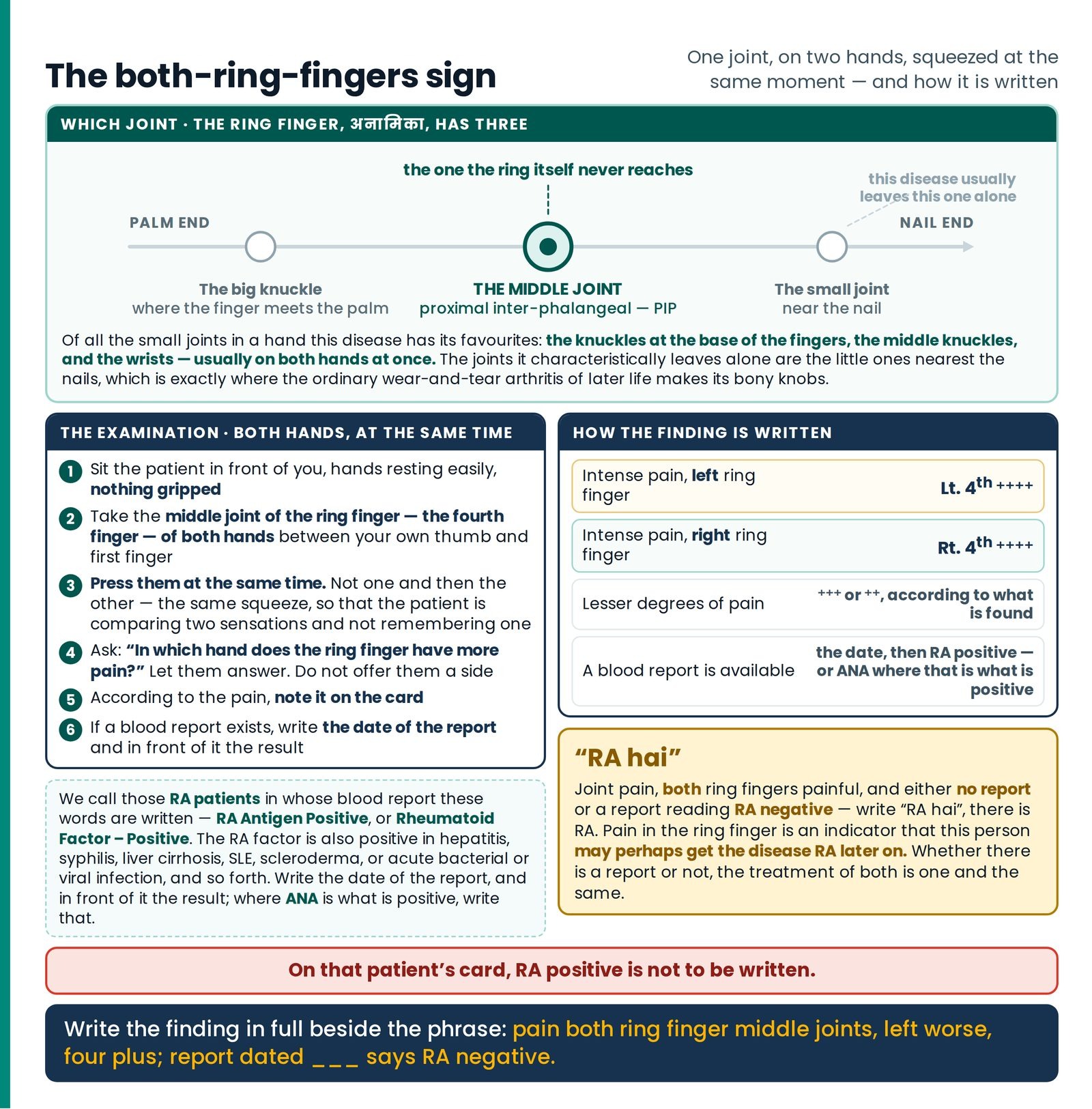
All RA patients had a great deal of pain at the middle joint of the अनामिका — the ring finger — of both hands.
That joint is the proximal inter-phalangeal joint.
Such people obtained great benefit from the New Star Modified.
One sign. Two fingers. A joint you can reach across a table without the patient undressing, without a couch, without a report, and without asking a single question that a frightened person might answer carefully. (Figure 36.3)
The new method of diagnosis for joint pain
Both at the same time, the same squeeze — and let them answer
Since the success of this treatment, a new method of diagnosis has been started for patients with joint pain or sandhi vāta, which every therapist is to adopt.
Table 7 — The ring-finger sign and its recording
| Finding | How it is elicited | How it is written |
|---|---|---|
| Intense pain, left ring finger, middle joint | Both middle joints squeezed at the same time between the therapist's thumb and first finger; the patient says which hand has more pain | Lt. 4ᵗʰ ⁺⁺⁺⁺ Left |
| Intense pain, right ring finger, middle joint | as above | Rt. 4ᵗʰ ⁺⁺⁺⁺ Right |
| Lesser degrees of pain | as above | ⁺⁺⁺ or ⁺⁺, according to what is found |
| A blood report is available | Read it | the date of the report, then RA positive — or ANA where that is what is positive |
The grading marks are the ones you already use everywhere else on a diagnosis card, and they mean here exactly what they mean there: what you found, not what you will give. An empty box is not examined; a minus is examined and silent.
And note the value of the negative. A therapist who squeezes both ring fingers of a patient with trembling hands, finds nothing, and writes it down has not wasted thirty seconds. He has removed a question from the case.
The patient whose report says negative
The same finger, the same treatment — and the word you may not write
Then something was seen which turned a treatment indication into a piece of clinical foresight.
Those who had joint pain but whose blood report was found RA Negative had the very same pain in the ring finger as the RA positive patients had. So, according to the experience above, they too were given the New Star Modified Formula, and all those patients' pain went out.
What the ring-finger pain means when the report is negative
This means that pain in the ring finger is an indicator that — this person may perhaps get the disease RA later on.
So a unique method was brought out for it. If a patient has pain in the joints, but either they have no blood test report, or the report says RA negative — and we have found that there is pain in both ring fingers — then we shall write on that patient's card: "RA hai" — "there is RA".
Whether there is a report or not, the treatment of both is one and the same.
The foresight in that passage deserves saying out loud, because it is the most valuable half-page in the article. A person with joint pain and two sore ring fingers and a negative blood test is a person about whom something has been noticed early. Whatever else you do, that is a patient to tell, plainly and without alarming them, that their joints are showing a pattern worth a doctor's opinion — and to keep telling until they have had one. A sign that arrives before a report is only worth having if somebody acts on it.
The full protocol for joint pain and RA
Three parts: the medulla and T1/T2, the formula, then every joint
The best results have been got in the following order. (Figure 36.4)
Table 8 — Card: the full protocol for joint pain and RA Seated Supine Prone 6 sec
| Written | I — (4) Medulla Clockwise + T1/T2; + if there is pain in the neck, also do Neck ghisai. II — the New Star Modified formula: (3) ONS (20) TF (6) NNS (6) Gal (6) WD (½) Ku – 40 seconds (20) ↑\ | ↓. Afterwards — the ghisai of all the joints, in order |
|---|---|---|
| Part I, step 1 — (4) Medulla, clockwise | Seated. Gather your fingers together into a pad — this is not the thumb glide of the rest of the Medulla family. Rotate the pad clockwise on the muscles of the neck, coming from the ear down to the shoulder, worked from above downward in various directions. Begin from the left side and go across to the right. Four, by this lane's count Seated Left Right | |
| Part I, step 2 — T1/T2 | Without moving the patient. Find the prominent bead at the base of the neck; the next two beads down are T1 and T2. That is the station. No count is written for the station itself — the treatment governs it. Light hands Seated | |
| Part I, step 3 — Neck ghisai, conditional | Only if there is pain in the neck. Four stages in order: first, with light hands, the muscles at the front of the neck and the muscles at the back; then the muscles of the right and left sides; then the necklace-like treatment; finally the muscles attached to the shoulder blade Seated ▲ Take care | |
| Part II | The New Star Modified formula, entire, exactly as Table 4 — ONS, TF, NNS, Gal, WD, the forty-second (½) Ku, the Round Arrow | |
| Part III | All joints ghisai — fingers to shoulder, every joint, very very light, one minute between joints | |
| The rule inside part I | Clockwise is a different hand action, not an adverb. Four ordinary downward strokes are (4) Medulla, which is not (4) Medulla clockwise | |
| What must not be given | The Ku bars — not in menstruation, not in low blood pressure. The anterior-neck rule governs Neck ghisai absolutely: glide, never thrust; no rotation, no traction, no leverage ▲ Take care | |
| Points taught in | (4) Medulla clockwise with T1/T2 — The Medulla Family, "The Medulla Family" · Neck Clockwise and T1/T2 — Seated I — Brain, Medulla, Neck, "Seated — I" · Neck ghisai — Seated II — Face, Jaw, Ear, Sinus · Each Point in Use |
Two notes on part I, both of which a student will otherwise get wrong.
The Medulla here is the one member of its family with a direction. (4) Medulla is given clockwise, with T1/T2, and is credited with the neck's own territories — the C1–C4 group, which carries the chest, the mitral valve, the spleen and the upper diaphragm, and the C5–C8 group, which is the arm written out from the shoulder to the fingertips. In a article about pain in the joints of the arm, that is not an ornament at the front of the formula. It is the road the arm's pain travels on.
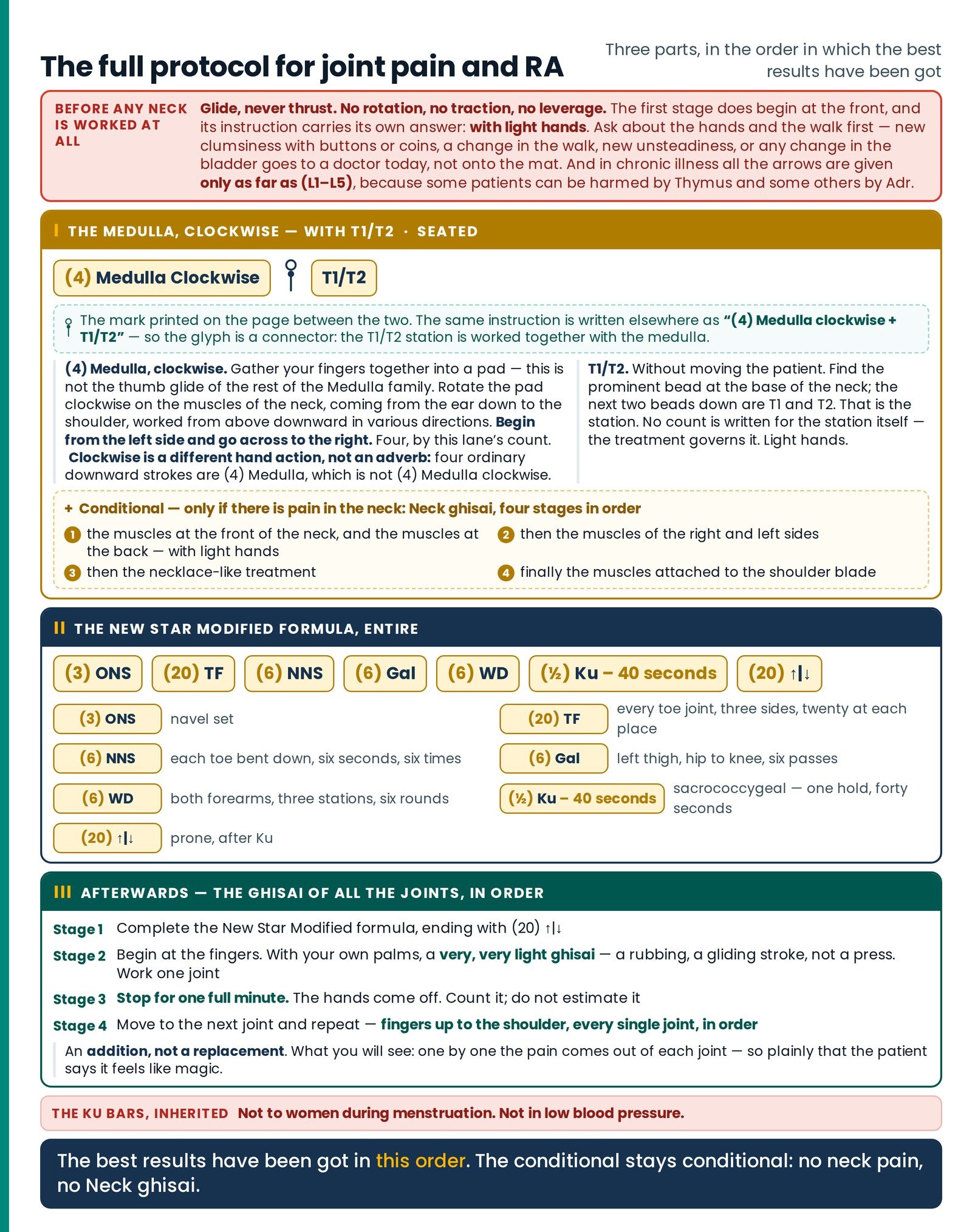
And the conditional stays conditional. If there is pain in the neck, then also do Neck ghisai. No neck pain, no Neck ghisai. A conditional addition is a gate, not decoration, and the habit of giving it anyway because it seems to belong is how formulas quietly stop being formulas.
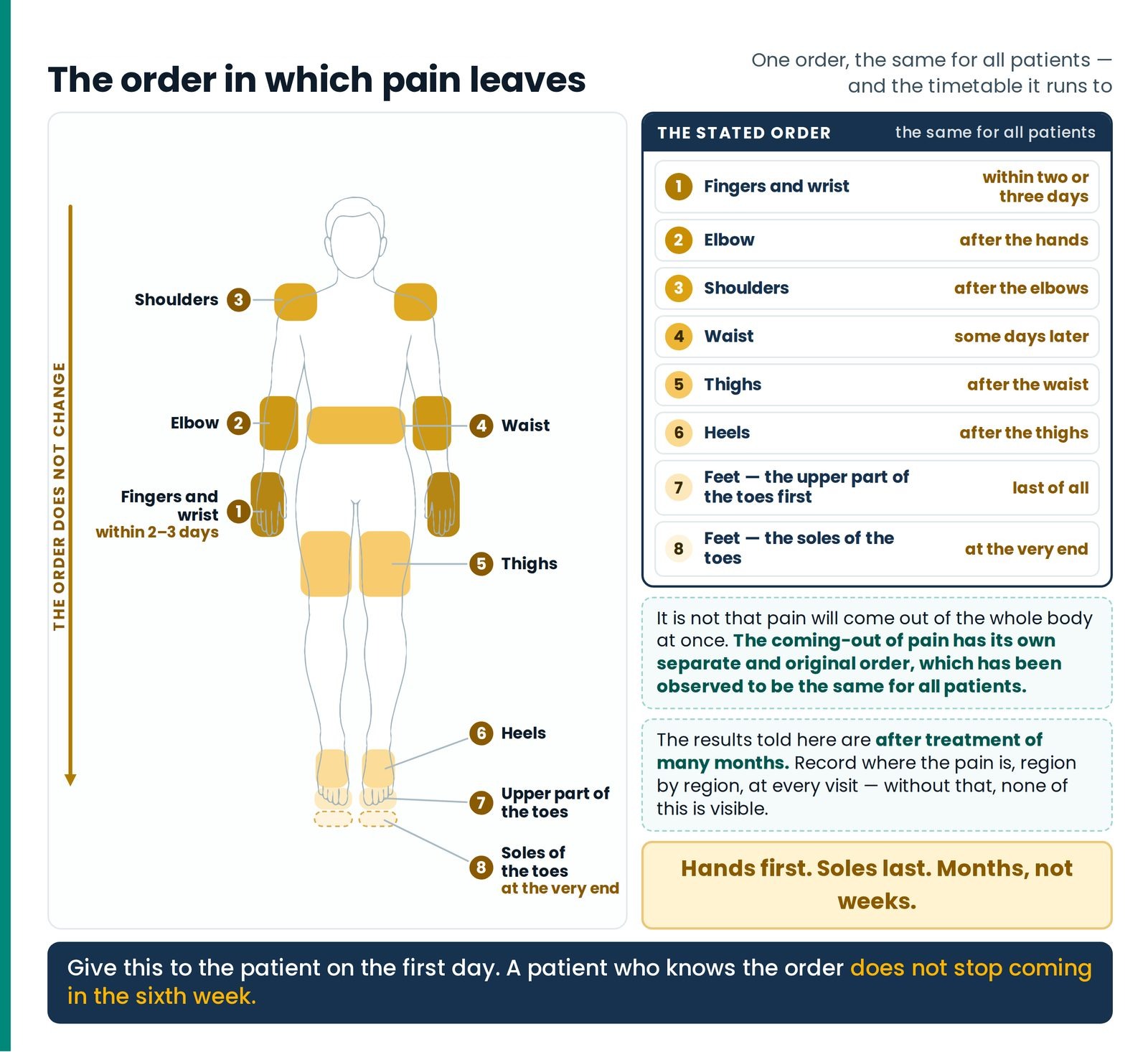
The order in which pain leaves the body
Hands first, soles last — and the chart that keeps a patient coming
This treatment proved so successful in sandhi vāta that — as the material puts it — do not ask. People got such relief that those who came weeping and stumbling went home after the treatment as if flying.
But it does not all go at once, and knowing the order is how you stop a patient losing heart in week three.
The order is the same for all patients
It is not that pain will come out of the whole body at once. The coming-out of pain has its own separate and original order, which has been observed to be the same for all patients.
First, within two or three days, the pain goes out completely from the fingers and the wrist of the hands. Then from the elbow. After that from the shoulders. And some days later from the waist, then from the thighs, then from the heels — and last of all, the pain of the feet will come out. In that too the order is such that first the pain comes out from the upper part of the toes, and at the very end from the soles of the toes.
The results told here are after treatment of many months.
Table 9 — The stated order in which pain leaves
| Order | Region | Stated timing |
|---|---|---|
| 1 | Fingers and wrist | within two or three days |
| 2 | Elbow | after the hands |
| 3 | Shoulders | after the elbows |
| 4 | Waist | some days later |
| 5 | Thighs | after the waist |
| 6 | Heels | after the thighs |
| 7 | Feet — the upper part of the toes first | last of all |
| 8 | Feet — the soles of the toes | at the very end |
Give that table to the patient on the first day. It is the single most useful thing you can hand a person with joint pain of fifteen years, because it converts the thing they will otherwise experience as failure — my hands are better but my feet are as bad as ever — into evidence that the treatment is running to time. A patient who knows the order does not stop coming in the sixth week. (Figure 36.5)
And notice what the table asks of you: that you record where the pain is, region by region, at every visit. Without that, none of this is visible; with it, you can show a patient in the fourth month a line of your own handwriting from the first week.
The patient for whom no treatment could be given
Hands could not be laid on her, so the answer needed no hands
Why Mukha Dhauti is given, and to whom
The left finger that comes back in a few hours, and the dose for it
Now understand to whom, how and why Mukha Dhauti is to be done, because it is not an extra for everybody.
The finding that calls for it
It is to be done because we have found that in RA patients some people feel very good immediately after our treatment, but within a few hours the pain returns in the joints.
Then it has been seen that the pain returns in the ring finger of their left hand — from which we understand that every few hours the acid increases.
One reason for this can be that the haemoglobin of RA patients remains lower than normal. When haemoglobin is low, sufficient oxygen will not reach the tissues.
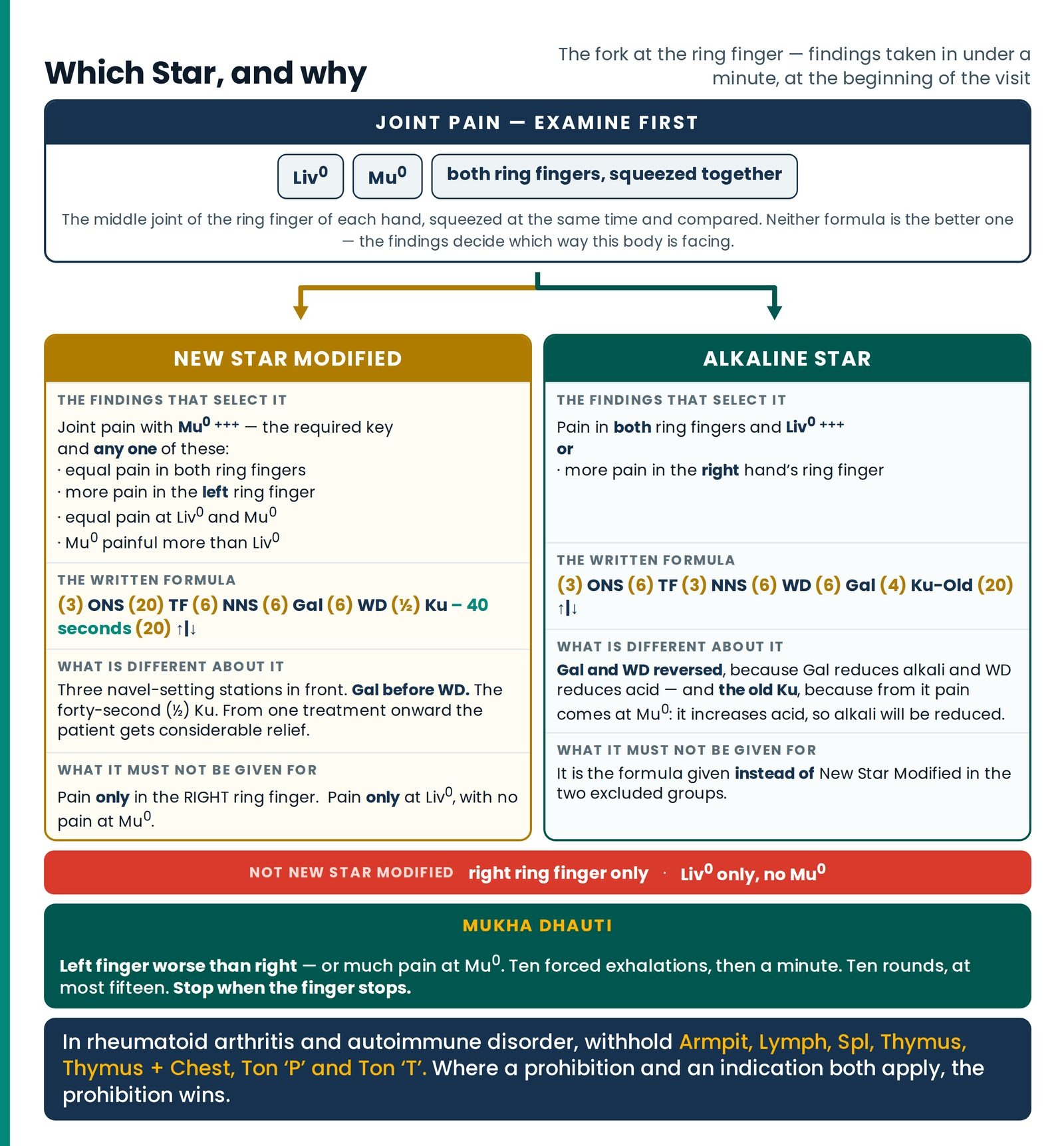
b. So: Mukha Dhauti is to be done by those who, along with joint pain, have much pain at Mu°, or at the middle joint of the ring finger of the left hand — but not as much pain in the same finger of the right hand.
That last clause is the selection rule and it is a comparison, not a threshold. Left worse than right. A patient with both fingers equally sore is not the patient this is written for; a patient whose right finger is the worse one is emphatically not, and you will see why at the head of the Alkaline Star.
And read the chain of reasoning in the first two paragraphs, because it is a good piece of clinical thinking regardless of what one makes of the chemistry. The relief does not hold. It stops holding after a few hours. The finger that comes back is the same finger every time — the left one. Therefore something is rising again on a cycle of hours, and it is rising on the acid side. A therapist who notices which thing returns, and when, has learned something a therapist who only notices it came back has not.
Table 10 — Card: Mukha Dhauti dosing for RA Seated Left
| Who it is for | Those who, along with joint pain, have much pain at Mu° or at the middle joint of the LEFT ring finger — but not as much pain in the same finger of the right hand |
|---|---|
| Position | Seated on a chair |
| The breath | Normal breath in through the nose; immediately, throw it out forcefully through the mouth |
| Set | Ten times together |
| Rest between sets | One minute — very necessary |
| Rounds | Ten rounds, at most fifteen — that is, 100 to 150 times |
| The heavier opening | Up to 150 times for the first one or two days, morning and evening, if there is very much pain in the left ring finger |
| Monitoring | Go forward while repeatedly checking the pain of the finger |
| Stopping rule | Stop as soon as the pain of the left ring finger goes |
| The reason for the rest and for the stopping rule | If too much acid goes out at once, then for some time the alkali will increase, and the body may perhaps not be able to bear it |
| What it is doing | The carbonic acid trapped inside the joints goes out of the body through the breath, as carbon dioxide — and relief is had from the pains |
| The rest in the table | Table 8, How a Formula Is Built |
When the New Star Modified formula is to be given
A two-key rule: Mu-zero at three plus, and any one of four
The indication, in two parts
The New Star Modified formula is to be given in the following conditions.
If, along with pain in the joints, there is Mu° ⁺⁺⁺ — and any one of the following:
equal pain in the ring fingers of both hands, or
more pain in the ring finger of the left hand, or
equal pain in both Liv° and Mu°, or
the pain of Mu° greater than the pain of Liv°
then it is to be given.
From one treatment onward the patient gets considerable relief.
Table 11 — Indications for the New Star Modified formula
| The required finding | Plus any one of these |
|---|---|
| Joint pain with Mu° ⁺⁺⁺ | Equal pain in both ring fingers |
| More pain in the left ring finger Left | |
| Equal pain at Liv° and Mu° | |
| Mu° pain greater than Liv° pain |
That is a two-key rule, and it is the same shape as the two-key rule you used for Kidney Clear: a required finding, and at least one qualifier. Neither key alone opens the door.
Read the four qualifiers together and something obvious appears: three of the four point the same way. More pain at Mu°. Left ring finger. Mu° greater than Liv°. In this therapy's scheme those all say acid — and the fourth, equal pain in both fingers, says acid at least as much as alkali. The New Star Modified is the Star for the patient the therapy reads as acidotic. Hold that sentence, because the next formula is its mirror.
The uses of the New Star Modified formula
Seven conditions offered, and two vitamin points still being watched
To cure joint pains — which is often found in RA patients. Besides this it is also beneficial in the following.
Table 12 — The conditions this formula is offered for
| psoriasis (सोरियासिस) | knee pain (घुटने का दर्द) |
|---|---|
| low back pain (कमर दर्द) | osteo-arthritis (ओस्टीयो आर्थ्राइटिस) |
| cervical spondylitis (सरवाइकल स्पौन्डीलाइटिस) | |
| Chorea (कोरिया) — benefit has been given in this also | |
| gout (गाउट) — in which, because of raised uric acid, swelling and pain come in the joints of the fingers |
Note well — the genes, and what is still being looked into
For curing genetic disorders — that is, diseases which have come from the spoiling of the genes — we stimulate the points of Vitamin B₁₂ and folic acid.
In many patients it has been seen that after giving the New Star modified formula, the pain of BOTH the Vitamin B₁₂ and the folic acid points goes away. Therefore this formula can also be used for diseases arising from the spoiling of the genes.
Guruji's research on this is continuing.
That last line is not a formality and it is not to be smoothed away. It is the therapy telling you exactly how far the claim has been carried: an observation repeated in many patients, an inference drawn from it, and the work still running. Give the formula where the findings call for it, watch the two vitamin points, and write down what you see.
What may not be given to a body whose defences have turned round
Seven points withheld, and the rule that the prohibition wins
Rheumatoid arthritis is not a wearing-out. It is a condition in which the body's own defences have turned round and begun taking its joints apart — and that fact governs a whole column of the atlas.
Two further things belong beside that list, and both are commonly needed in exactly this patient.
If the joint patient also has thin bones, remember the rule that governs them: (4) Para is not given separately by itself in osteoporosis — the 1,25 DCC formula is given as the mandatory whole. The bar is on the point given alone, not on the point.
And during an acute flare — a joint hot, swollen and exquisitely tender — do not work the joint itself. Work around it, give the formula, give the breathing if it is indicated, and come back to the joint when the heat has gone.
The discovery that made a fourth generation necessary
Gal reduces alkali, WD reduces acid — so the order decides the lean
In the clinic some new discovery or another goes on every day. So, watching the pains of patients, it was found that some people feel good when WD is given after Gal, while some other people get relief when Gal is given after WD.
Then the reason was found.
What Gal and WD each do to the body's direction
It was found that Gal reduces alkali, whereas WD reduces acid.
This means that in some people the pain came because of a rise in acid, while in others the pain came from a rise in alkali.
That is the whole key to this section, and it is the same logic you have met before in the Ch. Only / Round Arrow pair: a therapy of counterweights, where each element is described by what it reduces, and where the one you put second is the one whose direction you leave the patient in.
So a formula whose Gal comes before its WD leaves the patient leaning one way, and a formula whose WD comes before its Gal leaves him leaning the other. Two identical sets of hands, two opposite results, and nothing between them but the order. That is rule five of sequence doing its work in public.
When the New Star Modified is not to be given at all
Two exclusions, both describing one body from two directions
The Alkaline Star Formula
Gal and WD changed places, and the old Ku brought back on purpose
If there is pain in both ring fingers and Liv° is ⁺⁺⁺, or if there is more pain in the finger of the right hand — then for them a new formula was made, in which the order of Gal and WD was reversed. And in this treatment the old Ku is to be given.
Table 13 — Card: the Alkaline Star Formula Supine Seated Prone 6 sec
| Written | (3) ONS (6) TF (3) NNS (6) WD (6) Gal (4) Ku-Old (20) ↑\ | ↓ |
|---|---|---|
| Who it is for | Joint pain with pain in both ring fingers and Liv° ⁺⁺⁺, or more pain in the ring finger of the RIGHT hand Right | |
| Who it is not for | It is the formula given instead of New Star Modified in the two excluded groups above | |
| Step 1 — (3) ONS | Supine; both big toes gripped, feet raised to the height of the therapist's own standing hands, six seconds, lowered slowly. Three times Supine 6 sec × 3 | |
| Step 2 — (6) TF | Seated at the patient's feet; every joint of every toe, three sides, six times at each place, counted — never hard enough to make a wound. Left big toe → little toe, then the right foot Seated Left Right | |
| Step 3 — (3) NNS | Each toe bent downward toward the sole, held six seconds, three times on each toe; left big toe first 6 sec | |
| Step 4 — (6) WD | Head end; both forearms at once, three stations elbow to wrist, six seconds each, six rounds. Moved ahead of Gal — the acid-reducing member of the pair Supine Both sides 6 sec | |
| Step 5 — (6) Gal | Right sole on the left thigh, three or four stations hip crease to above the knee, six seconds each, six passes. Moved after WD — the alkali-reducing member Supine Left 6 sec | |
| Step 6 — (4) Ku-Old | The old Kundali. Prone, one and a half pillows under the chest, heels turned to face each other; mid-sole on the last end of the spine. Two equal one — so (4) Ku is eight presses of six seconds, without stopping Prone 6 sec | |
| Why the old Ku here | From the old Ku, pain comes at Mu° — which means that it increases acid; that is, alkali will be reduced | |
| Step 7 — (20) ↑\ | ↓ | Round Arrow, prone — and it follows Ku for the reason given at the start of this article Prone |
| What must not be given | The Ku bars — not in menstruation, not in low blood pressure ▲ Take care |
Four things are different from the New Star Modified, and it is worth naming all four rather than remembering the line whole: TF drops from twenty to six · NNS drops from six to three · WD and Gal change places · and the forty-second (½) Ku is replaced by the old Kundali at (4). The three navel-setting stations are all still there, in the same order, at different counts. (Figure 36.6)
And notice the honesty of step 6's reasoning. The old Ku was known to produce pain at Mu° in some people — which is why the Round Arrow was put behind it in the very first formula of this article. Here that same side-effect is the reason for choosing it. The thing that was a problem in a patient leaning towards acid is the tool in a patient leaning towards alkali. Nothing about the point changed. The patient changed.
July 2006 — the Star formulas are broken apart and rebuilt
One push, a reading on a finger, the push back, and the re-centring
However good a treatment may be, it is not the case that everyone will get the same benefit from it. So even after this, some new treatment was bound to be made — this is exactly the speciality of this therapy, that new discoveries go on being made.
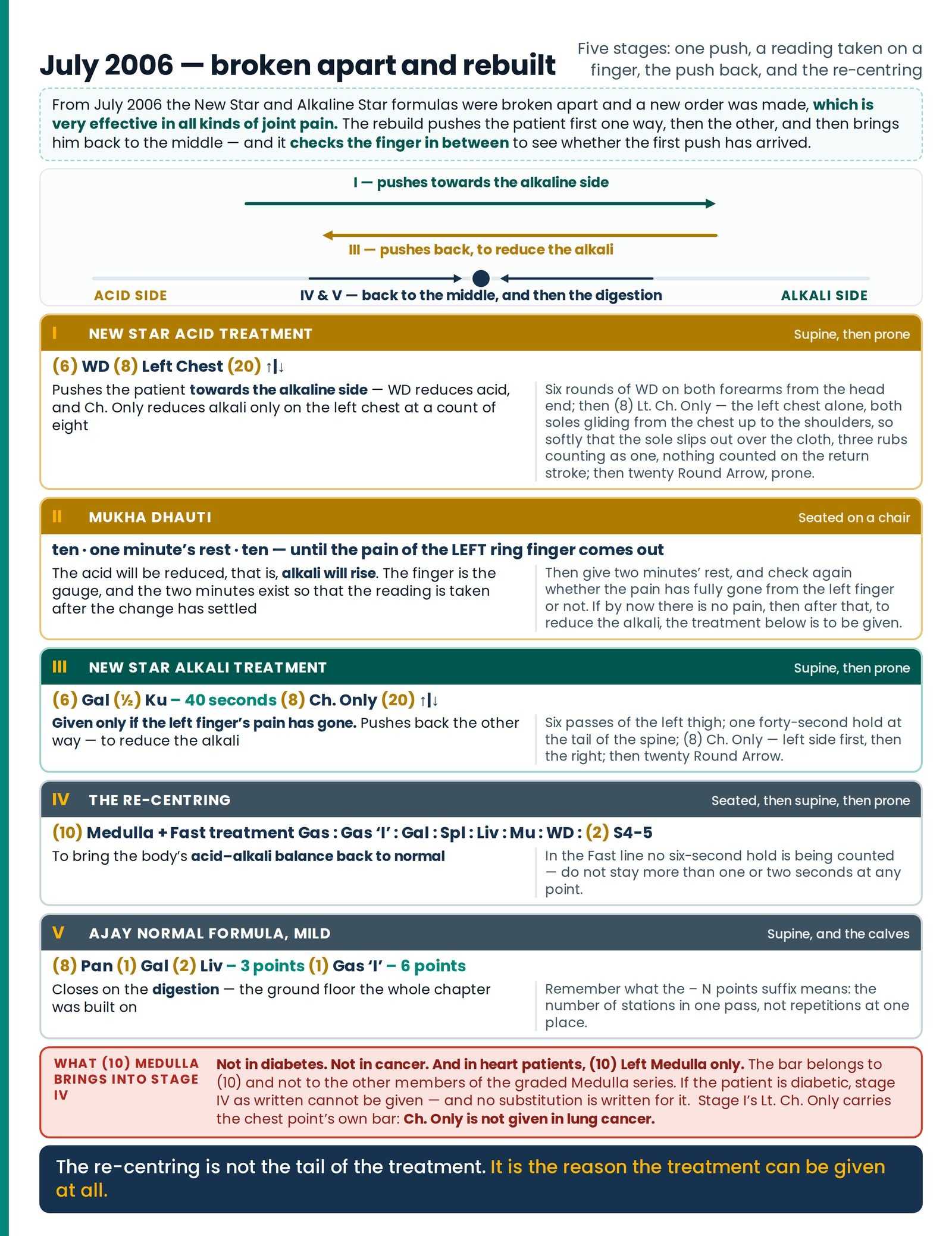
From July 2006, the New Star and Alkaline Star formulas above were broken apart and a new order was made, which is very effective in all kinds of joint pain.
Look at what the rebuild actually does before you learn its steps, because then it learns itself. The two earlier formulas each pushed a patient in one direction and left him there. The rebuild pushes him first one way, then the other, and then brings him back to the middle — and it checks the finger in between to see whether the first push has arrived. (Figure 36.7)
Table 14 — Card: the July 2006 rebuild, stage by stage
| Stage | Written | What the stage is doing | Position | |
|---|---|---|---|---|
| I — New Star Acid treatment | (6) WD (8) Left Chest (20) ↑\ | ↓ | Pushes the patient towards the alkaline side — WD reduces acid, and Ch. Only reduces alkali only on the left chest at a count of eight | Supine, then prone Supine Prone |
| II — Mukha Dhauti | ten, one minute's rest, ten — until the pain of the LEFT ring finger comes out; then two minutes' rest and re-check the finger | The acid will be reduced, that is, alkali will rise. The finger is the gauge, and the two minutes exist so that the reading is taken after the change has settled | Seated on a chair Seated Left | |
| III — New Star alkali treatment | (6) Gal (½) Ku – 40 seconds (8) Ch. Only (20) ↑\ | ↓ | Given only if the left finger's pain has gone. Pushes back the other way — to reduce the alkali | Supine, then prone Supine Prone |
| IV — the re-centring | (10) Medulla + Fast Gas : Gas 'I' : Gal : Spl : Liv : Mu : WD : (2) S4-5 | To bring the body's acid–alkali balance back to normal | Seated, then supine, then prone Seated | |
| V — Ajay Normal, mild | (8) Pan (1) Gal (2) Liv – 3 points (1) Gas 'I' – 6 points | Closes on the digestion — the ground floor the whole article was built on | Supine, and the calves Supine 6 sec |
Notice, finally, what stage II implies about stage I. A protocol that deliberately pushes a patient one way, measures the result on a finger, pushes back the other way, and then spends two whole stages re-centring is a protocol that takes its own effects seriously. The re-centring is not the tail of the treatment. It is the reason the treatment can be given at all.
The page turns here, and the material turns with it to a formula for severe constipation built in the same way — every aspect of a problem studied, and the organs then stimulated in that very order which sets right the body's own way of working. That is LSTF, the Left Side Treatment Formula, and it is taught whole in Water and Salt, "Water and Salt".
Questions students ask
1. I am twenty-two and studying science at college. The Star formula came from astrology. How am I supposed to teach that to anybody? Teach it exactly as it stands, and separate two questions that students collapse into one. Where an idea came from and whether the thing works are different questions, answered by different evidence. Plenty of useful medicine began in bad theory and good luck. What you are given here is not believe in the planets; it is a formula of four points with a stated purpose for each point, and forty years of people getting off a mat. Tell a patient what you are doing and why each step is there. If someone asks where the idea came from, tell them the truth — it is a more interesting story than a tidied one.
2. I have no science at all. What does it mean to say a joint has acid in it? Think of a small room where people are working. Working makes warm, stale air. If the window is open, the staleness leaves as fast as it is made and nobody notices. If the window is half shut — and a joint with a poor blood supply is a room with a half-shut window — the staleness builds up, and the people in the room get headaches. The treatment opens the window. The minute afterwards is the time the stale air needs to actually get out of the building.
3. Why is the rest exactly one minute and not two? Because it was counted, not chosen. Sixteen breaths are needed for more than about ninety per cent of the carbon dioxide to leave, and an ordinary person takes one minute to take sixteen breaths. That is where the minute comes from. Give less and the clearing is incomplete; that is the reason written down, and it is a better reason than most rests in most therapies have.
4. I am a physician. You are asking me to write "RA hai" on a card for a patient whose rheumatoid factor is negative. Why should I? Two answers. First, the material is careful in a way you will recognise: it explicitly forbids writing RA positive in that patient, precisely because that would be a claim about a laboratory result. Second — and you will know this better than the rest of the class — a negative rheumatoid factor does not exclude the disease. A substantial minority of people with genuine rheumatoid arthritis are seronegative, and the classification rests on the pattern of joints, the symmetry, the duration and the inflammatory markers together. So a symmetrical small-joint picture with a negative test is exactly the patient who should be seen again and worked up properly. Read the phrase as what it functionally is: this needs a rheumatologist's opinion. I would write the finding out in full and let the label go.
5. I run a village centre. I have no laboratory at all. Can I use this article? More than most articles, yes. The whole diagnostic apparatus here is two fingers, two kidney points and a question about the morning — no equipment, no electricity, no report. That is the therapy's own claim about its diagnostic method: that those who have learned it, even if they are little educated, are obtaining success with it. What you must have instead of a laboratory is the habit of sending people onward. Find both ring fingers sore, and make sure that person sees a doctor, even if it means a bus.
6. My patient's joints hurt but only the right ring finger. I gave the New Star Modified anyway because it is the formula for joint pain. Nothing happened. Why? Because it is not the formula for joint pain; it is the formula for one direction of joint pain, and you gave it to a patient facing the other way. Pain only in the right ring finger is one of the two written exclusions, and pain only at Liv° with none at Mu° is the other. That patient wants the Alkaline Star, with WD before Gal and the old Ku in place of the forty-second hold. Nothing happened is the kind outcome; going backwards is the other one.
7. A housewife asking for my mother: she has joint pain and her periods are due this week. Can I still give the formula? Not as written, because Ku is not given to women during menstruation, and every formula in this article contains Ku in one form or the other. The bar belongs to the point and travels into every formula holding it. Do the parts you may do, keep the week for the digestive and circulation work that suits her, and give the Star when the period has finished. The same applies to low blood pressure, which is the point's other bar.
8. How long before a patient believes this is working? On the stated experience, sooner than you expect in the hands and much later than they hope in the feet. Within two or three days the pain goes out completely from the fingers and the wrist. Then elbows, shoulders, waist, thighs, heels — and last of all the feet, upper toes before soles. Show them that order on the first day. The patients who stop coming are almost always the ones who were not told that slow feet were expected.
9. I am sixty-six and learning this for my husband. I cannot stand between two chairs. Can I still do the ghisai? That is the part of this article most suited to you. The All-joints ghisai is done with your own palms, seated beside him, and the instruction is very, very light — so hand strength is not what it asks for. What it asks for is patience with the minute. The Mukha Dhauti you do not do at all; you sit with him and count while he does it, and you stop him when his finger stops hurting.
10. What do I do if I cannot give stage IV of the rebuild because my patient is diabetic? You do not give it, and you do not invent a substitute. (10) Medulla is not given in diabetes, nor in cancer; and in heart patients only (10) Left Medulla. No substitution is written for stage IV, and this wiki does not manufacture one. What that leaves you with is a question for whoever supervises your practice and a card that is not written until it is answered. Meanwhile the New Star Modified or the Alkaline Star, chosen on the findings, stand on their own.
11. My patient feels wonderful for two hours after each session and then it all comes back. Have I failed? No — you have been handed the finding this article was partly built on. Ask which part comes back, and when. If it is the left ring finger, within a few hours, that is the picture for which Mukha Dhauti exists, and the reasoning is that every few hours the acid is rising again. Add it, teach it to the household, and check the finger as you go.
12. Does it matter that I do the ghisai from the fingers upward and not from the shoulder down? Yes, and for the same reason that everything else in this article has an order: the instruction is from the fingers up to the shoulder. You have no results for the other direction because nobody has counted any. Where a direction is written, it is part of the treatment and not a matter of convenience — and in a article whose central table is about pain leaving the body in a fixed order, working against that order is a strange thing to do on purpose.
Questions patients ask
1. "My blood test says I do not have arthritis. So why are you squeezing my fingers?" Because the test and the finger answer different questions. That test looks for one particular thing in the blood, and it can be negative in people who do have this trouble and positive in people who have something else entirely — a liver problem, an old infection. What I am feeling for is how the joints themselves are behaving, in both hands, at the same moment. If both your ring fingers are sore in the same place, that is worth knowing, and it is worth a doctor's opinion even with your report in your hand. I am not contradicting your test. I am adding something to it.
2. "You have written something on my card. What does it say?" It says what I found with my hands today: that the middle joint of the ring finger is painful on both sides, more on the left, and how much. Under it I have written the date of your report and what your report said. I have not written that your blood test is positive, because it is not, and I will not put a word on your card that your laboratory did not put on your report. You may read the card any time you like; it is about you.
3. "Should I stop my medicines now that I am coming here?" No, and I will not ask you to. We use no medicine at all in this work and we do not tell anybody to stop theirs. Keep taking exactly what your doctor gave you, on the days he said. If a time comes when your complaint has gone completely, go back to him and ask: "I have no pain at all now — must I still take the same quantity?" That decision belongs to him. In this particular illness I will also ask you to keep your appointments with him even when you are feeling well here, and I will keep asking.
4. "My hands are better but my feet are exactly the same. Is it not working?" It is doing exactly what it does. The pain leaves the body in an order, and the order is the same in everybody: hands and wrists first, in the first days; then elbows, then shoulders; then the waist, the thighs, the heels — and the feet last of all, with the soles of the toes at the very end. Your hands clearing first is the sign that we are on the road, not a sign that your feet have been forgotten. Look at this chart with me, and I will show you where your own card says you are.
5. "Why do you stop and stand there doing nothing between each joint?" I am not doing nothing — I am waiting for your lungs. When I rub that joint, the sourness that has been sitting in it goes into your blood, and your blood takes it to your lungs to be breathed out. That takes about sixteen breaths, which is about a minute. If I went straight on to the next joint, I would be sending the next load into blood that had not finished carrying the last one. The minute is part of the treatment, the same as the rubbing is.
6. "The breathing makes me feel light-headed. Should I push through it?" No. Stop, sit quietly and breathe normally until it passes, and tell me. Light-headedness, or tingling in the lips or fingers, means it has gone a little too far a little too fast — which is exactly why we take the full minute between every set of ten and why we stop the moment your finger stops hurting. This is a dose, like anything else. More is not better here; more is a different treatment, and not one I want to give you.
7. "My neighbour says there is a treatment here that builds up immunity. Can I have it?" Not in your case, and it is worth understanding why. In your illness the difficulty is not that your defences are too weak — it is that they have turned round and begun troubling your own joints. So the treatments that stir the defences up are the ones we deliberately keep away from you. Your neighbour is not wrong about the treatment; it is simply not for this body. What I can give you is everything in this article, which is aimed somewhere else entirely.
Words used here
| Hindi | English | Neurotherapy code / usage | |
|---|---|---|---|
| सन्धि वात (sandhi vāta) | Joint pain; literally wind in the joints | The presenting picture this whole article addresses; a description, never a diagnosis on a card | |
| अनामिका (anāmikā) | The ring finger — the fourth finger | Its middle joint, squeezed on both hands at once, is the article's chief sign. Recorded Lt. 4ᵗʰ ⁺⁺⁺⁺ / Rt. 4ᵗʰ ⁺⁺⁺⁺ | |
| कुण्डली (kuṇḍalī) | The birth chart | The idea from which the Star name and the Star formulas came | |
| घिसाई (ghisāī) | Rubbing, abrading | All joints ghisai — very, very light, with the palms, fingers to shoulder, one minute between joints | |
| मुख धौती (mukha dhautī) | Mouth washing — here, forceful exhalation through the mouth | Ten, one minute's rest, ten — up to 10 or at most 15 rounds; stop when the left ring finger's pain goes | |
| साँस (sā̃s) | Breath | Sixteen breaths ≈ one minute — the arithmetic inside the ghisai's rest | |
| पित्त की नली (pitt kī nalī) | The bile duct | (6) Gal is given to force bile through any block at the ampulla of Vater or on the road of the common bile duct | |
| मणके (maṇke) | The beads — the vertebrae | Unevenness in their alignment is the traffic jam the Round Arrow ↑\ | ↓ is given to clear |
| गाँठ / जोड़ (gā̃ṭh / joṛ) | A knot; a joint | Every joint from the fingers to the shoulder receives the ghisai, in order | |
| नाभि सेट (nābhi seṭ) | Navel setting | ONS — Old Nabhi Set · NNS — New Nabhi Set · with TF, Toe Fingers, the three stations in front of New Star Modified | |
| — | RA factor / RA antigen | Positive also in hepatitis, syphilis, liver cirrhosis, SLE, scleroderma, and acute bacterial or viral infection | |
| — | ANA | Where this is what is positive, write that on the card | |
| — | PIP joint | The proximal inter-phalangeal joint — the middle knuckle of the finger | |
| — | "RA hai" | Written where there is joint pain and both ring fingers are painful, with no report or a negative one. RA positive is not to be written |