Watch


From The Fire and the Ash
From a tomato skin to a disease
Proteins, amino acids, and the vicious cycle that starves every gland
What can the skin of a vegetable in a pan have to do with rheumatoid arthritis? Look again at List A — the items you will read aloud to a patient a few pages from now. Some are vegetables, some leaves, some seeds. What have they in common? They are all made of proteins.
What the skins are telling you
When the skins of vegetables and the rest appear in their original form in the stools, it means the body is unable to digest proteins. In such a person protein digestion is severely compromised.
The preliminary digestion of proteins begins not in the mouth but in the stomach, under pepsin — which needs the acid. The final digestion of proteins takes place in the duodenum and the jejunum, under the enzymes of the pancreas and the intestine.
The body runs on three kinds of chemical, and each has a one-line definition worth holding. (Figure 9.1)
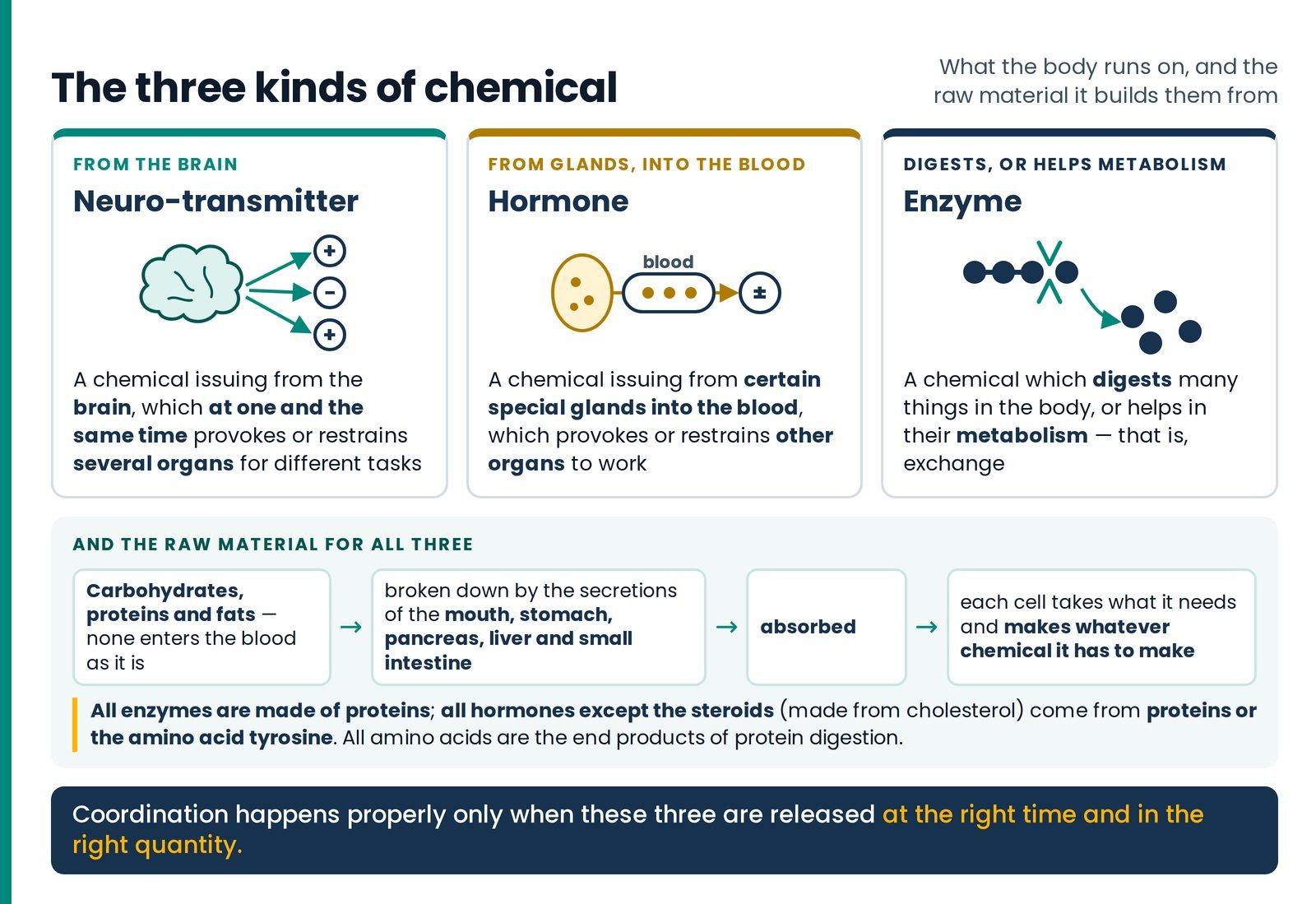
Coordination happens properly only when these three are released at the right time and in the right quantity. If one falls short the organs that keep watch make considerable effort so that no effect falls on the working of the body, and for some years they succeed — but when the quantity becomes rather too much or too little, they take the form of disease.
Such a body can be supplied two ways: from outside, as medicine, which is the way allopathy and some other systems have adopted, and in which side effects may occur because the body does not easily let foreign things inside; or by provoking the body's own glands, which is the work Neurotherapy does. And the raw material is the same in either case — carbohydrates, proteins and fats, none of which enters the blood as it is, each broken down by the secretions of the mouth, stomach, pancreas, liver and small intestine and then absorbed, so that each cell may take what it needs and make whatever chemical it has to make.
Why protein digestion decides everything else
Reason one — the chemistry of hormones and enzymes. All enzymes are made of proteins, which are made of amino acids; and except for the steroid hormones, all other hormones are derived either from proteins or from the amino acid tyrosine. All amino acids, tyrosine included, are the end products of protein digestion.
So if certain proteins are not digested, the body soon has a deficiency of those amino acids; if a number go undigested, a number of amino acids run short. In the absence of the raw materials, the production of hormones and enzymes is hampered. The glands cannot function properly. Disease follows.
The steroid hormones are the exception, made from cholesterol — which the liver makes when fats are digested, and from which the liver then makes bile, which in turn helps digest fats.
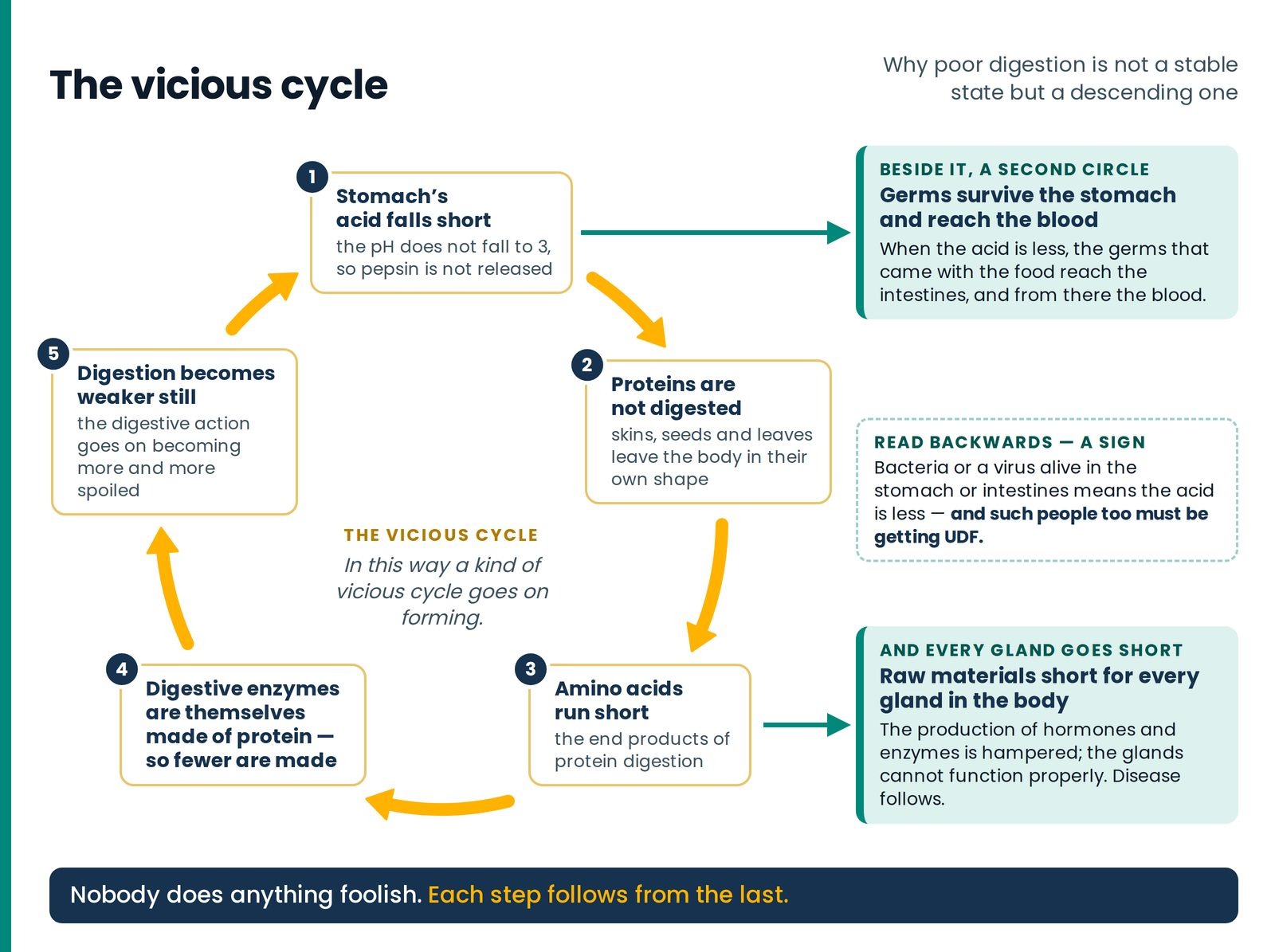
Reason two — and this is the trap. The digestive enzymes and hormones are themselves made of proteins only. A lack of certain amino acids will in time affect their production — which again causes poor digestion of proteins. This is the vicious circle.
The vicious cycle, stated whole
The chemicals of the digestive system itself are also made from proteins.
If some proteins do not digest properly, then in the end the digestive enzymes too will not be made properly, from which the digestive action goes on becoming more and more spoiled. In this way a kind of vicious cycle goes on forming. (Figure 9.2)
Beside it runs a second circle. If the stomach's acid is weak, any germ that comes in with the food can easily get inside the blood — because in fierce acid bacteria and viruses cannot remain alive; when the acid is less, the germs that came with the food reach the intestines, and from there the blood.
Read backwards, that is a diagnostic sign: if bacteria or a virus remains alive in someone's stomach or intestines, understand that his stomach's acid is less, or is not being made — and such people too must be getting UDF.
Reason three — the energy account
Say we have money in a bank. Add some daily and withdraw a portion for use, and the situation is healthy; withdraw without adding and it is an overdraft, which the manager may permit occasionally — but if he permits it for long periods, the bank will have to close down.
So with the body. We get energy from food, and when only a part of it is spent on the day's activities we feel energetic and lively. To get energy from food, the key factor is proper digestion and assimilation. But the amount of energy required to process food through the alimentary canal depends on the type of food eaten, and processed food requires far greater energy for digestion than raw food; and if the person is always under stress and tension, his digestive system never gets a chance to work properly, which itself contributes to the state of UDF.
In the absence of proper digestion, the energy obtained from food becomes progressively less and less than the energy required to digest it, so the person starts feeling lethargic and tired, especially after eating.
The best remedy in such cases is fasting. If hungry, such a person may eat raw food, along with a bare minimum of easily digestible carbohydrates. Instead, most people eat as before, straining the body's meagre energy resources further — and this lays the foundation for disease.
The liver's reserve, and why it runs out
Even where there is a shortage of some proteins in the food, the liver of a healthy person makes several amino acids — the non-essential amino acids, because it is not essential to obtain them from food. The liver goes on making them according to need, at the right time and in the right quantity.
It is only because of this wonderful capacity of the body that we do not fall ill at once even when the digestive system is out of order, and are able to get free quickly from small ailments.
But when, through wrong habits and wrong eating and drinking, illnesses come again and again, this capacity keeps on diminishing — and the body begins to become the victim of great diseases. When the liver does not function properly, this capacity is reduced, and then the body enters the diseased state.
Also explained in
- The formula that came out of what is inside bile — New Gal Setting the Stomach
Then it was seen that those who had any problem whatever in the skin had pain in Gal — and many of them also had constipation.
- Where the bath meets the meal Between Two Sessions
At that time the blood circulation remains more towards the skin and not towards the other organs.
- What is given to a small child at the mat The Child, the Elder and the Frail
Everything else about TF is unchanged: at every joint of the toes, as many times as the number written, counting as you go, rubbing the three sides so that the nerves under the skin are roused, but not so hard that a wou
- The two variants, each with its own condition The River — Heparin
Within two months the feet become completely well; even established gangrene is finished and the occasion of cutting off the foot is averted Variant — the wound that will not fill If blood is flowing from the wound and i
- Two bodies, read as this article teaches The Body's Own Pharmacy
Puffy about the face; the skin of the shins dry and scaly; the right shoulder carried visibly lower than the left since her college years, when the shoulder bag started.
- Brodmann's Area 17 & 18 Ghisai Seated II — Face, Jaw, Ear, Sinus
ub — ghisai — the back part of the head in such a way that the muscles under the skin relax, but no pulling comes in the hair.
- What this article hands to the next Seated II — Face, Jaw, Ear, Sinus
Both palms cap the head; both thumbs on the scalp behind the forehead, just inside the hairline; the other fingers meet at the centre of the brow, between and slightly above the eyebrows, flat pads on the skin, shown mid
- Lighter formulas exist, and they are named The Child, the Elder and the Frail
The fluid in which the child stays inside the mother's belly is antiseptic — that is, germ-killing — which Hari has made so that it will protect the child's skin from external germs.
- Ear Points — कान के पॉइंट Seated II — Face, Jaw, Ear, Sinus
Then with the soft part of your thumb, stroke the soft skin behind their ear 6 times, from above downward.
- Feather Touch — the lightest treatment there is Cranial Nerve and Brain Formulas
This is the reason that when we touch some place very softly, on the back part of the body or on the skin with powder applied, with the tip of the finger, then all the hairs of the body stand up.
- Satnam — सतनाम Seated II — Face, Jaw, Ear, Sinus
With your palms, cover their head so that both thumbs are behind the forehead and the remaining fingers are near the start of the nose — the Ājñā chakra … … Taking support with the thumbs, use your fingers to press the
- What travels with each direction The Two Kingdoms
Symptoms appear on the intestine, nose, hair, skin and the other organs of excretion: hard constipation and the diseases connected with it — piles, bavāsīr; fissure, a splitting around the anus; fistula, bhagandar · bloc
- Bell's Palsy / Facial Point Seated II — Face, Jaw, Ear, Sinus
Placing both thumbs one behind the other, and without scratching the skin, press the tissue underneath inward and go on drawing it along, leaving no place empty.
- Sinus Point — साइनस पॉइंट Seated II — Face, Jaw, Ear, Sinus
First, with your thumbs, press the skin of the sinus cavity and draw it from the nose towards the ears.