- Part of
- Lungs and breathing
Watch

Lu + Sh — Lungs + Shoulder
Read this as "Lungs plus Shoulder". This is for rousing the lungs, and is useful for breathing-related problems.
First, with the flats of your palms, give very light pressure on both sides at the collar bone — that is, the place below the shoulder bone. This is for rousing the lungs.
Ordinarily no pillow is needed in this treatment; but if the therapist's foot does not reach the ground, a thin pillow may be placed under the patient's forehead, so that pressure does not fall on the shoulder bone.
Then, with the middle part of the palm or the sole, press a little firmly above the shoulder joint and release at once — so that the shoulder is pulled outward. This is for opening the muscles of the chest.
These two points together make (1) Lu + Sh. Ordinarily (6) Lu + Sh is given. So repeat these two alternately, as many times as the number written.
| Patient's position | Supine; ordinarily no pillow, but a thin pillow under the forehead if the therapist's foot does not reach the ground Supine |
|---|---|
| Where the hands are placed | 1: flats of both palms at the collar bone, below the shoulder bone — very light pressure. 2: middle part of the palm or the sole above the shoulder joint, pressed a little firmly and released at once, so that the shoulder is pulled outward Both sides |
| Duration and repetitions | The two together = (1) Lu + Sh; repeated alternately, as many times as written. Ordinarily (6) Lu + Sh × 3 |
| What it is for | Rousing the lungs; breathing-related problems; opening the muscles of the chest |
Why station one is very light. In the narrow gap between the collar bone and the first rib run the great vessels and nerve trunks on their way to the arm, and the top of the lung rises above the inner third of the collar bone. Flat palm only — and stop instantly for tingling or numbness in the arm.
From The River — Heparin
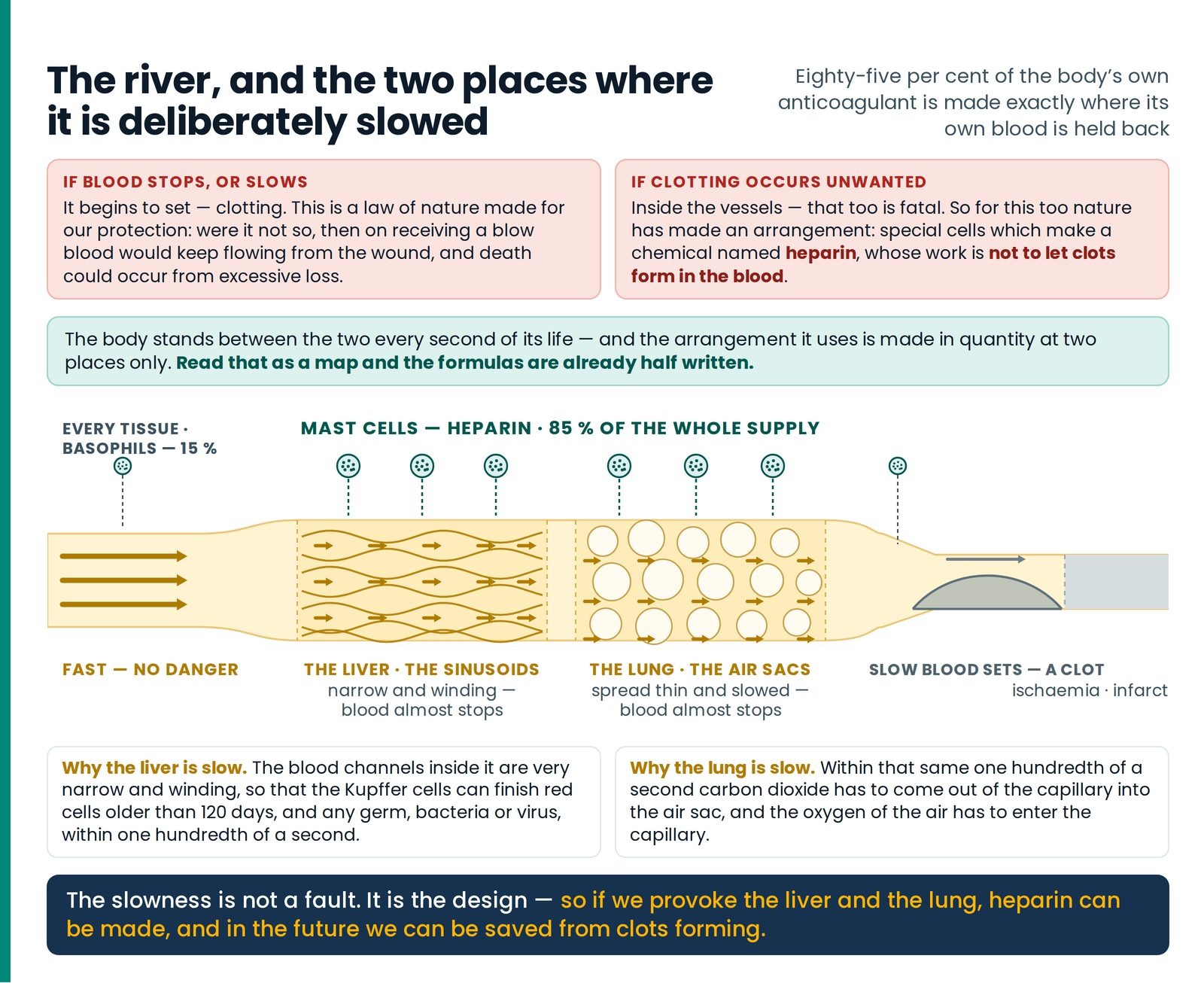
Why is heparin made in such large quantity in the lungs and the liver?
Because those are the two places the body slows its own blood
This is the question on which the whole family turns, and the answer, once you have it, makes the formulas obvious.
Because these are the two places where blood is deliberately slowed
This is because these two places, or organs, are such that the flow of blood there — even if only for a very short time — is of extremely slow speed.
The liver. In the liver there are cells named Kupffer cells, whose work is that if there are red cells older than 120 days, or in the blood any germ, bacteria or virus, then to finish or destroy them within one hundredth of a second. (The remaining material obtained from the destroyed cells is stored in the liver and used again according to need.)
To do this work properly, the blood channels inside the liver — the sinusoids — are very narrow and winding, and the blood has to pass through inside them. During this the motion or speed of blood becomes so slow that there is a danger of the blood setting there. And so that clotting should not happen there, in that part of the liver the mast cells make heparin.
The lungs. The second place is the alveoli — the air sacs. In these also, within one hundredth of a second, carbon dioxide has to come out from inside the capillary and enter into the alveoli, and during that same time the oxygen of the air inside the lungs has to enter into the capillary. At this place too the speed of blood is so slow that there also there is a danger of clotting. To be saved from that, the mast cells around the alveoli make heparin.
The meaning of this is that if we provoke the liver and the lung, then heparin can be made, and in the future we can be saved from clots forming.
Read that twice. It is one of the most satisfying pieces of reasoning in the whole formulary, and it runs in a straight line from an observation to a treatment. (Figure 33.1)
Here is the picture to keep. A river runs fast and clean between its banks — and then it reaches a stretch where the channel splits into a hundred narrow, twisting side-creeks so that every drop can be inspected and every bit of rubbish pulled out. That inspection is the liver's work, and it is only possible because the water has been slowed almost to a stop. The slowness is not a fault in the design. The slowness is the design. But water that slow will silt up — so at exactly that stretch, and nowhere else along the river, something must be added to the water to stop it silting. That is the mast cell, and that is heparin.
The lungs are the same bargain struck for a different reason. A red cell has to give up its carbon dioxide and take on oxygen in a hundredth of a second, and a cell travelling fast cannot do it. So the blood is spread thin and slowed to a crawl across the air sacs — and there too, something has to be added to stop it setting.
Two places where the body deliberately slows its own blood. Two places where it therefore has to make its own anticoagulant. Two places a pair of hands can reach. The parent formula in this article is those two organs, and one more.
From Water and Salt
Liver, kidney and lung — how the formula was built
Four questions, four answers, and a formula: (7) Liv (7) Mu° (6) Lu+Sh
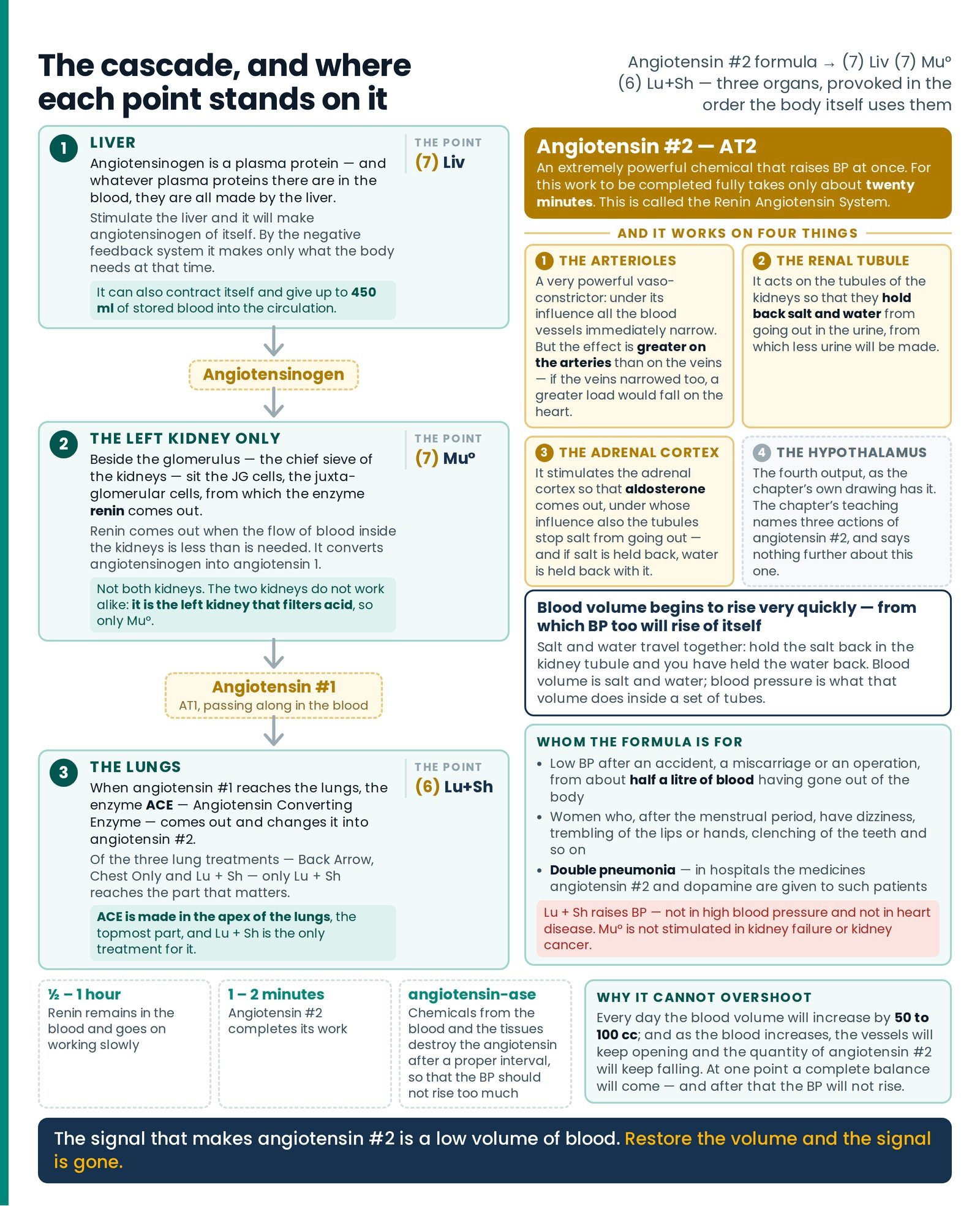
If we somehow make angiotensin #2 in the body, the BP will become normal. First we have to make angiotensinogen. Then the kidney and lungs will change it. So how is all this to be done?
Here comes the originality, and it is worth following one bullet at a time, because each answers a question a good student would have raised.
Four questions, four answers, and a formula
Where does angiotensinogen come from? It is written that angiotensinogen is a plasma protein. And whatever plasma proteins there are in the blood, they are all made by the liver. That is: if any plasma protein at all is to be made, we have only to stimulate the liver. It will make angiotensinogen of itself! And after that, the kidney and the lungs have to be stimulated. If we succeed in stimulating these three properly and in order, then we can solve this problem. Not only that — the lungs and the liver have one further quality, that some blood remains stored within them, which both of them can bring into the circulation when there is need. The liver can contract itself and give up to 450 ml of blood to the circulation.
But the liver makes a great many things — when we stimulate it, will it not make all of them? Answer — No, it is not so. In our body there is a negative feedback system, by which every organ of the body comes to know which thing or chemical the body needs at that time, and which it does not. So when we stimulate the liver, it will make only those things which the body needs at that time — among which one will be angiotensinogen. It will not make those things which are already present in the body in sufficient quantity.
Are we to stimulate both kidneys? Answer — No. We are not to stimulate both kidneys. Note that acidosis occurs because of a rise of acid in the body. And in this therapy it has been found that the two kidneys do not work alike. It is the left kidney that filters acid. That is, acidosis diseases come only when the left kidney is not working properly. So we have to stimulate only the left kidney, that is Mu°.
And which lung treatment? For stimulating the lungs there are three treatments — \°/, that is Back Arrow, Chest Only, and Lu + Sh. Which of the three? Answer — ACE is made in the apex of the lungs — that is, the topmost part — and to stimulate this part we have only one treatment: it is Lu + Sh.
Read the second of those four again, because it disposes of the objection most often raised against this whole therapy. The worry is: if you stimulate an organ, will you not get everything that organ makes, wanted or not? The answer offered is the negative feedback system — the body's own arrangement for knowing what it is short of. On that account a stimulation is not an order to manufacture; it is an invitation to a factory that already knows its own order book.
An everyday version: you do not tell the kitchen what to cook. You tell the kitchen the family is home. What comes out is what the family was short of.
Table 11 — Card: the Angiotensin No. 2 formula Supine 6 sec Left Both sides ▲ Take care
| Written | Angiotensin #2 formula → (7) Liv (7) Mu° (6) Lu+Sh |
|---|---|
| What it is for | To raise a suddenly-fallen blood pressure at once and bring it to normal, in the patient from whose body about half a litre of blood or more has gone out |
| Position | Supine throughout Supine |
| Step 1 — (7) Liv | Supine; the therapist's right sole on the patient's left arm above the elbow and the left sole on the left thigh, together — the Liv – 3 points pass given twice and then once more at the middle station, six applications and then a seventh. To make the liver produce angiotensinogen, and to bring as much as 450 ml of stored blood into the circulation 6 sec |
| Step 2 — (7) Mu° | Supine; the left kidney code, single station, hand contact high at the shoulder Left . To provoke the left kidney, so that by renin it makes angiotensin #1. Only the left — it is the left kidney that filters acid |
| Step 3 — (6) Lu+Sh | Supine, from the head end. Station 1: the flats of both palms, very light pressure, on both sides at the collar bone, the place below the shoulder bone — this is for rousing the lungs. Station 2: with the middle part of the palm or the sole, press a little firmly above the shoulder joint and release at once, so that the shoulder is pulled outward — this is for opening the muscles of the chest. These two together make (1) Lu + Sh; repeat them alternately six times. Ordinarily no pillow is needed; if the therapist's foot does not reach the ground, a thin pillow may be placed under the patient's forehead, so that pressure does not fall on the shoulder bone Both sides |
| Why the lung, and why this lung treatment | To provoke the lungs to make ACE, which will convert AT1 into AT2. ACE is made in the apex of the lungs, and Lu + Sh is the only treatment that reaches that part |
| What it inherits | Liv — not in liver cancer. Mu° — do not stimulate it in kidney failure or kidney cancer; those who have pain only at Liv° — do not give it to them. Lu + Sh — this raises BP, so do not give in high blood pressure and in heart disease ▲ Take care |
| Points taught in | Liv and Mu° — The Front of the Body I, "The Front of the Body — I"; Lu + Sh — The Front of the Body II, "The Front of the Body — II"; indications and bars — Each Point in Use |
Table 12 — The three points read against the cascade
| Step | Point | Organ | The step of the cascade it is aimed at |
|---|---|---|---|
| 1 | (7) Liv | Liver | Angiotensinogen — and 450 ml of stored blood into the circulation |
| 2 | (7) Mu° | Left kidney | Renin, which makes angiotensin #1 |
| 3 | (6) Lu+Sh | Lungs | ACE, which converts AT1 into AT2 |
It was seen that immediately after this treatment the shivering of those women stopped and the blood pressure began to rise. Since the formula is based on the facts of the physiology of angiotensin #2 production, its name was fixed as the Angiotensin #2 formula. (Figure 35.4)
Also explained in
- The note that belongs here: (6) Right Swt for bronchial asthma Fire and Swelling
And from infection in the lungs, eosinophils increase.
- The chest and the breath Each Point in Use
oth wings of the lungs, one side at a time, and one bar over all Table 8 — CH.
- The organs of digestion — the key to health The Body's Own Pharmacy
In the liver and the lungs a substance called heparin is continually made, whose business is to prevent lumps and clots forming in the circulation.
- Where this leads The River — Heparin
About 85 per cent is made by mast cells of the liver and the lungs; the remaining 15 per cent by every tissue — the pericapillary connective tissues — and by basophil leukocytes.
- At a glance Water and Salt
Station 1: the flats of both palms in the hollow just below the collar bones, on both sides, with very light pressure — this is for rousing the lungs, and it is the part of the lung where ACE is made.
- Why it works — the secret of it The Stiffening Joint
So: if in some way we increase the blood circulation in that joint, then the carbonic acid accumulated there will change into the form of carbon dioxide and water, will dissolve into the blood, and will go through the bl
- BACK ARROW — बेक एरो Face Down
Its other name is Blood supply to lungs, because it increases blood circulation in the lungs.
- In what manner is this fact used in Neurotherapy? The River — Heparin
Since heparin is being made in larger quantity in the liver and lungs, then by provoking those two organs heparin will be made.
- Why a chemical made by a pair of hands might reach the brain when an injection cannot The River — Heparin
So blood leaves the kidney carrying an unfinished message, travels to the heart, is pumped through the lungs — and comes out the other side with the message activated.
- The Oxygen formula Water and Salt
Only Supine To clean the lungs 2 (6) ←→ — Stretch Opens the muscles of the neck so that one can breathe well 3 (6) \°/ — Back Arrow Prone To increase the supply of blood to the lungs 4 (3) ↑o↑ — H Arrow Prone So that
- Why blood must keep moving The River — Heparin
Of the heparin made in the body: About 85 per cent is made in cells named mast cells, of the liver and the lungs.
- Why there are two orders, and not one Cranial Nerve and Brain Formulas
Table 22 — What drains where Into the left subclavian vein — the thoracic duct Into the right subclavian vein — the right lymphatic duct The lymphs of the left brain The lymphs of the right brain The lymphs of the left c
- The rests How a Formula Is Built
And it takes roughly sixteen breaths for more than about ninety per cent of the carbon dioxide freed into the blood to be carried to the lungs and blown out.
- The treatment given to a patient in coma Correcting the Two Kingdoms
The red cells have two parts — one is haemoglobin, which picks up oxygen from the lungs and releases that oxygen at another place in the body; and the second is a liquid substance in which there is carbonic anhydrase, wh