- Category
- Brain, nerves and mind · Eyes, ears, nose, mouth and throat
- What is given
- Ton 'T'; (12) Armpits; (6) Adr for throat pain due to tonsils; (9) Medulla for the nerves of the tonsils; Sangam points
- What must come first
- Ton 'T' is followed immediately by Sangam points
- What is barred
- Ton 'T' — not in diabetes, RA, autoimmune disorder or inflammation; not in pregnancy; and not to young people up to the age of bearing children, especially women. (6) Adr where immunity is low, or in high BP
- Explained in
- Uncommon Problems
Watch

The throat, and the treatments given with the hands
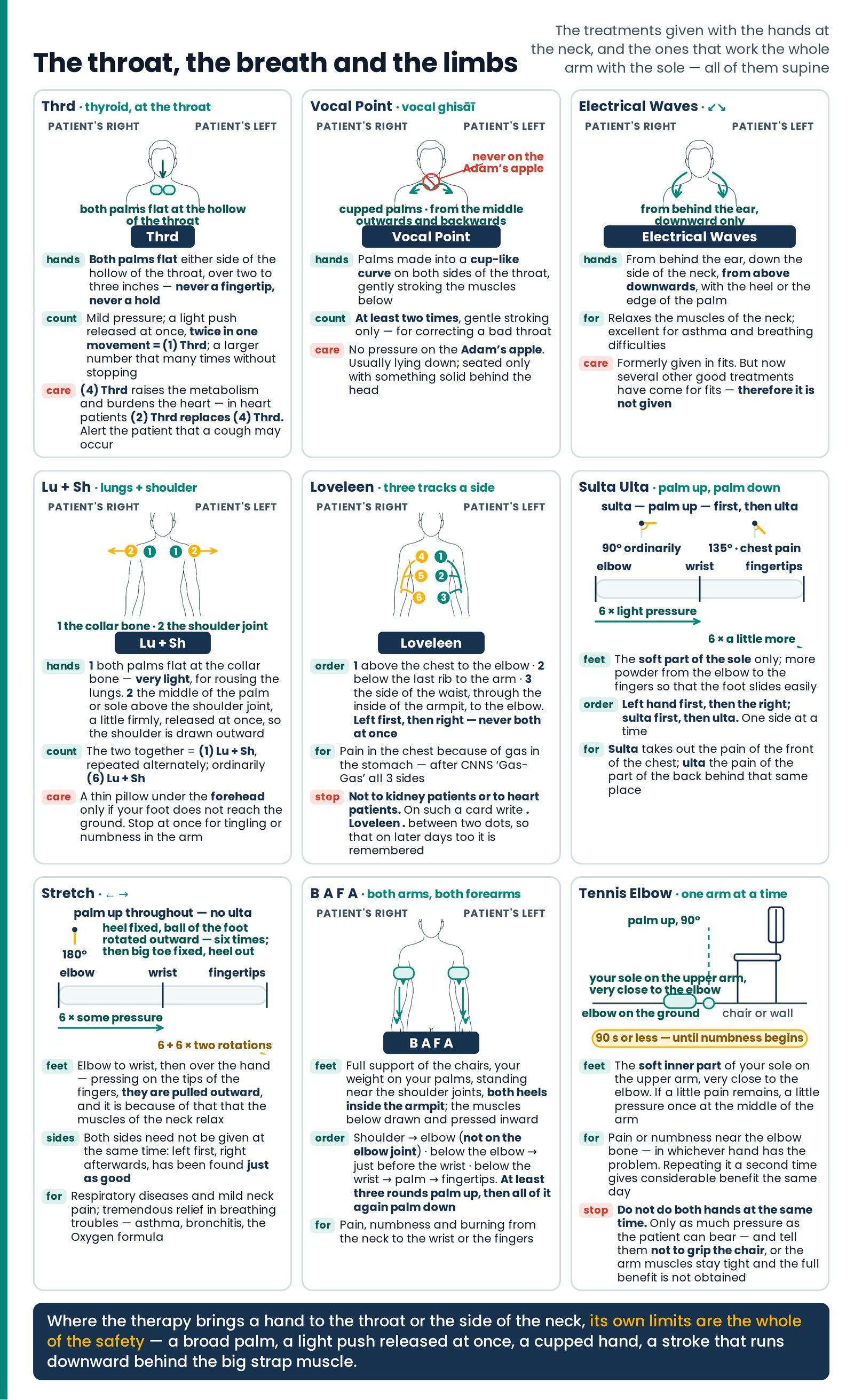
Thrd, Loveleen and Sulta Ulta — and a point written to be withheld
From Each Point in Use
The glands of the throat and the head
Four glands, and more mutual traffic than anywhere else in the atlas
Four points, four glands, and more mutual traffic than anywhere else in the atlas — one is given with another, one is given after another, one is given instead of another.
Table 9 — THRD, THRD 'P', PIT and PARA
| Point and variant | What it is used for | When it must not be used | Notes |
|---|---|---|---|
| (2) Thrd | In angina — that is, in heart patients — to reduce cholesterol, (2) Thrd is given in place of (4) Thrd | (governed by the (4) Thrd boxes below) | Not a refusal but a smaller count for a vulnerable patient. The substitution is the instruction. |
| (4) Thrd | To increase metabolism by means of the T₃ and T₄ hormones of the thyroid, and to raise the temperature of the body. In intellectually disabled children, for the development of the brain — because for one year after birth it is the thyroid gland that brings about the brain's development. For constipation due to hypothyroidism, and for falling asleep while sitting during the day. Oestrogen, progesterone, the gall bladder and the thyroid gland together take care of the skin — so for dandruff, scaling, lice, or hair falling at a young age; for roughness of the skin, or wrinkles. It will release iodine, which helps wounds, mouth ulcers and skin disease heal quickly. For cough, cold and catarrh, or throat problems; and for all problems of the eyes or the ears. Extremely good for diabetes, heart disease and kidney disease, because these diseases come from hypothyroidism. When a bone has broken, then after the wound has filled, giving (4) Thrd will fill calcium into the bone by means of calcitonin, making the bone strong | So do not give in bamboo spine, or spur and the like, because these diseases have come from increased calcium. In asthma the cough increases, so do not give. When the metabolism increases too much there can also be trouble — therefore do not give (4) Thrd to heart patients ▲ Take care | Three bars. Note the timing inside the bone indication: after the wound has filled, not before |
| (4) Thrd 'P' | Given to stimulate the anterior pituitary so that it will make its hormones — mainly growth hormone. If we give (4) Thrd 'P' + (4) Thrd, then by TSHRH the thyroid gland is stimulated to make iodine, and for the functions of the T₃ and T₄ hormones. If after (4) Thrd 'P' we give (6) Rt. Ov. or (6) Lt. Ov. as required, then by FSH and LH we can correct absence of menses or other disorders of the menses. Through stimulating growth hormone, children with a smaller head will also benefit. And by means of calcitonin, through the osteoblasts, to increase calcium in the bones, and for the repair of ligaments | Therefore, in a disease in which the osteoblasts are hyper — such as bamboo spine, or spur, or where bone has grown unwanted anywhere — do not give ▲ Take care | Two paired instructions live in this row: Thrd 'P' plus Thrd, and Thrd 'P' followed by an ovary point. |
| (1) Pit / (4) Pit | Given when we wish to stimulate the pituitary gland to make many hormones. Corrects weakness arising from lack of sugar. Good for players who feel fatigue after a few hours. To increase appetite and height. Given to fill water anywhere in the eye, the ear or the brain; and for absence of moisture in the eyes — what is called dry eyes. For the dizziness of vertigo — those who become giddy travelling in tall buildings, in buses or in aeroplanes get relief. Afterwards, giving (4) Up arrow gives complete benefit | Do not give to diabetic patients, because it raises sugar. It raises alkali — so do not give to high blood pressure, cancer and fits patients. Perhaps low blood pressure patients will benefit | The closing hedge is the therapy's own. The follow-on — Pit, then (4) Up arrow — is part of the instruction. |
| (2) Para | To stimulate the posterior pituitary to make vasopressin, which will stop water going out through the urine. By this, long-standing low blood pressure rises and becomes normal. Given in diabetes insipidus, because in it there is a deficiency of vasopressin | But do not give to high blood pressure patients ▲ Take care | Mechanism and prohibition in one thought |
| (4) Para | When given within the 1,25 DCC formula, to maintain the amount of calcium in the blood by means of the PTH hormone of the parathyroid gland. For those who get cramps from calcium deficiency, and for women with excessive flow during menstruation. When (4) Para is given separately by itself, it will lift calcium from the bone and put it into the blood — so it is given when bone has grown at some unwanted place anywhere in the body. Also usable in heart disease, to open unwanted clots, especially where the blood calcium is also low. Given to breastfeeding women, it stimulates the posterior pituitary to make oxytocin, so that if milk has recently stopped, milk will begin to come again | Those who have osteoporosis: do not give only (4) Para separately. They must be given the full 1,25 DCC formula ▲ Take care | The most carefully cut prohibition in the atlas. It does not forbid the point. It forbids the point alone, and requires the formula. |
What (4) Para alone does, and why the bar is cut where it is cut
Read the two halves of that row together and the rule assembles itself.
Inside the 1,25 DCC formula, (4) Para maintains the calcium in the blood — the parathyroid hormone working with the other points of that formula.
Given separately, by itself, it does something else: it lifts calcium out of the bone and puts it into the blood. That is precisely why it is the point used where bone has grown at some unwanted place.
So for a patient whose bones are already thin, the bar is not never give (4) Para. It is never give (4) Para alone; give the whole formula. The prohibition is aimed at the word separately, and a therapist who reads only the point code and not the word beside it will get this wrong in exactly the patient who can least afford it. ▲ Take care
From Cranial Nerve and Brain Formulas
IX — The glossopharyngeal nerve: the throat, taste from the back, and the blood pressure
The throat, the epiglottis, and the sensors that watch the blood
What it carries. The muscles and the lining of the pharynx — the throat behind the mouth. The closing of the epiglottis. Taste from the back third of the tongue. The tonsils. The parotid salivary glands in front of the ears. The middle ear and the Eustachian tube. And two things nobody expects of a throat nerve: the sensors that watch the blood pressure in the carotid arteries, and the sensors that watch the oxygen in the blood.
How the trouble shows. Difficulty swallowing. A dry mouth at mealtimes. Loss of taste at the back of the tongue. Hiccups. Trouble with blood pressure. Breathlessness where oxygen is short.
Given as. (9) Medulla.
Two recorded observations:
In the ashram, Shri Pankit Shah ji got hiccups at the time of the evening meal on 1st December 2006. After giving (9) Medulla, he obtained relief from the hiccups at once, without drinking any water. Since then it has been tried successfully on many students.
A patient in Chennai was given (5) Medulla + (9) Medulla × 3 treatments + Katka — and he obtained great relief immediately in the irritation, the soreness of the throat. There was difficulty in swallowing and dryness inside the mouth; that too was put right.
Also explained in
- After the treatment is over Uncommon Problems
The patient lies face down on three pillows under the chest and one under the chin, with a clear three-finger gap at the front of the throat, checked by hand before any weight is used.
- TON 'P' and TON 'T' — the same three rubs, different counts Uncommon Problems
TAKE CARE Three strokes that pass near the throat Keep every one of them to the side and the back of the neck.
- ROCKET POINT — driving the muscles back up Uncommon Problems
Behind the ear you are on the hard knob of bone below and behind the ear lobe — firm bone under the thumb, and the front of the throat nowhere near it.
- The two points that are given only after much thought Uncommon Problems
After placing the pillows, put your hand there and see that there is a three-finger gap near the prominence of the throat, so that there is no difficulty in breathing during the treatment.
- PROLAPSE POINT — also written P point Uncommon Problems
Thrd 'P' — a thyroid point of the supine atlas, at the neck, with a standing caution of its own about the great vessels of the throat.
- MOTOR NEURON POINT Uncommon Problems
Patient's position Prone, four pillows — three under the chest and one under the chin — with the three-finger gap at the throat checked by hand Prone ▲ Take care The therapist The weight of the body taken on the hand
- SANGAM POINTS — the three confluences Uncommon Problems
# The place What is done Count 1 A little below the elbow joint, where the confluence of the cervical C6, C7, C8 nerves is Press and release with the tip of your palm, or of the thumb of your foot 6 times 2 At the juncti
- Vocal Point (वोकल पॉइंट / वोकल घिसाई) The Front of the Body II
This treatment is for correcting a bad throat.
- The points of immunity Each Point in Use
For bacterial or viral illness, and for tonsils, sore throat and pain on swallowing.
- The face and the mouth Cranial Nerve and Brain Formulas
Table 15 — The pharynx and the tonsils Point or condition Treatment Control of the muscles of the pharynx (9) Medulla The mucous membrane of the pharynx (9) Medulla Sensation from the pharynx (7), (9) Medulla To stimulat
- The rule that governs the head end The Front of the Body II
Three more bring the hands to the throat or the side of the neck: Thrd, Electrical Waves and Vocal Point.
- Thrd — Thyroid (थाइरॉइड) The Front of the Body II
(Figure 17.6) Place the flats of your palms on both sides of the hollow of the patient's throat, touching the skin.
- Subclavian — सब क्लेवियन ट्रीटमेंट Seated I — Brain, Medulla, Neck
FROM AYURVEDA AND YOGA Dhauti, and the breath that the old teaching and the modern measurement both arrived at In the classical yoga texts, dhauti names a family of cleansings — of the mouth, the throat, the stomach, the
- Ear Points — कान के पॉइंट Seated II — Face, Jaw, Ear, Sinus
The nerve that runs the body's quiet background business — slowing the heart, working the gut, sensing the throat — sends one small branch, and only one, out to the skin of the ear.