The Body's Own Pharmacy — How the Body Makes and Balances Its Chemicals
The Hand That Heals said what this therapy is; The Man Who Would Not Accept 'Incurable' told the life of the man who built it. This article answers the question a thoughtful reader is left holding at the end of both: by what road can a foot on a thigh possibly reach a thyroid gland? The road exists, it is made of ordinary physiology, and every step of it can be explained to a person who left school at fourteen — which is what we shall do here, slowly, with an everyday picture for every mechanism.
Watch


The body is a factory, and the factory has a pharmacy
What the body makes for itself, and why illness is that making gone out of balance
Begin with the sentence the whole therapy is built on, and do not hurry past it.
The body makes its own medicines
The body has within itself the capacity to make every kind of chemical it needs in order to stay well.
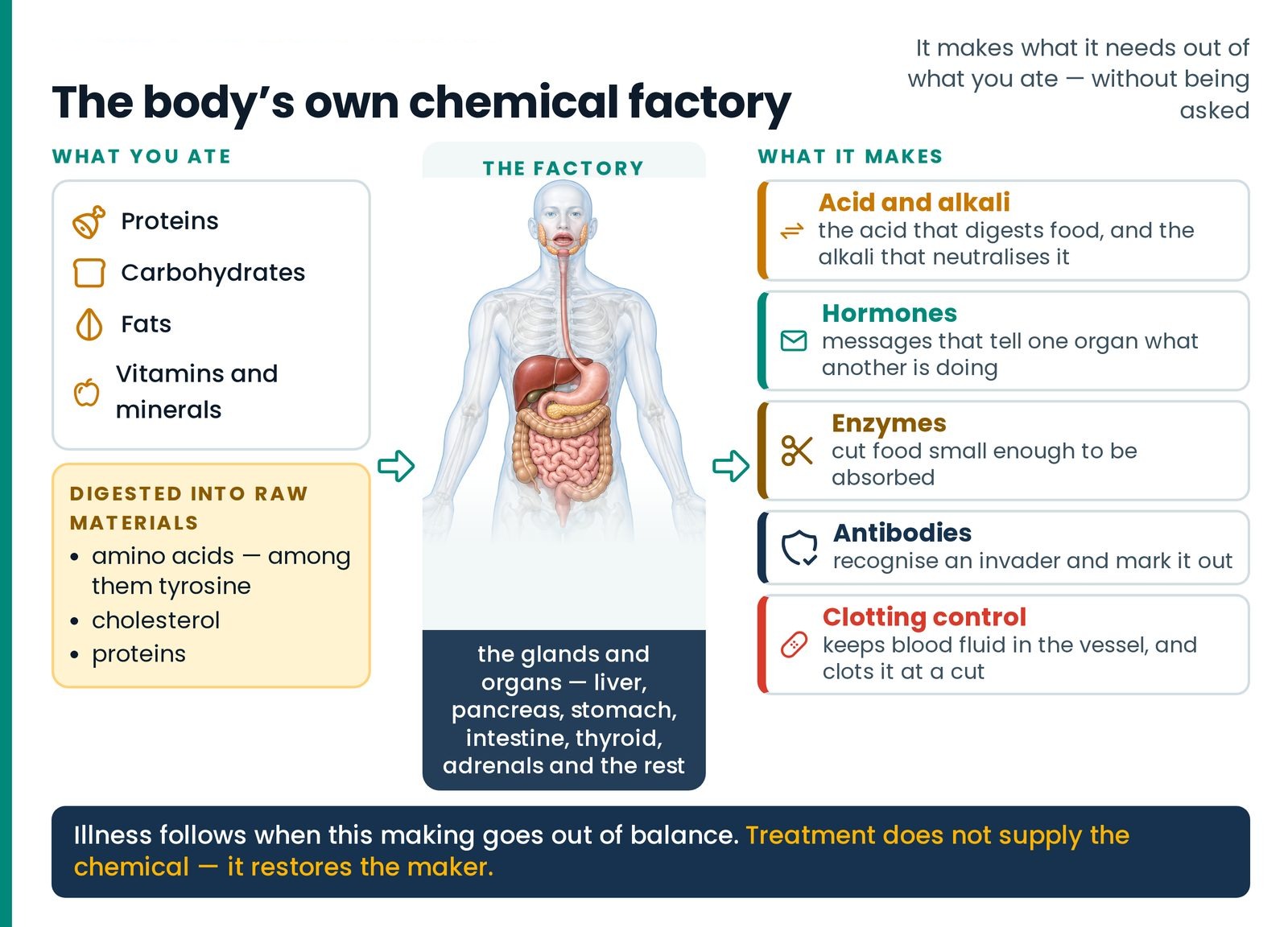
It makes the acid that digests your food and the alkali that neutralises it afterwards. It makes the hormones that tell one organ what another organ is doing. It makes the enzymes that cut food small enough to be absorbed. It makes the antibodies that recognise an invader and the substances that mark the invader out. It makes the chemical that keeps blood from clotting inside the vessel, and the chemicals that make it clot the moment you cut your finger. (Figure 3.1)
It makes all of this out of what you ate, and it makes it without being asked.
That is not a pious sentiment; it is the reason a medicine-free therapy is possible at all. If the body could not manufacture what it needs, the only way to supply it would be from outside, and the tablet would be the end of the discussion. Because the body can, a second possibility opens: do not supply the chemical — repair the workshop that makes it.
The chemistry of illness
All diseases arise because the balance of the body's internal chemicals is disturbed.
That disturbance shows itself in two ways, and it is worth learning them as two, because a therapist meets both every day.
One — the internal environment goes out of range. The acidity or alkalinity of the body's fluids; the blood pressure; the quantity of sugar in the blood; the temperature.
Two — the levels of the made chemicals rise or fall. Hormones, enzymes, antigens, antibodies and the rest.
Treatment restores that balance by provoking the various glands so that they begin to work normally again — and make the necessary chemicals in the proper quantity, at the proper time.
Not supplying the chemical. Restoring the maker of it.
Read those two lists again and notice that not one item in them is a disease name. Blood pressure, sugar, temperature, acid and alkali, hormones, enzymes, antibodies — these are things a body regulates minute by minute without your permission. Disease, in this account, is what regulation looks like when it has been failing a long time.
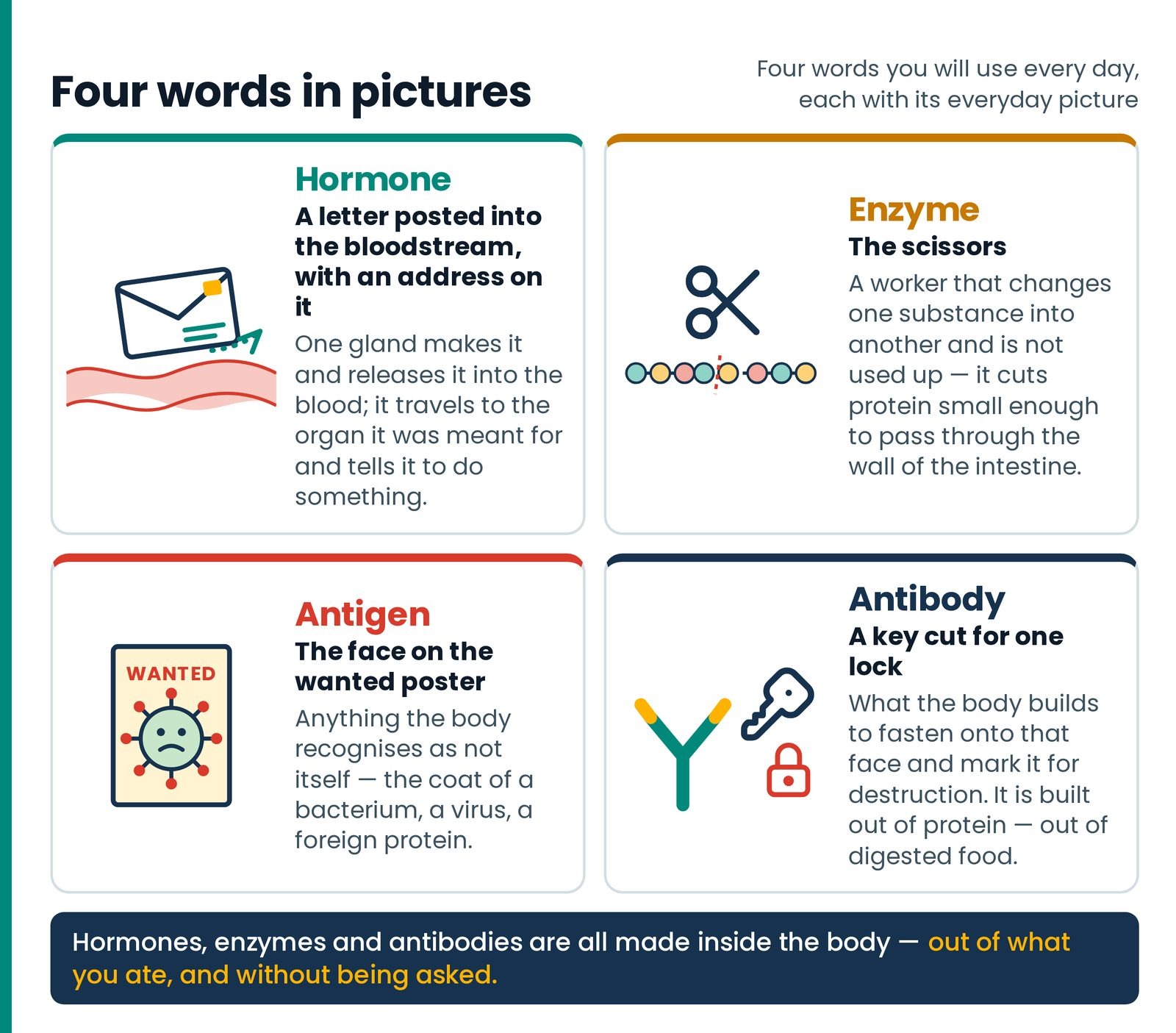
The therapy's own summary is short enough to write on a card: the human body suffers from ailments because of a disturbance in the balance of acid and alkali, of hormones, enzymes, antigens and antibodies — and treatment stimulates the organs to function normally, so that they produce the required chemicals in the required quantity at the appropriate time. Everything remaining in this article explains how a hand can reach that far in.
One supply, shared out
A fixed quantity of blood, and what becomes of the organ that goes short
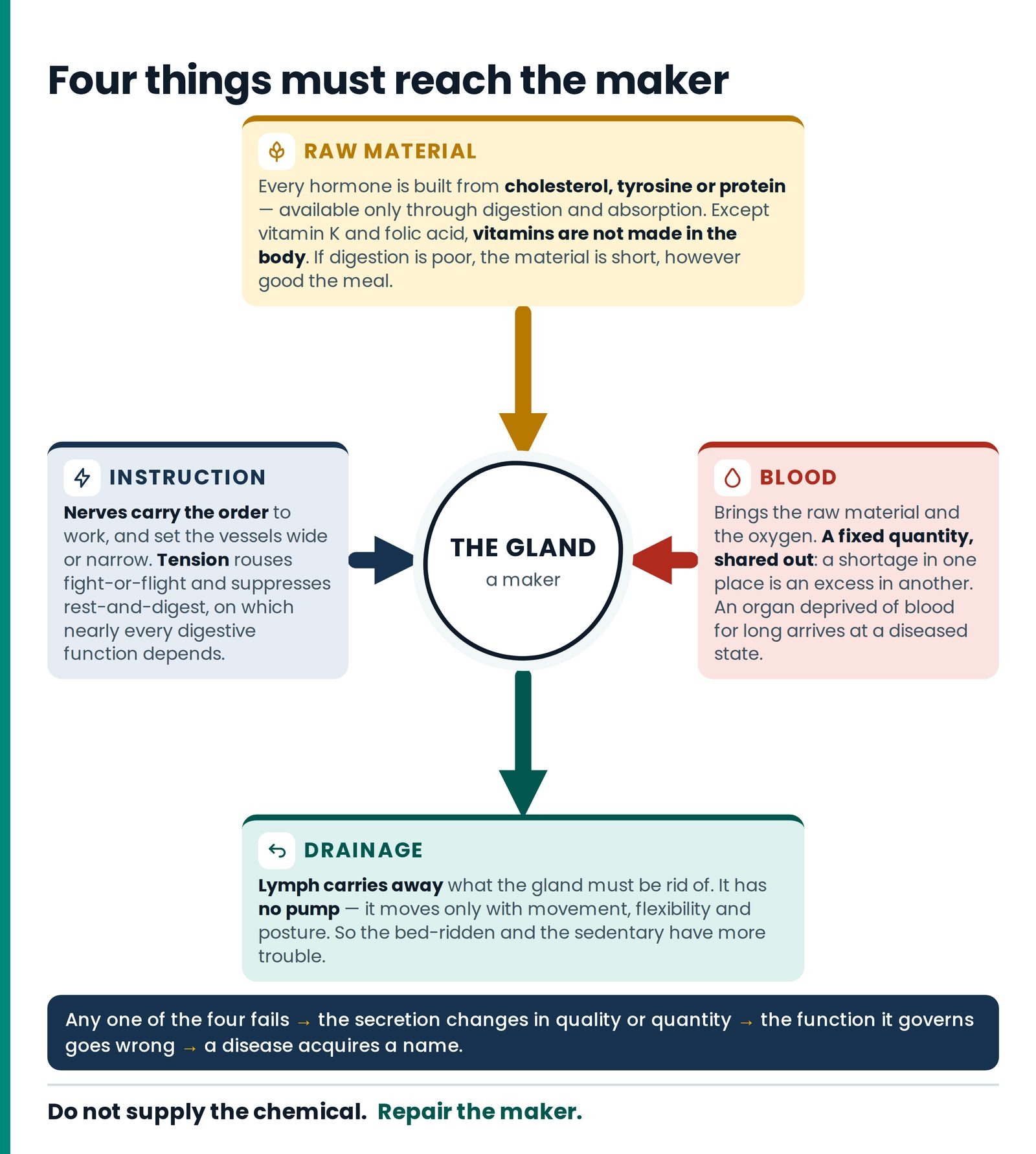
Now the most important idea in this article, and probably in this wiki. A student who grasps this and nothing else will still be a useful therapist; one who has learnt every formula and missed it will be a dangerous one.
Barring an accident or a hospital procedure, the quantity of blood in a body does not rise and fall from minute to minute. It is a fixed volume, in constant circulation, being distributed among all the organs at once.
From which one thing follows as arithmetic, not as theory:
There is only so much blood, and it is being shared out
A deficiency of blood in one region must be accompanied by an excess in some other region.
And therefore: any technique which can divert the flow from a region of excess to a region of deficit ought to bring results. That sentence is the engine of this therapy. Everything else — the points, the counts, the angles, the order — is the map of where to push so that the diversion goes where you intend.
Take the homely picture and keep it for life; you will be explaining it to patients for the next forty years.
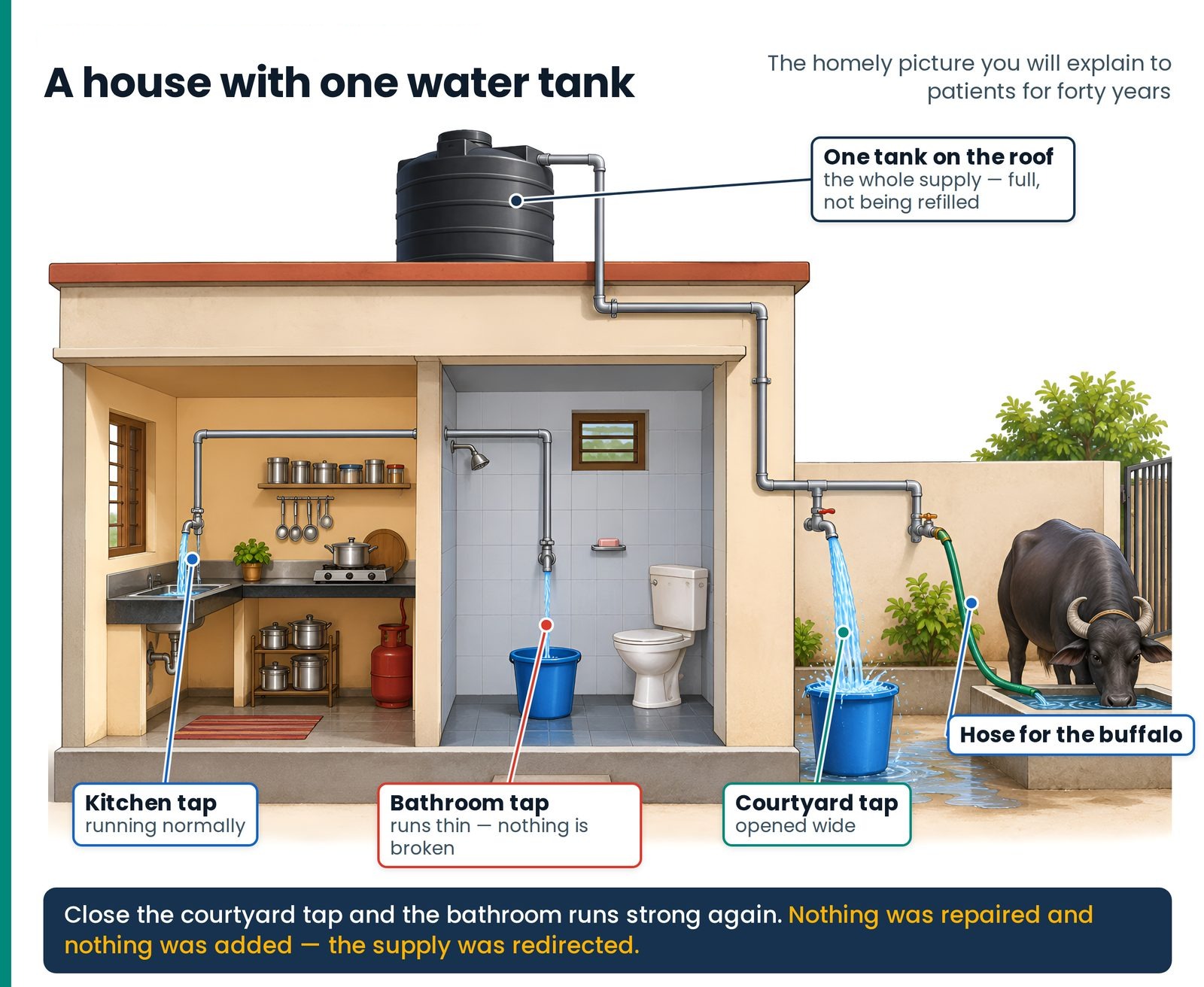
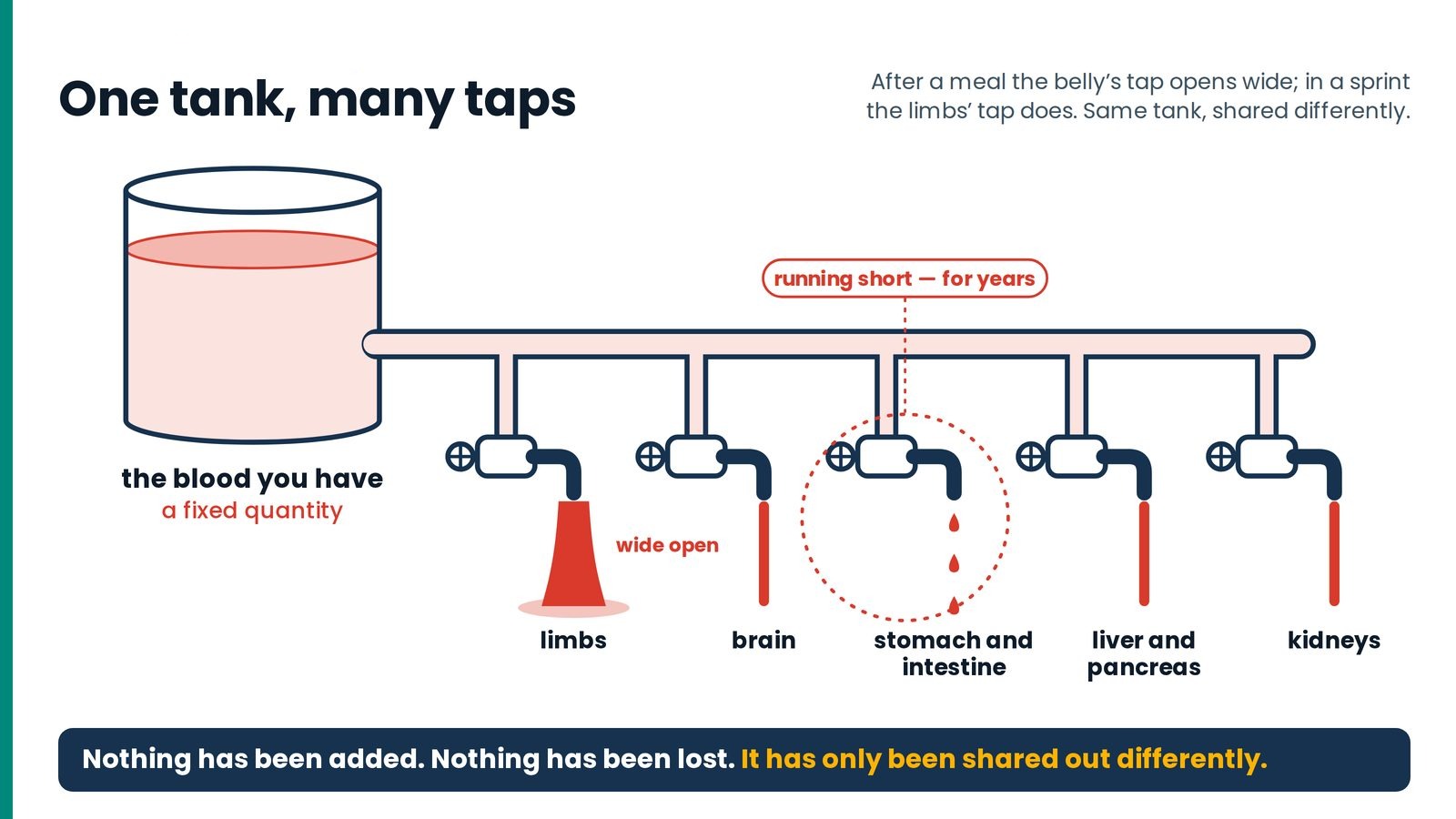
A house with one water tank on the roof. The tank is full and is not being refilled at this minute. There is a tap in the kitchen, one in the bathroom, one in the courtyard, a hose for the buffalo. Open the courtyard tap wide and go and stand in the bathroom. That tap has not been broken and nobody has stolen it — it simply runs thin, because the water is going elsewhere. Close the courtyard tap and the bathroom runs strong again. Nothing was repaired and nothing was added. The supply was redirected, and that was enough. (Figure 3.4)
Now put the tank inside a person. Every organ has a tap — the limbs a wide one, the brain one that is never allowed to close, the stomach, intestine, liver, pancreas and kidneys each their own. They are not all open at once and were never meant to be: after a meal, more goes to the belly; during hard work, more to the limbs; in fear, more to the muscles and less to the gut. That is not disorder, that is management. The trouble begins when a tap that ought to open properly several times a day opens only a little — for years. (Figure 3.5)
What an organ starved of blood becomes
All the organs of the body are programmed to function normally, unless and until the blood supply to some part of them is compromised for a period of time.
An organ deprived of adequate blood for a prolonged period will naturally arrive at a diseased state.
And the useful half, which is the reason a therapist can be hopeful without being foolish: it was working perfectly well before. There is no reason why it should not work perfectly well again once the supply is restored.
That is a claim about time, and the time matters. A tap run thin for ten minutes costs nothing; a tap run thin for ten years costs an organ. It is why the slow cases are slow: you are not repairing a machine, you are returning a supply and waiting while the organ rebuilds itself on the strength of it.
And here is the second half of the same fact, the half that gives the work its direction.
Pain is the report of interrupted supply
Whenever the blood supply to any organ or part is interrupted, it manifests itself as pain or numbness in that part.
Reverse it, and you have the therapist's working instrument: if the pain in a part is relieved, it means the blood supply to that part has been restored.
This is as true of an organ lying deep in the abdomen as it is of an aching back.
You have proved this a thousand times without noticing. Sit stooped or crookedly for two hours and a dull ache begins, usually in the back. Nobody injured you. The ache is a report: in the position you chose, some tissue is not receiving what it needs. So you shift, and it goes, because the supply went back.
Carry that inward and you have the diagnostic idea of the whole therapy. The organs of the abdomen ache too when they are short — but they cannot make you shift, and their ache is not felt cleanly in the organ. It is felt as tenderness or hardness at particular places on the body wall, which is why a trained hand finds what the patient did not know was there. Where those places lie and how to press so that you discover what is present rather than manufacture it is the business of The Navel Speaks First, "The Navel Speaks First", and The Educated Hand, "The Educated Hand". Here we need only the principle: pain is the sign of a supply that has been interrupted.
The second river, which has no pump
Lymph — the fluid that drains every organ, and why it moves only when you move
The therapy's own definition names two fluids, not one: it restores the flow of blood and lymph. Most students slide past the second word. Do not.
Now the fact that matters at the mat.
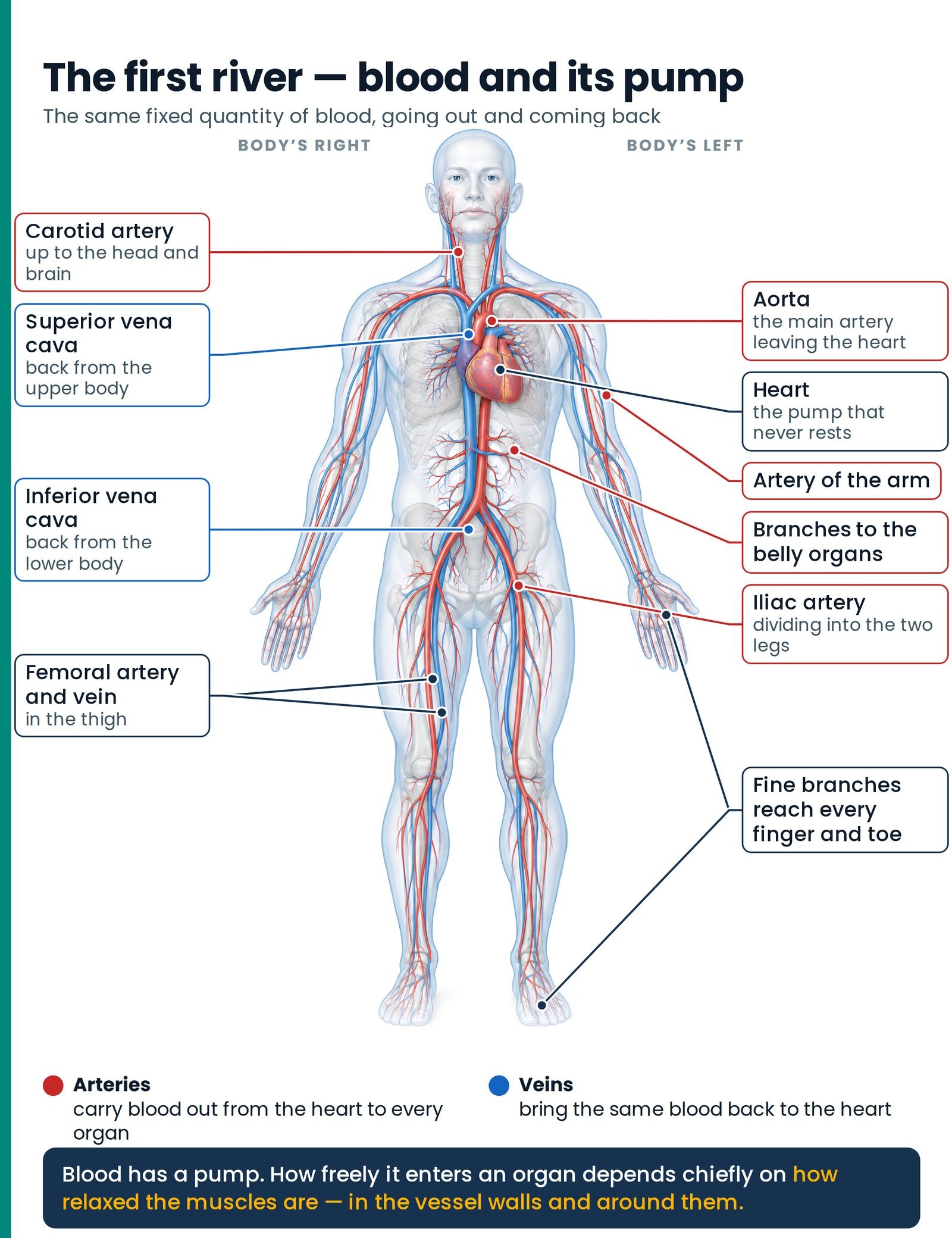
Blood has a pump; lymph does not
The flow of blood is dependent chiefly on the state of relaxation of the muscles — both the small muscles in the walls of the blood vessels themselves and the ordinary muscles of the body around them.
The flow of lymph is dependent mainly on body movement, flexibility and posture.
This is why persons who are bed-ridden, and those who lead sedentary lives, have more problems than persons engaged in many activities.
Blood has a pump you were born with, which never takes a holiday. Lymph has none. It moves because you move: every time a calf muscle tightens it squeezes the channels running through it, and small one-way valves inside them mean the fluid can go one way only — onward. Walk, and you pump your lymph. Sit still eleven hours, and you do not. (Figures 3.6 and 3.7)
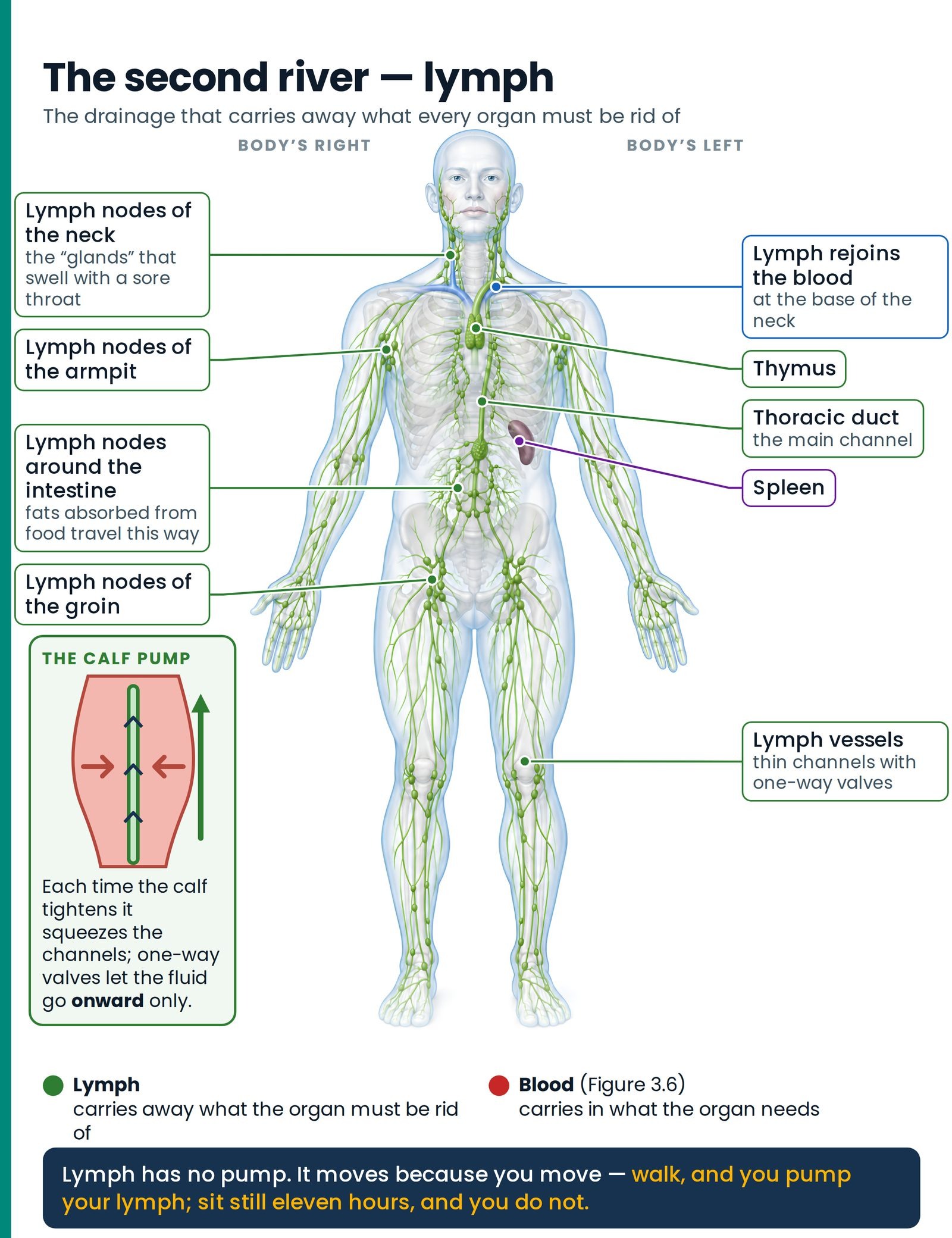
That is a mechanical statement, not a moral one. It is the reason a bedbound stroke patient, a child with severe cerebral palsy and a frail elder acquire swollen legs, indigestion, constipation and repeated infections on top of whatever they came with — and why, in such patients, a therapist's hands and feet stand in for a walk they cannot take.
What a nerve actually is
Reports in, orders out — and why the nerves are the handles of the taps
Ask ten students what a nerve is and nine will say "something to do with feeling". Give the plain answer, because the therapy carries the word in its name.
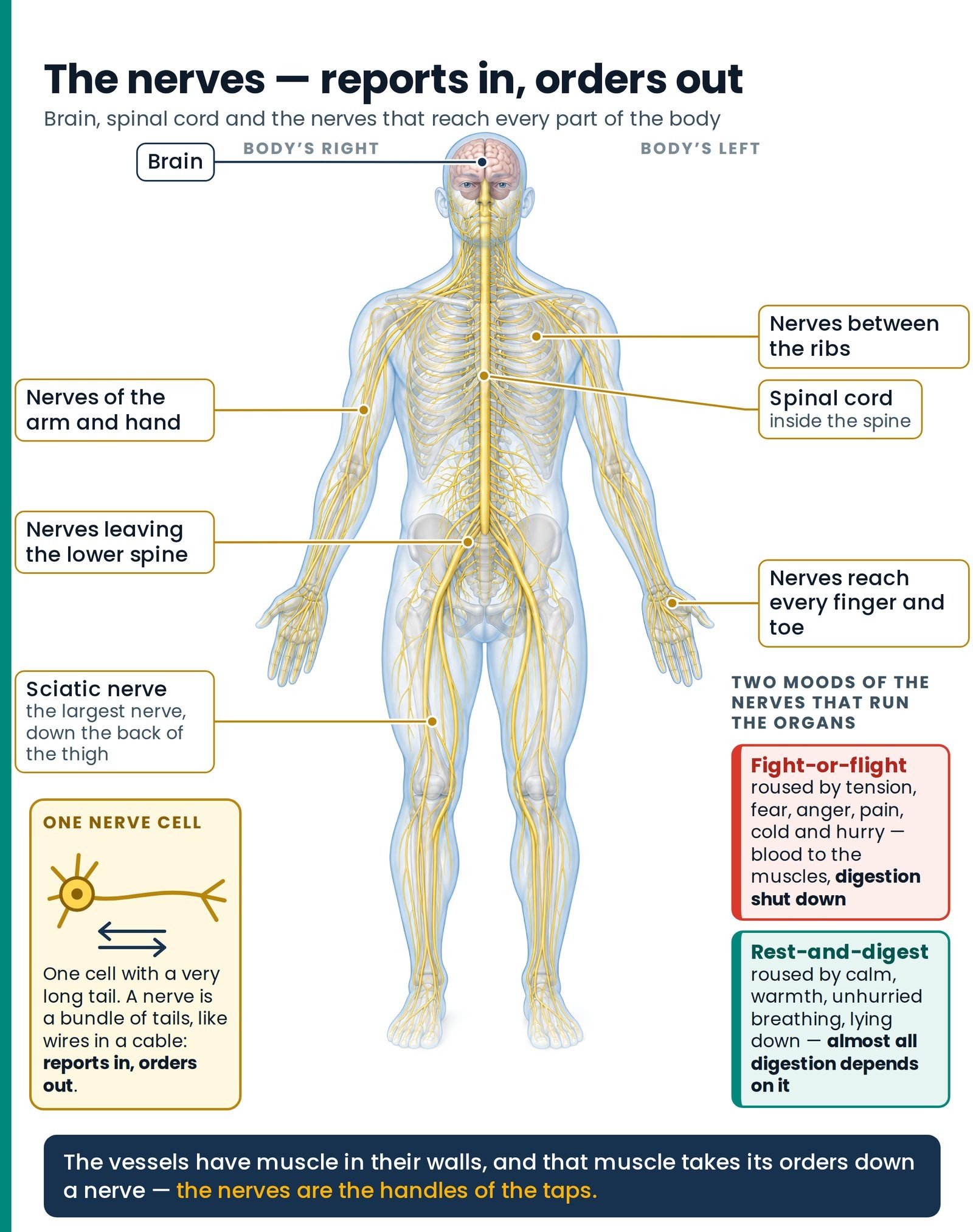
That last sentence is the hinge of the therapy. Every artery of any size has a coat of muscle wrapped round it: tighten the coat and the pipe narrows, relax it and the pipe widens. The tap is muscle, and the muscle is worked by a nerve. The nerves are not a separate system running alongside the circulation — the nerves are the tap handles. (Figure 3.8)
There is a second and blunter way in which muscle governs flow, needing no nerve at all: a vessel running through a hard, contracted muscle is being squeezed by it, and relaxing that muscle opens the vessel inside it. This is why a therapy of pressure and release, applied to muscle, is a therapy of circulation.
The two halves of the nervous system a therapist must know
The part of the nervous system that runs the organs without your permission works in two opposing moods, and almost everything in this therapy touches one or the other.
The fight-or-flight half — roused by tension, fear, anger, pain, cold and hurry. It sends blood to the muscles and the brain, quickens the heart, and shuts down digestion, because a body that believes it is about to be chased has no use for a working stomach.
The rest-and-digest half — roused by calm, warmth, unhurried breathing, lying down, safety. Almost all the functions of the digestive system depend on it.
Tensions and stresses take their toll by frequently arousing the first and inhibiting the second. A person who lives in a permanent low-grade emergency is a person whose digestive organs are permanently on short rations — and no amount of good food will make up for a gut that is never given the signal to work.
Say it to a patient in her own words and watch her recognise herself: when you are worried, your body puts your stomach last. If you are worried every day, your stomach is last every day.
One further nerve fact belongs here, because it is the reason this therapy dares to treat diseases of the brain from the abdomen.
The intestine has a nervous system of its own
A shortage of even one of the brain's principal chemicals is enough to spoil the working of the central nervous system.
The classic examples are diseases such as Parkinson's and motor neuron disorder.
But the intestine carries a nervous system of its own — the enteric nervous system — and the chemicals of the brain and the chemicals of that system are, in large part, the same chemicals built from the same raw materials.
So in Neurotherapy we provoke the enteric nervous system of the intestines, and by that route work upon a disease of the brain.
This is the reason a student sent to treat a Parkinson's patient is put to work on the belly and thinks a mistake has been made. No mistake has been made.
What a gland is, and why the wiki keeps saying "eight to ten"
The makers, the raw-materials works and the foreman
A gland is nothing more mysterious than an organ whose job is to make something and release it.
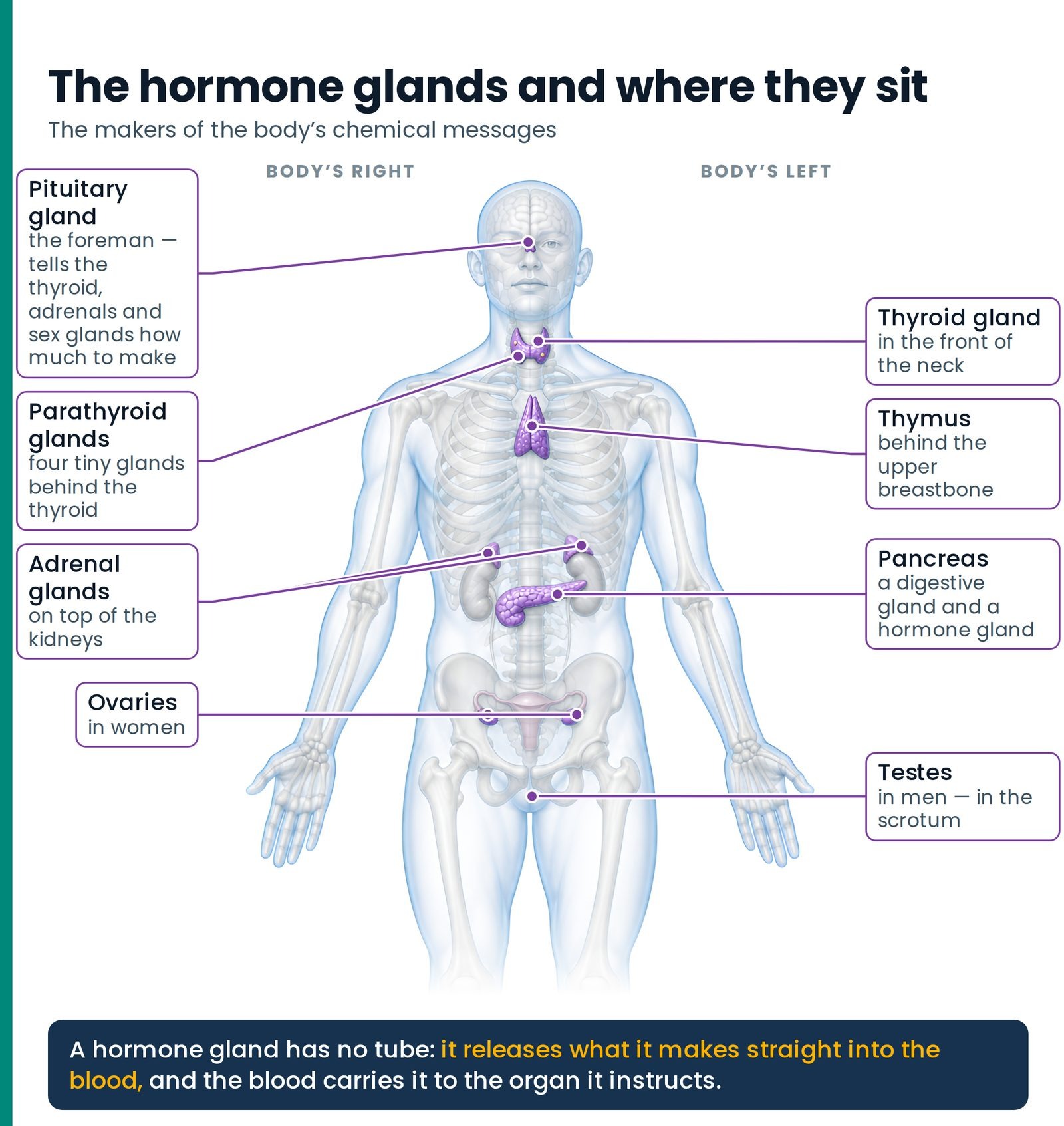
The wiki returns constantly to a small number: all the lakhs of disease names arise from a few among some eight to ten glands not working in the proper way. That is not a claim that the body has only eight glands. It is a working observation — the glands behind most of what walks through a centre's door are a short list, and a therapist who learns that list well is equipped for most of what she will meet.
Two glands deserve naming here because everything else leans on them.
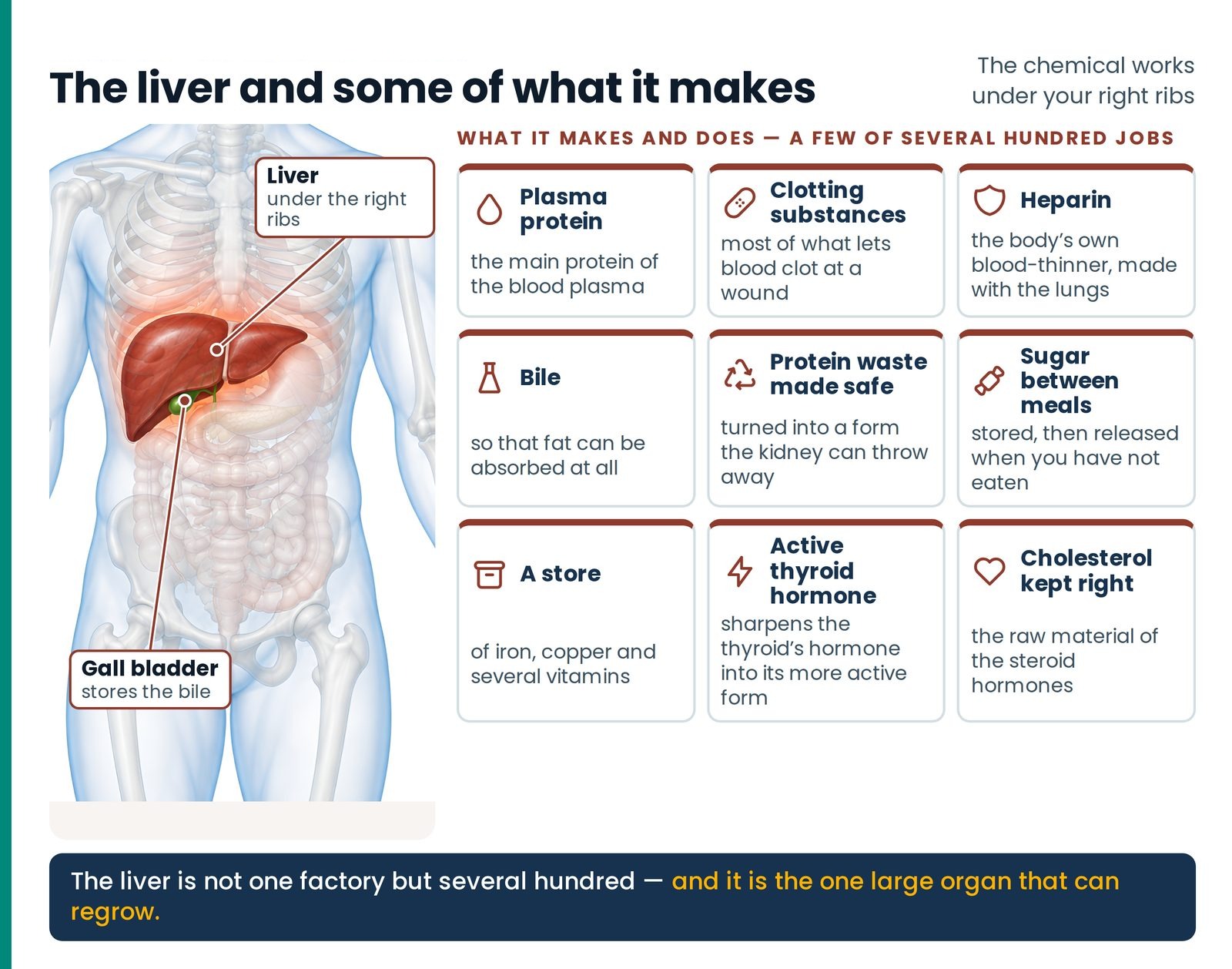
The liver and the pancreas are the raw-materials works. Between them they manufacture an enormous number of chemicals, and many of those are the base substances out of which the other glands build their own hormones and enzymes. They are the suppliers to the suppliers — which is why a course of treatment spends its first days on the belly.
The pituitary is the foreman. A pea-sized gland under the brain whose business is to instruct the thyroid, the adrenal cortex and the gonads how much to make. Both parts of it can be provoked by this treatment, and in that way disorders of the hormone glands are corrected by working on the pituitary.
Blood, nerve and gland are one system, not three
The six-step chain from a shortage of blood to a named disease
Now put the three together, because separating them is a convenience of textbooks and a trap for a therapist. Learn this chain in order; you will use it in front of patients for the rest of your working life.
The chain from a shortage of blood to a named disease
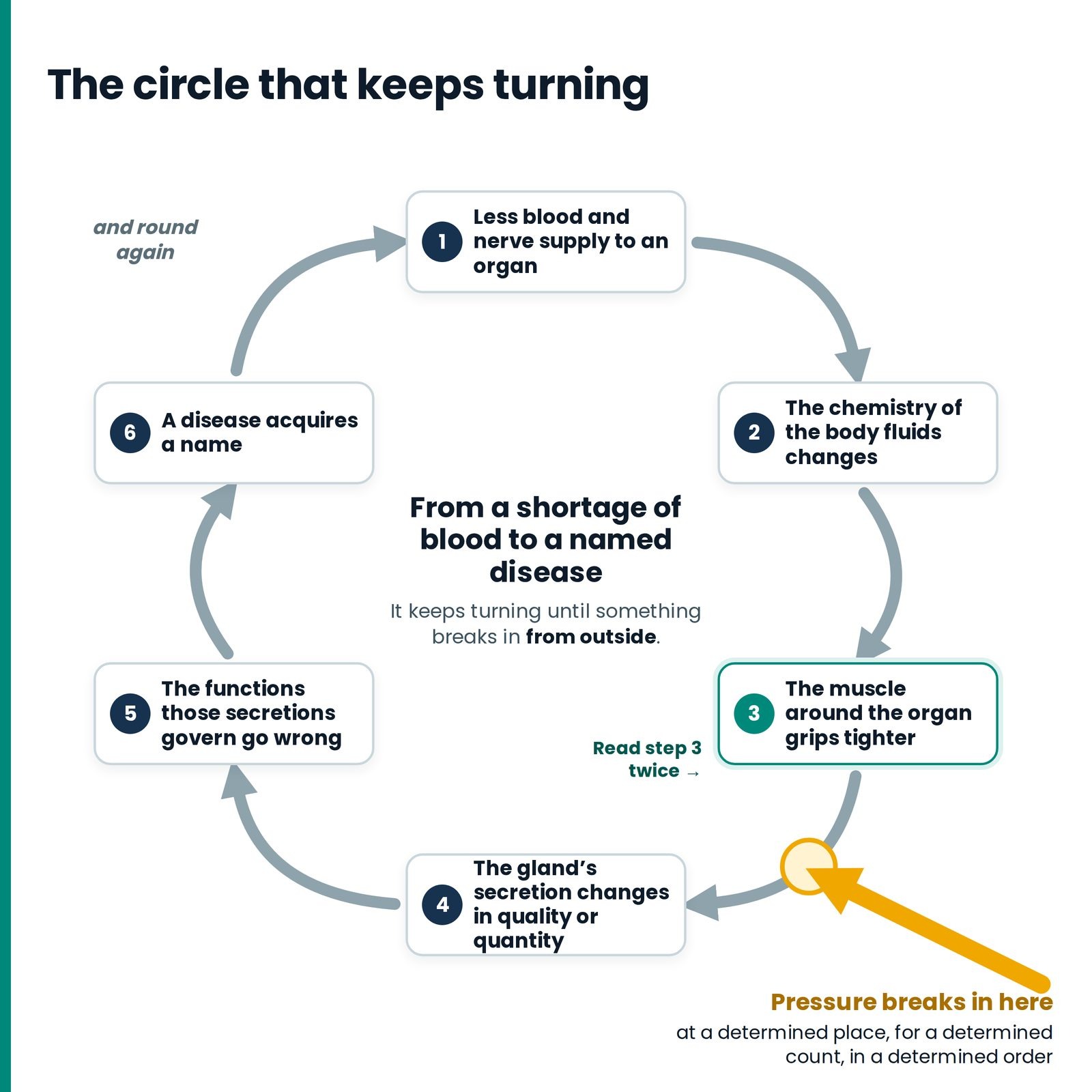
1. Improper blood or nerve supply to one or more organs — 2. — causes an alteration in the chemical composition of the body's fluids; 3. — this alters the tonicity of the muscles surrounding the glands and organs — that is, how tight or how slack they are held; 4. — which in turn affects the behaviour of those glands and organs, causing a variation in the quality or the quantity of their secretions; 5. — and since all the body's functions are constantly monitored and governed by the secretions of the glands, any variation in any of them must cause the body to malfunction; 6. — which lays the foundation of disease.
And therefore: treatment consists primarily in restoring the flow of blood, lymph and nervous signals to the organs concerned, and thereby stimulating the glands and organs back to normalcy.
Read step 3 twice. It is the step students skip, and it is the one that makes the therapy make sense.
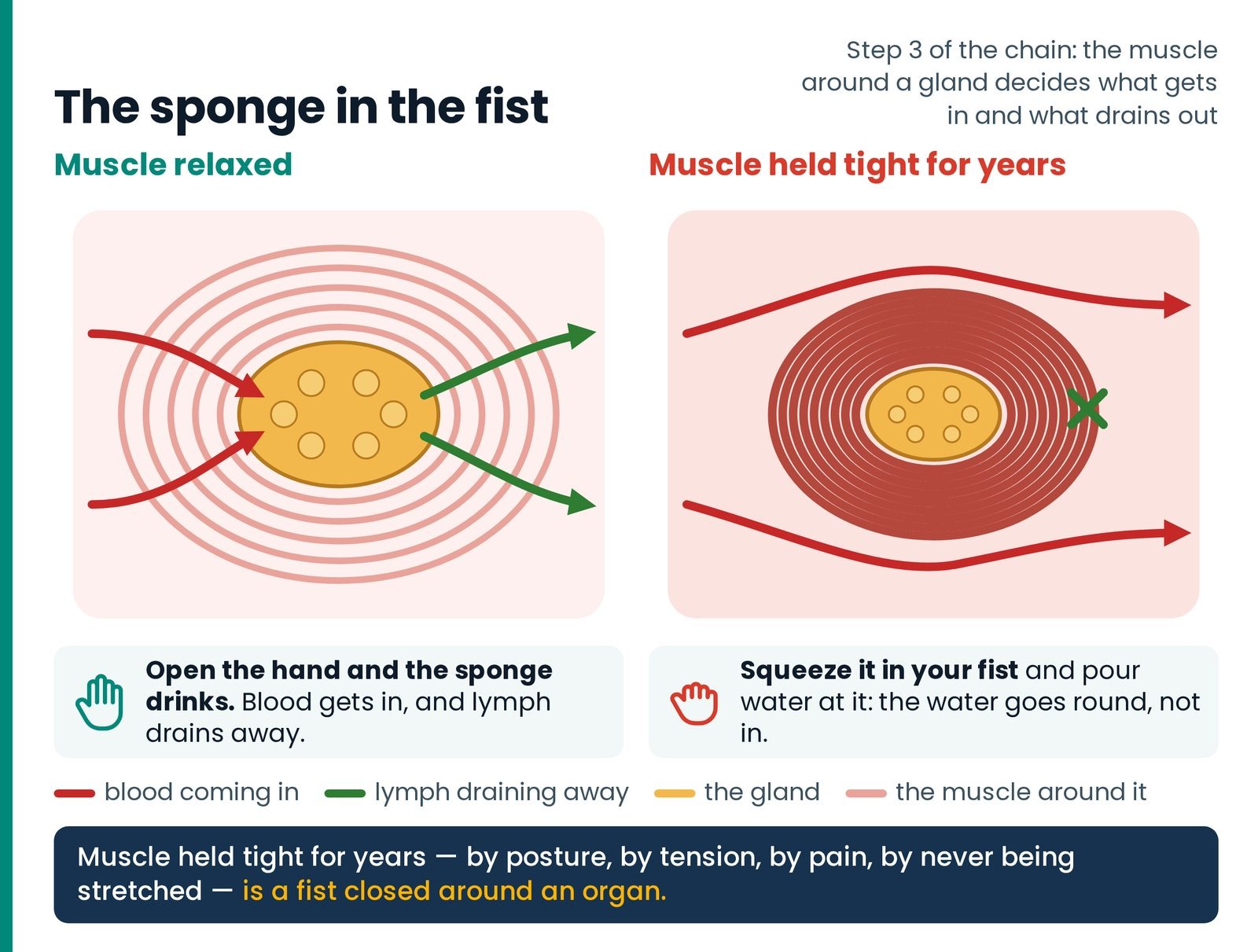
A gland is not a bag hanging in space. It sits in a bed of muscle, wrapped in tissue that is either supple or tight, and the tightness of what surrounds an organ decides how freely blood can enter it and how freely lymph can leave it. Squeeze a sponge in your fist and pour water at it: the water goes round, not in. Open the hand and the sponge drinks. Muscle held tight for years — by posture, by tension, by pain, by never being stretched — is a fist closed around an organ. (Figure 3.10)
And the tightness of the muscle is itself decided by the chemistry of the fluid it sits in. That is step 2 feeding step 3: get the fluid wrong and the muscle grips; get the muscle gripping and the supply falls; get the supply falling and the fluid goes further wrong. It is a circle, and it keeps turning until something breaks into it from outside. Doing that, with a hand or a foot, at a determined place for a determined count, is the whole of this therapy's technique. (Figure 3.11)
The organs of digestion — the key to health
Why every gland depends on digestion, and why the work begins at the belly
Everything so far has been preparation for one observation, and this observation is the founder's own contribution to the treatment of disease. It is short. It should be learnt by heart.
Where the raw materials come from
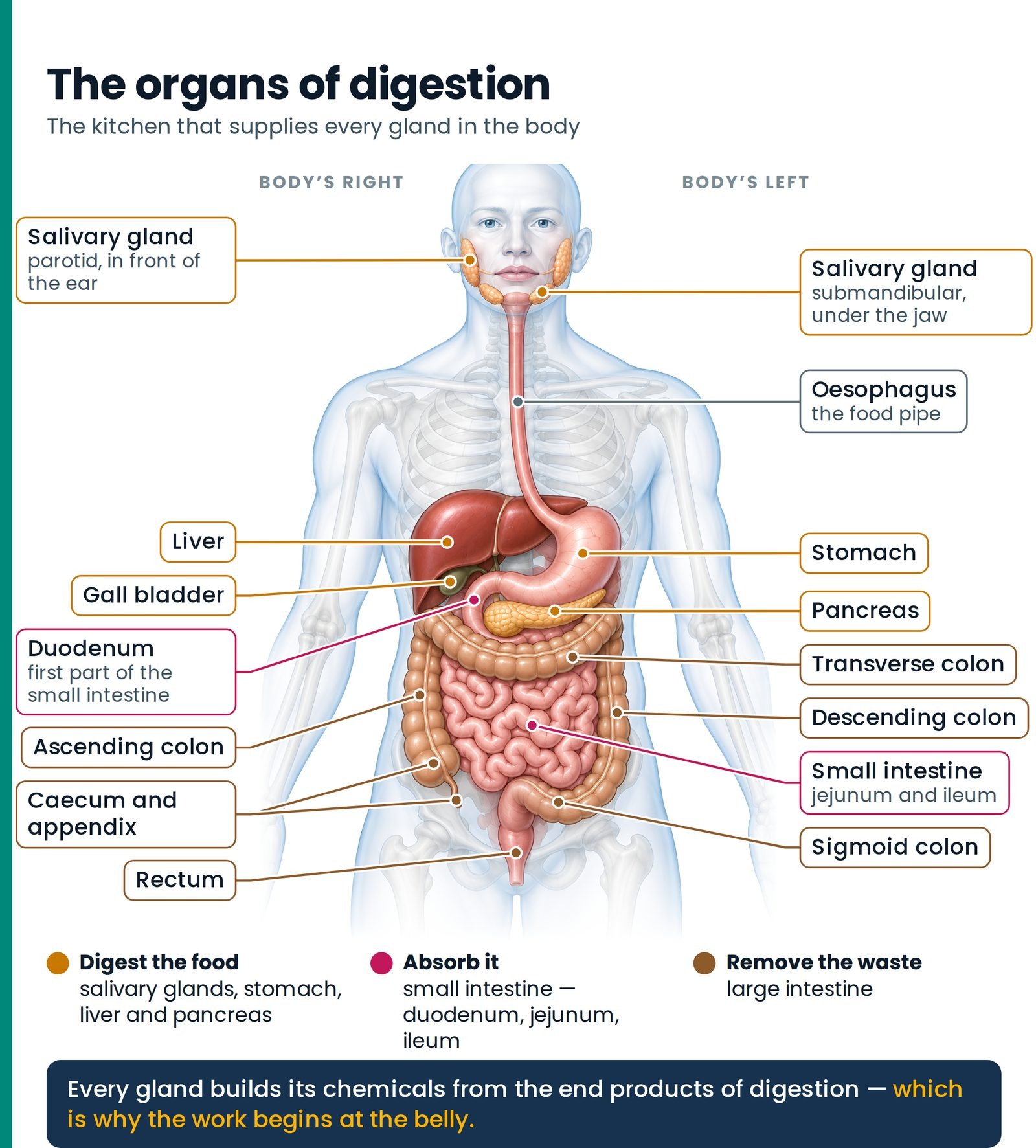
All glands and organs can produce their individual chemicals in the correct quantity and at the correct time only when the necessary raw materials for them are available from the end products of digestion.
In other words: the correct performance of every gland and organ depends wholly on the correct functioning of the digestive system — including the accessory organs of digestion. (Figure 3.12)
Here is the everyday picture, and it is the one to give a patient. One kitchen supplying a hundred households. If the kitchen is sound, every house eats. If it runs at half strength, no house is destroyed — but every one is a little short, and the weakest shows it first. Nobody looking at the hungriest house would say this house has a disease of its own; they would go and look at the kitchen. Which is why a slowed digestion does not produce one disease. It produces whichever disease that particular body is disposed to.
Three substances, and everything built from them
The raw materials of all the hormones are made from only three things — cholesterol, tyrosine amino acid, and proteins.
For those three to be formed properly and absorbed properly, the digestive system must be right. That is what this therapy corrects.
And with the vitamins the position is starker still: apart from vitamin K and folic acid, the vitamins are not manufactured in the body at all. They have to be obtained from food — and for that too, the digestive system must be in order.
Take three worked examples — the ones you will be asked about at the mat, each the same argument arriving from a different direction.
The thyroid. The thyroid builds its hormones on tyrosine, an amino acid which becomes available during the digestion of protein in the intestine. If digestion is not right, the material is short; if the material is short, the gland's output falls — the T₃ and T₄ on the patient's slip. And when they fall the pituitary, which is watching, shouts louder: that shout is the raised TSH she has come to ask you about. If digestion were right, tyrosine would be properly made, the thyroid's work would remain right, and we would not fall ill.
The bones. A person with thinning bones has less calcium in the bone, and less in the blood behind it, because calcium is not being absorbed. If the intestine is not working, then however many tablets are swallowed the deficiency will not be made up — the tablet passes through. Correct the intestine and calcium begins to be absorbed again; by that road even thinning of the bones can be corrected. This is the schoolteacher at the head of this article, and it is why nobody told her to buy a better brand.
Cholesterol and the liver. Cholesterol is not a villain; the body needs it, because out of cholesterol it builds the steroid hormones — the ones that let a person stand and fight a calamity or run from it. But if the liver is not working properly, cholesterol accumulates and settles on the inner walls of the arteries. They slowly narrow, the circulation is obstructed, and from that come disorders of the heart, of the kidney and much else. By correcting the function of the liver the level of cholesterol is kept right — and the very chance of those diseases arising is ended.
Two further examples belong in your pocket, because patients ask about them.
The body's own blood-thinner. In the liver and the lungs a substance called heparin is continually made, whose business is to prevent lumps and clots forming in the circulation. If clots are forming, heparin is not being made in sufficient quantity — and a clot carried to the heart can obstruct it and kill; carried to the brain, it obstructs the circulation there, and that is paralysis. By activating — stimulating — the pancreas, the liver and the lungs, heparin begins to be made again; it dissolves those lumps, and even knots dried and settled for a long time begin to come out, so that paralysis, heart disease and blockage in the heart begin to be cured.
The chemical that stops abnormal growth. The pancreas makes a hormone named somatostatin, whose work is to stop abnormal growth. By stimulating the pancreas for a special length of time, this therapy is able to end not only fibroids and cysts but even a tumour in the brain.
Now the conditions themselves. The therapy does not leave "digestion should be good" as a pious wish: it states what must be true, and then what a person must do to make it true. Both lists are examinable.
That triad is not a rhetorical flourish. The abdomen is the organ of supply — nothing enters the body's stores except through it. The kidneys throw out the fixed wastes and hold the water and salt balance. The lungs take in oxygen and put out carbon dioxide, and by how fast they do it they hold one whole side of the acid–alkali balance. Supply, drainage and air: get those three right and there is very little left for a disease to stand on.
Which brings us to the sentence that decides how a course of treatment is built.
Why the work begins at the belly
In our daily routine there are many factors under whose influence the greater part of the blood moves towards the limbs, the brain and elsewhere — and the blood flow in the organs of digestion decreases.
Sufficient blood is not obtained for the process of digestion.
Shortage of blood makes the organs of digestion sluggish, so that they become unable to digest the food and complete its absorption. Since all the glands depend on the products of digestion for their raw materials, the ill effect must fall on the working of the glands too. That gives birth to various symptoms, which in the end take the form of one disease or another.
This is the root cause of nearly every disease that afflicts the human race.
And therefore: in this therapy the greatest attention is given to setting right the stomach and the organs related to it — because in that lies the key to complete health.
The material's own image for the last step is a housewife's, and it is the best in the wiki. Just as many different dishes can be made in an ordinary kitchen out of the same few limited materials, so out of the different levels of functioning of our few organs different symptoms are produced — and different combinations of those symptoms are given the names of different diseases. Change the proportions and you get another dish. The pantry did not change. Whatever the name of the disease, it has come from the disorder of only a handful of organs.
That is the sentence for the patient who asks why you are pressing her belly when her complaint is her shoulder. Add the honest second half: your shoulder is repaired out of the same stores as everything else in you, and those stores are running short. If I only work the shoulder, I will give you a fortnight of relief and see you again in the spring.
Some causes of disease
The seven causes, and the daily habits that rob the belly of blood
Ask why the taps ran thin in the first place and the material answers without mystification. Nothing here is exotic; almost all of it is something a person does to himself most days, without noticing.
Why the organs and glands go slow
The body can make every chemical it needs. But for reasons such as these, the working of its organs and glands is affected, so that their function becomes slow or is spoiled:
No control over आहार-विहार (āhāra-vihāra) — what we eat, and how we conduct our day.
Rising and sitting in a wrong manner.
A polluted environment.
Mental tension.
Mental or physical work beyond one's capacity.
Deficiency of nutrition.
Fear. Anger.
From this, a reduction comes in the chemicals and hormones made by those glands. Because of that the body's acid–alkali balance and the like is spoiled — and from the deficiency of one thing or another, disease arrives.
Notice what is not on that list: no germ, no curse, no bad luck. Notice too that two of the seven are states of mind, and that one — rising and sitting in a wrong manner — is posture, which is where this article goes next.
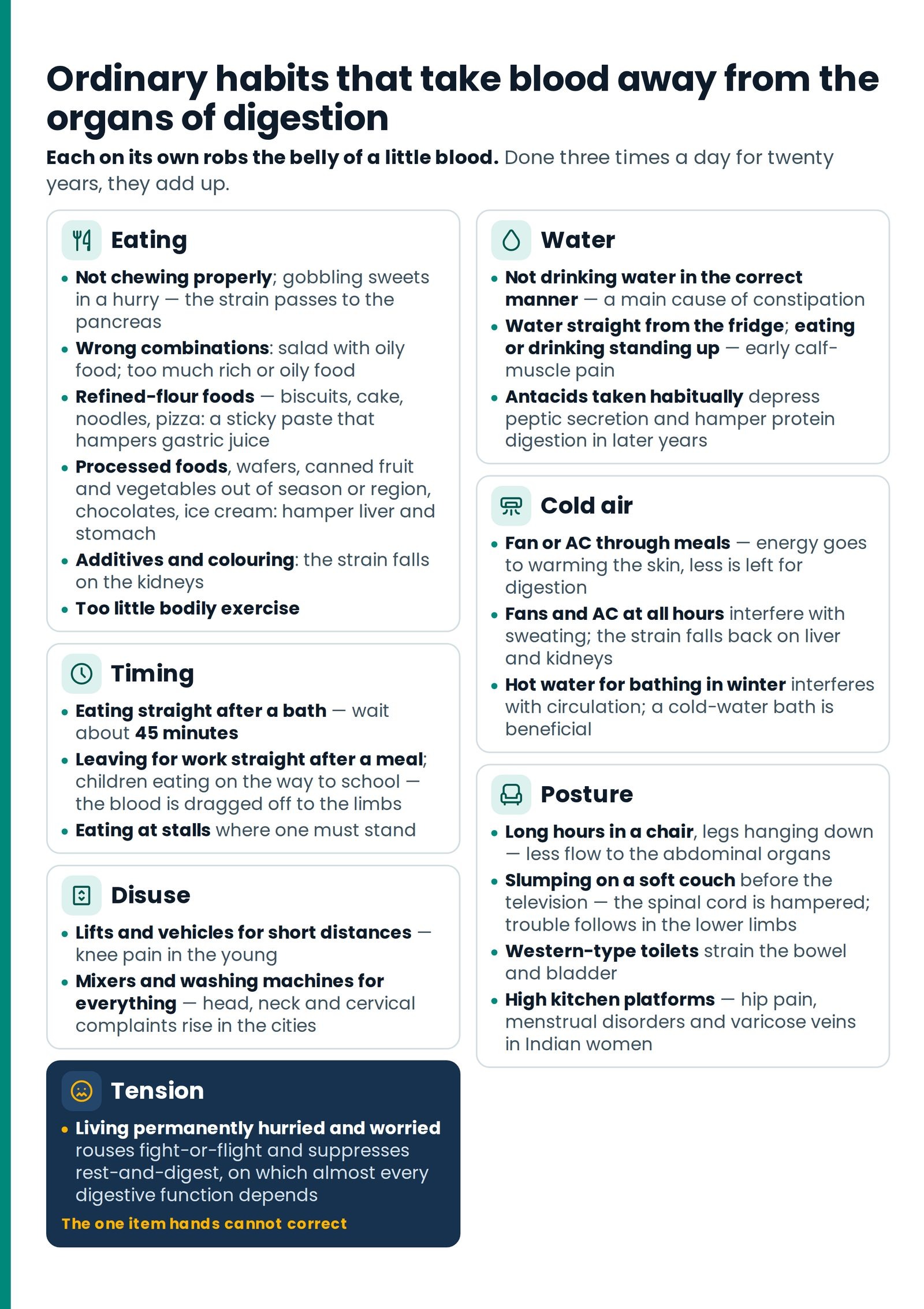
Underneath the seven sit the small daily things, set out in detail because their whole power lies in repetition. Each on its own robs the organs of digestion of a little blood; none on its own makes anybody ill. Done three times a day for twenty years, they are why a belly of fifty is not doing what a belly of twenty did. (Figure 3.13)
The comment on that last row deserves repeating, because it is the only item a therapist cannot correct with her hands. Over two or three centuries we have drifted, without deciding to, into a manner of thinking hostile to health — no time for the body, business carried into the middle of lunch and dinner, no room left for being unhurried. It is high time we reviewed our values and our way of life. Say it to a patient once, kindly, then get on with the treatment; a therapist who says it every week stops being listened to.
Posture, muscle, and the side that gets less
Why one side is so often short, and the stretch this therapy gives
We come now to a small observation with very large consequences, and it is the one to test on yourself before you finish this page.
Posture is the second great governor of muscle — and therefore of flow
After the state of relaxation of the muscles, the next most important factor influencing the working of the muscles is body posture — a fact which yoga recognises and corrects through the practices called āsana.
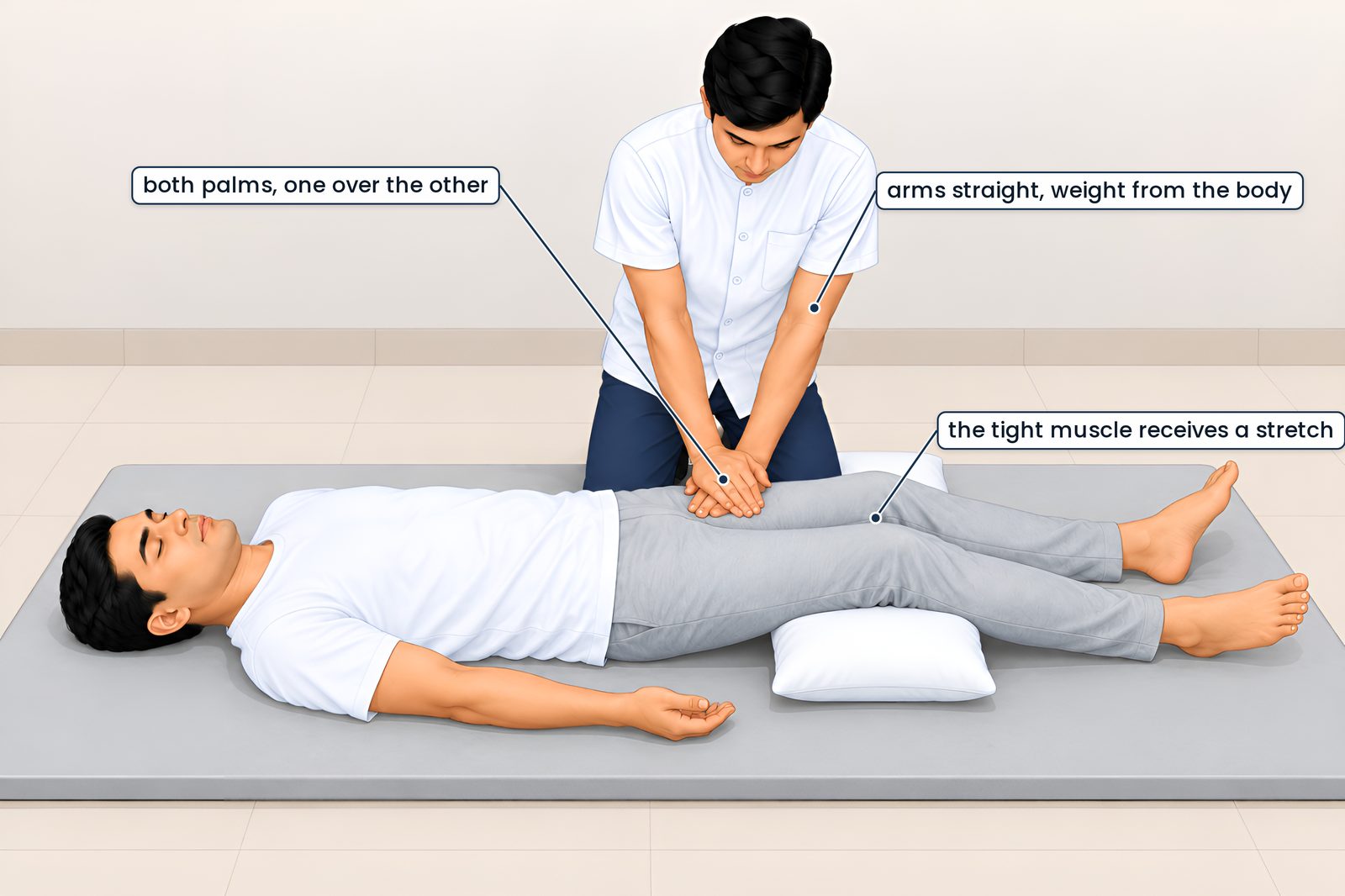
In Neurotherapy we hold that the application of pressure on the arms or the legs, over and above its other effects, also mimics the stretching actions found in several of the yogāsanas, and thereby helps to improve the functioning of the muscles.
Now the observation itself, which is the reason posture belongs in a article about chemicals at all.
Most people are not straight
Most persons tend to bend to one side or the other while sitting, while standing, and while walking.
Posture, even at the best of times, is far from ideal.
The consequence is not cosmetic. A body habitually bent to one side is a body in which the structures on that side are compressed for the greater part of every day — and so an organ on that side may not be receiving its proper blood supply for the greater part of the day.
This is why one kidney, and not both, is so often found sluggish; and it is why the first question of the examination is which side is short, not whether a side is short.
Watch people for a week and you will stop doubting it. The clerk with a bag on one shoulder for thirty years. The tailor bent over the machine with the same shoulder dropped since he was seventeen. The mother who carried every child on the same hip. The driver whose left arm rests on the window and whose right hand never leaves the wheel. The woman cooking at a platform built for a man, standing on the outer edge of one foot with the other hip pushed out. (Figure 3.14)
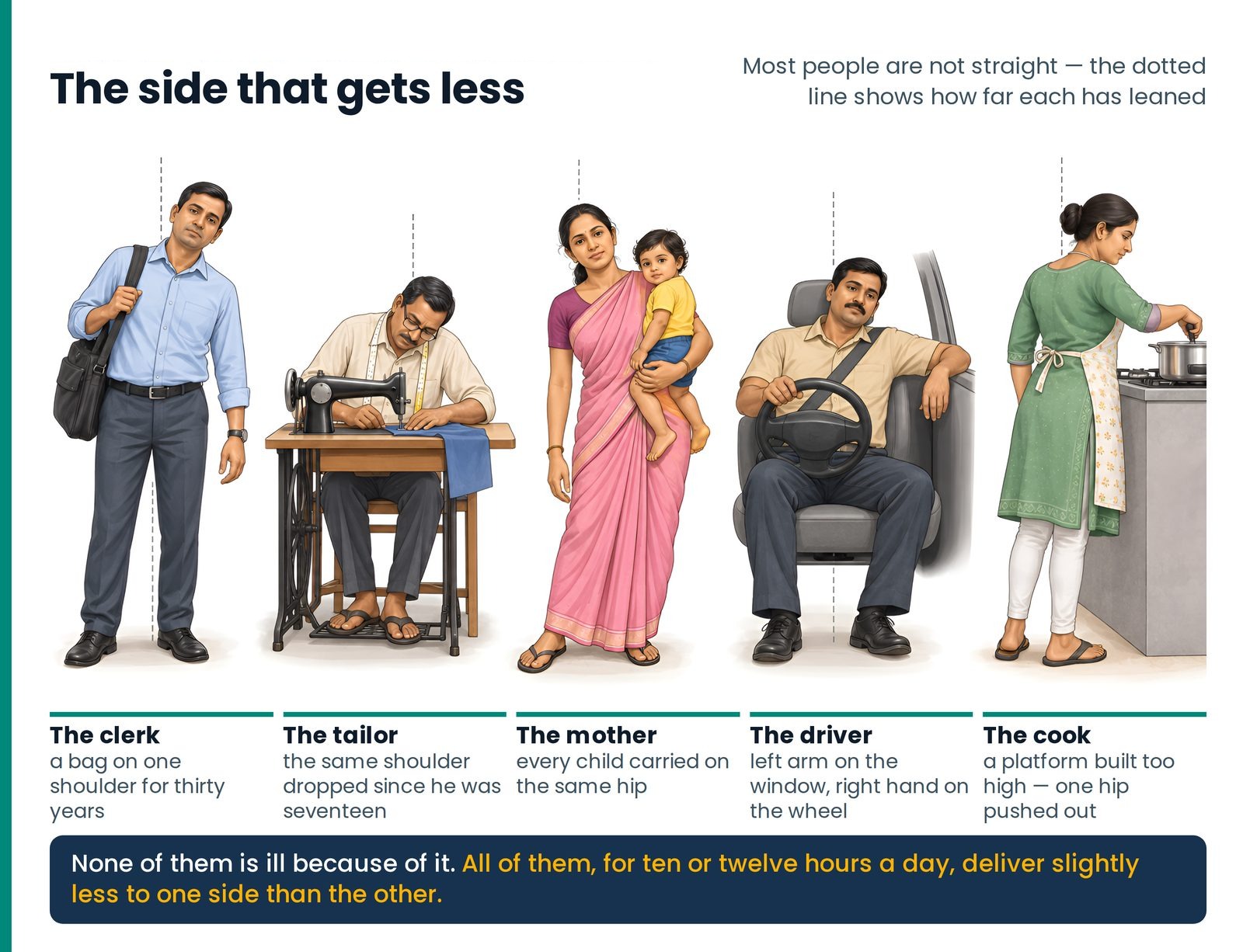
None of them is ill because of it. All of them are, for ten or twelve hours a day, delivering slightly less to one side than the other — and the account has been running for decades.
Two consequences follow, and both are practical.
First, look before you touch. Stand behind a new patient before she lies down and simply look: one shoulder lower, one hip higher, one foot turned further out, the head carried off centre? You are not making a diagnosis from it; you are forming an expectation the hands will confirm or contradict.
Second, understand what your pressure is standing in for.
What yogāsana does for oneself, this therapy does for another
Yogāsana is an ancient and very effective system of India, and India's gift to humankind. By yogāsana the muscles and the nerves are stretched and made flexible, and in that way the body is kept well and free of disease.
Seen in one way, the work which yogāsana does for oneself is the same work this therapy does for another. When we press with the foot on the thigh or on the arms, the muscles that have become tight or contracted receive a kind of stretch from our pressure, by which they become supple again. (Figure 3.15)
The principal benefit of this is easy to overlook. A patient with paralysis cannot perform a yogāsana. Nor can an intellectually disabled child, nor a very frail elder — and so, on top of everything else they carry, they acquire constipation, indigestion and repeated infections. Through this therapy we are able not only to relieve those, but to bring considerable improvement in their condition.
That is the answer to give when somebody says "then why not just tell people to do yoga?" Tell them to do yoga, by all means, if they can. The therapy exists for the body that cannot make its own stretch, and for the body whose organ is too far gone to be reached by a stretch alone. One heals the organ; the other holds the gain.
A novel approach to disease and its cure
The working assumptions, the paired organs and the four-step cycle
What makes this a different approach, and not merely a gentler one, is this. Modern investigation has assembled an enormous and reliable body of knowledge about how a body works, and this therapy uses that knowledge — but looks at it from a completely different angle, one in which the use of medicines is rejected. It does not dispute the physiology; it declines the pharmacy. How the founder came by that knowledge is told in The Man Who Would Not Accept 'Incurable', "The Man Who Would Not Accept 'Incurable'", and is not repeated here.
Out of that reading, and an experience of patients running into lakhs, come a set of working assumptions. They are the load-bearing beams of the formulary in , and a student who knows them can often work out why a formula is built as it is instead of memorising it blind.
The assumptions this therapy works on
1. Many of the body's principal chemicals are made in two places, or in more than two. If one place goes bad, that chemical will not be made there. We then provoke the other place, from which the chemical is secreted, and the disease is cured.
2. The pituitary gland has an effect on many of the hormone glands. Both parts of the pituitary can be provoked by this treatment — and by provoking the pituitary, disorders of the hormone glands are corrected.
3. The raw materials of all hormones are made from only three substances — cholesterol, tyrosine amino acid and proteins. For these to be formed and absorbed properly the digestive system must be right, which is what this therapy corrects.
4. A shortage of even one of the brain's principal chemicals spoils the working of the central nervous system. We then provoke the enteric nervous system of the intestines, and by that route treat the disease of the brain — as in Parkinson's and motor neuron disorder.
5. Apart from vitamin K and folic acid, the vitamins are not made in the body; they must come from food. Certain pains behind the back are linked with certain vitamin deficiencies. As the digestive system is set right and the pain is drawn out of those points, the symptoms of the deficiency begin to reduce — and vitamin-deficiency diseases are corrected without medicine.
6. When the cells of the thymus gland begin to kill the cells of one's own body, that is called auto-immunity, and the diseases arising from it auto-immune disorders. Such patients are given steroid medicines, whose ill effects follow. This therapy's control is over the adrenal gland, which suppresses the thymus. So to correct such diseases we provoke the adrenal cortex and the steroid is made within the body itself — where it has no side effect.
7. Wherever the body has two glands of one kind, their work is nevertheless not the same.
That seventh assumption is the founder's own discovery, and it changes how a therapist thinks about symmetry.
The old yogis knew, the material observes, that the two sides of the nose do not do the same work: the right raises the burning-down side of metabolism and warms the body, the left raises the building-up side and keeps it cool, and from the two working together the body's chayāpachaya — its metabolism — stays right. In the same way, it is this therapy's discovery that both ovaries, both kidneys and both medullae of the adrenal gland do different work. (Figure 3.16)
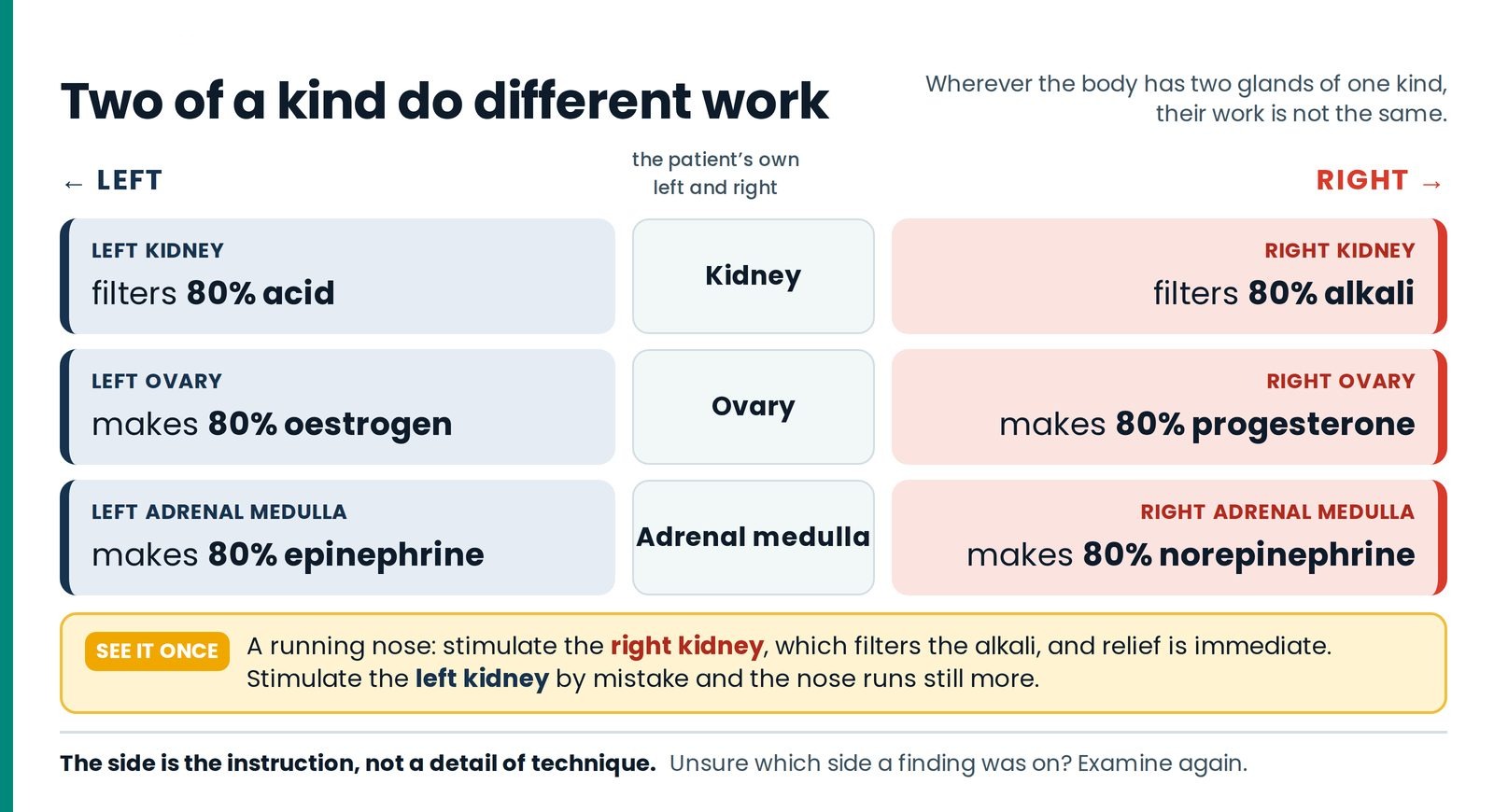
This can be demonstrated very easily. If someone's nose is running, stimulate the right kidney Right , which filters the alkali, and the patient gets immediate relief. Stimulate the left kidney Left in that patient by mistake and the nose will run still more and the condition will worsen. A student who has seen it once does not forget it. ▲ Take care
The same asymmetry governs one of the commonest treatments given to women. Because more oestrogen comes from the left ovary and more progesterone from the right, menstrual disorders are corrected by giving the oestrogen treatment — the left ovary Left — for the first fourteen days after the menses, and the progesterone treatment — the right ovary Right — in the following fourteen days. The order and the fortnight are the instruction; give them in the wrong halves of the month and you have given a different treatment whose effects you were not taught.
Finally, the whole method in four steps. Every examination you perform and every plan you write is this, repeated.
Where the pain points sit in this picture
A pain point is where a shortage inside is reported on the outside
One paragraph, so that nothing is left dangling; the map has its own article.
When there is disease, or the symptoms of disease, in a body, then on pressing certain determined points near the navel, or near the hip bone, or near both, pain or stiffness is felt. Finding them is simple: with the tips of the fingers press gently inwards at the determined places. The presence of pain at any place indicates that in that part, and in the organs related to it, there is some disturbance in the flow of blood — very often a pain the patient did not know she had. Note that this looking-for-pain, and the information taken from it, is a different act from the examination a physician calls palpation.
For convenience the points carry code names, generally indicating the principal organ or symptom of that region; sixteen lie around the navel in front, four near the hip, and two on the back behind the waist. Where each lies, what stands behind it and what a finding at it means is The Navel Speaks First; how to press so that you find what is there and do not create it is The Educated Hand; how to read several findings as one picture is From Findings to a Plan.
Keep only this much from the present article: a pain point is not a magic spot. It is the place at which a shortage inside is reported on the outside. That is why relieving it means something — and why relieving it is not the same as having finished. (Figure 3.17)
Two bodies, read as this article teaches
Two composite cases, reasoned the way this chapter teaches
Questions students ask
1. I am a housewife with no science at all. Is a "gland" the same thing as the lumps in my neck when I have a sore throat? The same word is used for both, which is why you are confused, and the confusion is the language's fault and not yours. The lumps in your neck are lymph nodes — filter stations where the body inspects what has been drained out of the tissues and mounts a defence. A hormone gland is a factory: it makes a chemical and releases it into the blood to carry a message elsewhere. Both are treated in this therapy, for different reasons.
2. If blood is a fixed quantity, does the treatment take blood away from somewhere else? Yes — and that is the mechanism, not a flaw in it. You are moving supply from a region with more than it needs to one that has been short for years. The body does this all day by itself: after a meal it favours the belly, during a run the legs. We do deliberately, at chosen places, what it already does without asking.
3. I am a physician. What exactly is being claimed by "restoring blood supply"? Three separable things, in separate pockets. The observation: tenderness or hardness at determined sites accompanies disease irrespective of its name, and treating those sites is followed by improvement. The principle: circulating volume and cardiac output are bounded, so regional flow is redistributed and not created — ordinary physiology. The proposal: that a determined, timed, ordered pressure redistributes it towards named viscera and normalises gland function. State the first two plainly, the third as what the therapy holds, and measure it where it can be measured.
- 4. Why does the wiki keep saying "eight to ten glands" when I can count more than that in a textbook? It is a clinical count, not an anatomical one. In practice, most of what walks through a centre's door traces back to a short list of glands running slow — and a therapist who learns that short list thoroughly is equipped for most of it. Learn the anatomy anyway; the two are not in competition.
- 5. I am nineteen and I keep losing the chain — supply, fluid, muscle tone, secretion. How do I hold it? Hold the sponge instead. A gland sits in muscle. Muscle held tight for years is a closed fist round a sponge — nothing gets in and nothing drains out. Loosen the fist and the sponge drinks. Everything in the chain is a way of saying which fist closed, and why.
- 6. I practise in a village with no laboratory. Can I use any of this? All of it. Nothing in this article needs a machine — only eyes to see how a patient stands, hands to find what is tender, ears for a history taken in the right shape, and a referral list you know by heart. Knowing when to send someone elsewhere is a clinical skill, not a confession of poverty.
7. My patient's thyroid report improved but she says she feels the same. What do I make of that? Say so out loud, to her and in your record. The number and the person are two separate observations and they do not always move together. When they diverge, that is information about the case, not a failure of nerve. Keep treating, keep recording both, and let the next two months say which was leading.
8. I am sixty-eight and learning this for my family. Is it too late for me to change the way I sit and stand? No, and you are the person best placed to prove it to the rest of them. Posture is not a fixed thing you were issued with; it is a habit renewed every hour. The tailor in this article had leaned one way for thirty-one years, and two bricks under his machine did more for his back than the first ten days of treatment.
Questions patients ask
1. "You keep saying my body makes its own medicine. Then why did I ever fall ill?" Because the making needs three things, and one of them has been short in you for a long time. It needs raw material, which comes only from food that has been properly digested and taken in. It needs blood delivered to the organ that does the making. And it needs the instruction to come down the nerve at the right moment. Your body has not forgotten how. It has been short of supplies.
2. "My doctor says my thyroid report is abnormal. Will this treatment fix the number?" It may, and I will not promise you that it will. What I am working on is the reason the gland is short — your digestion, your bowel, the blood reaching that region. Keep taking exactly what your doctor gave you, keep your next test appointment, and let us both look at the report together in three months. That way neither of us has to guess.
- 3. "Why does what I eat matter if you are the one doing the treatment?" Because I have half an hour of your day and you have the other twenty-three and a half. Every gland in you is built out of food you digested; I can improve how well you digest it, but I cannot put back what never went in. This is not a rule to make you miserable — it is the half of the work that belongs to you.
4. "My whole family has this problem. Isn't it just in our blood?" Families share more than blood. They share a kitchen, a way of sitting, a way of hurrying, the same chair, the same worries, often the same working posture. Some things really are inherited and I will not pretend otherwise. But much of what runs in families runs there because it is done in the same house every day — and that part can be changed.
5. "I have been leaning like this my whole life and nobody ever said anything. Is it really so serious?" It is not serious in itself, and I am not going to frighten you about it. It only matters because it has been going on so long. Leaning one way for a few minutes costs nothing; leaning one way for ten hours a day for thirty years means one side of you has been receiving a little less, every day, for thirty years. We will treat that side — and we will also raise your table by two inches, which is cheaper than anything I can do with my hands.
Words used here
| Hindi | English | Neurotherapy code / usage |
|---|---|---|
| ग्रंथि (granthi) | Gland | Covers hormone glands and lymph nodes alike — keep the two apart in your head |
| रक्त संचार (rakta sañcār) | Blood circulation | A fixed quantity, shared out; what the therapy redirects |
| लसीका (lasīkā) | Lymph | The drainage fluid; has no pump, and moves with movement and posture |
| नाड़ी / नस (nāṛī / nas) | Nerve | Carries reports inward and orders outward; sets the muscle of the vessel wall |
| पाचन तंत्र (pācan tantra) | Digestive system | Where every gland's raw materials come from; where a course of treatment begins |
| आहार-विहार (āhāra-vihāra) | Diet and daily conduct | Named first among the causes of disease; Between Two Sessions · Food as Medicine |
| चयापचय (chayāpachaya) | Metabolism | The building-up and burning-down of the body, held in balance |
| अम्ल–क्षार (amla–kṣār) | Acid and alkali | The balance whose spoiling brings on disease; taught in The Two Kingdoms |
| खिसकना (khisaknā) | To slip, to be displaced | Of the navel — the folk term behind navel setting |
| — | Mu° / Liv° | The two kidney pain points, left and right; taught in The Navel Speaks First |
| — | Pan, Gal, Liv, Const | Four of the front pain points named in this article's cases |