- How it is given
- Face Down
- What it is used for
- Each Point in Use · Fire and Swelling
- Take care
- lowers immunity; not in high BP
Watch


From Face Down
(2) Adr, (4) Adr, (6) Adr — three treatments, not three strengths
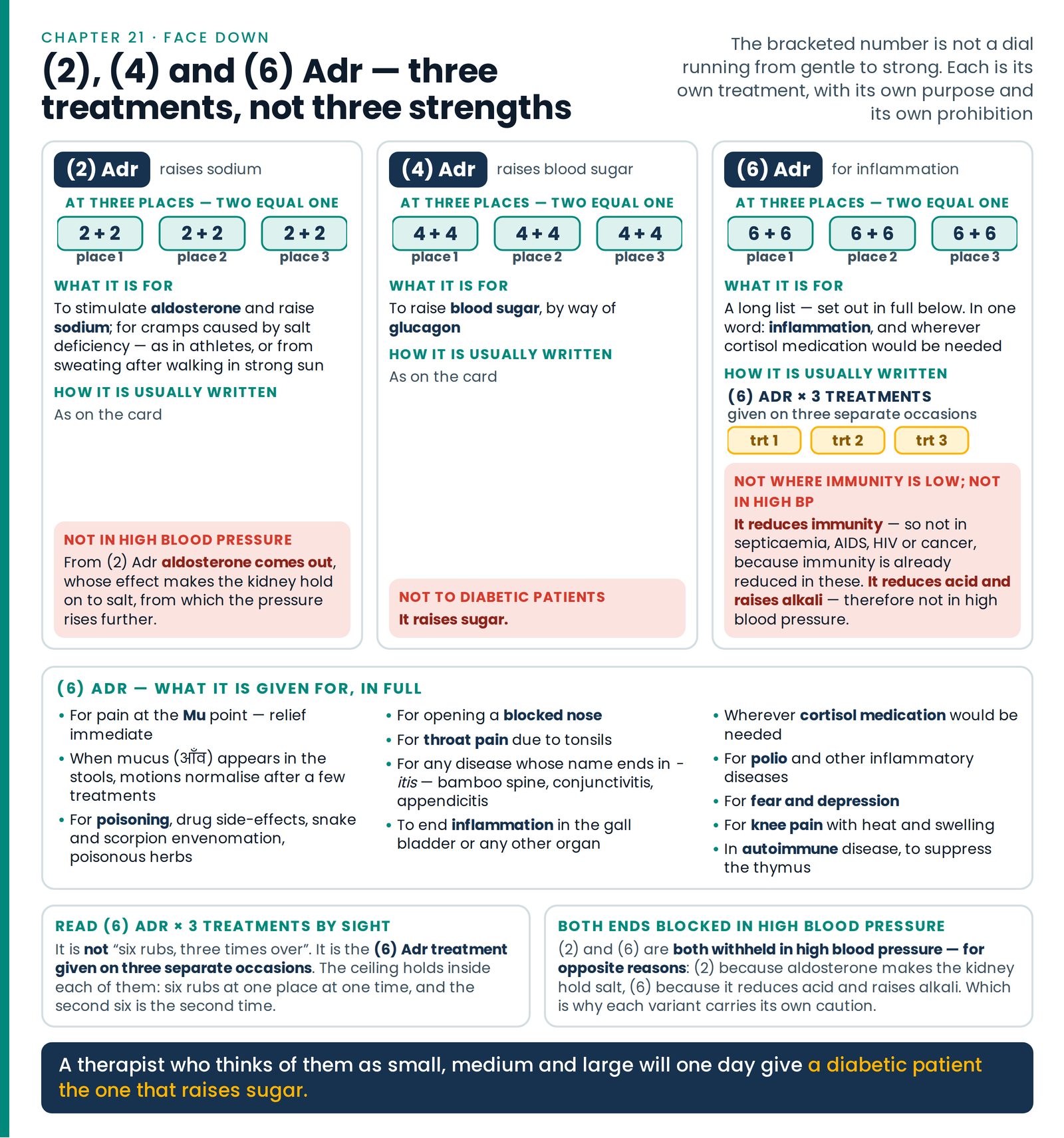
(6) ADR × 3 treatments is a form to learn by sight — not "six rubs, three times over", but the (6) Adr treatment given on three separate occasions. Note too that (2) and (6) are both withheld in high blood pressure for opposite reasons, which is why each variant carries its own caution. The rest of their use, and every condition in which each is blocked, is in Each Point in Use, "Each Point in Use", and When the Hand Must Stop, "When the Hand Must Stop". (Figure 21.3)
What lies beneath. A hand flat on the upper back lies over the broad sheet of muscle running to the shoulder, the two long ropes holding the spine upright, and then the ribs. The adrenal glands are nowhere near — two caps of four to six grams on top of the kidneys at the back of the belly, far lower than T6 and behind all of that. What the palm reaches is real; what it does not do is deliver a message to one named gland.
From Fire and Swelling
The adrenal cortex, T6, and the finding of (6) Adr
A question, a nerve supply half-remembered, and a hand laid on the back
The question that began it was the plainest question in this wiki. If some insect or creature bites, that place becomes red and swelling appears. So how should we treat this?
The answer came in two steps, and both are worth walking through slowly, because this is the clearest surviving example of how a treatment in this therapy actually gets made.
Step one — find out who is in charge of stopping it. The inflammatory response is the body's own work, so somebody inside the body must be responsible for calling it off. On practising, it was learnt that the chief responsibility of controlling — of stopping — inflammation belongs to the hormone cortisol, made by the cortex of the adrenal gland. If inflammation is a fire brigade that will not go home, cortisol is the officer who whistles them back to the station.
Step two — find a way to reach it with a hand. And here the difficulty was obvious at once. But the adrenal gland is at the back of the body, above the kidneys! How to provoke it? It is not a gland you can put a palm on. It sits deep, behind everything.
So the search moved from the gland to its wiring. On practising it was learnt that the nerve supply of the adrenal cortex is received from below T6? — and the therapy prints that question mark itself, because the statement was arrived at by reading and by inference rather than by dissection, and it has never been tidied since. On the strength of it, Guruji laid the patient face down and thought: let us see by rubbing — ghisāī — at that place on the back?
He did it a few times. The patient suddenly said he was feeling very good. The same treatment was given twice more at intervals, and almost all the swelling had come down.
The adrenal treatment, as it was made
(6) Adr × 3 treatments. If needed, it can be given again after 20 minutes.
Read the form by sight, because it is not what a beginner assumes. (6) Adr × 3 treatments is not "six rubs, three times over". It is the (6) Adr treatment given on three separate occasions — the × sign governs everything to its left, and what stands to its left is a whole treatment. Table 13, How a Formula Is Built.
This has proved to be the most important treatment for putting inflammation right.
Table 2 — Card: (6) Adr × 3 treatments, the adrenal treatment Prone Both sides × 3 ▲ Take care
| Written | (6) Adr × 3 treatments |
|---|---|
| Site | The middle part of the back, at three places, the hands set very close to the T6 bead |
| Position | Prone, with one and a half pillows under the chest — half the lower pillow sticking out beyond the edge, the chest on the upper, the chin resting on the lower. Compulsory Prone |
| The hands | Fingers gathered together, both palms laid down so that the flats of the two palms are very close to one another |
| The action | Rub from the middle outward as many times as the number written — and do the same again. That is: at three places, two equal one |
| The ceiling | At one place, do not rub more than 6 times at one time. If more is to be given, start again from the top ▲ Take care |
| The rounds | × 3 treatments — the whole treatment on three separate occasions, with the rest that Table 8, How a Formula Is Built sets for it |
| The repeat | If needed, it can be given again after 20 minutes |
| What it is for | Ending inflammation anywhere in the body, through the cortisol of the adrenal cortex |
| When it must not be given | If someone's immunity is low, then under no circumstances give (6) Adr at that time — septicaemia, cancer, AIDS. It reduces acid and raises alkali — therefore not in high blood pressure ▲ Take care |
| Point taught in | Face Down, "Face Down" |
Three things on that card catch students out, and all three are arithmetic.
The doubling is at the place, not at the places. Two equal one means you rub the written number outward at a place, and then do it again at that same place, and that pair is one of what the card asked for. It does not mean six places.
The ceiling is on a single stay, not on a session. (6) Adr asks for six rubs at a place and then six more, which is one (6) Adr. The ceiling — six at one place at one time — has not been broken, because the second six is the second time. If a card ever asks for more than the ceiling allows in one stay, you go back to the first of the three places and come down again. A large number becomes more passes down the back, never a longer stay in one spot.
And (2), (4) and (6) Adr are three treatments, not three strengths. (2) Adr raises sodium through aldosterone and is withheld in high blood pressure. (4) Adr raises blood sugar through glucagon and is withheld in diabetes. (6) Adr is the inflammation treatment, and carries its own two prohibitions. Nothing in this article permits substituting one for another.
Also explained in
- The Inflammation Treatment Formula — ITF Fire and Swelling
(6) Adr is aimed at the adrenal cortex, and through it at cortisol, the body's own officer for calling the defence home.
- Where this leads Fire and Swelling
(6) Adr × 3 treatments is the most important treatment for putting inflammation right — gathered palms very close to T6, three places, from the middle outward, two equal one, never more than six rubs at one place at one
- What distinguishes the two days Fire and Swelling
Day one gives (6) Adr twice.
- Questions students ask Fire and Swelling
The book says (6) Adr works by cortisol from the adrenal cortex, and then says the nerve supply "is received from below T6?" — with a question mark.
- The two adrenal points — cortex and medulla Each Point in Use
The mechanism and the prohibition are one thought (4) Adr To raise blood sugar by way of glucagon Do not give (4) Adr to diabetic patients ▲ Take care The same internal logic, applied to sugar instead of salt (6) Adr Us
- Polio, and why it belongs in this article Fire and Swelling
So such a patient was given (6) Adr × 3 treatments — and immediately said he felt somewhat better.
- Practical tips — joining ITF to another formula Fire and Swelling
Then we can treat thus — I (30) Medulla · II Fast treatment · III Ajay Normal + (6) Adr · IV ATF + (6) Adr, and so on.
- Introduction Fire and Swelling
Every written rest — the ninety seconds between the repeats of (6) Adr, the one minute between rounds, the five minutes between two whole formulas — is in Table 8 of that same article, with the reason given for each.
- The acute regimen — a sting, a bite, a swelling that is still growing Fire and Swelling
Establish that (6) Adr may be given at all.
- Choosing between the three families Fire and Swelling
What remains is the question a therapist actually faces with a patient in front of him, which is not what is this formula but which of these three is this? Table 11 — The chooser What you are looking at Which family Wh
- Introduction Face Down
Distinguish (2), (4) and (6) Adr as three treatments with three purposes and three prohibitions, and read (6) ADR × 3 treatments.
- Questions students ask Face Down
If (6) Adr is more than six rubs at a place, have I broken the ceiling? No — read the count.
- One disease, several points, one plan Each Point in Use
(6) Adr is given for polio — because polio is an inflammatory disease, and (6) Adr is the point that ends inflammation, given for any disease whose name ends in -itis.
- Questions students ask Each Point in Use
If (6) Adr is given for polio and the Armpit point is withheld in polio, how am I supposed to treat a polio patient? By giving each point the job it is written for.