- Category
- Kidney, bladder and fluid · Bones, joints, back and spine · Eyes, ears, nose, mouth and throat
- What is given
- JJ⁺²; L5–S1 ghisai; Kidney Clear with a left stone or more Mu° pain; Ulta Kidney Clear with a right stone or more Liv° pain; New Star Modified; New Genes formula; the knee, back, CP and alkali UDF formula; Bending forward then Standing; Sudhakar
- What is barred
- L3, 4, 5 — not where there is a fracture in any bone between L1 and S1
- Explained in
- The Low Back
Watch


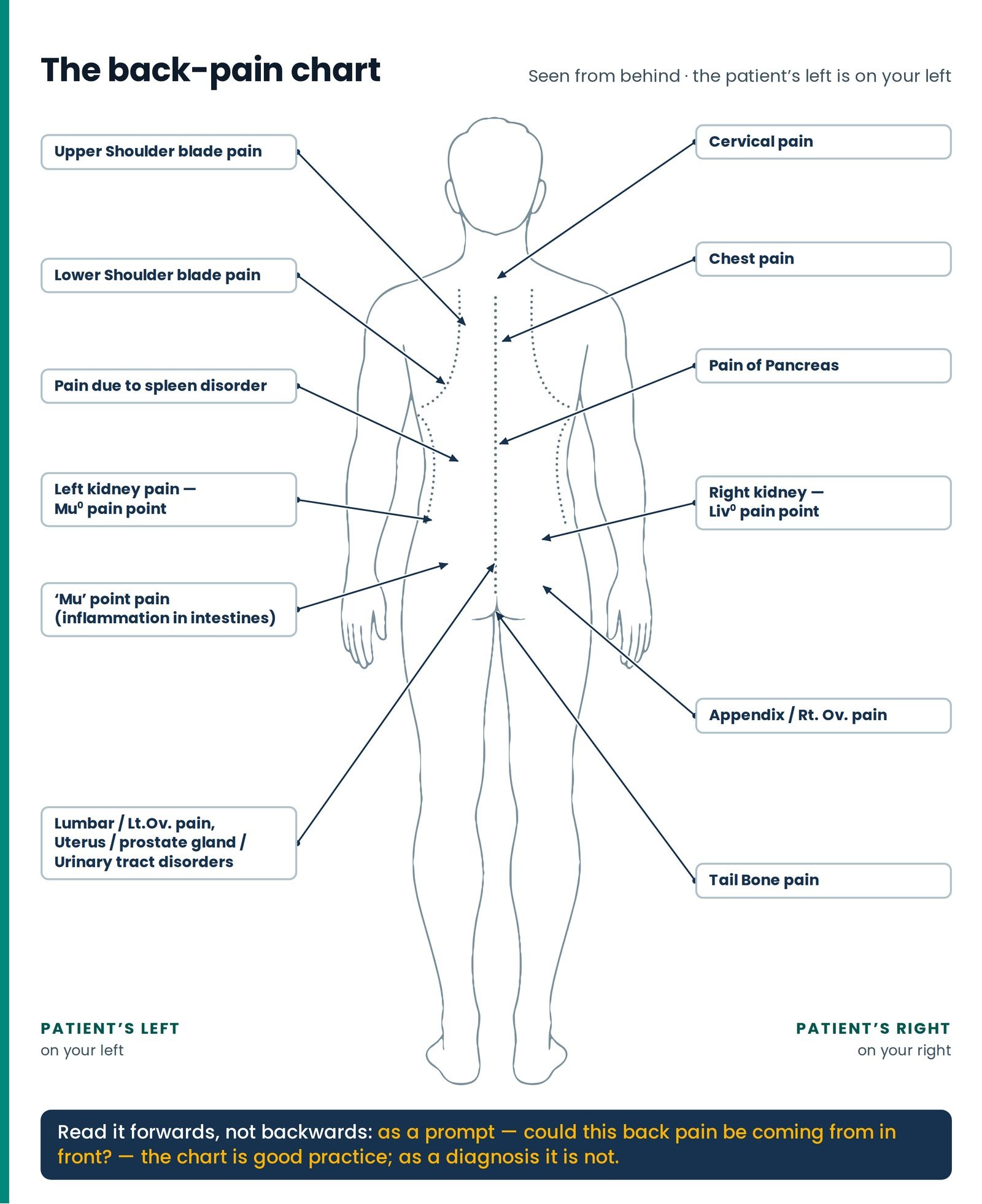
The back pain chart
Twelve sites where the back reports an internal organ’s trouble
The second full-page chart is a whole-body outline seen from behind, head to heels, the spine a dotted line down the middle, the shoulder blades and lower rib margins dotted curves either side. Twelve labelled call-outs run around it, and together they make a compact statement of something the body does constantly and confusingly: it reports the trouble of an internal organ as an ache in the back wall. (Figure 6.2)
One drafting point must not catch you. The drawing is a view from behind, so the patient's left is on the reader's right — but the twelve call-out boxes have been placed for the sake of the page, the left-sided labels sitting on the reader's left and the right-sided ones on his right, the arrangement that would be correct facing the patient's front. A student who learns the chart as a picture will reverse every side on it the first time he stands behind a patient. Locate these points by anatomy, never by the side of the page: spleen and Mu° on the patient's left; liver, Liv° and appendix on the patient's right. Left Right
Table 4 — The back pain chart, label by label
| Label on the chart | Where the arrow lands | What lies at that level |
|---|---|---|
| Cervical pain | Nape, base of the neck, midline | The seven neck bones and the long muscles either side |
| Upper Shoulder blade pain | Upper scapular region, inside the shoulder blade | Upper trapezius, the muscle that lifts the shoulder blade, the small rhomboid, over ribs two to four |
| Lower Shoulder blade pain | At the bottom corner of the shoulder blade | Large rhomboid, lower trapezius, ribs six to eight; the base of the lung deep to it |
| Chest pain | Upper back, beside the spine | The first six thoracic beads, the long back muscles, and the joints where each rib meets the spine |
| Pain due to spleen disorder | Lower thoracic, below the shoulder blade | Ribs nine to eleven and the fascia of the low back; deep to them, spleen left, liver right |
| Pain of Pancreas | Mid-thoracic beside the spine | Long back muscles, ribs ten to twelve; the pancreas lies at the front of this level |
| Left kidney pain — Mu° pain point | The flank, between the twelfth rib and the rim of the hip bone Left | The square muscle of the low back, the hip flexor, the fat around the kidney, and the kidney |
| Right kidney — Liv° pain point | The mirror-image flank Right | The same, the right kidney about half a bone lower because of the liver above it |
| Mu point pain — inflammation in intestines | Lower lumbar, out from the spine | Long back muscles and fascia; deep and in front, the descending colon and small-bowel loops |
| Lumbar / Lt.Ov pain — uterus, prostate gland, urinary tract disorders | Lower lumbar and upper sacral region | The junction of low back and sacrum, the joints between sacrum and hip bones; deep in front, the tubes from the kidneys, the bladder, the uterus or prostate |
| Appendix / Rt.Ov pain | Lower lumbar to the sacro-iliac joint, opposite side | That joint and the bony knob behind it; deep in front, the caecum and appendix, or the pocket in which the ovary sits |
| Tail Bone pain | Coccyx, top of the cleft of the buttocks | The tail bone and its joint with the sacrum; the muscles of the pelvic floor taking their attachment there |
The chart is intelligent about a real thing. A pancreas in trouble really does bore through to the mid-back and ease when the patient leans forward; a kidney in trouble really is felt in the loin between last rib and hip rim, running towards the groin as a stone travels; trouble in the womb or prostate really is felt low in the back and over the sacrum. But read it forwards, not backwards. Most back pain at every one of these levels is muscle and posture, and an ache between the shoulder blades is far more often a woman who sews for nine hours than a pancreas. As a prompt — could this mid-back pain be coming from in front? — the chart is good practice; as a diagnosis it is not.
From Clearing the Ash
For knee pain, back pain, CP children, and those whose alkali has increased
Table 18 — Card: the knee, back, CP and raised-alkali formula Seated Side-lying Prone Supine 6 sec
| Written | I (15) Medulla · II (3) Raman treatment · III (2) Rt Parkhoo (2) Lt Parkhoo · IV (½) Ku – 20 secs × 4 treatments · V (10) Medulla (1) Gas Only – 6 points + if there is constipation, then (4) Gas 'I' – 6 points |
|---|---|
| Stated indication | Knee pain · back pain · CP children · those whose alkali has increased |
| Part II — (3) Raman treatment | Seated Seated , the therapist standing behind. Both hands over the tops of the shoulders from behind, both first fingers very close to the neck, the palms of the two hands close to one another; the muscles of the back lifted upward from both sides. Lift and hold for six seconds, then release slowly; three times. Then the patient breathes in and out comfortably five or six times. Seated I — Brain, Medulla, Neck, "Seated — I" |
| Part III | The light pass only — (2) each |
| Part V | The compulsory pair; and only if there is constipation, (4) Gas 'I' – 6 points — four applications at six stations |
| What it does not have | No Ajay Normal closing. This is the only formula of the group that stops without one. The absence is the formula |
| Prohibitions | As for every formula in this group; and for a child with cerebral palsy, the further cautions below ▲ Take care |
Two things make this formula different, and both are readable from the card.
Raman has arrived, and it has arrived second. It is the first formula of the family to place it after the opening Medulla. In the two formulas that come after this one, Raman moves to the front and the opening Medulla is dropped.
And there is no absorption tail. The general and the stomach-setting formulas both end on Ajay Normal, which is the absorption step. This one ends at the compulsory pair. It is the shortest formula of the four, and the calves are added only for a costive bowel.
Also explained in
- The back that gets better, and the back that leaves the room today The Low Back
Nirmala Deshpande · 57 · retired bank cashier · Nashik · came with low back pain and pain down the right leg for five months What she said, on the twelfth day.
- Questions patients ask you The Low Back
Is that relevant to her back pain?" Yes — and thank you for saying it, because many people don't, thinking it is old news.
- Two treatments that serve the low back and the knee together The Low Back
Both of the treatments below are useful in both low-back pain and knee pain.
- STANDING POINT The Low Back
Patient's position Exactly as in Bending forward; therapist standing in front of the patient Seated Supine Where the feet go The heel on the joint from which each toe arises, on the top of the foot, big toe through t
- BINDU POINT — the long diagonal The Low Back
And above all of it: saddle numbness or new bladder or bowel trouble or both legs affected · back pain with a past cancer, night pain or new weakness · a fall or a sudden dated onset in a frail or steroid-treated person
- Questions students ask The Low Back
A woman came with low back pain and told me at the end that she is eleven weeks pregnant.
- Charging, or not charging Before You Touch Anyone
Shankarrao Deshpande · 66 · retired postmaster · Nanded · came with neck pain, giddiness on turning the head, and "new" low back pain of six weeks What he said.
- The milk for heavy bleeding Treating Women
For nausea, and to stop vomiting, Gas Only is immediately helpful — especially in pregnant women; but if they have back pain, it is better to give the treatment with the hands rather than the feet.
- The pillows Before You Touch Anyone
And the pillow must not come under the patient's waist, or they may get back pain during or after the treatment — it arches the low back and holds it arched for the entire session.
- The master list — every treatment point, by the position the patient is placed in The Shorthand
It is arranged not by organ and not by ailment, but by the position the patient is put into — supine, seated, side-lying, prone — with three further groups for the physical points of back pain, knee pain and everything e
- The Ulta Kidney Clear formula Water and Salt
Only not in lung cancer; in chronic illness all the arrows only as far as (L1–L5) ▲ Take care Table 26 — Which of the two, on the findings Finding Kidney Clear Ulta Kidney Clear The stone Left kidney stone Right kidney
- The article in one table — finding to formula Water and Salt
Parkhoo (2) Adr Heart disease · atherosclerosis · raised cholesterol · raised triglyceride · cardiac asthma · carpal or tarsal tunnel syndrome The Angina / Athero treatment, parts I–IV — and Mild ATF in place of part II
- Changing position in the middle of a formula Placing the Patient
She grew slowly worse — more back pain, in the evenings.
- The low back, the sacrum and the tail bone Each Point in Use
JJ⁺² Prone For knee pain, low back pain, and slip disc between L4, L5, S1 But if someone has knee pain together with pain in the soles of the feet, then they are to be given BOF treatment, and JJ⁺² is not to be given th