The patient is turned face down, and the atlas arrives at its largest and most forceful group. Here the spine lies directly under the hand, and the therapist's whole weight, carried on two chairs, is delivered through a heel — the gentlest stroke in the therapy and, a little further on, a jerk driven upward into the sacrum.
And here, more than anywhere, the arrangement of the body comes before the treatment. The rule for this group is printed at the foot of every page of it, which tells you how often it is forgotten.
Watch


The rule printed at the foot of every page
1½ pillows under the chest, compulsory — and the four prone stances
The four positions, the two-chair method, and how a patient is helped down onto their front are taught in Placing the Patient, "Placing the Patient", and are not repeated.
For the treatments given lying on the stomach — that is, laid face down — putting 1½ pillows under the chest is compulsory. That is:
The arrangement for every treatment given face down
Half of the lower pillow should stick out.
The chest should rest on the upper pillow.
Their chin should rest comfortably on the lower pillow.
Count the pillows the way the rule counts them. Two lie on the floor and the rule calls them one and a half, because only half of the lower one is under the patient; the other half projects beyond the edge, and that half is what the chin rests on. (Figure 21.1)
Three parts, three jobs. The upper pillow lifts the chest, taking the small of the back out of its deepest arch and leaving the lower ribs free; the projecting half of the lower gives the chin somewhere to sit; and the overhang leaves the face clear, so the patient breathes with the head down, not turned.
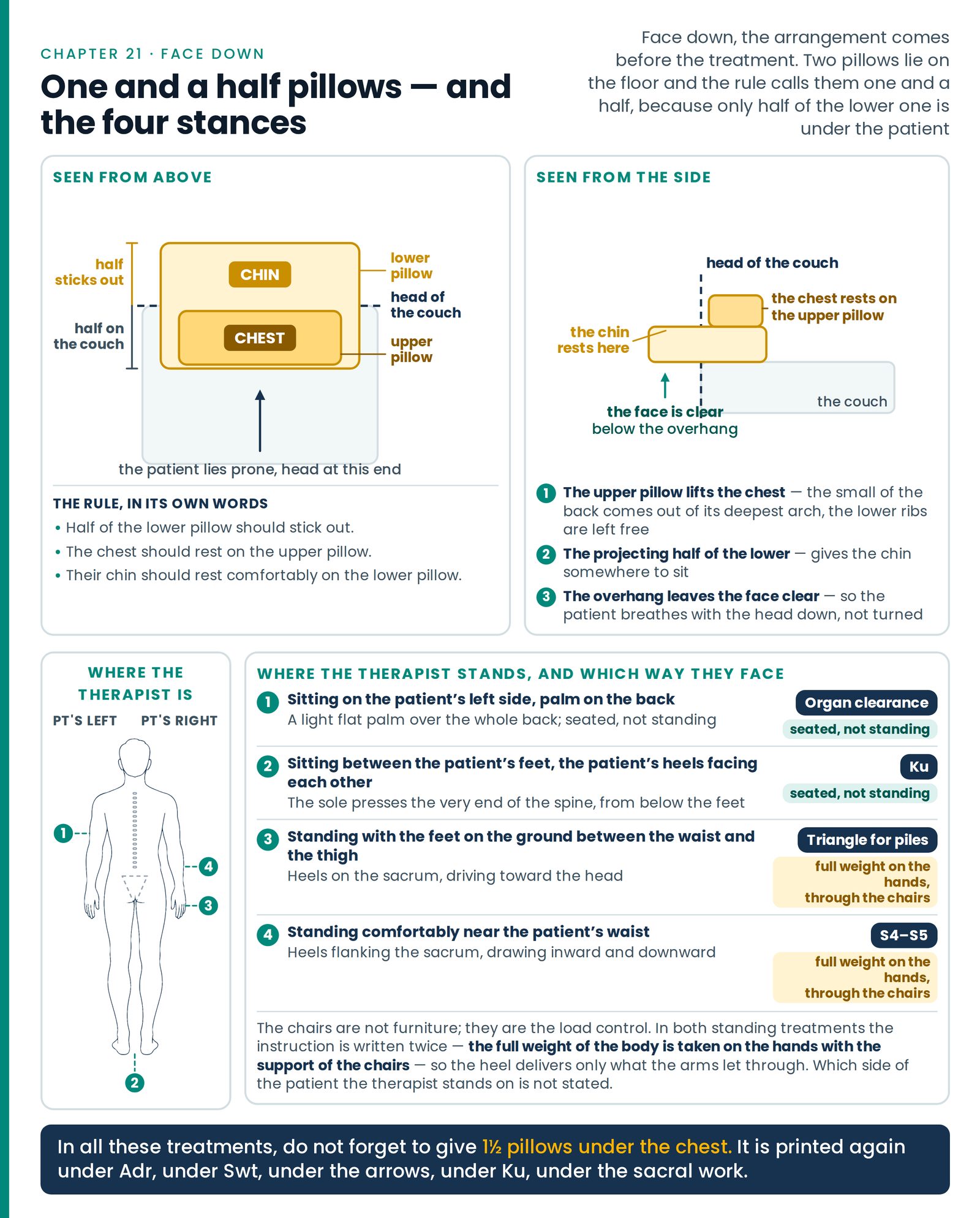
Where the therapist stands, and which way they face
| The stance | Named in | What it allows |
|---|---|---|
| Sitting on the patient's left side, palm on the back | Organ clearance | A light flat palm over the whole back; seated, not standing Prone |
| Sitting between the patient's feet, the patient's heels facing each other | Ku | The sole presses the very end of the spine, from below the feet |
| Standing with the feet on the ground between the waist and the thigh, the full weight of the body on the hands with the support of the chairs | Triangle for piles | Heels on the sacrum, driving toward the head |
| Standing comfortably near the patient's waist, again with the full weight on the hands through the chairs | S4–S5 | Heels flanking the sacrum, drawing inward and downward |
The chairs are not furniture; they are the load control. In both standing treatments the instruction is written twice — the full weight of the body is taken on the hands with the support of the chairs — so the heel delivers only what the arms let through. And at Triangle for piles the chairs decide the direction: place them so that the pressure is in the direction of the head, and not in the direction of the ground.
The two adrenal points
Adr for the cortex, Swt for the medulla — and nothing else is alike
Two points open the group, a pair by design: one is said to reach the outside of a gland, the other the inside. They are not alike — the hands are shaped differently, the pressure runs in a different direction, and they are counted differently.
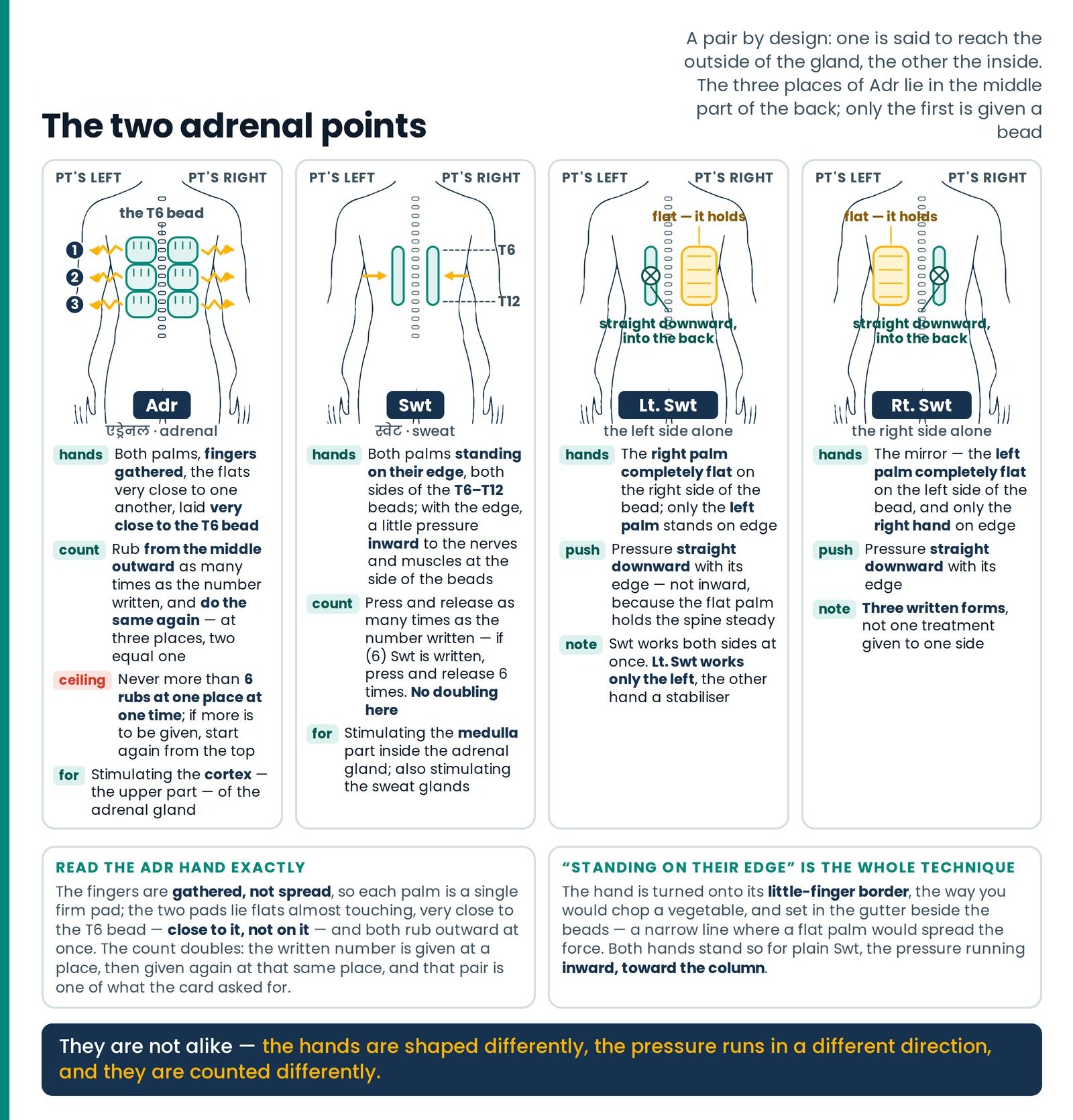
This is given to stimulate the cortex — that is, the upper part — of the adrenal gland.
Gathering your fingers together, place both palms very close to the T6 bead of the back, so that the flats of the two palms are very close to one another.
In the middle part of the back, at three places, rub from the middle outward as many times as the number written, and do the same again.
That is: at three places, two equal one.
At one place, do not rub more than 6 times at one time. If more is to be given, start again from the top.
| Patient's position | Prone, 1½ pillows under the chest, the chin resting Prone |
|---|---|
| Where the hands are placed | Both palms, fingers gathered, flats very close to one another, laid very close to the T6 bead; then at three places in the middle part of the back |
| Duration and repetitions | Rub from the middle outward as many times as the number written, and do the same again — at three places, two equal one. Never more than 6 rubs at one place at one time; if more is to be given, start again from the top ▲ Take care |
| What it is for | Stimulating the cortex — the upper part — of the adrenal gland |
Read the hand exactly. The fingers are gathered, not spread, so each palm is a single firm pad; the two pads lie flats almost touching, very close to the T6 bead — close to it, not on it — and both rub outward at once. And the count doubles: the written number is given at a place, then given again at that same place, and that pair is one of what the card asked for. (Figure 21.2)
ADR — एड्रेनल · adrenal
The ceiling on Adr, and what to do when the card asks for more
At one place, do not rub more than 6 times at one time. If more is to be given, start again from the top.
If the number written is larger than the ceiling allows, you do not stay and keep rubbing — you go back to the first of the three places and come down again. A large number becomes more passes down the back, never a longer stay in one spot.
(2) Adr, (4) Adr, (6) Adr — three treatments, not three strengths
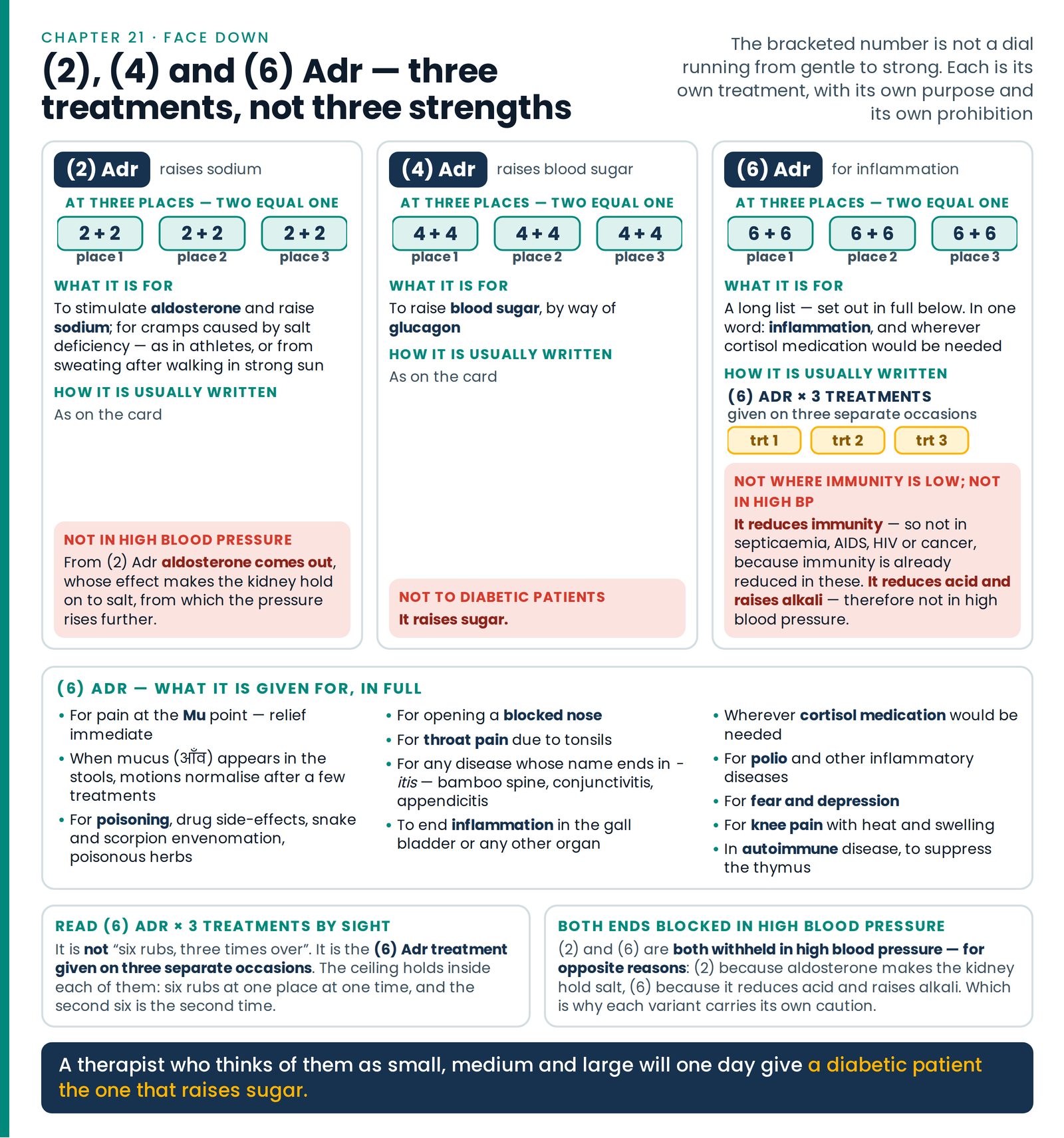
(6) ADR × 3 treatments is a form to learn by sight — not "six rubs, three times over", but the (6) Adr treatment given on three separate occasions. Note too that (2) and (6) are both withheld in high blood pressure for opposite reasons, which is why each variant carries its own caution. The rest of their use, and every condition in which each is blocked, is in Each Point in Use, "Each Point in Use", and When the Hand Must Stop, "When the Hand Must Stop". (Figure 21.3)
What lies beneath. A hand flat on the upper back lies over the broad sheet of muscle running to the shoulder, the two long ropes holding the spine upright, and then the ribs. The adrenal glands are nowhere near — two caps of four to six grams on top of the kidneys at the back of the belly, far lower than T6 and behind all of that. What the palm reaches is real; what it does not do is deliver a message to one named gland.
SWT — स्वेट · sweat
With this treatment we stimulate the medulla part inside the adrenal gland.
It is also useful for stimulating the sweat glands.
Place both palms standing on their edge on both sides of the T6–T12 beads, and with the edge of the hands give a little pressure inward to the nerves and muscles at the side of the beads, pressing and releasing as many times as the number written. If (6) Swt is written, press and release 6 times.
If Left Swt is to be given, place the right palm completely flat on the right side of the bead, and keep only the left palm standing on edge, giving pressure straight downward with its edge. If Right Swt is to be given, place the left palm completely flat on the left side of the bead, and keep only the right hand standing on edge and give pressure.
| Patient's position | Prone, 1½ pillows under the chest Prone |
|---|---|
| Where the hands are placed | Both palms standing on their edge, both sides of the T6–T12 beads; the edge of the hands, a little pressure inward to the nerves and muscles at the side of the beads |
| Duration and repetitions | Press and release as many times as the number written — if (6) Swt is written, press and release 6 times. No doubling convention here |
| Laterality | Left Swt: right palm completely flat on the right side of the bead, only the left palm on edge, pressure straight downward Left · Right Swt: the mirror — left palm flat, only the right hand on edge Right |
| What it is for | Stimulating the medulla part inside the adrenal gland; also stimulating the sweat glands |
"Standing on their edge" is the whole technique. The hand is turned onto its little-finger border, the way you would chop a vegetable, and set in the gutter beside the beads — a narrow line where a flat palm would spread the force. Both hands stand so for plain Swt, the pressure running inward, toward the column.
When one side alone is written, the other hand changes job entirely. For Left Swt the right palm goes down completely flat and stays there, and only the left works — and because the flat palm holds the spine steady, the pressure at Lt. and Rt. Swt is straight downward rather than inward. Three written forms, not one treatment given to one side.
What lies beneath. In the gutter either side of the T6–T12 beads lie the long upright muscles, the short slanting ones beneath, and the nerves supplying both. The sympathetic chain, which does reach the adrenal medulla, runs at these levels — but down the front of the vertebrae, on the far side of the bone from any hand on a back. The therapy has named the right system and the wrong side of it. The sweat half of the name is better founded: sweat glands really are governed by that same chain, segment by segment down the trunk.
The arrow family — six ways of working one strip of back
Tool, path, direction, count — the four things that separate them
Six treatments follow, one family: strokes run along or beside the spinal column, differing in exactly four things — what tool, what path, which direction, how it is counted.
They also share a set of glyphs, and this is the first group in the atlas where a point is likely to be met drawn rather than spelled. The full plate is in The Shorthand, "The Shorthand"; below is the family's own corner of it, described in words.
The six glyphs of the arrow family, described in words
Drawn on the card · Read it as · How it is drawn
\ ° / — also written ↖o↗ · Back arrow · A small circle with a stroke leaning away from it on each side, up-left and up-right, like two arms opening. Often preceded by three small arrows in a row
↑o↑ · H arrow · Two upward arrows with a small circle between them. Both heads point up
A ring-topped stem with a downward arrowhead · On the spine · A short stem, a small open ring at the top, an arrowhead below pointing down
↕ ° ↕ · Beside the spine · A double-headed vertical arrow, a ring-topped stem, a second double-headed arrow — the arrows standing either side of the stem, as the fingers stand either side of the spine
↑ \ · ↓ · Round arrow · An upward arrow, a plain vertical bar, a downward arrow, side by side
A plain ring-topped stem with no arrowhead at all · Up Arrow · The bare ring-and-stem. A different point, and not in this article — see Uncommon Problems
Three rules for reading them. An arrowhead shows the direction of your own push, never a flow inside the patient. The presence or absence of the head changes the point — ring-stem with a downward head is On the spine, the same stem bare is Up Arrow. And the number of heads is the number of directions the stroke travels.
BACK ARROW — बेक एरो
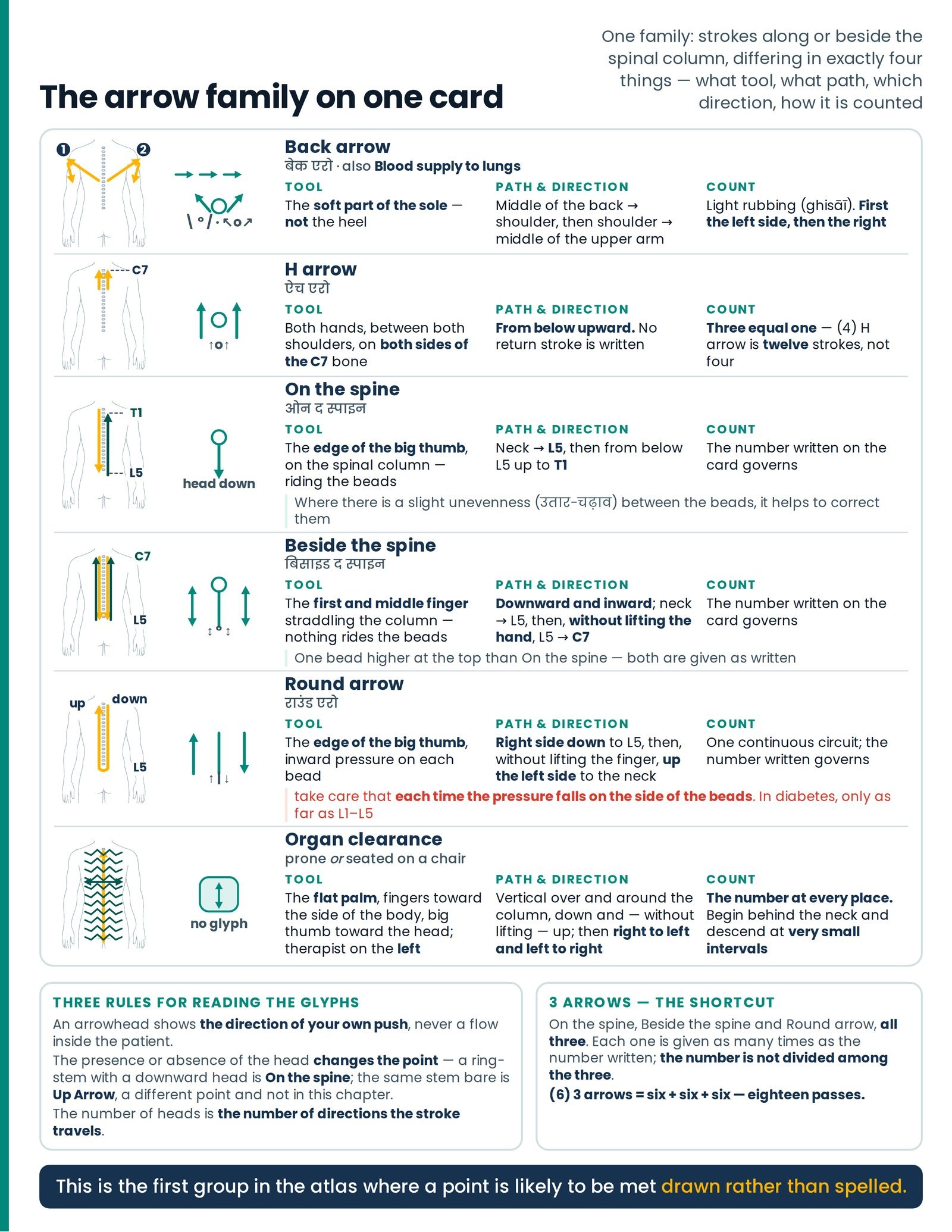
Its other name is Blood supply to lungs, because it increases blood circulation in the lungs. It is given in all breathing-related diseases.
With the soft part of the sole of the foot — from the middle of the back toward the shoulder, and from the shoulder to the middle part of the upper arm — do light rubbing (ghisāī). First the left side, then the right side.
Its symbol is → → → ↖o↗
| Patient's position | Prone, 1½ pillows under the chest Prone |
|---|---|
| Where the feet are placed | The soft part of the sole — not the heel — middle of the back → shoulder, then shoulder → middle of the upper arm |
| Duration and repetitions | Light rubbing (ghisāī); first the left side, then the right side Left Right |
| What it is for | Increasing blood circulation in the lungs; given in all breathing-related diseases |
Two words in that instruction are the safety of the point — soft part of the sole, never the heel, and light. The route is one continuous sweep in two halves, and the order is written: left side first, then right. (Figure 21.4)
What lies beneath. The big diamond of muscle across the upper back, the muscles binding the shoulder blade to the spine, the cap over the point of the shoulder — and under the inner edge of the shoulder blade, the ribs, with the top of the lung rising higher than most students expect. And the claim, once, since it recurs: pulmonary blood flow is set by the heart and the lungs' own vessels, not by a hand on a back. What a sweep can do is loosen a chest wall that has been working hard — worth having alongside a patient's inhaler, never instead of it.
H ARROW — ऐच एरो
Between both shoulders, on both sides of the C7 cervical bone, rub from below upward.
The count is three equal one.
Its symbol is ↑o↑
| Patient's position | Prone, 1½ pillows under the chest, the chin resting Prone |
|---|---|
| Where the hands are placed | Between both shoulders, on both sides of the C7 cervical bone |
| Duration and repetitions | Rub from below upward; the count is three equal one |
| What it is for | Not separately stated |
The count catches people. Three equal one — three upward strokes make one of what the card asks, so (4) H arrow is twelve strokes, not four. And the direction is one-way: from below upward, with no return stroke written, unlike the two points that follow.
ON THE SPINE — ओन द स्पाइन
On the spinal column, with the edge of your big thumb, rub from the neck down to the L5 bone, and then from below L5 upward to T1.
If there is a slight unevenness (उतार-चढ़ाव) between the beads, this helps to correct them.
See the picture for how to place the hand and fingers on their back.
| Patient's position | Prone, 1½ pillows under the chest Prone |
|---|---|
| Where the hands are placed | The edge of the big thumb, on the spinal column — riding the beads |
| Duration and repetitions | Rub from the neck down to the L5 bone, then from below L5 upward to T1; the number written on the card governs |
| What it is for | Where there is a slight unevenness between the beads, it helps to correct them |
The tool is the edge of the thumb, not its pad — the firm border from knuckle to nail, which can follow a row of knobs where the pad would slip off. Down, then up, and the two ends differ: down from the neck to L5, back up from below L5 to T1 — a return that stops short of where it started.
BESIDE THE SPINE — बिसाइड द स्पाइन
Place your first finger and middle finger so that they lie on both sides of the spinal column. Then, pressing those fingers with a little pressure downward and inward into the back, rub from the neck down to the L5 bone, and — without lifting the hand — then from L5 upward to the C7 bone.
| Patient's position | Prone, 1½ pillows under the chest Prone |
|---|---|
| Where the hands are placed | The first finger and middle finger on both sides of the spinal column, pressed with a little pressure downward and inward into the back |
| Duration and repetitions | Rub from the neck down to the L5 bone, and, without lifting the hand, from L5 upward to the C7 bone; the number written on the card governs |
| What it is for | Not separately stated at the point. Elsewhere the aim is given as stimulating the 31 pairs of spinal nerves that lie on both sides of the backbone |
The two fingers straddle the column, spread just enough that the beads run between them — nothing rides the beads, which is the whole difference between this point and the one before it. The pressure has two components and both are written: downward into the back, and inward toward the midline; and the hand does not lift at the turn, so the return drags the tissue the opposite way over ground already loaded.
Note the upper end, and note that it differs. On the spine returns to T1; Beside the spine to C7, one bead higher. Both are given as written.
What runs along and beside the spine, and why the therapy works it so heavily
The column.
Twenty-four movable bones — seven in the neck, twelve in the chest, five in the low back — then the sacrum, five bones fused into one triangular plate, and the tail bone. What the thumb rides is the row of backward spurs; the blocks that carry the weight, the cushions and the turning joints lie deeper and in front.
The thirty-one pairs of nerves. Along the whole cord, nerves leave in pairs, one left and one right, through small openings between the bones: thirty-one pairs — eight in the neck, twelve in the chest, five in the low back, five at the sacrum, one at the tail bone. Each is formed where two roots join, one carrying sensation in, one carrying orders out. Everything you feel and everything you move travels one of those thirty-one routes.
And every one divides at once. Within a finger's breadth of leaving the bone each nerve splits. The larger branch turns forward, becoming the nerves of the chest wall, belly wall and limbs. The smaller branch turns backward — and that is what this article is about: it supplies the deep muscles that hold the spine upright, the small joints between the beads, and a strip of skin either side of the midline. Work the gutter beside the spine and those backward branches are under your finger. They also carry pain from the back's own joints and muscles, which is why tenderness beside the spine is so common and so easily reproduced.
The lanes of muscle. Beside the beads runs a long column each side — three ropes inside a strong fibrous sheet — and beneath them short deep muscles running slantwise from one bead to another: the spine's own steadying system, packed with the tiny sense organs that report how much a muscle is stretched. The most densely reported-on piece of muscle in the body.
And the honest boundary. On the front face of the column runs the great chain of the alarm system and the nerves reaching the organs of the belly — the real fact behind "the spine influences the organs", and in the same breath the reason no hand on a back reaches that chain. What can be said honestly is that steady, firm, repeated pressure into this strip reliably reduces how much pain a person feels, locally and at sites away from the hand. A real effect at a real site, needing no claim that a bone was moved.
ROUND ARROW — राउंड एरो
The rubbing is done with the edge of your big thumb. Starting from below the neck, on the right side of the spinal column, giving inward pressure on each bead and pressing the nerves below, rub down as far as the L5 bone; then, without lifting the finger, come up the left side of the spinal column, from below upward to the neck.
Take care that each time the pressure falls on the side of the beads.
| Patient's position | Prone, 1½ pillows under the chest Prone |
|---|---|
| Where the hands are placed | The edge of the big thumb, right side of the column, below the neck down to L5; then, without lifting the finger, up the left side to the neck. Inward pressure on each bead, pressing the nerves below Right Left |
| Duration and repetitions | One continuous circuit — right side down, left side up; the number written on the card governs |
| What it is for | Not separately stated at the point; the emphasis is that each time the pressure falls on the side of the beads |
The "round" is the shape of the journey: down one side, round at L5, up the other, the thumb never leaving the skin. Right side down, left side up is written. What lies beneath is as under Beside the spine; the force is aimed into the angle between the bead and the muscle beside it.
3 ARROWS
If On the spine, Beside the spine and Round arrow are all three to be given, we call it "3 arrows" as a shortcut. Each one is to be given as many times as the number written.
| Patient's position | Prone, 1½ pillows under the chest Prone |
|---|---|
| What it consists of | On the spine, Beside the spine and Round arrow — all three |
| Duration and repetitions | Each one is given as many times as the number written; the number is not divided among the three |
| What it is for | A shortcut in the writing, not a separate treatment |
Shorthands are where doses get lost. (6) 3 arrows means six On the spine, six Beside the spine, six Round arrow — eighteen passes.
ORGAN CLEARANCE
This treatment can be given lying prone or seated on a chair. Sitting on their left side, place your palm on their back so that the fingers point toward the side of the body and the big thumb points toward the head. (See the figure.) Do it at each place as many times as the number given.
First, following the vertical arrows of the left figure, rub lightly over and around the spinal column — from above downward, and then, without lifting the hand, from below upward as well.
Then, following the horizontal arrows of the right figure, rub from right to left and from left to right.
Begin from behind the neck and descend at very small intervals.
If (10) Organ clearance is written, do it ten times at every place.
| Patient's position | Lying prone with 1½ pillows under the chest, or seated on a chair; the therapist sitting on the patient's left side Prone Seated |
|---|---|
| Where the hands are placed | The palm on the back, fingers toward the side of the body, big thumb toward the head. Vertical strokes over and around the column, down and, without lifting the hand, up; then horizontal, right to left and left to right |
| Duration and repetitions | Begin from behind the neck and descend at very small intervals, doing it at each place as many times as the number given — if (10) Organ clearance is written, do it ten times at every place |
| What it is for | Not separately stated; the rubbing is to be light |
The only treatment in the group covering the whole back rather than a named level, and the only one that may be given either face down or in a chair. The hand's stated orientation lets it run both ways without being repositioned.
"At very small intervals" is the count you are most likely to break. (10) Organ clearance is not ten strokes on a back; it is ten at the first station behind the neck, ten at the next, all the way down. And the name: clearance invites a story about waste being flushed out by rubbing, which measurement does not support. What is well supported is broader — slow, repeated contact over a large area settles a person. That is what an honest therapist says it does.
Sudhakar — the back treatment for which no method is given
A name that outruns its method, and a silence left standing
One more treatment belongs to this strip of back, and a student will meet it on a card long before they meet it in a article. It is called Sudhakar, after the patient in whom it was worked out, and this is the whole of what the therapy says about it: in this treatment, the muscles around all the vertebrae of the back are moved and brought to their correct place, and it is beneficial for the neck, the back, and all pains.
That is the entry, and it is an entry about what the treatment does, not about how a pair of hands does it. No tool, no path, no direction, no count and no order is given for Sudhakar anywhere. The six arrows above each name the edge of the thumb or the two fingers or the soft sole, the station it starts from, the station it ends at and the way the number on the card is spent. Sudhakar names none of these, and none is supplied here.
So the honest position for a therapist is this. You may read the card and know what is wanted — every vertebra of the back, the muscles around it moved and set back in place, for the neck, the back and all pains. You may not read it and know what to do with your hands, and a treatment reconstructed out of that description would be your own work under somebody else's name. Where a card says Sudhakar and you have not been shown it hand to hand, give the treatments of this article that do carry their method — the three arrows over the same territory, Organ clearance over the whole of it — and write on the card what you gave.
This is not the only place in the therapy where a name outruns its method, and the wiki does not close such a gap by filling it in. The material's own silences are left standing exactly where they stand, in the same way as its perhaps, its nowadays and its research is still going on.
The sacrum — Ku, the Triangle, and S4–S5
The most forceful work in the atlas, and its clearest prohibitions
The last three treatments are given over the sacrum, the broad triangular plate at the base of the spine, and they are the most forceful things in the atlas. They also carry the group's clearest prohibitions — and those point in opposite directions.
There are two kinds.
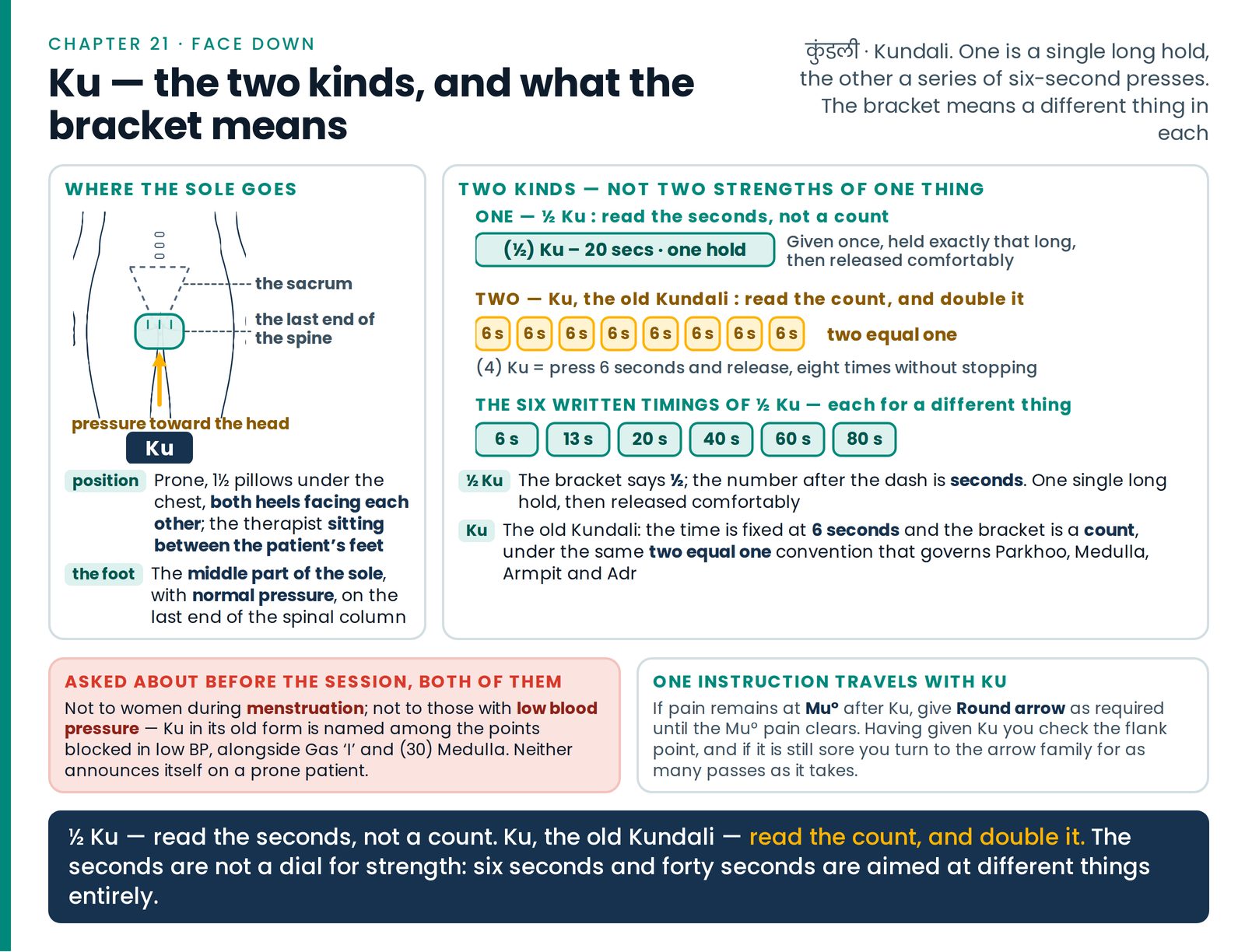
One is ½ Ku, in front of which is written how many seconds the treatment is to be given. For example: (½) Ku – 6 secs, (½) Ku – 20 secs, and so on.
Method of treatment: Lay the patient so that both their heels face each other. Sit between their feet, and with the middle part of your sole, with normal pressure, press on the last end of their spinal column; hold it pressed for as many seconds as is written, and then release comfortably.
There is another kind, called Ku, or the old Kundali. In that the time is 6 seconds; the count is two equal one. If (4) Ku is written, press for 6 seconds and release, and do this 8 times without stopping.
| Patient's position | Prone, 1½ pillows under the chest, both heels facing each other; the therapist sitting between the patient's feet Prone |
|---|---|
| Where the feet are placed | The middle part of the sole, with normal pressure, on the last end of the spinal column |
| Duration and repetitions | ½ Ku: held for as many seconds as is written — for example (½) Ku – 6 secs, (½) Ku – 20 secs — then released comfortably. Ku, the old Kundali: the time is 6 seconds, the count is two equal one, so (4) Ku = press for 6 seconds and release, 8 times without stopping |
| What it is for | Not stated at the point; each written timing carries its own purpose — see below ▲ Take care |
KU — कुंडली · Kundali
The two kinds are not two strengths of one thing. One is a single long hold, the other a series of six-second presses. (Figure 21.5)
½ Ku — read the seconds, not a count. The bracket says ½; the number after the dash is seconds. Given once, held exactly that long, then released comfortably.
Ku, the old Kundali — read the count, and double it. The time is fixed at six seconds and the bracket is a count, under the same two equal one convention that governs Parkhoo, Medulla, Armpit and Adr — so (4) Ku is eight presses of six seconds, without stopping.
Every written timing of Ku, and what each one is for
Each is a different instruction with a different purpose. They are never merged, and a card asking for one is not satisfied by another.
Written as · How it is given · What it is for · When it must not be given
(4) Ku (the old Kundali) · Two count as one — eight applications of 6 seconds, without stopping · To reduce alkali. To reduce spasticity and stiffness in the joints. If pain remains at Mu° after Ku, give Round arrow as required until the Mu° pain clears · Not to women during menstruation. Not to those with low blood pressure ▲ Take care
(½) Ku – 6 secs · Once, for 6 seconds · For the mast cells, which assist in producing heparin · —
(½) Ku – 13 secs · Once, for 13 seconds · For the eosinophils · —
(½) Ku – 20 secs · Once, for 20 seconds · For the neutrophils, which will fight infection. To raise WBC, RBC, monocytes and so on. To correct infection or inflammation in the intestines of those who have had UDF for many years · —
(½) Ku – 40 secs · Once, for 40 seconds · To stimulate the pineal gland — for melatonin. To correct disorders of the brain, speech or CSF — such as MND and MS. Excellent for cerebral atrophy · —
(½) Ku – 60 secs · (½) Ku – 80 secs · Once, for 60 or for 80 seconds · These also stimulate the pineal gland. Research on them is continuing · —
The seconds are not a dial for strength — six seconds and forty seconds are aimed at different things entirely. And the last line stands as written: research on them is continuing. A therapy that marks its own unfinished work deserves the mark kept.
And one instruction travels with Ku rather than with the point it names. If pain remains at Mu° after Ku, give Round arrow as required until the Mu° pain clears. Having given Ku, you check the flank point, and if it is still sore you turn to the arrow family for as many passes as it takes.
What lies beneath. The sacrum and the tail bone, with short strong ligaments and the great buttock muscle taking origin from the back of the plate. Deeper, on the front of the sacrum, lie the last station of the alarm chain and the nerves governing bladder and bowel. Interesting anatomy, a long way short of a demonstrated mechanism.
TRIANGLE FOR PILES — ट्रायंगल फॉर पाईल्स
This is given for piles (बवासीर). That is why it has been given this name.
Method:
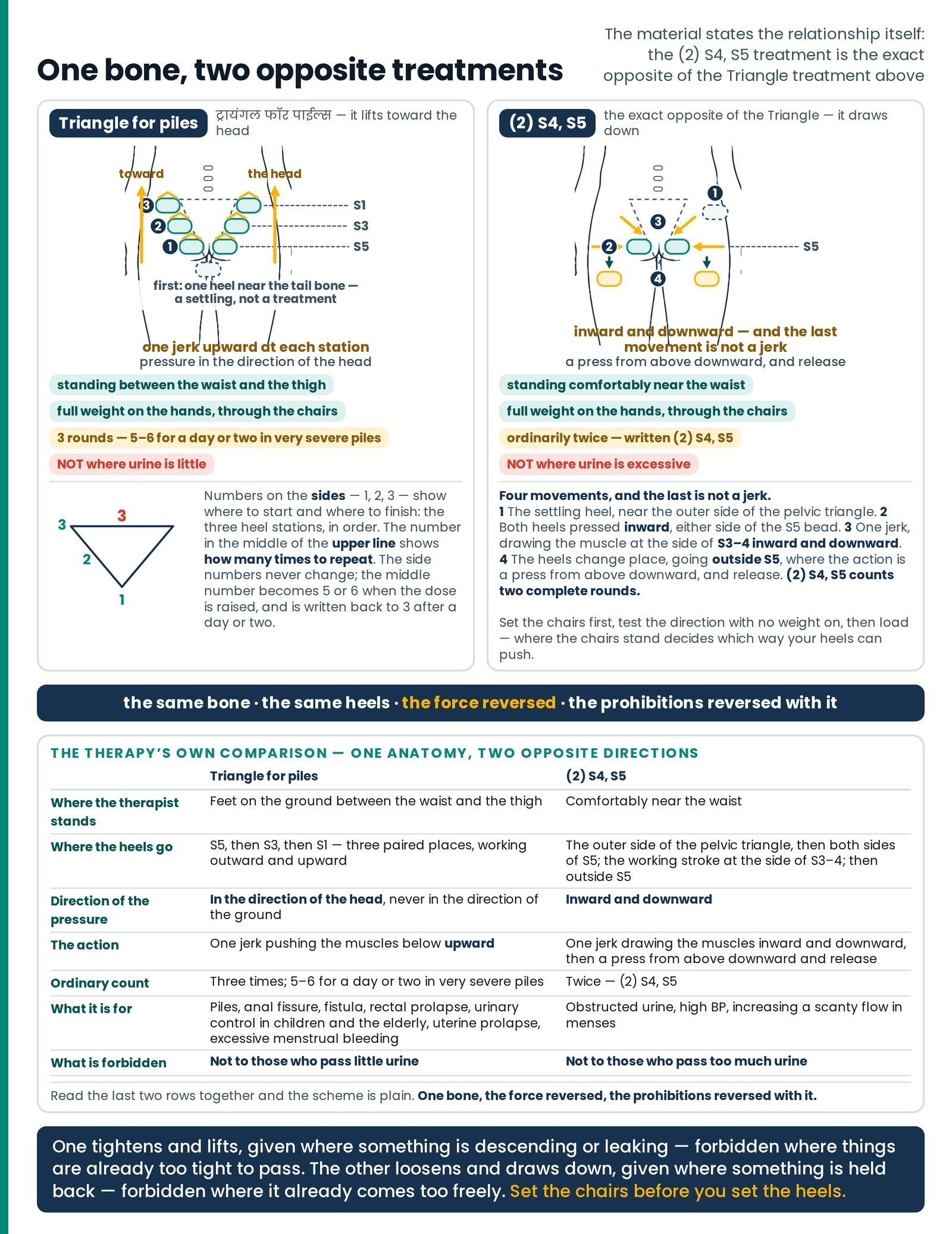
As per the figure, stand with the feet on the ground between the waist and the thigh. First place the heel of one foot on their hip near the tail bone — that is, the last end of the spinal column.
Then, taking the full weight of the body on the hands with the support of the chairs, place both heels above the hip, near the S5 bead (at the place marked 1 in the figure).
Simultaneously pressing with the heels in the direction of the head, with one jerk push the muscles below upward.
Then change the position of your heels, placing them slightly outward, near the S3 bead, and give an upward jerk.
Finally, do the same near the S1 bead.
Repeat as many times as needed.
In the symbol above, the numbers '1', '2', '3' on the sides of the triangle show where to start and where to finish; but the number '3' written in the middle of the upper line shows how many times to repeat.
For an ordinary person three times is enough, but for very severe piles one may give 5–6 times for a day or two at first — then the middle number will change to 5 or 6.
Besides piles, it also gives benefit in anal fissure, fistula and prolapse of the rectum. It is also beneficial for control of urine in children and in the elderly, and in women for prolapse of the uterus and for controlling excessive bleeding in menstruation.
| Patient's position | Prone, 1½ pillows; the therapist standing with the feet on the ground between the waist and the thigh, the full weight of the body on the hands with the support of the chairs Prone |
|---|---|
| Where the feet are placed | First the heel of one foot near the tail bone — the last end of the spine. Then both heels above the hip, near the S5 bead (place 1); slightly outward, near S3 (place 2); near S1 (place 3) |
| Duration and repetitions | At each place, pressing with the heels in the direction of the head, with one jerk push the muscles below upward. Three times is enough for an ordinary person; for very severe piles, 5–6 times for a day or two — the middle number then changes to 5 or 6. Repeat as many times as needed |
| Direction | Place the chairs so that the pressure is in the direction of the head, and not in the direction of the ground ▲ Take care |
| What it is for | Piles (बवासीर); anal fissure, fistula, prolapse of the rectum; control of urine in children and the elderly; in women, prolapse of the uterus and excessive bleeding in menstruation |
The three stations trace the shape of the bone — a triangle standing on its point: place 1 low and close to the midline at S5, place 2 further out at S3, place 3 highest and widest at S1. The first placement, one heel near the tail bone, is a settling, not a treatment. Then every station is one jerk, upward — a single quick lift of the tissue toward the head, both heels together, after which the heels are moved. You do not jerk twice from the same place. (Figure 21.6)
Reading the triangle symbol — numbers on the sides, and the number in the middle
The glyph is an inverted triangle with numbers on it, and they mean two different things depending on where they sit.
'1', '2', '3' on the sides show where to start and where to finish — the three heel stations, in order.
'3' in the middle of the upper line shows how many times to repeat.
So the middle number is a dose, and it changes: three times is enough for an ordinary person, but in very severe piles one may give 5–6 times for a day or two — and then the middle number will change to 5 or 6 on the card. The side numbers never change, because there are always three stations. The raised dose is written for a day or two, not for a course.
What lies beneath. The heel sits on the back plate of the sacrum, over the origin of the great buttock muscle and the flat tendon of the long back muscles; the small holes through which the sacral nerves reach the buttock lie in rows under the stations. The nerves running to bladder and back passage come off the same levels but turn forward, where no heel follows. The upward vector is coherent — but coherent is not demonstrated, and both words should be used. And one fact, because patients ask: the cushions inside the back passage are normal anatomy, and piles are what happens when the tissue anchoring them gives way.
S4–S5
Method:
Stand comfortably near the patient's waist. First place the heel of one foot on their hip near the outer side of the pelvic triangle (as per the figure).
Then, taking the full weight of the body on the hands with the support of the chairs, and pressing both heels inward into the hip, place them on both sides of the S5 bead.
Then, with your heels drawing and pressing the muscles at the side of S3–4 inward and downward, give one jerk.
Then change the place, and on both sides of the hip, on the outer side of S5, press from above downward and release.
Ordinarily it is done twice, which is written as (2) S4, S5.
From the method it will be clearly seen that the (2) S4, S5 treatment is the exact opposite of the Triangle treatment above.
If urine is obstructed, the (2) S4, S5 treatment helps to bring it.
So it is beneficial for high BP. And if the flow in menses is scanty, it is useful in increasing it.
| Patient's position | Prone, 1½ pillows; the therapist standing comfortably near the patient's waist, the full weight on the hands with the support of the chairs Prone |
|---|---|
| Where the feet are placed | First the heel of one foot near the outer side of the pelvic triangle; then, pressing both heels inward into the hip, both sides of the S5 bead; the heels drawing and pressing the muscles at the side of S3–4 inward and downward; then, changing place, both sides of the hip outside S5, pressing from above downward and releasing |
| Duration and repetitions | One jerk at the S3–4 stroke; then the press from above downward and release. Ordinarily it is done twice, which is written as (2) S4, S5 |
| What it is for | Bringing obstructed urine; high BP; increasing a scanty flow in menses |
Four movements, and the last is not a jerk. The settling heel at the outer side of the pelvic triangle; both heels pressed inward, either side of S5; one jerk, drawing the muscle at the side of S3–4 inward and downward; then the heels change place, going outside S5, where the action is a press from above downward, and release. (2) S4, S5 counts two complete rounds.
What lies beneath. The same field as the Triangle, worked in reverse. The therapy's own account is plain — to stimulate the sacral nerves, the muscles at both sides of the S3–S5 beads are pulled from above downward — and those levels genuinely are the levels from which bladder, uterus and back passage take their nerve supply. The levels are right. The route from a heel on the back of the bone to nerves running on its front face is the part that has never been shown.
What this article hands to the next
The atlas stays prone and moves down to the low back
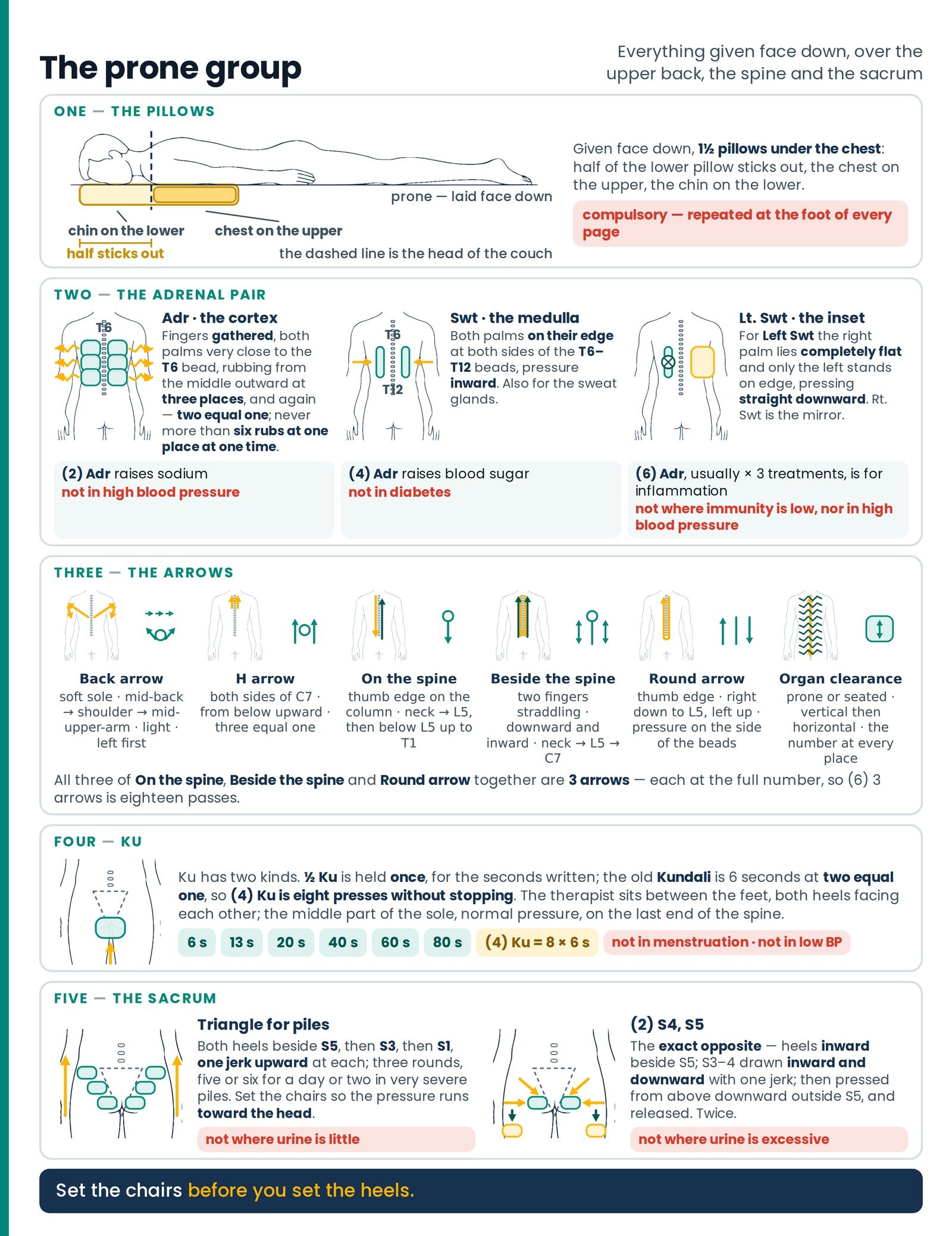
That completes the treatments given face down over the upper back, the spine and the sacrum. The atlas stays prone and moves to the low back. (Figure 21.7)
Two layers are left out. What each point is used for, and every condition in which it is withheld, is in Each Point in Use and When the Hand Must Stop. Every formula they appear in belongs to — Round arrow in Correcting the Two Kingdoms, (½) Ku in Clearing the Ash and The River — Heparin, Adr in Fire and Swelling, "Fire and Swelling".
Questions students ask
- 1. Why "one and a half" pillows? Why not just say two? Because only half of the lower one is under the patient; the other half projects past the edge, and that half is what the chin rests on. Call it two and a student will stack both under the chest, leaving nothing for the face.
- 2. If (6) Adr is more than six rubs at a place, have I broken the ceiling? No — read the count. (6) Adr is six rubs at a place and then six more, which makes one of what the card asks; the ceiling is six at one place at one time, and the second six is the second time. If the card asks for more than that allows, start again from the top.
- 3. What is the difference between Swt and Lt. Swt if both work on the left? Swt works both sides at once, both hands on edge, pressure inward. Lt. Swt works only the left, with the right palm completely flat as a stabiliser, and the pressure straight downward.
- 4. (4) H arrow — four strokes or twelve? Twelve. Three equal one — the same family of conventions as Parkhoo, Medulla, Ku and Adr, and it belongs to the point, not to the therapist. See also → Six Seconds, "Six Seconds".
- 5. Can I make a (½) Ku – 40 secs out of two twenties? No. Twenty seconds is written for one thing and forty for another. Two twenties is two twenties.
- 6. Why is Triangle for piles forbidden in someone passing little urine, when it is given for urine control in children? Because both follow from the same action. It tightens the sphincters — wanted in a child who wets the bed, and exactly not wanted where urine already comes with difficulty.
- 7. The patient says she is comfortable with her head turned. Must I still build the pillows? Yes. She is comfortable at minute one; the rule exists because of minute twenty-two. It is compulsory for everyone.
- 8. I am not strong enough to hold my weight on two chairs. May I kneel and use my hands? For these two sacral treatments the chairs are what makes the force controllable, and a hand cannot deliver the same movement. Give what you can give properly, and say so on the card. See also → The Record That Shows the Truth, "The Record That Shows the Truth".
Questions patients ask
- 1. "Why are you pressing my back when my problem is my stomach?" Because the nerves that serve your stomach come out of your spine, and the back is where I can reach them from outside. I am not treating the skin I am touching; I am working where the wiring runs.
- 2. "That pillow arrangement is strange. Can I not just turn my head?" Please don't, and it is not fussiness. If you turn your head for twenty minutes, your neck spends twenty minutes at the far end of what it can do — and you will feel that tonight, not now.
- 3. "You are going to jerk my hip bone with your heel? Is that safe?" It is a short movement, not a heavy one, and my whole weight is on my arms through these two chairs, so I can make it as small as it needs to be. I will do one and stop, and you tell me. If you want me to stop at any moment, say so; you do not have to give a reason.
- 4. "My blood pressure was 150 in the clinic. You will bring it down with this?" One reading in a clinic is not a blood pressure; it is a reading. Take it at home, morning and evening, for two weeks, and bring me the sheet. Then we will both know where you are starting from.
- 5. "This point is called the adrenal point. Will it fix my hormones?" The name tells me where to find it on your card; it is not a promise. That gland sits deep at the back of your belly and no hand reaches it. What my hands are on is your back and the nerves in it — real work with real effects.
Words used here
| Hindi | English | Neurotherapy code / usage | |
|---|---|---|---|
| पेट के बल / उलटे लिटाकर | Laid face down — prone | 1½ pillows under the chest, compulsory, in every treatment of the group Prone | |
| मणका | Bead — a vertebra | On the beads = On the spine; beside them = Beside the spine; on the side of them = Round arrow | |
| एड्रेनल | Adrenal | Adr — gathered palms at T6, three places, middle outward, two equal one, never more than 6 at one place | |
| स्वेट | Sweat | Swt — both palms on edge at T6–T12, pressure inward; Lt./Rt. Swt with the other palm flat, pressure downward | |
| बेक एरो · ऐच एरो | Back arrow · H arrow | Back arrow (Blood supply to lungs) — soft sole, mid-back → shoulder → arm, light, left first. H arrow — beside C7, upward, three equal one | |
| ओन द स्पाइन · बिसाइड द स्पाइन | On / Beside the spine | Thumb edge on the beads, neck → L5 → T1; and two fingers straddling, downward and inward, neck → L5 → C7, hand not lifted | |
| राउंड एरो | Round arrow | Thumb edge, right down, left up, finger not lifted; pressure on the side of the beads; glyph ↑\ | ↓ |
| — | 3 arrows · Organ clearance | 3 arrows = the three spinal strokes, each at the full number. Organ clearance — prone or seated, therapist on the left, vertical then horizontal, the number at every place | |
| कुंडली | Kundali | Ku — ½ Ku held for the written seconds, once; old Kundali at 6 seconds, two equal one. Not in menstruation; not in low BP | |
| बवासीर | Piles | Triangle for piles — S5, S3, S1, one upward jerk each, 3 rounds; not where urine is little | |
| — | S4–S5 | (2) S4, S5 — inward and downward, the exact opposite of the Triangle; not where urine is excessive | |
| सुधाकर | Sudhakar | The muscles around all the vertebrae of the back moved and brought to their correct place; for the neck, the back and all pains. No tool, path, direction or count is given for it |