- Part of
- Bones, joints and muscles
Watch

From Knee, Leg, Foot
b. KNEE CAP FREE — given laid straight, or seated
Tell the patient to let the knee go completely loose and to lie or sit relaxed. Do the more troublesome knee first; the other can be done afterwards. Supine Seated
- 1. Place the palms so that the thumbs are near each other and the fingers are on both sides of the thigh. With light pressure, knead the muscles right and left, in the direction of the arrows. Do this at two or three places on the thigh, from the hip down to the knee.
- 2. Do the same at 2–3 places on the skin below the knee.
- 3. Stand the palms on edge on both sides of the knee-cap and, from the borders, knead the muscles at the sides of the knee up-down and down-up, to relax them.
- 4. Then, with the sole of the palm, rub at the four corners of the knee-cap, and move the hand round and round on all sides, to free the cap from the muscles beneath it.
Doing all this makes the knee-cap completely loose, which reduces the stiffness of the knee — and that is exactly why it is called cap free.
| Patient's position | Laid straight, or seated; the knee completely loose, the patient relaxed. Do the more troublesome knee first Supine Seated |
|---|---|
| Where the hands are placed | Palms with thumbs near each other and fingers on both sides of the thigh, at two or three places from the hip down to the knee; then at 2–3 places on the skin below the knee; then the palms standing on edge on both sides of the knee-cap; then the sole of the palm at the four corners of the knee-cap, moving round and round on all sides |
| Duration and repetitions | Kneading with light pressure, right and left, in the direction of the arrows; at the sides of the knee up-down and down-up. No count is given |
| What it is for | Making the knee-cap completely loose and freeing the cap from the muscles beneath it, which reduces the stiffness of the knee |
"Let the knee go completely loose" is a technical precondition, not a pleasantry. The cap sits inside the tendon of the big thigh muscle, and when that muscle tightens — as it does the instant a patient braces, lifts the heel an inch, or holds the leg "helpfully" straight — the tendon pulls tight over the cap and clamps it into its groove. All four stages are then working against a locked bone. Hands off until the leg is heavy: lift the heel two inches and let it drop; a loose leg drops like a sandbag.
"Do the more troublesome knee first" runs against instinct, and it is written. The troublesome knee gets your freshest hands, before the session runs long — and it gets treated before the patient has decided, from ten comfortable minutes on a knee that was never the problem, how much she will let you do to the one that is.
"In the direction of the arrows" sends you to the figure, which shows zig-zag arrows running side to side at two or three levels above the knee and two or three below. The kneading is cross-wise, not along the length of the leg. Stage 3 turns the hands: the palms come up on edge, like two knife blades, one each side of the cap, and the sides of the knee are kneaded up-down and down-up. And stage 4 is the treatment the name is about — the sole of the palm, the soft pad at the base of the thumb, at the four corners first and then round and round on all sides. Do not shorten it to the circle.
From Knee, Leg, Foot
The knee sequence, said aloud
Nine separable treatments, their counts and their sides, in one order
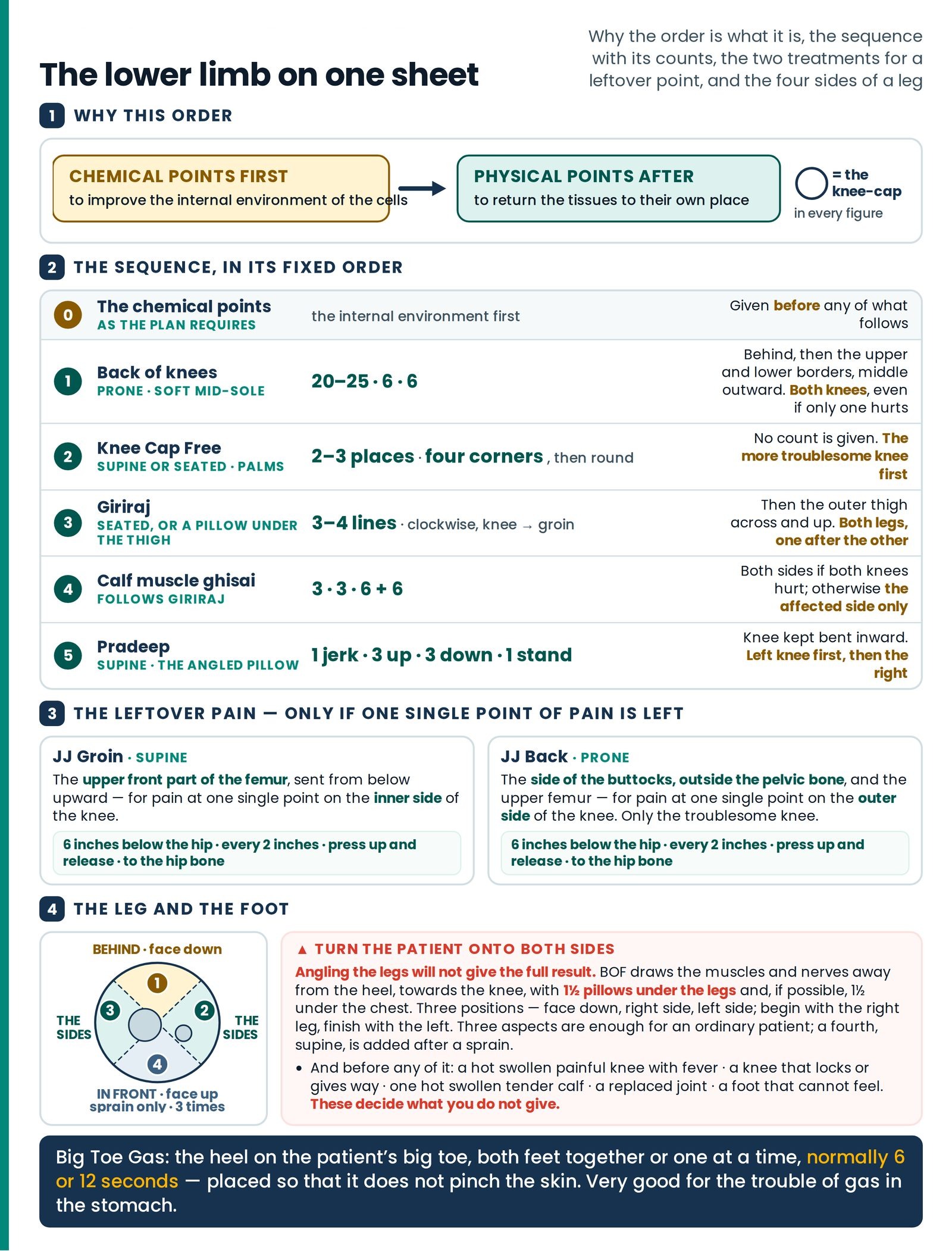
From Each Point in Use
The knee and the lower limb
Tissue pulled back to its place, and a numb leg that cannot report
Table 16 — The knee, the calf, the foot and the vessels of the leg
| Point | What it is used for | When it must not be used | Notes |
|---|---|---|---|
| Giriraj Supine | Given for knee pain. Those muscles that have descended from the waist down into the thigh and the inside of the knee are pulled upward; and those muscles that have climbed up from the calves or the heel are brought downward | — | Two directions in one treatment: down-from-above is pulled up, up-from-below is pushed down. |
| Knee cap free | Given for knee pain. In it we relax the following muscles: the muscles behind the knee; the thigh muscles above the knee; the muscles around the bone below the knee; the muscles around the *kaṭorī* — the knee cap; and the muscles inside the *kaṭorī* | — | Five groups of muscle, named in order. |
| Pradip trt. | Given for knee pain. In it we pull the muscles and nerves of both sides of the knee away from the *kaṭorī*, and bring them to their correct place, from which the patient gets immediate relief | — | The treatment named in the JJ⁺¹ bar: a knee patient is given Pradip, in which the pull runs in the opposite direction. Its full staged sequence — the pillow, the jerk, the walks and the stand — is taught in Knee, Leg, Foot |
| J groin Supine | With this treatment we pull upward the tissue on the inner side of the knee that has descended, and bring it back to its own place. After all the other knee treatments, if a little pain remains on the inner side of the kaṭorī, this treatment is given to remove it | — | A finishing point, not an opening one. Given supine only. |
| J back Prone | With this treatment we pull upward the tissue on the outer side of the knee that has descended, and bring it back to its own place. After all the other knee treatments, if a little pain remains on the outer side of the kaṭorī, this treatment is given to remove it | — | The mirror of J groin: inner side, supine; outer side, face down. |
| BOF — Bottom of Feet | Above the heel, at the back, there is something like a band, through which pass the blood vessels of the feet and toes, the nerves that control movement, and the tendons — the ropes that keep the bones in their place — all of which come down from the knee or the waist and reach the feet. On striking something, or when we bend to lift a heavy weight, or make some sudden movement, many tendons and nerves and blood vessels are pulled and slip down quickly; afterwards not all of them are able to go back, and some get caught inside that band, from which there is very severe pain in the heel, or around the toe concerned. With this treatment we press those tendons caught inside the heel from below upwards and pull them, bringing them to their correct place, from which the patient gets immediate relief. Excellent for numbness, pain, burning or any kind of trouble from the toes, soles and heel up to the calves | (see the note on sides) | Ordinarily it is not given on the upper side. It is given only on the three sides of the calves. But if there is a sprain, then it is to be given on the upper side too — for which we write on the card BOF – all four sides. And JJ⁺² is not given the same day as BOF for sole pain. |
| Blood supply to legs — for polio | Given to increase blood circulation in the arteries of the legs of polio patients. Give where there is numbness in the legs, or in the front or the back of the thighs. Some paralysis patients also get relief from it. Usually given thirty times on both legs | — | Thirty times, both legs Both sides . |
| Blood supply to sides | For those who have numbness in the side portion of the thighs, this treatment increases the flow of blood in that part and ends the numbness | — | Its own entry, and its own region — the side of the thigh, not the front or back. Method: |
| Hydrocele point | Given for hydrocele — that is, swelling in the scrotum — and in inguinal hernia. Pressing at the appropriate part of the calf, where there is intense pain, increases the flow of blood in the testis of that side and the patient gets relief | — | A scrotal complaint found and treated in the calf. |
| Vasanti | This is given to increase the circulation of blood in the veins. In diabetes, or in tarsal tunnel syndrome, when the feet go numb, give it from the heel towards the thigh. In carpal tunnel syndrome, when there is very severe pain, burning and numbness in the hands, give the treatment from the fingers towards the shoulder | — | The direction is the whole instruction, and it differs between the two conditions: heel → thigh for the foot, fingers → shoulder for the hand. |
Also explained in
- a. BACK OF KNEES — given face down Knee, Leg, Foot
With the soft middle part of your sole, rub the region behind the knee, up-down, down-up — 20 to 25 times.
- Two treatments that serve the low back and the knee together The Low Back
Both of the treatments below are useful in both low-back pain and knee pain.
- For knee pain, back pain, CP children, and those whose alkali has increased Clearing the Ash
able 18 — Card: the knee, back, CP and raised-alkali formula Seated Side-lying Prone Supine 6 sec Written I (15) Medulla · II (3) Raman treatment · III (2) Rt Parkhoo (2) Lt Parkhoo · IV (½) Ku – 20 secs × 4
- PRADEEP — the pillow, the jerk, the walks and the stand Knee, Leg, Foot
Do the left knee first, then the right.
- Why the chemical points come first Knee, Leg, Foot
hemical first to change the conditions, physical after to put back This group carries a heading of its own — घुटने के दर्दों के लिए कुछ उपचार, some treatments for pains of the knee — and it opens with an explanation rath
- The two variants, each with its own condition The River — Heparin
If along with the knee pain there is pain and inflammation at Mu°, then — A.
- JJ BACK — given face down Knee, Leg, Foot
It is for those who, even after all the other treatments, still have pain at one single point on the outer side of the knee.
- What lactic acid actually does — the story to tell a patient Water and Salt
After that we shall not be able to lift even one step, because the knees do not get enough oxygen through the blood, so the muscles of the knee will tire from lack of oxygen.
- What this article hands to the next On the Side
The patient lies on her left side with a pillow under her head so the neck rests level; two firm pillows fill the space between her knees, holding the upper knee at waist level; both knees are drawn close to the chest an
- GIRIRAJ — carrying the thigh back upward Knee, Leg, Foot
ingers together, clockwise, knee → groin, along three or four lines Several treatments in this atlas carry a person's name rather than a place — Giriraj and Pradeep here, and elsewhere Loveleen, Raman, Shivaji, Mauneesh.
- ABDOMEN SETTING — four movements, and nothing touches the abdomen Uncommon Problems
Then, in turn, straighten one leg and bend the other knee inward towards the ground.
- Questions students ask Knee, Leg, Foot
Back of knees says do the other knee as well, but Giriraj says only the affected side.
- How to say it When the Hand Must Stop
Against the blood thinner he wrote no jerks, no full weight, which closed the Pradeep jerk and its fifth stage before a knee was touched.
- Position three — side-lying Side-lying Placing the Patient
Table 2 as a comparison: Acid and Fluid, Parkhoo right and left, and the vitamin group, each with its knee arrangement drawn against the level of the waist, its shoulder, and the reason given for it.