The Front of the Body II finished the front of the body, and with it every point given to a patient lying down. From here the atlas changes position for the first time, and the change of position is a change of risk.
Everything in this article is given with the patient sitting on a chair, and nearly all of it at the back of the head and the neck — the most crowded few inches in this wiki. Inside a span you can cover with one hand lie the arteries that feed the brain, the cord where it leaves the skull, the airway, the great vein of the neck, and the exits of nerves serving the face, the ear, the tongue and the shoulder — and it is the one place on the body surface where the nerves of the face and the nerves of the neck arrive on the same cells.
The technique is simple: a counted thumb-glide, a lift, a press, a circle. What makes this article demanding is that nothing in it may ever be rushed, levered or forced.
Watch


The standing rules of every seated treatment
A firm chair, three stances — and glide, never thrust
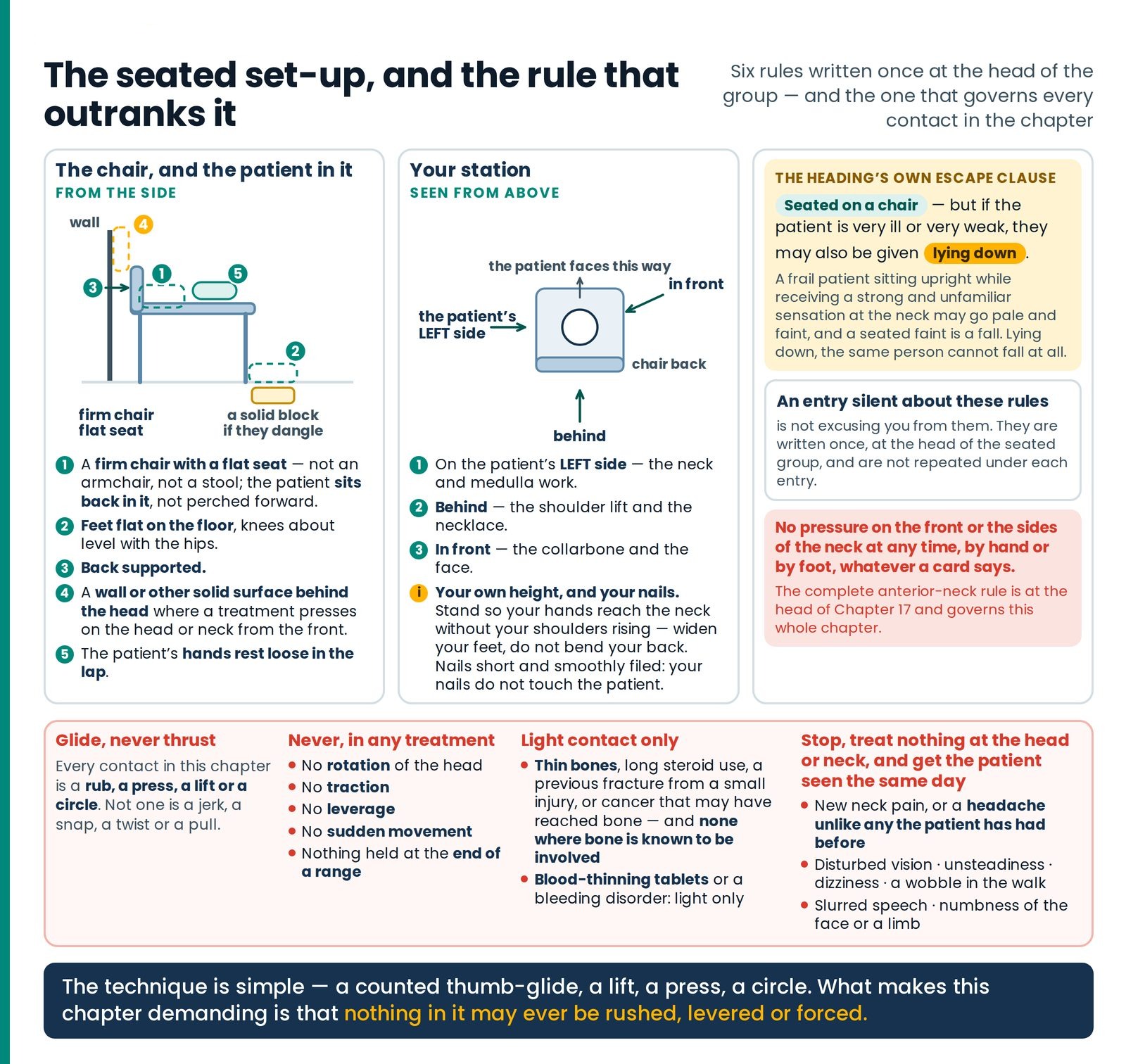
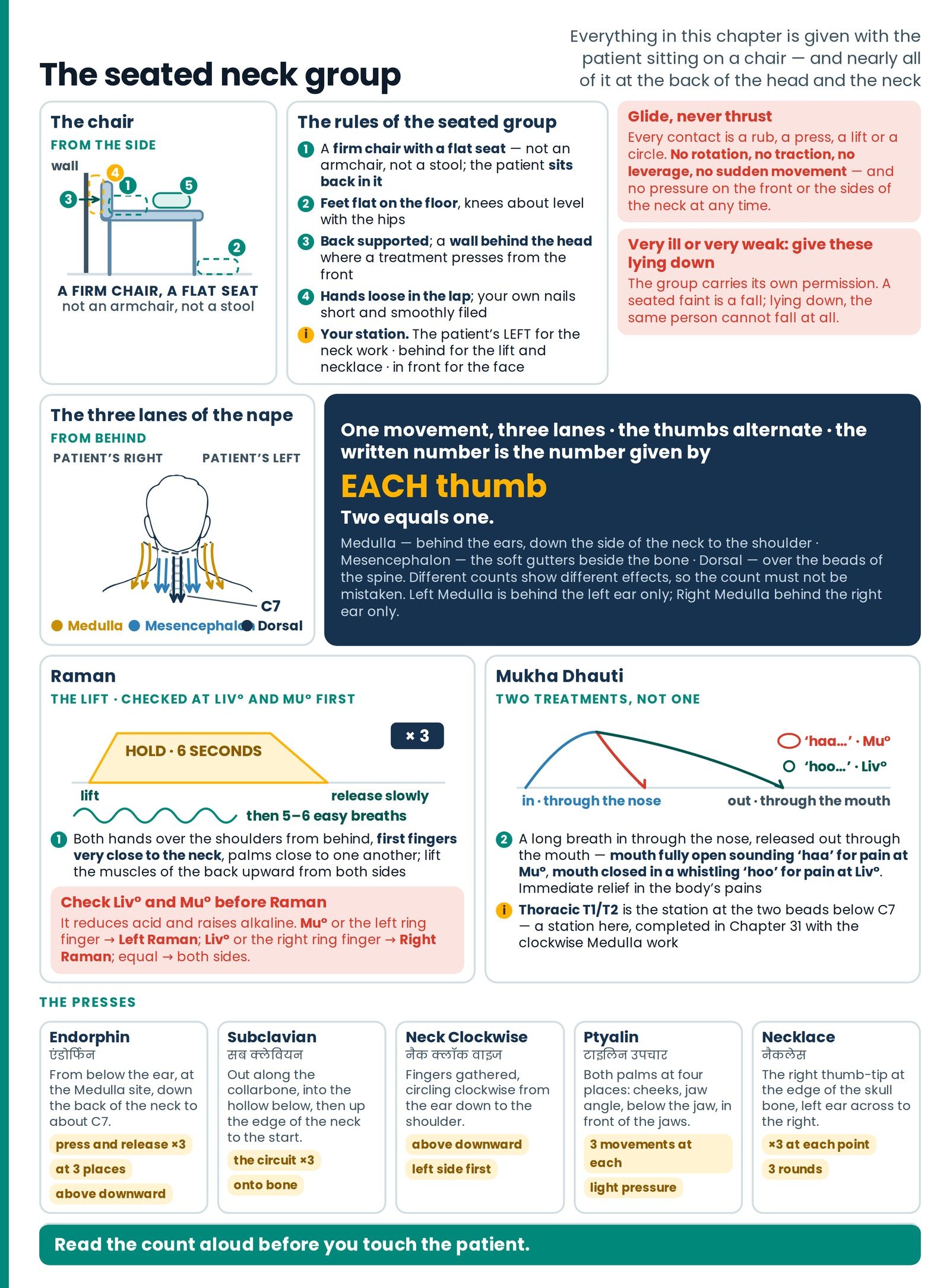
These are written once, at the head of the seated group, and are not repeated under each entry. An entry silent about them is not excusing you from them. (Figure 18.1)
The four positions and their rules — including the seating method in full — are taught in Placing the Patient, "Placing the Patient". What follows is the check-list to run before your thumbs go anywhere near a neck.
The six rules that hold for every point in this article
1. The heading of this group, and its own escape clause.
These treatments are given with the patient seated on a chair — but if the patient is very ill or very weak, they may also be given lying down.
That is a rule, not a courtesy. A frail or unwell patient sitting upright while receiving a strong and unfamiliar sensation at the neck may go pale and faint, and a seated faint is a fall. Lying down, the same person cannot fall at all. Seated Supine
2. The chair. A firm chair with a flat seat — not an armchair, not a stool — and the patient sits back in it, not perched forward.
3. The feet and the back. Feet flat on the floor, knees about level with the hips; if the feet dangle, put something solid under them. Back supported, and where a treatment presses on the head or neck from the front, a wall or other solid surface behind the head.
4. The hands. The patient's hands rest loose in the lap.
5. Your own height, and your nails. Stand so your hands reach the neck without your shoulders rising — widen your feet, do not bend your back. And nails short and smoothly filed: here the thumbs and fingertips are the instruments and the skin under them is thin. Your nails do not touch the patient.
6. Your station. Three stances, each named in the treatment that uses it — on the patient's left side for the neck and medulla work, behind for the shoulder lift and the necklace, in front for the collarbone and the face. The stance is part of the point.
And the rule that outranks all six.
The anterior neck is governed from The Front of the Body II and is not restated here. The complete rule — no pressure on the front or the sides of the neck at any time, by hand or by foot, whatever a card says; what lies there; and the conditions under which it bites — is set out in full at the head of The Front of the Body II, "The Front of the Body — II". Read it before you give a single point in this article. Several points here work close to that boundary, and each one says below what its own boundary is.
The three lanes of the nape — Medulla, Mesencephalon, Dorsal
One counted thumb-glide, told apart by thumb placement alone
Three treatments open the seated group, and they are the same movement three times over: a counted thumb-glide downward at the back of the neck, the two thumbs alternating. What separates them is where the thumbs are, and nothing else — behind the ears for Medulla, in the soft gutters beside the bone for Mesencephalon, on the beads of the spine themselves for Dorsal. (Figure 18.2)
Medulla — मेडूला
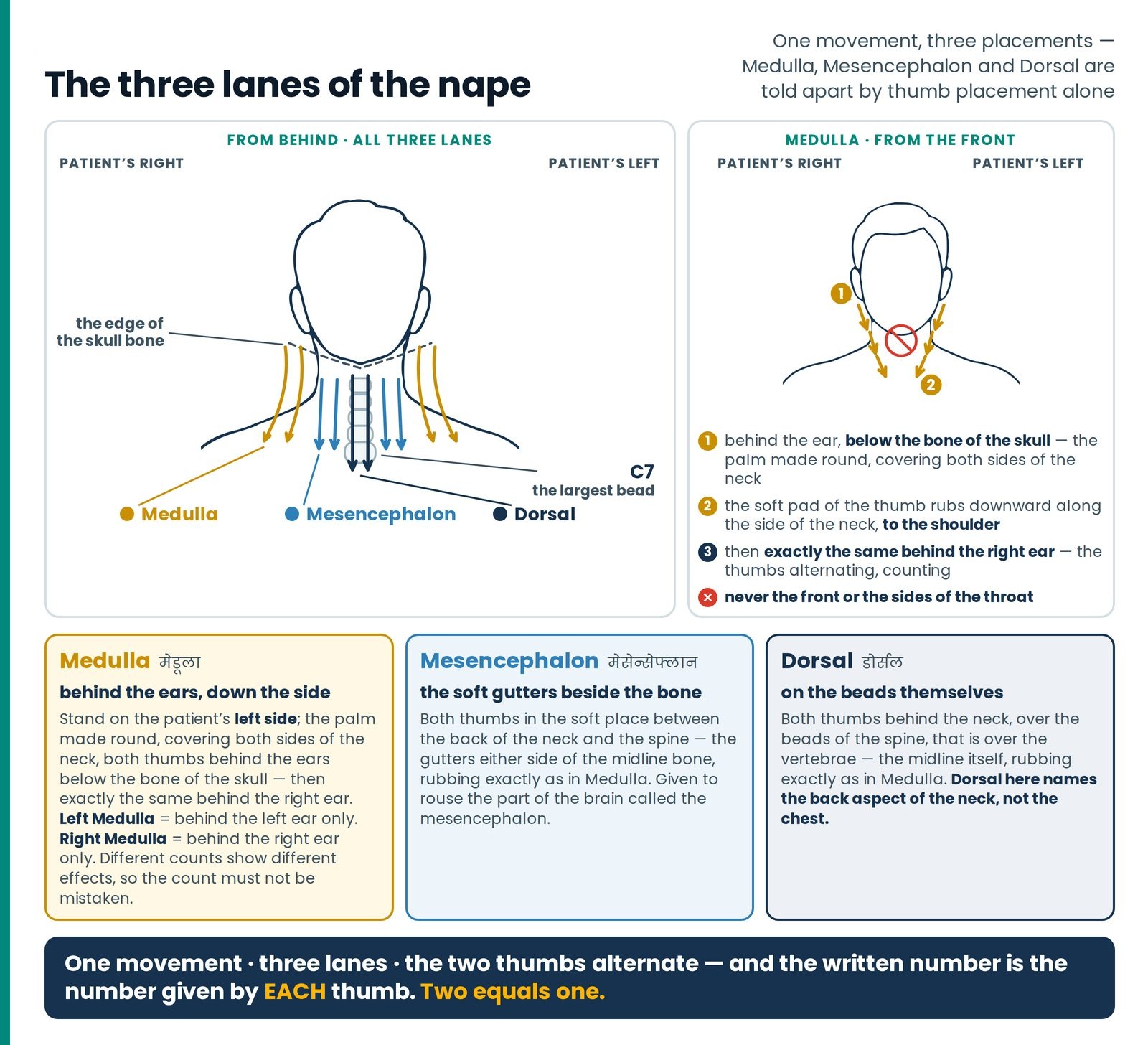
Stand on the patient's left side. Make your palm round and cover both sides of the patient's neck with it. Both your thumbs should be behind their ears, below the bone of the skull.
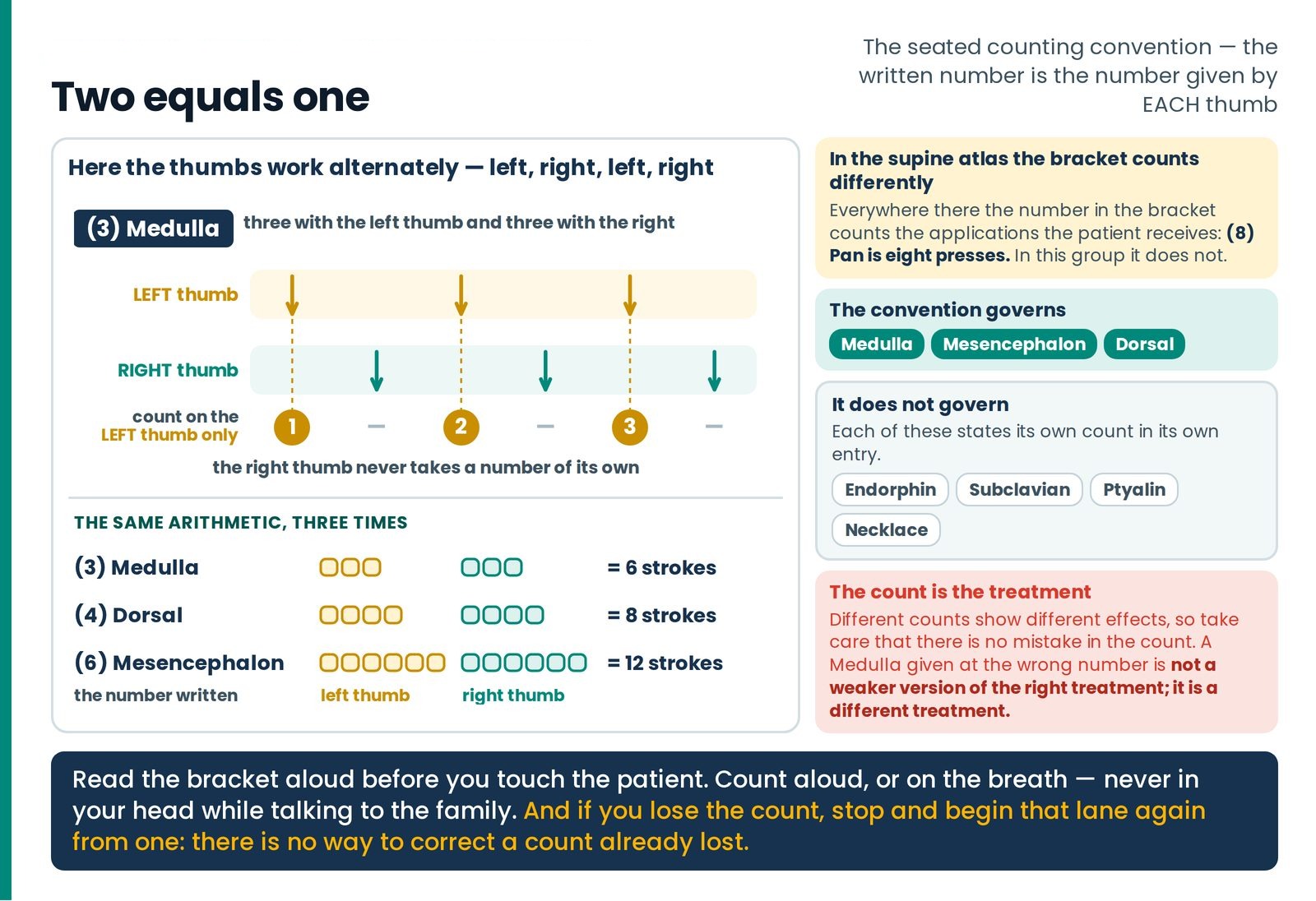
Then, with the soft pad of the thumbs, from behind the ear below the bone down to the shoulder, rub downward along the side of the neck, counting, alternately. Rub as many times as the number with each thumb — that is, two equals one. After this, do exactly the same behind the right ear.
If Left Medulla is written, do it only behind the left ear.
If Right Medulla is written, do it only behind the right ear.
Different counts show different effects, so take care that there is no mistake in the count.
| Patient's position | Seated on a chair — or lying down if the patient is very ill or very weak; the therapist standing on the patient's left side Seated Supine |
|---|---|
| Where the hands are placed | The palm made round, covering both sides of the neck; both thumbs behind the ears, below the bone of the skull; the soft pads of the thumbs rubbing downward along the side of the neck to the shoulder Both sides |
| Duration and repetitions | Downward rubs, thumbs alternating, counting; as many times as the number with each thumb — two equals one. Then exactly the same behind the right ear. Left Medulla = behind the left ear only; Right Medulla = behind the right ear only Left Right |
| What it is for | Named for the medulla; different counts show different effects, so the count must not be mistaken |
What lies beneath. The medulla itself is the stalk at the bottom of the brain where it becomes the spinal cord, and it sits inside the skull. No thumb reaches it; it is behind a wall of bone. What the name records is an intention, not an address.
What the thumb rests on is far from a consolation. Running up over the back of the head from the top of the neck is the large nerve that supplies the scalp, with a smaller one beside it to the skin behind the ear, and beneath both the four position-reporting muscles described above. And in the cord at that level, the nerves of the face and the nerves of the neck arrive on the same cells — which is why the neck refers pain to the head, and why a counted stroke at the nape can be felt behind an eye. It is the best reason in the whole atlas why a point at the back of the neck should influence anything at all in the head.
The graded series is named by its count — and is taught in The Medulla Family
A card in this therapy rarely says Medulla alone. It says (2) Medulla, (4) Medulla, (6) Medulla, (8) Medulla, (10) Medulla, (12) Medulla, (15) Medulla, (20) Medulla or (30) Medulla — and each of those is a named treatment in its own right, with its own work and its own place in a formula.
This article teaches you to give a Medulla. It does not yet teach you which one to give. The members of the series, what each is for, the clockwise form, the pairing with Thoracic T1/T2, and the rule about what is given before any of them, are set out together in The Medulla Family, "The Medulla Family — The Graded Series", where they can be learned as a family. Do not read this entry and think the series has been taught: it has been made giveable.
Mesencephalon — मेसेन्सेफ्लान
This is given to rouse the part of the brain called the mesencephalon.
In the soft place between the back of the neck and the spine, exactly as in the Medulla treatment, rub with both thumbs, alternately, counting. Rub with each thumb as many times as the number written.
| Patient's position | As for Medulla — seated, or lying down if the patient is very ill or very weak Seated Supine |
|---|---|
| Where the hands are placed | Both thumbs in the soft place between the back of the neck and the spine — the gutters either side of the midline bone Both sides |
| Duration and repetitions | Rubbing exactly as in Medulla, both thumbs alternately, counting — as many times as the number written with each thumb |
| What it is for | Rousing the part of the brain called the mesencephalon |
What lies beneath. The mesencephalon is the topmost segment of the brain stem, and like the medulla it is inside the skull and out of reach. But the name is better chosen than it looks: that segment holds the body's own pain-suppressing switchboard — the system that can turn a pain signal down before it reaches the place where pain is felt. Under the gutter thumbs lie the long straps running from the back of the skull down the neck, and beneath them the small joints of the neck bones with their nerves; a steady input there is exactly the kind that recruits that descending system. The point does not touch the midbrain. It plausibly speaks to it.
Dorsal — डोर्सल
Behind the neck, over the beads of the spine — that is, over the vertebrae — exactly as in the Medulla treatment, rub with both thumbs, alternately, counting.
As many times as the number written — rub that many times with each thumb.
| Patient's position | As for Medulla and Mesencephalon Seated Supine |
|---|---|
| Where the hands are placed | Both thumbs behind the neck, over the beads of the spine, that is over the vertebrae — the midline itself Both sides |
| Duration and repetitions | Rubbing exactly as in Medulla, both thumbs alternately, counting — that many times with each thumb |
| What it is for | Named for the dorsal, that is the back, aspect of the spine |
What lies beneath. The midline of the neck is bone and cord. The beads you feel are the backward-pointing spurs of the neck vertebrae, joined by a strong sheet of ligament running from the skull down to the shoulders, with almost no muscle padding. In a slim patient your thumb is very nearly on bare bone, and heavy pressure there is painful out of all proportion to any good it does. The therapy's own instruction — a light, counted glide, exactly as in Medulla — is the only sensible version of this point.
All three are glides, never thrusts; all three are governed by the six standing rules above and by the anterior-neck rule of The Front of the Body II; and in all three the thumbs alternate, so two equals one. (Figure 18.3)
The lift and the breath — Raman and Mukha Dhauti
Six held seconds three times — and a breath she takes home
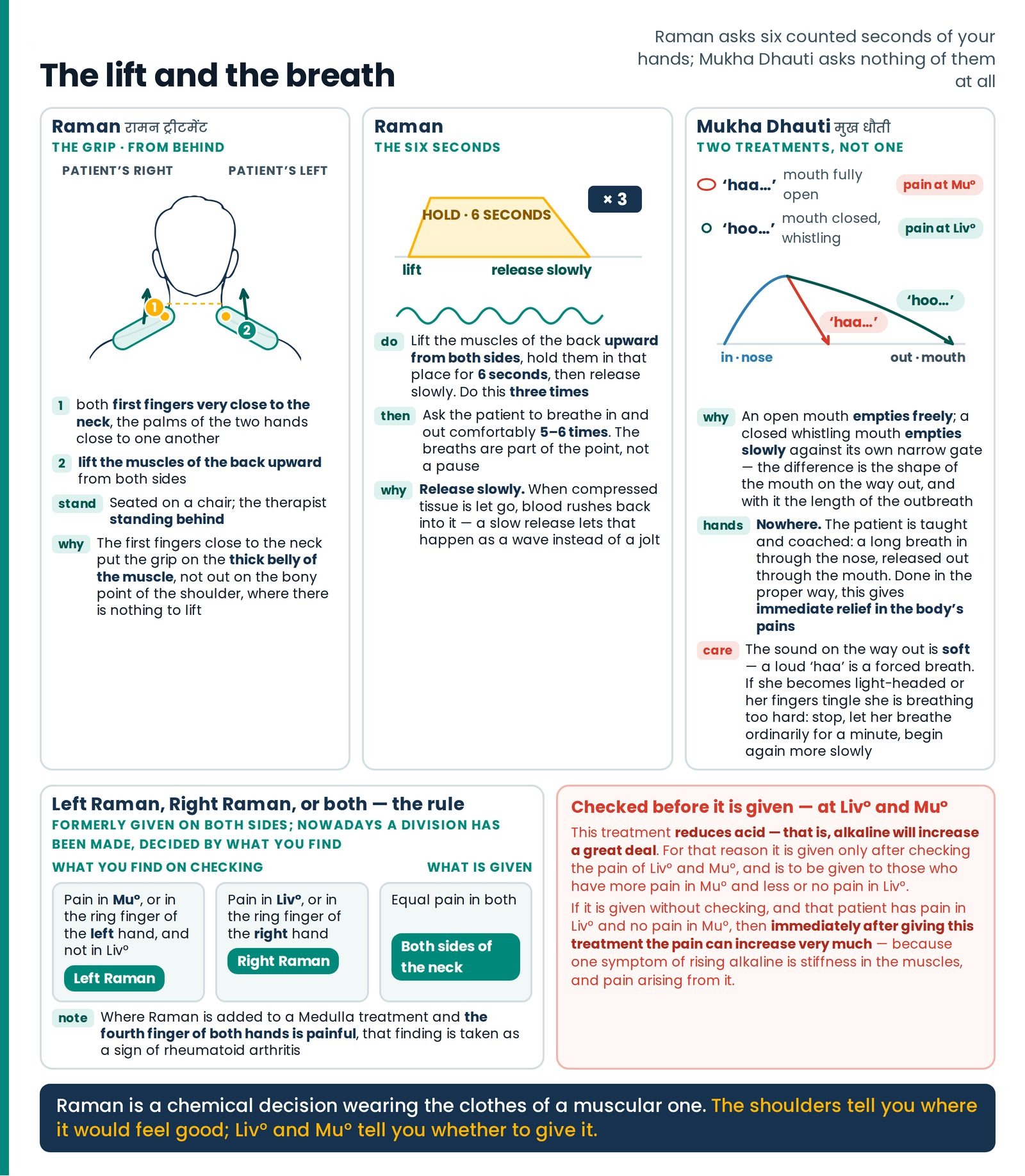
Two treatments follow that are not thumb-points at all. The first lifts a handful of muscle and holds it for a counted six seconds; the second asks nothing of the therapist's hands and everything of the patient's breath. (Figure 18.4)
Place both hands onto the shoulders from behind, in such a way that both first fingers are very close to the neck and the palms of the two hands are close to one another.
Then lift the muscles of the back upward from both sides, and hold them in that place for 6 seconds, then release slowly.
Do this three times.
After this, ask the patient to breathe in and out comfortably 5–6 times.
| Patient's position | Seated on a chair; the therapist standing behind Seated |
|---|---|
| Where the hands are placed | Both hands over the tops of the shoulders from behind, both first fingers very close to the neck, the palms of the two hands close to one another; the muscles of the back lifted upward from both sides Both sides |
| Duration and repetitions | Lift and hold for 6 seconds, then release slowly; three times. Then the patient breathes in and out comfortably 5–6 times 6 sec × 3 |
| What it is for | A treatment in its own right, closed by the 5–6 easy breaths |
What lies beneath. The handful is the great fan of muscle running from the base of the skull out to the point of the shoulder, with a deeper muscle under it that lifts the shoulder blade.
Three things in the instruction do real work. The first fingers close to the neck put the grip on the thick belly of the muscle rather than out on the bony point of the shoulder, where there is nothing to lift. And release slowly matters more than it looks: when compressed tissue is let go, blood rushes back into it, and a slow release lets that happen as a wave instead of a jolt. The breaths are part of the point, not a pause — five or six easy ones after the third lift are what turn a squeeze into a settling.
Raman — रामन ट्रीटमेंट
Formerly Raman was given on both sides of the neck. Nowadays a division has been made into Left Raman and Right Raman, decided by what you find:
What you find on checking · What is given
Pain in Mu°, or in the ring finger of the left hand, and not in Liv° · Left Raman Left
Pain in Liv°, or in the ring finger of the right hand · Right Raman Right
Equal pain in both · Given on both sides of the neck Both sides
Left Raman, Right Raman, or both — the rule
Further experience will make it understood.
The ring finger earns its place there. Where Raman is added to a Medulla treatment and the fourth finger of both hands is painful, that finding is taken as a sign of rheumatoid arthritis — and the pain of that finger used to go. The formula in which Raman sits with the Medulla work and Thoracic T1/T2 is in The Medulla Family, "The Medulla Family"; its place among the lymph and cranial-nerve formulas is in Cranial Nerve and Brain Formulas, "The Twelve Messengers".
Mukha Dhauti — मुख धौती
Take a long breath in through the nose and release it out through the mouth. Done in the proper way, this gives immediate relief in the body's pains.
If there is pain in Mu°, tell them to exhale with the mouth fully open, making a sound like 'haa…'.
If there is pain in Liv°, tell them to exhale with the mouth closed, making a whistling 'hoo…' breath.
| Patient's position | Seated; the therapist's hands do nothing — this is an instruction given to the patient Seated |
|---|---|
| Where the hands are placed | Nowhere. The patient is taught and coached |
| Duration and repetitions | A long breath in through the nose, released out through the mouth; no count is given. Mouth fully open, 'haa…' if there is pain in Mu°; mouth closed, whistling 'hoo…' if there is pain in Liv° |
| What it is for | Immediate relief in the body's pains |
The two forms are the instruction. This is not one breathing exercise with a decorative choice of sound. It is two treatments, and the finding at the navel selects which one the patient is taught: pain at Mu° → the mouth fully open, sounding 'haa…'; pain at Liv° → the mouth closed, a whistling 'hoo…'.
Both begin the same way — a long breath in through the nose — and both release through the mouth. The difference is the shape of the mouth on the way out, and with it the length and resistance of the outbreath: an open mouth empties freely, a closed whistling mouth empties slowly against its own narrow gate.
How to coach it, since this is the one point where your hands are idle. The breath in through the nose is long and unhurried; the sound on the way out is soft, because a loud 'haa' is a forced breath and forcing is the one thing this must not become. If she becomes light-headed or her fingers tingle she is breathing too hard — stop, let her breathe ordinarily for a minute, begin again more slowly. And give it to her to take home — a treatment she can give herself at four o'clock in her own office is worth more than one she can only have from you on a Tuesday.
Endorphin — एंडोर्फिन
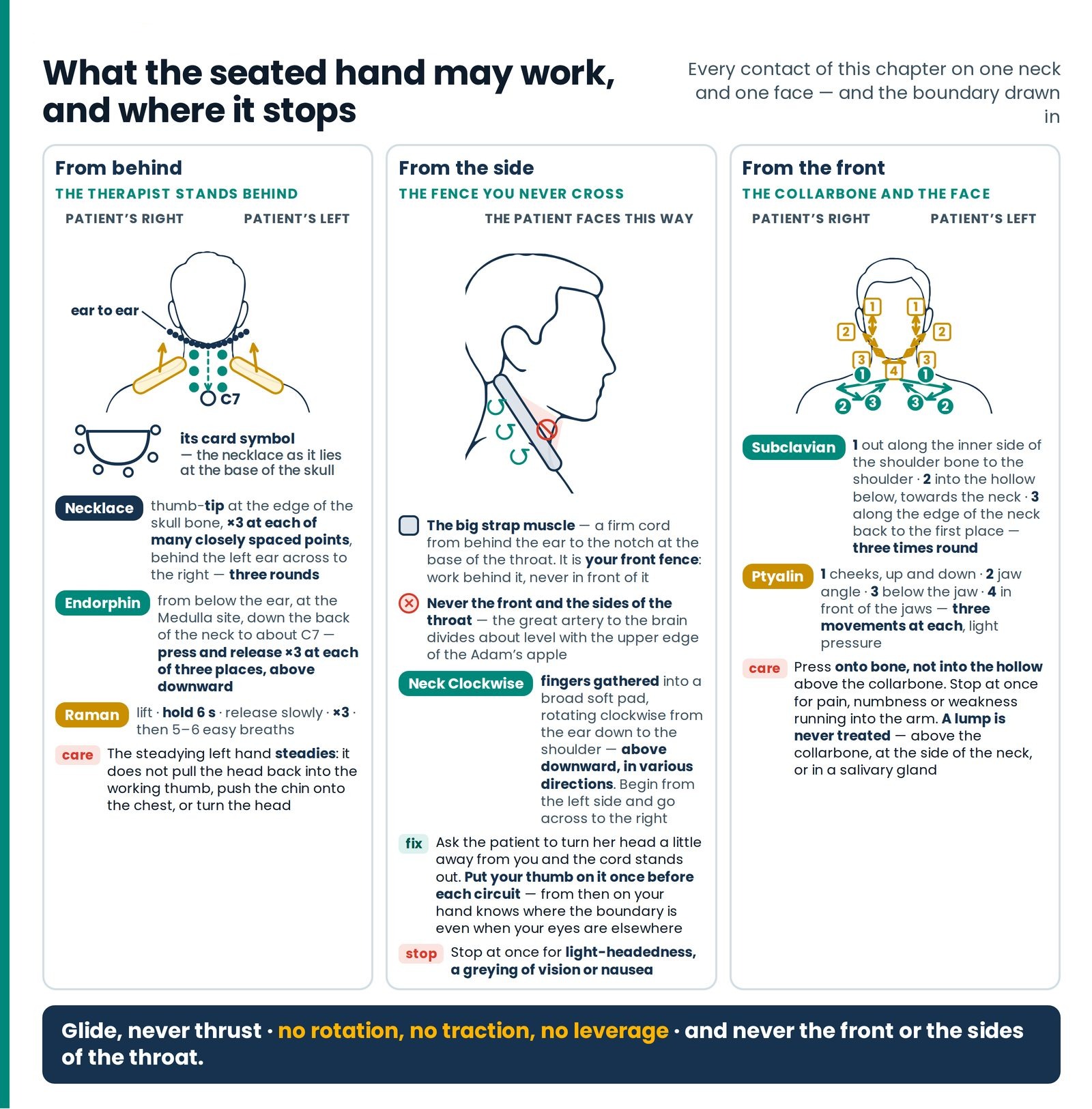
With the soft part of both your thumbs, starting from below the ear, where we give the Medulla treatment, press and release three times each at points running down the back part of the neck, to around the C7 bead.
Do this at three places below the ear, working from above downward.
This reduces the sensation of pains; it lessens the feeling of pain in the body.
| Patient's position | Seated — or lying down if the patient is very ill or very weak, by the rule at the head of this group Seated Supine |
|---|---|
| Where the hands are placed | The soft part of both thumbs, starting from below the ear, at the Medulla site, running down the back part of the neck to around the C7 bead Both sides |
| Duration and repetitions | Press and release three times each at three places below the ear, working from above downward × 3 |
| What it is for | Reducing the sensation of pains; it lessens the feeling of pain in the body |
Where the thumbs go, exactly — and how this differs from Medulla
The two points start in the same place and go different ways. Medulla starts behind the ear, under the edge of the skull bone, and travels down the side of the neck to the shoulder — a glide, counted by the convention two equals one. Endorphin starts at that same spot, below the ear at the Medulla site, and travels down the back of the neck to about the C7 bead — not a glide at all, but press and release, three times at each of three stations, worked from above downward, both thumbs, one each side.
Say it as a sentence before you begin: "Medulla runs down the side and rubs; Endorphin runs down the back and presses."
Finding C7. Ask the patient to let her head drop gently forward and run a finger down the midline of her nape: the last bead of the neck stands out further than the rest. To be certain, feel the two most prominent bumps and tip the head backwards — the upper one slides away, the lower one stays. The one that stays is C7, the bottom end of this point's run; do not go below it.
What lies beneath. The same territory as Medulla, worked downward — the strap muscle at the side, the great fan of the shoulder behind it, the scalp nerves at the top of the run, the prominent bead at the foot of it.
What the name records, and what it does not. The body genuinely makes its own pain-quietening chemicals, and it is also true that a strong sensation at one place can raise the threshold for pain felt at another. But naming a patch of skin "Endorphin" does not prove that pressing it releases one. The technique stands on its own feet; the name is a memory hook, not an address.
Subclavian — सब क्लेवियन ट्रीटमेंट
With the soft part of your thumb, pressing at many points on the inner side of the shoulder bone on both sides, go out as far as both shoulders.
Then from there, go into the hollow below, towards the neck, in the same way.
Finally, coming along the edge of the neck, return to the first place.
Repeat the whole process three times.
| Patient's position | Seated; the therapist in front Seated |
|---|---|
| Where the hands are placed | The soft part of the thumb, at many points on the inner side of the shoulder bone, out as far as both shoulders; then into the hollow below, towards the neck; then along the edge of the neck back to the first place Both sides |
| Duration and repetitions | Many closely spaced thumb-pressures; the whole process three times × 3 |
| What it is for | Named for the subclavian region; no separate indication is given here. Its place in the lymph formulas is in Cranial Nerve and Brain Formulas; its indications and precautions in Each Point in Use |
Read it as a circuit, not as three points: a closed loop from the inner end of the collarbone out to the shoulder, into the hollow beneath the bone and back inward towards the neck, then up the edge of the neck to where it began — both sides, three times round. (Figure 18.5)
What lies beneath. The name is literal, and that is the reason for the care. Under the collarbone the great vessels of the arm cross the first rib, and with them the cords of nerves on their way to the shoulder, the elbow and the hand; deeper and further in, the very top of the lung rises into the root of the neck, higher than most students expect.
The neck, the jaw and the base of the skull — Neck Clockwise, Ptyalin, Necklace
Circles, four salivary stations, and a string of beads ear to ear
Neck Clockwise — नैक क्लॉक वाइज
Gathering the fingers together, rotate them in a clockwise direction on the muscles of the neck, coming from the ear down to the shoulder — do this from above downward, in various directions.
Begin from the left side and go across to the right side.
| Patient's position | Seated Seated |
|---|---|
| Where the hands are placed | The fingers gathered together into a pad, rotating clockwise on the muscles of the neck, from the ear down to the shoulder |
| Duration and repetitions | Clockwise rotation from above downward, in various directions; no count is given. Begin from the left side and go across to the right side Left Right |
| What it is for | Not separately stated |
Two details earn their keep. The fingers are gathered together — a broad soft pad, not a fingertip digging in — and the circles travel from above downward, taking the muscle in successive bands rather than staying in one place. The side order is stated and is not optional: left first, then across to the right.
What lies beneath. The pad sits on the big strap muscle of the side of the neck and, behind it, the muscle that lifts the shoulder blade. A nerve crosses that strap on its way up to the ear — which is why circling here sometimes sends a feeling into the ear lobe or the jaw angle.
The back border of that muscle is a safe working line. Its front border is the wall of the forbidden triangle. Stop at once for light-headedness, a greying of vision or nausea.
Ptyalin Treatment — टाइलिन उपचार
Place both palms on the patient's two cheeks, at the place marked number 1. With light pressure, move the muscles below the cheek up and down, three times each, and release. This treatment stimulates the parotid glands.
Then place the palms below the patient's jaws, at the place marked number 2, and move the muscles there forward and backward, three times each. This is to stimulate the sub-mandibular glands.
Then place the palms below the patient's jaws and move the muscles there forward and backward, three times each (see number 3). This is to stimulate the sub-lingual glands beneath the tongue.
Finally, move the muscles in front of the jaws, three times each. This too will increase the production of saliva.
| Patient's position | Seated Seated |
|---|---|
| Where the hands are placed | Both palms: (1) on the two cheeks; (2) below the jaws; (3) below the jaws; (4) on the muscles in front of the jaws Both sides |
| Duration and repetitions | Three movements at each of the four places — up and down at 1, forward and backward at 2 and 3, and at 4 × 3 |
| What it is for | Stimulating the parotid, the sub-mandibular and the sub-lingual glands, and increasing the production of saliva |
The four stations are taken in that order — cheeks for the parotid, jaw angle for the sub-mandibular, below the jaw for the sub-lingual, then in front of the jaws, where no gland is named and the stated purpose is simply more saliva — three movements at each.
Note the words light pressure, which appear at station 1 and govern the whole run. These are palms laid on a face, moving the soft tissue under them — not a massage of the cheeks, and certainly not a grip.
What lies beneath. The big salivary gland wraps over the jaw hinge in front of and below the ear, so station 1 sits directly on it; the next gland down is in the soft triangle under the body of the jaw — stations 2 and 3. The nerve that works the whole face runs through the first gland, and the artery to the face crosses the lower edge of the jaw bone at the angle. Everything here is close to the surface and delicate, which is what light pressure protects.
Necklace — नैकलेस
Place your left hand on the patient's head with light pressure, so that their forehead does not move during the treatment. Then open the palm of your right hand and place it so that your thumb is below, at the edge of the skull bone, and the remaining four fingers point upward and stay open.
With the tip of your thumb, starting from behind the left ear, press three times each at many closely spaced points, going across as far as the right ear. Do three rounds like this, from right to left.
This treatment is given to relax the muscles just below the bone of the lower back part of the skull — so that there is no obstruction in the coming and going of impulses (that is, waves of sensation) between the brain and the rest of the body, and communication happens properly.
With this treatment, the pains of the whole body become very much less.
Its symbol is: a shallow bowl or half-moon curve with a small circle at each end and a row of dots along its inner edge — the necklace itself, as it lies at the base of the skull.
| Patient's position | Seated; the therapist behind, the left hand on the patient's head with light pressure so that the forehead does not move Seated |
|---|---|
| Where the hands are placed | The tip of the right thumb at the edge of the skull bone, the remaining four fingers pointing upward and staying open; pressing at many closely spaced points from behind the left ear across as far as the right ear Left Right |
| Duration and repetitions | Press three times each at every point; three rounds — the run given as behind the left ear across to the right ear, and the rounds as from right to left × 3 |
| What it is for | Relaxing the muscles just below the bone of the lower back part of the skull, so that there is no obstruction in the coming and going of impulses between the brain and the rest of the body; the pains of the whole body become very much less |
Three details of the hand position are doing work. The left hand is there so the forehead does not move — steadied, not gripped and not pulled; light pressure, because a hand that holds hard turns a glide into a lever. The four fingers stay open and upward, not curled round the skull: an open hand cannot squeeze, and every bit of the pressure comes from the one working thumb. And it is the tip of that thumb at the edge of the skull bone — not the pad, and not below the bone into the soft neck — pressing at closely spaced stations, which makes the arc a string of beads rather than four or five separate presses.
What lies beneath. The arc is the ridge of bone across the back of the skull into which the great muscles of the neck and shoulder all fasten — a crowded anchorage. The nerve supplying the back of the scalp comes up through the muscle just to the side of the middle bump, which is why a patient will sometimes say one particular bead of your necklace "goes up into my head".
One image to set aside gently. The stated purpose speaks of tight muscle obstructing the coming and going of impulses. A nerve impulse is not squeezed off like water in a kinked hose; what tight tissue at the nape does is pour traffic into the very cells where the nerves of the face and the nerves of the neck arrive together. The message is not blocked; it is crowded.
Thoracic T1/T2 — the station at the base of the neck
The two beads below C7 — given here, completed in Chapter 31
This point sits in the seated list with the others, and it is given here for completeness of the group, because a student who meets it first inside a formula will not know where his hands go.
T1 and T2 are the first and second thoracic vertebrae — the two beads immediately below the prominent one at the base of the neck. Find C7 as described under Endorphin; the next two beads down are T1 and T2. That is the station.
| Patient's position | Seated Seated |
|---|---|
| Where the hands are placed | At the upper thoracic beads — the first and second thoracic vertebrae, immediately below the prominent C7 bead at the base of the neck |
| Duration and repetitions | No count is given for the station itself. It is written on a card as part of a treatment, and the treatment governs it |
| What it is for | Classed among the physical points of the seated group. Its stated indications are given with the rest of the atlas in Each Point in Use |
Why T1/T2 is taught here and completed in The Medulla Family
Thoracic T1/T2 is almost never written by itself. It appears on cards attached to the Medulla work — most often as (4) Medulla clockwise with T1/T2 — and what it is credited with there belongs with that formula, not with a bare station. The Medulla Family, "The Medulla Family", gives it in full: the clockwise Medulla, the addition of T1/T2, the regions that combination is credited with, and the further addition of Raman when the fourth finger of both hands is painful. Each Point in Use gives its indication and precautions.
Two other points reach this level from face down — the arrow treatments, which run between T1 and L5 along the whole spine, taught in Face Down, "Face Down". Thoracic T1/T2 is the seated station; the arrows are the prone journeys that pass through it.
What lies beneath. The top of the thoracic spine is where the ribs begin, and where the great chain of nerves governing the body's "alarm" responses has its topmost station, close to the neck of the first rib. It is also where thin bone fails: in the elderly, in anyone long on steroid tablets, and where cancer may have reached bone, this is precisely where a vertebra gives way under a load a healthy spine would shrug off. Light hands always.
What this article hands to the next
The chair stays; the hands move up onto the head and the face
The seated group does not end here. After Necklace the atlas turns to the head and the face — the rubbing of the visual areas at the back of the skull, the light tapping given through a folded towel, the shoulder-blade treatment, the facial points, the teeth, the jaw, the tear points, the sinuses, the treatment for headache given from behind, and the ear points. Those are taught together in Seated II — Face, Jaw, Ear, Sinus, "Seated — II", because they share a position, a set of landmarks and a set of cautions of their own.
One whole layer of every point here has also been left out on purpose: what each is used for, and when it must not be used. That is Each Point in Use, "Each Point in Use". The formulas are 's business entirely.
Questions students ask
- 1. I am seventeen and this is my first practical article at the neck. What should I be frightened of, and what should I not be? Be frightened of force and of speed — a hand that twists, pulls or jerks, and a therapist in a hurry. Do not be frightened of a slow, light, counted contact on the back of a neck, given to a patient who has been screened. (Figure 18.6)
- 2. The card says (6) Mesencephalon. How many strokes is the patient getting? Twelve — six with your left thumb and six with your right, alternating. The written number is the number given by each thumb. Count on the left thumb only and the arithmetic takes care of itself.
- 3. If Medulla and Endorphin start in the same place, why are they two points? Because from that same starting place they go in different directions and do different things. Medulla rubs down the side of the neck to the shoulder and is counted by the doubling convention. Endorphin presses down the back of the neck to about C7, three presses at each of three stations.
4. I am a physician. What exactly is being claimed by the name "Medulla"? An intention, not an address — and the entry says so. The structure is inside the skull and cannot be touched. What the contact plausibly reaches is the scalp nerves, an exceptionally sensor-dense group of small muscles, and the level of the cord where facial and cervical input converge on shared cells. That convergence is the most defensible reason a nape contact should influence anything in the head.
5. My patient says she feels dizzy when I do Neck Clockwise. Do I use less pressure? No. You stop. Dizziness, a greying of vision, nausea or light-headedness at the neck ends that treatment for the day, and you look at where your fingers actually were — almost always they had drifted forward of the big strap muscle into the front triangle. If it happens again with the hand correctly placed behind that muscle, the patient is screened before any further neck work.
- 6. I am a housewife treating my mother-in-law, who is eighty-one and cannot sit for long. Must I leave out the whole seated group? No. The group carries its own permission: if the patient is very ill or very weak, these treatments may also be given lying down. Lay her down, work from the same landmarks, and use less pressure. See also → The Child, the Elder and the Frail, "The Child, the Elder and the Frail".
- 7. I cannot feel the difference between the gutter and the midline on a heavy neck. How do I find my lane? With the head dropped very slightly forward, run one finger down the midline until you feel the row of beads. That row is Dorsal. Move about a finger's width to either side and you fall off the bone into a soft trough. That trough is Mesencephalon.
8. I am a village therapist working alone, and my patients arrive with headaches every day. How much of this article can I safely give? All of it — after the questions. Ask every headache patient, out loud: is this the first bad headache you have ever had? Did it come to full strength within seconds? Did it begin with effort? Has anything changed in your seeing, speech, walk or face? Is there fever? If every answer is reassuring, give the article. If any is not, give nothing at the head or neck and send them, with a note.
- 9. Am I allowed to give Medulla without knowing which number to give? You may give what is written on a card by someone who does know — that is what a card is for. What you may not do is choose the number yourself before you have studied The Medulla Family.
Questions patients ask
1. "You are pressing the back of my neck. Is that safe? I have heard of people having strokes from neck treatment." It is a sensible question and I am glad you asked. What you have heard about is twisting and jerking the neck, and there is none of that here — my thumb slides and presses; it never turns your head or pulls on it. I asked you those questions about your vision, speech and walking for exactly this reason. If anything changes while I am working — dizziness, a wobble, double vision — tell me at once and I stop.
- 2. "My problem is my knee. Why are you working on my neck?" Because the top of the neck is one of the places from which the whole body's sense of pain is turned up or down, and quietening it there often reduces pain a long way away. Your knee is not being ignored; we will come to it.
3. "The last time somebody lifted my shoulders like that, I could not turn in bed all night." Thank you for telling me — that is exactly what I need to know. That treatment suits some bodies and not others, and there is a way to tell which, by pressing two places on your abdomen before I give it. I will check those two places today, and if they say what I think they may, we simply will not give it.
4. "Breathing exercises? My grandmother told me to do that. Is that really treatment?" Your grandmother was giving you good advice. Breathing slowly and letting the breath out long is one of the few things a person can do to themselves, in a minute, that measurably changes how the body settles. The shape of the mouth on the way out depends on what I found in your abdomen. Do it when the pain comes, not only when you are here.
5. "You did not treat me at all today. Have I wasted my journey?" No — today was the most important visit you will make here. Two or three things you told me sit together in a pattern I am not willing to treat past, and the honest thing is to say so rather than give you something gentle and send you home feeling looked after. Take this note, get seen this week, and come back afterwards — I am not closing the door, I am holding it open with the right paperwork.
Words used here
| Hindi | English | Neurotherapy code / usage |
|---|---|---|
| कुर्सी पर बिठाकर | Seated on a chair | The position of this whole group — or lying down if the patient is very ill or very weak |
| मेडूला | Medulla | Medulla — thumbs behind the ears, down the side of the neck; Left Medulla, Right Medulla |
| मेसेन्सेफ्लान | Mesencephalon — the midbrain | Mesencephalon — thumbs in the soft gutters beside the bone |
| डोर्सल | Dorsal — of the back | Dorsal — thumbs on the beads of the neck, not the upper back |
| गर्दन के मनके | The beads of the spine | The largest at the base of the neck is C7; the two below it are T1 and T2 |
| — | Two equals one | The seated counting convention: the written number is the number given by each thumb |
| रामन ट्रीटमेंट | Raman treatment | Raman — lift, 6 seconds, release slowly, ×3, then 5–6 breaths. Checked at Liv° and Mu° first |
| मुख धौती | Mouth cleansing | Mukha Dhauti — open 'haa' for Mu° pain; closed whistling 'hoo' for Liv° pain |
| एंडोर्फिन | Endorphin | Endorphin — press and release ×3 at three places, below the ear to C7 |
| सब क्लेवियन | Subclavian — under the collarbone | Subclavian — the closed circuit, three times round; onto bone, never into the hollow |
| टाइलिन उपचार | Ptyalin treatment | Ptyalin — four stations, three movements at each, light pressure |
| नैकलेस | Necklace | Necklace — thumb-tip along the edge of the skull bone, ear to ear, ×3 at each point, three rounds |