- Category
- Glands, hormones, thyroid and diabetes · Children · Eyes, ears, nose, mouth and throat
- What is given
- Teeth point — upper and lower separately, on the same side as the side on which the teeth hurt; (5) Medulla for every problem of the teeth
- What must come first
- Before this, the appropriate heparin treatment according to the patient's body is to be given. A card reading Teeth point alone is a card missing a line
- Explained in
- Seated II — Face, Jaw, Ear, Sinus
Watch

From Seated II — Face, Jaw, Ear, Sinus
The face — the facial point, the teeth and the jaw
The arrow on the card, and the points you hand the patient
From Seated II — Face, Jaw, Ear, Sinus
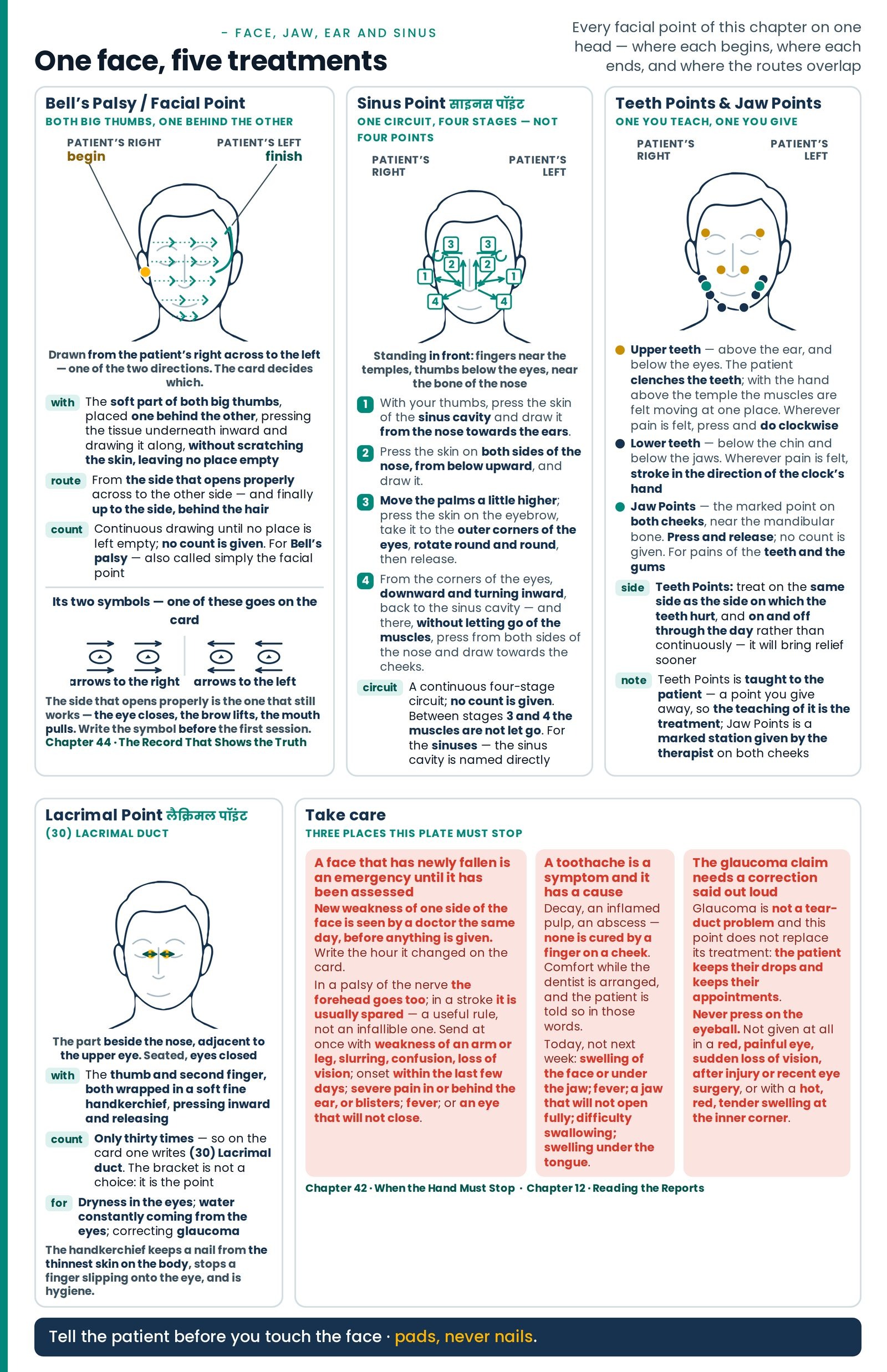
Teeth Points — दांतों के दर्द के लिए पॉइंट्स
This treatment is to be taught to the patient, and tell them to press and release at the points shown in the figure.
For the upper teeth, press at the points above the ear and below the eyes. To find the point above the ear, tell the patient to clench their teeth; at that moment, placing the hand above the temple, the muscles will be felt moving at one place. Wherever pain is felt there, press at that place and do clockwise.
For the lower teeth, at the points below the chin and below the jaws, wherever pain is felt, stroke in the direction of the clock's hand at that place.
Treat on the same side as the side on which the teeth hurt.
Doing it on and off through the day, rather than continuously, will bring relief sooner.
| Patient's position | Seated; the treatment is taught to the patient to do themselves Seated |
|---|---|
| Where the hands are placed | Upper teeth: the point above the ear — found by asking the patient to clench the teeth and feeling where the muscles move — and the point below the eyes. Lower teeth: below the chin and below the jaws. Wherever pain is felt |
| Duration and repetitions | Press and release, then clockwise; no count is given. Doing it on and off through the day, rather than continuously, will bring relief sooner |
| What it is for | Pain of the teeth — upper and lower separately, on the same side as the side on which the teeth hurt Left Right |
This is a point you give away, so the teaching of it is the treatment.
What lies beneath. The bunch that rises when the jaw clenches is the fan-shaped muscle of the temple; below the cheekbone is the thick slab doing the same work from the other direction. Both are run by the lower division of the great nerve of the face — the same division that carries sensation from the lower teeth — while the upper teeth are served by the division above it. Hence something a therapist meets constantly: pain from a clenching jaw muscle is very commonly reported as toothache.
From The Child, the Elder and the Frail
When the teeth are coming
Half milk and half sago water — and the fever that may stay two days
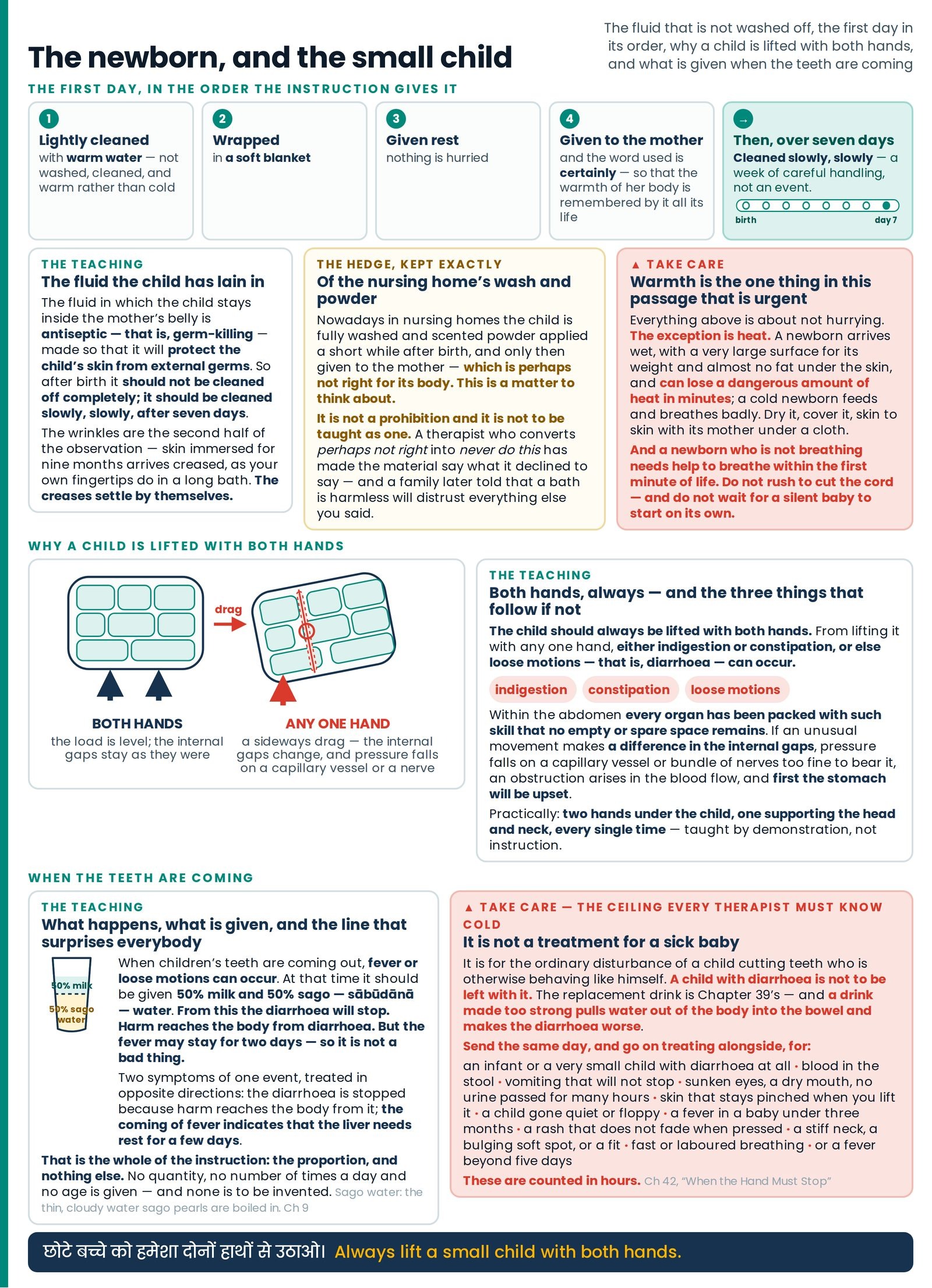
Teething — what happens, what is given, and the line that surprises everybody
When children's teeth are coming out, then fever or loose motions can occur.
At that time it should be given 50% milk and 50% sago — sābūdānā — water.
From this the diarrhoea will stop. Harm reaches the body from diarrhoea.
But the fever may stay for two days — so it is not a bad thing.
Read the last sentence twice. It is the one nobody expects and it is not carelessness; it is consistent with what this material teaches about fever everywhere else. The diarrhoea is to be stopped, because harm reaches the body from diarrhoea. The fever is not to be stopped, and may stay for two days, and that is not a bad thing. The two symptoms of one event are treated in opposite directions, for stated reasons, and a therapist should be able to say why.
The why is in the teaching on undigested food, and it is where this rule connects to the rest of the wiki. To small children, UDF comes for the first time when their teeth are coming out — and a few days after undigested food appears in the motion, the child may get pain in the stomach or the head, or fever, for a day or two. The coming of fever indicates that the liver needs rest for a few days. A white layer-like coating appears on the child's tongue, and at that time hunger is not felt. A fever read that way is not an enemy to be put down; it is the body's own instruction to stop working the liver for a few days, and the food rules of the febrile child follow from it.
Also explained in
- Jaw Points — जॉ पॉइंट्स Seated II — Face, Jaw, Ear, Sinus
This is excellent for pains of the teeth and the gums.
- What this article hands to the next Seated II — Face, Jaw, Ear, Sinus
Note the time of onset; ask every session, can you close that eye? Teeth Points are taught to the patient.
- Introduction Seated II — Face, Jaw, Ear, Sinus
Teach a patient the Teeth Points on themselves, and give Jaw Points and Lacrimal Point with the count that names the card.
- Satnam — सतनाम Seated II — Face, Jaw, Ear, Sinus
It was stopped, the home work changed to the Teeth Points shape of instruction, and the headache settled inside a fortnight.
- Questions students ask Seated II — Face, Jaw, Ear, Sinus
The facial, teeth, jaw, lacrimal and ear points adapt; Satnam and Shivaji do not, because both depend on the seated position.
- Layer four — the near-neighbours, and the one question that separates each pair The River — Heparin
Teeth point is given to increase the circulation of blood in the teeth or the jaws, from which the pain in them comes to an end.
- The head and the face Each Point in Use
ammering, speech, ear, eye and teeth — and the side crosses Table 18 — The head, the face, the ear and the eye Point What it is used for When it must not be used Notes Bell's palsy Seated For a person whose mouth is twi
- What is given to a small child at the mat The Child, the Elder and the Frail
Thin, with the belly of a small child who is not absorbing, and the four front teeth through with two more coming.
- The schoolchild and the bus Food as Medicine
TAKE CARE Teeth, and the patient who cannot chew Chew well is an instruction to a mouth that can.
- Two bodies, read as this article teaches The Fire and the Ash
"He was fine until the teeth started.
- The face and the mouth Cranial Nerve and Brain Formulas
Table 12 — The jaw, the teeth and the gums Point or condition Treatment Problems of the muscles of chewing (5) Medulla For every problem of the teeth (5) Medulla Problems of the gums (5) Medulla Problems of the lips (5)
- Feather Touch — the lightest treatment there is Cranial Nerve and Brain Formulas
Show the teeth — the mouth pulled across to the left, the good side.
- Questions patients ask you The Child, the Elder and the Frail
(A grandmother) "My grandson's teeth are coming and he has loose motions and a little fever.
- Why the sequence matters Six Seconds
It is a sequence: rise at a stated hour, then evacuate, then clean the teeth, then the tongue, then the eyes, then oil, then exercise, then bathe, then eat.