That answer is exactly right about the records it refuses, and this article is about a different kind. Records kept to prove something about a therapist are a vanity and a theft of time. Records kept to prove something about a patient are the treatment — because without them you cannot tell whether Thursday was better than Monday, and a therapy that treats according to the condition of the body has to know what the body was in on Monday. The card is not for your reputation. It is for the man on the mat, and for whoever treats him on a morning you are not there.
Watch


What this article does not repeat
Grading, the composition of a finding and the notation are taught elsewhere
Three things belong elsewhere and are used here without being taught again, because a thing taught twice is a thing learned once.
The plus-and-minus grading — Pan⁺⁺⁺⁺ before the treatment, and Pan⁺⁺, Pan⁺ or Pan ₋ written below it afterwards — is taught in full, with the reasons Guruji gives for showing it to the patient, in Uncommon Problems, "Points for Uncommon Problems", together with the whole of the after-treatment care. The way a finding is composed — point · side · ring · grade · H or P — belongs to The Educated Hand, "The Educated Hand". The notation of formulas, every mark of it, is closed at How a Formula Is Built, "How a Formula Is Built", in Table 13; nothing in this article re-explains a bracket, a colon, an underline or an Ulta.
What is this article's own is the card as a document. Not what the marks mean — how they sit on a page, in what order, in what fixed places, and by what discipline, so that the page is still usable by somebody else in five years. A notation is a vocabulary. A record is a piece of writing, and writing has its own rules.
A working practice keeps three things, and students routinely try to make one of them do the work of all three.
There is only one test, and every rule in this article is a consequence of it.
The one test of a card
Can a therapist who has never met this patient pick up this card on a morning you are not there — and continue the course?
Note the word continue. Any competent therapist can examine a stranger from the beginning and build a plan; that is what training is for. Continuing is harder, because it requires knowing what was already tried, what was deliberately not given and why, what was changed and what change was expected, what the patient was told, and where in the estimate she now stands. None of that is in a set of findings. All of it is in the lines written between them.
The test is not rhetorical. Run it. Hand three of your own cards to a colleague, say nothing, and ask what he would give tomorrow. The cards that fail are usually the ones for your favourite patients, because familiarity is the enemy of a written record.
Four kinds of line, and never a fifth
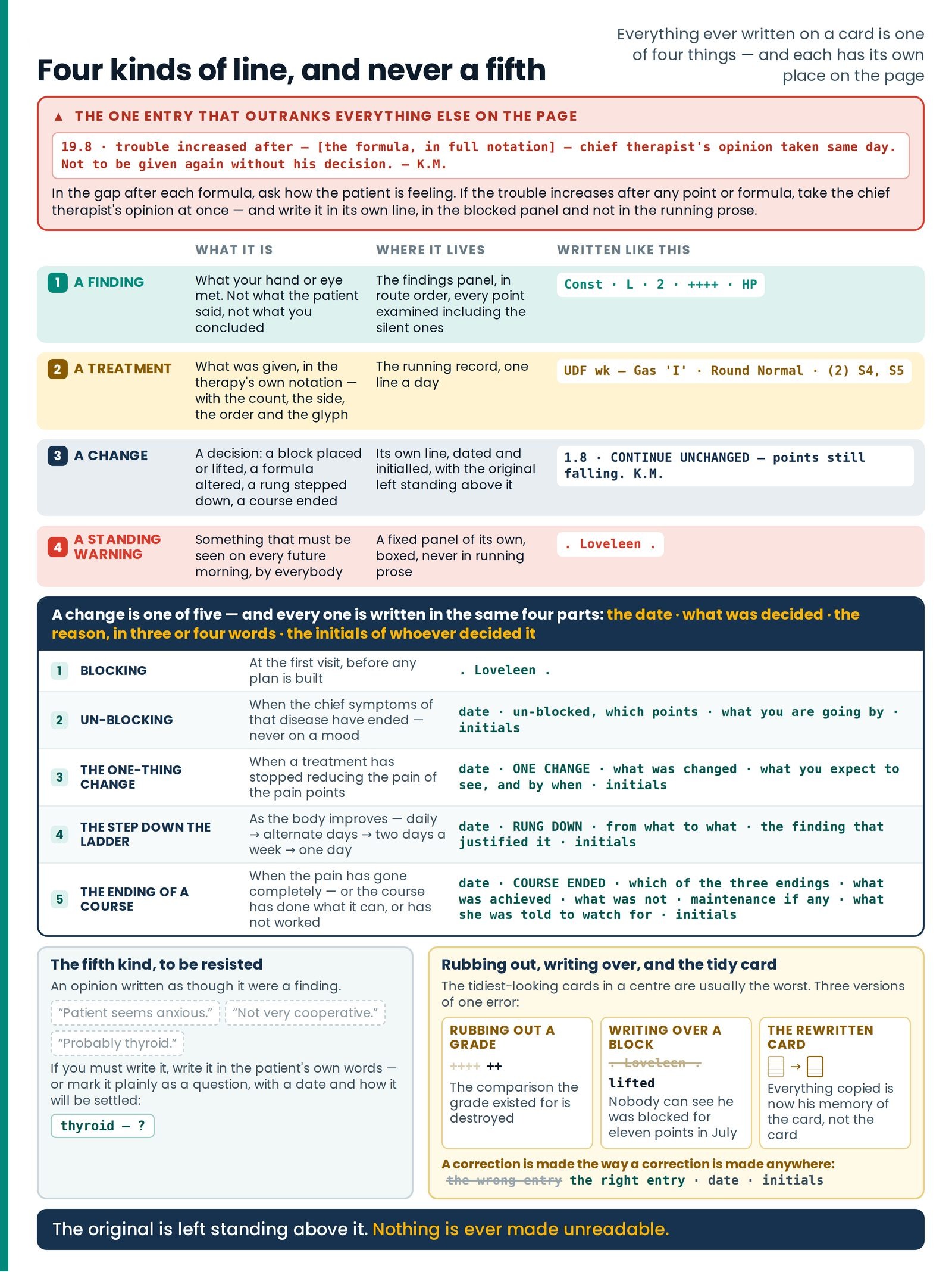
A finding, a treatment, a change, a standing warning — and no opinions
Everything ever written on a card is one of four things. The commonest failure in a practice is that they are written in the same voice, in the same ink, in no particular place — so that a year later nobody can tell a fact from an opinion, or a decision from a note. (Figure 44.1)
A fifth kind creeps in and should be resisted: the opinion written as though it were a finding. "Patient seems anxious." "Not very cooperative." "Probably thyroid." If you must write it, write it in the patient's own words or mark it plainly as a question — thyroid — ?, with a date and how it will be settled.
How a finding is written
Every point examined appears; the before-grade is never touched
The composition of a finding is The Educated Hand's and its grading is Uncommon Problems's. What belongs to the card is the arrangement, and three rules govern it.
The three rules of the findings panel
1. Every point examined appears, including the silent ones.
An empty box means not examined; a minus means examined and silent. These are two entirely different facts and a card that cannot distinguish them is worth very little. Nine minuses on a page are evidence that a hand was calibrated that morning; no minuses at all is evidence of a hand that went looking for pluses.
2. The after-grade is written below the before-grade, and the before-grade is never touched. This is the form the instruction itself gives: the four plus stands where it was written, and the two plus goes beneath it. A card on which a grade has been altered has destroyed the only comparison you own.
3. Write at the point, not afterwards. 6 sec A grade decays in about a minute, and what survives the walk to the desk is the loudest finding, the first finding and the finding you expected — a summary of your own expectations.
The running record is a different sheet with one line to a day, and there the same pair is written across rather than down: Const ⁺⁺⁺⁺ → ⁺⁺. The arrow is the one-line equivalent of the stacked form and says exactly the same thing. On the card's findings panel keep the stacked form, as the instruction gives it.
How a treatment is written
In the therapy's own notation — the glyph and the code, always both
A treatment is written in the therapy's own notation and in no other — which means with its counts, its sides, its order, its rests and its variant letters, exactly as Table 13 in How a Formula Is Built defines them. A card that reads Medulla has told the next therapist nothing; a card that reads (15) Lt. Medulla has told him everything.
And there is a second half to it, which is what the symbol key exists for. Many treatments are written not as words but as glyphs — a ring on a stem, two arrows springing apart, a numbered chevron, a small face with dots along the jaw. Forty-two of them are set out, each beside its code and its full name, in The Shorthand, "The Shorthand". They are fast to write, which is why they came into being in the first place: a man writing dozens of formulas a day in a camp, each of which had to survive being copied by a student and read back a week later.
The glyph and the code, both
Write every formula with the glyph and the code.
The glyph is for speed, on a busy morning, in your own hand. The code is so that a colleague years later — or a doctor reviewing what was done — can reconstruct which manoeuvre was applied.
The rule behind it is short enough to hang on a wall: notation only its author can read is not a record.
The same applies to your abbreviations. Every centre grows its own, and they are harmless until the day somebody else reads them. If you shorten anything, shorten it the same way every time, and put the key on the inside of the register's cover.
How a change is written
Date, decision, reason in four words, initials, original left standing
This is the heart of the article and the part of a card that students simply do not write. A finding is easy to record because your hand has just produced it. A decision has to be noticed before it can be written, and most decisions in a practice are made without being noticed at all — a formula quietly dropped, a block quietly ignored, a patient quietly seen twice a week instead of daily because that is how it worked out.
Every decision in this therapy that changes what will be done to a patient is written in the same four parts, in this order:
The form of a written decision
the date · what was decided · the reason, in three or four words · the initials of whoever decided it
And one rule about the page: the original is left standing above it. A block that is lifted is not rubbed out; a new line is written below with the date and the name, and the old line stays visible so that anyone reading the card can see both what had been true and when it stopped being true.
A decision without a date cannot be reviewed. A decision without a name cannot be asked about. A decision that erased what it replaced has hidden the one thing worth knowing.
Five decisions recur in every practice, and each one has already been specified elsewhere in this wiki as a written line. Here they are gathered, with the exact shape of each.
Table 2 — The five written decisions, and how each is set down
| The decision | When it is made | Written as | Established in |
|---|---|---|---|
| Blocking | At the first visit, before any plan is built — the points not to be given in this patient's conditions | A boxed panel of its own, each point with its reason in three or four words beside it. The model the material itself gives is . Loveleen . — written with a full stop before and after, so that on later days too it is remembered that this point is not to be given | From Findings to a Plan · When the Hand Must Stop |
| Un-blocking | When the chief symptoms of that disease have ended — never on a mood, never on he feels much better | A new dated, named line beneath the original, which stays standing: date · un-blocked, which points · what you are going by · initials. One point back is a normal result; three at once is usually enthusiasm | When the Hand Must Stop · Weeks, Not Sessions |
| The one-thing change | When a treatment has stopped reducing the pain of the pain points — and only after attendance, the twenty-three hours and the body have been looked at first | date · ONE CHANGE · what was changed · what you expect to see, and by when · initials. The expectation is the half everybody leaves out, and it is the half that teaches you something next week | From Findings to a Plan · Weeks, Not Sessions |
| The step down the ladder | As the body improves — daily → alternate days → two days a week → one day. Not on the calendar and not on the patient's convenience | date · RUNG DOWN · from what to what · the finding that justified it · initials. A pause is not a rung and is written as a pause | Weeks, Not Sessions |
| The ending of a course | When the pain has gone completely and the symptoms are all right — or when the course has done what it can, or when it has not worked and is being ended for that reason | date · COURSE ENDED · which of the three endings · what was achieved · what was not · maintenance if any · what she was told to watch for · initials | Weeks, Not Sessions |
The card is built once. The record is built daily, and the whole argument for it is that it costs seconds. A therapist seeing thirty patients a morning cannot write paragraphs and should not try; what he can do, and what turns his year into something readable, is one disciplined line.
What is written after the treatment, and why it is written at all
Three things from the last ten minutes have to reach the paper
The last ten minutes of a session belong to Uncommon Problems and are taught there whole: the re-check of every pain point, the stacked grading, showing or telling the patient where and by how much the pain has decreased, turning onto the side to get up, walking about a little if it is a pain patient, food after half an hour, the giddy patient sat down and supported and given jaggery water in half a glass if need be, the cupped palm behind the neck for a heavy head, the telephone touched by nobody until all of it is done, and the mat cleaned and the pillows laid again before the next patient.
What belongs here is the part of that which reaches the paper. Three of those ten minutes produce entries, and they are the three most often lost.
The three things that must reach the record from the last ten minutes
1. The after-grades, at every point re-checked.
Written below the before-grades on the card, or across the line on the record. Without these the decision rule has nothing to stand on: so long as any treatment reduces the pain of the pain points, there is no need to change it and give another. The rule requires the grades to exist.
2. Anything the patient felt, including the ordinary reactions. Giddiness on rising, a heavy head, soreness or tiredness for a day or two afterwards. These are common, they are usually nothing, and they are exactly the sort of thing a therapist stops noticing after his first year. Writing them down is how a practice learns which patients react and which treatments provoke it — and how you discover, three years in, that one of your own habits produces more of it than the others.
3. What the patient was told. The estimate, on the first day and again at the fourth-week review. The two rules given to the household. The sentence she is to take to her own doctor. A patient who was told many months in July does not panic in August; a patient whose card does not record what she was told will be told something different by the next therapist, and will believe neither of you.
This is the part of the article to copy. What follows is one patient's card and record from the first morning to the last, written exactly as they should actually be written — abbreviations, initials, corrections and all. The clinical reasoning is not the lesson here; the paper is the lesson. Every formula named is taught in its own article and every block is taken from When the Hand Must Stop. (Figure 44.2)
The patient came to the centre in the story above, which is why the initials on every line are the same two.
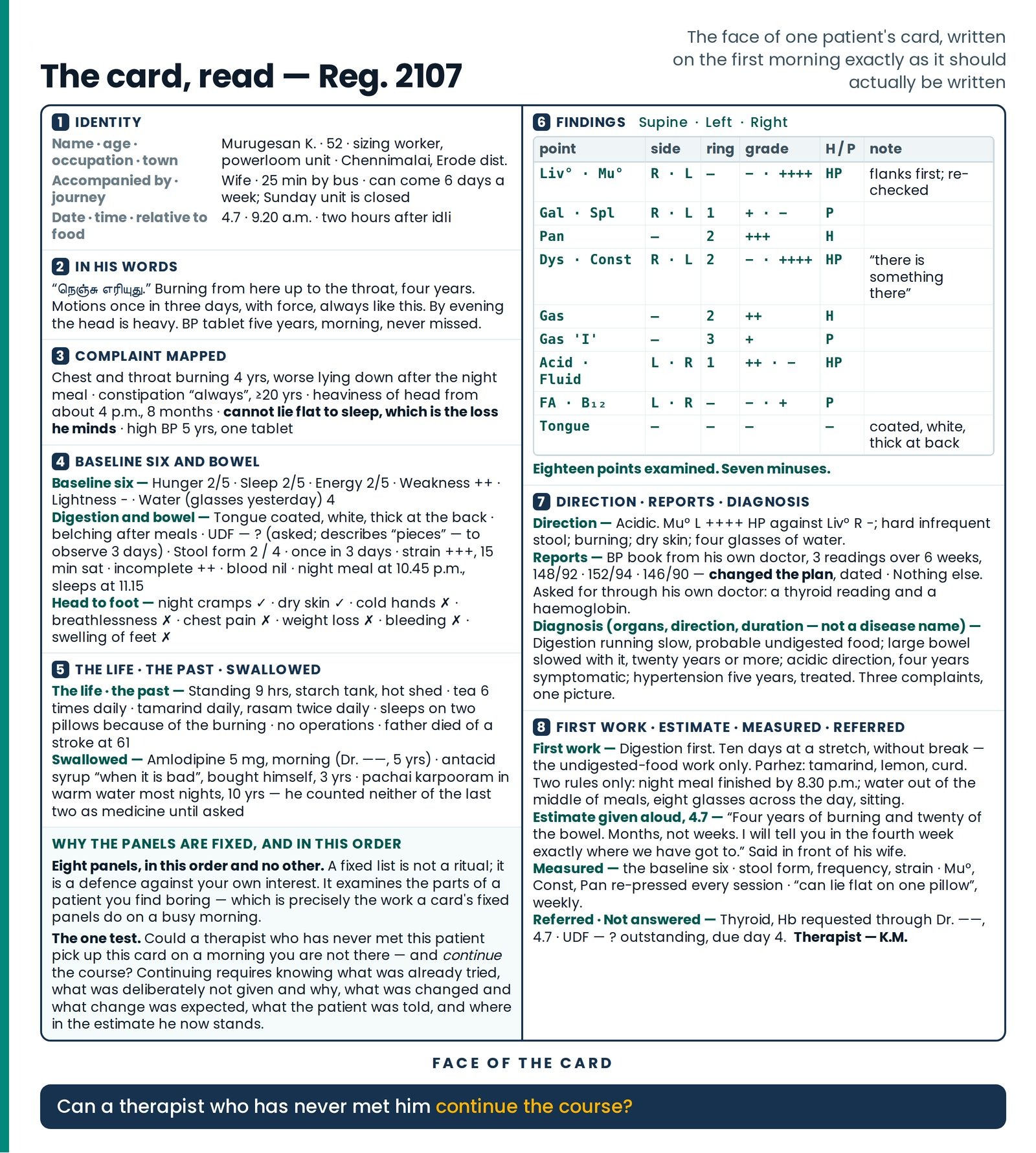
DIAGNOSIS CARD · Reg. 2107
One patient's card, written exactly as it should actually be written
| Name · age · occupation · town | Murugesan K. · 52 · sizing worker, powerloom unit · Chennimalai, Erode dist. |
|---|---|
| Accompanied by · journey | Wife · 25 min by bus · can come 6 days a week; Sunday unit is closed |
| Date · time · relative to food | 4.7 · 9.20 a.m. · two hours after idli |
In his words — "நெஞ்சு எரியுது." Burning from here up to the throat, four years. Motions once in three days, with force, always like this. By evening the head is heavy. BP tablet five years, morning, never missed.
Complaint mapped — Chest and throat burning 4 yrs, worse lying down after the night meal · constipation "always", ≥20 yrs · heaviness of head from about 4 p.m., 8 months · cannot lie flat to sleep, which is the loss he minds · high BP 5 yrs, one tablet
Baseline six — Hunger 2/5 · Sleep 2/5 · Energy 2/5 · Weakness ++ · Lightness − · Water (glasses yesterday) 4
Digestion and bowel — Tongue coated, white, thick at the back · belching after meals · UDF — ? (asked; describes "pieces" — to observe 3 days) · Stool form 2 / 4 · once in 3 days · strain +++, 15 min sat · incomplete ++ · blood nil · night meal at 10.45 p.m., sleeps at 11.15
Head to foot — night cramps ✓ · dry skin ✓ · cold hands ✗ · breathlessness ✗ · chest pain ✗ · weight loss ✗ · bleeding ✗ · swelling of feet ✗
The life · the past — Standing 9 hrs, starch tank, hot shed · tea 6 times daily · tamarind daily, rasam twice daily · sleeps on two pillows because of the burning · no operations · father died of a stroke at 61
Swallowed — Amlodipine 5 mg, morning (Dr. ——, 5 yrs) · antacid syrup "when it is bad", bought himself, 3 yrs · pachai karpooram in warm water most nights, 10 yrs — he counted neither of the last two as medicine until asked
Findings Supine Left Right
| Point | Side | Ring | Grade | H / P | Note |
|---|---|---|---|---|---|
| Liv° · Mu° | R · L | — | − · ++++ | HP | flanks first; re-checked |
| Gal · Spl | R · L | 1 | + · − | P | |
| Pan | — | 2 | +++ | H | |
| Dys · Const | R · L | 2 | − · ++++ | HP | "there is something there" |
| Gas | — | 2 | ++ | H | |
| Gas 'I' | — | 3 | + | P | |
| Acid · Fluid | L · R | 1 | ++ · − | HP | |
| FA · B₁₂ | L · R | — | − · + | P | |
| Tongue | — | coated, white, thick at back |
Eighteen points examined. Seven minuses.
Direction — Acidic. Mu° L ++++ HP against Liv° R −; hard infrequent stool; burning; dry skin; four glasses of water.
Reports — BP book from his own doctor, 3 readings over 6 weeks, 148/92 · 152/94 · 146/90 — changed the plan, dated · Nothing else. Asked for through his own doctor: a thyroid reading and a haemoglobin.
Diagnosis (organs, direction, duration — not a disease name) Digestion running slow, probable undigested food; large bowel slowed with it, twenty years or more; acidic direction, four years symptomatic; hypertension five years, treated. Three complaints, one picture.
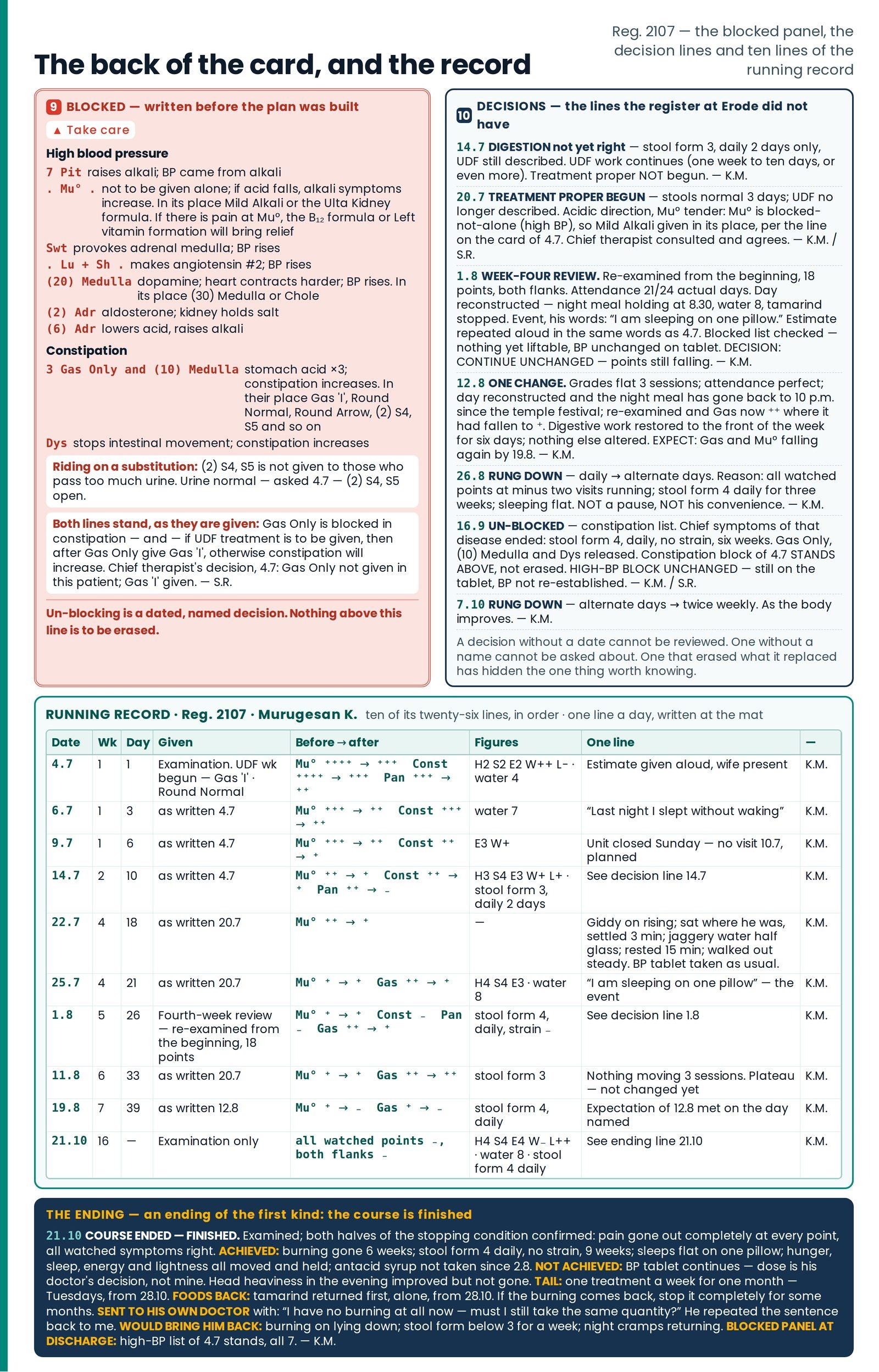
BLOCKED — written before the plan was built ▲ Take care
Seven points closed for the blood pressure, two for the constipation
High blood pressure — 7 Pit — raises alkali; BP came from alkali · . Mu° . — not to be given alone; if acid falls, alkali symptoms increase. In its place Mild Alkali or the Ulta Kidney formula. If there is pain at Mu°, the B₁₂ formula or Left vitamin formation will bring relief · Swt — provokes adrenal medulla; BP rises · . Lu + Sh . — makes angiotensin #2; BP rises · (20) Medulla — dopamine; heart contracts harder; BP rises. In its place (30) Medulla or Chole · (2) Adr — aldosterone; kidney holds salt · (6) Adr — lowers acid, raises alkali
Constipation — 3 Gas Only and (10) Medulla — stomach acid ×3; constipation increases. In their place Gas 'I', Round Normal, Round Arrow, (2) S4, S5 and so on · Dys — stops intestinal movement; constipation increases
Riding on a substitution: (2) S4, S5 is not given to those who pass too much urine. Urine normal — asked 4.7 — (2) S4, S5 open.
Both lines stand, as they are given: Gas Only is blocked in constipation — and — if UDF treatment is to be given, then after Gas Only give Gas 'I', otherwise constipation will increase. Chief therapist's decision, 4.7: Gas Only not given in this patient; Gas 'I' given. — S.R.
Un-blocking is a dated, named decision. Nothing above this line is to be erased.
First work — Digestion first. Ten days at a stretch, without break — the undigested-food work only. Parhez: tamarind, lemon, curd. Two rules only: night meal finished by 8.30 p.m.; water out of the middle of meals, eight glasses across the day, sitting. Estimate given aloud, 4.7 — "Four years of burning and twenty of the bowel. Months, not weeks. I will tell you in the fourth week exactly where we have got to." Said in front of his wife. Measured — the baseline six · stool form, frequency, strain · Mu°, Const, Pan re-pressed every session · "can lie flat on one pillow", weekly. Referred · Not answered — Thyroid, Hb requested through Dr. ——, 4.7 · UDF — ? outstanding, due day 4. Therapist — K.M.
RUNNING RECORD · Reg. 2107 · Murugesan K.
Twenty-six lines, one to a day, from the first morning to the last
| Date | Wk | Day | Given | Before → after | Figures | One line | — |
|---|---|---|---|---|---|---|---|
| 4.7 | 1 | Examination. UDF wk begun — Gas 'I' · Round Normal | Mu° ⁺⁺⁺⁺ → ⁺⁺⁺ Const ⁺⁺⁺⁺ → ⁺⁺⁺ Pan ⁺⁺⁺ → ⁺⁺ | H2 S2 E2 W++ L− · water 4 | Estimate given aloud, wife present | K.M. | |
| 5.7 | 1 | 2 | as above | Mu° ⁺⁺⁺⁺ → ⁺⁺⁺ Const ⁺⁺⁺⁺ → ⁺⁺ | water 6 | — | K.M. |
| 6.7 | 1 | 3 | as written 4.7 | Mu° ⁺⁺⁺ → ⁺⁺ Const ⁺⁺⁺ → ⁺⁺ | water 7 | "Last night I slept without waking" | K.M. |
| 7.7 | 1 | 4 | as written 4.7 | Mu° ⁺⁺⁺ → ⁺⁺ Const ⁺⁺⁺ → ⁺⁺ Pan ⁺⁺ → ⁺ | H3 S3 · stool form 2, day 3 | UDF confirmed — describes pieces, 2 of 3 days | K.M. |
| 8.7 | 1 | 5 | as written 4.7 | Mu° ⁺⁺⁺ → ⁺⁺ Const ⁺⁺⁺ → ⁺ | — | K.M. | |
| 9.7 | 1 | 6 | as written 4.7 | Mu° ⁺⁺⁺ → ⁺⁺ Const ⁺⁺ → ⁺ | E3 W+ | Unit closed Sunday — no visit 10.7, planned | K.M. |
| 11.7 | 2 | 7 | as written 4.7 | Mu° ⁺⁺⁺ → ⁺⁺ Const ⁺⁺ → ⁺ | stool form 3, day 2 | — | K.M. |
| 12.7 | 2 | 8 | as written 4.7 | Mu° ⁺⁺ → ⁺ Const ⁺⁺ → ⁺ | — | "Burning comes only twice a week now" | K.M. |
| 13.7 | 2 | 9 | as written 4.7 | Mu° ⁺⁺ → ⁺ Const ⁺⁺ → ⁺ | — | K.M. | |
| 14.7 | 2 | 10 | as written 4.7 | Mu° ⁺⁺ → ⁺ Const ⁺⁺ → ⁺ Pan ⁺⁺ → ₋ | H3 S4 E3 W+ L+ · stool form 3, daily 2 days | See decision line 14.7 | K.M. |
| 15.7 | 3 | 11 | UDF wk continued | Mu° ⁺⁺ → ⁺ Const ⁺⁺ → ⁺ | — | K.M. | |
| 18.7 | 3 | 14 | UDF wk continued | Mu° ⁺⁺ → ⁺ Const ⁺ → ₋ | stool form 4, daily, strain + | — | K.M. |
| 21.7 | 4 | 17 | Treatment proper begun — see decision line 20.7 | Mu° ⁺⁺ → ⁺ Const ⁺ → ₋ | — | K.M. | |
| 22.7 | 4 | 18 | as written 20.7 | Mu° ⁺⁺ → ⁺ | — | Giddy on rising; sat where he was, settled 3 min; jaggery water half glass; rested 15 min; walked out steady. BP tablet taken as usual. | K.M. |
| 25.7 | 4 | 21 | as written 20.7 | Mu° ⁺ → ⁺ Gas ⁺⁺ → ⁺ | H4 S4 E3 · water 8 | "I am sleeping on one pillow" — the event | K.M. |
| 1.8 | 5 | 26 | Fourth-week review — re-examined from the beginning, 18 points Supine Both sides | Mu° ⁺ → ⁺ Const ₋ Pan ₋ Gas ⁺⁺ → ⁺ | stool form 4, daily, strain ₋ | See decision line 1.8 | K.M. |
| 8.8 | 6 | 31 | as written 20.7 | Mu° ⁺ → ⁺ Gas ⁺⁺ → ⁺⁺ | — | Attendance 26/28 actual days | K.M. |
| 11.8 | 6 | 33 | as written 20.7 | Mu° ⁺ → ⁺ Gas ⁺⁺ → ⁺⁺ | stool form 3 | Nothing moving 3 sessions. Plateau — not changed yet | K.M. |
| 12.8 | 6 | 34 | — | See decision line 12.8 | K.M. | ||
| 19.8 | 7 | 39 | as written 12.8 | Mu° ⁺ → ₋ Gas ⁺ → ₋ | stool form 4, daily | Expectation of 12.8 met on the day named | K.M. |
| 26.8 | 8 | — | as written 12.8 | Mu° ₋ Gas ₋ | H4 S4 E4 W₋ L++ | See decision line 26.8 | K.M. |
| 9.9 | 10 | — | as written 12.8 · alt. days | all watched points ₋ | — | "The burning has not come for three weeks" | K.M. |
| 16.9 | 11 | — | as written 12.8 · alt. days | all watched points ₋ | stool form 4, daily, 6 wks | See decision line 16.9 | K.M. |
| 7.10 | 14 | — | as written 12.8 · twice weekly | all watched points ₋ | — | Thyroid and Hb received — both normal; filed with date; changed nothing | K.M. |
| 21.10 | 16 | — | Examination only Supine Both sides | all watched points ₋, both flanks ₋ | H4 S4 E4 W₋ L++ · water 8 · stool form 4 daily | See ending line 21.10 | K.M. |
The decision lines, written in full
The seven lines the register at Erode did not have
These are the lines the register at Erode did not have. Each of them is one sentence long and each is the reason the record above can be read by a stranger.
14.7 · DIGESTION not yet right — stool form 3, daily 2 days only, UDF still described. UDF work continues (one week to ten days, or even more). Treatment proper NOT begun. — K.M.
20.7 · TREATMENT PROPER BEGUN — stools normal 3 days; UDF no longer described. Acidic direction, Mu° tender: Mu° is blocked-not-alone (high BP), so Mild Alkali given in its place, per the line on the card of 4.7. Chief therapist consulted and agrees. — K.M. / S.R.
1.8 · WEEK-FOUR REVIEW. Re-examined from the beginning, 18 points, both flanks. Attendance 21/24 actual days. Day reconstructed — night meal holding at 8.30, water 8, tamarind stopped. Event, his words: "I am sleeping on one pillow." Estimate repeated aloud in the same words as 4.7; told he is in week four of months. Blocked list checked — nothing yet liftable, BP unchanged on tablet. DECISION: CONTINUE UNCHANGED — points still falling. — K.M.
12.8 · ONE CHANGE. Grades flat 3 sessions; attendance perfect; day reconstructed and the night meal has gone back to 10 p.m. since the temple festival; re-examined and Gas now ⁺⁺ where it had fallen to ⁺. Digestive work restored to the front of the week for six days; nothing else altered. Night-meal rule renegotiated with his wife, where it actually broke. EXPECT: Gas and Mu° falling again by 19.8. — K.M.
26.8 · RUNG DOWN — daily → alternate days. Reason: all watched points at minus two visits running; stool form 4 daily for three weeks; sleeping flat. NOT a pause, NOT his convenience. — K.M.
16.9 · UN-BLOCKED — constipation list. Chief symptoms of that disease ended: stool form 4, daily, no strain, six weeks. Gas Only, (10) Medulla and Dys released. Constipation block of 4.7 STANDS ABOVE, not erased. HIGH-BP BLOCK UNCHANGED — still on the tablet, BP not re-established. Decided with chief therapist. — K.M. / S.R.
7.10 · RUNG DOWN — alternate days → twice weekly. As the body improves. — K.M.
The ending
An ending of the first kind: what was achieved, and what was not
A course ends with a line, exactly as a block is lifted with a line. This one is an ending of the first kind — the course is finished. (Figure 44.3)
21.10 · COURSE ENDED — FINISHED. Examined; both halves of the stopping condition confirmed: pain gone out completely at every point, all watched symptoms right. ACHIEVED: burning gone 6 weeks; stool form 4 daily, no strain, 9 weeks; sleeps flat on one pillow; hunger, sleep, energy and lightness all moved and held; antacid syrup not taken since 2.8. NOT ACHIEVED: BP tablet continues — dose is his doctor's decision, not mine. Head heaviness in the evening improved but not gone. TAIL: one treatment a week for one month — Tuesdays, from 28.10. FOODS BACK: tamarind returned first, alone, from 28.10. If the burning comes back, stop it completely for some months. SENT TO HIS OWN DOCTOR with: "I have no burning at all now — must I still take the same quantity?" He repeated the sentence back to me. WOULD BRING HIM BACK: burning on lying down; stool form below 3 for a week; night cramps returning. BLOCKED PANEL AT DISCHARGE: high-BP list of 4.7 stands, all 7. — K.M.
Read what that ending does. It names what was achieved and what was not, in the same breath and without embarrassment. It sets the tail the material gives for the small ailments and names the day of the week. It gives back one food at a time with the qualification attached. It sends the tablets question to the person who prescribed the tablets, and it makes the patient say the sentence out loud so that he will say it correctly. It says what would bring him back in findings rather than in come if you have any trouble, which nobody acts on. And it leaves the blocked panel standing, because a blood pressure treated by somebody else is still a blood pressure.
Ruling up your own card and record
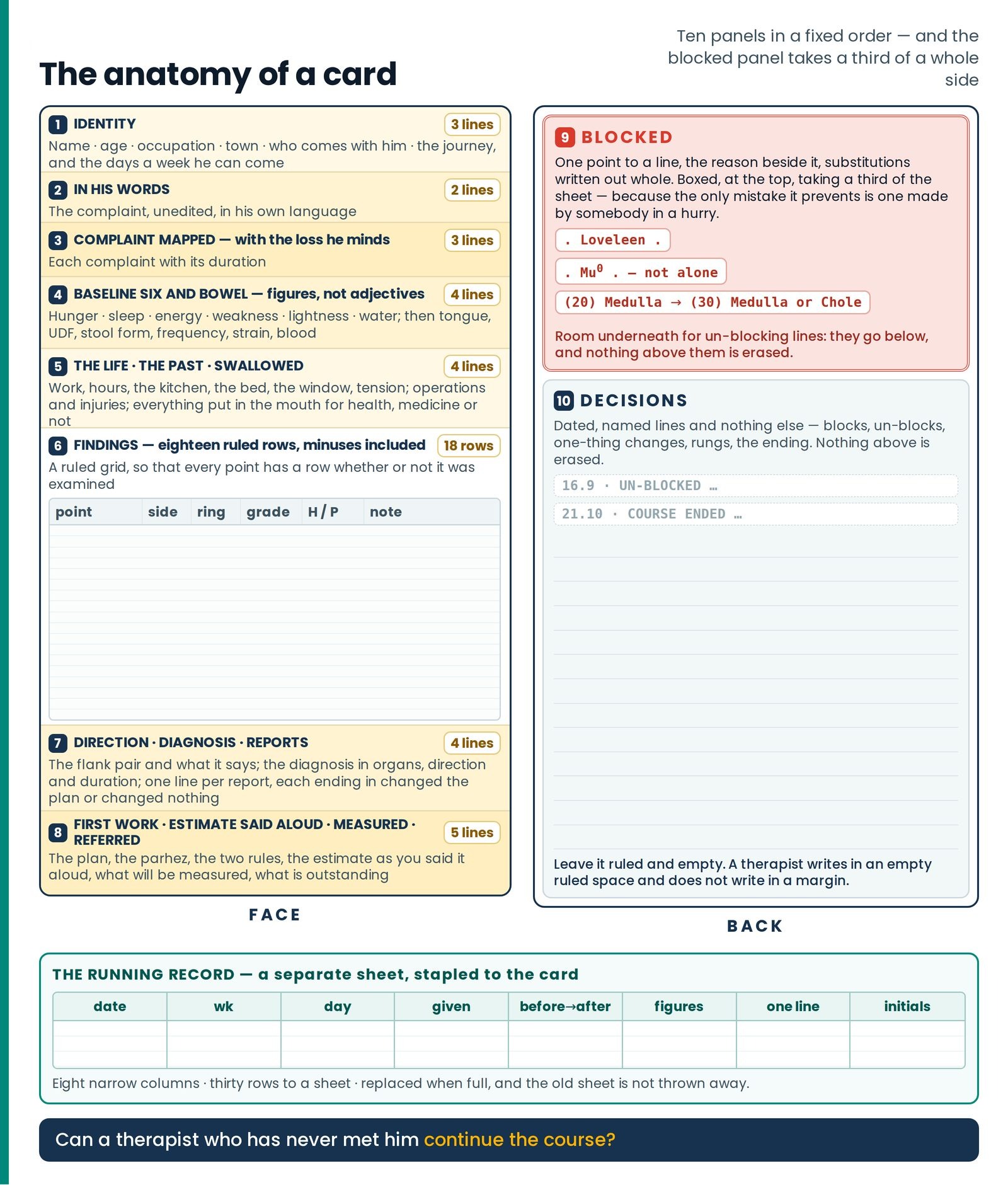
Eight panels on the face, two on the back, and four minutes' ruling
You do not need printed stationery and you should not wait for it. A card is a sheet of paper with lines ruled on it in the right places, and the ruling takes four minutes. (Figure 44.4)
A founder who says there is a long way to go has told you what he expects of you, and it is not admiration. It is that you keep your eyes open and record what you see — which means, once a year, sitting down with your own year and reading it instead of remembering it.
The question nobody asks a therapist out loud
A therapist's memory is a collection of successes, useless as evidence
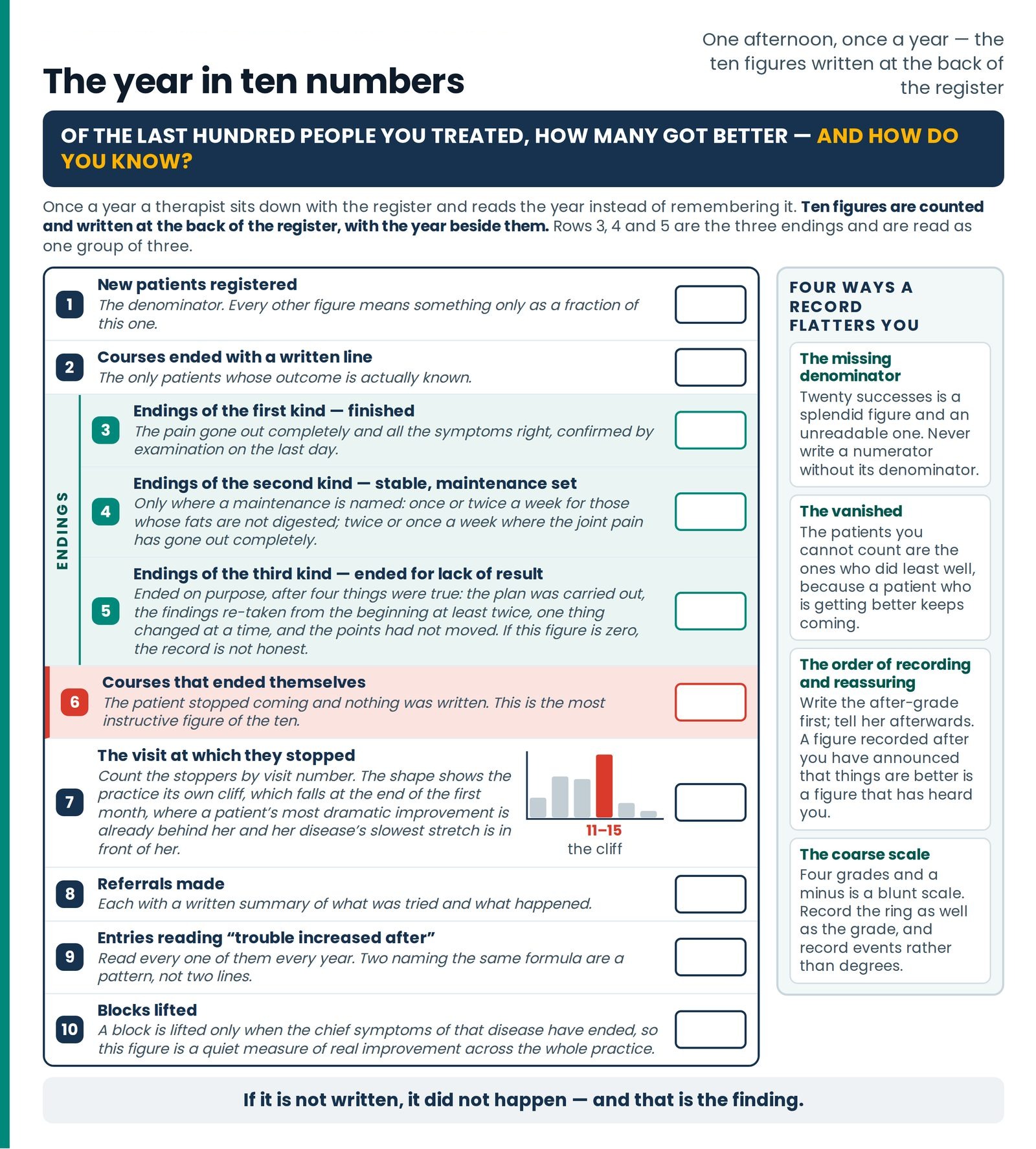
Of the last hundred people you treated, how many got better — and how do you know?
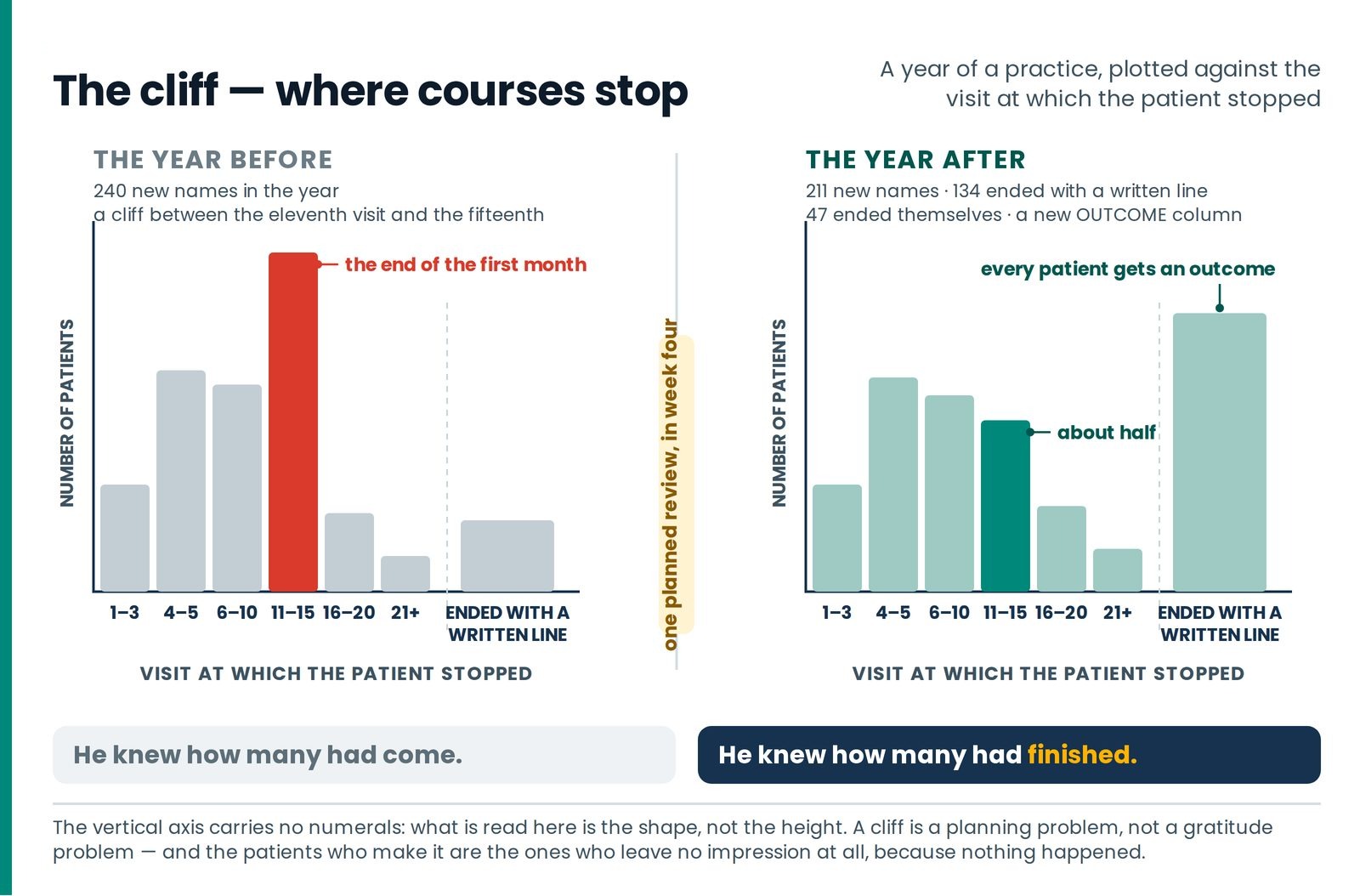
Every therapist has an answer ready and almost every answer is wrong in the same direction, because it is assembled from the patients who came back to say thank you. Those patients are real, and they are not a sample; they are a selection, made by the patients themselves, of the cases that went well. The ones who stopped in the fourth week did not come back to tell you they had stopped. Nothing happened to make you remember them. A therapist's memory is a collection of successes, honestly formed and completely useless as evidence. (Figure 44.7)
The defence is arithmetic, and it needs only a register with one more column in it than most registers have. (Figure 44.5)
What to count
Ten figures — and the one the Erode register could not produce
Table 3 — What a year must be able to tell you, and why each one
| Count this | Why it is the one that matters |
|---|---|
| New patients registered | Your denominator. Every other number in this table is meaningless as a bare figure and means something as a fraction of this one |
| Courses ended with a written line | The only patients whose outcome you actually know. If this is small, nothing else in the table can be interpreted |
| Endings of the first kind — finished | The pain gone out completely and the symptoms all right, confirmed by examination on the last day |
| Endings of the second kind — stable, maintenance set | Only where the material names a maintenance. A weekly appointment you and the patient have grown fond of is not an ending |
| Endings of the third kind — ended for lack of result | If this number is zero, your record is not honest. Every practice has these. A therapist who has never ended a course for lack of result has been letting them end themselves |
| Courses that ended themselves | The patient stopped coming and nobody wrote anything. This is the number the Erode register could not produce, and it is the most instructive figure in the table |
| The visit at which they stopped | Count the stoppers by visit number: how many at four or five, how many at ten, how many between eleven and fifteen. The shape will show you your own cliff, and a cliff is a planning problem, not a gratitude problem |
| Referrals made | Patients sent to somebody qualified, with a written summary. A practice that never refers is not seeing the patients it thinks it is seeing |
| Entries reading "trouble increased after…" | Rare, and they should be. Read every one of them, every year. These are the only cases in which your own practice has taught you something about harm |
| Blocks lifted | A quiet measure of real improvement across a whole practice, because a block is lifted only when the chief symptoms of a disease have ended |

The four ways a record flatters the person who wrote it
The missing denominator, the vanished, the order, and the coarse scale
The three flatterers of a therapist's judgement — the patient's kindness, the worst day, and your own memory — belong to Weeks, Not Sessions and are not restated. These four are different: they are ways a record that genuinely exists can still mislead, and each has a cheap correction.
The missing denominator. Twenty successes is a splendid figure and an unreadable one. Twenty out of twenty-four is a practice. Twenty out of a hundred and ninety is a different practice. Never write a numerator without its denominator, not in a register, not in a report to a doctor, and not in your own head.
The vanished. The patients you cannot count are systematically the ones who did least well, because a patient who is getting better keeps coming. Any figure computed only from completed courses is therefore kind to you by construction. The correction is the column at Erode: every registered patient gets an outcome, and "stopped coming, no reason known" is an outcome. (Figure 44.6)
The order of recording and reassuring. The instruction to show or tell the patient at which places and by how much the pain has decreased is a good one, and it is kept — it builds the patient's faith, and it gives you the card you will need if she disappears for a month and comes back saying the treatment did nothing. But the order matters for the record's sake. Write the after-grade first; tell her afterwards. A figure recorded after you have announced that things are better is a figure that has heard you. The two acts cost the same and one order protects both of you.
The coarse scale. Four grades and a minus is a good working scale and a blunt one. Two things sharpen it without adding a minute to a session: record the ring as well as the grade, because a finding that travels from the middle ring to the inner one has moved without going away; and record events rather than degrees — how many stairs, how many minutes standing, whether he can sit on the floor, whether he slept through. An event does not re-base itself.
There are therapists in this country who have been giving treatment for thirty and forty years and are still getting better at it, and there are others who stopped improving in their fourth year and have not noticed. The difference is not talent and it is not the number of patients seen. It is a short list of habits, most of which are about writing things down and none of which is difficult.
Table 4 — The habits, and the reason for each
| The habit | The reason |
|---|---|
| Examine before every treatment — including the patient you treated yesterday 6 sec | Neurotherapy treats according to the condition of the body, and Thursday's body is not Monday's. The habit's hard edge is the rule: never repeat yesterday's treatment from memory when the card cannot be found, because from a wrong treatment the patient's trouble can increase |
| Write at the point, not at the desk | A grade decays in about a minute and what survives is what you expected to find |
| Write the decision as well as the finding | Findings are easy to write because your hand has just made them. A decision has to be noticed before it can be recorded, and an unnoticed decision is how a practice drifts |
| Record what went wrong, in your own hand, on the day | Especially where you were at fault. These entries cost something to write, which is why they must be written before you have had time to think about them — and they are the only cases from which your own practice will ever teach you about harm |
| Ask the chief therapist — and write down the answer with his initials | An opinion taken and not recorded has to be taken again by the next person, who may get a different one |
| Take somebody else's eyes on your own patients, regularly | You cannot see your own habits. A colleague can see them in ten minutes, and the ones you cannot see are precisely the ones nobody has ever mentioned to you |
| Give the estimate out loud on day one, and again in week four | It costs forty seconds and it is the cheapest thing that will keep a chronic patient past the cliff |
| End courses on purpose — all three kinds | A course that ends itself teaches nobody anything, costs the patient her tail of treatment and her sentence for her own doctor, and leaves the next patient with the same disease to be treated by a therapist one case-worth poorer |
| Read your own cards from three years ago, once a year | The only direct evidence you will ever have that you are still improving. If you would make every one of those decisions again today, be uneasy |
| Teach somebody | Nothing examines your own knowledge as fast as a student's question, and this therapy has been given away from the beginning — free treatment, free teaching, and widowed and orphaned women taught a trade rather than given alms |
| Keep a referral list you know by heart, and use it | Knowing when to send somebody elsewhere is a clinical skill, not a confession of poverty. |
| Count, once a year | Because everything above this line is invisible to you without it |
Now the line that stands behind every habit in that table, and behind every rule in this article. It is a small sentence and it is the whole of a therapist's duty, which is why it is placed at the end of the last article of this wiki as it is placed at the end of a day's work.
The instruction that outranks the others
Whether or not the patient gets immediate benefit from our treatment, let no harm reach him through our carelessness — attend to this.
Read the shape of it before the content. It concedes at once the thing a lesser system would hide: the benefit is not promised. Some patients will improve in three days and some will not improve at all, and no honest therapist can know in advance which of the two is lying on his mat this morning. That half is not in your hands.
The other half is entirely in your hands, and the sentence puts it there. Harm through carelessness is not an accident; it is a decision made by somebody in a hurry, and every specific rule in this wiki is that sentence applied to one situation. Block the card before you plan the treatment. Read the blocked list aloud. Do not repeat yesterday's treatment from memory when the card cannot be found. Check the three-finger gap by hand before any weight goes on. Ask in the gap after each formula how the patient is feeling, and write it down if the trouble increased. Do not walk a giddy patient to a chair. Say what would bring her back, in findings and not in come if you have any trouble.
Not one of those is difficult. Every one of them is skipped by a tired person with four people waiting, and that is exactly the person the sentence is addressed to. ▲ Take care
Questions students ask
1. I am twenty and I write slowly. By the time I have written the card the patient has gone. What do I leave out? Nothing, but you write in a different order than you think. The findings go down at the point, with your hand still on the patient — six seconds each, in the grid, as marks and not as sentences. The one line of the running record goes down at the mat before you stand up. Only the prose fields wait, and there are very few of them. What makes a card slow is prose, and prose is the part with the least information in it.
2. I am a retired accountant and I keep everything on my computer. Is a paper card really necessary? The form matters more than the material. Whatever you use must satisfy four conditions: it must be findable by somebody who does not know your system, it must preserve what it replaces so that no correction destroys the original, it must show the blocked panel before anything else, and it must be usable at the mat with your hands on a patient. Paper satisfies all four cheaply and has no battery. If your system satisfies all four, use it — and keep a paper blocked-panel by the mat anyway.
3. Why write the minuses? It is half the card and it says nothing happened. It says a great deal. An empty box means not examined; a minus means examined and silent — and those are entirely different facts about your morning. Nine minuses are evidence that your hand was calibrated and that you were not hunting for pluses. And a point that is silent in July and tender in September is a finding you can only see if July's silence was written down.
4. I am a housewife treating my mother-in-law at home. She is in the next room. Surely a card is absurd? It is more necessary, not less, and for a reason that has nothing to do with formality. You will never notice a fourth week, because she never stops coming. You will never be asked to justify a decision, because nobody is watching. And you will be the last person on earth able to say to her that something is not working. Write the grades down even though she is family; fix a date for a review; and be willing to read the card and say what it says.
5. A doctor asked to see my records for a patient we share. What do I send him? A written summary, not a photocopy of the card, because the card is in a notation he cannot read and should not have to. One page: what the patient came with, in dates; what was found, in plain words; what was given, described rather than coded; how long; what changed and what did not, in figures where you have them; what you advised; and what you are asking of him. End it with the sentence that this is given alongside his treatment and never instead of it. See also → Reading the Reports, "Reading the Reports".
6. I work in a village and my patients cannot read. Whose card is it? The centre keeps the card; the patient should carry something. A single folded sheet with her name, what she was found to have in plain language, the dates, the two rules for her household, the estimate in the words you used, and the sentence for her own doctor. Read it aloud to her and to whoever came with her. A patient who can produce that sheet at another centre has saved that therapist a morning.
7. My chief therapist changes my plans and does not write anything. What do I do? Write it yourself, with his initials beside it, and show it to him: "Sir, I have written that we changed to this and why — is that right?" No one has ever objected to that question. An opinion taken and not recorded has to be taken again by the next person, who may not get the same answer, and it is the patient who pays for the difference.
- 8. How long do I keep cards? Longer than you think you need to. The patient who returns after four years is common, and her old card is the only thing that tells you whether the treatment she had was working when she stopped. The case in this article turned on an entry that was four years old. Keep them in order, in one place, dry, and tell somebody else where they are.
9. I am a doctor and I find the four-grade scale very coarse. Can I add my own measures? Yes, and two are worth more than the rest. Record the ring as well as the grade, because a finding can move inward without going away and you will otherwise read that as failure. And record events in the patient's own words — stairs, minutes standing, sitting on the floor, sleeping through — because a degree re-bases itself against the patient's current imagination and an event does not. Add anything else you like, provided it does not displace the therapy's own measure, which is what the decision rule runs on.
- 10. Nothing happened today. The grades are the same as yesterday. Do I write a line? Yes, and it is one of the more valuable lines you will write, because three of them in a row is a plateau and a plateau is a decision point. A record with the dull days missing is a record of your own interest. See also → Weeks, Not Sessions, "Weeks, Not Sessions".
11. I made a real mistake last week — gave a formula I should not have. Do I write that down? Write it down the same day, in your own hand, with what you did about it. Nobody will punish you for it and one day it will protect a patient. And be clear about what the alternative is: an unwritten mistake is not an erased mistake; it is a mistake that is still there, waiting for whoever treats this patient next, with nothing here to stop them.
12. My centre is busy and nobody else keeps records this way. Should I do it alone? Do it alone. It costs you a few seconds a patient and it will cost you nothing to be the person whose cards can be picked up. When somebody eventually asks why your fourth-week attendance is better than everybody's, you will have an afternoon's worth of figures to show them, and that is how a habit spreads in a centre — not by being announced.
Questions patients ask
1. "Why are you writing so much? Can you not just treat me?" The writing is part of the treatment and it takes about a minute of your half hour. What I write down is where the pain was before I began today and where it is now. That is what tells me next Tuesday whether this treatment is working for you, instead of both of us going by how we happen to feel about it. And if I am unwell one morning, whoever treats you that day can read it and carry on properly.
- 2. "Can I see my card?" Yes, and I will read it to you rather than hand it over, because half of it is in a shorthand that would only mislead you. Sit down and I will show you the part that matters — what I found on your first day at each of these places, and what I found today. This is the useful part. It is also the part that will settle any argument about whether this is helping.
- 3. "Who else will read what you have written about me?" Whoever treats you here, and nobody else. If you are sent to a doctor I will write a separate page saying what we did and what happened, and I will read it to you before it goes. Your card stays in this room, in a cupboard, with your number on it.
4. "Last time I came for four days and it came back, so it did not work." Let us find out rather than either of us guessing. I have your card from then. Look — these two points were painful before that day's treatment and not painful after it, in my own handwriting on the day. So the treatment did work on the day you took it. What did not happen was the course; four days is not a course for what you have. If you would like to start again, we will do it properly, and I will tell you on the first day how long it should take.
5. "You have written some things in a box on the back. What are they?" Those are the treatments I will not give you, and why. Some treatments are excellent for one person and wrong for another with your condition, so before I planned anything at all I wrote down the ones that are closed for you. They stay written on the card so that I remember them on a tired morning and so that anybody else who treats you sees them first. Some of them may come off later, and if they do I will write that down too, with the date.
- 6. "My daughter will be bringing me from next month. Will she need to explain everything again?" No. That is what the card is for. She should tell me anything new — a medicine begun, a food changed, anything that happened — but she does not need to carry your history in her head, and neither do you.
7. "You have written down that I felt giddy. Is something wrong with me?" No. It settled in three minutes and you walked out steadily, and that is written down too. I record it for the same reason I record everything else: so that if it happens again I can see that it is the second time and not the first, and so that I can tell whether it comes after one particular part of your treatment. Nothing is written on your card to alarm you. It is written so that neither of us has to rely on remembering.
Words used here
| Hindi | English | Neurotherapy code / usage |
|---|---|---|
| कार्ड (kārḍ) | The diagnosis card | One patient's whole picture, written once and added to — never rewritten; built in From Findings to a Plan |
| रिकॉर्ड / दैनिक पर्ची | The running record | One line a day: date, week, what was given, grades before and after, figures, one sentence, initials |
| रजिस्टर (rajisṭar) | The register | The centre's book — every patient who registered, with the date and manner of ending |
| ब्लॉक करना (blŏk karnā) | To block | To write on the card, enclosed, a point not to be given in this patient's condition, with the reason beside it — . Loveleen . |
| ब्लॉक हटाना | To un-block | To release a blocked point when the chief symptoms of that disease have ended — a dated, named line beneath the original, which stays |
| तारीख़ और दस्तख़त | Date and initials | The two things without which a decision cannot be reviewed or asked about |
| हर बात लिखो | Write everything down | The working form of let no harm reach him through our carelessness |
| चिन्ह (chinh) | Symbol, glyph | The drawn form of a point; write the glyph and the code, never the glyph alone — The Shorthand |
| पड़ताल (paṛtāl) | Audit, reckoning | The yearly reading of one's own register, from the figures and not from memory |
| — | Pan⁺⁺⁺⁺ → Pan ₋ | The before-and-after grading, written below, never over; taught whole in Uncommon Problems |
| — | Const ⁺⁺⁺⁺ → ⁺⁺ | The same pair written across, on a running record that has one line to a day |
| — | Empty box / minus | Not examined / examined and silent — two different facts, never confused |
| — | trouble increased after… | The entry that outranks everything else here; chief therapist's opinion taken at once and written clearly |
| — | OUTCOME | The column most registers do not have; stopped coming, no reason known is an outcome |