- How it is given
- Face Down
- What it is used for
- Each Point in Use
Watch

From Face Down
The two adrenal points
Adr for the cortex, Swt for the medulla — and nothing else is alike
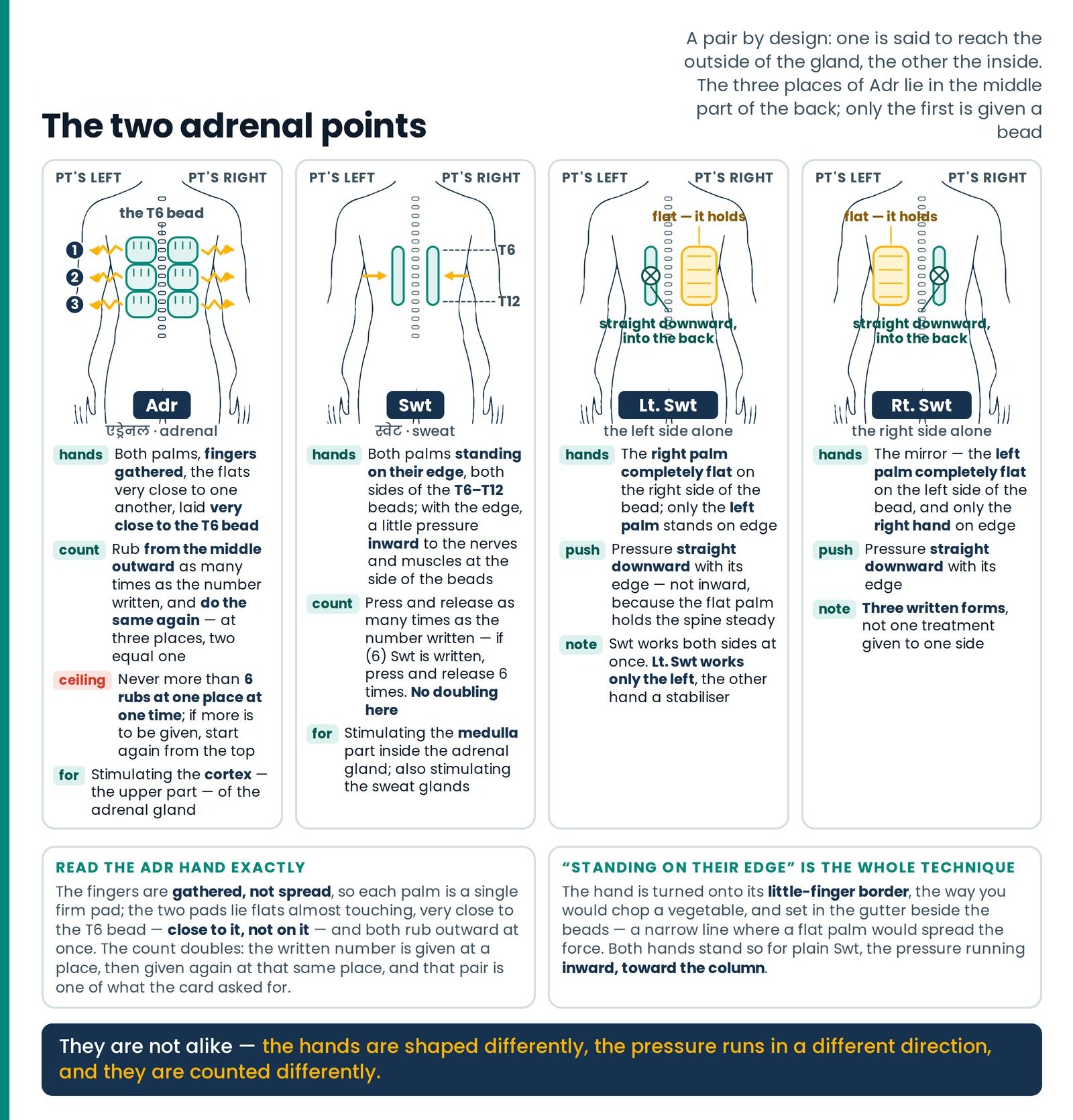
Two points open the group, a pair by design: one is said to reach the outside of a gland, the other the inside. They are not alike — the hands are shaped differently, the pressure runs in a different direction, and they are counted differently.
This is given to stimulate the cortex — that is, the upper part — of the adrenal gland.
Gathering your fingers together, place both palms very close to the T6 bead of the back, so that the flats of the two palms are very close to one another.
In the middle part of the back, at three places, rub from the middle outward as many times as the number written, and do the same again.
That is: at three places, two equal one.
At one place, do not rub more than 6 times at one time. If more is to be given, start again from the top.
| Patient's position | Prone, 1½ pillows under the chest, the chin resting Prone |
|---|---|
| Where the hands are placed | Both palms, fingers gathered, flats very close to one another, laid very close to the T6 bead; then at three places in the middle part of the back |
| Duration and repetitions | Rub from the middle outward as many times as the number written, and do the same again — at three places, two equal one. Never more than 6 rubs at one place at one time; if more is to be given, start again from the top ▲ Take care |
| What it is for | Stimulating the cortex — the upper part — of the adrenal gland |
Read the hand exactly. The fingers are gathered, not spread, so each palm is a single firm pad; the two pads lie flats almost touching, very close to the T6 bead — close to it, not on it — and both rub outward at once. And the count doubles: the written number is given at a place, then given again at that same place, and that pair is one of what the card asked for. (Figure 21.2)
From Face Down
(2) Adr, (4) Adr, (6) Adr — three treatments, not three strengths
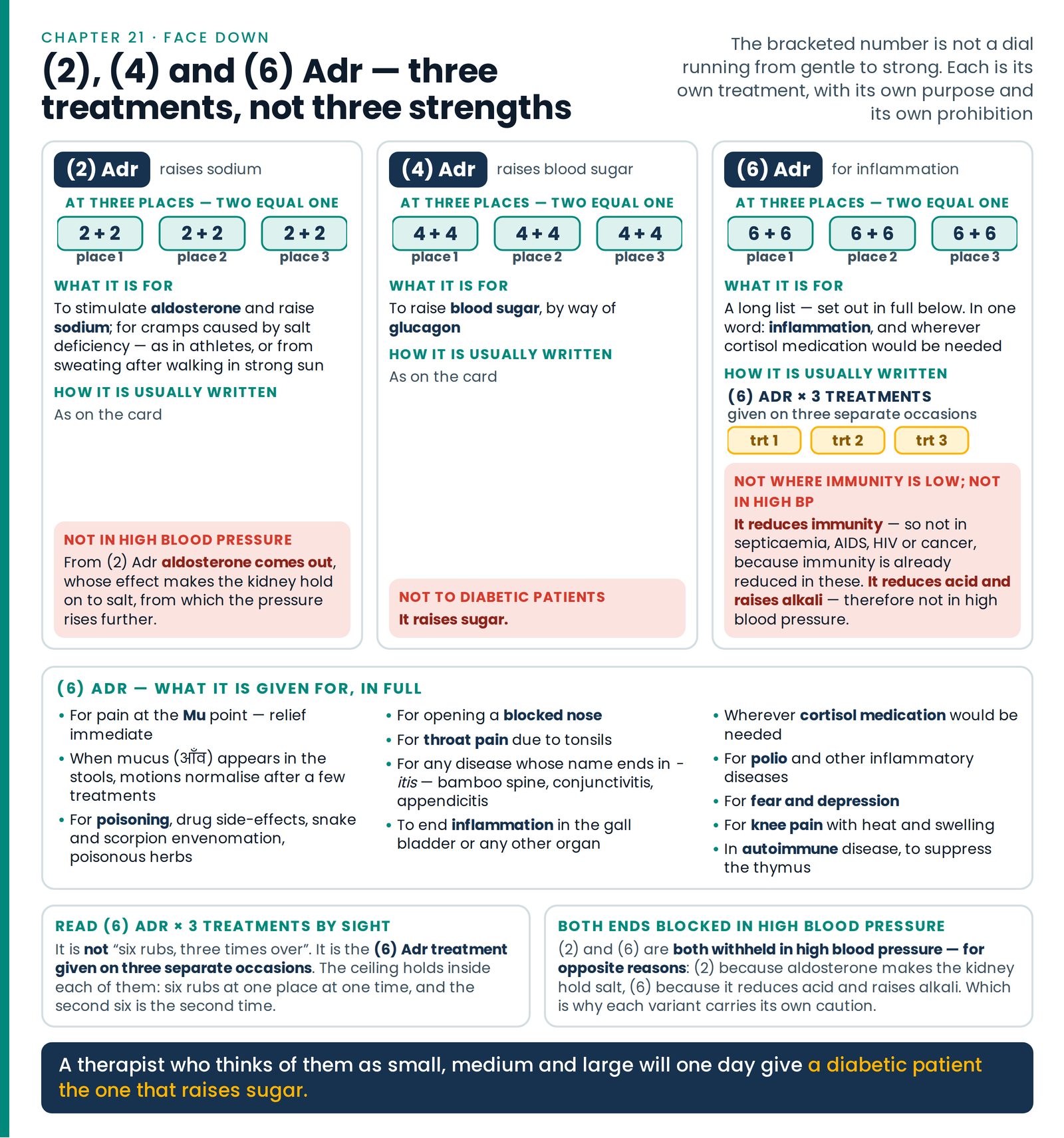
(6) ADR × 3 treatments is a form to learn by sight — not "six rubs, three times over", but the (6) Adr treatment given on three separate occasions. Note too that (2) and (6) are both withheld in high blood pressure for opposite reasons, which is why each variant carries its own caution. The rest of their use, and every condition in which each is blocked, is in Each Point in Use, "Each Point in Use", and When the Hand Must Stop, "When the Hand Must Stop". (Figure 21.3)
What lies beneath. A hand flat on the upper back lies over the broad sheet of muscle running to the shoulder, the two long ropes holding the spine upright, and then the ribs. The adrenal glands are nowhere near — two caps of four to six grams on top of the kidneys at the back of the belly, far lower than T6 and behind all of that. What the palm reaches is real; what it does not do is deliver a message to one named gland.
From Each Point in Use
The two adrenal points — cortex and medulla
Adr is aimed at the rind, Swt at the core — and the counts differ
The adrenal gland is two glands in one wrapper. The outer rind makes the slow chemicals — the salt-holding one, the sugar-raising one, the one that puts out inflammation. The inner core makes the fast ones, the two that a fright releases. ADR is aimed at the rind; SWT is aimed at the core. That is the whole of why they behave so differently, and why the counts under each open onto such different rooms.
Table 1 — ADR, the adrenal cortex point
| Point and variant | What it is used for | When it must not be used | Notes |
|---|---|---|---|
| ADR (the family) | Stimulates the adrenal cortex — the upper, outer part of the adrenal gland. Stimulating it in different numbers produces different effects | — | The framing line for everything below it. Method: |
| (2) Adr | To stimulate aldosterone and so raise sodium. For cramps caused by salt deficiency — as occurs in athletes, or from sweating after walking in strong sun | Do not give (2) Adr to high blood pressure patients ▲ Take care | Salt held in the body is water held with it, and water held is pressure raised. The mechanism and the prohibition are one thought |
| (4) Adr | To raise blood sugar by way of glucagon | Do not give (4) Adr to diabetic patients ▲ Take care | The same internal logic, applied to sugar instead of salt |
| (6) Adr | Usually given as (6) Adr × 3 treatments. For pain at the Mu point — relief is immediate. When mucus (आँव) appears in the stools, motions normalise after a few treatments. For poisoning, drug side-effects, snake and scorpion envenomation, and poisonous herbs. Good for opening a blocked nose. For throat pain due to tonsils — immediate relief. For any disease whose name ends in *-itis* — ankylosing spondylitis (bamboo spine), conjunctivitis, appendicitis and so on. To end inflammation in the gall bladder or any other organ. Wherever cortisol medication would be needed, this gives relief. For polio and other inflammatory diseases. For fear and depression — extreme sadness. For knee pain with heat and swelling. In autoimmune disease, to suppress the thymus | It reduces immunity. So do not give in septicaemia, AIDS, HIV or cancer, because immunity is already reduced in these. It reduces acid and raises alkali. Therefore do not give in high blood pressure ▲ Take care × 3 | Two prohibitions, each drawn from a stated mechanism. Note that the count is written with the number of treatments as well as the number of applications |
Poisoning, envenomation and appendicitis are named in that list and each of them is a race. A (6) Adr given while somebody carries a child to a hospital is one thing; a (6) Adr given instead of carrying the child is another.
Table 2 — SWT, the adrenal medulla and sweat point
| Point and variant | What it is used for | When it must not be used | Notes |
|---|---|---|---|
| SWT (the family) | Stimulates the adrenal medulla — the inner part of the adrenal gland — and the sweat glands. In this too it has been seen that stimulating in different numbers produces different functions | — | Method: |
| (3) Swt | To reduce the smell of sweat, or the smell of urine. And if there are pimples, it is to be given | — | The smallest count and the mildest use |
| (6) Swt | By means of nor-epinephrine, to reduce the motility of the intestines in loose motions | — | Given as one point, without a side |
| (6) Left Swt Left | To open — dilate — any sphincter, valve or duct that has become narrowed. For those with difficulty breathing in asthma. It stimulates epinephrine, which can reduce the diastolic blood pressure. Where there is difficulty swallowing from constriction of the food pipe, immediate benefit has been found. Where narrowing of the urinary passage makes urine come with burning and pain in a forceful stream, this gives relief. In men, where prostate enlargement makes urine come in stops and starts, or drop by drop, it may perhaps be beneficial | Epinephrine raises blood sugar, so do not give to diabetic patients ▲ Take care | The opening side. The last claim is printed with its own question mark and is not to be promised to a patient |
| (6) Right Swt Right | Stops the movement of the intestinal tract — so beneficial in loose motions. To constrict any sphincter, valve or duct that has become dilated. For those with difficulty breathing out in bronchitis — immediate benefit is seen. Very effective for the swelling in the legs from varicose veins. Where expansion of the muscles of the urinary bladder makes some women, or elderly people, pass a few drops of urine on laughing or sneezing, it corrects that | It stimulates nor-epinephrine. Therefore do not give to high blood pressure patients ▲ Take care | The closing side |
Read those last two rows across each other and you will see the finest piece of bookkeeping in the whole atlas. One point, split by side, becomes two opposite treatments. The left opens and the right closes. The left is refused to a diabetic; the right is refused to a hypertensive. Nothing else in this therapy is built quite so symmetrically, and a student who can recite the left–right split of Swt has understood what is meant by the count and the side are the treatment.
Also explained in
- The adrenal cortex, T6, and the finding of (6) Adr Fire and Swelling
On practising, it was learnt that the chief responsibility of controlling — of stopping — inflammation belongs to the hormone cortisol, made by the cortex of the adrenal gland.
- SWT — स्वेट · sweat Face Down
ith this treatment we stimulate the medulla part inside the adrenal gland.
- Introduction Face Down
Distinguish (2), (4) and (6) Adr as three treatments with three purposes and three prohibitions, and read (6) ADR × 3 treatments.
- ROUND ARROW — राउंड एरो Face Down
In diabetes, the full Round arrow is held to provoke both the thymus and the adrenal, so that the patient may be harmed by one or the other; there, Round arrow is given only as far as L1–L5.
- What this article hands to the next Face Down
The article as one poster in five bands — the pillows, the adrenal pair, the six arrows, Ku, and the sacrum worked in two opposite directions — ending on the line the whole group turns on.
- Questions patients ask you Face Down
"This point is called the adrenal point.
- How to read this article Each Point in Use
THE WORDS WE USE Chemical points and physical points A chemical point is named for a substance the therapy is working to move — Pan for the pancreas and what it makes, Adr for the adrenal cortex, Thrd for the thyroid, Pa
- The points of immunity Each Point in Use
If the adrenal is hyper — as when a person goes into coma from an injection of adrenaline — this can be given to correct it (the prohibitions are printed jointly with Thymus + Chest and apply here in full) Thymus + Ches
- The chest and the trunk Each Point in Use
T 8 Seated Supine Given for diseases of the kidney, the pancreas, or the adrenal gland, and for cataract, weakness of the eyes, and in diabetes Give until the pain goes out — but comfortably ▲ Take care The limit is
- When calcium has gone where calcium should not be Correcting the Two Kingdoms
wo complete orders, Thymus or Adrenal — give one, never both Group 5 of Table 2 named a family: calcium deposited between the bones or the joints — bamboo spine, spur.
- Two bodies, read as this article teaches The Body's Own Pharmacy
When the gland work did begin, the adrenal was given before the thyroid and not after — because the adrenal tends to suppress the thyroid, and the order is the instruction.
- A novel approach to disease and its cure The Body's Own Pharmacy
This therapy's control is over the adrenal gland, which suppresses the thymus.
- The engine underneath — why pressing a limb changes a belly How a Formula Is Built
The methods used are chiefly two: A gentle wiping action — for the thymus, the adrenal cortex, the lungs, the lymph nodes in the armpits, and the like.
- Practical tips — joining ITF to another formula Fire and Swelling
The adrenal treatment has been attached to the end of each digestive formula rather than given as a block of its own.