- Family
- Star — generation five
- Sequence
(4)Gal (4)Liv (4)Rt.Ov. (4)Liv° (4)Rt.Ch.Onlyverified by Dr. Diwakar Shukla- Used for
- Reduces alkaline level. For high BP, body stiffness, autoimmune conditions, anxiety, alkalosis. Used when Liv° is dominant pain point.
- Safety
- NEVER give to acidosis patient. NEVER if Mu° is dominant. Always check dominant kidney.
- Explained in
- The Stiffening Joint
Watch


From The Stiffening Joint
The Alkaline Star Formula
Gal and WD changed places, and the old Ku brought back on purpose
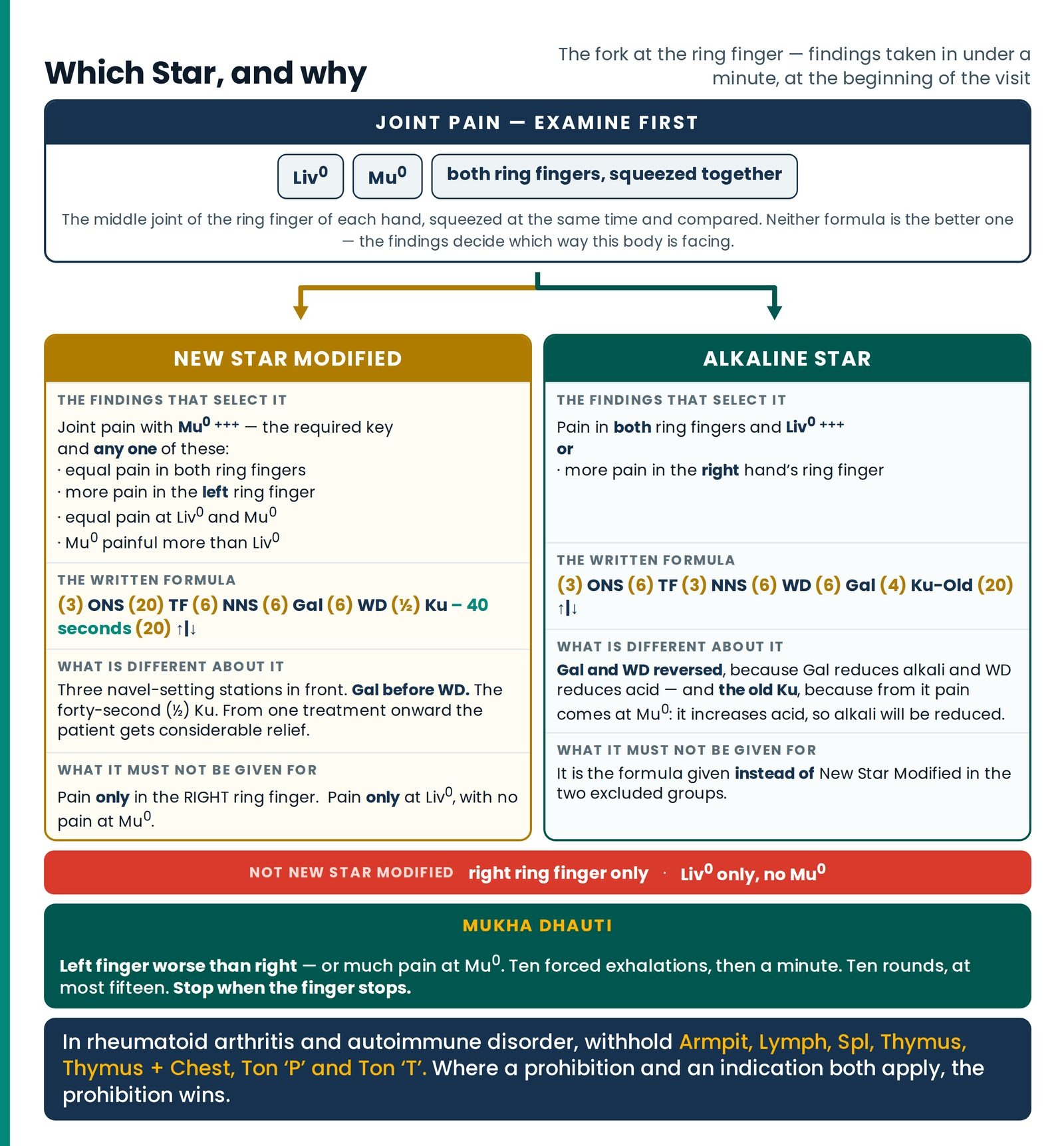
If there is pain in both ring fingers and Liv° is ⁺⁺⁺, or if there is more pain in the finger of the right hand — then for them a new formula was made, in which the order of Gal and WD was reversed. And in this treatment the old Ku is to be given.
Table 13 — Card: the Alkaline Star Formula Supine Seated Prone 6 sec
| Written | (3) ONS (6) TF (3) NNS (6) WD (6) Gal (4) Ku-Old (20) ↑\ | ↓ |
|---|---|---|
| Who it is for | Joint pain with pain in both ring fingers and Liv° ⁺⁺⁺, or more pain in the ring finger of the RIGHT hand Right | |
| Who it is not for | It is the formula given instead of New Star Modified in the two excluded groups above | |
| Step 1 — (3) ONS | Supine; both big toes gripped, feet raised to the height of the therapist's own standing hands, six seconds, lowered slowly. Three times Supine 6 sec × 3 | |
| Step 2 — (6) TF | Seated at the patient's feet; every joint of every toe, three sides, six times at each place, counted — never hard enough to make a wound. Left big toe → little toe, then the right foot Seated Left Right | |
| Step 3 — (3) NNS | Each toe bent downward toward the sole, held six seconds, three times on each toe; left big toe first 6 sec | |
| Step 4 — (6) WD | Head end; both forearms at once, three stations elbow to wrist, six seconds each, six rounds. Moved ahead of Gal — the acid-reducing member of the pair Supine Both sides 6 sec | |
| Step 5 — (6) Gal | Right sole on the left thigh, three or four stations hip crease to above the knee, six seconds each, six passes. Moved after WD — the alkali-reducing member Supine Left 6 sec | |
| Step 6 — (4) Ku-Old | The old Kundali. Prone, one and a half pillows under the chest, heels turned to face each other; mid-sole on the last end of the spine. Two equal one — so (4) Ku is eight presses of six seconds, without stopping Prone 6 sec | |
| Why the old Ku here | From the old Ku, pain comes at Mu° — which means that it increases acid; that is, alkali will be reduced | |
| Step 7 — (20) ↑\ | ↓ | Round Arrow, prone — and it follows Ku for the reason given at the start of this article Prone |
| What must not be given | The Ku bars — not in menstruation, not in low blood pressure ▲ Take care |
Four things are different from the New Star Modified, and it is worth naming all four rather than remembering the line whole: TF drops from twenty to six · NNS drops from six to three · WD and Gal change places · and the forty-second (½) Ku is replaced by the old Kundali at (4). The three navel-setting stations are all still there, in the same order, at different counts. (Figure 36.6)
And notice the honesty of step 6's reasoning. The old Ku was known to produce pain at Mu° in some people — which is why the Round Arrow was put behind it in the very first formula of this article. Here that same side-effect is the reason for choosing it. The thing that was a problem in a patient leaning towards acid is the tool in a patient leaning towards alkali. Nothing about the point changed. The patient changed.
Also explained in
- July 2006 — the Star formulas are broken apart and rebuilt The Stiffening Joint
From July 2006, the New Star and Alkaline Star formulas above were broken apart and a new order was made, which is very effective in all kinds of joint pain.
- The line of development, in one table The Stiffening Joint
For those whose digestion is not right or whose navel is upset — and the one that has proved extremely useful in RA Alkaline Star formula (3) ONS (6) TF (3) NNS (6) WD (6) Gal (4) Ku-Old (20) ↑\ ↓ Gal and WD revers
- Questions students ask The Stiffening Joint
That patient wants the Alkaline Star, with WD before Gal and the old Ku in place of the forty-second hold.
- Introduction The Stiffening Joint
Choose between New Star Modified and the Alkaline Star on the findings in front of you, and state the two conditions in which New Star Modified is not to be given at all.
- The New Star Modified formula The Stiffening Joint
And the exclusions at the head of the Alkaline Star section, which decide whether this formula is the right one at all ▲ Take care Points taught in ONS, TF, NNS — The Front of the Body II, "The Front of the Body — II"; the finger-by
- Why Mukha Dhauti is given, and to whom The Stiffening Joint
A patient with both fingers equally sore is not the patient this is written for; a patient whose right finger is the worse one is emphatically not, and you will see why at the head of the Alkaline Star.
- The formulary closes Cranial Nerve and Brain Formulas
· Multi Heparin · (½) Ku – 6 secs The River — Heparin, "The River" B₁₂ · Folic and Pure Folic · Black · Pure Genes · New Genes · Large Folic Black Vitamin and Gene Formulas, "The Missing Links" Kidney Clear, Mild and Ulta · Anil Sharma · Angiotensin #2 ·