Watch


The Maunish treatments
Treat the drainage station, and the finger lets go
These treatments were made by an old student of Guruji's, Shri Mauneesh Vyas ji, and they are a simple way of provoking the lymph nodes.
Whenever there is an infection in any part of the hand or foot, or an injury is taken, then within a short while there can be swelling along with severe pain in the lymph nodes.
What they are for, and the finding behind them
If the trouble is in the hand, the pain will be at the place of the armpits — कच्छ.
If the injury is in the foot, the pain will be in that part of the groins — that is, where we place the foot for the Pan treatment.
And the rule that makes this a treatment rather than an observation: until that place is set right, the pain of the finger, or of the hand or foot, will also not be put right.
By this treatment, immediate relief is obtained from this kind of swelling and pain.
That is a piece of clinical reasoning worth sitting with for a moment, because it explains a great many failures. A man cuts his finger; the cut heals; the finger goes on hurting. The therapist works the finger, the hand, the forearm. Nothing. The finger is not where the trouble is any more — the drainage station for that finger is. Treat the armpit and the finger lets go.
Two treatments that stand on these same pages belong to another article and are not repeated here. The Ulta Kidney Clear formula — the reversed order of the kidney codes, its four graded strengths, the seven qualifying findings by which it is selected, and the substitution of Th + Ch where there is pain along with the stone — is taught whole in Water and Salt, "Water and Salt", together with the two observations of Shri Anil Bhalerao ji of Pune, the note on pneumonia and the kidneys, and the open question about (20) Medulla and the kidneys that is left standing there. LSTF, the Left Side Treatment Formula, with the four steps of reasoning that produced it and the Adr/Thrd compromise stated with its cost, is also Water and Salt's. Where a formula in this article asks for either of them, turn there; nothing about them is restated here.
Why there are two orders, and not one
Three quarters of the lymph drains up the left side
Here is the anatomy on which the two Mauneesh orders rest.
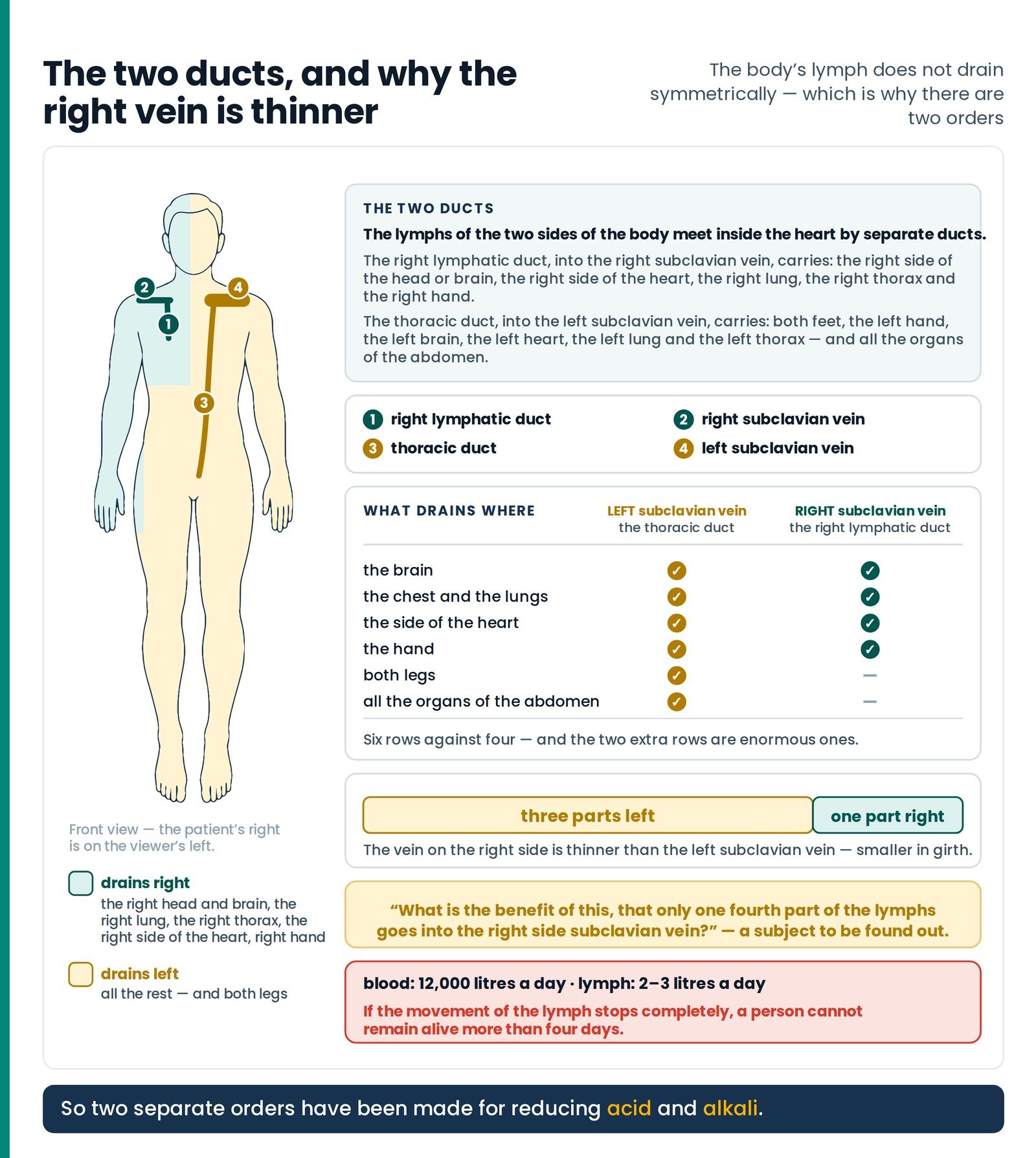
The two ducts, and the two subclavian veins
The lymphs of the two sides of the body meet inside the heart by separate ducts.
The right lymphatic duct, into the right subclavian vein, carries: the right side of the head or brain, the right side of the heart, the right lung, the right thorax and the right hand.
The thoracic duct, into the left subclavian vein, carries: both feet, the left hand, the left brain, the left heart, the left lung and the left thorax — and all the organs of the abdomen.
So two separate orders have been made for reducing acid and alkali.
Table 22 — What drains where
| Into the left subclavian vein — the thoracic duct | Into the right subclavian vein — the right lymphatic duct |
|---|---|
| The lymphs of the left brain | The lymphs of the right brain |
| The lymphs of the left chest and lungs | The lymphs of the right chest and lungs |
| The lymphs of the left side of the heart | The lymphs of the right side of the heart |
| The lymphs of the left hand | The lymphs of the right hand |
| The lymphs of both legs | — |
| The lymphs of all the organs of the abdomen | — |
Count the rows. Six against four, and the two extra rows are enormous ones — both legs, and every organ in the belly. So the two sides are not mirror images, and neither are the veins they empty into. (Figure 37.4)
The subclavian veins on the two sides are not alike. The vein on the right side is thinner than the left subclavian vein — that is, smaller in girth. And the reason given is exactly the table above: the flow of lymph in the veins of the two sides is not equal.
And then the question is left open, in its own words: it is a subject to be found out — what is the benefit of this, that only one fourth part of the lymphs goes into the right side subclavian vein. It is not answered. It stands as a question, and this wiki leaves it standing.