Watch


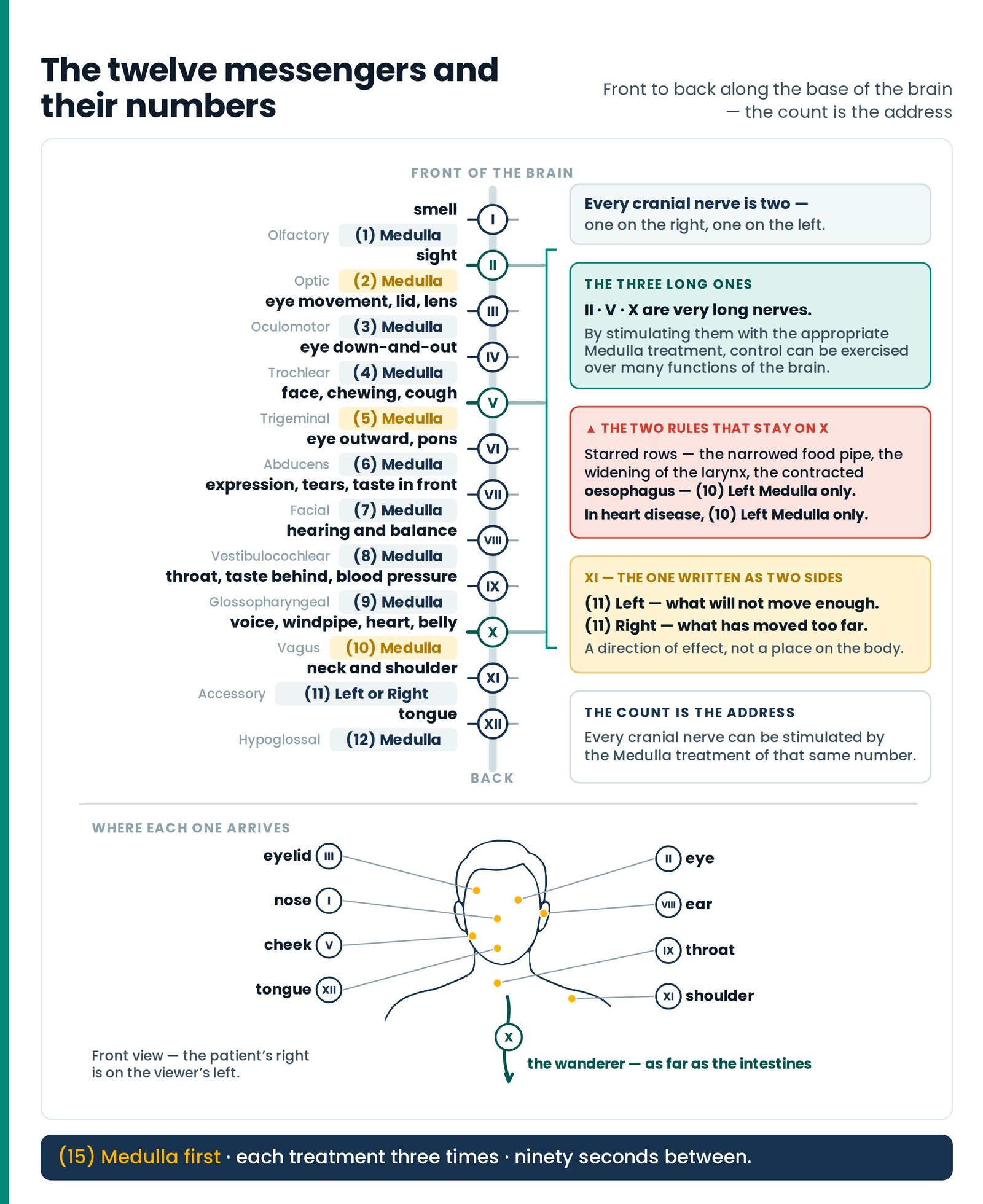
The twelve in one table
The whole of Part two on one page, with the rule beneath it
Table 2 — The twelve messengers, their number, their errand and their treatment Seated × 3
| # | The nerve | What it carries | The trouble you will meet | Treatment |
|---|---|---|---|---|
| I | Olfactory | Smell | Anosmia — a clear nose that smells nothing; almost never complained of | (1) Medulla |
| II | Optic | Sight; and the retina's own chemicals | Blindness of any kind; seeing little; cerebellar illness in children; Parkinson's; cerebral palsy; RA | (2) Medulla |
| III | Oculomotor | Four eye muscles, the upper lid, the lens and the pupil | Ptosis; eyes that will not open or shut; squint outward; dilated pupil with double vision; lens will not adjust | (3) Medulla |
| IV | Trochlear | The superior oblique — down and outward | The eye down and outward with double vision; mid brain; fits and cramps | (4) Medulla |
| V | Trigeminal | All sensation of the face; the muscles of chewing; the dura | Migraine; trigeminal neuralgia; toothache; sinus; jaw; almost every kind of cough; the bolus going backward | (5) Medulla |
| VI | Abducens | The lateral rectus — outward | The pupil crooked up and outward with double vision; the pons; infertility from low body temperature, with Raman | (6) Medulla |
| VII | Facial | Expression; tears; the sublingual and submaxillary saliva; taste from the front | Bell's palsy; the mouth pulling to the good side; the eyelid that will not close; no whistle; no wrinkles; Parkinson's flat face | (7) Medulla |
| VIII | Vestibulocochlear | Hearing and balance | Deafness; ringing; vertigo; giddiness with nausea; all problems of the ear; the RAS in coma; serotonin | (8) Medulla |
| IX | Glossopharyngeal | The pharynx; the epiglottis; taste from the back third; parotid saliva; the BP and oxygen sensors | Difficulty swallowing with loss of taste; dry mouth; hiccups; BP; breathlessness from low oxygen | (9) Medulla |
| X | Vagus | Larynx, trachea, bronchi, heart, and the gut to the descending colon | Difficulty swallowing with a heavy voice; hoarseness; contracted food pipe; bronchitis; fast heart | (10) Medulla — starred rows Left only; heart patients Left only ▲ Take care |
| XI | Accessory | The sternocleidomastoid and the trapezius; with X, the pharynx and larynx | Neck will not turn; frozen shoulder; shoulder sloping or dislocated; the neck cords of extreme breathlessness | (11) Left for what will not move; (11) Right for what has moved too far |
| XII | Hypoglossal | The muscles of the tongue | The tongue going to one side; a voice that has gone; thick speech; fits in sleep | (12) Medulla |
And before every one of them, (15) Medulla. And every one of them three times, ninety seconds apart.
These are the tables the student will come back to for years. They are set out region by region, exactly as they are given, and they are the reference half of this article: Part two tells you what a nerve is; these tables tell you every complaint that has been assigned to it. Do not read them straight through the first time. Read the heading of each, note what kind of complaint it collects, and come back when a patient puts one of those complaints in front of you.
Three rules govern every row in every one of them, and they are not repeated inside the tables: (Figure 37.8)
(15) Medulla first, before any cranial-nerve Medulla treatment.
Three treatments, at an interval of one and a half minutes. × 3
Where a row is starred, it is (10) Left Medulla only. Left ▲ Take care
The nose and the breathing
Two rungs of one complaint — the ninth nerve and the eleventh
Table 3 — Problems of the nose and breathing, and their Medulla treatments
| Point or condition | Treatment |
|---|---|
| Where the nose begins — the root of the nose | (5) Medulla |
| The mucous membrane of the nose | (5) Medulla |
| The skin of the nose | (5) Medulla |
| Problems of the sensation of the nose and the pharynx | (7) Medulla |
| Difficulty in breathing — to increase the respiratory activity when there is a shortage of oxygen, by way of the chemoreceptors of the carotid bodies | (9) Medulla |
| When the difficulty in breathing is extreme, and the accessory muscles of respiration — that is, the sternocleidomastoid muscles — are to be used | (11) Medulla |
| Sinus problems — the maxillary sinus | (5) Medulla |
| Loss of smell — anosmia | (1) Medulla |
All the above treatments are to be given three times at an interval of one and a half minutes — that is, (5) Medulla × 3 treatments, (7) Medulla × 3 treatments, and so on. × 3
Read the fifth and sixth rows together and you have a small clinical staircase. Breathlessness because oxygen is short is a chemical problem and the ninth nerve carries the sensor that detects it. Breathlessness so extreme that the neck muscles are recruited is a mechanical problem, and the eleventh nerve owns those muscles. Two different rungs of the same complaint, two different numbers.
The eyes
Six muscles, three nerves, and the finding that chooses the number
The eye is moved by six small muscles, and three different cranial nerves share them. Which is why three different Medulla numbers appear in the next table, and why the number you need is chosen not by the word squint but by which way the eye is actually pointing. Watch the patient's eyes before you decide.
Table 4 — The six muscles of the eye and their Medulla treatments
| The movement | The muscle | Treatment |
|---|---|---|
| Turning the pupils inward | Medial rectus | (3) Medulla |
| Turning the pupils upward | Superior rectus | (3) Medulla |
| Turning the pupils downward | Inferior rectus | (3) Medulla |
| Turning the pupils down and outward | Superior oblique | (4) Medulla |
| Turning the pupils up and outward | Inferior oblique | (6) Medulla |
| Turning the pupils outward | Lateral rectus | (6) Medulla |
Table 5 — Other problems of the eyes and their Medulla treatments
| Point or condition | Treatment |
|---|---|
| Blindness — of any kind whatever | (2) Medulla |
| Seeing little, or not seeing | (2) Medulla |
| Problems of the neurons of the retina | (2) Medulla |
| To increase the flow of tears | (7) Medulla |
| The tear glands — the lacrimal glands | (7) Medulla |
| The lacrimal nerve of the tear glands | (5) Medulla |
| The sac of the tear glands — the lachrymal sac | (5) Medulla |
| The eyes remaining shut | (3) Medulla |
| Pain coming in the eye, or sensation not remaining | (5) Medulla |
| Conjunctivitis — (6) Adr × 3 treatments is also to be given | (5) Medulla |
| Problems of the cornea or the conjunctiva | (5) Medulla |
| Redness and constant watering — (6) Adr is also to be given | (5) Medulla |
| Problem in the adjustment of the lens | (3) Medulla |
| Constriction of the ciliary muscles of the iris, by which the lens is adjusted for different kinds of light | (3) Medulla |
| The pupil turning outward — as happens in squint | (3) Medulla |
| Dilation of the pupil, because of which there is double vision | (3) Medulla |
| The pupil becoming crooked up and outward, because of which there is double vision | (6) Medulla |
| The ball of the eye remaining down and outward, because of which there is double vision | (4) Medulla |
| Problems of the eyelids | (5) Medulla |
| The eyelids remaining fallen — drooping of the eyelids, ptosis | (3) Medulla |
| Not being able to close the eyelids properly — (Bell's palsy) | (7) Medulla |
| Problems of the frontal sinus | (5) Medulla |
Three rows of that table say double vision and each gives a different number. That is not a contradiction; it is a diagnostic instrument. Look at where the eye is sitting. Dilated pupil — (3). Crooked up and outward — (6). Down and outward — (4). The complaint the patient gives you is the same word every time; the finding is different every time, and the finding chooses.
The ear
Five numbers for one organ, and the row that is the safety net
Table 6 — Ear problems and their Medulla treatments
| Point or condition | Treatment |
|---|---|
| Sensations of the inner or outer part of the ear | (5) Medulla |
| The voice, or the acoustic meatus — the doorway of the organ of hearing | (5) Medulla |
| The outer part of the ear | (5) Medulla |
| Deafness — (the hearing area of the cerebrum) | (8) Medulla |
| Vertigo — giddiness — because of a disturbance of the semicircular canals inside the ear | (8) Medulla |
| To stimulate the spiral Organ of Corti inside the ear | (8) Medulla |
| For all problems of the ear | (8) Medulla |
| Bells ringing in the ears | (8) Medulla |
| Inflammation in the ear — (6) Adr is also to be given | (8) Medulla |
| The outer part of the ear, hearing, and carrying sensation to the brain from the cranial fossa of the posterior part of the dura mater | (10) Medulla |
| The ear — relating to the middle ear and the Eustachian tube | (9) Medulla |
| Problems of the middle ear — the stapedial motor nerve | (7) Medulla |
Five different numbers appear in a table about one organ. That is not untidiness; it is the ear's actual wiring. The outside of the ear is felt by the fifth and by the tenth. The middle ear belongs to the seventh and the ninth. The inner ear — hearing and balance, the two things people mean when they say "my ear" — is the eighth. And the row that says for all problems of the ear, (8) Medulla is the safety net beneath the rest: when you cannot tell which part of the ear is at fault, that is the row you use.
The brain and the forehead
The longest reference table: from migraine to the RAS in coma
Table 7 — Brain and forehead problems and their Medulla treatments
| Point or condition | Treatment |
|---|---|
| For headache — migraine | (5) Medulla |
| The skin of the upper part of the head | (5) Medulla |
| Absence of sensation in the scalp, the upper part of the forehead | (5) Medulla |
| The skin of the temple | (5) Medulla |
| Pain coming in the sides of the head — the temples | (5) Medulla |
| The maxillary sensory nerve goes as far as the dura mater | (5) Medulla |
| Silhouette or wrinkles not appearing on the forehead | (7) Medulla |
| Ataxia — cerebellar ataxia; serotonin is necessary to stimulate the legs | (2), (8) Medulla |
| The brain — from the front to the back | (2) Medulla |
| Balance or posture going wrong because of a problem of the ears or the eyes | (2) Medulla, (8) Medulla |
| The body's balance, posture and coordination of movement not being right | (2) Medulla |
| Problems of the basal ganglia | (2), (12) Medulla — both are useful |
| Problems of the cerebellum | (2), (8) Medulla — both are useful |
| Cerebellum — the vestibulocochlear nerve | (8) Medulla |
| Problems of the cerebellum due to a deficiency of GABA | (2) Medulla |
| Dopamine, acetylcholine, GABA — the retinal neurons | (2) Medulla |
| The temporal lobe of the cerebral cortex | (8) Medulla |
| Giddiness coming, or the nausea and vomiting caused by it | (8) Medulla |
| Vertigo — because of a disturbance of the semicircular canals of the inner ear | (8) Medulla |
| The formation of serotonin | (8) Medulla |
| When the RAS is disturbed a person can go into coma. To put that right | (8) Medulla |
| Mid brain | (4) Medulla |
| Mid brain, medial geniculate body, red nucleus | (8) Medulla |
| Pons — the abducent nerve | (6) Medulla |
| Pons, trigeminal ganglion, spinal, principal and mesencephalonic nucleus | (5) Medulla |
| Medulla oblongata — the glossopharyngeal nerve | (9) Medulla |
| Fits which come during sleep, or shortly after waking from sleep | (12) Medulla |
| To stimulate the hippocampus | (12) Medulla |
Three notes are printed beneath that table and belong with it:
For the maintenance of posture and balance, impulses of cranial nerve #2 from the eyes, along with impulses from the semicircular canals of the ears carried by cranial nerve #8, are necessary. That is why two numbers stand in the balance rows, and why you give both.
Control of equilibrium is a combined function of portions of the cerebellum and the reticular substance of the medulla, pons and mesencephalon.
And the discovery already met in Part two: (2) Medulla × 6 treatments stimulates the retinal neurons' GABA, acetylcholine, dopamine and several other neurotransmitters.
The neck and the shoulders
Seven ordinary complaints, sorted into two heaps by the polarity rule
This is the short table, and it is the most instructive one in the article, because it is the polarity rule written out as seven ordinary shoulder complaints.
Table 8 — Neck and shoulder problems, and the side that is given Left Right
| Point or condition | Treatment |
|---|---|
| Not being able to turn the neck towards the good side | (11) Left Medulla |
| Pain in the neck or the shoulders | (11) Medulla |
| Not being able to rotate the shoulder properly | (11) Left Medulla |
| Frozen shoulder — not being able to raise the arm fully | (11) Left Medulla |
| The shoulder sloping downward | (11) Left Medulla |
| Pain in the shoulder — the kind that comes from a fall or a blow; that too is because of dislocation | (11) Right Medulla |
| The shoulder coming out of its place and dropping a little — shoulder dislocation | (11) Right Medulla |
Sort those seven rows into two heaps and the rule falls out of them.
Reading the eleventh nerve's two sides
Left is given where something will not move enough: a neck that will not turn, a shoulder that will not rotate, an arm that will not rise, a shoulder that has lost its lift and sags. Left opens.
Right is given where something has moved too far: a joint that has come out of its place, a shoulder dropped by a fall. Right closes.
This is the same rule as the cardiac sphincter and the varicose vein, stated in muscle instead of in plumbing. Once you have seen it here, you will find you can predict the side for a complaint you have never met, and then check yourself against the table.
The face and the mouth
Eight doors into one list: what the face feels, and what the face does
The longest table in the formulary runs across four pages. It is set out here in eight groups, so that a therapist can find a row in the time a patient takes to describe a complaint. Nothing has been left out and nothing has been combined; the groups are only doors into one list.
Table 9 — Swallowing Seated × 3
| Point or condition | Treatment |
|---|---|
| For swallowing — to take the bolus, the mouthful, backwards | (5) Medulla |
| For swallowing — to open and close the epiglottis, by way of the cricothyroid and arytenoid muscles | (10) Medulla |
| For swallowing — for the muscles of the tongue | (12) Medulla |
| To close the epiglottis | (9) Medulla |
| To remove a problem in swallowing — in swallowing food | (9) Medulla |
| To remove difficulty in swallowing — because of narrowing of the food pipe | (10) Medulla * Left |
| To open the oesophagus — the food pipe — if it has contracted | (10) Medulla * Left |
Two instructions decide between the two commonest rows of that group, and they are worth learning as a pair, because they are a diagnosis made from one extra question:
Which nerve, when swallowing is hard
If, with difficulty in swallowing, taste does not come — that will be put right by (9) Medulla.
But if, with difficulty in swallowing, the voice is heavy — that will be put right by (10) Medulla.
One complaint, two answers, and the question that separates them takes four seconds: and how is your taste? and how is your voice?
Behind it: cranial nerves 5, 9, 10, 11 and 12 together look after the work of swallowing, and the motor impulses that cause swallowing are transmitted by the 5th, 9th, 10th and 12th. The larynx and the pharynx are both controlled by cranial nerves 10 and 11, while the pharynx is also controlled by cranial 9. Both of those organs are necessary for swallowing food and for the voice to come out correctly.
Table 10 — The voice and the larynx
| Point or condition | Treatment |
|---|---|
| To bring back a voice that has gone | (12) Medulla |
| To correct a heavy voice — thick speech | (12) Medulla |
| To bring sweetness into the voice | (10) Medulla |
| To remove hoarseness — roughness — in the voice | (10) Medulla |
| To remove difficulty in speaking — to widen the larynx, the voice-box, by way of the left vagus | (10) Medulla * Left |
| The muscles of the larynx | (10) Medulla |
| The mucous membrane of the larynx | (10) Medulla |
| Contraction of the muscles of the pharynx and larynx | (10), (11) Medulla |
| It contracts the smooth muscles of the trachea and bronchi — for bronchitis | (10) Medulla |
Table 11 — The face
| Point or condition | Treatment |
|---|---|
| Paralysis of one side of the face | (7) Medulla |
| The expressions of the face, by which a person's face contracts or lights up according to the emotions | (7) Medulla — and this should be used in Parkinson's disease |
| The mouth turning towards the good side — as happens in Bell's palsy | (7) Medulla |
| The mouth becoming crooked, in which all the muscles of one side are paralysed | (7) Medulla |
| Not being able to whistle | (7) Medulla |
| Silhouette or wrinkles not appearing on the forehead or the eyebrow | (7) Medulla |
| Pain on the face, or the sensation or absence of sensation | (5) Medulla |
| Pain on the temple, or the sensation or absence of sensation | (5) Medulla |
| Pain in the eyebrow, or no sensation there | (5) Medulla |
| Trigeminal neuralgia | (5) Medulla |
| Problem in the cheekbone | (5) Medulla |
| The skin and mucous membrane of the cheeks | (5) Medulla |
Notice what that table does with one face. Everything that the face feels is the fifth. Everything the face does is the seventh. Sensation and movement, two nerves, side by side over the same cheek. When a patient's face droops but she can still feel your finger on it, you are looking at the seventh; when she feels nothing but the face moves normally, you are looking at the fifth.
Table 12 — The jaw, the teeth and the gums
| Point or condition | Treatment |
|---|---|
| Problems of the muscles of chewing | (5) Medulla |
| For every problem of the teeth | (5) Medulla |
| Problems of the gums | (5) Medulla |
| Problems of the lips | (5) Medulla |
| The soft part inside the jaw | (5) Medulla |
| Problems of the muscles of the jaw — from the motor root not working | (5) Medulla |
| The jaw turning towards the paralysed side, and the patient not being able to chew properly | (5) Medulla |
| Problem of the upper or lower part of the jaw | (7) Medulla |
Table 13 — The tongue, the mouth and taste
| Point or condition | Treatment |
|---|---|
| The mucous membrane of the front two-thirds of the tongue | (5) Medulla |
| Not experiencing sensation in the tongue | (5) Medulla |
| Not experiencing pain or touch sensation on the mouth | (5) Medulla |
| Movement of the muscles of the tongue | (12) Medulla |
| Paralysis of one side of the tongue — the tongue repeatedly going to one side | (12) Medulla # |
| Problems of the palate inside the mouth | (5), (9) Medulla |
| Contraction of the muscles of the palate | (10) Medulla |
| Taste — the posterior third of the tongue | (9) Medulla |
| The experience of taste — the chorda tympani | (7) Medulla |
| The experience of taste — from the front two-thirds of the tongue | (7) Medulla |
Table 14 — Saliva
| Point or condition | Treatment |
|---|---|
| If the mouth has gone dry — to bring saliva | (7), (9) Medulla |
| To increase saliva — from the parotid glands | (9) Medulla |
| To increase saliva — from the sublingual and submaxillary glands | (7) Medulla |
| The salivary glands — the visceral motor nerve | (7) Medulla |
Ptyalin is found in greater quantity in the saliva of the parotid glands. And it is the 9th cranial nerve that stimulates the parotid glands, not the seventh. That sentence is printed as a footnote, and it is a correction — the kind of small, exact self-correction that tells you somebody checked.
Table 15 — The pharynx and the tonsils
| Point or condition | Treatment |
|---|---|
| Control of the muscles of the pharynx | (9) Medulla |
| The mucous membrane of the pharynx | (9) Medulla |
| Sensation from the pharynx | (7), (9) Medulla |
| To stimulate the nerves of the tonsils | (9) Medulla |
Table 16 — The blood pressure and the carotid sensors
| Point or condition | Treatment |
|---|---|
| Control of BP by the nerves of Hering | (9) Medulla |
| Control of BP — by way of the carotid sinus | (9) Medulla |
| Problems of the carotid arteries and the carotid bodies | (9) Medulla |
Two marks travel with the face-and-mouth list and must be carried wherever a row from it is copied onto a card:
The coughs
Nine kinds of cough identified across a mat, with no instrument at all
For almost every kind of cough, (5) Medulla has proved useful. Then nine kinds are distinguished, and the descriptions are worth learning because they are how a cough is identified across a mat without any instrument at all.
Table 17 — The coughs, and their treatment
| The cough | Treatment |
|---|---|
| Dry cough | (5) Medulla |
| A very forceful cough | (5) Medulla |
| The cough of asthma | (5) Medulla |
| The cough that comes because of an aortic aneurysm — because of pressure on the left recurrent laryngeal nerve | (5) Medulla |
| Bronchial cough — which comes on turning over in bed or on getting up in the morning, in which the phlegm is grey in colour, frothy and foul-smelling; the cough comes first with soreness and difficulty, but later comes more easily; a great deal of phlegm coming, or thin phlegm coming | (5) Medulla |
| The cough that comes because of diphtheria in the larynx | (5) Medulla |
| The metallic cough of laryngitis — a cough that comes with a scraping sound | (5) Medulla |
| Pulmonary cough, which is hard and comes with pain — as happens in pneumonia; at the beginning of TB it comes with soreness | (5) Medulla |
| Whooping cough — pertussis — in which the face turns red with coughing and coughing | (5) Medulla |
Perhaps for such a cough (10) Medulla will also be beneficial, because it looks after the laryngeal nerve.
That perhaps is not an editor's softening. It is written as a perhaps, and it stays one. So does the line that closes the whole cough section, printed by itself under a rule: in the detailed knowledge of the functions of (6) Medulla and (10) Medulla, some further discovery remains to be made.
This is the most unusual page in the whole formulary, and a student should be told what it is before reading a line of it. Every row below prefixed with a question mark is not an instruction. It is a hypothesis — a piece of reasoning forward from the anatomy just set out, saying this ought to follow; somebody should look.
Table 18 — Proposals for further research, exactly as they stand
| Proposal | Treatment |
|---|---|
| ? Kidney stone — the vagus nerve goes as far as the upper part of the ureter | (10) Medulla |
| ? For hiccups — if it is because the epiglottis is not closing properly; this is to be tried on motor neurone patients, and on children whose saliva keeps dribbling from the mouth | (9) Medulla |
| ? If tears keep flowing excessively from the eyes, to reduce them — this stimulates the muscles of the tear glands, so it must also control the quantity of tears? | (7) Medulla |
| ? If tears keep flowing excessively from the eyes, to reduce them — because this stimulates the paranasal sinuses | (5) Medulla |
| ? For hair that is dry and lifeless — it carries sensation from the skin of the upper part of the forehead | (5) Medulla |
| ? Bronchitis — in which there is difficulty in breathing out; the vagus nerve constricts the bronchi | (10) Right Medulla Right |
| ? Perhaps it will calm the hyperactivity of the brain — will it help in autism? (it works in the medulla oblongata) | (8) Medulla |
| ? Bell's palsy — from the motor root not working, the jaw will turn towards the paralysed side | (5) Medulla |
| ? No expression on the face — not being able to express feeling — for Parkinson's patients | (7) Medulla |
| ? Sores inside the cheeks, in those who repeatedly bite their cheeks with their own teeth | (5) Medulla |
| ? Perhaps it will calm the medulla oblongata and the hyperactivity of the brain | (8) Medulla |
| ? To stop vomiting | (8) Medulla |
| ? To reduce snoring — the bronchial motor nerve contracts the muscles of the palate | (10) Medulla |
| ? Not being able to keep the eyes or the eyelids open — for myasthenia gravis? | (3) Medulla |
| ? Every kind of toothache — the unbearable pain that comes after a tooth is extracted | (5) Medulla |
| In Chennai, one patient was found to benefit for fits and cramps | (4) Medulla |
| Dryness of the mouth — because ptyalin is not being formed at mealtimes | (9) Medulla |
| Bleeding from the gums, or pain in the gums | (5) Medulla |
| To detect taste — it carries sensation from the tongue | (5) Medulla |
And then the line that governs the table:
What the question marks mean
Wherever there is a ? question mark above, it is an indication that this is my own thinking, on which other people can now do research.
Read that twice, and notice where it sits. It is the last substantive instruction in the whole formulary, at the end of a lifetime's work. It could have been a claim. Instead it separates, in print, what has been observed from what is suspected, and hands the second category to the reader.
That is the structure of a scientific programme: a body of observations, a set of derived hypotheses, an open invitation. The habit is the thing to take from this page. Mark your own question marks. Say out loud which of your conclusions you have seen and which you think ought to follow. And then go and look.
Observe also that the last four rows of that table carry no question mark. They are not proposals; they are things that happened and were written down. The marks are used accurately, row by row, and a student must read them that way — a ? row is not to be given as a settled treatment, and an unmarked row is not to be discounted because of the company it keeps.
The last observations
Hiccups twice over, incontinence, and a thought about reading glasses
Eight further notes close the formulary. Four of them have already been given in their places above — the Pondicherry child with cerebral palsy, the Chennai throat, (6) Medulla with Raman in infertility, and Shri Pankit Shah's hiccups on the 1st of December 2006. Four remain.
For hiccups, benefit may also be had from (15) Left Medulla (6) Lt. Swt × 3 treatments. Two different answers to one complaint, both written down: the ninth nerve, which owns the epiglottis; and the polarity pair, which opens what is in spasm. Neither cancels the other. A therapist meeting a patient with intractable hiccups has two things to try and an order to try them in.
No control over urine. As age increases, it happens to some people that with a sneeze, or with laughing hard, urine comes away by itself. This is found especially in middle-aged women, because by that age the muscles below their navel have become loose. The material puts it beside a second thing, which is the observation that makes the treatment obvious: this problem is just like the passing of urine in children while lying in bed. It is called incontinence, and it happens in women too.
Card: the Incontinence treatment {{x3}}
(15) Right Medulla (6) Right Swt × 3 treatments + Piles triangle
For · No control over urine — leaking with a sneeze or with hard laughter; especially middle-aged women, because by that age the muscles below the navel have become loose. The same picture as bed-wetting in children
Why the right side · By this treatment the opening for urine will narrow. A slack passage is to be closed, and the right side closes Right
Why the Piles triangle · By the Piles triangle the muscles around the pelvis will tighten — especially the muscles of the anus and of the urinary sphincter — by which control over urine will come
Rounds · Three treatments, an interval of a minute and a half between them × 3
Points taught in · Medulla and Swt — Seated I — Brain, Medulla, Neck · Face Down; Triangle for Piles — Face Down, "Face Down", with its own indication and its bar in those passing little urine ▲ Take care
Set this card beside the Madhya Pradesh camp in Part one and the polarity rule is complete in a single organ. A narrow urinary sphincter with a jetting stream — (15) Left Medulla (6) Lt. Swt. A slack one that leaks — (15) Right Medulla (6) Right Swt. The same two points. Opposite sides. Opposite complaints.
And the last question of the formulary, which is about spectacles.
The dilated pupil, and a thought about reading glasses
? If the pupil of the eye is dilated — that is, widened — then perhaps it is because the muscles are tight, that is, stiff. To relax them, (15) Left Medulla (6) Lt. Swt should be given.
(I think that the main reason why people need spectacles after the age of 40 is that their eyes cannot relax.)
By giving this treatment daily we may perhaps be able to postpone the need for spectacles for a good many years.
And a fact offered in support of it: a salt solution of acetylcholine is used to produce contraction of the pupil after cataract surgery — so perhaps (15) Medulla will for this reason also help to constrict the pupil, since (15) Medulla is the acetyl choline treatment.
Every hedge in that paragraph is Guruji's own: perhaps, I think, we may perhaps. They stay. It is a chain of reasoning offered openly as reasoning — a mechanism guessed at, a treatment derived from the guess, a supporting fact from elsewhere, and a claim that is large and is marked as unproven. Do not repeat it to a patient as a finding. Do, if you wish, keep a record.
The whole index in reverse — number by number
Sorted by the count, so you can look up what a treatment covers
Everything above sorted the other way round: by the Medulla number, so that you can look up what a treatment covers before you give it. This is the table to photocopy.
Table 19 — Each Medulla number and the territory the index gives it
| Number | Cranial nerve | Its territory in the index |
|---|---|---|
| (1) | Olfactory | Loss of smell — anosmia |
| (2) | Optic | Blindness of any kind; seeing little or not seeing; the neurons of the retina; the retina's dopamine, acetylcholine and GABA; the brain from front to back; balance and posture; ataxia; the cerebellum; the basal ganglia (with (12)); GABA deficiency in the cerebellum; rheumatoid arthritis; retinitis pigmentosa (with Necklace and Formula Number Four); Parkinson's; cerebral palsy |
| (3) | Oculomotor | Medial, superior and inferior rectus; the adjustment of the lens; the ciliary muscles of the iris; the pupil turning outward in squint; a dilated pupil with double vision; ptosis; the eyes remaining shut; ? myasthenia gravis |
| (4) | Trochlear | Superior oblique; the eye remaining down and outward with double vision; the mid brain; fits and cramps (one Chennai patient) |
| (5) | Trigeminal | Sensation of the face, nose, sinuses, teeth, gums, lips, cheeks, tongue, jaw, temple, scalp, eyebrow and eyelids; the muscles of chewing; migraine; trigeminal neuralgia; the dura mater; conjunctivitis and the cornea; the bolus moving backward; the palate (with (9)); almost every kind of cough |
| (6) | Abducens | Lateral rectus and inferior oblique; the pupil crooked up and outward with double vision; the pons; infertility in women from low body temperature (with Raman) |
| (7) | Facial | Facial expression; paralysis of one side of the face; Bell's palsy; eyelids that will not close; whistling; wrinkles on forehead and eyebrow; tears and the lacrimal glands; the sublingual and submaxillary glands; taste from the front two-thirds; the stapedial motor nerve; sensation of the nose and pharynx |
| (8) | Vestibulocochlear | Deafness; ringing in the ears; vertigo and the semicircular canals; the Organ of Corti; all problems of the ear; the temporal lobe; the cerebellum; mid brain, medial geniculate body and red nucleus; the formation of serotonin; the RAS and coma; giddiness with nausea and vomiting; ? autism and hyperactivity of the brain; ? vomiting |
| (9) | Glossopharyngeal | The muscles and mucous membrane of the pharynx; closing the epiglottis; difficulty swallowing with loss of taste; taste from the posterior third; the tonsils; the middle ear and Eustachian tube; parotid saliva and ptyalin; control of BP by Hering's nerve and the carotid sinus; the carotid arteries and bodies; breathlessness when oxygen is short; the medulla oblongata; hiccups; the palate (with (5)) |
| (10) | Vagus | The muscles and mucous membrane of the larynx; hoarseness and sweetness of the voice; opening and closing the epiglottis; narrowing of the food pipe — Left only; widening the larynx by the left vagus — Left only; opening a contracted oesophagus — Left only; the muscles of the palate; the trachea and bronchi in bronchitis; the auricle, hearing and the posterior fossa dura; ? the ureter in kidney stone; ? snoring; ? bronchitis as (10) Right ▲ Take care |
| (11) Left | Accessory | A neck that will not turn towards the good side; a shoulder that will not rotate; frozen shoulder; the shoulder sloping downward Left |
| (11) Right | Accessory | Shoulder pain from a fall or a blow, which is from dislocation; the shoulder coming out of place and dropping a little Right |
| (11) (side not written) | Accessory | Pain in the neck or the shoulders; the sternocleidomastoids as accessory muscles of respiration; the pharynx and larynx (with (10)) |
| (12) | Hypoglossal | The muscles of the tongue in swallowing; movement of the tongue; paralysis of one side of the tongue; bringing back a voice that has gone; a heavy voice — thick speech; fits during sleep or shortly after waking; the hippocampus; the basal ganglia (with (2)) |
| (15) | — | Given before all the Medulla treatments of the cranial nerves. With Left Swt — the cardiac sphincter, oesophageal stenosis, a narrow urinary sphincter, hiccups, ? the dilated pupil. With Right Swt — varicose veins with leg swelling, incontinence |
| (20) | — | Dopamine; given in ADK; and the open question — for problems of the kidneys, will (20) Medulla also be beneficial? |