- Category
- Eyes, ears, nose, mouth and throat
- What is given
- (2) Medulla
- Explained in
- Cranial Nerve and Brain Formulas
Watch


From Cranial Nerve and Brain Formulas
The twelve in one table
The whole of Part two on one page, with the rule beneath it
Table 2 — The twelve messengers, their number, their errand and their treatment Seated × 3
| # | The nerve | What it carries | The trouble you will meet | Treatment |
|---|---|---|---|---|
| I | Olfactory | Smell | Anosmia — a clear nose that smells nothing; almost never complained of | (1) Medulla |
| II | Optic | Sight; and the retina's own chemicals | Blindness of any kind; seeing little; cerebellar illness in children; Parkinson's; cerebral palsy; RA | (2) Medulla |
| III | Oculomotor | Four eye muscles, the upper lid, the lens and the pupil | Ptosis; eyes that will not open or shut; squint outward; dilated pupil with double vision; lens will not adjust | (3) Medulla |
| IV | Trochlear | The superior oblique — down and outward | The eye down and outward with double vision; mid brain; fits and cramps | (4) Medulla |
| V | Trigeminal | All sensation of the face; the muscles of chewing; the dura | Migraine; trigeminal neuralgia; toothache; sinus; jaw; almost every kind of cough; the bolus going backward | (5) Medulla |
| VI | Abducens | The lateral rectus — outward | The pupil crooked up and outward with double vision; the pons; infertility from low body temperature, with Raman | (6) Medulla |
| VII | Facial | Expression; tears; the sublingual and submaxillary saliva; taste from the front | Bell's palsy; the mouth pulling to the good side; the eyelid that will not close; no whistle; no wrinkles; Parkinson's flat face | (7) Medulla |
| VIII | Vestibulocochlear | Hearing and balance | Deafness; ringing; vertigo; giddiness with nausea; all problems of the ear; the RAS in coma; serotonin | (8) Medulla |
| IX | Glossopharyngeal | The pharynx; the epiglottis; taste from the back third; parotid saliva; the BP and oxygen sensors | Difficulty swallowing with loss of taste; dry mouth; hiccups; BP; breathlessness from low oxygen | (9) Medulla |
| X | Vagus | Larynx, trachea, bronchi, heart, and the gut to the descending colon | Difficulty swallowing with a heavy voice; hoarseness; contracted food pipe; bronchitis; fast heart | (10) Medulla — starred rows Left only; heart patients Left only ▲ Take care |
| XI | Accessory | The sternocleidomastoid and the trapezius; with X, the pharynx and larynx | Neck will not turn; frozen shoulder; shoulder sloping or dislocated; the neck cords of extreme breathlessness | (11) Left for what will not move; (11) Right for what has moved too far |
| XII | Hypoglossal | The muscles of the tongue | The tongue going to one side; a voice that has gone; thick speech; fits in sleep | (12) Medulla |
And before every one of them, (15) Medulla. And every one of them three times, ninety seconds apart.
These are the tables the student will come back to for years. They are set out region by region, exactly as they are given, and they are the reference half of this article: Part two tells you what a nerve is; these tables tell you every complaint that has been assigned to it. Do not read them straight through the first time. Read the heading of each, note what kind of complaint it collects, and come back when a patient puts one of those complaints in front of you.
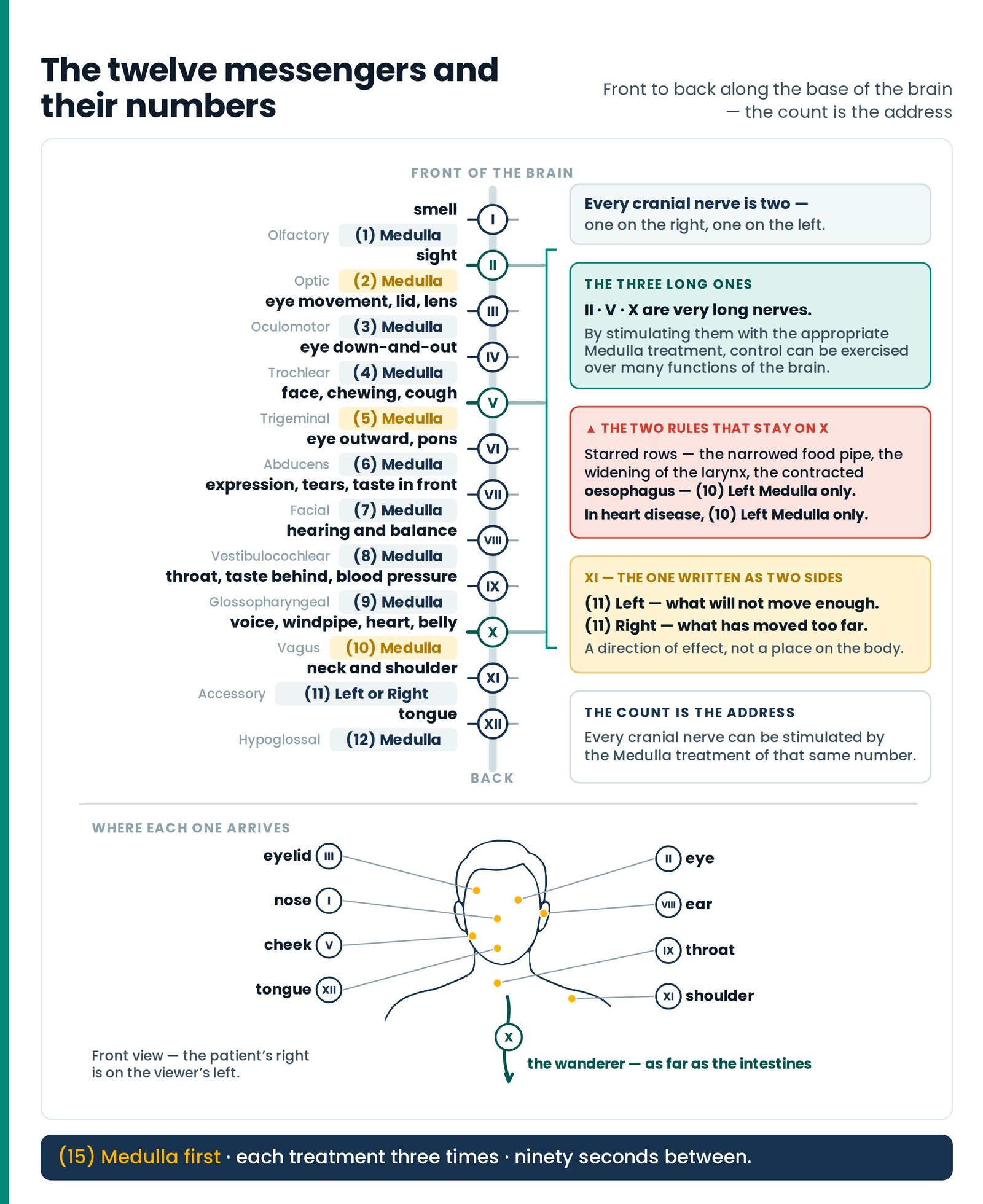
Three rules govern every row in every one of them, and they are not repeated inside the tables: (Figure 37.8)
(15) Medulla first, before any cranial-nerve Medulla treatment.
Three treatments, at an interval of one and a half minutes. × 3
Where a row is starred, it is (10) Left Medulla only. Left ▲ Take care
Also explained in
- The whole index in reverse — number by number Cranial Nerve and Brain Formulas
Table 19 — Each Medulla number and the territory the index gives it Number Cranial nerve Its territory in the index (1) Olfactory Loss of smell — anosmia (2) Optic Blindness of any kind; seeing little or not seeing; the
- II — The optic nerve: sight Cranial Nerve and Brain Formulas
Seeing little; not seeing at all; whiteness over the covering of the eye; double vision of certain kinds; the balance going wrong; a child who cannot hold posture; the flat face and the slow start of Parkinson's disease.
- The eyes Cranial Nerve and Brain Formulas
Table 4 — The six muscles of the eye and their Medulla treatments The movement The muscle Treatment Turning the pupils inward Medial rectus (3) Medulla Turning the pupils upward Superior rectus (3) Medulla Turning the pu