- Category
- Brain, nerves and mind · Blood
- What is given
- M. Heparin for repeated headache; Satnam; (5) Medulla for migraine and pain in the temples; Necklace; ATF
- What is barred
- A first, worst or thunderclap headache, or a new headache with disturbed vision in a person past fifty, ends the session. M. Heparin's (6) Medulla not to 13–20-year-olds treated for height; with a shunt, less pressure on the neck
- Explained in
- Seated I — Brain, Medulla, Neck
Watch
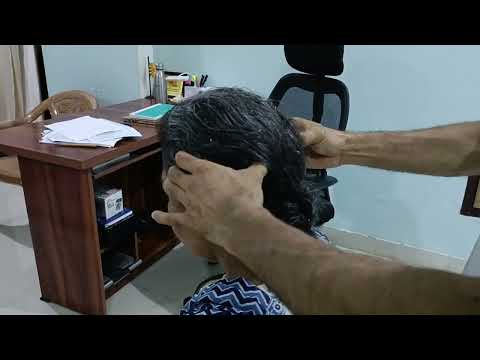

From Seated I — Brain, Medulla, Neck
Necklace — नैकलेस
Place your left hand on the patient's head with light pressure, so that their forehead does not move during the treatment. Then open the palm of your right hand and place it so that your thumb is below, at the edge of the skull bone, and the remaining four fingers point upward and stay open.
With the tip of your thumb, starting from behind the left ear, press three times each at many closely spaced points, going across as far as the right ear. Do three rounds like this, from right to left.
This treatment is given to relax the muscles just below the bone of the lower back part of the skull — so that there is no obstruction in the coming and going of impulses (that is, waves of sensation) between the brain and the rest of the body, and communication happens properly.
With this treatment, the pains of the whole body become very much less.
Its symbol is: a shallow bowl or half-moon curve with a small circle at each end and a row of dots along its inner edge — the necklace itself, as it lies at the base of the skull.
| Patient's position | Seated; the therapist behind, the left hand on the patient's head with light pressure so that the forehead does not move Seated |
|---|---|
| Where the hands are placed | The tip of the right thumb at the edge of the skull bone, the remaining four fingers pointing upward and staying open; pressing at many closely spaced points from behind the left ear across as far as the right ear Left Right |
| Duration and repetitions | Press three times each at every point; three rounds — the run given as behind the left ear across to the right ear, and the rounds as from right to left × 3 |
| What it is for | Relaxing the muscles just below the bone of the lower back part of the skull, so that there is no obstruction in the coming and going of impulses between the brain and the rest of the body; the pains of the whole body become very much less |
Three details of the hand position are doing work. The left hand is there so the forehead does not move — steadied, not gripped and not pulled; light pressure, because a hand that holds hard turns a glide into a lever. The four fingers stay open and upward, not curled round the skull: an open hand cannot squeeze, and every bit of the pressure comes from the one working thumb. And it is the tip of that thumb at the edge of the skull bone — not the pad, and not below the bone into the soft neck — pressing at closely spaced stations, which makes the arc a string of beads rather than four or five separate presses.
What lies beneath. The arc is the ridge of bone across the back of the skull into which the great muscles of the neck and shoulder all fasten — a crowded anchorage. The nerve supplying the back of the scalp comes up through the muscle just to the side of the middle bump, which is why a patient will sometimes say one particular bead of your necklace "goes up into my head".
One image to set aside gently. The stated purpose speaks of tight muscle obstructing the coming and going of impulses. A nerve impulse is not squeezed off like water in a kinked hose; what tight tissue at the nape does is pour traffic into the very cells where the nerves of the face and the nerves of the neck arrive together. The message is not blocked; it is crowded.
Also explained in
- Endorphin — एंडोर्फिन Seated I — Brain, Medulla, Neck
A headache that is new, unlike any the patient has had before, that woke her from sleep, that came to full strength within seconds, or that arrives with fever or with any weakness, numbness or change in vision, is a head
- Questions students ask Seated I — Brain, Medulla, Neck
Ask every headache patient, out loud: is this the first bad headache you have ever had? Did it come to full strength within seconds? Did it begin with effort? Has anything changed in your seeing, speech, walk or face? Is
- The standing rules of every seated treatment Seated I — Brain, Medulla, Neck
New neck pain, or a headache unlike any the patient has had before, with disturbed vision, unsteadiness, dizziness, a wobble in the walk, slurred speech, or numbness of the face or a limb: stop, treat nothing at the head
- Dorsal — डोर्सल Seated I — Brain, Medulla, Neck
That single fact explains a great deal of ordinary clinical life: why a stiff neck is felt as a headache behind the eye; why so many people with migraine say their neck goes first; why a patient insists the pain is in he
- What this article hands to the next Seated I — Brain, Medulla, Neck
After Necklace the atlas turns to the head and the face — the rubbing of the visual areas at the back of the skull, the light tapping given through a folded towel, the shoulder-blade treatment, the facial points, the tee
- Satnam — सतनाम Seated II — Face, Jaw, Ear, Sinus
This treatment is very effective for headache.
- Rising Between Two Sessions
Lekin asli baat yeh hai ki main hamesha thaki rehti hoon." The headache is there, but the real thing is that I am tired all the time.
- Two bodies, read with the fingers The Educated Hand
Not a headache and a bowel and a dry mouth, but one direction with three faces: hard, infrequent, effortful stools; a mouth she called "always dry, I keep a glass by me"; a headache arriving late in the morning at the sa
- The two directions, symptom by symptom The Two Kingdoms
Table 1 — The complete picture of the two directions Typical picture of the ACIDIC patient Left Typical picture of the ALKALINE patient Right The points Pain at the Mu° pain point and at the Acid point · pain in the r
- Questions patients ask you Seated II — Face, Jaw, Ear, Sinus
"The eye doctor's drops have not helped my headache.
- The Acid Treatment Formula — when it is given at all Correcting the Two Kingdoms
What travels with Mu° pain Pain in the joints without cause · headache, often near the temples — this is called migraine · ulcer, that is sores, in the stomach or the duodenum Group 3 is worth following all the way,
- Why a chemical made by a pair of hands might reach the brain when an injection cannot The River — Heparin
The hypothalamus treatment — the very first Medulla treatment that was obtained Seated Steps 2–4 The parent sequence, unchanged The addition (6) Adr may be given along with it: there will be much benefit in the inflamma
- Two bodies, read as this article teaches The History That Cannot Mislead You
Sushma Bhandari · 49 · schoolteacher · Nagpur · came with "acidity and a headache behind the eyes, ten years" In her own words.
- Four problems, or one? From Findings to a Plan
If food is not digested properly in the stomach, the patient will have sometimes a headache, sometimes gas, sometimes loose motions or vomiting, sometimes burning in the chest — on one day or on different days.