Nothing in that story is a failure of the formula. The formula was correct, given correctly, by a therapist who had done everything the first thirty-seven articles of this wiki asked of him. It failed for four weeks because of what happened in a bedroom he had never asked about.
This is where begins, and it begins with an arithmetic problem. You have the patient for half an hour. The patient has himself for twenty-three and a half. Everything you correct on the mat is handed straight back to those hours, and those hours will either hold it or undo it by morning. A therapist who has learnt the whole atlas and the whole formulary has learnt the smaller half of the work. The larger half is not something you do. It is something you say — and say in such a way that a tired, sceptical adult who has been given the opposite advice by three other people actually does it.
That is why this article is built the way it is. Every rule is taught with the reason attached. A rule without a reason is an order, and an adult does not keep orders from a stranger for eleven weeks. A rule with a reason becomes the patient's own property; she keeps it because she now understands her own body slightly better than she did, and that is a thing nobody gives up.
The rules of the treatment hour are the patient's half of a session. The therapist's half — how a patient is placed, what goes under a thigh and what never goes under a head, the two chairs, dress, consent and chaperone — is taught in Before You Touch Anyone, "Before You Touch Anyone", and Placing the Patient, "Placing the Patient". The plain shape of a session from the door to the door, and what to tell a patient who has never lain on a mat, is in The Hand That Heals, "The Hand That Heals". What follows here is the other side of the same hour: what the patient is asked to do, and why.
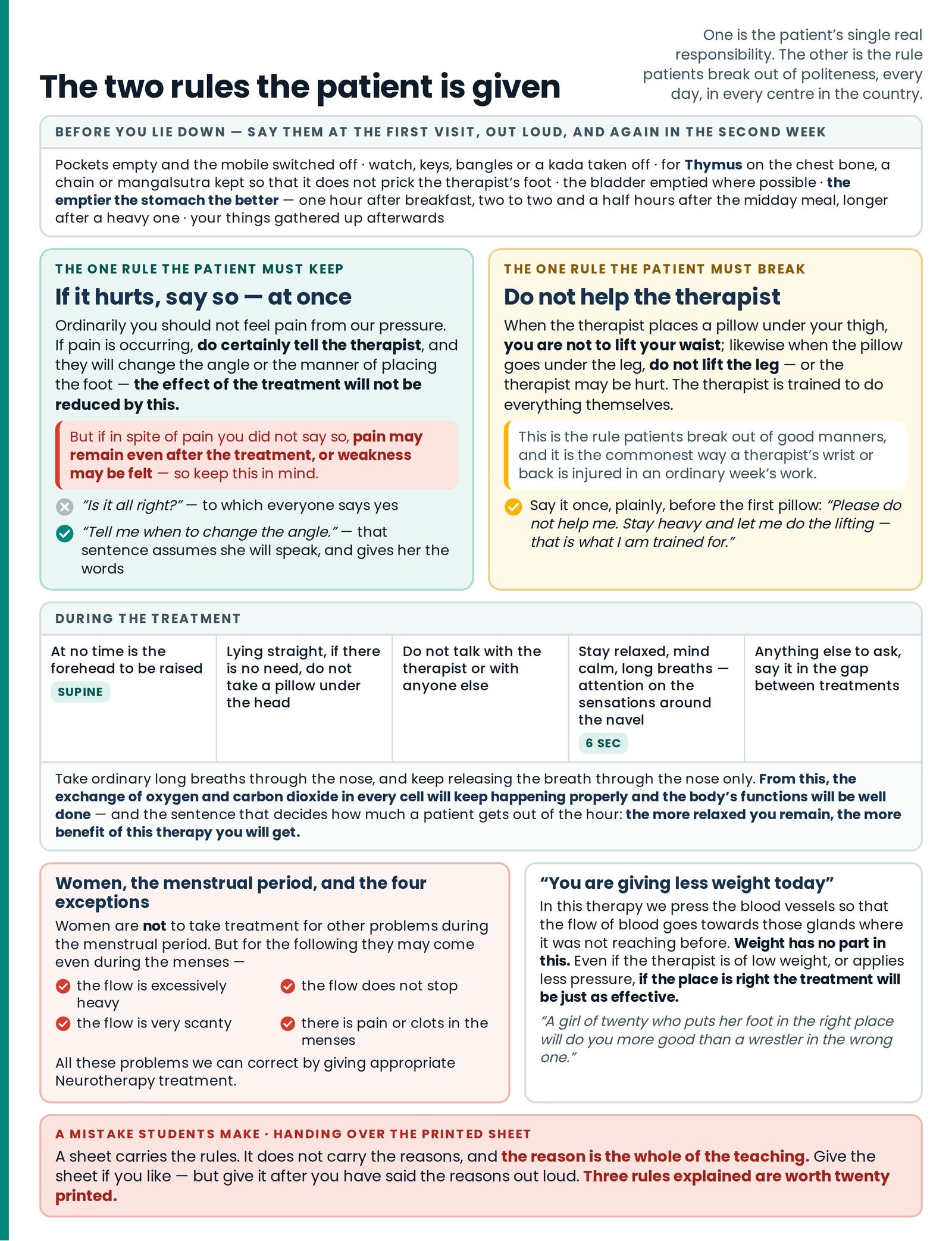
Say these at the first visit. All of them, out loud, before the patient lies down. Then say them again in the second week, because nobody remembers a list given while they were nervous.
Table 1 — What the patient does before the treatment, and why
| The rule | The reason |
|---|---|
| Empty your pockets and switch off the mobile phone. If a watch, keys, bangles or a kada are worn, take them off and give them to whoever has come with you, or keep them safely under your own responsibility. | Hard objects between a therapist's foot and a patient's body are hard objects on both sides of the pressure. |
| When the treatment named Thymus is given on the chest bone, a chain or mangalsutra at the neck must be kept so that it does not prick the therapist's foot. | The Thymus treatment is delivered onto the breastbone with the sole. A chain lying across it is under the whole contact. ▲ Take care |
| Where possible, pass urine and empty the bladder before treatment. | This is knowledge obtained from experience. |
| The emptier the stomach, the better — as far as possible. Treatment may be taken at least one hour after breakfast, and two to two and a half hours after the midday meal; after a heavy meal, a longer gap is better. | During treatment the patient has to lie straight, turn onto the side, lie face down and so on by turns. If there is heaviness in the stomach, changing position again and again will be difficult. |
| After the treatment, gather all your things back and keep them safe. | Stated within the rule. |
Notice the shape of the second rule. It does not say take off your mangalsutra. It says keep it so that it does not prick the foot — tucked to the side, inside the garment, out of the line of contact. That distinction matters more than a paragraph of physiology, because in a great many households the chain does not come off, and a therapist who demands that it does has lost the patient at the doorway for no clinical gain whatever. See also → The Front of the Body II, "The Front of the Body — II", for the Thymus and chest group, and Before You Touch Anyone for the conduct that surrounds them.
Watch


The one rule the patient must keep, and the one the patient must break
Say it the moment it hurts — and never help with the pillow
Two of the treatment-hour rules are different in kind from the rest. One is the patient's single real responsibility. The other is the one rule patients break out of politeness, every day, in every centre in the country.
If it hurts, say so — at once
Ordinarily you should not feel pain from our pressure.
If pain is occurring, do certainly tell the therapist, and they will change the angle or the manner of placing the foot; the effect of the treatment will not be reduced by this. ▲ Take care
But if in spite of pain you did not say so, pain may remain even after the treatment, or weakness may be felt — so keep this in mind.
Say the last sentence to the patient in exactly that spirit. It is not a threat and it is not a disclaimer. It is a description of what will happen tomorrow if she is polite today.
That is the rule the patient must keep, and it is harder than it sounds. A woman raised to be a good guest does not interrupt a man who is helping her for nothing to tell him he is hurting her. So you must ask — during the treatment, not after it — and you must ask in a form that makes saying yes easy. Not "Is it all right?", to which everyone says yes. "Tell me when to change the angle." That sentence assumes she will speak and gives her the words. (Figure 38.1)
Do not help the therapist
When the therapist places a pillow under your thigh, you are not to lift your waist; likewise when the pillow goes under the leg, do not lift the leg — or the therapist may be hurt. The therapist is trained to do everything themselves.
This is the rule patients break out of good manners, and it is the commonest way a therapist's wrist or back is injured in an ordinary week's work. A patient who lifts her waist as a hand goes under it has put the therapist's forearm between a moving pelvis and the floor.
Say it once, plainly, before the first pillow: "Please do not help me. Stay heavy and let me do the lifting — that is what I am trained for."
During the treatment
At no time during treatment is the forehead to be raised. Supine ▲ Take care
Lying straight, if there is no need, do not take a pillow under the head.
Do not talk with the therapist or with anyone else.
Staying relaxed with a calm mind, taking long breaths, keep giving attention to the sensations around the navel.
If you have to say or ask the therapist something else, say it during the gap between treatments. Otherwise, during the treatment and in that intervening time, take ordinary long breaths through the nose, and keep releasing the breath through the nose only.
The reason for the breathing: from this, the exchange of oxygen and carbon dioxide in every cell will keep happening properly and the body's functions will be well done. And the sentence that decides how much a patient gets out of the hour: the more relaxed you remain, the more benefit of this therapy you will get.
Attention on the sensations around the navel is not a piety. It is the most useful instruction in the list, because it gives a patient something to do with a mind that would otherwise spend thirty minutes composing questions. It also, week by week, teaches her to notice her own abdomen — which is the region you will be asking her about for the next three months.
"You are giving less weight today"
Not a rule but a complaint, and the answer has to be ready
This one is not a rule at all. It is a complaint, it arrives in every practice, and the answer has to be ready.
Weight has no part in this
Sometimes patients say the therapist is giving less weight.
In this therapy we press the blood vessels so that the flow of blood goes towards those glands where it was not reaching before. Weight has no part in this. Even if the therapist is of low weight, or applies less pressure, if the place is right the treatment will be just as effective.
Across the mat, in the patient's own language: "You are thinking of it as a massage, where harder means more. It is not. I am moving blood into a place it was not reaching. What decides that is where my foot is and for how long — not how much of me comes down on you. A girl of twenty who puts her foot in the right place will do you more good than a wrestler in the wrong one."
The therapist's side of the same question — the student who presses harder because effort feels like care — is taught in The Hand That Heals, and the reason the two chairs exist at all is taught there too. The patient's side is simply this: never let a patient talk you into more weight, and never let her leave believing she got less treatment. She got the same treatment.
The rules of the night are the most valuable thing in this article, and the most neglected. A patient spends a third of her life doing this, unsupervised, in the dark, out of habits formed in childhood. Change one of them and you have changed something that happens three thousand times a year.
Begin with the one that applies not only to sleep but to every bed, sofa and mat the patient will ever get on or off.
The side-turn — how to lie down and how to get up
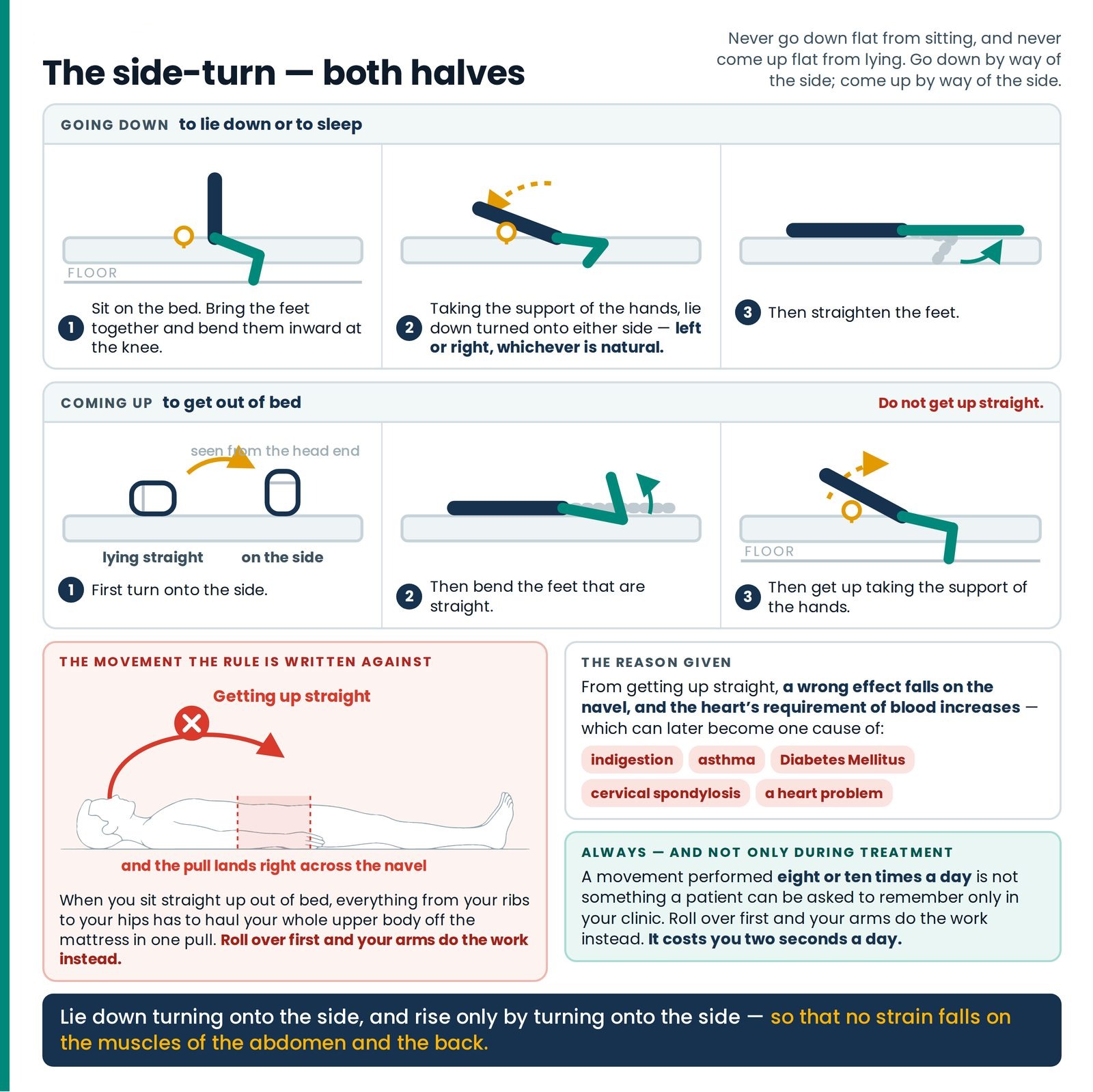
Down by way of the side, up by way of the side — always
Why the side-turn matters — the reason given
From getting up straight, a wrong effect falls on the navel, and the heart's requirement of blood increases — which can later become one cause of indigestion, asthma, Diabetes Mellitus, cervical spondylosis, or a heart problem.
Teach the rule exactly as it stands. It is one of the very few rules in this article whose stated reason reaches that far forward, and a student who trims it has removed the part that makes a patient take it seriously.
Say it across the mat in the patient's own terms. When you sit straight up out of bed, everything from your ribs to your hips has to haul your whole upper body off the mattress in one pull — and the pull lands right across your navel. Roll over first and your arms do the work instead. It costs you two seconds a day. (Figure 38.2)
Then show her. Do not describe it — lie down on the mat yourself, get up the wrong way, get up the right way, and make her do it twice before she leaves. An instruction about a movement is learnt by moving.
The hour, the dark and the window
Asleep by 10.30, the room dark, the window open — and why each
Table 2 — The rules of sleeping, and the reason for each
| The rule | The reason |
|---|---|
| We should go to sleep before 10.30 at night. | Only from the pineal gland remaining in order do all the body's affairs run smoothly. It is said that in India it awakens between 12.30 and one o'clock at night. Even if it works only for ten minutes, it will work only if we are in good deep sleep — and to reach deep sleep the ordinary person needs at least two hours. |
| Take care that there is complete darkness in the room, so that the pineal gland is properly provoked. Better not to form the habit even of a night lamp — a zero-watt bulb. | From sleeping in a dark room the lifespan becomes long. The tortoise's lifespan is more than two to three hundred years, and it always sleeps in darkness with its neck tucked in. In the old days the rishis and munis lived in dark caves, and many had lifespans of more than two to three hundred years. |
| Lie down keeping the whole body loose; give attention that there be no tension in the mind. | If there is tension in the mind on rising, the head will remain heavy all day. So at night, remembering Hari, sleep with a calm mind; and on rising too, taking Hari's name, get up with good positive thoughts — the whole day will go well. |
| Sleep with the windows opened, so that fresh air comes into the room. | From sleeping in a closed room the quantity of carbon dioxide in the room increases, from which the body will remain tired all day and there will be no wish even to work. |
| Sleep with the legs straight. | Taught with its full reason in Part seven of this article, where the position of the legs is given whole. |
| Do not sleep with the hands placed under the head. | Taught with its full reason below. |
Take the 10.30 rule apart before you give it, because it is the one patients argue with hardest and it is not a rule about 10.30 at all. It is a rule about being two hours deep by half past midnight. The clock time is arithmetic performed backwards from the gland: the ordinary person needs about two hours to reach good deep sleep, so a person who lies down at 10.30 is in that state when the gland does its work, and a person who lies down at half past twelve is not. Give a patient the arithmetic and she will do the arithmetic herself for her own household — which matters, because in a house where the last meal is at ten the rule has to be argued with the kitchen first.
The darkness rule and the hour rule are one rule, not two. The gland is provoked by darkness, and a zero-watt bulb burning all night is not darkness. The instruction is specific about the habit rather than the bulb: better not to form the habit even of a night lamp. A child who cannot sleep without one is a separate conversation; an adult who leaves it on because it was on when she was a child is not.
The open window, and a patient who did not respond
When a treatment fails one patient, stop adjusting it and ask about the life
The instruction is short: sleep with the windows opened, so that fresh air comes into the room — because from sleeping in a closed room the quantity of carbon dioxide in the room increases, from which the body will remain tired all day and there will be no wish even to work.
The case that established it in the teaching is told in full, with the whole of its reasoning, in The Hand That Heals, "The Hand That Heals" — the woman at the Bandra clinic whose rheumatoid pain returned every morning, who slept with her windows shut out of fear of the cold, and who got well on the same treatments that had been failing her for weeks once she opened them.
What belongs here is what the case is for. It is the founding case of the patient's half, and the move in it is one you will make a hundred times: a treatment that works for many patients and not for this one is usually not the wrong treatment. Stop adjusting it. Ask about the life.
The counted breath at bedtime
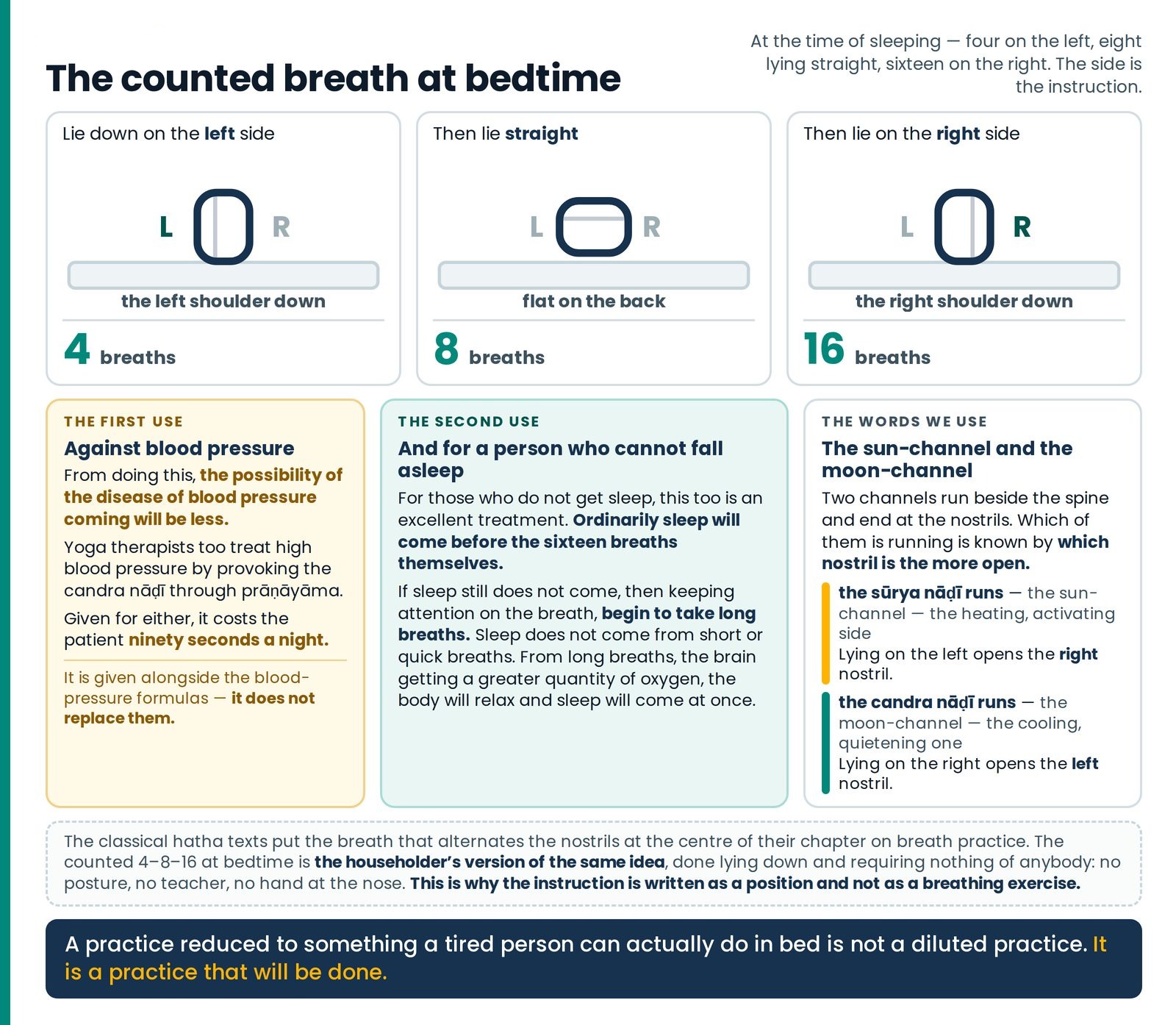
Four on the left, eight lying straight, sixteen on the right
Two uses, one practice. It is given as a preventive against blood pressure, and it is given — in its own bracketed note — as a treatment for a person who cannot fall asleep. Give it for either and it costs the patient ninety seconds a night. (Figure 38.3)
Why the arms must stay down
The pipe to the arm comes out under the collarbone, and the arm is a lever
Never sleep with the hands under the head
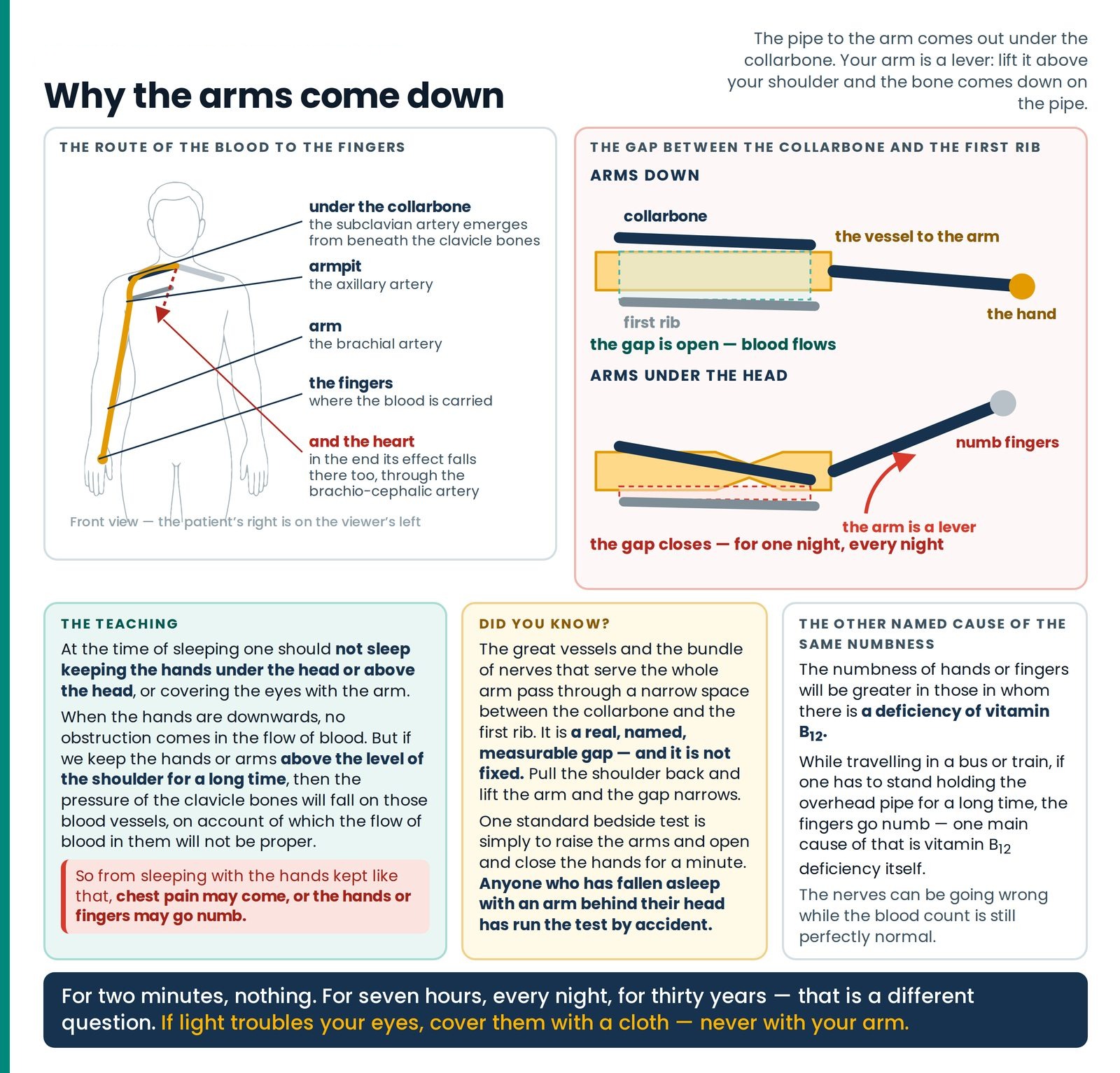
At the time of sleeping one should not sleep keeping the hands under the head or above the head, or covering the eyes with the arm.
If any light is falling on the eyes, cover them with a cloth — but do not place the arm on the eyes.
The reason. From both sides of the neck the subclavian arteries emerge, which, coming out from beneath the clavicle bones above the shoulders, carry blood up to the fingers through the vessels named the axillary and brachial arteries. When the hands are downwards, no obstruction comes in the flow of blood. But if we keep the hands or arms above the level of the shoulder for a long time — as happens when sleeping with them under the head — then the pressure of the clavicle bones will fall on those blood vessels, on account of which the flow of blood in them will not be proper. In the end its effect will fall on the heart too, through the brachio-cephalic artery.
So from sleeping with the hands kept like that, chest pain may come, or the hands or fingers may go numb. ▲ Take care
Trace it for the patient with your own hand on your own collarbone: the pipe to your arm comes out here, under this bone. Your arm is a lever. Lift it above your shoulder and the bone comes down on the pipe. For two minutes, nothing. For seven hours, every night, for thirty years — that is a different question. (Figure 38.4)
And give the second half of the rule its due, because students drop it. The arm across the eyes is forbidden too. A patient who cannot sleep with light on her face is to cover the eyes with a cloth, which costs nothing and puts no arm above a shoulder.
The numbness, and what lies behind it
The numbness of hands or fingers will be greater in those in whom there is a deficiency of vitamin B₁₂.
While travelling in a bus or train, if one has to stand holding the overhead pipe for a long time, the fingers go numb — one main cause of that is vitamin B₁₂ deficiency itself.
That is a piece of ordinary observation worth more than most laboratory slips: the patient who tells you her fingers go dead on the morning bus has told you something to follow up.
And it is worth knowing, when a patient waves a normal blood report at you, that this particular vitamin does its damage in an unusual order. Most people meet it as a cause of anaemia and expect a shortage to show first as a low haemoglobin. It does not have to. The nerves can be going wrong while the blood count is still perfectly normal — pins and needles, dead fingers, an unsteady walk in the dark — because the vitamin's work in the coverings of nerve fibres is a separate job from its work in the marrow. So persistent, symmetrical numbness in both hands is worth a question rather than a shrug.
Rising
Before sunrise, thirty seconds on the bed's edge, slippers before the floor
Table 3 — The rules of rising, and the reason for each
| The rule | The reason |
|---|---|
| At the time of rising in the morning too there should be complete darkness — so rise before the sun rises. | If there is a great deal of light in the room at the time of rising, the head will remain heavy all day. From sleeping early and rising early, the body will be healthy. |
| While rising, rise taking Hari's name, with good thoughts. | If there is tension in the mind on rising, the head will remain heavy all day — so get up with good positive thoughts, and the whole day will go well. |
| Do not get up straight: first turn onto the side, then bend the straight legs, then get up taking the support of the hands. | Given in full above, with the side-turn. |
| At the time of getting up, sit on the bed for at least thirty seconds and then get up. | Given in full in Part five, with the organ of balance. |
| Whether morning, noon or evening, on getting up from the bed do not place the feet immediately on bare ground. Place them on slippers — or after staying a while, they may be placed on bare ground. | Inside the bed your feet were warm, whereas the ground is cold, so placing the feet on bare ground immediately on rising may give you a cold. |
Rise before the sun rises is the rule, and the reason attached to it is about light in the room at the moment of waking, not about virtue. That is worth saying to a patient who works nights and cannot keep it: what the rule is protecting is being woken in darkness rather than in glare, and a shift worker can get most of that with a heavy curtain. Do not pretend the rule is fully kept; say which half of it can be.
The slippers rule is one patients keep more readily than any other in this article, because it costs nothing and because everybody has felt the shock of a cold floor at five in the morning. Take the free compliance. It also happens to be the rule that protects the patients you worry about most — the ones who cannot feel their feet properly.
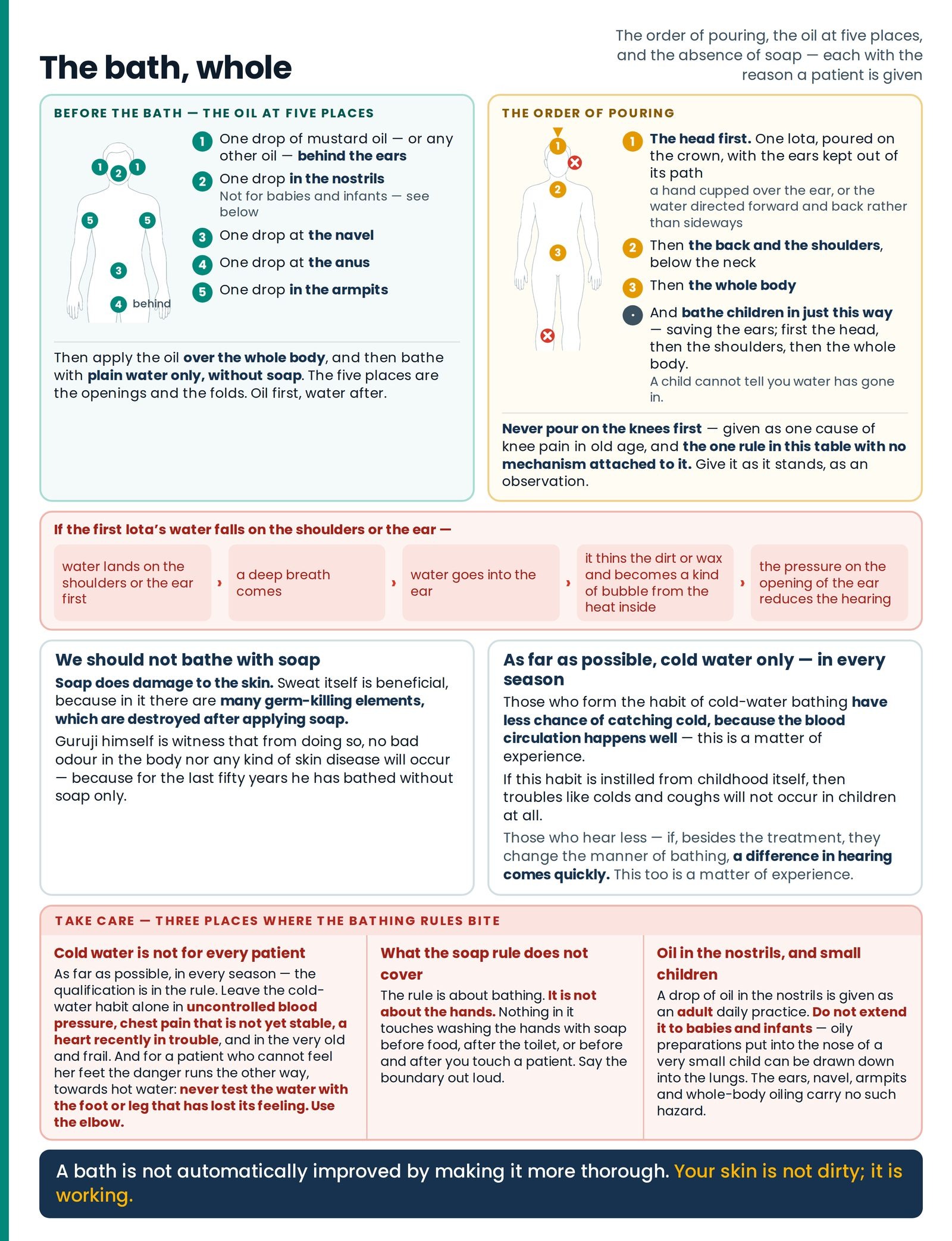
Bathing looks like the least clinical subject in this wiki and is not. It is a thing done daily, with water, near the ears, near the head, on knees that are already painful, with an article of commerce applied to the whole skin — and every one of those has a rule attached, with a reason.
Table 4 — The rules of bathing, and the reason for each
| The rule | The reason |
|---|---|
| As far as possible bathe with cold water only, in every season. | Those who form the habit of cold-water bathing have less chance of catching cold, because the blood circulation happens well — this is a matter of experience. Bathing with cold water is best for the blood circulation. If this habit is instilled from childhood itself, then troubles like colds and coughs will not occur in children at all. |
| When washing the head, first pour one lota of water on the head, taking care that it does not come onto the ears; then on the back and shoulders below the neck; then on the whole body. | If the first lota's water falls on the shoulders or the ear, then a deep breath coming, water can go into the ears. This water, after thinning the dirt or wax of the ears, becomes a kind of bubble on account of the heat inside, whose pressure coming onto the opening of the ear reduces the hearing. Those who hear less, if besides our treatment they change the manner of bathing, a difference in hearing comes quickly — this is a matter of experience. |
| Some people, bathing sitting with hot water, first pour water on the knees. Guruji says this too is one cause of knee pain coming in old age — so instead of pouring on the knees first, begin by pouring water on the head as said above. | Stated within the rule. |
| We should not bathe with soap. | Soap does damage to the skin. Sweat itself is beneficial, because in it there are many germ-killing elements, which are destroyed after applying soap. |
| Before bathing, one drop each of mustard oil, or any other oil, should certainly be applied at five places — behind the ears, in the nostrils, and the navel, the anus, and the armpits. After applying oil at all these places, apply it on the whole body, and afterwards bathe with plain water only, without soap. | Guruji himself is witness that from doing so, no bad odour in the body nor any kind of skin disease will occur — because for the last fifty years he has bathed without soap only. |
That last line is the one to say to a young mother, and it is worth thirty seconds of demonstration with an empty mug.
The order is not ceremony. It follows from what the rule is protecting: water arriving first at the shoulders sends the person's breath in sharply, and water goes into the ear on that breath. Anybody who has had cold water land on the back of the neck knows the gasp. Pour on the crown first and the gasp happens with the ears already out of the line of fire. (Figure 38.5)
Hearing, and the manner of bathing
Those who hear less — if, besides the treatment, they change the manner of bathing, a difference in hearing comes quickly. This is a matter of experience.
Two things follow for practice. First, a patient who comes with reduced hearing is asked how she bathes, at the first visit, before any point is chosen. Second, the change costs nothing and can be made the same evening, which means you will know within a fortnight whether it was part of the answer.
The oil at five places, and the absence of soap
Oil at the openings and the folds first, then plain water and no soap
The five places are the openings and the folds — the places where the body meets the outside. The whole-body application follows them, and the bath follows that, in that order and not another: oil first, water after.
Where the bath meets the meal
Forty-five minutes between a cold bath and breakfast, and why
One rule stands on the boundary between this article and the next, and it is a rule about the bath, so it is given here in the form the patient needs.
The bath and the meal must not touch
After bathing in cold water in the morning, breakfast should not be taken for at least forty-five minutes.
Breakfast should be taken only after bathing. If for some reason it has to be taken first, then bathe only after a good deal of time, so that the food eaten is digested.
The reason. After bathing, the body takes half an hour to forty-five minutes to become warm. At that time the blood circulation remains more towards the skin and not towards the other organs. The stomach and the digestive system will not work properly until the whole body becomes warm and the circulation increases towards them; food taken within that time will be digested less and a gas problem will remain. And bathing immediately after breakfast or a meal can cause indigestion or other stomach problems.
That is the whole of what a bathing article owes the subject. Everything else about the table — what is eaten, how it is chewed, when water is drunk and when it is not, what is kept away from during a course of treatment, and what to do about food in illness — belongs to Food as Medicine, "Food as Medicine", and is taught there completely.
Three further daily practices are given, and they do not belong to any of the groups above. They belong to the day, which is why they are here.
The tear ducts, stroked while bathing {{x3}}
At the sides of the eyes there are two small openings, which are called the lacrimal ducts.
From stroking these slowly thirty times daily while bathing, the circulation of tears and the pressure inside the lens of the eyes will be proper, and glaucoma or cataract can be avoided.
Even after glaucoma has come, many patients have already taken benefit from this treatment.
For those from whose eyes water keeps flowing continuously, this too is an excellent treatment.
Slowly, and thirty times, and daily, and while bathing — all four are part of the instruction. It is attached to the bath because that is when it will actually be done; a practice with no fixed hour is a practice that is skipped.
Meditation in vīrāsana
From doing meditation in vīrāsana, concentration power — that is, the power of one-pointedness — increases, from which memory increases.
Children get much benefit in study. It is good for attaining Hari.
Those who get fits: teaching them this āsana, besides their Neurotherapy treatment, will be of much benefit.
Note the words besides their treatment. This is given as an addition to what is being done, for a condition in which nothing is ever to be replaced.
The doorbell
Some people fit musical bells at the door.
If, while one is asleep in the morning, the milkman rings this bell, then on some people getting up with a start, bells begin to ring by themselves in their ears — because the sound of that bell is very sharp.
From this, vertigo — that is, giddiness — can also come.
So in houses one should fit only a low-sounding buzzer, and not a musical bell.
That is a rule about a fitting on a wall, and it is a perfectly serious one. It belongs to the family of rules about how a person is brought out of sleep, which is why it sits beside the darkness at waking and the thirty seconds on the edge of the bed. A body pulled upright out of deep sleep by a sharp noise is doing, in one second, everything the rising rules were written to slow down.
Ask about it. Who wakes you, and how? The answers — a bell, an alarm across the room, a grandchild, a phone on a metal table — are cheap to change and nobody has ever thought of them as medical.
Table 5 — Rules for the ears and the nose, and the reason for each
| The rule | The reason |
|---|---|
| Inside the ears a wax forms, by which the ear is protected. So dirt should not be removed from the ears — because you will keep removing it and the body will keep making it. | Stated within the rule. |
| Drops of oil should not be put in the ears. | From that, damage or harm can come to the hole of the eardrum, or that hole may get closed, from which hearing decreases. But you may apply oil lightly with cotton (rūī). ▲ Take care |
| From eating antibiotic medicines, or from the caffeine or nicotine that is in tea, coffee, cigarettes and so on, the nerves of the ear become weak, from which hearing can stop. | Besides this, these medicines harm the beneficial bacteria that make vitamin K in the body. If there is a deficiency of vitamin K in the body then the clotting of blood will not happen. So if blood begins to flow anywhere in the body for any reason, that haemorrhage will simply not stop. If women have this problem, then their menses, which should stop after four days, will not stop at all. Because of the deficiency of blood, weakness, giddiness or other diseases will come. |
| Behind the ear there are three tubes which are called the semi-circular canals. In them a water-like fluid stays filled, which maintains our body's equilibrium — that is, balance. If we get up with a start, that is quickly, at the time of rising, then from water going out of any one of them much giddiness can come, which is called vertigo. | So at the time of getting up it is better, remembering Hari, to sit on the bed for at least thirty seconds and then get up. |
| From pressing the opening of the ears in all four directions, from inside towards outside, one time each, the ears open up; and if pressed three times each in all four directions, then high blood pressure — high BP — is reduced. Doing this daily after bathing, BP will never rise. This is a matter of experience. | Stated within the rule. × 3 |
| When one has a cold, the nose should not be cleaned very forcefully or too much. If it is to be cleaned, it should be cleaned keeping both nostrils open. | If the nose is blocked and you try to force air out of one while keeping the other closed, then the mucus or rubbish that is there will get inside the tube of the ear, from which hearing will stop, or one will begin to hear less. ▲ Take care |
| If water is flowing from the nose, then from lying on the left side for ten minutes the sūrya nāḍī will begin to run, and the flowing of water from the nose will stop. | Those to whom this happens early in the morning because of cold or allergy — if they make a habit, on waking, of lying ten minutes on the left side and getting up afterwards, then within a few days they can be freed from this trouble. Left |
Four of those deserve a sentence each of the kind a therapist says out loud.
The wax. You will keep removing it and the body will keep making it. That is the whole argument, and it is unanswerable. A patient who digs the wax out every morning has told his ear it is short of wax.
The thirty seconds. This is the same instruction as the side-turn, arriving from another direction and with another reason attached — the fluid in the three tubes behind the ear, and what happens if the body is jerked upright before it has settled. Give both reasons; they are not competitors, they are two accounts of why nobody should stand up out of sleep. And give the practical form, which is exact: sit on the bed for at least thirty seconds, then get up.
The four directions. × 3 Once each way opens the ears; three times each way is given for high blood pressure, done daily after bathing. The rule attaches it to the bath for the same reason the tear ducts were attached to the bath: an unfixed time is an unkept practice. It is offered as a matter of experience and should be given in exactly those words. And it is given alongside the treatment and alongside whatever the patient's doctor has prescribed, never instead — see Water and Salt, "Water and Salt", for the blood pressure formulas, and remember that blood pressure is a thing to be measured, not felt.
Both nostrils open. This is the cleanest piece of reasoning here and the easiest to demonstrate. Pinch one nostril, blow hard through the other, and the pressure has only two places to go — and one of them is the tube that runs from the back of the nose to the middle ear. A child with a cold who is taught to blow gently with both sides open has been protected from something real.
Four last suggestions close this section. They are of four different kinds — one an experience, one a warning with a full argument attached, one a piece of tradition explained, one a practice — and they should be given as four different kinds of thing.
Cramp, and the yawn
On cramps — that is, ainṭhan — coming, from taking both hands above the head and snapping the fingers, the cramps go away. This is a matter of experience.
Likewise, on a yawn coming, from snapping the fingers in front of the mouth, the mouth remaining open, or the jaw getting stuck, and so on, will not happen.
Given as experience, and to be passed on as experience. It costs nothing, it is done in two seconds, and this is a matter of experience is the honest label. Keep the label on it.
Hair dye — the argument in full
Every time hair dye — that is, the means of changing the colour of the hair — is used, whether it be made of mehndi or otherwise, its chemical enters the blood through the pores of the skin, and keeps coming in the urine for at least forty days.
From this dye a kind of cancer can also come.
The reason. All the rubbish of the blood has to be taken out by the kidneys alone. That the dye comes in the urine means that the kidneys are forced — besides their normal work — to do extra, that is useless, work for forty days to remove this dye.
Just consider: those people who for many years use dye every month, or again and again — how much extra work will their kidneys have to do? Then why should they, the kidneys, not become weak? And if the kidneys become weak, why will cancer or other big diseases not come?
Note the form of the last part. It is put as a chain of questions, not as a series of assertions, and it should be given to the patient in that same form — as a thing to consider, in the words it is given in.
This is the rule patients resist most after the food rules, and they resist it for reasons that have nothing to do with kidneys. Meet that honestly. A woman of fifty-five who has dyed her hair every month for twenty years is not weighing a physiological argument; she is being asked to look older in front of people she works with. Say so. I know exactly what I am asking, and I am not going to pretend it is a small thing. Then give the argument whole and let her decide, and do not make her compliance a condition of your attention. A rule imposed on a patient's dignity is a rule that ends the course.
The nerve between the toes
Between the big toe of the foot and the first finger there is a nāḍī, which, if it is pressed, the feeling of viṣaya-bhoga — that is, the fulfilment of desire — is suppressed, or comes to an end.
It is for just this reason that sādhu people used to wear the thumb-pegged khaḍāū — the wooden sandal — from which that nāḍī was pressed, so that such feelings did not come.
Given as the explanation of an old practice, and taught as such.
The Gayatri and its twenty-four syllables
The Gayatri mantra is of twenty-four syllables.
It is said that from pronouncing it purely, the twenty-four valves, twenty-four large nāḍīs and twenty-four small nāḍīs that are in our body — all will open.
Note it is said. The phrase is part of the teaching and is not to be removed. Give the rule with the phrase attached and the student learns something more useful than the rule itself: the difference between what is asserted and what is reported.
One thing about recitation is not merely reported, and it is worth having ready for the student who thinks a counted verse is arbitrary. When people recite aloud at the traditional pace, their breathing settles at almost exactly six breaths a minute — and six a minute happens to be the rate at which the rhythm of the heart and the rhythm of the breath come into their closest agreement, and at which the body's own pressure-regulating reflex works at its most sensitive. The effect is produced by the length of the line. A verse counted in syllables is a breath counted in seconds, wearing other clothes — which is the same discovery the bedtime 4–8–16 makes from the other end.
Two rules remain, and both are about the hours immediately before sleep. The first is about how a person sits and lies all day; the second is about the gap between the last meal and the bed.
One leg over the other
Women and girls should not sit or sleep with one leg placed up over the other.
The reason. From sitting or sleeping with leg over leg, a one-sided pull comes on the muscles of the organs below the navel, whose effect will fall on the blood circulation as well. Chief among these organs are the uterus and the ovaries. From the blood circulation in them being spoiled, white discharge, the menses coming early or late, or uterus prolapse and so on can happen.
So everyone should sleep with straight legs.
Until the habit of sitting like that is given up, the suggestion is to keep changing the legs turn by turn at regular intervals, so that an equal pull comes on the muscles of both sides.
Three things in that rule are routinely lost, and each of them is the part that makes it usable.
It ends with everyone. The rule opens by naming women and girls and closes by saying that everyone should sleep with straight legs. Both halves stand. The sleeping instruction is the one that completes Table 2 above, and it applies to the whole household.
It carries its own fallback. Until the habit is given up — the rule does not assume that a woman who has crossed her legs since she was twelve will stop on Tuesday. It gives her something to do in the meantime: change the legs, turn by turn, at regular intervals. A rule that contains its own interim version is a rule that gets kept, and a student who drops the fallback has made the rule twice as hard and half as likely.
It is about a one-sided pull. So the remedy for the interim is symmetry, not stillness. Say it that way across the mat: If you must cross them, do not always cross the same one on top.
The gap between the night meal and sleep
The night meal should be taken by such a time that there is a gap of at least two hours between eating and the time of sleeping — so that the food which has been eaten in solid form becomes thin like water and is digested properly.
If intercourse is performed immediately after eating, then both husband and wife will get a gastric problem — that is, a stomach problem — because the blood which is needed for the digestive system is being used for other functions.
This is one instruction, and it is given here in one piece. Both halves rest on the same reasoning — that the work of digestion is going on for a definite stretch of time after a meal, and that it needs what it needs. The rule of the night meal is also a rule of the bed: it is why a household that eats at half past nine cannot keep the 10.30 rule without moving the kitchen first, and it is the point on which the sleeping rules and the eating rules meet.
Everything about the meal itself — what is on the plate, how it is chewed, when the water is drunk, what is kept away from, what changes in illness — is Food as Medicine, "Food as Medicine". What belongs here is the clock: finish eating two hours before you lie down.
That line is attached, in these teachings, to the cold-water bath, to the change in hearing that follows a change in the manner of bathing, to the pressing of the ear openings for blood pressure, and to the finger-snap for cramp. It is not a hedge and it is not an apology. It is a label, and it is put on exactly the rules that carry no mechanism — which means that every other rule in this article, by the same author's own standard, is claiming something more than that.
Use the label the way he uses it. A therapist who says "this one is a matter of experience" about the cramp and "this one is about the pipe under your collarbone" about the arms is a therapist a patient will believe about both.
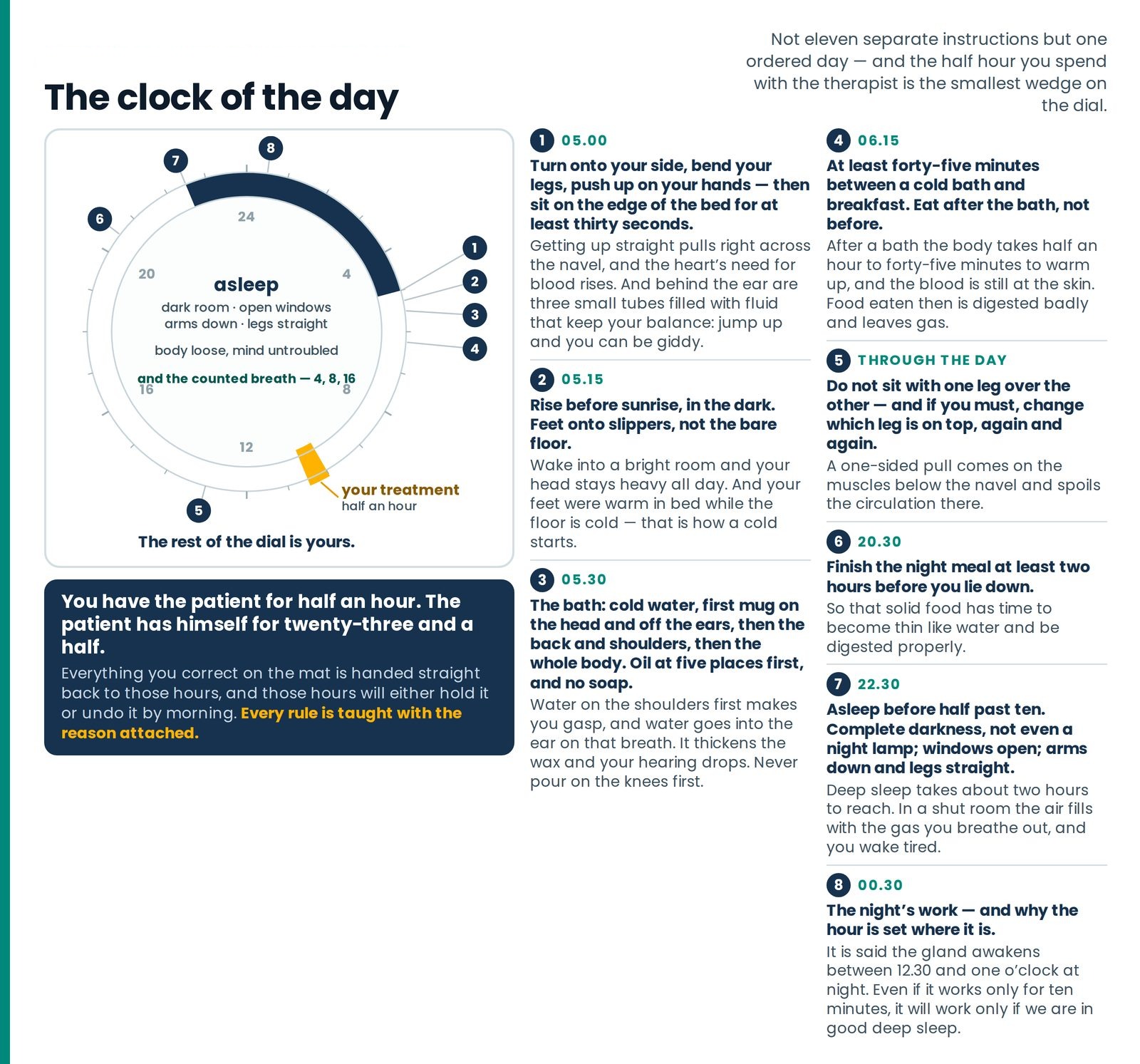
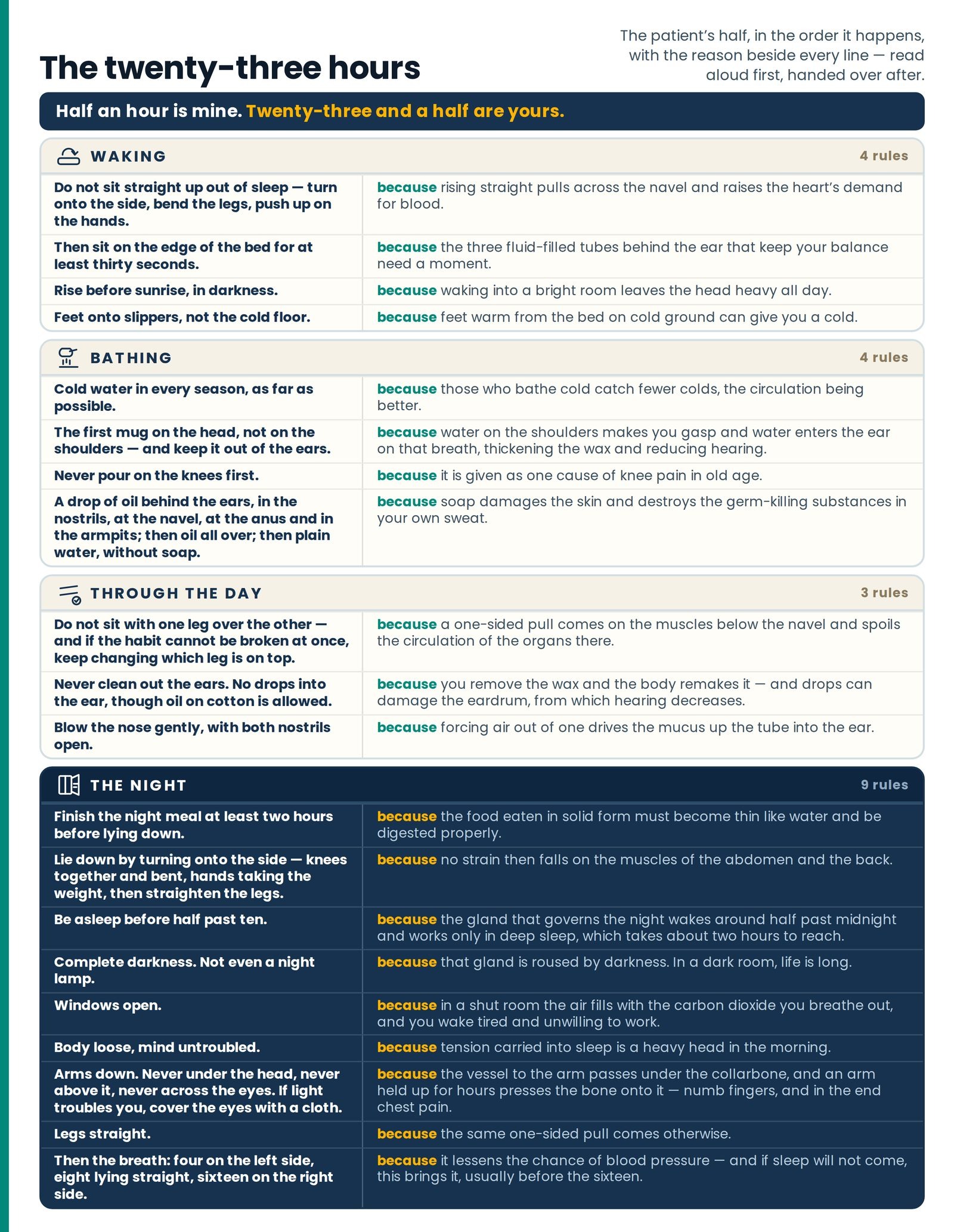
Rules scattered through a article are a article. Rules laid out in the order of a day are a thing a patient can use. What follows is the whole of the patient's half of this article, in the order it happens, with the reason beside each line — written to be read aloud across the mat, or handed over on a single sheet after it has been read aloud. (Figure 38.6)
Do not hand it over cold. See the mistake box above. (Figure 38.7)
Table 6 — Your day, in order
| When | What to do | Why |
|---|---|---|
| On waking | Do not sit up straight out of sleep. Turn onto your side first, bend your legs, then push up on your hands. | Getting up straight pulls right across the navel, and the heart's need for blood rises. |
| Then sit on the edge of the bed for at least thirty seconds before standing. | Behind the ear are three small tubes filled with fluid that keep your balance. Jump up and you can be giddy. | |
| Rise before sunrise, while the room is still dark. | Wake into a bright room and your head stays heavy all day. | |
| Get up with a good thought, taking God's name. | If the mind is tense on rising, the head is heavy all day. Start it well and the day goes well. | |
| Put your feet on slippers, not on the bare floor — or sit a while first. | Your feet were warm in bed and the floor is cold. That is how a cold starts. | |
| If your nose runs every morning from cold or allergy: lie ten minutes on your left side before getting up. | It changes which nostril is running. Make it a habit and in a few days the trouble goes. | |
| The bath | Cold water, in every season, as far as you can manage it. | People who bathe cold catch fewer colds, because the blood circulates well. |
| First mug on the head — keep it off the ears. Then the back and shoulders. Then the whole body. | Water on the shoulders first makes you gasp, and water goes into the ear on that breath. It thickens the wax and your hearing drops. | |
| Never pour on the knees first. | Pouring hot water on the knees first is one cause of knee pain in old age. | |
| Before the bath, one drop of oil behind the ears, in the nostrils, at the navel, at the anus, in the armpits — then over the whole body. Then plain water, no soap. | Soap damages the skin. Your own sweat contains germ-killing substances, and soap destroys them. | |
| Bathe children the same way — ears saved, head first, then shoulders, then the body. | Same reason, and a child cannot tell you water has gone in. | |
| Stroke the tear ducts at the outer corners of the eyes, slowly, thirty times. | Keeps the flow of tears and the pressure inside the eye right. It helps eyes that water constantly. It is in addition to your eye drops, never instead of them. | |
| After the bath, press the opening of each ear in all four directions, from inside outwards — once each to open the ears, three times each if your blood pressure runs high. | A matter of experience. Done daily, it is said the pressure will not rise. Keep taking your tablets and keep measuring. | |
| Before eating | At least forty-five minutes between a cold bath and breakfast. Eat after the bath, not before. | After a bath the body takes half an hour to forty-five minutes to warm up, and the blood is still at the skin. Food eaten then is digested badly and leaves gas. |
| Through the day | Do not sit with one leg over the other — and if you must, change which leg is on top, again and again. | A one-sided pull comes on the muscles below the navel and spoils the circulation there. |
| Never clean out your ears. Oil on a little cotton is allowed; drops poured in are not. | You will keep removing the wax and the body will keep making it. Drops can damage the eardrum, or close the hole, and hearing drops. | |
| Blow your nose gently, with both nostrils open. | Close one and force air out of the other and the muck goes up the tube into your ear. | |
| If cramp comes: both hands above the head and snap the fingers. | A matter of experience. | |
| Stop the hair dye. | Its chemical goes into the blood through the skin and comes out in the urine for at least forty days — forty days of useless extra work for your kidneys, every time. | |
| The evening | Finish the night meal at least two hours before you lie down. | So that solid food has time to become thin like water and be digested properly. |
| Going to bed | Lie down by turning onto your side, not by dropping flat backwards. Knees together and bent, hands taking the weight, then straighten the legs. | So that no strain falls on the muscles of the abdomen and the back. |
| Asleep before 10.30. | The gland that runs the night's work wakes around half past midnight, and it only works if you are already in deep sleep — which takes about two hours to reach. | |
| Complete darkness. Not even a night lamp. | The gland is woken by darkness. In a dark room, life is long. | |
| Windows open. | In a shut room the air fills with the gas you breathe out. You wake tired and unwilling to work. | |
| Whole body loose, mind untroubled. | Tension carried into sleep is a heavy head in the morning. | |
| Arms down. Never under the head, never above it, never across the eyes. If light troubles you, cover the eyes with a cloth. | The pipe carrying blood to your arm passes under the collarbone. Raise the arm for hours and the bone presses on it — numb fingers, and in the end chest pain. | |
| Legs straight. | Same reason as the crossed legs: no one-sided pull. | |
| Then the breath: four breaths on the left side, eight lying straight, sixteen on the right side. | It lessens the chance of blood pressure. And if sleep will not come, this brings it — usually before the sixteen. If not, keep the attention on the breath and lengthen it; short quick breaths do not bring sleep. | |
| In the house | A low buzzer at the door, not a musical bell. | A sharp sound that wakes you with a start can set bells ringing in the ears, and can bring giddiness. |
Questions students ask
1. I am nineteen and new. A patient asked me why she should sleep before half past ten when her grandmother lived to ninety sleeping at midnight. What do I say? Say what the rule actually is, because it is not a rule about 10.30. It is a rule about being two hours deep by about half past midnight, which is when the gland is said to do its work, and deep sleep takes an ordinary person about two hours to reach. The clock time is arithmetic worked backwards. Give her the arithmetic and let her do it for her own household; she will get closer to it than any order of yours would have brought her. And do not fight the grandmother. Say: "I cannot explain your grandmother. I can tell you what I am asking you to try for three weeks and why."
2. I am a housewife learning this for my family. My mother-in-law cannot sleep without a night lamp and we share a room. What is the answer? The one in the case above: move the light out of the room and leave the door ajar. She gets her light, the room gets its darkness, and nobody is asked to give anything up. Most of the daily rules have a version like this, and finding it is a better use of your ten minutes than repeating the rule louder. Solve it as a household problem and you get the physiology for free.
3. I am a doctor. Some of the reasons in this article would not survive a viva. Do I teach them? Teach them as they stand, and keep the labels the teaching itself puts on them. Notice that this material is more careful than it is often given credit for: some rules are attached to a named structure — the vessel under the collarbone, the tube from the nose to the ear, the canals behind the ear — and others are explicitly marked this is a matter of experience. That distinction is the teaching's own, and a therapist who preserves it is giving a patient a truer picture than one who either flattens everything into physiology or dismisses the lot. The rules themselves, with almost no exception, cost the patient nothing and are followed by benefit.
4. I practise in a village. Half my patients sleep on the floor in one room with six others. How do I give the sleeping rules? Give the ones that are free and keep your mouth shut about the ones that are not. Darkness, the side-turn, the arms down, the legs straight, the thirty seconds, the slippers, the counted breath — every one of those can be done on a floor in a shared room and costs nothing. An open window may be impossible in one season and easy in another; say so. A rule a patient cannot keep is worse than no rule, because it teaches her that your instructions are for other people.
5. A patient improved for two weeks and then stopped improving. How do I know whether it is the plan or the daily rules? Do it in that order. Re-examine from the beginning as though it were a first visit — and if the findings are what they were and the plan still fits them, the answer is in the twenty-three hours. Then reconstruct a day rather than auditing the rules: last night from the end of the meal; this morning from opening the eyes to standing on the floor; how the bath went, mug by mug. The thing you find will usually be something nobody has ever called medical. See also → Weeks, Not Sessions, "Weeks, Not Sessions".
6. I am sixty-eight and learning this for myself. Are these rules different for an older body? The rules are the same; the reasons bite harder. The side-turn matters more in a thin, old spine than a young one; the thirty seconds on the edge of the bed matters more when the reflexes that hold your blood pressure up are slower; the slippers matter more when a cold floor is also a slippery one; and cold-water bathing is the one rule where age is a genuine reason to go carefully rather than boldly. See also → The Child, the Elder and the Frail, "The Child, the Elder and the Frail".
7. How many rules do I give at the first visit? Two. Three if one of them is the side-turn, which you will also demonstrate. A first visit is already carrying a diagnosis, a strange room, a stranger's foot and a course of unknown length; a list of eleven instructions on top of that is heard as noise and remembered as nothing. Pick the two with the clearest connection to the complaint in front of you — the window for the joint patient, the arms for the numb fingers, the pouring order for the ear — and add the rest as the weeks go.
8. A patient says his Ayurveda vaidya told him never to bathe in cold water. Do I argue? No. Ask what his own body tells him, and give him the qualification that is already in the rule: as far as possible. The instruction on cold bathing is given as a matter of experience about circulation and colds, and it is not the rule on which this course will turn. Spend your credit on the rules that carry mechanisms — the arms, the pouring order, the nostrils — and leave the ones where two traditions differ to the patient's own judgement. A therapist who fights every battle wins none of them.
9. Why is the side-turn repeated three times in one article? Because it is performed eight or ten times a day and is the only rule here that is also a rule of the treatment hour. It appears as a precaution during treatment, as the way to get in and out of bed, and as a rule of life — and each time it is written always, and not only during treatment. A movement done that often is not learnt from one telling. Demonstrate it, make the patient do it twice in front of you, and ask her to show you again next week.
10. Which of these rules would you not give up, if a patient would only take one? The side-turn, and it is not close. It is free, it is instant, it applies to every bed the patient will ever get out of, it protects the region this whole therapy is built around, and the reason given for it reaches further forward than any other reason in this article. If you get only one rule kept in a course of treatment, get that one.
11. A young man laughed at the doorbell rule. What do I do? Laugh with him, and then ask him how he wakes up. If the answer is a phone alarm on a metal table by his ear, you have just been handed the same rule in his own language. The rule is not about musical bells; it is about how a person is brought out of sleep — sharply or gently — and it belongs beside the darkness at waking and the thirty seconds on the edge of the bed. Translate it into his house and it stops being funny.
12. My patient keeps the rules for three weeks and then drifts. Is that failure? It is the usual course of every behaviour change ever attempted by a human being, and you should expect it and plan for it. Write down which two rules you asked for and on what date — see The Record That Shows the Truth, "The Record That Shows the Truth" — and revisit those two, by reconstruction rather than audit, at the fourth week. A drifted rule recovered at week four is worth more than eleven rules given once at week one.
Questions patients ask
1. "You are asking me to open my window in December. Do you want me to catch pneumonia?" No, and the rule is not about cold — it is about air. In a shut room, all night, the air fills up with the gas you breathe out, and that is why you wake up tired and with no wish to do anything. What has to happen is that the air changes. How much of the window is open is entirely up to you. A hand's width at the top, or the ventilator, or the door left ajar to a room that has air — any of those will do it. I am not asking you to sleep in a draught and I would not.
2. "My skin is already dry and you are telling me to stop soap. I will smell." That is exactly the worry, and here is the answer that was given long before you asked it: a man who has bathed without soap for fifty years is the witness that it does not happen, and that no skin disease comes of it either. Two things make the difference. First, you oil the body before the bath — a drop behind the ears, in the nostrils, at the navel, at the anus, in the armpits, then all over — so the skin is not going into the water bare. Second, the sweat you are washing off has germ-killing substances of its own in it, and soap destroys them. Your skin is not dirty; it is working. And this is about your bath — your hands still get soap, before food and after the toilet, always.
3. "I have been sleeping with my hands under my head since I was a child. How can that be wrong?" It is not wrong, exactly — it is a position you cannot hold for seven hours without something being squeezed. Put your fingers on your collarbone. The pipe that carries blood down your arm comes out underneath it. Your arm is a lever: lift it above your shoulder and the collarbone comes down on that pipe. For two minutes, nothing at all. For seven hours a night, for thirty years, you get exactly what you have been getting — fingers that go dead in the night. Try it for two nights with your arms down and tell me on Thursday what your fingers were like. And if the light troubles you, put a cloth over your eyes; just not your arm.
4. "I have dyed my hair every month for twenty years. Are you telling me to go grey?" I am, and I am not going to pretend it is a small thing to ask. Here is the reason, and then you decide, and I will treat you either way. Every time it goes on, the chemical passes through the skin into the blood, and it keeps coming out in the urine for at least forty days — which means your kidneys are doing forty days of extra, useless work every single time, on top of everything else they do. Do it every month for years and ask yourself how much extra work that is, and what happens to kidneys that are worked like that. That is the argument. It is yours to weigh.
5. "My doctor gave me drops for my blood pressure. You are telling me to press my ears. Which one do I do?" Both. The ear is given as something you do in addition — once each way to open the ears, three times each way where the pressure runs high, daily after your bath — and it is offered as a matter of experience, which is exactly how I am offering it to you. Do not stop your tablets, do not reduce them, and keep measuring. If a day comes when everything is normal and staying normal, take your readings to the doctor who prescribed them and ask him whether the dose should change. That decision is his.
6. "My mother says water must not touch the head first — it brings on a cold." Households differ on this and I am not going to tell you your mother is wrong about her own family. What I can tell you is why the order is given here. When cold water lands on the back of your neck or your shoulders, you gasp — everybody does — and water goes into the ear on that gasp. It thickens the wax, and the pressure on the ear reduces the hearing. That is why the first mug goes on the crown, with the ears kept out of its way, and the shoulders come second. If the cold is what worries your mother, the answer is the temperature of the water, not the order of pouring. Keep her rule about warmth and take mine about order; they do not clash.
7. "I do everything you said and I am still not better. So what was the point?" It is a fair question and it deserves a straight answer. The rules are not the treatment; they are what stops the treatment being undone between visits. If you are keeping them and nothing is moving, then the problem is mine, not yours — and what I will do is examine you again from the beginning, as though today were your first visit, rather than tell you to try harder. Tell me exactly what you have been doing, including the bits you have not managed. I am not going to be annoyed. I need to know which of these is actually happening before I can tell what is left to explain.
8. "Is it not a bit much — you are telling me how to get out of bed?" It is, and I know how it sounds. Here is why I am doing it anyway. You get out of a bed or a chair perhaps ten times a day; that is three and a half thousand times a year. Almost nothing else I ask of you happens that often. Thirty minutes a week on this mat cannot compete with three and a half thousand of anything. That is why I care how you get out of bed — not because I want to run your house.
Words used here
| Hindi | English | Neurotherapy code / usage |
|---|---|---|
| करवट (karvat) | A turn onto the side | The side-turn: lie down and rise only by turning onto the side, always, not only during treatment |
| करवट लेना (karvat lenā) | To turn onto one's side | The movement itself, taught as a two-part method going down and coming up |
| लोटा (lotā) | A small round vessel for pouring water | The unit of the bathing rule — the first lota goes on the head, ears kept clear |
| नहाना (nahānā) | To bathe | Cold water as far as possible, in every season; oil at five places first; no soap |
| तेल (tel) | Oil, usually mustard oil here | One drop at each of the five places before the bath, then over the whole body |
| कान का मैल (kān kā mail) | Ear wax | Never removed; the ear protects itself with it. No drops in the ear; oil on cotton only |
| रूई (rūī) / कापूस | Cotton wool | The permitted way to apply oil about the ear |
| चक्कर (chakkar) | Giddiness, vertigo | The complaint the thirty-second rule and the doorbell rule are given against |
| ऐंठन (aiṇṭhan) | Cramp | Both hands above the head and a snap of the fingers — a matter of experience |
| तजुर्बे की बात (tajurbe kī bāt) | A matter of experience | The label attached to a rule that carries no mechanism. Keep the label on |
| कारण (kāraṇ) | The reason | What is attached to every rule in this article. A rule without it is an order |
| दिनचर्या (dincharyā) | The ordering of the day | The daily rules taken together, from waking to sleeping |
| नाड़ी (nāḍī) | A channel of the body | Sun-channel and moon-channel — which one runs is known by which nostril is open |
| परहेज़ (parhez) | Abstinence; what is kept away from | The negative half of the daily rules; the food side is Food as Medicine |
| — | Thymus | The chest-bone treatment before which a chain or mangalsutra is kept clear of the foot |