- Forms
- (4), (8) Thymus
- How it is given
- The Front of the Body II
- What it is used for
- Each Point in Use
Watch


Th. Only — Thymus Only (थैमस ओनली)
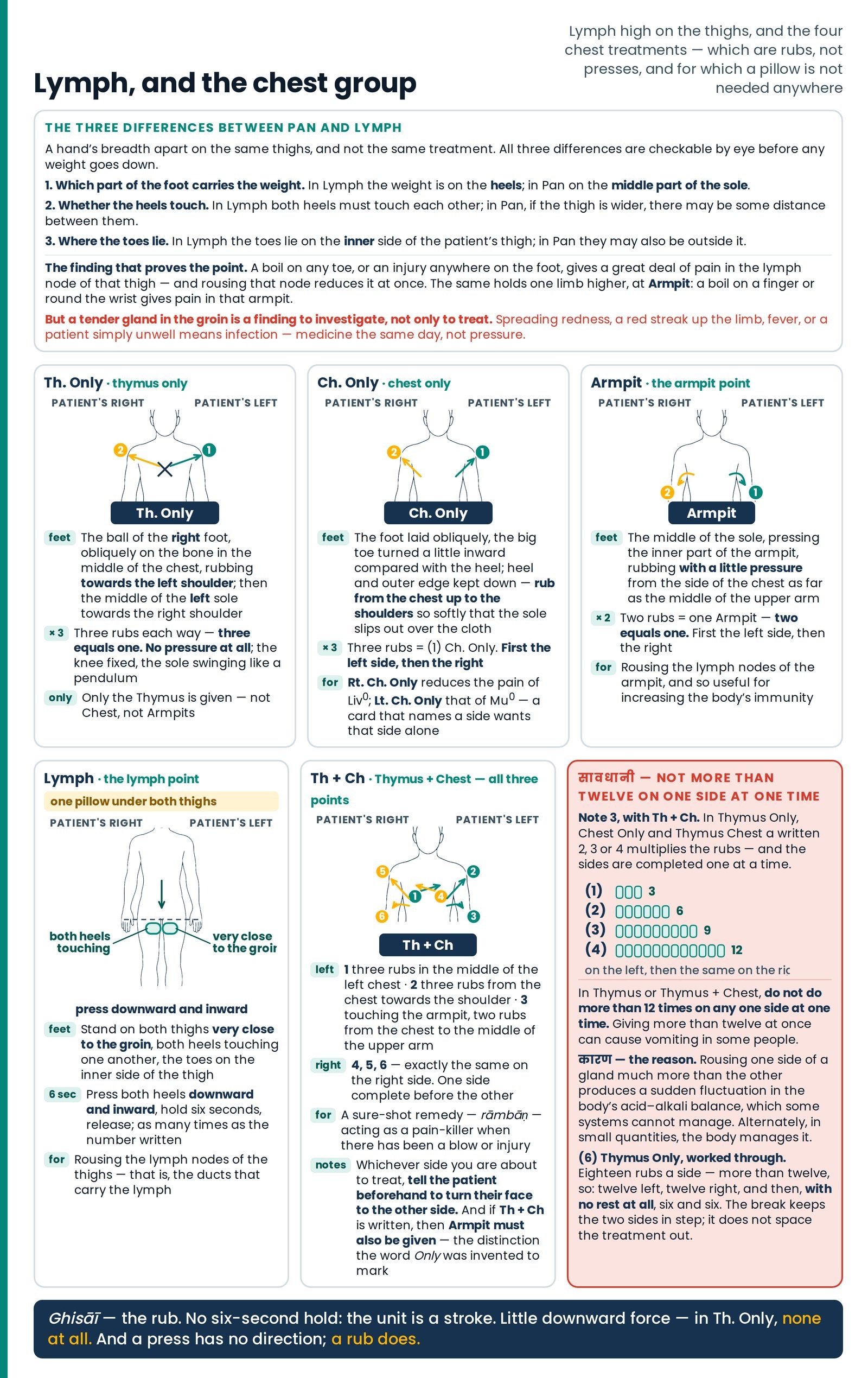
Taking the support of the chairs, place your feet on both sides of the patient's waist. First lay the right sole obliquely and, with the soft part of the ball of the foot, on the bone in the middle of the chest, without giving pressure, rub three times towards the left shoulder; then with the middle part of the left sole rub three times towards the right shoulder. The count is three equals one.
The word Only has been added here to show that only the Thymus is to be given — not Chest and not Armpits.
| Patient's position | Supine, no pillow; the therapist on the chairs, feet on both sides of the patient's waist Supine |
|---|---|
| Where the feet are placed | The soft part of the ball of the right foot, laid obliquely on the bone in the middle of the chest, rubbing towards the left shoulder; then the middle of the left sole, rubbing towards the right shoulder Both sides |
| Duration and repetitions | Three rubs each way; the count is three equals one. No pressure at all. One-directional strokes only × 3 |
| What it is for | Named for the thymus; given alone — not Chest, not Armpits |
From Face Down
(2) Adr, (4) Adr, (6) Adr — three treatments, not three strengths
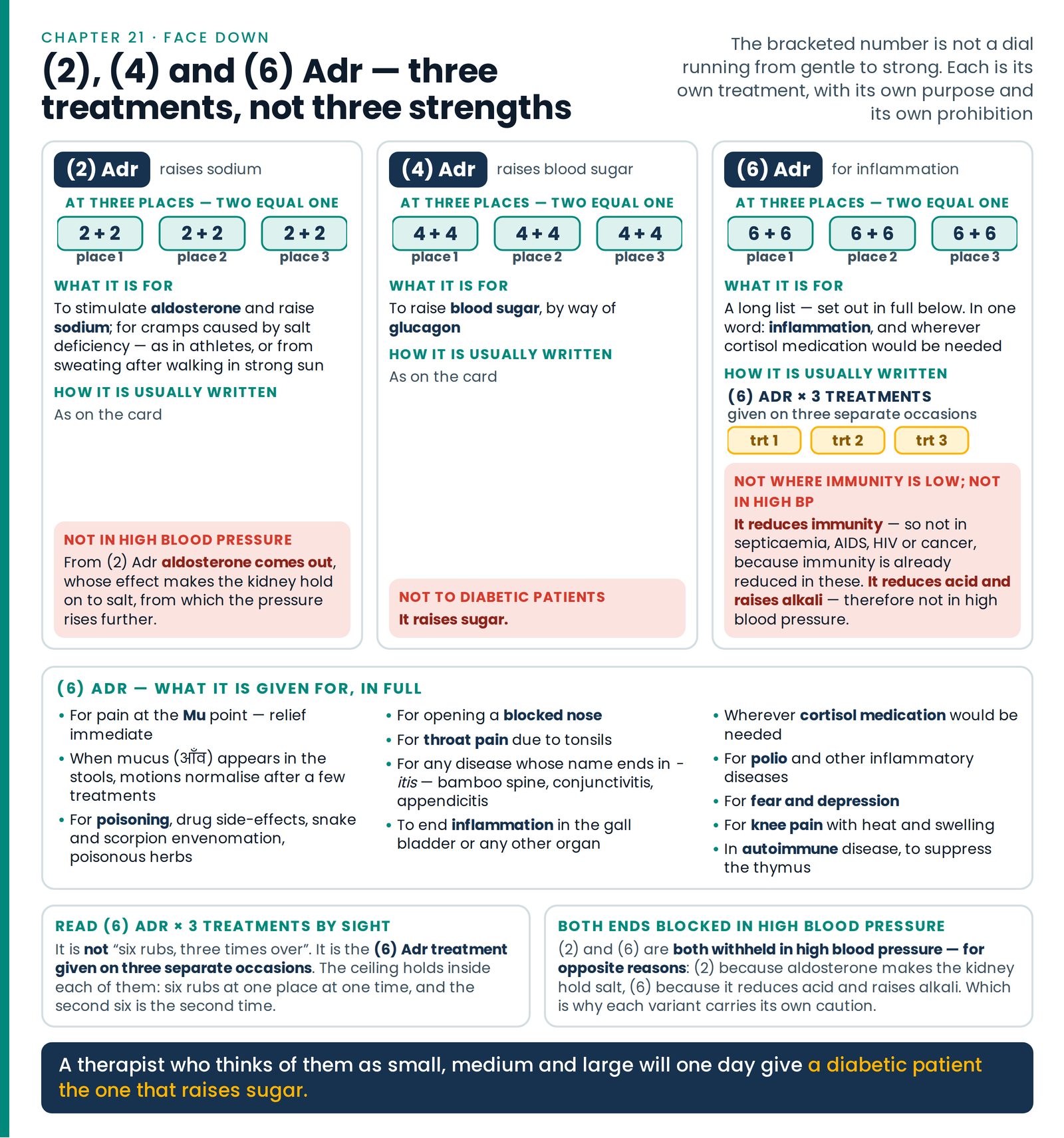
(6) ADR × 3 treatments is a form to learn by sight — not "six rubs, three times over", but the (6) Adr treatment given on three separate occasions. Note too that (2) and (6) are both withheld in high blood pressure for opposite reasons, which is why each variant carries its own caution. The rest of their use, and every condition in which each is blocked, is in Each Point in Use, "Each Point in Use", and When the Hand Must Stop, "When the Hand Must Stop". (Figure 21.3)
What lies beneath. A hand flat on the upper back lies over the broad sheet of muscle running to the shoulder, the two long ropes holding the spine upright, and then the ribs. The adrenal glands are nowhere near — two caps of four to six grams on top of the kidneys at the back of the belly, far lower than T6 and behind all of that. What the palm reaches is real; what it does not do is deliver a message to one named gland.
From The Medulla Family
(4) Medulla — the clockwise treatment, with T1/T2
The one member with a direction, and the one with a conditional third part
The last member, and the only one in the family given with a stated direction of the hand.
(4) Medulla, in its original form
Formerly this treatment used to be given in this way: (4) Medulla clockwise + T1/T2 — by which relief was seen in the following symptoms:
the troubles of the cervical nerves C1–C4 — pain of the right and the left chest
mitral valve pain, spleen pain, pain of the upper part of the diaphragm
pain of cervical beads number 1 to 4, and
by giving T1/T2, right and left chest pain goes away
the pains which come because of disturbance of the cervical nerves C5–C8 —
all the pains of the arms, elbow, hand, wrist, palm, fingers and so forth are removed.
And the addition, with its condition: if, along with this treatment, the Raman treatment is also given, then the pain of the fourth finger of both hands used to go — which we take to be a sign of RA (rheumatoid arthritis).
Table 15 — Card: (4) Medulla clockwise with T1/T2 Seated 6 sec Both sides
| Written | (4) Medulla clockwise + T1/T2 · with Raman added under the condition below |
|---|---|
| The three parts, in order | (4) Medulla, clockwise → T1/T2 → Raman, conditional. Given as one pass — the panel above Seated |
| What part one is credited with | The troubles of C1–C4 — pain of the right and the left chest; mitral valve pain; spleen pain; pain of the upper part of the diaphragm; pain of cervical beads 1 to 4. And the pains that come from disturbance of C5–C8 — all the pains of the arms, elbow, hand, wrist, palm, fingers and so forth |
| What part two is credited with | By giving T1/T2, right and left chest pain goes away |
| When part three is added | When the fourth finger of both hands is painful — and only after checking Liv° and Mu° ▲ Take care |
| What part three is credited with | The pain of the fourth finger of both hands used to go — a finding we take to be a sign of RA |
| What the index adds | For spleen and mitral valve pain and for chest pains. For cervical spondylosis or spondylitis. And to stimulate the lungs |
| The word *formerly* | It stands in the instruction and is not removed. This is how the treatment used to be given; in this therapy the older form of a treatment is printed beside its successor and is not an error — Table 13, How a Formula Is Built |
| Points taught in | Medulla — Seated I — Brain, Medulla, Neck; the clockwise rotation of the neck — Seated I — Brain, Medulla, Neck, Neck Clockwise; Thoracic T1/T2 — Seated I — Brain, Medulla, Neck; Raman — Seated I — Brain, Medulla, Neck; the indications and precautions of T1/T2 — Each Point in Use |
Three things in that card need saying plainly.
Clockwise is a different hand action, not an adverb. Everywhere else in this family the thumbs glide downward; here the fingers are gathered into a pad and rotated, and it is the action taught as Neck Clockwise in Seated I — Brain, Medulla, Neck, performed at the Medulla count. A therapist who reads clockwise and gives four ordinary downward strokes has given (4) Medulla and not (4) Medulla clockwise, and the two are not the same instruction.
The list of symptoms is not a jumble. Read it as a map of the neck and it falls into three tidy groups. C1–C4 are the nerves of the top of the neck, and the chest, the mitral valve, the spleen and the upper part of the diaphragm all report in at that level — which is why a treatment given at the nape is credited with a pain the patient feels under the ribs. C5–C8 are the nerves of the arm, and their list is simply the arm written out from the shoulder to the fingertips. And T1/T2 are the two beads where the chest begins. Three groups, three parts of the treatment, one card.
And the RA sign is a sign, not a treatment. Pain in the fourth finger of both hands — the two ring fingers, symmetrically — is read here as a sign of rheumatoid arthritis. The instruction attached to it is to add Raman, and the result reported is that the finger pain used to go. What that finding also does is tell you what you are looking at, and that is worth more than the relief.
Also explained in
- The glands of the throat and the head Each Point in Use
Table 9 — THRD, THRD 'P', PIT and PARA Point and variant What it is used for When it must not be used Notes (2) Thrd In angina — that is, in heart patients — to reduce cholesterol, (2) Thrd is given in place of (4) Thrd
- At a glance Each Point in Use
(2) Adr, (4) Adr and (6) Adr are three treatments with three different targets and three different bars, and a prohibition attached to one does not travel to the others.
- The pancreas — PAN Each Point in Use
They may be given (4) Pan or (10) Pan ▲ Take care A prohibition that names its mechanism and its substitute — the best-shaped rule in the article.
- Questions students ask Each Point in Use
(4) Para is not given alone; the full 1,25 DCC formula is given instead, and that is the important distinction.
- The twelve-rub limit The Front of the Body II
The multiplying counts of this article as rows of squares: four six-second applications for Pit, Para and Thrd 'P', three one-way rubs for Th. Only and Ch.
- Vocal Point (वोकल पॉइंट / वोकल घिसाई) The Front of the Body II
Th. Only is given with no pressure at all, the knee still, no rub on the return stroke; Th.
- How to read this article Each Point in Use
(4) Adr raises blood sugar and is refused to a diabetic.
- The points of immunity Each Point in Use
(Figure 25.4) Table 10 — THYMUS, THYMUS + CHEST, ARMPIT, LYMPH, TON 'P' and TON 'T' Point and variant What it is used for When it must not be used Notes (4) Thymus / (8) Thymus Given to increase the body's disease-resis
- The points of generation Each Point in Use
They may be given (4) Pan or (10) Pan.
- Th + Ch — Thymus + Chest (Thymus Chest) The Front of the Body II
He has now given six half-strokes in two directions instead of three strokes in one — Th. Only into the chest and back into the breastbone, which is not what the point is.
- Introduction Each Point in Use
She had palpated him properly, found tenderness at Const and at Gal, and built her card out of what she had found: (4) Const for the bowel, (4) Thrd for the hair and the skin and the sluggish afternoons, (1) Pt.
- The chest group — Thymus, Chest, Armpit, and their combination The Front of the Body II
Four treatments built out of one another: Th. Only works the breastbone, Ch.
- Thrd — Thyroid (थाइरॉइड) The Front of the Body II
(4) Thrd raises the metabolism — the body's rate of building up and breaking down.
- Questions students ask The Front of the Body II
(6) Thymus Only — why can I not simply give eighteen and eighteen and save time? Because more than twelve on one side at one time can cause vomiting in some people, and the reason given is that one side of a gland has be