- How it is given
- The Front of the Body I
- What it is used for
- Each Point in Use
Watch

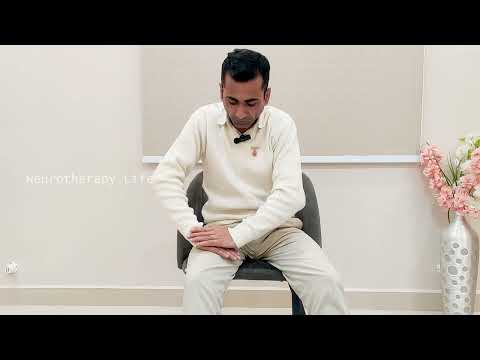
Spl — the spleen point
Do exactly as for Gal above, but give the pressure with the sole of your left foot on their right thigh. At every place press for six seconds and release. Completing this from the waist down to the right knee is called (1) Spl. Repeat from waist to knee as many times as the number written, pressing six seconds and releasing at each place.
| Patient's position | Supine, one pillow under both thighs; therapist standing straight, other foot lifted clear, knee not bent Supine |
|---|---|
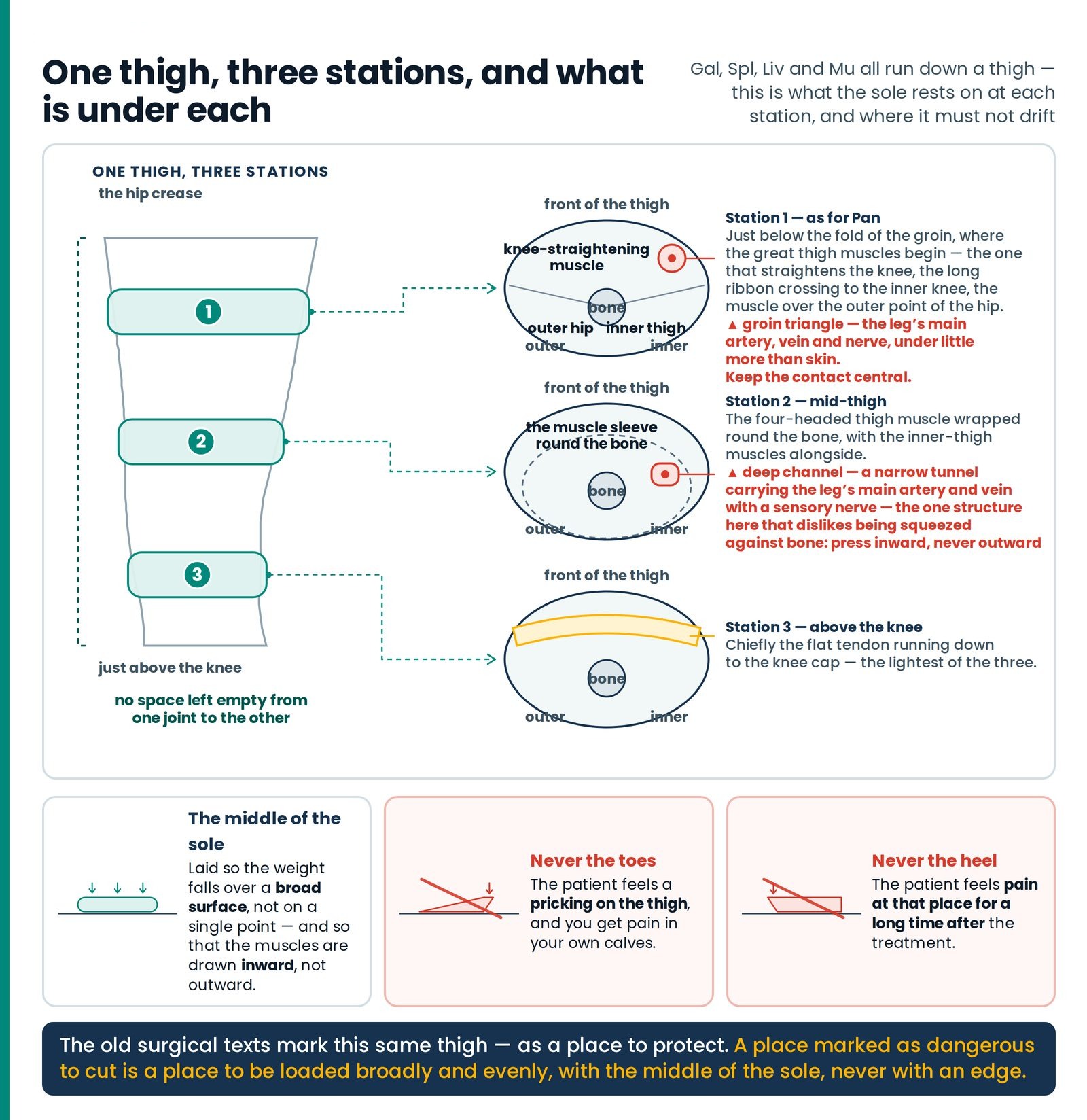
| Where the feet are placed | Therapist's left sole on the patient's right thigh; three (or four) stations from below the hip to just above the knee Right |
| Duration and repetitions | 6 seconds at each station; a full hip-to-knee pass = (1) Spl; repeated as written 6 sec |
| What it is for | The pain below the ribs on the left side of the chest, which is found in blood disorders and in diseases of the spleen |
The stance for both. Gal and Spl share a stance of their own — the one place in the supine atlas where the therapist deliberately puts all of himself onto the patient: do not bend your knee; give the pressure with the middle part of your sole; lift the other foot clear of the ground and stand straight, so that your full weight comes onto the patient. And: if the patient's legs stay straight, better results come — but if the patient straightens their own legs the muscles stay tight and they will be uncomfortable, so place a pillow on the outer side of the legs for support to stop them rolling outward.
What lies beneath. The mirror of Gal — thigh muscle front and inner, the deep tunnel with the leg's main vessels at mid-thigh, the flat tendon above the knee. The spleen itself sits high on the left, behind the ninth to eleventh ribs and under the dome of the diaphragm, and in health cannot be felt at all: a spleen you can feel below the ribs is an enlarged one.
From Each Point in Use
The liver and the spleen
Table 5 — LIV and SPL
| Point and variant | What it is used for | When it must not be used | Notes |
|---|---|---|---|
| (1) Liv – 3 points / (2) Liv – 3 points | Pain to the right of the navel. To stimulate the liver and the middle part of the ascending colon. To reduce fever and fight infection through the Kupffer cells — excellent for fevers of every kind. To increase appetite and improve fat metabolism. To lower blood cholesterol. To improve circulation and keep blood sugar correct. To clear the scars of burns — from fire or from chemicals — and wounds from a blow. In kidney failure and other chronic diseases, to stimulate erythropoietin so that the red cell count does not fall too low. It may be given in any disease | But if there is cancer in the liver, do not give it ▲ Take care | The widest indication in the atlas and a single hard bar, printed in adjacent lines. |
| (7) Liv | Used in the Heparin, 1,25 DCC and angiotensin #2 formulas | (the liver-cancer bar stands) | |
| (12) Liv | Very beneficial for dissolving gallstones. Perhaps it works something like cholic acid. Also used in the Lactic acid formula | (the liver-cancer bar stands) | The hedge — perhaps — is the therapy's own and is kept. |
| (1) point liver × 6 treatments | Given all day, at one-hour intervals. Beneficial in liver diseases — hepatitis, jaundice, cirrhosis, or fatty infiltration of the liver, fat accumulating in the liver tissue and obstructing its function. In all serious or long-standing diseases — kidney disease, enlarged spleen, enlarged heart. In angina, HIV, AIDS, cancer. In blood clot in the brain. In circulation problems. To increase lung capacity, digestion, weight or immunity. For erythropoietin, for B₁₂ deficiency, and to raise red cells or haemoglobin — especially in pregnant women. Where white cells are raised, where ammonia is raised, where potassium is high or low, or to reduce abnormal protein | (the liver-cancer bar stands) | Six treatments through one day, an hour apart — the count is a timetable, not a number of presses |
| Spl — TF 'Spl', (1) point Spl, (1) Spl, (3) Spl | To stimulate the upper part of the descending colon — for those who have constipation, or pain in the left front part of the chest. To make white cells and antibodies by means of the spleen. To be given in viral fever, septicaemia, HIV and the like. Nowadays also given in inflammation. To be tried on polio patients, to see whether they benefit from it? | In cold, allergy, asthma and the like this does harm — so do not give it to asthma patients. Nowadays it is not given in cancer. It is not given in diabetes or in other autoimmune disorders ▲ Take care | But one myasthenia gravis patient obtained much relief from Spl after a single treatment. One patient, recorded as one patient — and the word nowadays, twice, marking a rule that changed |
Notice the word nowadays. It appears twice in the Spl box — nowadays it is also given in inflammation, nowadays it is not given in cancer — and it is doing something a therapist should respect. It marks a rule that was different before and was changed on evidence. A teaching that prints its own revisions rather than quietly rewriting them is telling you that the atlas is a living record, and that your own careful observations have somewhere to go.
From Water and Salt
Why the spleen and the ovary, when the trouble is in the bowel?
A point's name is a postal address, not a description of the parcel
A natural question arises. To cure constipation, why are Spl — the spleen — and Lt. Ov. — the left ovary — being stimulated? Constipation has come about because the movement of food in the alimentary canal is very slow, and both of these are outside the alimentary canal.
Here is the thing to attend to. By our points we increase the blood circulation in the various parts of the abdomen all around the navel. Each point's name has been given by keeping in mind the chief organ in that region. But when we give that point, it will increase blood flow not only in that organ, but in all the organs that are in that region.
In the region above and to the left of the navel the chief organ is the spleen — but the left terminal part of the transverse colon and the upper part of the descending colon are there too, and when Spl is given, blood flow increases in all three. In the same way Mu removes the pains of the left side of the navel: besides the small intestine, the middle part of the descending colon is there, so it is stimulated as well. And Lt. Ov. takes out the pain of the region below and to the left of the navel, where besides the ovaries or testes there is the terminal part of the descending colon and the sigmoid colon.
What a point's name means, and what it does not
In this formula the point Spl has not been given in order to stimulate the spleen, but rather for that part of the large intestine.
This is one of the most freeing ideas in the whole formulary, and it disposes of a great deal of student anxiety. A point name is a postal address, not a description of the parcel. You are not pressing a spleen; you are increasing the blood supply to a region that happens to contain a spleen, and also contains two lengths of colon that nobody thought to name a point after.
An everyday version: you open the tap in the kitchen and the pressure drops in the bathroom, because you did not turn on "the kitchen" — you drew from a pipe that serves both rooms. Blood is that pipe.
Table 4 — Why each point of LSTF is given
| Point | The reason it is in the formula |
|---|---|
| Spl | To stimulate the terminal part of the transverse colon and the upper part of the descending colon |
| Const | Whenever there is constipation, there is pain at this point — so, to take that pain out |
| Mu | To stimulate the middle part of the descending colon, and to increase lubrication in the intestines, so that the residue of stool moves forward easily |
| Lt. Ov. | To stimulate the terminal part of the descending colon and the sigmoid colon |
| Mu° | To reduce acidosis — because when acid is high, constipation will certainly occur |
| Adr | To reduce inflammation in the intestines. By this, acid will also be reduced |
| Thrd | Because one main cause of constipation is the thyroid gland working too little |
Also explained in
- The revision — Gal and Spl taken out of an inflamed abdomen APR — Abdominal Pain
So by giving these two points — Gal and Spl — the inflammation could increase.
- Spl — the spleen point The Navel Speaks First
Not the spleen — that sits further back and higher, under ribs nine to eleven, and in health cannot be felt at all.
- GAL–SPL GHISAI — the pelvic rim, softly, six times Uncommon Problems
GAL and SPL are the gall bladder and spleen codes of the supine atlas; ghisai is the therapy's own word for a rubbing, sliding application rather than a still press.
- Introduction The Front of the Body I
The student had given a correct, careful, eleven-day course of Spl to a man who did not need Spl — and was then given the one sentence that makes this article make sense.
- Why the map crosses The Front of the Body I
Spl is named for the spleen, on the left, and is given on the right.
- W D — White Discharge The Front of the Body I
This note is printed once and governs a named list: Gas, Gas I, Gal, Spl, Liv, Mu, Lt.
- The points on the thighs The Front of the Body I
an never travels; Gal and Spl run hip to knee without stopping Figure 16.2 The points on the thighs.
- Questions students ask The Front of the Body I
Must I learn all of this before I can be useful? Learn Pan, Gal, Spl, Liv and Mu properly and you can already give the largest part of an ordinary morning's work.
- Two cases from the reference Each Point in Use
A student watching was asked to write the card from the indication lists alone, and wrote a long one: Gal for the skin; (4) Thrd for the sluggishness and the cold; Armpit for the winter cough; (10) Pan for the joint pain
- Questions students ask Each Point in Use
And Spl carries an open question.
- The standing rules of every supine treatment The Front of the Body I
For Gal and Spl, one foot on the patient: do not bend your knee, press with the middle of the sole, lift the other foot clear of the ground and stand straight.
- Liv — the liver point The Front of the Body I
(Figure 16.4) The thigh contact is as for Gal and Spl, and for the same reason the instruction says pressed inward: a muscle belly sits in a tough sleeve that already packs it toward the bone, so press along that packing
- (1) Gas Only – 6 points — (1) Gas only – 6 वाला The Front of the Body I
Patient's position Supine, one pillow under both thighs Supine Where the feet are placed Both soles on both thighs, soft mid-sole; at least six places from below the waist joint to a little before the knee, leaving no s
- One disease, several points, one plan Each Point in Use
And Spl carries an open question: to be tried on polio patients, to see whether they benefit from it? — printed as a question, and to be read as one.