- How it is given
- The Front of the Body I
- What it is used for
- Each Point in Use
- Take care
- stimulates the genital organs — not in cancer
Watch


WD — the white discharge point
Finding it. The midline below the navel, between navel and pubic bone.
What is beneath. The midline seam; behind it the dome of the bladder when full — one good reason a patient passes urine before a session — the uterus resting above the bladder in a woman, and loops of sigmoid colon.
Why the name. Whenever women have the problem of white discharge, pain or stiffness is found at just this place below the navel; and as soon as the treatment named WD is given, both the pain and the discharge come to an end. The code covers the corresponding organ in either sex: uterus and prostate gland.
W D — White Discharge
"White discharge" — that is, white water passing.
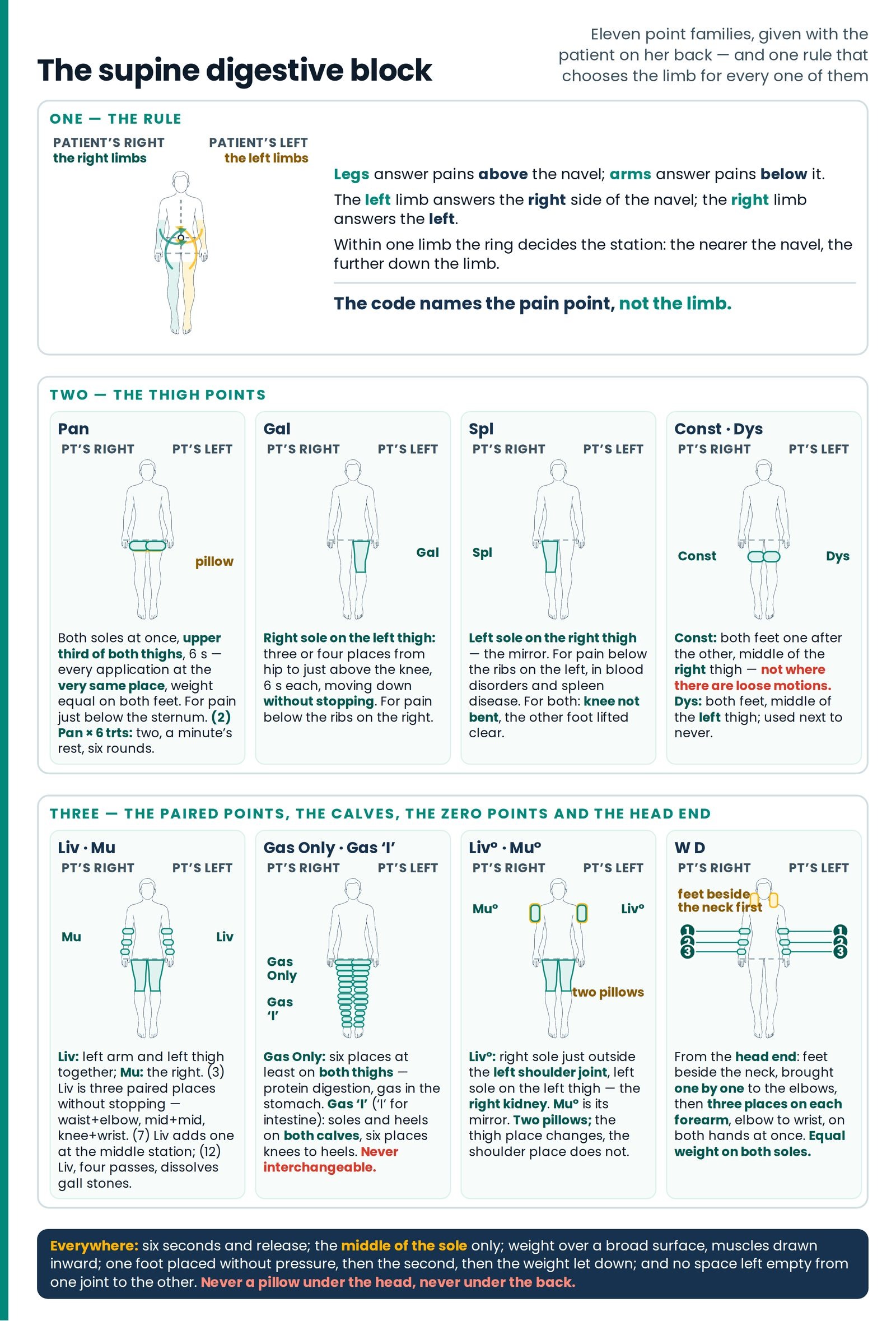
Taking the support of the chairs, place your feet on both sides of their neck. Then, one by one, bring them near the patient's elbows, and with the middle part of your soles give pressure on both hands at once at three places from elbow to wrist; at each place press for six seconds and release. This is (1) WD. Do as many rounds as are written.
| Patient's position | Supine, no pillow under the head unless there is need of one; the therapist at the head end, supported on both chairs Supine |
|---|---|
| Where the feet are placed | Both feet first on both sides of the neck; then brought one by one to the elbows; three places on each forearm, elbow → wrist, on both hands at once Both sides |
| Duration and repetitions | 6 seconds at each paired place = (1) WD; as many rounds as are written. Keep equal weight on both soles 6 sec × 3 |
| What it is for | Reduces the pain below the navel and increases blood circulation in the genital organs |
Three things in that instruction are the instruction. The feet go beside the neck — resting there, carrying no weight; the rule about the neck is set out in full for the whole head-end group in The Front of the Body II, "The Front of the Body — II". They are brought to the elbows *one by one* — the loading rule of the article inside an entry, applying to WD exactly as to Pan and Liv. And the weight stays equal on both soles, which the note governing the stations states explicitly for WD: you are standing over a person's head with a foot on each of her forearms, and an unequal load there is felt as a twist at both shoulders at once.
What lies beneath. At the elbow, the hollow in front with the arm's main artery and median nerve close under the skin and the ulnar nerve in its groove behind the inner knob. Through the middle of the forearm, the muscles that bend the wrist and fingers, the pulse artery down the thumb side and a second artery and nerve down the little-finger side. At the wrist, almost entirely tendon over the band that holds the tendons down, with the median nerve passing beneath into its tunnel — the lightest contact of the three, and the one place where a heel or a toe would do real harm. The organs the point is named for lie deep in the pelvis, out of reach of any hand from outside.
ध्यान दें — how many places, and why the number varies
This note is printed once and governs a named list: Gas, Gas I, Gal, Spl, Liv, Mu, Lt. Ov., Rt. Ov. and WD.
While giving all these points, three places is enough for an ordinary person — but this depends on the length of the patient's thigh and the width of the therapist's foot. The main issue is that no space should be left empty from one joint to the other joint.
a. For a tall patient, four places may be enough for an ordinary therapist — but if the therapist is a young child, then even five places may be needed, and that too is correct. b. If it is a very small child, then even two places may be enough. c. This is a matter of experience. d. While giving WD and Pit, keep equal weight on both soles → pay attention to this. Both sides
Note what the instruction actually measures. Not a number of stations, but complete coverage of the segment between two joints — the number being whatever that takes for this foot on this limb. Decide the stations before any weight goes down, and write the number you used on the card.
Two entries in that list — Rt. Ov. and Lt. Ov. — belong with the head-end group and are taught with Pit, Para, Thrd 'P', ONS and TF in The Front of the Body II, "The Front of the Body — II". (Figure 16.7)
From The Stiffening Joint
The WD variant
The connection is from birth, so it must reach the generative organs
Then a second thought followed from the first. Since the planets' connection is from birth, their effect must certainly be upon the generative organs — and in this therapy the generative organs are stimulated by the WD treatment. So the formula was changed.
Table 2 — Card: the WD variant of the Star formula Supine Prone 6 sec
| Written | (3) WD (1) Gal (4) Ku (20) ↑\ | ↓ — and if there is a need, (3) ONS may also be given first |
|---|---|---|
| What changed, and why | WD replaces ONS as the opening, because the planets' connection is from birth and so must reach the generative organs. Gal is cut from three passes to one. The ONS is not abolished — it becomes conditional, given first if there is a need | |
| Step 0 — (3) ONS, conditional | Supine, exactly as in Table 1. Given first only if there is a need — read the condition as carefully as the step Supine × 3 | |
| Step 1 — (3) WD | From the head end: the therapist's feet placed on both sides of the patient's neck, carrying no weight; then brought to the elbows one by one; with the middle part of the soles, pressure on both forearms at once at three places from elbow to wrist, six seconds at each place. That is (1) WD; here three rounds. Keep the weight equal on both soles. Supine Both sides 6 sec | |
| Step 2 — (1) Gal | Right sole, left thigh, one hip-to-knee pass Left 6 sec | |
| Step 3 — (4) Ku | Old Kundali — eight presses of six seconds, without stopping, prone Prone 6 sec | |
| Step 4 — (20) ↑\ | ↓ | Round Arrow, prone, as in Table 1 Prone |
| What must not be given | The Ku bars — not in menstruation, not in low blood pressure ▲ Take care | |
| Points taught in | WD — The Front of the Body I, "The Front of the Body — I" |
Both these treatments began to please all the patients with joint pain. Two formulas, four steps each, and a clinic full of people who had been disappointed everywhere else now getting up off the mat differently.
WD never travels alone after P point
WD is one half of an inseparable pair. Wherever P point is given, (6) WD follows immediately — the two are written as one instruction and are never split.
That pair is not triggered by this article's formulas, which do not contain P point. But a therapist who meets WD here and WD again in New Genes — Vitamin and Gene Formulas, "The Missing Links" — and WD inside the Fast line of the rebuild at the end of this article, should hold the pair in mind as part of the point's identity, not as a rule attached to one formula.
Also explained in
- The points of generation Each Point in Use
wo ovary points and WD — and the bar that protects a child's growing Table 11 — LT.
- The navel, the womb and the paralysed limb Each Point in Use
etting the navel; and the prolapse point never written alone Table 20 — The navel-setting points, the prolapse point and the limb points Point What it is used for When it must not be used Notes (3) ONS Supine This treat
- Two cases from the reference Each Point in Use
P point, with the sonography in hand and the heel on the middle of the thigh, left thigh first — and, written on the same line of the card so that it could not be forgotten, (6) WD immediately afterwards.
- Why the map crosses The Front of the Body I
WD is a midline point below the navel, and so is not given on a thigh at all, but on both forearms.
- The points of immunity Each Point in Use
P point → (6) WD, immediately.
- Introduction The Front of the Body I
Eleven names and their variants — Pan, Gal, Spl, Liv, Mu, Gas Only, Gas 'I', Liv°, Mu°, Const, Dys, WD — account between them for more time on the mat than everything in Seated I — Brain, Medulla, Neck to 24 together.
- The standing rules of every supine treatment The Front of the Body I
For Pan, Liv, Mu, Liv°, Mu°, Gas Only and Gas 'I' — and the same caution applies for WD, Rt.
- The three rules before the "zero" points The Front of the Body I
The last five entries of the supine block on one plate — Liv° and Mu° with the shoulder contact that stays and the thigh place that changes, Const and Dys on opposite thighs, and WD given from above the patient's head.
- Questions patients ask you The Front of the Body I
"I have white discharge and my neighbour says it is nothing.
- Introduction Each Point in Use
Give the two paired instructions that must never be separated: P point followed immediately by (6) WD, and Ton 'T' followed immediately by Sangam points.
- The exclusions that are same-session, not permanent Each Point in Use
Give this And with it, always The reason as given Th + Ch Armpits, without fail Printed as a standing instruction above the entry Gas Only in constipation, piles or fistula Gas 'I' — and (2) S4, S5 too if the constipatio
- At a glance Each Point in Use
P point → (6) WD, immediately — otherwise that woman will have still more trouble.
- Questions students ask Each Point in Use
Three entries in this atlas hang a capital P off a shared stem and none of them is the others: P point, the prolapse point, which must be followed immediately by (6) WD; Thrd 'P', a point of the anterior pituitary with i
- The uses of the New Genes formula, and its three variants Vitamin and Gene Formulas
Give them the following treatment — (8) Pan (6) WD (8) Ch.