Everything in this article follows from a single property of blood, and it is a property you can watch in a drain. Blood is safe while it moves. Slow it, stop it, let it stand — and it begins to set. The therapy's answer to that danger, and to the opposite danger of blood that will not set at all, is a family of eleven named formulas plus a twelfth that contains six of them. They all share one word, and the word is Heparin.
The notation is closed. Every bracket, prefix, × sign, glyph and treatments suffix used in this article was taught once and completely in Table 13 of How a Formula Is Built, "How a Formula Is Built". It is not explained again. Every written rest — the ninety seconds, the one minute, the minute and a half between Medulla rounds, the five minutes between two whole formulas — is in Table 8 of that same article, with the reason given for each. If a line will not read, go back to those two tables.
Watch


Why blood must keep moving
Two opposite catastrophes, and a body that must stand between them
Begin with the danger, because the whole family is an answer to it.
The two opposite catastrophes
It is a property of blood that as long as it keeps moving fast there is no danger. But if it stops anywhere, or its speed becomes very slow, it will begin to set — which is called clotting.
This is a law of nature made for our protection. Were it not so, then on receiving a blow blood would keep flowing from the wound, and death could occur from excessive loss.
Exactly the opposite is also true. If clotting occurs unwanted, inside the vessels, that too is fatal.
So for this too nature has made an arrangement. In our body there are special cells which make a chemical named heparin, whose work is not to let clots form in the blood.
Two dangers, pointing in opposite directions, and the body has to stand between them every second of its life. A therapist who holds only one of them in mind will sooner or later do harm with the other.
Think of a canal running past a village. While the water moves, the channel stays open and the silt travels with it. Let the flow drop — a gate half-shut, a bend, a season of little rain — and the silt drops out of the water and begins to build a bar across the bed. Nobody put the bar there. It formed because the water slowed, and once it has formed it slows the water further, and the thing feeds itself. That is a clot inside a vessel, and it is why this article is called what it is called.
Now the arithmetic of where the anticoagulant comes from, which decides everything about the formulas.
Of the heparin made in the body:
Where heparin is made, and in what proportions
About 85 per cent is made in cells named mast cells, of the liver and the lungs.
The remaining 15 per cent is made by every tissue — the pericapillary connective tissues — and by basophil leukocytes, a special kind of white blood cell found all over the body.
Read that as a map and the formulas are already half written. Eighty-five per cent of the supply sits in two organs a therapist can reach: the liver, and the lungs by way of the chest. The other fifteen is spread thin across the whole body and has no single address.
How a clot forms
Twelve factors, five links, three lines — and a missing ingredient
Now the other half of the balance: the machinery that makes blood set when it should.
The twelve factors, and the three the therapy names first
In the blood there are twelve chemicals necessary for clotting, called clotting factors.
Chief among them are Vitamin K, the cells named platelets, and calcium, present in the blood itself.
And two more, which is where the liver enters the story for the second time: the liver also makes two clotting factors, called prothrombin and fibrinogen.
What happens when a blow lands is a chain, and each link has a name.
Table 1 — The cascade, restated as the therapy writes it
| Prothrombin (+ calcium) + thrombokinase | → thrombin will be made |
|---|---|
| Thrombin + fibrinogen | → fibrin will be made |
| Fibrin + wounded blood cells | → a clot will be made |
Three lines. Learn them in that shape and you can recite the whole of coagulation from memory, and — much more usefully — you can say at once which ingredient a particular patient might be short of.
An everyday picture for the net. Think of a hole in a mud wall during the rains. Throwing mud at it achieves nothing, because there is nothing for the mud to hold on to. Push a handful of straw into the hole first, in a loose tangle, and then the mud has something to catch on and the wall closes. Fibrin is the straw. The broken red cells are the mud. The body does not plug a wound; it first builds something for the plug to stick to.
What happens when an ingredient is missing
The thing to note
If prothrombin or fibrinogen does not come out from someone's liver, or if there is a deficiency of other clotting factors — such as calcium, platelets or vitamin K — then clotting will not occur, and even a slight injury will make him bleed continuously.
If this happens in women, their menses will not stop at all.
That last sentence deserves a moment, because it is the kind of observation a therapist meets and a laboratory often does not. A woman whose periods have never stopped properly since they began, who bruises where she cannot remember being knocked, whose small cuts weep all afternoon, is not describing a gynaecological complaint and a clumsy nature and bad luck. She is describing one thing three times. The finding is in the pattern, and the pattern is only visible to somebody who asks about all three in the same conversation.
And then the therapy's own bracketed note, which is a guess and is printed as one:
The acid formula, and the perhaps attached to it
When we give such women the acid formula, the bleeding stops.
So perhaps if the blood's pH is more acidic, thrombokinase cannot work properly.
The perhaps is the therapy's own and it stays exactly where it is. What is reported without a perhaps is the observation — the acid formula was given, the bleeding stopped. The explanation offered for it is offered as an explanation and no more. Hold the observation firmly and the reasoning loosely. That is how it was handed to you, and this wiki does not upgrade it.
Why is heparin made in such large quantity in the lungs and the liver?
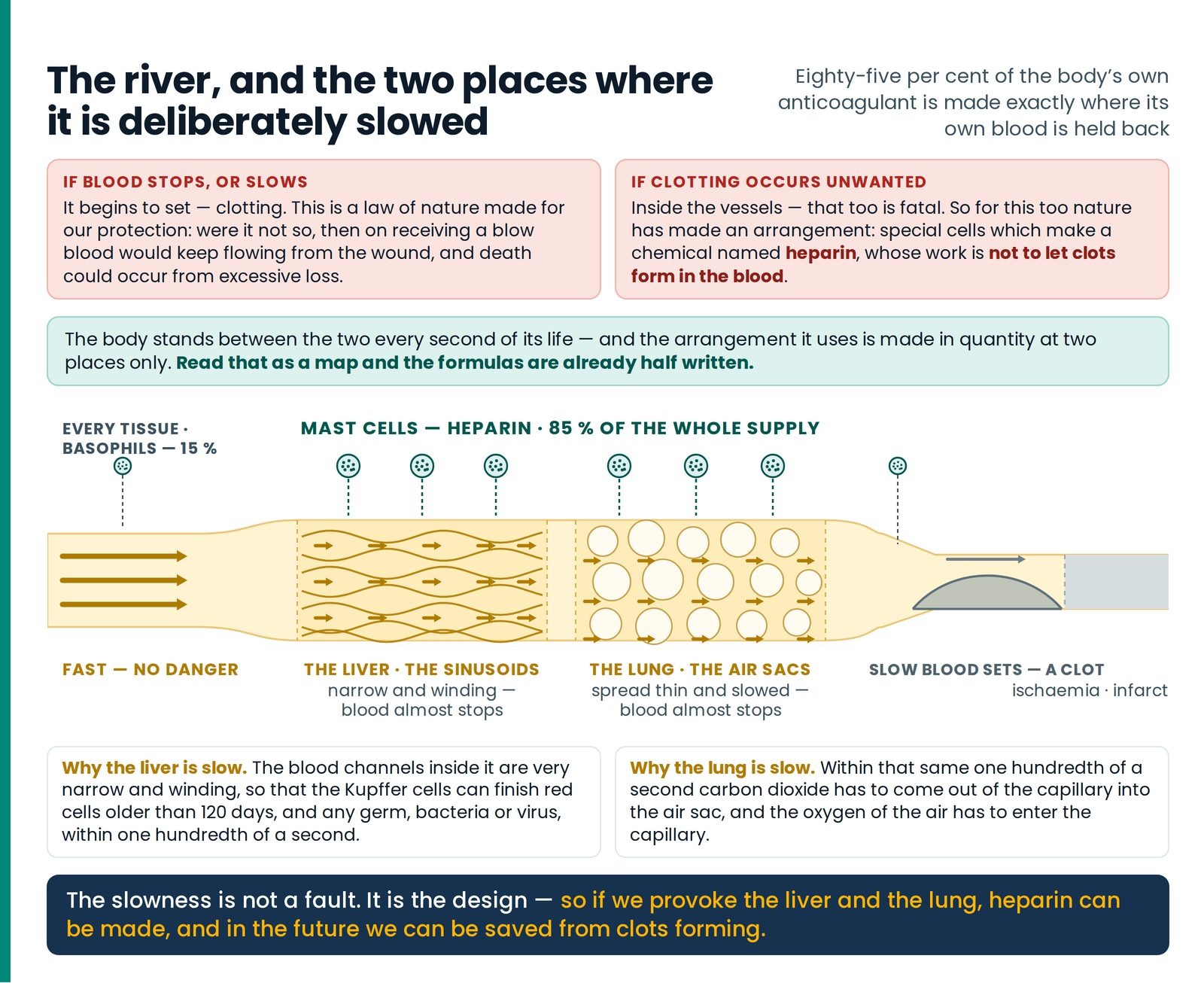
Because those are the two places the body slows its own blood
This is the question on which the whole family turns, and the answer, once you have it, makes the formulas obvious.
Because these are the two places where blood is deliberately slowed
This is because these two places, or organs, are such that the flow of blood there — even if only for a very short time — is of extremely slow speed.
The liver. In the liver there are cells named Kupffer cells, whose work is that if there are red cells older than 120 days, or in the blood any germ, bacteria or virus, then to finish or destroy them within one hundredth of a second. (The remaining material obtained from the destroyed cells is stored in the liver and used again according to need.)
To do this work properly, the blood channels inside the liver — the sinusoids — are very narrow and winding, and the blood has to pass through inside them. During this the motion or speed of blood becomes so slow that there is a danger of the blood setting there. And so that clotting should not happen there, in that part of the liver the mast cells make heparin.
The lungs. The second place is the alveoli — the air sacs. In these also, within one hundredth of a second, carbon dioxide has to come out from inside the capillary and enter into the alveoli, and during that same time the oxygen of the air inside the lungs has to enter into the capillary. At this place too the speed of blood is so slow that there also there is a danger of clotting. To be saved from that, the mast cells around the alveoli make heparin.
The meaning of this is that if we provoke the liver and the lung, then heparin can be made, and in the future we can be saved from clots forming.
Read that twice. It is one of the most satisfying pieces of reasoning in the whole formulary, and it runs in a straight line from an observation to a treatment. (Figure 33.1)
Here is the picture to keep. A river runs fast and clean between its banks — and then it reaches a stretch where the channel splits into a hundred narrow, twisting side-creeks so that every drop can be inspected and every bit of rubbish pulled out. That inspection is the liver's work, and it is only possible because the water has been slowed almost to a stop. The slowness is not a fault in the design. The slowness is the design. But water that slow will silt up — so at exactly that stretch, and nowhere else along the river, something must be added to the water to stop it silting. That is the mast cell, and that is heparin.
The lungs are the same bargain struck for a different reason. A red cell has to give up its carbon dioxide and take on oxygen in a hundredth of a second, and a cell travelling fast cannot do it. So the blood is spread thin and slowed to a crawl across the air sacs — and there too, something has to be added to stop it setting.
Two places where the body deliberately slows its own blood. Two places where it therefore has to make its own anticoagulant. Two places a pair of hands can reach. The parent formula in this article is those two organs, and one more.
How a clot that has already formed is dissolved
Plasminogen waits inside the clot; tPA takes about 24 hours
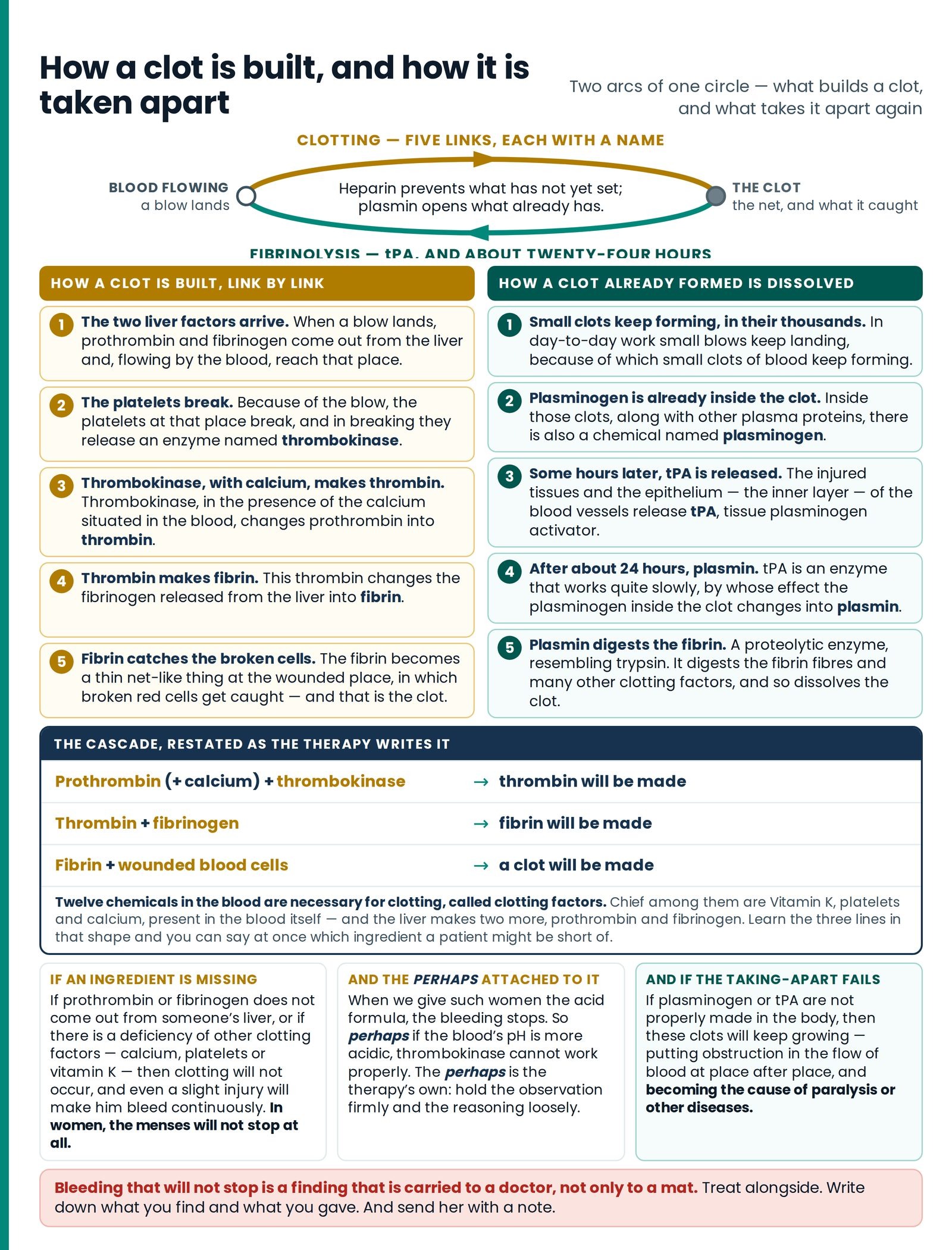
Everything above is about prevention — being saved from clots forming in future. The other half of the article's work is opening what has already closed, and that runs through a different set of chemicals. (Figure 33.2)
In our body, in day-to-day work, small blows and so on keep landing, because of which small clots of blood keep forming in their thousands.
Inside those clots, along with other plasma proteins, there is also a chemical named plasminogen.
Some hours after a blow lands, the injured tissues and the epithelium — that is, the inner layer — of the blood vessels release a chemical named tPA (tissue plasminogen activator).
This tPA is an enzyme that works quite slowly, by whose effect the plasminogen inside the clot changes, after about 24 hours, into a chemical named plasmin.
This plasmin is a proteolytic enzyme — that is, an enzyme that digests protein — and it resembles trypsin. It is able to digest not only the fibrin fibres of the clot but also many other clotting factors. In this way it is able to dissolve the clot.
The fibrinolytic system
When clots form inside the small blood vessels in the body, it is by this same process that those clots are opened.
Fibrinolysis, and what happens when it fails
The work of finishing or digesting fibrin is called fibrinolysis.
But if plasminogen or tPA are not properly made in the body, then these clots will keep growing — which will put obstruction in the flow of blood at place after place, and become the cause of paralysis or other diseases.
That sentence is the bridge from a article about blood to a article about people who cannot lift an arm. A clot that does not get dissolved does not stay the size it was. It grows, in one place and then in another, and the thing a patient finally arrives with — a weak side, a hand that has gone numb, a heart that gets breathless on the stairs — is downstream of a process that began years earlier with a housekeeping failure.
In what manner is this fact used in Neurotherapy?
Pancreas, liver, lung — and the hold that now opens every formula
Everything above is physiology. Here is the sentence that turns it into a treatment.
The reasoning that built the parent formula
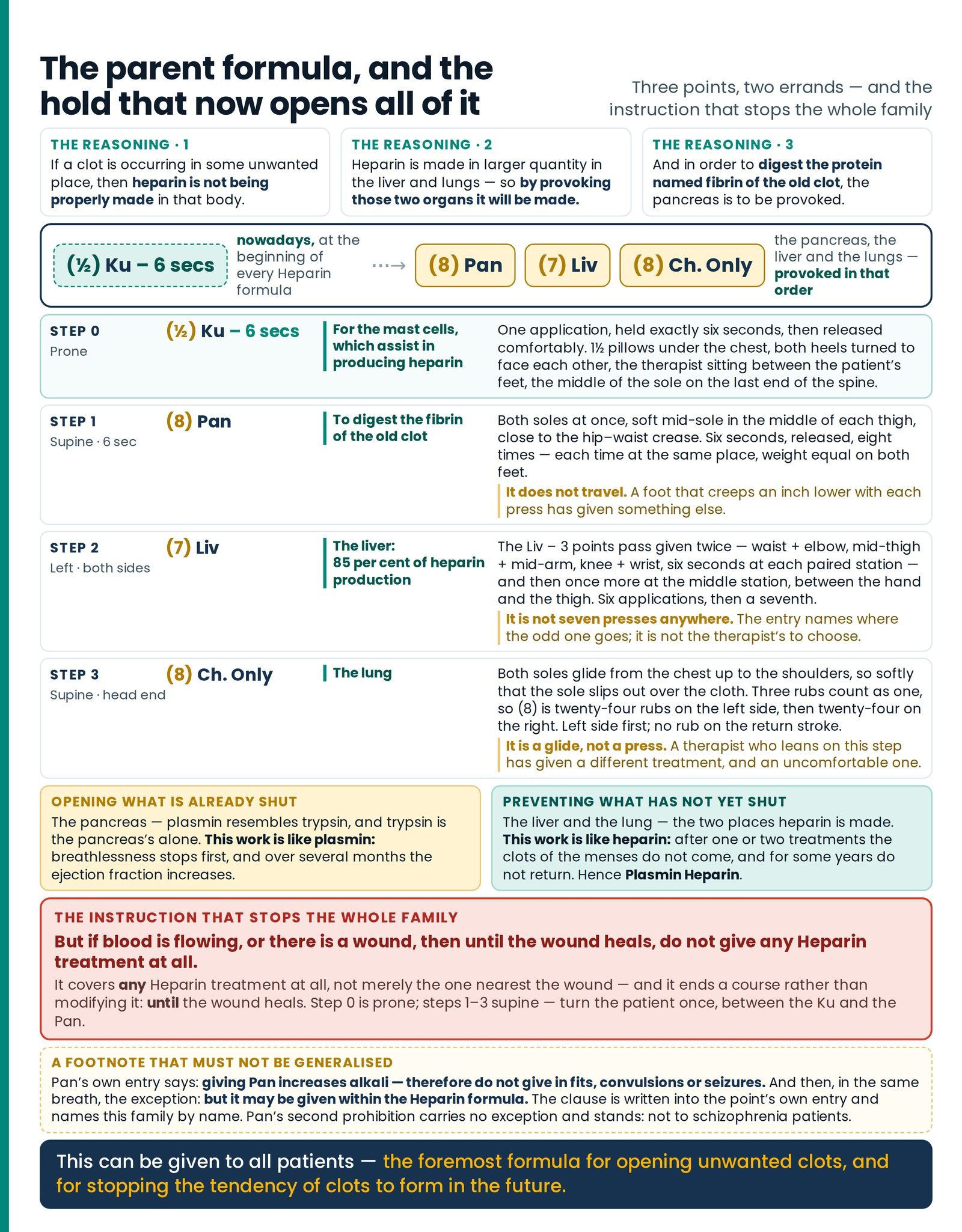
From the above fact we come to understand that if a clot is occurring in some unwanted place in a person, then heparin is not being properly made in that person's body.
Since heparin is being made in larger quantity in the liver and lungs, then by provoking those two organs heparin will be made.
Along with it, in order to digest the protein named fibrin of the old clot, the pancreas is to be provoked.
With this thinking Guruji made the following treatment, in which the pancreas, liver and lungs are provoked in that order →
Three points. Pancreas, liver, lungs. And each of them is doing a named job: the pancreas is there to digest the fibrin of an old clot, the liver and the lungs to make heparin so that no new clot forms. One formula, two errands — opening what is shut, and preventing what has not yet shut. Hold on to that, because when you meet F. Heparin and Anti-F. Heparin at the end of the article, the whole difference between them will lie in how hard the first of those three points is pressed. (Figure 33.3)
What is the secret of provoking the pancreas?
The liver and the lungs explain themselves. The pancreas does not, and the therapy sets out its reasoning openly rather than leaving the step to be taken on trust.
The two boys on the road
If, while passing along the road, we were to see two boys who looked similar to one another, could we not say that perhaps they ought to be the children of the same mother and father?
It has been written that plasmin is a fibrinolytic enzyme which resembles trypsin. Trypsin is made by the pancreas in order to digest proteins — and in the body the chief responsibility for digesting proteins is the pancreas's alone.
So is it not possible that plasmin too is being made by the pancreas?
Guruji has perhaps provoked Pan with exactly this thought. (fibrinolytic = one that breaks fibrin.)
This is the clearest window anywhere in the formulary into how a treatment in this therapy actually got made. A sentence was read in a textbook — plasmin resembles trypsin. A question was asked about the resemblance. The organ that makes the one was provoked, to see whether it would make the other. And then the patients were watched.
Notice also the two perhaps in that passage, and that neither has been taken out. Perhaps they ought to be the children of the same parents. Perhaps this is the thought with which the point was provoked. The therapy is telling you which parts of its own reasoning are inference. Keep them marked that way.
Two kinds of result seen from the formula
What was seen, and what was concluded from it
First — the clots that stop coming.
If some woman is getting clots in her menses, then after giving the above treatment once or twice, in the next menses clots do not come — and this has been proved on many women. That is, this formula works like heparin, which stops clots that are going to come. And this formula is so effective that once the clots in the menses have ended, for some years this trouble does not occur.
Second — the blockages that open. From this treatment considerable comfort reaches patients of heart disease and paralysis. Those who have blockage in the heart — if they are given P. Heparin, then first of all their breathlessness stops. And if it is given for several months, it has been seen that their ejection fraction increases — from which we draw the conclusion that the blockages are ending. This work is like plasmin.
From both of these results Guruji came to the conclusion that this formula provokes both plasmin and heparin. That is exactly why this formula has been given the name P. Heparin — that is, Plasmin Heparin.
Read the two results side by side and you can see why the name has two halves. The menstrual result is a heparin result: nothing was dissolved, something was stopped from forming. The cardiac result is a plasmin result: something that had already closed was opened. One formula was seen doing both, so the name carries both.
And note what kind of evidence each rests on. The first rests on a thing the patient reports and can count — clots, next month, present or absent. The second rests on a number somebody else measures with a machine and that nobody in the room can influence. The therapy has chosen, for once, an outcome outside its own hands, and it is worth knowing that it has.
Everything else in this article is this formula with something put in front of it, or with one of its numbers changed. Learn it properly and you have learned nine-tenths of the family. (Figure 33.6)
First, the question a careful student asks straight away — and the therapy prints it, together with an answer that does not pretend to be more than it is.
The question, and the estimate offered in reply
Question.
According to physiology, plasminogen is already present inside the clot beforehand. If it is prepared after our provoking, then after the clot has formed, how does it reach inside and open it?
Answer. The plasminogen that is inside the clot cannot change into plasmin until tPA has its effect upon it. So we make the estimate that by provoking the pancreas through LMNT, perhaps tPA is also being made, which is changing plasminogen into plasmin.
Whatever the cause may be, there is no doubt that the P. Heparin formula stops the tendency of clots to form in the future, and is also able to open old clots in paralysis and in heart diseases. (Those who have had paralysis recently — that is, only a few days ago — get relief quickly from this treatment, whereas an old disease can take a good deal of time to become well.)
The bracketed sentence at the end is a prognosis, and it is the sentence to say out loud to a family on the first day. Recent paralysis, quick relief. Old disease, a good deal of time. Not no benefit — a good deal of time. Say it before the treatment starts, and a family measuring week three against a cure will measure it against the right thing instead.
The family, and the hold that now opens all of it
The foremost formula for opening unwanted clots is P. Heparin.
Then, by joining some other points to it, various Heparin formulas have been made, which are used for correcting different symptoms.
And one change applies to the whole family at once: nowadays more benefit has been found by giving (½) Ku – 6 secs at the beginning of every Heparin formula.
The word nowadays is the therapy's own, and it means what it always means in this wiki: the older form is not an error and is not deleted. A card written before this was found, showing three steps and no Ku, is an earlier generation of the same formula. Table 13, How a Formula Is Built.
Why that hold, and not another. (½) Ku is not a count; the number after the dash is seconds, and each written timing of it is a separate treatment aimed at a separate cell. Six seconds is the one written for the mast cells, which assist in producing heparin — and the mast cells are where eighty-five per cent of the supply comes from. The hold is the family's opening move because it is aimed at the factory, before the three points that are aimed at the organs.
Table 2 — Card: P. Heparin, the parent formula Prone Supine 6 sec Both sides ▲ Take care
| Written | P. Heparin → (8) Pan (7) Liv (8) Ch. Only — with (½) Ku – 6 secs at the beginning, nowadays |
|---|---|
| What it means | P is for plasmin. Plasmin Heparin — because the formula was seen doing both jobs: stopping clots that were going to come, and opening ones that had already come |
| What it is for | This can be given to all patients. The foremost formula for opening unwanted clots; and for stopping the tendency of clots to form in the future |
| Step 0 — (½) Ku – 6 secs | One application, held exactly six seconds, then released comfortably. Prone, 1½ pillows under the chest, both heels turned to face each other, the therapist sitting between the patient's feet, the middle part of the sole on the last end of the spinal column. For the mast cells, which assist in producing heparin Prone |
| Step 1 — (8) Pan | Supine. Both soles at once, soft mid-sole in the middle of each thigh, close to the hip–waist crease. Six seconds, released, eight times — each time at the same place, weight equal on both feet. To digest the fibrin of the old clot Supine Both sides 6 sec |
| Step 2 — (7) Liv | The Liv – 3 points pass given twice — waist + elbow, mid-thigh + mid-arm, knee + wrist, six seconds at each paired station — and then once more at the middle station, the place between the hand and the thigh. Six applications, then a seventh. The liver: 85 per cent of heparin production Left Both sides |
| Step 3 — (8) Ch. Only | Supine, worked from the head end. Both soles glide from the chest up to the shoulders, so softly that the sole slips out over the cloth. Three rubs count as one, so (8) is twenty-four rubs on the left side, then twenty-four on the right. Left side first. No rub on the return stroke — count the outward journeys only. The lung |
| The position change | Step 0 is prone; steps 1 to 3 are supine. Turn the patient once, between the Ku and the Pan, and place her properly — Placing the Patient, "Placing the Patient" |
| When it must not be given | If blood is flowing, or there is a wound, then until the wound heals, do not give any Heparin treatment at all ▲ Take care |
| Points taught in | Ku — Face Down; Pan and Liv — The Front of the Body I; Ch. Only — The Front of the Body II |
Three details on that card that decide whether it is given or only approximated
(8) Pan does not travel. Every other thigh point in the wiki runs down the limb; Pan does not move at all. Eight presses at one and the same spot, on both thighs together, weight equal. A foot that creeps an inch lower with each press has given something else. The Front of the Body I.
(7) Liv is not seven presses anywhere. It is the three-station pass twice over — six applications — and then one more at station two. The entry names where the odd one goes, and it is not the therapist's to choose. The Front of the Body I.
(8) Ch. Only is a glide, not a press, and it is the only step of its kind in the formula. The foot is laid obliquely, the big toe turned a little inward relative to the heel, the heel and the outer edge of the sole kept down, and the rub travels from the chest up to the shoulders so lightly that the sole slides out over the cloth. The Front of the Body II. A therapist who leans on this step has not given a stronger lung treatment; he has given a different one, and an uncomfortable one.
Pan raises alkali — and the exception that is written for this article alone
Pan's own entry carries a prohibition that applies to the point in general, not to one count of it: giving Pan increases alkali — therefore do not give in fits, convulsions or seizures.
And then, in the same breath, the exception: but it may be given within the Heparin formula.
That clause is not an oversight and it is not a loophole. It is written into the point's own entry, it names this family by name, and it is one of only a handful of places in the whole wiki where a general prohibition is opened for one specific use. Read it whole or you will withhold the formula from the very patients — the paralysed, the fitting child — for whom it was built.
Pan's second prohibition carries no such exception and stands: giving Pan to schizophrenia patients causes them to hear voices in the ears. So do not give it to them. ▲ Take care
The measured ground of the name
Two findings, counted patient after patient, and no laboratory report
A student is entitled to ask where a name like Plasmin Heparin came from, and the therapy answers plainly: from what was counted, on patient after patient, over years. The formula was built in 1994, on the basis of facts from physiology, with two aims held together from the start — that unwanted clots should not form in the body, and that old clots should also be dissolved.
Two findings were recorded from it, and those two findings are the whole of the evidence offered for the name.
The first is in women who pass clots during their menses. When the formula is given to such a woman, then after one or two treatments no clots at all appear in the next period. From the day this was found until now it has been seen on many women.
The second is in paralysis that has come from an infarct. Given to such patients, immediately after the treatment they say that a single treatment has given them more than twenty-five to thirty per cent benefit. Notice who is doing the measuring in that sentence. Not an instrument, and not the therapist — the patient, saying it in the same hour. A student who wants a firmer figure than that will not find one here, and should not pretend to one when quoting it.
From those two findings the reasoning runs as it is written. The work of the chemical called heparin is to stop the blood from clotting, and the work of plasmin is to open up an old clot. One treatment was seen doing both jobs. So it is understood that both heparin and plasmin are produced or provoked by it — and the treatment was given the name Plasmin Heparin, or P. Heparin.
Note carefully what that naming does and does not claim. It does not say heparin was measured in anybody's blood. It says the formula was seen to do the two things heparin and plasmin do, and was named for them. The therapy is open about why the measurement is missing: such laboratory tests are very expensive, and there is a second difficulty as well — in some places the hospitals will not even give the reports of tests that were done, saying these are our own documents, we cannot give them to you. What stands in the place of a laboratory report is experience, set down in figures and in cases, of which the following is one.
The main diseases in which P. Heparin gives benefit
Fourteen entries, and the asterisk that sends AVN to A. Heparin
In high BP, P. Heparin reduces the diastolic BP. Apart from this, in the following also.
Table 3 — The stated indications of P. Heparin
| Children of dull intellect — MR child | Hypothyroidism |
|---|---|
| Paralysis — that is lakwa, adhrang | Atherosclerosis, or angina |
| Diseases of the kidney and the heart | Thrombosis — that is, the process of clot formation |
| Clots and pain in the monthly period | Thrombocytosis — platelets in excess |
| If there are clots anywhere in the body | To increase blood circulation — that is, blood supply |
| Diabetes — that is, the sugar disease | AVN (avascular necrosis) — occurs especially in the femur bone of the thigh * |
| Carpal tunnel syndrome — intense pain or numbness in the fingers of the hands | |
| Tarsal tunnel syndrome — intense pain or numbness in the toes of the feet |
* Often AVN patients have pain at Mu°. If this is so, A. Heparin is to be given.
That asterisk is the first appearance of the rule the whole selection table is built on, so take it now rather than later. A named condition does not by itself choose the formula. The pain point does. AVN sends you to P. Heparin — unless the patient is tender at Mu°, in which case it sends you to A. Heparin instead.
P. Heparin for a raised diastolic pressure
The renin argument: a starved kidney squeezes the whole body
The renin argument, whole
If the diastolic BP should rise, then we correct it at once by giving P. Heparin.
Explanation. The chief work of the kidneys is to filter the blood. If the flow of blood inside the kidneys is not sufficient, then they will not be able to filter the blood properly. In such a condition the kidneys release a chemical named renin, which through the renin–angiotensin system causes the blood vessels to constrict — that is, to narrow. From this the flow of blood will certainly increase, but along with it the diastolic BP will rise.
When renin begins to be made in greater quantity, then from this high BP results. Especially the diastolic BP rises.
(Guruji thought a great deal about this fact of physiology and made the estimate that if someone has atherosclerosis, then because of it a clot can also form in the renal artery of the kidneys. This too can be one reason for the blood flow inside the kidneys becoming less. If this is to be corrected, then in order to open the clot we must give P. Heparin. We have seen that after only a few treatments of P. Heparin the diastolic BP falls at once. So we understand that by P. Heparin the blood clot has ended, and because the blood flow inside the kidneys has become correct, the coming out of renin from the kidneys has stopped, from which the BP became normal. Such an effect has been seen in many patients.)
The chain is worth saying aloud once, because a patient will ask and the answer is short. The kidney cannot be starved of blood quietly. If its supply falls, it does not simply work less; it sends out a chemical that squeezes the vessels of the whole body to force more blood through itself. The rest of you pays for the kidney's shortage in raised pressure — and specifically in the lower of the two numbers, the one that describes the pressure between beats.
So on this reading a raised diastolic figure is not a disease of the arteries at large. It is the kidney shouting. And if the kidney is shouting because something has narrowed the vessel feeding it, the treatment is aimed at that narrowing and not at the shouting.
A. Heparin
A. Heparin * → (8) Pan (7) Liv (8) Ch. Only (1) acid (4) Ch. Only
'A' means acid.
The parent formula, unchanged, and then two steps added at the end: the Acid point once, and the chest glide again at half the count to close.
This treatment is extremely excellent for pain in the knee. The therapy's own reading of why: perhaps the blood going into the knee has been stopped by a clot of blood, or inflammation has come. The perhaps is its own, and it stays.
And attached to that sentence is the cleanest definition in the wiki of a word therapists use loosely every day.
Inflammation and swelling are not two words for one thing
Only when there is pain along with the swelling, and it feels hot to the touch, and there is redness, is it called inflammation. Otherwise swelling is called swelling.
Four findings, and they must be present together: swelling, pain, heat to the hand, redness. Anything less is a swelling, and a swelling has an entirely different set of causes behind it.
This one sentence does more work at the mat than any test. Put the back of your hand on the joint and then on the same joint of the other leg. Look at the colour in daylight rather than under a tube light. Ask whether it hurts at rest or only on use. Three seconds of examination, and you have told two conditions apart.
The two variants, each with its own condition
The knee variant
If along with the knee pain there is pain and inflammation at Mu°, then —
A. Heparin (6) Adr + capfree
By giving this, the knee becomes considerably well after a single treatment.
The feet of diabetic patients swell up or go numb. Sometimes a wound occurs in some one toe. Afterwards, for want of blood, that place turns blue or black. Infection keeps spreading, which is called gangrene. Then the doctor says to cut off that toe, so that the poison should not spread into the whole body.
The diabetic foot variant
For diabetic patients who have gangrene in the toes of the feet, or to be saved from gangrene occurring —
A. Heparin (6) Adr + Bottom of feet
By giving this, within only two months the feet will become completely well, and even if gangrene has come it will be finished, and the occasion of cutting off the foot will be averted.
If blood is flowing from the wound and it is not becoming well, then at the end of the above treatment (4) Thrd. will also have to be put in, so that the wound fills up quickly.
These people also find Loveleen + Sulta Ulta agreeable.
Table 4 — Card: A. Heparin and its variants Side-lying Supine Prone 6 sec ▲ Take care
| Written | A. Heparin * → (8) Pan (7) Liv (8) Ch. Only (1) acid (4) Ch. Only |
|---|---|
| What it means | A is for acid |
| Steps 1–3 | (8) Pan, (7) Liv, (8) Ch. Only — the parent sequence, unchanged Supine |
| Step 4 — (1) acid | One Acid. Side-lying on the right, left shoulder somewhat outward, right leg straight and long, left leg bent over two or three pillows with the knee at waist level; the middle of the therapist's right sole travels from waist to knee on the lower thigh — pressure for only 2–3 seconds, because the pain can be very great Side-lying ▲ Take care |
| Step 5 — (4) Ch. Only | The chest glide again at half the count — twelve rubs left, then twelve right, chest up to the shoulders, no rub on the return |
| The asterisk | (6) Adr at the end has given still better results in most people — but not to those diabetic patients who did not feel well after it Prone ▲ Take care |
| Variant — the knee | Knee pain with pain and inflammation at Mu° → A. Heparin (6) Adr + capfree. The knee becomes considerably well after a single treatment |
| Variant — the foot | Diabetic gangrene of the toes, or to prevent it → A. Heparin (6) Adr + Bottom of feet. Within two months the feet become completely well; even established gangrene is finished and the occasion of cutting off the foot is averted |
| Variant — the wound that will not fill | If blood is flowing from the wound and it is not becoming well, add (4) Thrd at the very end, so the wound fills up quickly ▲ Take care |
| Also agreeable | Loveleen + Sulta Ulta — these people find it agreeable |
| When to give | In all the above diseases where there is pain at Mu°, and some further symptoms of acidosis as well — constipation, drying of the skin, burning in the skin, dry and rough hair, and so on |
| Chief uses | Gangrene · bamboo spine · burning in the feet or in the soles · diabetes · pain in the knee |
| Points taught in | Acid — On the Side; Knee Cap Free — Knee, Leg, Foot; BOF — Knee, Leg, Foot; Thrd — The Front of the Body II; Loveleen and Sulta Ulta — The Front of the Body II; Adr — Face Down |
Three things travel with that card and must travel with it.
(4) Thrd carries its own substitution. (4) Thrd raises the metabolism, and in a heart patient that increase throws a burden onto the heart and the trouble can increase — so in angina, that is in heart patients, (2) Thrd is given in place of (4) Thrd, to reduce cholesterol. Both halves of a substitution travel together: which count is withheld, which replaces it, in whom, and why. And tell the patient beforehand that some people occasionally get a cough during thyroid work, so that they are not alarmed.
Loveleen is not given to everybody. Loveleen is not given to kidney patients or to heart patients — and both of those appear in this very article's indication lists. A card carrying Loveleen in a patient with kidney disease is a card that needs a line drawn through one step.
And the boxed rule still governs. A. Heparin's foot variant is written for a patient who may well have an open, weeping toe, and the family's own boxed instruction reads: if blood is flowing, or there is a wound, then until the wound heals, do not give any Heparin treatment at all. Both of those sentences are printed in this teaching, they are a little further on, and this wiki does not reconcile them for you. What it does insist on is that you know both are there before your hands go anywhere near that foot.
G. Heparin
G. Heparin → (30) Medulla (8) Pan (7) Liv (8) Ch. Only
'G' means 'glandins — prostaglandins.
When to give. By (30) Medulla we provoke prostaglandins, by which we correct the ill-effects of medicines, or the problem that has come through inflammation in any part of the body.
Table 5 — Card: G. Heparin Seated Supine 6 sec ▲ Take care
| Written | G. Heparin → (30) Medulla (8) Pan (7) Liv (8) Ch. Only |
|---|---|
| Step 1 — (30) Medulla | Thirty applications, both sides of the neck below the ears, seated, ghisāī with the soft pads of the thumbs, one side at a time. The highest Medulla count in this article Seated |
| Steps 2–4 | The parent sequence, unchanged |
| Chief uses | To reduce systolic high BP · if paralysis has come because of high BP |
| Menses | If there is pain in the menses, and clots, then by giving G. Heparin, from the very next monthly cycle both pain and clots stop |
| The knee | Knee pain in which the knee feels hot to the hand, and that place is red and there is swelling there also, but there is no pain at Mu°. The X-ray report may read "Osteo arthritis of the knee" or "OA of the knee". In such a patient, within one or two treatments both the heat and the swelling in the knee are reduced |
| Auto immunity | To finish diseases that have come through auto immunity, such as the disease named multiple sclerosis, in which the muscles become extremely weak |
| Paralysis | By mixing prostaglandins into heparin, considerable benefit has been seen in those who have had paralysis because of high BP |
| When it must not be given | This treatment is not to be given to those patients who have heart disease ▲ Take care |
| Points taught in | Medulla — Seated I — Brain, Medulla, Neck; the graded series and what each count is for — The Medulla Family |
Now put A. Heparin and G. Heparin side by side, because a knee will make you choose between them within your first month.
Table 6 — The knee: which of the two, and the question that decides it
| A. Heparin | G. Heparin | |
|---|---|---|
| The knee itself | Painful. Swelling may or may not be present | Hot to the hand, red, and swollen — the full four-part picture |
| Mu° | Painful — and inflammation at Mu° in the variant | No pain at Mu° |
| What else is in the picture | Constipation, dry skin, burning skin, dry and rough hair — the acidosis signs | The X-ray may read "OA of the knee" |
| What is given | A. Heparin, or A. Heparin (6) Adr + capfree | G. Heparin |
| What is reported | Considerably well after a single treatment | Both the heat and the swelling reduced within one or two treatments |
| The bar to check first | (6) Adr — not in low immunity, not in high BP; and not in the diabetic who did not feel well after it | (30) Medulla — not in heart disease |
The discriminator is Mu°, and it is a finding you make with your fingers before you write anything. Two patients can arrive with the same sentence — my knee is killing me — and go home with different cards, because one of them was tender in the soft gap between last rib and hip bone on the left and the other was not. That is the whole method of this therapy in one comparison. (Figure 33.5)
And note the blood-pressure split while it is in front of you: P. Heparin reduces the diastolic. G. Heparin reduces the systolic. Two formulas, two numbers, and the reason is in the prefix.
J. Heparin
J. Heparin → (4) Para (8) Pan (7) Liv (8) Ch. Only (6) Adr
'J' means 'joints'.
When to give. We give (4) Para in order to increase the quantity of calcium in the blood. Those to whom cramps come while lying asleep, or who have weakness or pain in the body, will get benefit from this treatment.
Cramps means a stretching in the muscles, which often occurs in the calves from a deficiency of calcium.
Table 7 — Card: J. Heparin Supine Prone 6 sec Right ▲ Take care
| Written | J. Heparin → (4) Para (8) Pan (7) Liv (8) Ch. Only (6) Adr |
|---|---|
| Step 1 — (4) Para | The parathyroid point. On the right arm only — near the elbow bone, then near the shoulder, six seconds at each, and then the same again at the same places: four equals one. Given to raise the calcium in the blood Right 6 sec |
| Steps 2–4 | The parent sequence, unchanged |
| Step 5 — (6) Adr | The adrenal treatment, prone, 1½ pillows under the chest, gathered palms very close to the T6 bead, three places, two equal one, never more than six rubs at one place at one time. Built into this formula, not optional Prone |
| Chief use | Those who have pain all over the body and feel weakness — especially the diabetic patient |
| What it does | From J. Heparin the body's fatigue goes away |
| How long the effect lasts | At least two days |
| The warning | But if on the second day the Normal formula or NAN is given, then whatever benefit the patient had from this formula ends at once, and the patient says that he did not enjoy it ▲ Take care |
| What it inherits | (6) Adr's own bars — not where immunity is already low (septicaemia, AIDS, HIV, cancer); and not in high blood pressure, because it reduces acid and raises alkali ▲ Take care |
| Points taught in | Para — The Front of the Body II; Adr — Face Down; and Setting the Stomach for Normal and NAN |
M. Heparin
M. Heparin → (6) Medulla (8) Pan (7) Liv (8) Ch. Only
By giving (6) Medulla and then giving heparin, it has been seen that those children who have meningitis or hydrocephalus get considerable relief. So it is thought that this is able, by way of the hypothalamus, to open the 3rd ventricle of the brain.
The reasoning behind that is short and worth having whole, because it explains a formula that otherwise looks like a brain treatment bolted onto a blood treatment for no reason.
Why the water collects, and what it does
When, after some sharp fever, inflammation comes into the layers of the brain, that is called meningitis.
Normally in the brain the cerebrospinal fluid — CSF — comes out from the lateral ventricles and reaches into the third ventricle, and from there goes into the fourth ventricle.
But because of inflammation occurring in the brain, that fluid is not able to get out of the third ventricle and begins to collect in the brain. From the pressure of that collected water falling on the other parts of the brain, fits also come to that patient.
The collecting of water in the brain is called hydrocephalus.
By M. Heparin we can correct the obstruction that has come in the circulation of CSF in the brain. And by giving (6) Adr along with it there will be much benefit in the inflammation, and we can reduce the swelling of the brain.
Picture a house with four water tanks connected in a line and one outlet at the end. Block the passage out of the third tank and the water does not stop arriving — it keeps coming from the two above, and the pressure builds against the walls. Nothing is leaking and nothing is being over-produced. One doorway has closed, and everything downstream of that closure is starved while everything upstream is squeezed. That is what this formula is aimed at.
Why a chemical made by a pair of hands might reach the brain when an injection cannot
The blood–brain barrier, and the inference drawn from it
Paralysis patients get much benefit from M. Heparin, and in the last forty years thousands of patients have become well from this treatment — the real reason for which is perhaps as follows.
In the brain there is a structure named the blood brain barrier, because of which no artificial medicine or injection can reach inside the brain. If anything can go, then it is anaesthetic medicine, alcohol, and the body's own chemicals.
When we give the Heparin formula, we see that within only a few days the patient gets considerable progress. So it is thought that the chemical made from our treatment is the body's own chemical, which goes inside the brain and finishes the clotted blood and so on.
(In allopathy also, the attempt has been made to send medicine into the brain by injection through L2 and L3, but in that no special success was obtained, because on account of this blood brain barrier no artificial — that is, man-made — medicine can get into the brain.)
The perhaps at the head of that passage is the therapy's own and it is not removed. The claim being made without a perhaps is the clinical one — paralysis patients get much benefit, over forty years and thousands of patients. The explanation offered underneath it is offered as an explanation.
Table 8 — Card: M. Heparin Seated Supine Prone 6 sec ▲ Take care
| Written | M. Heparin → (6) Medulla (8) Pan (7) Liv (8) Ch. Only |
|---|---|
| What it means | M is for Medulla — and at six, the lowest of the three Medulla prefixes in this family |
| Step 1 — (6) Medulla | Six applications, both sides of the neck below the ears, seated, one side at a time. The hypothalamus treatment — the very first Medulla treatment that was obtained Seated |
| Steps 2–4 | The parent sequence, unchanged |
| The addition | (6) Adr may be given along with it: there will be much benefit in the inflammation, and we can reduce the swelling of the brain Prone |
| Chief uses | Headache · pains of the forehead, face, neck or shoulders · diseases of the brain · paralysis which has come because of an infarct · dullness of intellect · meningitis, that is swelling in the brain because of fever · to increase the power of memory · encephalitis · diseases of the eyes · Bell's palsy, in which the mouth becomes crooked to one side · any blockage — that is, obstruction — in the sixth cranial nerve of the brain (Cranial nerve VI) |
| Hydrocephalus | If there is any blockage in the third ventricle of the brain, because of which water fills up in the brain, that is called hydrocephalus. In that too M. Heparin is very beneficial |
| The shunted patient | Even if a shunt has been fitted it can be given — but at that time do not press with much force on the neck; give the treatment with less pressure ▲ Take care |
| What it inherits | (6) Medulla's own bar — not to boys and girls between 13 and 20 years of age who come for treatment to increase height, unless there is a special need. And, where (6) Adr is added, that point's two bars ▲ Take care |
| Points taught in | Medulla — Seated I — Brain, Medulla, Neck; (6) Medulla whole — The Medulla Family; Adr — Face Down; cranial nerve VI and the polarity rule — Cranial Nerve and Brain Formulas |
These two are a single idea at two strengths, and they are the only members of the family whose timing is written into the indication rather than the technique.
T. and TT. Heparin
T. Heparin → (4) Thymus+Chest (8) Pan (7) Liv (8) Ch. Only
TT. Heparin → (8) Thymus+Chest (8) Pan (7) Liv (8) Ch. Only
The reasoning. After a blow has landed, the blood sets, becomes a clot and stays below, and the serum remains collected above it. So when a blow lands, we must first finish that collected serum. For this we must first give the Injury treatment — and that is to be given until the serum dries up.
After ten to fifteen days of treatment, when the serum has dried completely, after that TT. Heparin should be given, in order to heal the wound inside the blood vessels of that place.
When to give. When a blow has landed, then after the wound has dried, to increase the blood circulation at that place, this is to be given.
Chief conditions. After an accident or an operation. If the blow is ordinary, give T. Heparin. If the blow is deeper, then in place of (4) Thymus+Chest, (8) Thymus+Chest should be given.
But whether it be TT. Heparin or T. Heparin, give it only after the wound has dried.
Read the two articles together and you have a complete course for a blow. Fire and Swelling, "Fire and Swelling" gives the Injury treatment formula, which runs ten to fifteen days, or until the serum dries up — the serum being the light-yellow watery liquid left over once the collected blood has clotted. This article gives what comes afterwards. The Injury formula clears the wreckage; TT. Heparin repairs the vessel wall underneath it and opens the circulation of the place again. Two formulas, two phases, in that order, and the changeover is decided by a finding under your hand and not by the calendar.
Table 9 — Card: T. and TT. Heparin Supine 6 sec Left Right ▲ Take care
| T. Heparin | TT. Heparin | |
|---|---|---|
| Written | (4) Thymus+Chest (8) Pan (7) Liv (8) Ch. Only | (8) Thymus+Chest (8) Pan (7) Liv (8) Ch. Only |
| What the prefix means | T is for thymus, single strength | TT, double strength |
| Step 1 | (4) Thymus+Chest — all three contacts of the group, three rubs equal one, so twelve rubs a side, one side complete before the other, left first, no pillow at all | (8) Thymus+Chest — twenty-four rubs a side, which is twice the twelve-rub ceiling and must therefore be divided: twelve left, twelve right, then without giving any rest, twelve left and twelve right again — Fire and Swelling |
| Steps 2–4 | The parent sequence | |
| Given for | The ordinary blow | The deeper blow; and the treatment given at ten to fifteen days once the serum has dried; an old blow; paralysis because of a haematoma after a blow |
| Chief conditions | After an accident or an operation | The same |
| When it must not be given | Only after the wound has dried ▲ Take care | |
| Points taught in | Th + Ch — The Front of the Body II; the twelve-rub arithmetic and the division — Fire and Swelling |
X. Heparin
X. Heparin → (10) Medulla (8) Pan (7) Liv (8) Ch. Only
By (10) Medulla we provoke the vagus nerve — that is, the tenth cranial nerve — which provokes all the glands of the abdomen. From the tenth cranial nerve the acid of the stomach can be increased threefold.
This treatment is given in order to remove the obstruction caused by blood clots in all the places of the digestive system.
When to give. When there is pain at the Pan or Gas point, then give it.
Chief conditions. To provoke all the glands of the abdomen, and to remove the blood clots in the digestive system.
The name is exact, and once you see it you will never forget which formula this is. X is the Roman numeral ten, and the vagus is the tenth cranial nerve. Everything else in the family is named for a substance or a body part; this one is named for a number.
Table 10 — Card: X. Heparin Seated Supine 6 sec ▲ Take care
| Written | X. Heparin → (10) Medulla (8) Pan (7) Liv (8) Ch. Only |
|---|---|
| Step 1 — (10) Medulla | Ten applications, both sides of the neck below the ears, seated, one side at a time. The vagus, the tenth cranial nerve Seated |
| Steps 2–4 | The parent sequence, unchanged |
| When to give | Pain at the Pan point, or at the Gas point |
| What it is for | Provoking all the glands of the abdomen; removing the obstruction caused by blood clots in all the places of the digestive system; repeated trouble in the stomach or digestive system |
| What it inherits — every word of it | (10) Medulla's own bars: not in diabetes. Not in cancer. Not where the stomach acid is raised. In heart patients, (10) Left Medulla only ▲ Take care Left |
| Points taught in | Medulla — Seated I — Brain, Medulla, Neck; (10) Medulla whole — The Medulla Family; Pan and Gas — The Front of the Body I |
Three Medulla prefixes, three different formulas — and the number is the selector, not the strength.
Table 11 — The three Medulla-headed Heparins side by side
| M. Heparin | X. Heparin | G. Heparin | |
|---|---|---|---|
| Prefix | (6) Medulla | (10) Medulla | (30) Medulla |
| What that count acts on | The hypothalamus | The vagus — the 10th cranial nerve | The prostaglandins |
| What it reaches | The brain, the ventricles, the CSF | All the glands of the abdomen | Inflammation anywhere; the ill effects of medicines |
| Selected by | Repeated headache; disease of the eye, the nose or the brain | Pain at Pan or at Gas | Hot, red, swollen knee with no Mu° pain; menstrual pain and clots; high systolic BP |
| Its own bar | Not to 13–20-year-olds being treated to increase height | Not in diabetes, not in cancer, not where stomach acid is raised; heart patients — (10) Left Medulla only | Not in heart disease |
Read the last row across. Three different lists, and not one of them is a general Medulla rule. A therapist who refuses every Medulla to every diabetic has invented a prohibition nobody wrote, and has withheld M. Heparin from a diabetic with a headache for no reason at all.
The three newest, given whole
Just now the newest formulas are —
PT. Heparin → (8) Pan (7) Liv (8) Thymus+Chest
F. Heparin, or Fibrinolysin heparin → (18) Pan (7) Liv (8) Ch. Only
Anti F. Heparin, or Anti fibrin heparin → (2) Pan (7) Liv (8) Ch. Only
The above three treatments work in different ways from one another.
All of these have been proved useful for all kinds of paralysis.
Some people get relief from pains by giving P.T. Heparin in place of P. Heparin.
In old diseases, F. Heparin is useful for breaking the fibrin set in clots, whereas if there is obstruction in blood circulation anywhere on account of unwanted growth, then Anti F. Heparin is beneficial.
It will be known further from experience. Research upon these is continuing.
That last line is the therapy's own and it is not closed by this article or by any later one. These three are the newest members of the family, they are printed, they are given, and the man who made them says the account of them is not finished. Both halves of that are true at once, and a student is entitled to know which parts of a system are settled and which are still being explored.
Table 12 — The three newest, and what makes each one different
| Formula | Sequence | The difference from the parent | Stated indication |
|---|---|---|---|
| PT. Heparin | (8) Pan (7) Liv (8) Thymus+Chest | The last step is replaced — Ch. Only out, Thymus+Chest in | All kinds of paralysis. Some people get relief from pains by giving it in place of P. Heparin. And: infarct or ischaemia in paralysis with pain as well |
| F. Heparin (Fibrinolysin heparin) | (18) Pan (7) Liv (8) Ch. Only | One number changed — Pan raised from 8 to 18 | Old diseases: breaking the fibrin set in clots. And: infarct with paralysis of many years |
| Anti F. Heparin (Anti fibrin heparin) | (2) Pan (7) Liv (8) Ch. Only | One number changed — Pan lowered from 8 to 2 | Obstruction in blood circulation on account of unwanted growth. And: fibroids, a cyst, or a kidney stone |
Now look hard at the last two rows, because they carry the most easily misgiven instruction in this article.
The Pan count is a selector, and here it is the whole formula
F. Heparin and Anti-F. Heparin are the same three points, in the same order, with the same counts at the second and third steps.
The only difference between them is the number in the first bracket: eighteen in one, two in the other.
And they are given for opposite errands. F. Heparin breaks the fibrin that has set in an old clot. Anti-F. Heparin is for obstruction caused by unwanted growth.
That is the bracket doing exactly what Table 13, How a Formula Is Built says it does at a chemical point: the number is a selector, not a strength. Go to the Pan entry in Each Point in Use and the two counts have quite different accounts written against them — (2) Pan is the count that works by somatostatin, given to end tumour, cyst or cancer and to stop unwanted abnormal growth anywhere in the body, and named for lipoma and for fibroids; (18) Pan is the highest count in the family. Read Anti F. Heparin's indication list — fibroids, a cyst, a kidney stone — beside (2) Pan's own entry, and the formula stops looking arbitrary. The prefix names what the formula is for; here the count does.
Everything so far has been one formula with one thing added. Multi Heparin is different in kind: it is six parts run as one treatment, four of them whole formulas in their own right, and it was built in an afternoon for a patient who was not getting better.
Table 13 — Multi Heparin: the six parts as they are written
| Part | Sequence |
|---|---|
| I | (15) Left Medulla (6) Lt. Swt × 3 treatments |
| II | (4) Para (7) Liv (8) Ch. Only (10) Adr |
| III | F. Heparin → (18) Pan (7) Liv (8) Ch. Only |
| IV | Anti F. Heparin → (2) Pan (7) Liv (8) Ch. Only |
| V | (½) Ku – 6 secs × 8 treatments |
| VI | P. Heparin → (8) Pan (7) Liv (8) Ch. Only |
Guruji's reasoning, part by part
I.
Whenever blood does not reach somewhere, one reason is that the channels there have become narrow. It is experience that (15) Left Medulla (6) Lt. Swt opens the channels, or the sphincters.
II. The treatment for breaking calcification anywhere is (4) Para (7) Liv (8) Ch. Only (10) Adr — here it has been given in order to open the calcium inside the clot.
III. For opening the fibrin of clots — F. Heparin.
IV. For breaking the unwanted growth of clots — Anti F. Heparin.
V. For the mast cells to make heparin — (½) Ku – 6 secs.
VI. In order to keep the blood circulation regular, at the end of all these — P. Heparin.
Six parts, and every one of them is aimed at a different thing inside the same clot. That is the design, and once you see it the formula is easy to hold. The channel is opened first, because nothing else will get there if it is shut. Then the calcium in the clot, then the fibrin in the clot, then the unwanted growth in the clot — three different materials, three different treatments, in that order. Then the factory is asked to make more heparin, and finally the circulation is left running regularly.
An everyday picture. A blocked drain outside a house is never one substance. There is the narrowed pipe, the hard scale on its walls, the fibrous mat of roots and rag, and the soft new growth that has taken hold since. Nobody clears that with one tool. You widen the way in, take off the hard scale, cut the fibrous mat, pull out the new growth, and then run water through to keep it running. Multi Heparin is that list, in that order, written for a vessel.
This is the newest treatment, which has proved a sure remedy — रामबाण, rāmbāṇ, Rama's arrow, the shaft that does not miss — for all kinds of paralysis, infarct, clot, or years-old pain and so on.
Everything in this article has now been taught. What remains is the question a therapist actually faces, which is not what is X. Heparin but which of these eleven am I looking at, and how do I know?
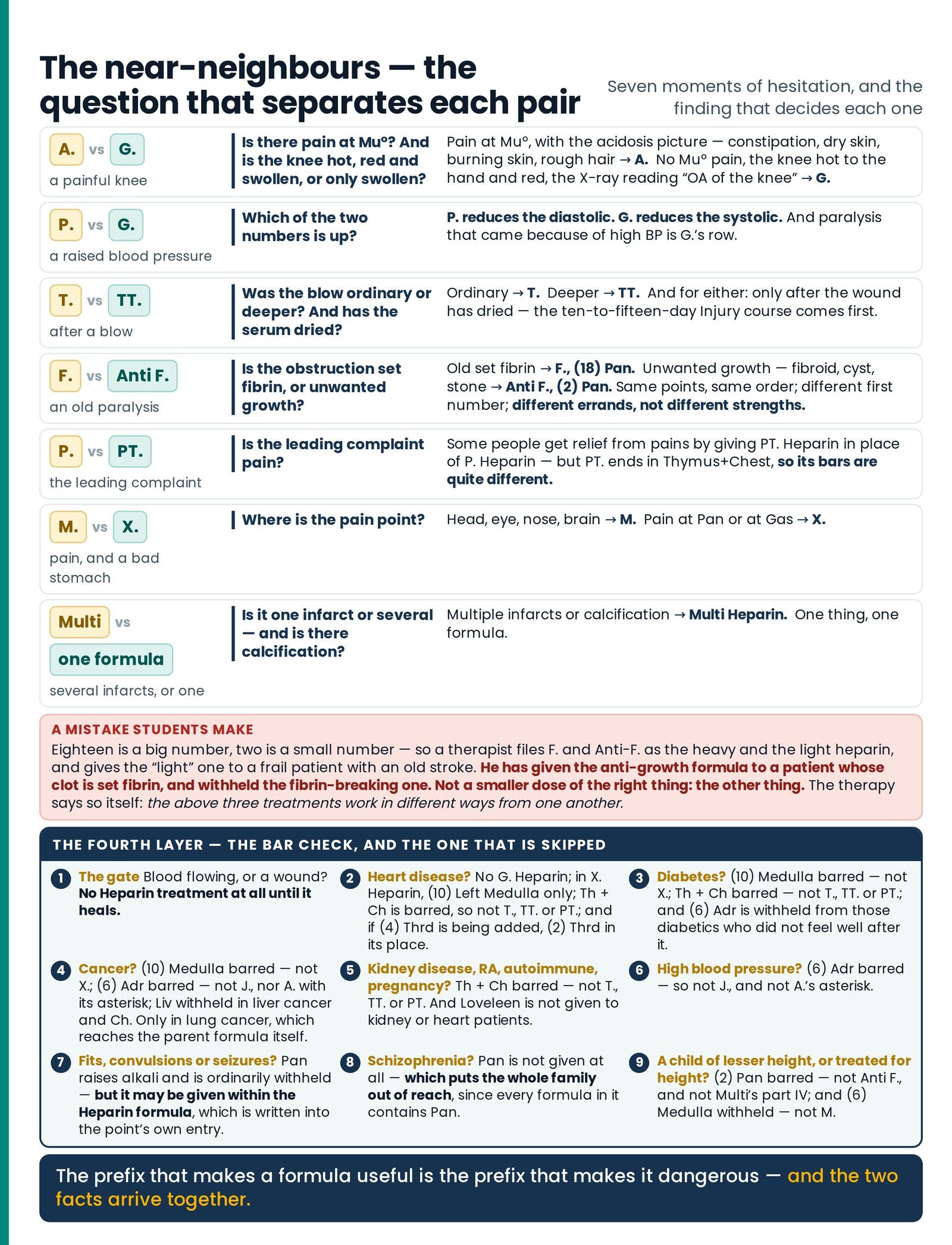
Take it in four layers. The first decides whether this is a Heparin patient at all; the second which one; the third separates the near-neighbours that get confused; the fourth checks the bars before your hands go down. (Figure 33.7)
Layer one — is this a Heparin patient?
Three doors in — and the returning-pain test that opens the third
How will we know when to give a Heparin formula, apart from paralysis and heart disease?
Apart from paralysis and heart disease, we give the Heparin formulas chiefly in pains.
Often on the first day, immediately after our treatment, the patient will say that there is considerable relief in the pain.
But if the next day he comes and says that after a few hours of relief the pain came back, then we should understand that there is some clot in the related part, because of which the pain has returned. For that, the appropriate Heparin formula is to be given.
That is the returning-pain test, and it is the article's own way in. Notice what makes it useful: it is not something you find on the first day. It is something the second day tells you, and only if you asked the right question on the second day — not "are you better?" but "how long did it last, and when did it come back?"
So the three doors into this family are:
1. Paralysis or heart disease. The family's home ground; no test needed. 2. A pain that came back after a few hours of relief. The returning-pain test. 3. A named finding from the lists — clots in the menses, thrombosis, a clot anywhere, AVN, raised diastolic pressure, carpal or tarsal tunnel, thrombocytosis, and the rest of Table 3.
And before any of them, the gate: is blood flowing, or is there a wound? Then no Heparin treatment at all, until the wound heals.
Layer two — the worked example, across three days
One head pain, re-examined each day, ending in two different cards
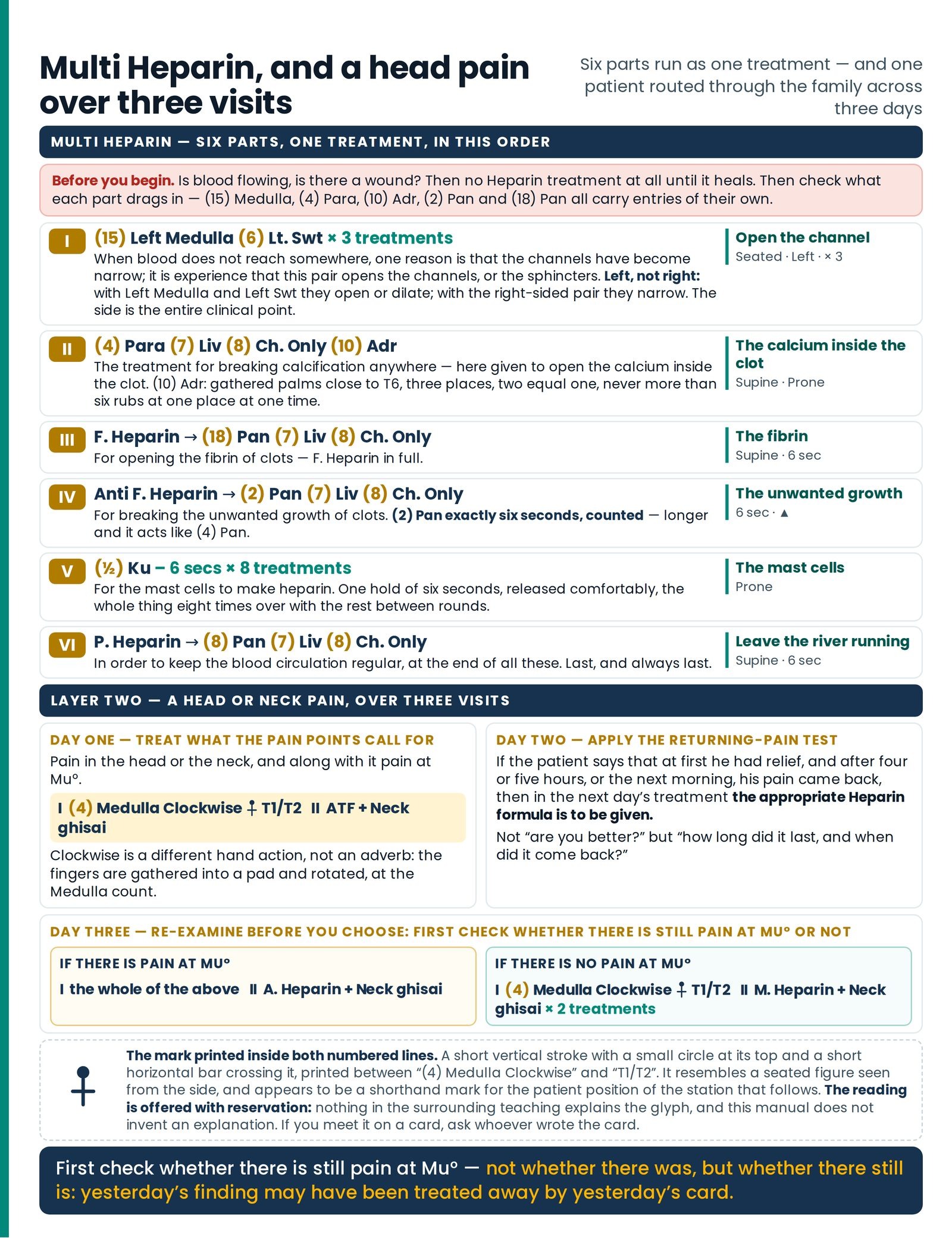
The therapy gives its own example, and it is worth walking through slowly because it shows the method rather than describing it.
That glyph is printed and its reading is offered with reservation; nothing in the surrounding teaching explains it, and this wiki does not invent an explanation for it. If you meet it on a card, ask the person who wrote the card.
Three things in that worked example are the whole method of the article. (Figure 33.4)
One — the first day's treatment was not wrong. It was chosen correctly from the pain points, and it produced relief. What the second day added was information the first day could not have given.
Two — the examination is repeated before the heparin is chosen. First check whether there is still pain at Mu° or not. Not whether there was — whether there still is. The finding that chose yesterday's card may have been treated away by yesterday's card.
Three — the neck work rides along unchanged in all three versions. Neck ghisai is attached to whichever formula is chosen; the heparin is what changes. Seated I — Brain, Medulla, Neck, "Seated — I", has the neck work and the region it must never enter: never the front of the throat.
Layer three — the selection table
Eleven rows, and a default for the patient nothing steers you to
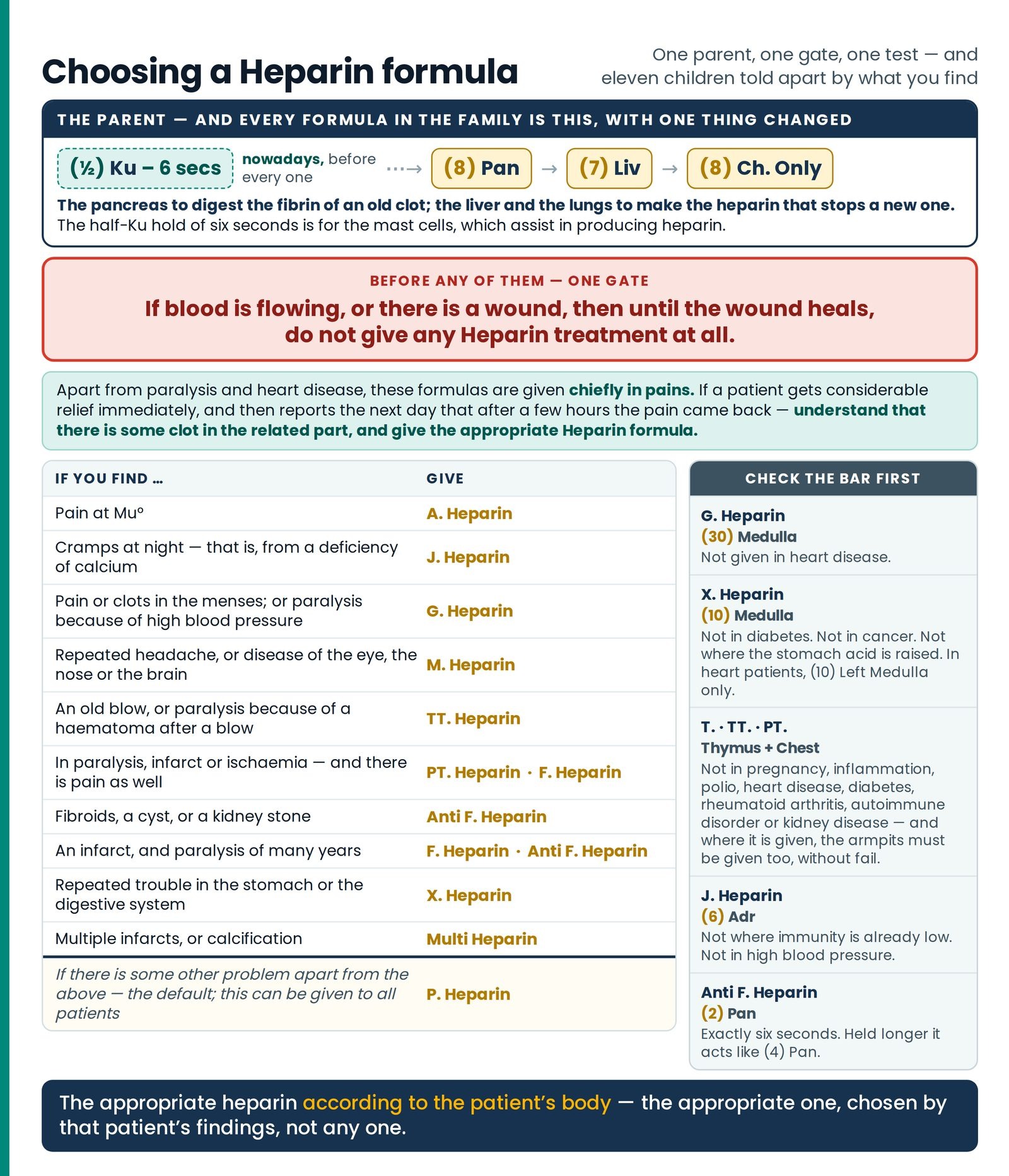
Table 14 — Choosing the appropriate Heparin formula
| If … | Give |
|---|---|
| If they have pain at Mu° | A. Heparin |
| If cramps come at night — that is, from a deficiency of calcium | J. Heparin |
| If there is pain or clots in the menses; or paralysis because of high BP | G. Heparin |
| Repeated headache, or disease of the eye, the nose or the brain | M. Heparin |
| If an old blow has been received, or paralysis because of a haematoma after a blow | TT. Heparin |
| If in paralysis there is infarct or ischaemia and there is pain as well | PT. Heparin, F. Heparin |
| If there are fibroids, a cyst, or a kidney stone | Anti F. Heparin |
| If there is an infarct and there has been paralysis for many years | F. Heparin, Anti F. Heparin |
| If there is repeated trouble in the stomach or digestive system | X. Heparin |
| If there are multiple infarcts or calcification | Multi Heparin |
| If there is some other problem apart from the above | P. Heparin |
The last row is not a shrug. Some other problem apart from the above is the instruction to give the parent formula, and the parent formula's own entry says this can be given to all patients. The family has a default, and the default is the one thing everybody may have.
Table 15 — The whole family at a glance
| Formula | Sequence | What is different | Stated target | The bar to check first |
|---|---|---|---|---|
| P. Heparin (Plasmin) | (8) Pan (7) Liv (8) Ch. Only | — the parent | All patients. Clots anywhere; raised diastolic BP; paralysis; heart; kidney; diabetes; AVN; carpal and tarsal tunnel; thrombosis; thrombocytosis; MR child; hypothyroidism; menstrual clots and pain | No Heparin at all while a wound is open |
| A. Heparin (acid) | parent + (1) acid (4) Ch. Only; ± (6) Adr | Acid point and a closing chest glide | Pain at Mu° with acidosis signs; knee; gangrene; bamboo spine; burning feet or soles; diabetes | (6) Adr — low immunity, high BP, and the diabetic who did not feel well after it |
| G. Heparin ('glandins) | (30) Medulla + parent | The highest Medulla count | Systolic high BP; paralysis from high BP; menstrual pain and clots; hot, red knee with no Mu° pain; auto immunity, such as MS | Not in heart disease |
| J. Heparin (joints) | (4) Para + parent + (6) Adr | Parathyroid prefix, adrenal suffix | Night cramps; pain all over the body with weakness — especially the diabetic patient; fatigue | (6) Adr's two bars. And no Normal or NAN the next day |
| M. Heparin (medulla) | (6) Medulla + parent; ± (6) Adr | The lowest Medulla count | Headache; face, neck, shoulder pain; brain disease; meningitis; hydrocephalus; encephalitis; eye disease; Bell's palsy; cranial nerve VI; memory; dullness of intellect | (6) Medulla — not to 13–20-year-olds treated for height. Shunt: less pressure on the neck |
| T. Heparin (thymus) | (4) Thymus+Chest + parent | Sternal prefix, single strength | The ordinary blow, after the wound has dried; after an accident or an operation | Th + Ch — pregnancy, inflammation, polio, heart, diabetes, RA, autoimmune, kidney. Armpits compulsory |
| TT. Heparin | (8) Thymus+Chest + parent | Sternal prefix, double strength | The deeper blow; the old blow; haematoma after a blow; the treatment at 10–15 days once the serum has dried | as above; and twenty-four a side must be divided 12/12, then without rest 12/12 |
| X. Heparin (cranial nerve X) | (10) Medulla + parent | The vagal prefix | Pain at Pan or Gas; repeated trouble in the stomach or digestive system; clots in the digestive system | (10) Medulla — diabetes, cancer, raised stomach acid; heart patients (10) Left Medulla only |
| PT. Heparin | (8) Pan (7) Liv (8) Thymus+Chest | The last step replaced | All kinds of paralysis; pain — given in place of P. Heparin; infarct or ischaemia with pain | Th + Ch, as for T. and TT. |
| F. Heparin (Fibrinolysin) | (18) Pan (7) Liv (8) Ch. Only | Pan raised to 18 | Old clots — breaking the fibrin that has set; infarct with paralysis of many years; all kinds of paralysis | The general Pan bars |
| Anti F. Heparin (Anti fibrin) | (2) Pan (7) Liv (8) Ch. Only | Pan lowered to 2 | Obstruction from unwanted growth; fibroids, cyst, kidney stone; infarct with long-standing paralysis; all kinds of paralysis | (2) Pan — exactly six seconds; not to children being treated for height |
| Multi Heparin | Six parts, I–VI | The full assembly | Multiple infarcts or calcification; all kinds of paralysis, infarct, clot, or years-old pain | Every bar of every part — the list above |
| (the opening hold) | (½) Ku – 6 secs | Before any of the above, nowadays | For the mast cells, which assist in producing heparin | — |
Layer four — the near-neighbours, and the one question that separates each pair
Five pairs account for almost every wrong card in this family
A table tells you what to give when you already know what you are looking at. The hard part is the moment before that — when two rows both look like your patient. Five pairs account for almost every wrong card written in this family.
Eleven names is more than anybody can hold. One formula with a key is not.
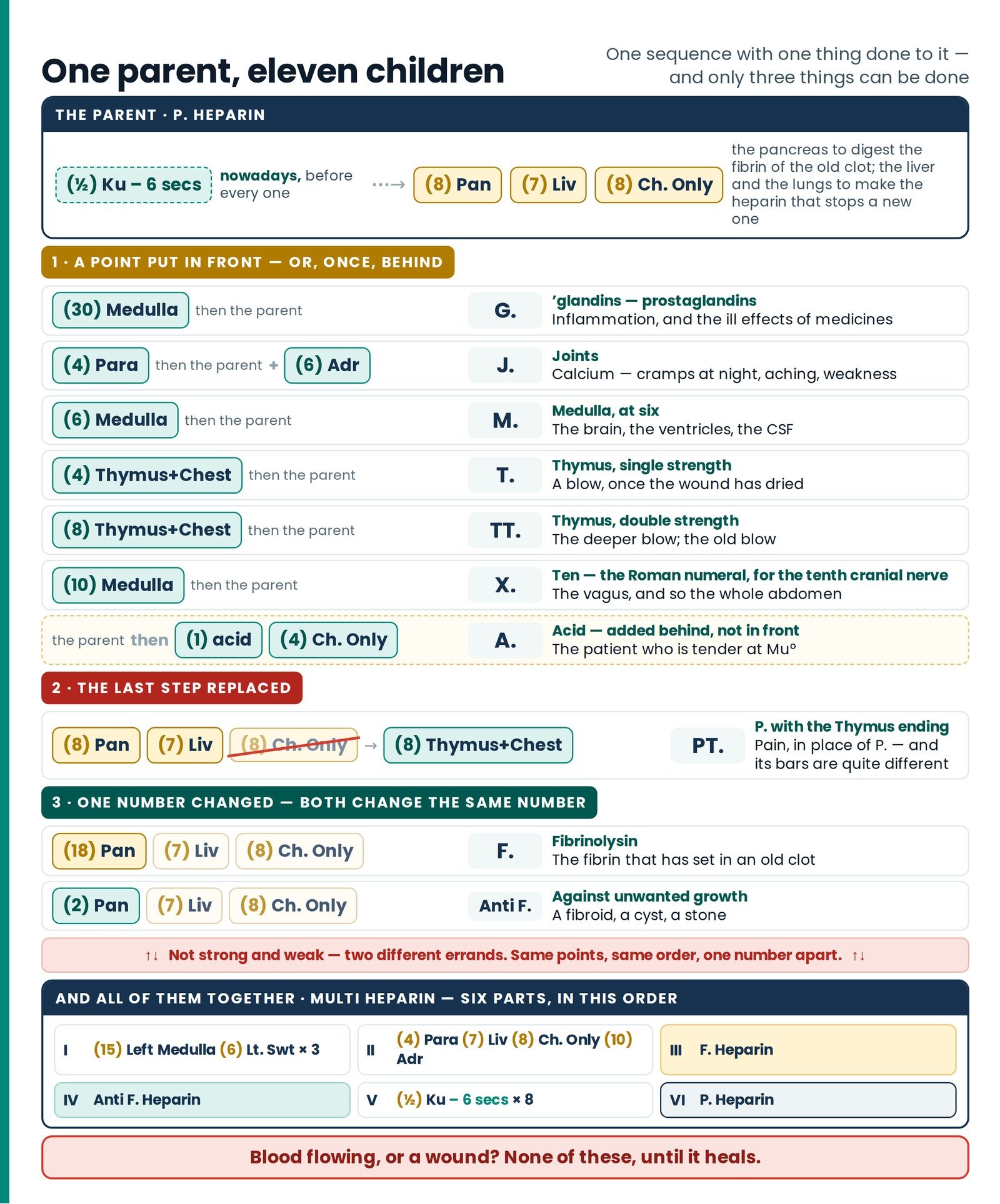
There is one parent: (8) Pan (7) Liv (8) Ch. Only — the pancreas to digest the fibrin of the old clot, the liver and the lungs to make the heparin that stops a new one. Every other formula in the article is that sequence with one thing done to it, and there are only three things that can be done:
- 1. Put a point in front of it. A. puts Acid behind it and a closing chest glide; G., J., M., T., TT. and X. all put a single step in front. The prefix names the formula, and the prefix is what the formula is for.
- 2. Replace its last step. PT. alone does this — Ch. Only out, Thymus+Chest in.
- 3. Change one of its numbers. F. and Anti F. alone do this, and both change the same number: Pan, up to eighteen or down to two.
Why the family is organised the way it is — the key that makes eleven into one
And the letters are a key you can read cold:
Letter · Stands for · Which is why the formula is aimed at
P · Plasmin · Opening clots and stopping new ones — the parent
A · Acid · The patient who is tender at Mu°
G · 'glandins — prostaglandins · Inflammation, and the ill effects of medicines
J · Joints · Calcium — cramps, aching, weakness
M · Medulla, at six · The brain, the ventricles, the CSF
T / TT · Thymus, single and double · A blow, once the wound has dried
X · Ten — the Roman numeral, for the tenth cranial nerve · The vagus, and so the whole abdomen
PT · P with the Thymus ending · Pain, in place of P.
F · Fibrinolysin · The fibrin that has set in an old clot
Anti F · Against unwanted growth · A fibroid, a cyst, a stone
Multi · All of them together · Several infarcts; calcification
A student who learns that key can reconstruct any formula in this article from its name, and — much more useful at the mat — can look at a name on a card and say at once which prefix it contains and therefore which prohibitions it drags in.
One point in the whole atlas may not be given until a Heparin formula has been given first, and it is here that its instruction is completed.
Teeth point, and the line that must stand above it on the card
Teeth point is given to increase the circulation of blood in the teeth or the jaws, from which the pain in them comes to an end.
Before this, the appropriate heparin treatment according to the patient's body is to be given.
Read the qualifier and not only the noun. Not a heparin treatment. The appropriate one — according to the patient's body. That is not a form of words; it is an instruction to examine, and it is the reason this point could not be finished in Each Point in Use, "Each Point in Use", where it is the only entry in the whole physical half carrying a prerequisite. A card that reads Teeth point alone is a card missing a line.
So what does according to the patient's body actually mean at the mat? Exactly what it has meant since the a little further on wiki: Neurotherapy treats according to the condition of the body, not according to the name of the complaint. Toothache does not choose a heparin. This patient's findings choose it, and you have just spent a article learning how. Run the four layers on a patient with toothache and they answer in order:
Table 17 — The appropriate heparin according to the patient's body, worked for a toothache
| What you find on this patient | The heparin that is appropriate for this body |
|---|---|
| Pain at Mu°, with the acidosis picture — constipation, dry skin, burning skin, rough hair | A. Heparin |
| Repeated headache, or trouble of the eye, the nose or the brain, alongside the jaw pain | M. Heparin |
| Pain at Pan or Gas — repeated trouble of the stomach or digestion | X. Heparin |
| Cramps at night, aching all over, weakness | J. Heparin |
| Nothing else to steer you — no Mu°, no head, no stomach, no cramps | P. Heparin — some other problem apart from the above, and this can be given to all patients |
| A wound in the mouth, or bleeding gums that are still bleeding | None at all, until it heals — and therefore no Teeth point either, because its prerequisite cannot be met ▲ Take care |
Then, and only then, Teeth point. And note how that point is given, because it is one of the few in this wiki that the therapist does not give at all: it is taught to the patient, to do on themselves. For the upper teeth — the point above the ear, found by asking the patient to clench the teeth and feeling where the muscles move, and the point below the eyes; press where pain is felt, and do clockwise. For the lower teeth — below the chin and below the jaws, wherever pain is felt, stroked in the direction of the clock's hand. Treat on the same side as the side on which the teeth hurt. And doing it on and off through the day, rather than continuously, will bring relief sooner.
Read the two halves together and the prerequisite stops looking like a formality. The patient is sent home to press her own face several times a day. What the therapist does before that is open the blood supply to the region she will be pressing — with the formula her own body selected. One half is done by you, once, and chosen by examination. The other half is done by her, all day, and needs no choosing at all.
Where this leads
Here an organ is asked to make something; next, what it cannot make
One thread of this article has been left deliberately loose, and the next article picks it up.
Every formula here works by asking an organ to make something — heparin from the mast cells of liver and lung, something plasmin-like from the pancreas, prostaglandins, acetylcholine, calcium out of the bone. In each case the body already has the machinery and the raw material, and the treatment is a provocation to use them.
But some of the things a body runs on it cannot make at all, whatever it is asked. A vitamin is precisely a substance that has to come in from outside. And a therapist who has learned this article properly will now want to know what happens to a family of formulas when the thing the patient is short of is not being withheld by a sluggish gland but is genuinely absent — and what it can mean that a treatment named after a vitamin works at all. That is the whole subject of the next article, and it begins with a tired woman and her small son in Amritsar.
Questions students ask
1. I am twenty and I cannot keep eleven names in my head. Where do I start? Start with one formula, not eleven. Learn (8) Pan (7) Liv (8) Ch. Only until you can give it in your sleep — the eight presses that do not travel, the seven that are six-plus-one-at-the-middle-station, and the twenty-four soft rubs a side that are counted outward only. Then learn the letter key, which fits on the back of a hand. Everything else in the article is that one sequence with a point put in front of it, its last step swapped, or its first number changed. You are not learning eleven formulas; you are learning one formula and ten modifications.
2. I am a retired chemistry teacher. The article says the pancreas is provoked because plasmin resembles trypsin. That is an argument from resemblance. Am I meant to take it seriously? You are meant to read it exactly as it is written, which is what makes this passage unusual. The therapy sets out the argument, names it as an argument — two boys who look similar on the road — and attaches two perhaps to it. It is telling you which part of the reasoning is inference. What is not offered as inference is the observation: the pancreas was provoked, in that order, and the two kinds of result were seen and counted. Hold the observation firmly and the explanation loosely; that is how it was handed to you, and this wiki does not upgrade it.
3. A housewife learning this for my family — my mother has clots every month. Can I give this at home? The treatment is three ordinary positions and no instrument, so yes, this is the kind of thing families are taught. Two things before you begin. Ask the gate question: is anything bleeding now, is there any wound — because while there is, no Heparin treatment is given at all. And take her to be looked at properly if the bleeding is heavy, or has been going on for years, or started after her periods had stopped. What you can give and what somebody needs to find out are not in competition; they run alongside each other.
4. Why is the pancreas first? The liver and lungs are where the heparin comes from. Because the two halves of the formula do different work, and the order says which comes first. The pancreas is there to digest the fibrin of the old clot — to open what is already shut. The liver and the lung are there to make heparin — to stop what has not yet formed. Clear first, then prevent. And remember that the line is read left to right and performed in the order it is read: change the order and a stimulation in a different sequence can sometimes produce opposite results. How a Formula Is Built.
5. I am a village therapist with no laboratory. Half the words in this article — infarct, ejection fraction, MRI — are things I will never see. Can I work? Yes, and with almost none of them. The article's own selection table is built out of things you find with your hands and your questions: pain at Mu°, cramps at night, clots in the menses, repeated headache, an old blow, pain at Pan or Gas. Not one of those needs a machine. What the machines gave this article was proof for somebody else — a report that a therapist could not have influenced. Your work is the finding; the reports, when they exist, are somebody else's confirmation of it.
6. I am a doctor. What exactly is being claimed here — that pressure on a thigh makes an anticoagulant? What is claimed is set out in three separable layers, and they should be kept in separate pockets. The observations: menstrual clots that stopped after one or two treatments and did not return for years; breathlessness that settled first and an ejection fraction that rose over months; a diastolic pressure that came down after a few treatments; recent paralysis improving faster than old. The proposed mechanism: that provoking liver and lung raises heparin production, and provoking the pancreas supplies something plasmin-like. The therapy's own acknowledgement: whatever the cause may be, and, of the three newest formulas, research upon these is continuing. State the first layer without leaning on the second, and you will never have to defend more than you have.
7. The card says (7) Liv. Why can I not just press seven times? Because (7) Liv names where the seventh one goes. It is the three-station pass given twice — waist and elbow, mid-thigh and mid-arm, knee and wrist, six seconds at each paired station — which is six applications, and then once more at the middle station, between the hand and the thigh. Seven presses distributed as you please is a different treatment whose effects nobody has taught you. The Front of the Body I.
8. The article says Pan must not be given in fits — and then says it may be given in the Heparin formula. Which is it? Both, and the sentence is one sentence. Giving Pan increases alkali, therefore do not give in fits, convulsions or seizures — but it may be given within the Heparin formula. The exception is written into the point's own entry, it names this family by name, and it is part of the rule rather than a hole in it. Take out the second clause and you will refuse this whole article to the fitting child for whom the M. Heparin passage was written. Take out the first and you will give Pan freely where the entry says not to. Each Point in Use carries it whole.
9. If P. Heparin can be given to all patients, why would I ever give anything else? Because can be given to all patients is a statement about safety and breadth, not about precision. The family exists because by joining some other points to it, various formulas have been made which are used for correcting different symptoms — and each added point brings a job the parent does not do. A hot red knee, a night cramp, a headache, a blocked third ventricle and an old haematoma are five different jobs. What the sentence does give you is a default: when nothing steers you, the last row of the selection table says some other problem apart from the above — P. Heparin.
10. My senior gives (6) Adr at the end of A. Heparin for everybody. Mine does not. Who is right? Both of you may be, and the asterisk is why. Most people have found still better results by giving (6) Adr at the end of A. Heparin. But some diabetic patients did not feel well after Adr was given; to such people it is not to be given. That is a rule that can only be kept patient by patient, by giving it, asking at the next visit how the rest of that day went, and writing the answer on the card. And before either of you gives it at all, (6) Adr has two standing bars of its own: not where immunity is already low, and not in high blood pressure.
11. How do I know the pain came back because of a clot, and not just because the treatment wore off? You do not know it; you are taught to understand it that way and act on it. The instruction is exact: relief, then the pain returning after a few hours or by the next morning, is read as there is some clot in the related part. What the instruction also does is send you back to the body before you act: first check whether there is still pain at Mu° or not, because that finding — not yesterday's finding — chooses the formula. And it is worth saying plainly that a pain which is new, unlike the patient's usual pain, or accompanied by anything happening in the head, is not a card to be rewritten. It is a patient to be sent. When the Hand Must Stop.
12. The MRI case worries me. Am I supposed to tell a patient there is no need for any other medicine? No, and the wiki's standing rule has never changed: we use no medicine of any kind, and if a patient is already taking some medicine or tablet, we do not even tell them to stop it. When the complaint has gone entirely, the patient goes to their own doctor and asks whether the quantity still needs to be the same. That sentence in the Bandra account was said by the man who built the therapy, about someone he knew, in a building he ran. It is recorded here because it is what happened. It is not an instruction to you. And sudden weakness or numbness down one side is the plainest example in the wiki of something that goes today rather than next week. The Hand That Heals, and When the Hand Must Stop.
Questions patients ask
1. "My doctor has put me on a blood-thinner. Can I still take this treatment?" Tell me exactly what you are taking, and keep taking it — I will not ask you to change or skip a single dose; that is entirely your doctor's business. What it changes is my side: somebody on those tablets bruises and bleeds far more easily than the rest of us, so the work is given lighter, and I will look at your skin afterwards and ask you to tell me about any mark that comes up in the next day or two. And if you have any bleeding at all — gums, a cut that keeps weeping, anything — we wait until it has healed, because this particular family of treatments is the wrong direction for somebody who is bleeding.
2. "Why are you pressing my thigh and my chest when the problem is in my brain?" Because I am not treating the brain. I am treating the two organs that make the body's own chemical for keeping blood from setting — the liver, which I reach from the thigh and the arm, and the lungs, which I reach from the chest — and the one that makes what dissolves what has already set. Whatever your body then makes, your body sends where it is needed, including to places my hands could never go. It is closer to clearing a blocked canal from the sluice gate than from the middle of the field.
3. "My periods come with clots and a lot of pain. Everyone says it is normal at my age." It is common, which is not the same word. This is one of the things this treatment is specifically written for, and what is reported is that after one or two treatments the clots do not come in the next cycle, and often do not come back for years. I will also ask you to have it properly looked at — not because I expect something to be wrong, but because bleeding that is heavy or changing is worth somebody knowing the cause of. The two things are not in competition; they go together.
4. "My blood pressure came down after three sessions. Can I stop the tablet?" I am glad, and no — and I would not be doing my job if I said anything else. A pressure that is good while you are taking the tablet is evidence that the tablet is working, not that you have stopped needing it. Keep taking exactly what you were given. Keep a note of your readings. When you are ready, take that note to the doctor who prescribed it and ask him: must I still take the same quantity? That decision belongs to him and not to me.
5. "My father had a stroke four years ago. Is it too late?" No, but I will tell you honestly what to expect, because that is fairer than a promise. What this therapy says about itself is that somebody whose paralysis is only a few days old gets relief quickly, and an old disease can take a good deal of time to become well. Four years is an old disease. So we would work steadily, week by week, and measure against how he was last month rather than against how he was five years ago — and we would go on doing everything else he is already doing, not instead of it.
6. "The doctor says my toe may have to come off. Can you save it?" I will not promise you that, and I would be careful of anybody who does. There is a treatment here written for exactly this situation and it has a good reputation, and I will give it — but I will only give it once the wound has closed, because while anything is open this family of treatments is the wrong one. What I want you to do meanwhile is keep every appointment with the people looking after the foot. A surgeon who talks about taking a toe is not giving up on you; he is stopping something from spreading. Let us work alongside him, and let us both look at that foot every single time you come.
Words used here
| Hindi | English | Neurotherapy code / usage |
|---|---|---|
| खून का जमना | Clotting | Blood setting where it has slowed or stopped — protective in a wound, fatal inside a vessel |
| हेपरिन | Heparin | The body's own anticoagulant — its work is not to let clots form. 85% from mast cells of liver and lungs, 15% from every tissue and from basophils |
| मास्ट सेल | Mast cell | The granule-packed cell that makes heparin; the target of (½) Ku – 6 secs |
| थक्का / गाँठ | Clot | What Pan is in the formula to digest; clots in the menses are the family's best-reported result |
| लकवा / अधरंग (lakwā / adhraṅg) | Paralysis | The family's home ground, with heart disease. Recent — quick relief. Old — a good deal of time |
| सूजन (sūjan) | Swelling | Swelling alone is swelling. With pain, heat to the hand and redness, it is inflammation — and then the knee question is G., not A. |
| ऐंठन | Cramp | A stretching in the muscles, often in the calves from calcium deficiency → J. Heparin |
| पित्ताशय / यकृत | Gall bladder / liver | Liv — 85% of heparin production, and the maker of prothrombin and fibrinogen |
| फेफड़ा | Lung | Reached by Ch. Only — the soft glide from chest to shoulders, three rubs equal one, left side first |
| घिसाई (ghisāī) | Rubbing | Ch. Only, Th + Ch, Medulla, Adr, Neck ghisai — a rub, never a press; count the outward journeys only |
| रामबाण (rāmbāṇ) | A sure and unfailing remedy | Said of Multi Heparin for all kinds of paralysis, infarct, clot, or years-old pain |
| — | Mu° | The left kidney code; tenderness reads as acidic — and it is the finding that selects A. Heparin over G. |
| — | Thrombosis · ischaemia · infarct | The process of clot formation · blood not reaching · tissue that has died for want of it |
| — | Serum | The light-yellow watery liquid left once blood has clotted; finished first, by the Injury formula, before T. or TT. Heparin |
| — | tPA · plasminogen · plasmin | The activator · what waits inside the clot · what it becomes after about 24 hours, and digests the fibrin |
| — | Ejection fraction | The proportion of blood pushed out of the heart's main chamber per beat; reported to increase over several months of P. Heparin |
| — | Hydrocephalus | Water collecting in the brain when the fluid cannot get out of the third ventricle → M. Heparin |
| — | CSF | Cerebrospinal fluid — lateral ventricles → third → fourth |