This article is about water, salt and the pressure they make between them, and about the organ that decides how much of each the body keeps. It is the largest article in the formulary, and it carries the debts the last nine articles have been running up — six of them, named and discharged here.
The notation is closed. Every bracket, prefix, ring, glyph, arrow, × sign and secs suffix in this article was taught once and completely in Table 13 of How a Formula Is Built, "How a Formula Is Built", and is not explained again. Every written rest is in Table 8 of that same article, with its reason attached. Two spellings you will meet on a card in this article: ↑|↓ is the Round Arrow, and \°/ is the Back Arrow, whose other name is Blood supply to lungs.
You have now reached the end of nine articles of formulas, and a great many of them have closed with the same two steps. New Genes closes with them. 1,25 DCC closes with them. Mild Genes closes with a quarter of them. Jeevan Dhara closes two of its four parts with them. Every time, you have been told the same sentence — this has been given to maintain the balance of acid and alkali — and every time you have been sent here.
This is here.
Watch


What the two halves actually do
Both are described by what they reduce — this is a therapy of counterweights
The observation the pair is built on
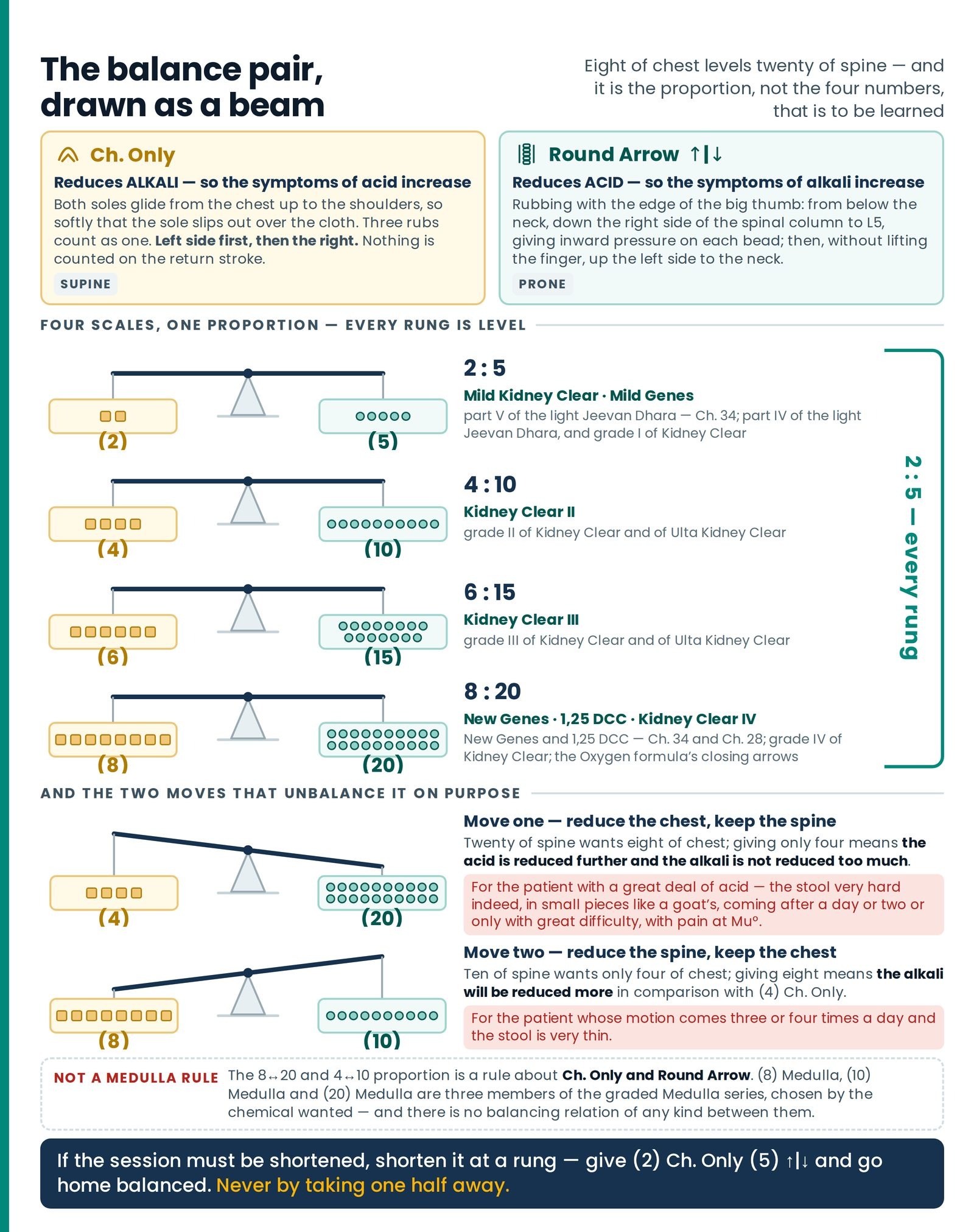
It has been seen that from Ch. Only alkali becomes less — that is, the symptoms of acid increase — whereas from Round Arrow acid becomes less, that is, the symptoms of alkali increase.
Not only that: to balance (20) ↑|↓, (8) Ch. Only is needed, whereas to balance (4) Ch. Only, (10) ↑|↓ is sufficient.
Since Neurotherapy treats not the disease but the condition of the body, Guruji has used this observation in a wonderful way.
Read that slowly, because four separate things are packed into three lines.
One. The two halves pull in opposite directions. That is why they are a pair and not a sequence.
Two. Neither of them is described by what it adds. Both are described by what they reduce — Ch. Only reduces alkali, Round Arrow reduces acid. A body in which alkali has been reduced will show more of the signs of acid, not because acid has been manufactured but because the counterweight has come off. This is a therapy of counterweights, and the language is exact.
Three. The two are not equal in strength. Twenty of one weighs the same as eight of the other. Four of the chest weighs the same as ten of the spine. Both of those are the proportion two to five — eight is to twenty as four is to ten as two is to five. Learn the proportion, not the four numbers.
Four, and this is the sentence a student skips: since Neurotherapy treats not the disease but the condition of the body. The pair exists so that it can be broken on purpose. If the only thing you ever do with it is give eight and twenty, you have learned half of it.
The counts, and what the proportions mean
The complete card for Ch. Only and the Round Arrow, side by side
Table 1 — The balance pair, complete
| Ch. Only | Round Arrow — ↑\ | ↓ | |||
|---|---|---|---|---|---|
| What it is | Both soles glide from the chest up to the shoulders, so softly that the sole slips out over the cloth. Three rubs count as one. Left side first, then the right. Nothing is counted on the return stroke Supine Left Right | Rubbing with the edge of the big thumb: from below the neck, down the right side of the spinal column to L5, giving inward pressure on each bead and pressing the nerves below; then, without lifting the finger, up the left side from below to the neck Prone | |||
| What it does to the body's direction | Reduces alkali — so the symptoms of acid increase | Reduces acid — so the symptoms of alkali increase | |||
| Where it is given in a formula | At the end — rule three of sequence | At the end, immediately after Ch. Only | |||
| The balancing proportions | (8) Ch. Only balances (20) ↑\ | ↓ · (4) Ch. Only is balanced by (10) ↑\ | ↓ · (2) Ch. Only is matched with (5) ↑\ | ↓ | The same four rows, read from the other side |
| The caution that belongs to the technique | — | Take care that each time the pressure falls on the side of the beads ▲ Take care | |||
| What it inherits | Ch. Only — not in lung cancer ▲ Take care | The dose limit in chronic illness, below | |||
| Taught in | The Front of the Body II, "The Front of the Body — II" | Face Down, "Face Down" |
Four scales, one proportion
A ladder of balance pairs, and every rung is the same two to five
Here is where the proportion earns its place. The therapy does not carry one balance pair; it carries a ladder of them, and every rung is the same ratio.
Table 2 — The balance pair at all four of its sizes, and where each is met
| Ch. Only | Round Arrow | Ratio | Where you have already met this rung |
|---|---|---|---|
| (2) | (5) | 2 : 5 | Mild Genes — part V of the light Jeevan Dhara — Vitamin and Gene Formulas. Mild Kidney Clear — part IV of the light Jeevan Dhara, and grade I of Kidney Clear, in this article |
| (4) | (10) | 2 : 5 | Grade II of Kidney Clear and of Ulta Kidney Clear, in this article |
| (6) | (15) | 2 : 5 | Grade III of Kidney Clear and of Ulta Kidney Clear, in this article |
| (8) | (20) | 2 : 5 | New Genes and 1,25 DCC — Vitamin and Gene Formulas · Correcting the Two Kingdoms. Grade IV of Kidney Clear. The Oxygen formula's closing arrows |
Vitamin and Gene Formulas noticed that Mild Genes keeps the proportion at a quarter of the size — two to five where the parent gave eight to twenty — and left the arithmetic here. That is the arithmetic. A formula reduced by a quarter is still balanced, because balance is a ratio and not a quantity. It is the difference between a smaller meal and a badly cooked one.
The proportion belongs to this pair and to nothing else
The 8↔20 and 4↔10 proportion is a rule about Ch. Only and Round Arrow. It is not a Medulla rule.
This must be said plainly because the numbers collide. (8) Medulla and (20) Medulla are two members of the graded Medulla series; (10) Medulla is a third. They are three different treatments at one site, chosen by the chemical wanted — serotonin, dopamine, the vagus — and there is no balancing relation of any kind between them. Giving (20) Medulla does not create a debt that (8) Medulla pays off.
Read the point before you read the number, and then read the number as belonging to that point.
How a therapist actually uses it
The pair exists so that it can be broken on purpose — two moves, one ratio
Now the fourth sentence of the observation comes into its own. Because the therapy treats the condition of the body, the pair is not only a closing formality — it is the adjustable part of many formulas, and the adjustment is made on a finding you can take in thirty seconds.
Unbalancing the pair on purpose — the two moves, and what each is for
Move one — reduce the chest and leave the spine.
(4) Ch. Only with (20) ↑|↓. By the proportion, twenty of spine wants eight of chest; giving only four means the acid is reduced further and the alkali is not reduced too much. This is the move for the patient with a great deal of acid — the stool very hard indeed, in small pieces like a goat's, coming after a day or two or only with great difficulty, with pain at Mu°.
Move two — reduce the spine and leave the chest. (10) ↑|↓ with (8) Ch. Only. By the proportion, ten of spine wants only four of chest; giving eight means the alkali will be reduced more in comparison with (4) Ch. Only, which is what a body wants when the alkali has increased a good deal. This is the move for the patient whose motion comes three or four times a day and the stool is very thin.
Both moves are written into the four stool-selected versions of the 1,25 DCC formula, which are taught whole in Correcting the Two Kingdoms, "Correcting the Two Kingdoms", and are not repeated here. What belongs here is the arithmetic underneath them: to change the tilt of a formula, you do not add a new point. You alter one number in the pair, and you know which way it will lean because you know the ratio.
There is a third move, and it is the one that gives the Ulta formulas of this article their name: give the pair in the reverse order — Round Arrow first and Ch. Only afterwards. Where a formula does that, it does it because the body's own direction has turned round, and you will meet it twice in the pages ahead. (Figure 35.1)
The half-chest — the same tool, aimed at one side
Ch. Only has a left form and a right form, and they are not halves of a balance; they are directional instruments.
Left Chest Only stimulates the left lung only — it reduces the symptoms of acid, and reduces pain at Mu°.
Right Chest Only stimulates the right lung only — it reduces the symptoms of alkali, and reduces pain at Liv°.
That is why ATF, the acid treatment, ends with (4) Lt. Ch. Only and then Adr, and why Right Chest Only appears in the list of treatments that reduce alkalosis alongside ALTF. The whole chest balances; the half chest chooses a side.
How a formula gets built, watched from the inside
Four questions asked before a hand was laid on anybody
Before LSTF itself, watch it being made, because this is the clearest view anywhere in the formulary of how a sequence comes into existence.
One chief reason for the success of this therapy is that Guruji goes to the depth of how every function in the body takes place. Where some organ is not working properly, he studies every aspect of it intensively — and then he stimulates the organs in that very order which sets right the body's own way of working. It is precisely because of this that patients get benefit immediately.
In that same series comes this treatment for severe constipation, made keeping every aspect of the problem in mind. This formula is suitable for everybody. Follow the line of thinking in four steps.
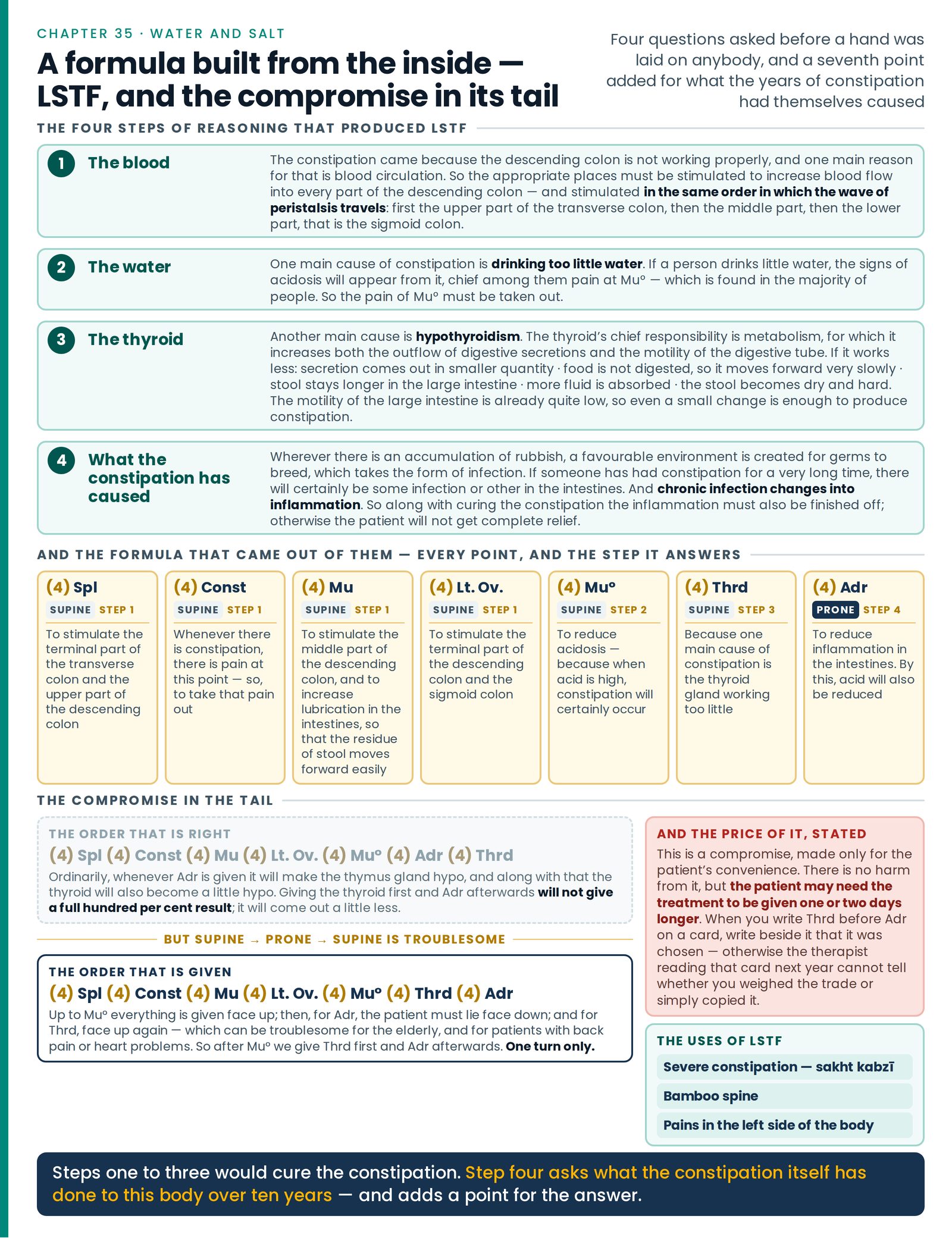
The four steps of reasoning that produced LSTF
1 — The blood.
The constipation came because the descending colon is not working properly, and one main reason for that is blood circulation. So the appropriate places must be stimulated to increase blood flow into every part of the descending colon — and stimulated in the same order in which the wave of peristalsis travels in the intestine: first the upper part of the transverse colon, then the middle part, then the lower part, that is the sigmoid colon, in that order.
2 — The water. Then the other causes must also be set right. One main cause of constipation is drinking too little water. If a person drinks little water, the signs of acidosis will appear from it, chief among them pain at Mu° — which is found in the majority of people. So the pain of Mu° must be taken out.
3 — The thyroid. Another main cause of constipation is hypothyroidism. The thyroid's chief responsibility is metabolism, for which it increases both the outflow of digestive secretions and the motility of the digestive tube. If the thyroid works less, digestive secretion comes out in smaller quantity; food is not digested in the intestines, so it moves forward very slowly; stool and waste stay in the large intestine for a longer time; more fluid is absorbed from the large intestine; and the stool becomes dry and hard. Note that the motility of the large intestine is already quite low, so even a small change in motility is enough to produce constipation. So in the treatment of constipation the thyroid gland must certainly be stimulated.
4 — What the constipation has caused. Wherever there is an accumulation of rubbish, a favourable environment is created for germs to breed, which takes the form of infection. If someone has had constipation for a very long time, there will certainly be some infection or other in the intestines. And chronic infection — an infection which stays for a long time — changes into inflammation. So along with curing the constipation the inflammation must also be finished off; otherwise the patient will not get complete relief.
Read step four twice. Steps one to three would cure the constipation and any competent formula-builder would have stopped there. Step four asks a different question — what has the constipation itself done to this body over ten years? — and adds a point for the answer. That is the whole difference between a formula that relieves and a formula that finishes.
The result was named the Left Side Treatment Formula, LSTF, because it improves the working of the organs of the left — the bāyī — side. It is given to those who have chronic constipation, that is, constipation of very long standing. In it every single part of the left side of the body has been stimulated, in a specific ordered manner, in keeping with the peristalsis — the motion — of the large intestine.
Table 3 — Card: LSTF, the Left Side Treatment Formula Supine Prone 6 sec Left Right ▲ Take care
| Written | LSTF → (4) Spl (4) Const (4) Mu (4) Lt. Ov. (4) Mu° (4) Thrd (4) Adr |
|---|---|
| What it is for | Severe constipation (sakht kabzī) · Bamboo spine · pains in the left side of the body |
| Positions, in order | Supine for steps 1–6 Supine → prone for step 7 Prone . One turn only |
| Step 1 — (4) Spl | Supine; the sole across the left upper quadrant, under the left costal margin, six seconds a station. For the terminal part of the transverse colon and the upper part of the descending colon Left 6 sec |
| Step 2 — (4) Const | Supine; left upper quadrant, ring 2, over the descending colon and splenic flexure. Whenever there is constipation there is pain at this point — so, to take that pain out |
| Step 3 — (4) Mu | Supine; left of the navel, ring 2. To stimulate the middle part of the descending colon, and to increase lubrication in the intestines, so that the residue of stool moves forward easily in the large intestine |
| Step 4 — (4) Lt. Ov. | From the head end; the therapist's left sole, three stations elbow → wrist on the patient's right forearm, the other foot beside the ear. To stimulate the terminal part of the descending colon and the sigmoid colon Right |
| Step 5 — (4) Mu° | Supine; the left kidney code, single station, hand contact high at the shoulder. To reduce acidosis — because when acid is high, constipation will certainly occur Left |
| Step 6 — (4) Thrd | Left arm only: elbow → shoulder → elbow → shoulder. Four equal one. Because one main cause of constipation is the thyroid gland working too little Left |
| Step 7 — (4) Adr | Prone; fingers gathered, both palms very close together at the T6 bead. To reduce inflammation in the intestines. By this, acid will also be reduced Prone |
| The order rule inside it | The colon is worked in the direction peristalsis travels — transverse, then mid-descending, then sigmoid |
| The compromise in steps 6 and 7 | Physiologically the adrenal should come before the thyroid. It is written the other way for the patient's comfort — see the box below |
| What it inherits | Spl — not in cold, allergy or asthma, where it does harm; nowadays not in cancer; not in diabetes or other autoimmune disorders. Const — not to those who have loose motions. Lt. Ov. — not in cancer, because cancer arises from excess oestrogen; not to children being treated to increase height, since oestrogen and progesterone hasten the closure of the epiphyseal line. Mu° — do not stimulate it in kidney failure or kidney cancer; those who have pain only at Liv° — do not give it to them. Thrd — not in bamboo spine or spur and the like, because these diseases have come from increased calcium; not in asthma, where the cough increases; (4) Thrd not to heart patients, because when the metabolism increases too much there can also be trouble. Adr — it reduces immunity, so not in septicaemia, AIDS, HIV or cancer; it reduces acid and raises alkali, so not in high blood pressure ▲ Take care |
| Points taught in | Spl, Const, Mu, Lt. Ov., Mu° — The Front of the Body I, "The Front of the Body — I"; Thrd — The Front of the Body II; Adr — Face Down, "Face Down"; indications and bars point by point — Each Point in Use, "Each Point in Use" |
Notice the collision in that last row and do not smooth it over. LSTF is given for bamboo spine; and Thrd is not given in bamboo spine, because that disease has come from increased calcium. Both sentences are printed, both are correct where they stand, and neither cancels the other. What the therapist does with such a pair is what a therapist is for: read the whole patient, and if the two instructions meet in one body, the bar written against the point is the one that decides that point. Nothing in this wiki asks you to give a point to a patient it is written against.
Why the spleen and the ovary, when the trouble is in the bowel?
A point's name is a postal address, not a description of the parcel
A natural question arises. To cure constipation, why are Spl — the spleen — and Lt. Ov. — the left ovary — being stimulated? Constipation has come about because the movement of food in the alimentary canal is very slow, and both of these are outside the alimentary canal.
Here is the thing to attend to. By our points we increase the blood circulation in the various parts of the abdomen all around the navel. Each point's name has been given by keeping in mind the chief organ in that region. But when we give that point, it will increase blood flow not only in that organ, but in all the organs that are in that region.
In the region above and to the left of the navel the chief organ is the spleen — but the left terminal part of the transverse colon and the upper part of the descending colon are there too, and when Spl is given, blood flow increases in all three. In the same way Mu removes the pains of the left side of the navel: besides the small intestine, the middle part of the descending colon is there, so it is stimulated as well. And Lt. Ov. takes out the pain of the region below and to the left of the navel, where besides the ovaries or testes there is the terminal part of the descending colon and the sigmoid colon.
What a point's name means, and what it does not
In this formula the point Spl has not been given in order to stimulate the spleen, but rather for that part of the large intestine.
This is one of the most freeing ideas in the whole formulary, and it disposes of a great deal of student anxiety. A point name is a postal address, not a description of the parcel. You are not pressing a spleen; you are increasing the blood supply to a region that happens to contain a spleen, and also contains two lengths of colon that nobody thought to name a point after.
An everyday version: you open the tap in the kitchen and the pressure drops in the bathroom, because you did not turn on "the kitchen" — you drew from a pipe that serves both rooms. Blood is that pipe.
Table 4 — Why each point of LSTF is given
| Point | The reason it is in the formula |
|---|---|
| Spl | To stimulate the terminal part of the transverse colon and the upper part of the descending colon |
| Const | Whenever there is constipation, there is pain at this point — so, to take that pain out |
| Mu | To stimulate the middle part of the descending colon, and to increase lubrication in the intestines, so that the residue of stool moves forward easily |
| Lt. Ov. | To stimulate the terminal part of the descending colon and the sigmoid colon |
| Mu° | To reduce acidosis — because when acid is high, constipation will certainly occur |
| Adr | To reduce inflammation in the intestines. By this, acid will also be reduced |
| Thrd | Because one main cause of constipation is the thyroid gland working too little |
The compromise in the tail, stated with its price
Adr before Thrd is right; Thrd before Adr is given — and the cost is named
The two orders set side by side, and what each costs, are in Table 7 of How a Formula Is Built, where this passage is used to teach what a compromise is and why one that is not written down stops being a compromise and becomes a mistake. It is not repeated here. What belongs to LSTF is the practical consequence: when you write Thrd before Adr on a card, write beside it that it was chosen — otherwise the therapist reading that card next year cannot tell whether you weighed the trade or simply copied it. (Figure 35.2)
The Round Normal Formula
Breadth for the everyday case — the whole bowel walked in order, three times
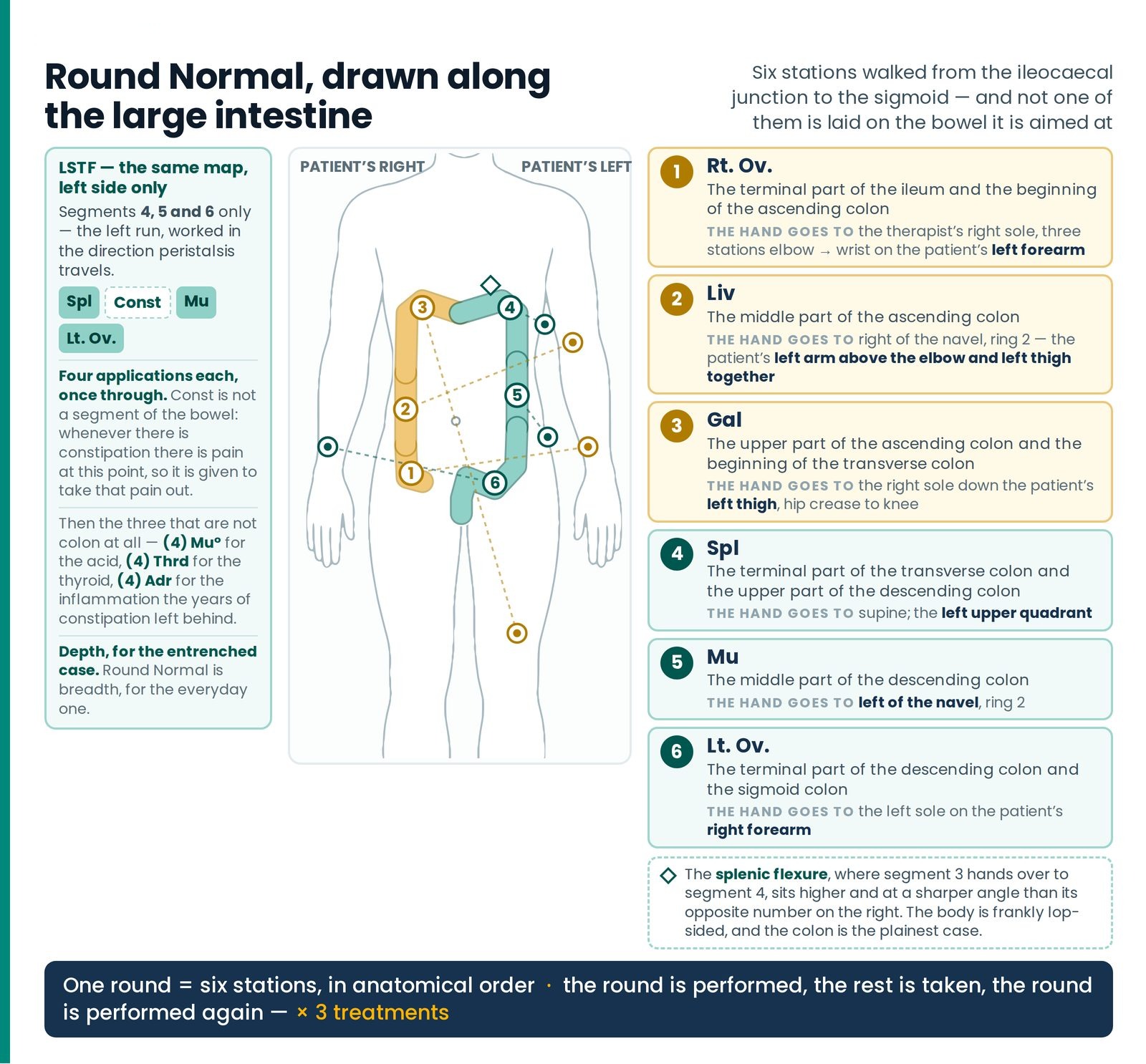
LSTF works the left run, deeply, for a constipation of many years. Round Normal works the whole run, lightly, three times over, for the ordinary kind. (Figure 35.3)
Round Normal
(1) Rt. Ov. (1) Liv (1) Gal (1) Spl (1) Mu (1) Lt. Ov. × 3 treatments
This too is a very good formula for ordinary constipation. The difference in it is that not only the descending colon, but all the parts of the large intestine from the ascending colon right through to the sigmoid colon, have been stimulated in order.
Table 6 — Card: the Round Normal formula Supine 6 sec Left Right × 3
| Written | Round Normal → (1) Rt. Ov. (1) Liv (1) Gal (1) Spl (1) Mu (1) Lt. Ov. × 3 treatments |
|---|---|
| What it is for | Ordinary constipation |
| Position | Supine throughout — the patient is not turned at all Supine |
| Step 1 — (1) Rt. Ov. | From the head end; the therapist's right sole, three stations elbow → wrist on the patient's left forearm. The terminal part of the ileum and the beginning of the ascending colon Left |
| Step 2 — (1) Liv | Supine; right of the navel, ring 2 — left arm above the elbow and left thigh together. The middle part of the ascending colon |
| Step 3 — (1) Gal | The right sole down the patient's left thigh, hip crease to knee. The upper part of the ascending colon and the beginning of the transverse colon Left |
| Step 4 — (1) Spl | Supine; left upper quadrant. The terminal part of the transverse colon and the upper part of the descending colon Left |
| Step 5 — (1) Mu | Supine; left of the navel, ring 2. The middle part of the descending colon |
| Step 6 — (1) Lt. Ov. | The left sole on the patient's right forearm. The terminal part of the descending colon and the sigmoid colon Right |
| The round and the rest | The six steps are one round. The round is performed, the rest is taken, the round is performed again — three rounds in all. The rest between rounds is Table 8, How a Formula Is Built × 3 |
| Why the order is rule five | Round Normal is one of the therapy's own examples of a formula built beyond the five rules — made by experience, but provoking in accordance with peristalsis. How a Formula Is Built |
| What it inherits | Rt. Ov. — also makes 20% oestrogen, so not in cancer; not to children being treated to increase height. Liv — not in liver cancer. Gal — not in leukaemia, blood cancer or other diseases arising from a raised white cell count; not in asthma, where this point increases the trouble; not to those passing little urine. Spl, Mu, Lt. Ov. — as Table 3 ▲ Take care |
| Points taught in | All six — The Front of the Body I, "The Front of the Body — I" |
Table 7 — Why each point of Round Normal is given
| Point | Segment of the large intestine it is aimed at |
|---|---|
| Rt. Ov. | The terminal part of the ileum and the beginning of the ascending colon |
| Liv | The middle part of the ascending colon |
| Gal | The upper part of the ascending colon and the beginning of the transverse colon |
| Spl | The terminal part of the transverse colon and the upper part of the descending colon |
| Mu | The middle part of the descending colon |
| Lt. Ov. | The terminal part of the descending colon and the sigmoid colon |
Read that column straight down and you have walked the whole large bowel from the ileocaecal junction to the sigmoid without missing a segment. The name is well chosen: it is a round — a circuit — of the normal stations, in anatomical order.
Table 8 — LSTF and Round Normal side by side
| LSTF | Round Normal | |
|---|---|---|
| For | Chronic constipation, of very long standing | Ordinary constipation |
| Territory | The left run only, plus three systemic points | The whole large intestine, ascending to sigmoid |
| Dose at each station | Four applications | One application |
| Repeats | Once through | × 3 treatments |
| Positions | Supine, then prone for Adr | Supine throughout |
| The shape of it | Depth, for the entrenched case | Breadth, for the everyday one |
A composite of many such patients makes the point about how LSTF is chosen. Devidas Karmakar, 67, a retired postmaster of Bardhaman, came with "gas" and a stiffening back and did not mention constipation at all; asked directly, he said motions came every third or fourth day, with force, in hard small pieces, and had done so since his service days. He did not count it as an illness. He counted it as his nature — which is what every patient does with a symptom they have lived with for thirty years, and which is why the question has to be asked rather than waited for.
On the abdomen he was very tender at Const and at Mu°, less at Mu, and almost not at all at Liv°. His spine moved as one piece and his chest barely expanded on a deep breath. His thyroid panel mattered — the thyroid is one of the four legs LSTF stands on and his had never been checked — and his films of the sacroiliac joints mattered, because the way that spine moved raised the question of bamboo spine, which changes what may be given. An ultrasound done four years earlier changed nothing.
He was not given Round Normal. Thirty years is not ordinary constipation; the stool was hard and scanty; Const was the loudest point on the abdomen; and Mu° was tender, which is the acid side and is LSTF's second step of reasoning stated out loud in a single finding. LSTF was given in the taught order, with Thrd before Adr and a note on the card saying that the order had been chosen. The first four days brought a daily motion, which astonished him more than anybody. In the second week the daily motion held while the abdominal tightness came back each evening — and nothing was added, because the fourth step of the reasoning, the inflammation left behind by years of constipation, was already in the formula and was left to do its work. By the fifth week he was bending to his shoes.
Then, in week six, the films came back reported as bamboo spine. LSTF is written for bamboo spine; Thrd is written against it. He was not given the point anyway, and he was not abandoned either: the bar on the point was honoured, the rest of the sequence stood, what had been gained on the bowel was held, and he was told plainly that a report naming that disease is a reason to be under a physician for it and to stay under one.
Three things in that account are worth carrying. Nobody reports a symptom they have decided is their nature — how often, and what does it look like found in one minute what six years of consultations had not asked. The four steps of reasoning are a checklist: blood to the left colon, the water and the acid, the thyroid, and what the years of constipation have themselves caused. And a formula's indication and a point's prohibition can name the same disease; when they meet in one body, the bar on the point decides that point, and it does not decide the formula.
The Lactic Acid Conversion formula
(6) Rt. Ov. (6) Lt. Ov. (8) Pan (12) Liv (6) Adr
Table 9 — Card: the Lactic Acid Conversion formula Supine Prone 6 sec Left Right ▲ Take care
| Written | Lactic Acid conversion formula → (6) Rt. Ov. (6) Lt. Ov. (8) Pan (12) Liv (6) Adr |
|---|---|
| Positions, in order | Supine for steps 1–4 Supine → prone for step 5 Prone |
| Step 1 — (6) Rt. Ov. | From the head end; the therapist's right sole on the patient's left forearm, three stations elbow → wrist, the other foot beside the ear. The pair is ordinarily given right first Left |
| Step 2 — (6) Lt. Ov. | The left sole on the patient's right forearm, three stations elbow → wrist Right |
| Step 3 — (8) Pan | Supine; both thighs together, soft mid-sole on the upper third of each Both sides . One of the two most painful points in the patient the formula was made for |
| Step 4 — (12) Liv | Supine; right of the navel, ring 2 — the highest count in the formula. (12) Liv is also the count very beneficial for dissolving gallstones; perhaps it works something like cholic acid |
| Step 5 — (6) Adr | Prone; fingers gathered, both palms very close together at the T6 bead. Added because inflammation was suspected Prone |
| What it is said to do | To help in some direction with the conversion — the interchange — of lactic acid. That word is the therapy's own: this is an inference, arrived at by reading after the result |
| What it inherits | Rt. Ov. — not in cancer (it also makes 20% oestrogen); not to children being treated to increase height. Lt. Ov. — not in cancer, because cancer arises from excess oestrogen; not to children being treated to increase height. Pan — raises alkali, therefore not in fits, convulsions or seizures (the Heparin exception belongs to The River — Heparin and to that family alone); never to schizophrenia patients, in whom giving Pan causes them to hear voices in the ears. Liv — not in liver cancer. Adr — it reduces immunity, so not in septicaemia, AIDS, HIV or cancer; it reduces acid and raises alkali, so not in high blood pressure ▲ Take care |
| Points taught in | Rt. Ov., Lt. Ov., Pan, Liv — The Front of the Body I; Adr — Face Down; indications and bars — Each Point in Use |
What lactic acid actually does — the story to tell a patient
Why a man stops on a landing: he is fetching oxygen, not resting his legs
First, what the work of lactic acid in the body is. If we are doing daṇḍ-baiṭhak or heavy exercise, then after twenty-five or thirty repetitions one cannot get up — and then, after resting a little while, one can do them again. In the same way, climbing stairs, after seventy-five or eighty steps one suddenly cannot lift a step; but after pausing for a few moments and breathing hard, one can climb further. Why is this?
The cycle, in the order it happens
The carbohydrates in our food — rice, chapati and so on — after being digested all become glucose and reach the blood. There the glucose is stored in the muscles in the form of glycogen. The energy the muscles of the arms and legs need for any work is obtained by burning this stored glycogen, and during that process a chemical called lactic acid comes out of the muscles.
When there is heavy exercise, the accumulation of this lactic acid in the blood increases. Now, the muscles of the heart also require glucose in order to work. But if the quantity of lactic acid in the blood rises, acidosis can result from it, because of which the muscles will go slack, and harm can come to the body.
So that this should not happen, the muscles of the heart have the capacity to change the raised lactic acid in the blood into pyruvic acid and to obtain energy from it. This is a self-protective process for saving the body, which prevents acidosis in the blood even when the quantity of lactic acid rises.
As soon as the quantity of oxygen in the body rises, it is the property of lactic acid that it will convert back into glycogen, from which strength returns to the muscles. In this way the cycle keeps going.
Now put the stairs into that cycle and the whole complaint explains itself.
In the first forty or fifty stairs climbed, the quantity of oxygen in the muscles and in the body goes on decreasing. After that, to climb another twenty-five or thirty stairs, the heart takes its energy from lactic acid — that is, at that moment it is lactic acid that is helping us. But the other muscles of the body do not have this capacity, to get energy from lactic acid. After that we shall not be able to lift even one step, because the knees do not get enough oxygen through the blood, so the muscles of the knee will tire from lack of oxygen. Then, on taking some breaths and getting oxygen, the lactic acid that is in the blood will change into glucose, and the knees will obtain energy, by which we can climb the rest of the stairs.
That is why a person stops on a landing, breathes, and goes on. He is not resting his legs. He is fetching oxygen so that a chemical can be turned back into fuel.
When somebody says they went on a climb some days ago, or walked a very long way, or went to the gym after a long gap, and that since returning they have pain in their knees or calves — then if this treatment is given to them, immediately after the treatment the pain of their knees or calves goes away. And they say that life has come back into their knees.
Now you tell me: if, on giving this treatment, so many patients begin to feel good, then would you not agree that this treatment helps in changing lactic acid back into glycogen in the body?
Table 10 — The chief uses of the Lactic Acid formula
| The finding | The instruction |
|---|---|
| Knee pain, especially where there is pain at both Liv° and Mu° | Give the Lactic Acid formula. "This is experience" |
| Diabetes with high blood pressure, and knee pain | Diabetes is a disease of acid — in it the patient often has pain at Mu°. High BP is a disease of alkali — in it there is often pain at Liv°. So a patient with both diseases will often have both points tender, and this treatment gives benefit in the knee pain |
| High blood pressure | Oestrogen and progesterone are both vasodilators — they widen the blood vessels. Perhaps this too is one reason why Rt. Ov. and Lt. Ov. give benefit in high blood pressure |
| Pain in the calves on the second day after heavy exercise, a hill climb, a long journey, or the gym after a long gap | Understand that that pain came from a lack of oxygen in the muscles, for which this treatment is a sovereign remedy |
| RA — rheumatoid arthritis, whose chief sign is pain in both ring fingers | Give the treatment. The recognition and treatment of rheumatoid arthritis belong whole to The Stiffening Joint, "The Stiffening Joint" |
| Osteoarthritis — pain in the back, knees and other joints in older people, especially those joints on which the body's weight falls | They have got benefit from this treatment |
Row two of that table is worth dwelling on, because it is a small masterpiece of this therapy's way of thinking. A patient arrives with two named diseases and a sore knee. Nobody treats the knee for diabetes. But diabetes is an acid disease and shows at Mu°; high blood pressure is an alkali disease and shows at Liv°; a patient with both will be tender at both; and both Liv° and Mu° tender is precisely the finding that selects this formula. The two diseases did not have to be treated. They only had to be read as a pair of pain points.
Two formulas in this therapy raise a blood pressure. They are not alternatives. They are written for two completely different patients, and one of them is forbidden to the other's patient. Everything in this part is aimed at making that distinction automatic. (Figure 35.5)
The Angiotensin No. 2 formula
For a pressure that fell suddenly because half a litre of blood went out
This is a treatment for raising low BP and bringing it immediately to normal, made exactly on the basis of the facts of physiology. It is very good for those patients whose blood pressure has fallen because 500 ml or more of blood has flowed out of the body — from menstruation, or from a blow, or from the cutting of some limb.
By this treatment the blood pressure will rise at once. And it has one further quality that no tablet has: as the production of blood in the body increases over some days, so this treatment reverses itself. That is, the blood pressure will not rise more than is needed. How that happens is the whole of what follows.
The Renin–Angiotensin System, in plain words
Angiotensinogen, renin, ACE — and the three actions of angiotensin #2
The cascade, step by step
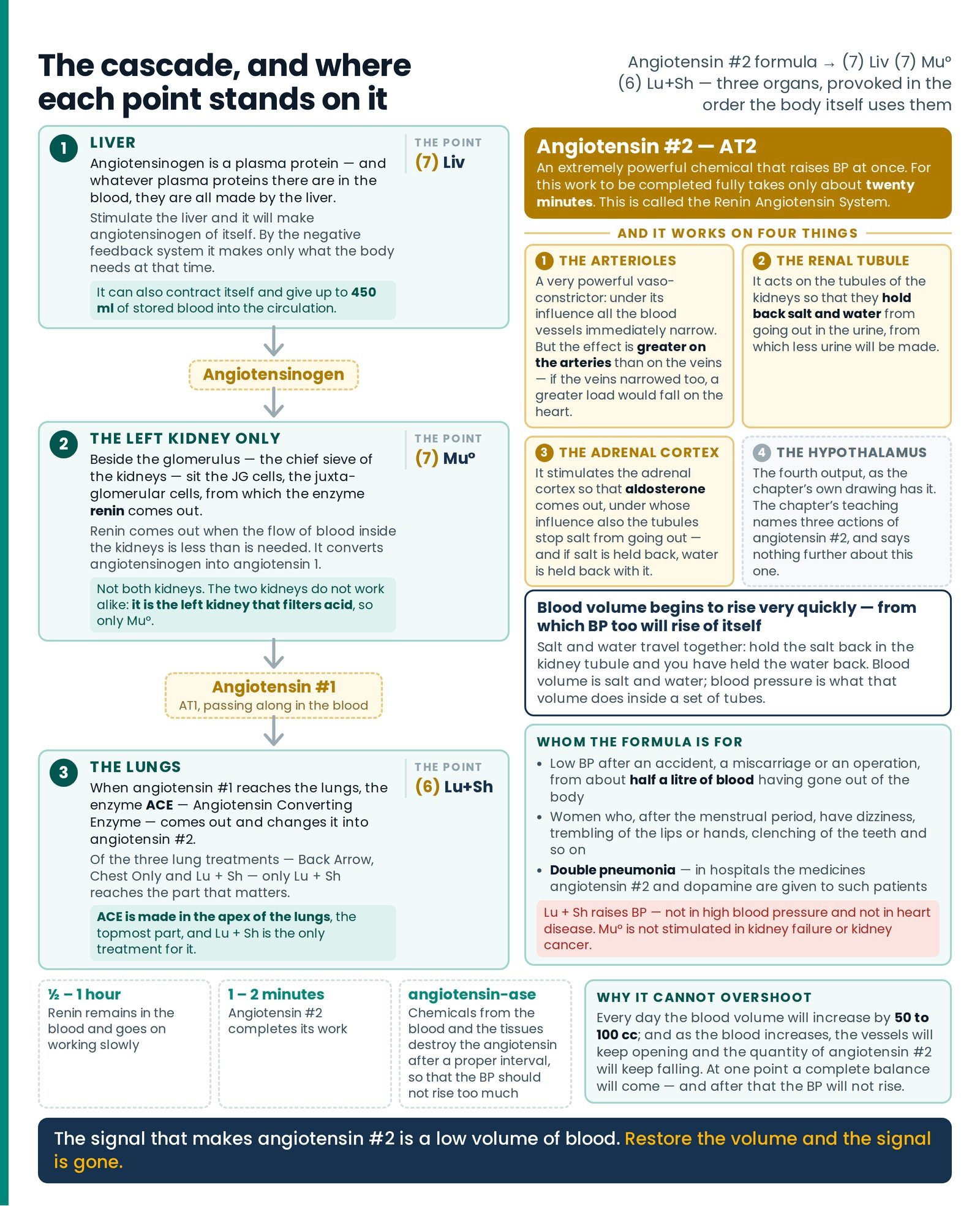
In the blood there is a plasma protein called angiotensinogen. When for some reason the BP in the body falls, the kidneys will not be able to filter the blood properly. From this there will be an accumulation in the blood of unwanted things like urea and creatinine, from which harm will come to the body.
So that this should not happen, near the glomerulus of the kidneys — the glomerulus being the chief sieve of the kidneys — there are cells called the JG cells, the juxta-glomerular cells, from which an enzyme called Renin comes out. This enzyme will come out when the flow of blood inside the kidneys is less than is needed. If there is angiotensinogen in the blood, renin will convert it into angiotensin 1 (AT1).
When angiotensin #1, passing along in the blood, reaches the lungs, then from the lungs an enzyme called ACE comes out — Angiotensin Converting Enzyme — which changes that angiotensin #1 into angiotensin #2.
Angiotensin #2, written in short as AT2, is an extremely powerful chemical that raises BP at once. It works in three ways, and the third of them is the one that gives this article its title.
The three actions of angiotensin #2
First — it is a very powerful vaso-constrictor: under its influence all the blood vessels immediately constrict, that is, narrow. But the remarkable thing is that it does not have the same effect on arteries and on veins. Its effect is greater on the arteries, from which the pressure inside them — the arterial pressure — rises. Against this raised pressure in the arteries the heart has to pump the blood; and if at the same time the vessels of the veins were also narrowed, a greater load would fall on the heart — so that this should not happen, AT2's effect on the veins is less.
Second — it acts on the tubules of the kidneys so that they hold back salt and water from going out in the urine, from which less urine will be made. If more urine were made, the volume of the blood would fall further, would it not?
Third — it stimulates the adrenal cortex, so that aldosterone will come out of it, under whose influence also the tubules of the kidney will stop salt from going out. But if salt is held back, water will be held back along with it. So salt and water will remain in the body.
That is: three different effects of this kind, because of which the blood volume begins to rise very quickly, from which BP too will rise of itself. For this work to be completed fully takes only about twenty minutes. This is called the Renin Angiotensin System.
There is a clock inside it, and the clock is the reason the system does not run away with itself.
Renin remains in the blood for half an hour to one hour and goes on working slowly, whereas angiotensin #2 completes its work within one or two minutes. And from the blood and the tissues several chemicals come out which are called angiotensin-ase, which destroy the angiotensin after a proper interval, so that the BP should not rise too much. A chemical whose name ends in -ase is an enzyme that breaks — that is, digests — something. Angiotensin-ase: the enzyme that digests angiotensin.
Where a blood pressure falls from, and what falling does
Haemorrhage, hypovolaemia — and the signs that say the system did not answer
Now let us see from what causes BP can fall. If low BP has come on suddenly, one main cause of it is blood suddenly flowing out of the body. This is called haemorrhage. Because of it, the blood volume — the quantity — falls all at once.
Ordinarily this can happen from the following causes:
when some deep injury has occurred;
or an accident has happened;
or, in women, when there has been very heavy bleeding during an abortion — a miscarriage — or in the menses;
some people can feel giddy even after donating blood. That too is from this same cause.
Note: if bleeding has occurred because of an accident, in the hospital report it is written as haemorrhage due to RTA — RTA meaning Road Traffic Accident.
What trouble is caused by BP falling
If the bleeding is suddenly so great that 35% of the body's blood — around one and three-quarter litres — goes out, then because of it, first the outflow of blood from the heart will be very much reduced, and afterwards the BP will keep falling. Then heart failure can also occur — that is, the heart may even stop altogether — which is called hypovolaemic shock. So that this should not happen, angiotensin #2 constricts the peripheral arteries more, so that the situation of heart failure should not arise.
[hypo = less; vol = volume; -aemia = in the blood. Hypovolaemia means the volume of blood becoming low.]
If around half a litre of blood goes out of the body, there is not so much danger. In some women this can happen after the menses — because of which, for two to three days after the menstrual period, or for somewhat longer, they feel giddy on doing any work at all. On being asked they will say that their bleeding in the menstrual cycle is very heavy. Because of this their blood volume and blood pressure fell suddenly for some days.
And then the sentence that turns a physiological account into a way of examining a woman standing in front of you.
A shortage of blood means a shortage of haemoglobin — the oxygen-carrier — in the body. When the woman is lying down, the blood she has is enough to supply the oxygen needed for the body's involuntary work — the work of the heart, the lungs and so on. But when she sets to work, she needs more oxygen, which she cannot get because of the shortage of haemoglobin. Because sufficient oxygen does not reach the brain, she feels giddy.
The other signs in such women are shivering, clenching of the teeth, speech stopping — that is, not even having the strength to speak — and falling temperature and pulse.
The sign that says the system is not doing its own work
So if, after blood has suddenly been lost, the above signs appear in someone, one meaning of it is that angiotensin #2 is not being formed in their body.
(The production of angiotensin number two increases when the pressure in the arteries, or the quantity of blood in them, suddenly falls. So where the pressure has fallen and the signs of the fall are there, the system that should have answered it has not answered.)
Liver, kidney and lung — how the formula was built
Four questions, four answers, and a formula: (7) Liv (7) Mu° (6) Lu+Sh
If we somehow make angiotensin #2 in the body, the BP will become normal. First we have to make angiotensinogen. Then the kidney and lungs will change it. So how is all this to be done?
Here comes the originality, and it is worth following one bullet at a time, because each answers a question a good student would have raised.
Four questions, four answers, and a formula
Where does angiotensinogen come from? It is written that angiotensinogen is a plasma protein. And whatever plasma proteins there are in the blood, they are all made by the liver. That is: if any plasma protein at all is to be made, we have only to stimulate the liver. It will make angiotensinogen of itself! And after that, the kidney and the lungs have to be stimulated. If we succeed in stimulating these three properly and in order, then we can solve this problem. Not only that — the lungs and the liver have one further quality, that some blood remains stored within them, which both of them can bring into the circulation when there is need. The liver can contract itself and give up to 450 ml of blood to the circulation.
But the liver makes a great many things — when we stimulate it, will it not make all of them? Answer — No, it is not so. In our body there is a negative feedback system, by which every organ of the body comes to know which thing or chemical the body needs at that time, and which it does not. So when we stimulate the liver, it will make only those things which the body needs at that time — among which one will be angiotensinogen. It will not make those things which are already present in the body in sufficient quantity.
Are we to stimulate both kidneys? Answer — No. We are not to stimulate both kidneys. Note that acidosis occurs because of a rise of acid in the body. And in this therapy it has been found that the two kidneys do not work alike. It is the left kidney that filters acid. That is, acidosis diseases come only when the left kidney is not working properly. So we have to stimulate only the left kidney, that is Mu°.
And which lung treatment? For stimulating the lungs there are three treatments — \°/, that is Back Arrow, Chest Only, and Lu + Sh. Which of the three? Answer — ACE is made in the apex of the lungs — that is, the topmost part — and to stimulate this part we have only one treatment: it is Lu + Sh.
Read the second of those four again, because it disposes of the objection most often raised against this whole therapy. The worry is: if you stimulate an organ, will you not get everything that organ makes, wanted or not? The answer offered is the negative feedback system — the body's own arrangement for knowing what it is short of. On that account a stimulation is not an order to manufacture; it is an invitation to a factory that already knows its own order book.
An everyday version: you do not tell the kitchen what to cook. You tell the kitchen the family is home. What comes out is what the family was short of.
Table 11 — Card: the Angiotensin No. 2 formula Supine 6 sec Left Both sides ▲ Take care
| Written | Angiotensin #2 formula → (7) Liv (7) Mu° (6) Lu+Sh |
|---|---|
| What it is for | To raise a suddenly-fallen blood pressure at once and bring it to normal, in the patient from whose body about half a litre of blood or more has gone out |
| Position | Supine throughout Supine |
| Step 1 — (7) Liv | Supine; the therapist's right sole on the patient's left arm above the elbow and the left sole on the left thigh, together — the Liv – 3 points pass given twice and then once more at the middle station, six applications and then a seventh. To make the liver produce angiotensinogen, and to bring as much as 450 ml of stored blood into the circulation 6 sec |
| Step 2 — (7) Mu° | Supine; the left kidney code, single station, hand contact high at the shoulder Left . To provoke the left kidney, so that by renin it makes angiotensin #1. Only the left — it is the left kidney that filters acid |
| Step 3 — (6) Lu+Sh | Supine, from the head end. Station 1: the flats of both palms, very light pressure, on both sides at the collar bone, the place below the shoulder bone — this is for rousing the lungs. Station 2: with the middle part of the palm or the sole, press a little firmly above the shoulder joint and release at once, so that the shoulder is pulled outward — this is for opening the muscles of the chest. These two together make (1) Lu + Sh; repeat them alternately six times. Ordinarily no pillow is needed; if the therapist's foot does not reach the ground, a thin pillow may be placed under the patient's forehead, so that pressure does not fall on the shoulder bone Both sides |
| Why the lung, and why this lung treatment | To provoke the lungs to make ACE, which will convert AT1 into AT2. ACE is made in the apex of the lungs, and Lu + Sh is the only treatment that reaches that part |
| What it inherits | Liv — not in liver cancer. Mu° — do not stimulate it in kidney failure or kidney cancer; those who have pain only at Liv° — do not give it to them. Lu + Sh — this raises BP, so do not give in high blood pressure and in heart disease ▲ Take care |
| Points taught in | Liv and Mu° — The Front of the Body I, "The Front of the Body — I"; Lu + Sh — The Front of the Body II, "The Front of the Body — II"; indications and bars — Each Point in Use |
Table 12 — The three points read against the cascade
| Step | Point | Organ | The step of the cascade it is aimed at |
|---|---|---|---|
| 1 | (7) Liv | Liver | Angiotensinogen — and 450 ml of stored blood into the circulation |
| 2 | (7) Mu° | Left kidney | Renin, which makes angiotensin #1 |
| 3 | (6) Lu+Sh | Lungs | ACE, which converts AT1 into AT2 |
It was seen that immediately after this treatment the shivering of those women stopped and the blood pressure began to rise. Since the formula is based on the facts of the physiology of angiotensin #2 production, its name was fixed as the Angiotensin #2 formula. (Figure 35.4)
Why it cannot overshoot
Restore the volume and you have removed the signal that makes the chemical
Here is the part that makes this formula unlike a drug, and it is worth saying to a patient in exactly these terms.
The self-cancelling arrangement
The quantity of blood is a fourteenth part of the whole body weight.
By this treatment the vessels are immediately constricted by the renin–angiotensin system, the flow of blood increases, and the BP begins to come right. Every day the blood volume will increase by 50 to 100 cc; and as the blood increases, the vessels will keep opening and the quantity of angiotensin #2 will keep falling.
And at one point a complete balance will come — the quantity of blood will be right, and just so the quantity of angiotensin #2 will also become normal, and after that the BP will not rise.
Is this an unbelievable thing? Can a thing said on the basis of experience not be true?
A thermostat is the analogy every household understands. You do not turn a thermostat off when the room is warm; the room being warm is the instruction that turns it off. The signal that makes angiotensin #2 is a low volume of blood. Restore the volume and you have removed the signal — and the treatment stops working because there is nothing left for it to answer.
Table 13 — Whom the Angiotensin No. 2 formula is for
| The patient | The instruction |
|---|---|
| Low BP after an accident, a miscarriage, or an operation, from about half a litre of blood having gone out of the body | Give the Angiotensin #2 formula |
| Women who, after the menstrual period, have dizziness, trembling of the lips or hands, clenching of the teeth and so on | Give the Angiotensin #2 formula |
| Double pneumonia | The formula is useful. In hospitals, to give relief to such patients, the medicines angiotensin #2 and dopamine are given. In a normal person, when there is a lack of oxygen, blood flow in the tissues increases; but perhaps in this illness the flow of blood cannot increase enough for the needs of the tissues to be met. This formula has been found excellent for those patients too — in pneumonia the flow of blood in the tissues is reduced, from which there will also be a deficiency of oxygen |
How the name Angiotensin #2 was arrived at, and what was seen at Salem
Reasoned first, named afterwards — with the doctor's disbelief kept in
The formula was reasoned out first and named afterwards, on what was seen. It is worth having the sequence in that order, because that order is itself the claim.
Where the interest began. In hospitals, for the treatment of double pneumonia, the medicines given are dopamine and angiotensin # 2. The two chemicals of this part of the article were not picked out of a physiology book. They were picked out of what was being put into patients who were very ill.
What was already in hand before the formula was built. That dopamine can be provoked with (20) Medulla had already been seen.
The dopamine reasoning, and the answer that came back from the hospitals
When the treatment called (20) Medulla is given, a considerable difference comes in the tremor of the hands of many Parkinson's patients. In the same way, if the quantity of Prolactin has risen in a woman, that same treatment lowers the Prolactin level in her body.
It is precisely from a deficiency of dopamine that Parkinson's disease arises, and another of dopamine's functions is to inhibit — that is, to hold back — prolactin. This treatment has an effect on both these things, and so it is said that the treatment of (20) Medulla produces dopamine in the body.
And then the line that is easy to read past. When several hospitals in Mumbai were telephoned and asked, the same answer came from everywhere: dopamine testing is not done in their laboratories!
That last line stands where it stands and is not tidied. It is not an excuse, and it is not offered as one. It is the plain account of why a claim about dopamine in this therapy has a telephone call behind it and not a report: the test was asked for, in Mumbai, from several hospitals, and the same answer came back from all of them — it is not done here. A student who is asked why did you not simply test it? may give that answer exactly as it is written, and add nothing to it.
What was then read, and then done. From the books it was learnt that angiotensin # 2 is formed by the working of the liver, the kidneys and the lungs. When these three organs were provoked in order, in this therapy's own way, a patient's low blood pressure rose and began to come right. After using it on various occasions it began to be felt that the treatment really does the work that angiotensin #2 does. On that, the name angiotensin #2 formula was fixed. The three organs, in that order, are the three steps of Table 11; the reading of this section is that the order came from the book and the name came from the patients.
And the use that grew out of it. When a child has double pneumonia and is given (20) Medulla and the Angiotensin #2 formula along with the other treatments, the child benefits considerably after only a few treatments. That is the same pairing the hospitals use in the same illness — dopamine and angiotensin #2 together — and it is the seed of the ADK sequence taught immediately below.
One further sentence belongs here, because it describes how a finding travels in this therapy rather than what any finding was: "And I do not hide this from my students — as soon as any good results are obtained, I tell all those who are in contact with me at once."
ADK — the sequence for the patient who once had pneumonia
Angiotensin, dopamine, kidney — and the illness the mother had
One line of enquiry led straight out of the Angiotensin formula and into a group of patients nobody had thought to connect.
ADK, and the way to remember it
For those who had pneumonia in childhood and came to us many years later, the following treatment has been found very beneficial:
I — the Angiotensin #2 formula II — (20) Medulla — for dopamine III — the Kidney clear treatment — because of pneumonia there is an effect on the kidney as well
(Remember the order — ADK. A means AT2; D means dopamine; K means kidney.)
One more reason for the use of Angiotensin #2 is that it increases the flow of blood inside the kidney.
Table 14 — Card: the ADK sequence Supine Seated Prone ▲ Take care
| Part | What is given | Detail | Why |
|---|---|---|---|
| I — A | The Angiotensin #2 formula | (7) Liv (7) Mu° (6) Lu+Sh — Table 11 Supine | Angiotensin II |
| II — D | (20) Medulla | Twenty applications, both sides of the neck below the ears, the patient seated Seated | For dopamine |
| III — K | The Kidney clear treatment | The grade chosen by the condition of the body on that day — Table 22 and Table 25 Supine Prone | Because of pneumonia there is an effect on the kidney as well |
| What it inherits | Lu + Sh — not in high blood pressure and not in heart disease. (20) Medulla — the contraindication card blocks it in heart disorders and in high blood pressure. Mu° — not in kidney failure or kidney cancer. Ch. Only — not in lung cancer ▲ Take care |
Where this sequence is used, and why, widens considerably from the child with pneumonia.
In mentally retarded children it is sometimes found that some of them had pneumonia in childhood. Giving these three treatments along with the other treatments makes a considerable difference — the parents of such children tell us so themselves.
Not only that. If a child comes to us for any problem at all, and we learn that the child earlier — or the mother during her pregnancy or a few days before it — had pneumonia, then when we give the child all three of the above treatments the benefit reaches him at once, even though he may have come to us for some entirely different illness.
Why a treatment is given to the child for an illness the mother had
Question — everything else was understood, but this was not: if the mother had pneumonia, why is this treatment to be given to the child?
Answer. For as long as the child is in the mother's belly, whatever deficiencies there are in the mother will be in the child as well. If the mother had pneumonia during the pregnancy, then whatever deficiency came from it — surely that same deficiency will have come in the child too?
The same reasoning was already used once, in the Chole treatment formula — Setting the Stomach, "Setting the Stomach". And you met its exact twin in the vitamin article, where a small child who cannot say whether a point hurts is investigated by checking the mother's pain points and treating the child for whatever she was short of in pregnancy.
An open question, left open
An increase in the quantity of AT2 helps to maintain the GFR — the flow of blood inside the kidneys — and to keep the excretion of waste things such as creatinine and urea normal.
That is: if we want to improve kidney function, can we give the angiotensin #2 formula for that too? If kidney patients do not have high BP, then this is to be tested: will it reduce creatinine or urea? — both of these are to be considered, are to be tested.
That is exactly how it stands, and this wiki leaves it standing. Note what the question already contains: a condition (if kidney patients do not have high BP), a measurement (creatinine or urea), and an honest verb (to be tested). It is not a claim. It is a proposal for work, and the work has not been done.
The Vasopressin formula
(2) Para, and nothing else — the shortest formula in the manual
The story at the head of this article is how it was found. Here is the formula, which is the shortest in the wiki.
The Vasopressin formula
(2) Para
Table 15 — Card: the Vasopressin formula Supine 6 sec Both sides ▲ Take care
| Written | Vasopressin formula → (2) Para |
|---|---|
| What it is for | Low BP of many years' standing — a pressure that always remains below normal, for example 100/70. Such people become tired very quickly from working |
| The whole formula | Two applications of the parathyroid point. That is all of it |
| Technique | The Para contact, elbow and shoulder places, four contacts equal one — elbow, shoulder, elbow, shoulder, six seconds at each. The Front of the Body II, "The Front of the Body — II" 6 sec |
| What was recorded | The blood pressure rose after one treatment. After one more treatment of (2) Para the next day, it became normal. On checking again after some days it was still normal; it had not come back down |
| What the chemical is | Vasopressin is a hormone which is made in the hypothalamus and is then stored in the posterior pituitary. It is a very powerful chemical, by whose effect all the blood vessels of the body contract and become narrow. By its effect the kidneys hold water and do not let it go out — that is, the blood volume increases, and from that the BP begins to rise |
| The other use | Diabetes insipidus — an illness in which ADH is not made in the body, on account of which the person drinks a very great deal of water, and very soon afterwards passes a very great deal of urine as well. But by the grace of Hari this illness is very rare |
| What it inherits | (2) Para — do not give to high blood pressure patients ▲ Take care |
| What (4) Para is instead | A different treatment at the same site: (4) Para raises the calcium in the blood by means of parathormone, PTH. See the box below |
Para at its two counts, and why the number is the whole instruction
(2) Para → vasopressin — to normalise a long-standing low blood pressure, and for diabetes insipidus, in which there is a deficiency of vasopressin.
(4) Para → parathormone (PTH) — to raise the calcium in the blood; given inside the 1,25 DCC formula to maintain the amount of calcium in the blood; for those who get cramps from calcium deficiency; and for women with excessive flow during menstruation.
Two applications and four applications, at one site, are two different treatments provoking two different glands — the posterior pituitary and the parathyroid. Read the number before you read the point. And carry (4) Para's own rule with it: those who have osteoporosis are not given (4) Para separately by itself; they must be given the full 1,25 DCC formula.
Since then this treatment has been tried on many patients for low BP. And on all of them the same kind of results have been found, from which it is proved that the inference was right — that from giving (2) Para, vasopressin is made.
The readings the name was given on
Beside the account of how the formula was found stands a set of figures, repeated on patient after patient. These are the measurements the name was actually offered on.
What was measured, and in what order
If a patient's blood pressure is 90/50, we give them the treatment called (2) Para twice, at an interval of one minute each — and it has been seen that within one hour their blood pressure rises to 100/60.
And after some days of treatment the blood pressure comes to 110/70 or even higher.
And that patient no longer gets the giddiness they had before — they feel very well. This has been proved on many such people.
So it is understood that this treatment produces or provokes vasopressin in the body, and for that reason the treatment was given the name Vasopressin treatment.
Take the measured record by itself, in the order it was taken:
Before treatment — 90/50. That is the patient this record is about: not a pressure that is a little soft, but one low enough to be making her giddy.
The treatment — (2) Para, given twice, at an interval of one minute each. Carry the interval with the count. The formula on the card is (2) Para; what was done to get these figures was that formula given twice, a minute apart, in a patient found at 90/50.
Within one hour — 100/60.
After some days of treatment — 110/70, or even higher.
And alongside the figures — the giddiness she had before no longer comes, and she says she feels very well.
Three things are worth saying about that list, and none of them is a complaint about it.
The first is that the figure moved inside an hour, which is short enough to be watched in the room, and long enough that anybody can check it. A therapist who wants to know whether this is true of the patient in front of him has only to take the reading, give the treatment, and take the reading again. This is the most easily checked claim in the article, and it costs nothing but a cuff and an hour.
The second is that both halves moved together — ten points on the upper figure and ten on the lower — which is what a change in the volume and the tone of the whole system looks like, rather than a change in one part of it.
The third is the last line, and it is the one a patient cares about. The giddiness stopped. A pressure that reads better on a machine while the patient still cannot cross a room has not answered anything; this record says the reading and the person moved in the same direction.
Which of the two, for which patient
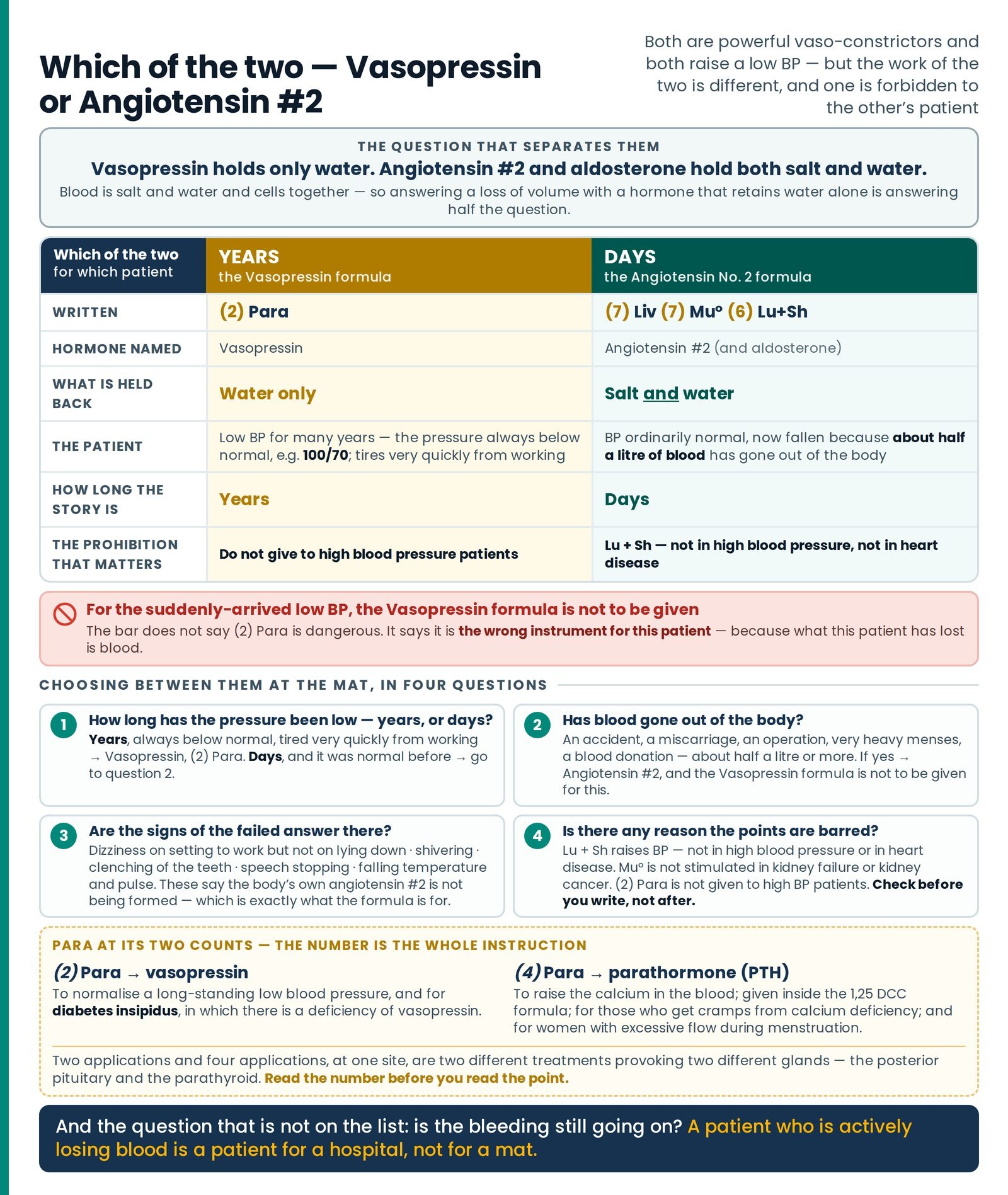
Vasopressin holds water only; angiotensin #2 holds salt and water
The question, and the answer that separates them
Question — the angiotensin #2 formula and vasopressin both raise the BP. So how will it be known which formula is to be used for which patient?
Answer. Angiotensin #2 and vasopressin are both powerful vaso-constrictors. Both raise the blood pressure, that is, they make a low BP normal. But the work of the two is different.
Vasopressin holds only water.
Angiotensin #2 and aldosterone — these hold both salt and water.
| Vasopressin formula | Angiotensin No. 2 formula | |
|---|---|---|
| Written | (2) Para | (7) Liv (7) Mu° (6) Lu+Sh |
| Hormone named | Vasopressin | Angiotensin #2 (and aldosterone) |
| What is held back | Water only | Salt and water |
| The patient | Low BP for many years — the pressure always below normal, e.g. 100/70; tires very quickly from working | BP ordinarily normal, now fallen because about half a litre of blood has gone out of the body |
| How long the story is | Years | Days |
| The prohibition that matters | Do not give to high blood pressure patients ▲ Take care | Lu + Sh — not in high blood pressure, not in heart disease ▲ Take care |
Where they came from
A bottle of multivitamin tablets, a question asked, and four treatments
Once Guruji, Kamlesh Didi, Shri Piyush Panchal ji and some other therapists were sitting and having some discussion about the formulas. Then Piyush ji asked Guruji why some such treatment should not be made from which everybody would get energy — that is, strength. At that very moment a bottle of multivitamin tablets came into his hand; and looking at it, the names Vitamin B₁₂, calcium and so forth were on it.
Until then, separate treatments were already being given to raise calcium, sodium and so on. After Piyush ji's question this thought came — why not join these together and make one treatment? From that thought came four treatments.
At present these are four separate treatments, which correct the deficiency of sugar, sodium, calcium and vitamin B₁₂ and so forth in the body. Often it is from the deficiency of these things that a person feels tired for no reason. So when the appropriate formula is given to remove their deficiency, the patient's tiredness goes away at once. Hence these are called Multivitamin formulas, because if there is weakness in the body, doctors often tell people to take multivitamin tablets.
The four Multivitamin formulae, and the rule that governs them
1.
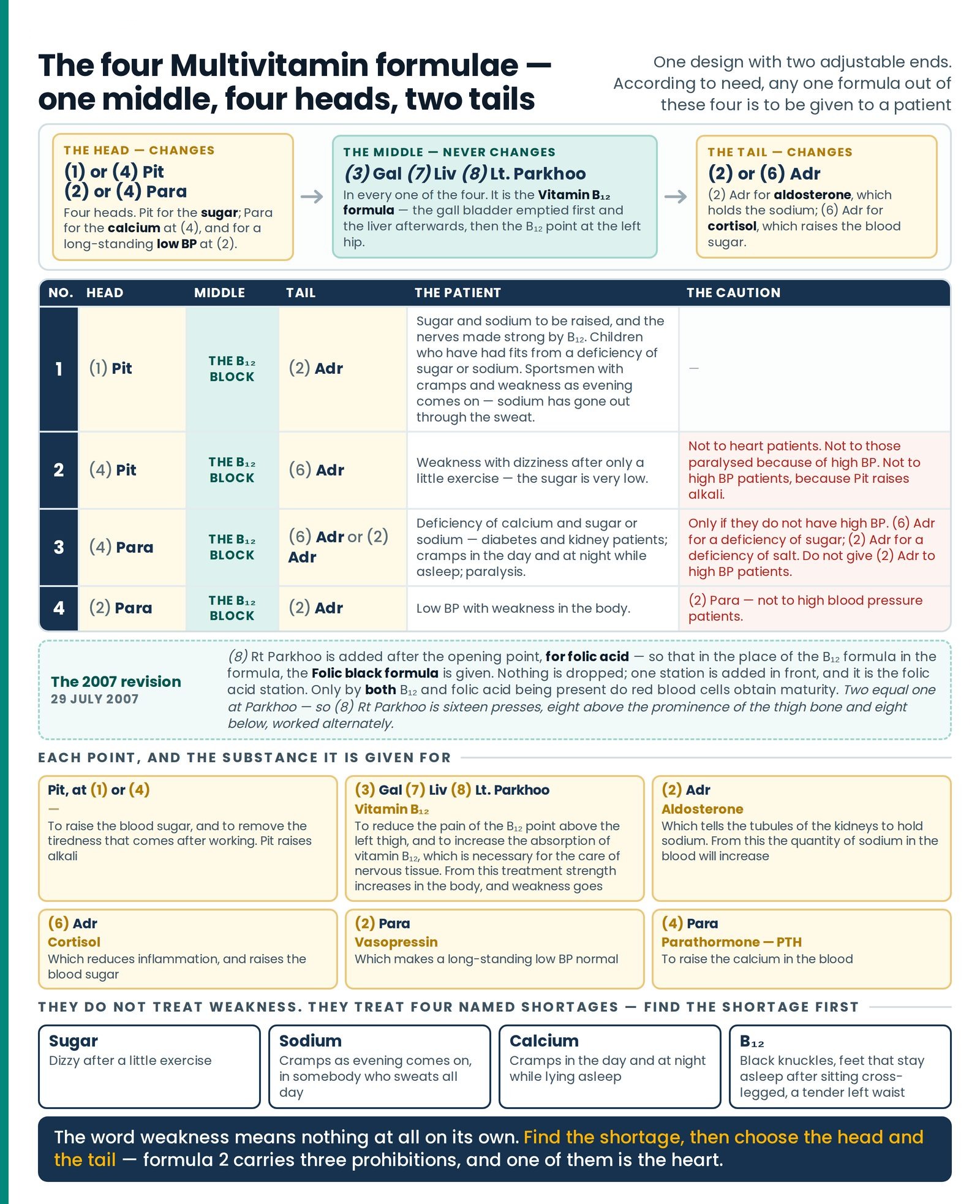
(1) Pit (3) Gal (7) Liv (8) Lt. Parkhoo (2) Adr 2. (4) Pit (3) Gal (7) Liv (8) Lt Parkhoo (6) Adr 3. (4) Para (3) Gal (7) Liv (8) Lt. Parkhoo (6) Adr or (2) Adr 4. (2) Para (3) Gal (7) Liv (8) Lt. Parkhoo (2) Adr
According to need, any one formula out of these four is to be given to a patient.
Look at the four lines together before you learn any of them separately, because they are one design with two adjustable ends. (Figure 35.6)
The middle three steps never change. (3) Gal (7) Liv (8) Lt. Parkhoo stands in every one of the four — and you already know it, whole, from the previous article: it is the Vitamin B₁₂ formula, the gall bladder emptied first and the liver afterwards, then the B₁₂ point at the left hip.
What changes is the head and the tail. The head is either Pit or Para, at one of two counts. The tail is Adr, at one of two counts. Four heads, two tails, and the whole clinical decision lives in those two brackets.
Table 17 — Each point of the Multivitamin formulae, and the substance it is given for
| Point and count | Substance named | What it is there for |
|---|---|---|
| Pit, at (1) or (4) | — | To raise the blood sugar, and to remove the tiredness that comes after working. Pit raises alkali |
| (3) Gal (7) Liv (8) Lt. Parkhoo | Vitamin B₁₂ | To reduce the pain of the B₁₂ point above the left thigh, and to increase the absorption of vitamin B₁₂, which is necessary for the care of nervous tissue. From this treatment strength increases in the body, and weakness goes |
| (2) Adr | Aldosterone | Which tells the tubules of the kidneys to hold sodium. From this the quantity of sodium in the blood will increase |
| (6) Adr | Cortisol | Which reduces inflammation, and raises the blood sugar |
| (2) Para | Vasopressin | Which makes a long-standing low BP normal |
| (4) Para | Parathormone — PTH | To raise the calcium in the blood |
That table is the whole grammar of the family. Four substances — sugar, sodium, calcium, B₁₂ — and a point for each, with the B₁₂ block sitting permanently in the middle because it is the one every tired body is assumed to want.
Which formula for which patient
Four named shortages — sugar, sodium, calcium, B₁₂ — one formula each
Formula 1 — (1) Pit (3) Gal (7) Liv (8) Lt. Parkhoo (2) Adr
Use — to raise sugar and sodium, and to make the nerves strong by means of B₁₂.
Especially those children who have had fits from a deficiency of sugar or sodium.
Or sportsmen who say that as evening comes on they feel something like cramps and weakness. Weakness in the evening means that sodium has gone out through the sweat. They have a deficiency of sodium, so (2) Adr will benefit them, because with (2) Adr we provoke aldosterone, which will stop the salt from going out.
Formula 2 — (4) Pit (3) Gal (7) Liv (8) Lt Parkhoo (6) Adr
Use — those who feel weakness, and who get dizziness after only a little exercise. This means the quantity of sugar in their body is very low. For them this treatment is excellent.
Formula 3 — (4) Para (3) Gal (7) Liv (8) Lt. Parkhoo (6) Adr or (2) Adr
Those who have a deficiency of calcium and sugar or sodium may be given this — such as diabetes and kidney patients, or those who get cramps in the day and also at night while lying asleep.
Those who have paralysis may also be given it, if they do not have high BP.
To those who have a deficiency of sugar, give (6) Adr.
To those who have a deficiency of salt, give (2) Adr. To high BP patients, do not give (2) Adr. ▲ Take care
Formula 4 — (2) Para (3) Gal (7) Liv (8) Lt. Parkhoo (2) Adr
This is good for those who have low BP and weakness in the body.
Formula 4 is worth a second look, because it is the only place in the wiki where (2) Para appears inside a longer formula. The Vasopressin formula is two applications on its own; here those same two applications open a five-step sequence, and the reason is stated in the point table: (2) Para for vasopressin, which makes a long-standing low BP normal. The patient is the same patient — low pressure of long standing — with weakness in the body on top of it, and the weakness is what the other four steps are for.
| Formula | Head | Tail | The patient | The caution |
|---|---|---|---|---|
| 1 | (1) Pit | (2) Adr | Sugar and sodium to be raised, and the nerves made strong by B₁₂. Children who have had fits from a deficiency of sugar or sodium. Sportsmen with cramps and weakness as evening comes on — sodium has gone out through the sweat | — |
| 2 | (4) Pit | (6) Adr | Weakness with dizziness after only a little exercise — the sugar is very low | Not to heart patients. Not to those paralysed because of high BP. Not to high BP patients, because Pit raises alkali ▲ Take care |
| 3 | (4) Para | (6) Adr or (2) Adr | Deficiency of calcium and sugar or sodium — diabetes and kidney patients; cramps in the day and at night while asleep; paralysis | Only if they do not have high BP. (6) Adr for a deficiency of sugar; (2) Adr for a deficiency of salt. Do not give (2) Adr to high BP patients ▲ Take care |
| 4 | (2) Para | (2) Adr | Low BP with weakness in the body | (2) Para — not to high blood pressure patients ▲ Take care |
The inherited bars, once, for all four. Pit — not to diabetic patients, because it raises sugar; it raises alkali, so not to high blood pressure, cancer and fits patients; perhaps low blood pressure patients will benefit. Para — (4) Para is not given separately by itself to those who have osteoporosis; they must be given the full 1,25 DCC formula; (2) Para not to high blood pressure patients. Gal — not in leukaemia, blood cancer or other diseases arising from a raised white cell count; not in asthma; not to those passing little urine. Liv — not in liver cancer. Lt. Parkhoo — no prohibition is printed for this point. Adr — (2) Adr not to high blood pressure patients; (6) Adr reduces immunity, so not in septicaemia, AIDS, HIV or cancer, and reduces acid and raises alkali, so not in high blood pressure. ▲ Take care
The 2007 revision — the right hip comes in
(8) Rt Parkhoo added for folic acid: the middle becomes Folic Black
A thought that came at the time of writing this — 29.07.2007
It seems that from now on (8) Rt Parkhoo should also be added into the Multivitamin formula — for folic acid.
That is, in the place of the B₁₂ formula in the formula, the Folic black formula is to be given.
Table 19 — The four Multivitamin formulae as revised, 29 July 2007
| No. | Step 1 | Step 2 | Step 3 | Step 4 | Step 5 | Step 6 |
|---|---|---|---|---|---|---|
| 1 | (1) Pit | (8) Rt Parkhoo | (3) Gal | (7) Liv | (8) Lt. Parkhoo | (2) Adr |
| 2 | (4) Pit | (8) Rt Parkhoo | (3) Gal | (7) Liv | (8) Lt Parkhoo | (6) Adr |
| 3 | (4) Para | (8) Rt Parkhoo | (3) Gal | (7) Liv | (8) Lt. Parkhoo | (6) Adr or (2) Adr |
| 4 | (2) Para | (8) Rt Parkhoo | (3) Gal | (7) Liv | (8) Lt. Parkhoo | (2) Adr |
Notice what the revision actually does. The three B₁₂ steps in the middle are replaced, as a block, by the four steps of Pure Folic Black — (8) Rt Parkhoo (3) Gal (7) Liv (8) Lt. Parkhoo, the right hip and then the whole B₁₂ formula. Nothing is dropped; one station is added in front, and it is the folic acid station. The reason is the one the vitamin article makes its whole argument out of: only by both B₁₂ and folic acid being present do red blood cells obtain maturity. A family of formulas written for tiredness that had only half of that pair in it was going to be improved by having both.
Two equal one at Parkhoo — so (8) Rt Parkhoo is sixteen presses, eight above the prominence of the thigh bone and eight below, worked alternately; and the same for (8) Lt. Parkhoo. The technique, the side the patient lies on and the pillows between the knees are in On the Side, "On the Side".
This is one of the most consequential treatments in the wiki, and it is consequential twice over: once for what it does, and once because it is the gate a heart patient must pass through before another formula may be given at all.
The Angina treatment, or Athero treatment
I — (4) Medulla Clockwise, ↑ (Up Arrow) at T1/T2 + Raman trt + (10) Pan (2) Thrd
II — (1) Single point liver × 2 treatments
III — P. Heparin → (8) Pan (7) Liv (8) Ch. Only + Sulta Ulta (with the hand at 135°)
or, for those who have pain in Mu° and hard constipation, for them:
III — Mild ATF
IV — A. Heparin + Sulta Ulta (to be given with the hand placed up at 135°)
Main illnesses — heart disease; atherosclerosis; raised cholesterol; raised triglyceride; cardiac asthma; carpal tunnel syndrome or tarsal tunnel syndrome, and so on.
Table 20 — Card: the Angina / Athero treatment Seated Supine Side-lying Prone 6 sec ▲ Take care
| Written | I (4) Medulla Clockwise ↑ T1/T2 + Raman trt + (10) Pan (2) Thrd · II (1) Single point liver × 2 trts. · III P. Heparin + Sulta Ulta at 135° — or Mild ATF · IV A. Heparin + Sulta Ulta at 135° |
|---|---|
| What it is for | Heart disease · atherosclerosis · raised cholesterol · raised triglyceride · cardiac asthma · carpal tunnel syndrome or tarsal tunnel syndrome, and so on |
| What selects the alternative part III | Pain in Mu° and hard constipation → Mild ATF in place of P. Heparin |
| Sulta Ulta, exactly | Supine. Ordinarily the arm at 90°; for those who have angina or heart disease, keep both arms extended — not parallel to the shoulders but a little upward, at 135°, or as far up as they will go. Powder from elbow to fingers. The soft part of the sole only: six times elbow → wrist with light pressure, then six times wrist → fingertips with a little more pressure, palm up (sulta); then all of it again palm down (ulta). It is not necessary to give both sides at the same time. Give the left side first and the right afterwards. With sulta the pain of the front of the chest goes out; with ulta the pain of the part of the back behind that same place goes out Left Right |
| Why (2) Thrd and not (4) Thrd | In angina — that is, in heart patients — to reduce cholesterol, (2) Thrd is given in place of (4) Thrd. And the reason (4) Thrd is withheld: (4) Thrd raises metabolism, and when the metabolism increases too much there can also be trouble — therefore (4) Thrd is not given to heart patients ▲ Take care |
| What it inherits | Pan — raises alkali, therefore not in fits, convulsions or seizures; never to schizophrenia patients. Liv — not in liver cancer. Ch. Only — not in lung cancer. acid — not if there are loose motions, or if there is no pain at Mu°. For the heart patient the contraindication card blocks (10) Medulla, (20) Medulla, (30) Medulla, Lu + Sh, Swt, Katka, Loveleen, Thymus and (4) Thrd ▲ Take care |
| Points and formulas taught in | Medulla — Seated I — Brain, Medulla, Neck, "Seated — I"; Raman and Neck Clockwise — Seated I — Brain, Medulla, Neck; the arrows — Face Down, "Face Down"; Pan, Liv — The Front of the Body I; Thrd, Ch. Only, Sulta Ulta — The Front of the Body II; P. Heparin and A. Heparin — The River — Heparin, "The River"; Mild ATF — Correcting the Two Kingdoms |
The rule that makes this a gate
The Angina treatment only, two to four days, before Vater may be touched
There is a second thing in that rule worth naming out loud, because students miss it. The graded Medulla series carries its own heart rule, and it is a substitution and not a refusal. (10) Medulla is not withheld from a heart patient; (10) Left Medulla is named as the half that may be given — and side is part of the identity of a point, not a detail of technique. That instruction belongs to (10) and travels with every formula containing (10) Medulla; it does not automatically attach to the other members of the graded series, each of which carries its own rules.
Why the upper back, when the trouble is the heart
A student's first question about part I is always the same: why does a treatment for angina begin at the neck and the T1/T2 beads?
Because that is where the heart reports. The nerves that carry sensation from the heart run with the sympathetic supply and enter the spinal cord at the upper thoracic segments, where they arrive at the same cells that carry sensation from the chest wall and the inner arm. That convergence is the reason a heart complains in the chest, the jaw and the left arm rather than in the heart — the plainest example of referred pain in the whole of physiology.
So a treatment that addresses the upper thoracic segments for a cardiac complaint is working on the segment the heart itself uses to speak. And Sulta Ulta — six passes down the arm palm up for the front of the chest, six palm down for the back behind it — is working the territory that shares those cells.
How the formula came to have a tail
A formula that reaches the acid–alkali machinery must put something back
In this therapy we use the WD point to provoke the reproductive organs. To provoke the organs below the navel we give the New Genes formula; and if there is severe pain there, then in it, in place of Chest Only we give Thymus Chest. We use this in problems of the uterus or the prostate gland.
The reasoning, exactly as it runs
In just the same way, to provoke the kidneys we use the Liv° – Mu° point.
From the experience of the Pure 1,25 DCC treatment, Guruji thought that provoking Liv° – Mu° alone could cause trouble to some patients. So, to make the acid–alkali balance, he began to give Ch. Only and ↑|↓ (Round Arrow) along with it —
— from which it was seen that patients get wonderful results.
That short passage is the reason of this article had to come first, and it is also the clearest demonstration anywhere of what the balance pair is for. A formula that provokes the two kidneys is a formula that reaches straight into the body's acid–alkali machinery — the left kidney filters acid, as you were told in the Angiotensin section — and a formula like that cannot be allowed to end where it stops. Something has to be put back.
You have met the same lesson from the other side. Pure 1,25 DCC has no balance pair, and both Pure formulas of the vitamin article carry a warning in the same words for exactly that reason. A formula that ends without a balance is a formula that leaves the patient somewhere.
The Kidney Clear formula
The old single form rebuilt as a staircase of four graded steps
The formula for provoking the kidneys is called the Kidney clear formula, of which there are two kinds — and we have to choose the appropriate formula according to the patient's condition on that day.
Kidney Clear — the earlier form, and the graded form
Earlier it was given as (7) Liv° (7) Mu° (8) Ch. Only (20) ↑|↓; afterwards it was changed into the following form —
I · (1) Liv° · (1) Mu° · (2) Ch. Only · (5) ↑\ · ↓
II · (3) Liv° · (3) Mu° · (4) Ch. Only · (10) ↑\ · ↓
III · (5) Liv° · (5) Mu° · (6) Ch. Only · (15) ↑\ · ↓
IV · (7) Liv° · (7) Mu° · (8) Ch. Only · (20) ↑\ · ↓
Table 21 — Kidney Clear: the old single form and the four graded steps
| Version | Liv° | Mu° | Ch. Only | Round Arrow ↑\ | ↓ |
|---|---|---|---|---|---|
| The earlier single form | 7 | 8 | 20 | ||
| Graded step I — this is Mild Kidney Clear | 1 | 2 | 5 | ||
| Graded step II | 3 | 4 | 10 | ||
| Graded step III | 5 | 6 | 15 | ||
| Graded step IV | 7 | 8 | 20 |
Look down the two right-hand columns. 2 and 5. 4 and 10. 6 and 15. 8 and 20. Every rung is the same two-to-five proportion of — and grade IV is exactly the old single form. The reform did not change the formula; it built a staircase up to it.
Mild Kidney Clear
Mild Kidney Clear → (1) Liv° (1) Mu° (2) Ch. Only (5) ↑|↓
This is graded step I of the Kidney clear formula, and it is also part IV of the light Jeevan Dhara, where it sits between Ajay Normal Mild and Mild Genes. It is the same four steps as grade IV at an eighth of the kidney count and a quarter of the tail, in the same order, with nothing dropped.
It has been owed to this article since APR — Abdominal Pain · The Medulla Family.
Table 22 — Card: the Kidney Clear formula Supine Prone 6 sec Left Right ▲ Take care
| Written | Kidney clear formula → (n) Liv° (n) Mu° (n) Ch. Only (n) ↑\ | ↓ — at grade I, II, III or IV |
|---|---|---|
| Positions, in order | Supine for steps 1–3 Supine → prone for the Round Arrow Prone | |
| Step 1 — Liv° | The right kidney code: single station beside the navel, hand contact high at the shoulder Right . Stimulates the function of the right kidney; reduces alkali in the blood; reduces pain in the right side of the back | |
| Step 2 — Mu° | The left kidney code, given the same way Left . Stimulates the function of the left kidney; reduces the acid of the blood; reduces pain in the left part of the back | |
| Step 3 — Ch. Only | Both soles glide from the chest up to the shoulders, three rubs counting as one, left side first, nothing counted on the return Left Right | |
| Step 4 — ↑\ | ↓ | The Round Arrow: down the right side of the beads to L5, round, and up the left; the pressure falling on the side of the beads each time Prone |
| Why steps 3 and 4 are there at all | Because provoking Liv° – Mu° alone could cause trouble to some patients — so Ch. Only and the Round Arrow are given to make the acid–alkali balance. of this article | |
| Choosing the grade | According to the patient's condition on that day. Begin low in the chronic, the elderly and the frail — a gland which is already spoiled should first be provoked less, which is Correcting the Two Kingdoms's light-treatment reasoning | |
| The substitution | If there is pain along with the stone, then in place of Ch. Only and ↑\ | ↓, give Th + Ch ▲ Take care |
| What it inherits | Liv° — do not stimulate it in kidney failure or kidney cancer. Mu° — do not stimulate it in kidney failure or kidney cancer; those who have pain only at Liv° — do not give it to them. Ch. Only — not in lung cancer. In chronic illness, all the arrows only as far as (L1–L5). Where Th + Ch is substituted, it carries its own bars in full — see the box below ▲ Take care | |
| Points taught in | Liv° and Mu° — The Front of the Body I; Ch. Only and Th + Ch — The Front of the Body II; the Round Arrow — Face Down |
Whom the Kidney Clear formula is for — the two-key rule
A complaint from one list and a finding from the other — never one alone
The conjunctive indication
The Kidney clear treatment is to be given to those who have low back pain, left kidney stone, ringworm (dād), itch (khāj), allergy, psoriasis, or any other dry skin disease — and who have any one of the following:
those who have a normal or hard motion, or constipation;
those who have equal pain in Liv° – Mu°, or more pain in Mu° and less in Liv°;
those women whose menses come for four days or more;
those who have other signs of acidosis, such as pain in the left ring finger, and so on;
and those whose BP remains normal, or sometimes becomes low.
This formula especially gives benefit to those children who have micro head or micro-cephalus — that is, a child whose head is smaller than other children's in comparison with the body.
Note — if there is pain along with the stone, then in place of Ch. Only and ↑|↓, give Th + Ch.
Two things about that indication are worth learning as craft, not just as content.
First, it is conjunctive. A complaint from the first group and at least one item from the second. That is a two-key rule, and it is far more disciplined than a list of diseases. A patient with psoriasis does not thereby get Kidney Clear; a patient with psoriasis and a hard motion, or and more pain at Mu° than at Liv°, does.
Second, look at what the second group is made of. It is almost entirely findings, not complaints: the relative tenderness of two named points, the duration of the menstrual period, one specific finger, the blood pressure. You are being told to examine before you choose — and exactly what to examine.
Table 23 — Whom the Kidney Clear formula is for
| The instruction | ||
|---|---|---|
| The presenting complaint — any one of: low back pain · left kidney stone · ringworm (dād) · itch (khāj) · allergy · psoriasis · any other dry skin disease | Give the Kidney clear formula — and any one of the findings below must also be present | |
| Normal or hard motion, or constipation | one of the qualifying findings | |
| Equal pain in Liv° – Mu°, or more pain in Mu° and less in Liv° | one of the qualifying findings | |
| Women whose menses come for four days or more | one of the qualifying findings | |
| Other signs of acidosis — such as pain in the left ring finger | one of the qualifying findings | |
| BP remains normal, or sometimes becomes low | one of the qualifying findings | |
| Micro head / micro-cephalus in children | This formula especially gives benefit | |
| Pain along with the stone | In place of Ch. Only and ↑\ | ↓, give Th + Ch ▲ Take care |
The Ulta Kidney Clear formula
Both pairs turned round, because the body's own direction has turned round
Why there is a second kind
But not everyone has the same symptoms every day.
When the body deteriorates, then some people show loose motions or other symptoms of alkali increasing. So, from sixty years of experience, the finding is that the order of the above formula is to be changed according to the patient's condition, in this manner —
I · (1) Mu° · (1) Liv° · (5) ↑\ · ↓ · (2) Ch. Only
II · (3) Mu° · (3) Liv° · (10) ↑\ · ↓ · (4) Ch. Only
III · (5) Mu° · (5) Liv° · (15) ↑\ · ↓ · (6) Ch. Only
IV · (7) Mu° · (7) Liv° · (20) ↑\ · ↓ · (8) Ch. Only
Two things have been turned round, and both matter. (Figure 35.7)
The kidneys have swapped places. Mu° — the left kidney, which filters acid — now comes first, and Liv°, the right kidney, follows. And the balance pair has swapped too. The Round Arrow comes first and Ch. Only afterwards.
That is precisely the ulta operation you met once already, in Ulta 1,25 DCC — Mu° is to be given first and Liv° afterwards; and (20) ↑|↓ is to be given first and (8) Ch. Only afterwards. One operation, performed on two different formulas, for the same reason: the patient's own direction has turned round, so the order that addresses it turns round with it. Counts unchanged; proportion unchanged; only the order reversed.
| Grade | Kidney Clear | Ulta Kidney Clear | ||
|---|---|---|---|---|
| I | (1) Liv° (1) Mu° (2) Ch. Only (5) ↑\ | ↓ | (1) Mu° (1) Liv° (5) ↑\ | ↓ (2) Ch. Only |
| II | (3) Liv° (3) Mu° (4) Ch. Only (10) ↑\ | ↓ | (3) Mu° (3) Liv° (10) ↑\ | ↓ (4) Ch. Only |
| III | (5) Liv° (5) Mu° (6) Ch. Only (15) ↑\ | ↓ | (5) Mu° (5) Liv° (15) ↑\ | ↓ (6) Ch. Only |
| IV | (7) Liv° (7) Mu° (8) Ch. Only (20) ↑\ | ↓ | (7) Mu° (7) Liv° (20) ↑\ | ↓ (8) Ch. Only |
Table 25 — Card: the Ulta Kidney Clear formula Supine Prone 6 sec Left Right ▲ Take care
| Written | Ulta Kidney clear formula → (n) Mu° (n) Liv° (n) ↑\ | ↓ (n) Ch. Only — at grade I, II, III or IV |
|---|---|---|
| The presenting complaint | Back pain · right kidney stone — and any one of the findings below | |
| The qualifying findings | More pain in Liv° and less pain in Mu° · soft or loose motions · women whose menstrual flow is very scanty, or comes for only a day or two · those in whose body swelling comes which is not there at night, is there on rising in the morning, and reduces after some hours · those who have ringworm, itching, or any other skin disease from which water keeps coming out · other symptoms of alkalosis, such as pain in the right ring finger and the like · those who have high BP, either off and on or always | |
| Positions, in order | Supine for the two kidney codes and — after the Round Arrow — for Ch. Only. The patient is turned prone for the arrow between them Supine Prone | |
| The substitution | If someone has pain along with the stone, then in place of the Round Arrow and Ch. Only, give Th + Ch — with everything the box above says about what that brings with it ▲ Take care | |
| The stop rule | The Ulta formulas work against peristalsis and are given for a limited time only; after a few days the Normal formula must be given to bring the body back — rule four of sequence, How a Formula Is Built ▲ Take care | |
| What it inherits | As Table 22 — Liv° and Mu° not stimulated in kidney failure or kidney cancer; Ch. Only not in lung cancer; in chronic illness all the arrows only as far as (L1–L5) ▲ Take care |
Table 26 — Which of the two, on the findings
| Finding | Kidney Clear | Ulta Kidney Clear |
|---|---|---|
| The stone | Left kidney stone | Right kidney stone |
| The complaint | Low back pain | Back pain |
| The two kidney points | Equal pain, or more at Mu°, less at Liv° | More at Liv°, less at Mu° |
| The motions | Normal or hard, or constipation | Soft or loose |
| The menses | Come for four days or more | Very scanty, or for only a day or two |
| The skin | Ringworm, itch, allergy, psoriasis, any dry skin disease | Ringworm, itching, any skin disease from which water keeps coming out |
| The ring finger | Pain in the left ring finger — acidosis | Pain in the right ring finger — alkalosis |
| The blood pressure | Normal, or sometimes low | High, off and on or always |
| Swelling | — | Swelling not there at night, there on rising in the morning, reducing after some hours |
Read that table down rather than across and something becomes obvious: it is the two kingdoms, on one page, in nine rows. Dry skin against weeping skin. Hard stool against loose. Left ring finger against right. Low pressure against high. The formula is not chosen by the disease at all. It is chosen by which direction this body is leaning today — which is why one patient can need the plain form one month and the ulta form the next, and why the material says exactly that: not everyone has the same symptoms every day.
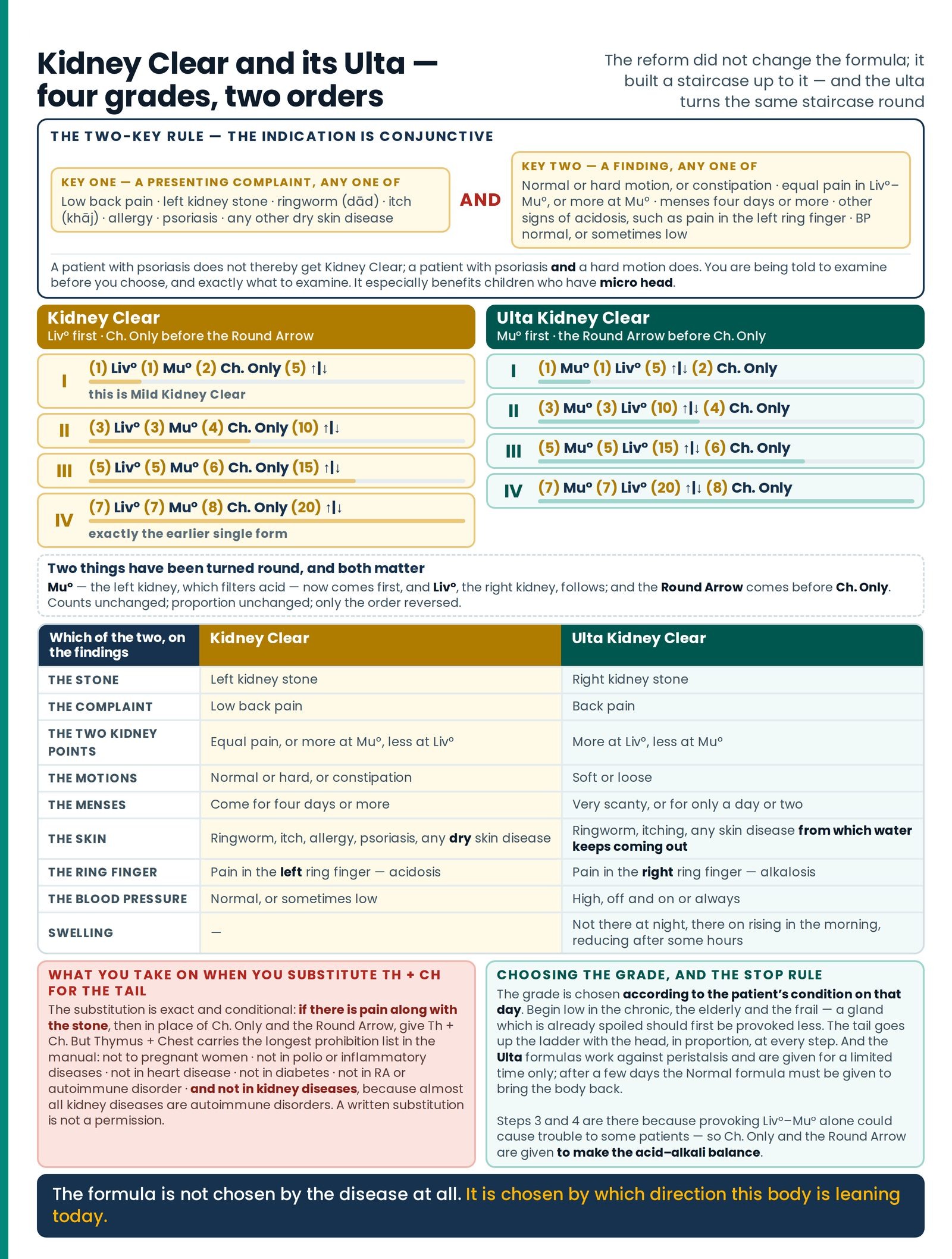
What else the Kidney Clear treatments are used for
Pneumonia, CP children, swelling — and one question left open
Pneumonia, the kidneys, and a question left open
In the disease called pneumonia, a bad effect falls upon the kidneys.
For that too, the appropriate Kidney clear treatment is to be given according to the condition of the body. This treatment is also to be given to those who have come to us for some other illness and, on asking, we learn that they had pneumonia at some time in childhood.
This treatment will also give benefit to those children who have loose motions three or four times a day — as is found in some CP children.
And one thing more, which is written as a question and stays one. One function of dopamine is to increase the blood flow in the kidneys. So for problems of the kidneys, will (20) Medulla also be beneficial? Further research is to be done on this.
That last paragraph is the whole of the K in ADK, arrived at from the other end — and the open question in it is the same open question as the one attached to the Angiotensin formula a a little earlier. Two independent lines of reasoning have both arrived at this is to be tested, and neither has been tested. That is where the material stands and this wiki leaves it standing.
Two further observations belong here, both from practice rather than from theory.
The son of Shri Anil Bhalerao ji of Pune had pimples — that is, acne — and allergy, and along with it Gal +++. Shri Bhalerao gave the New Gal formula on the first day, and on the second day the New Gal formula together with the Kidney clear treatment. The next morning all the pimples came out. The face was so clean that it was beyond belief.
And a second observation of Bhalerao ji's: if there is swelling in the body — whether it be because of the heart or because the kidneys are not working properly — then giving that patient (10) Pan × 3 treatments often brings benefit. If full benefit is not obtained from that, then afterwards the appropriate Kidney clear treatment can be given.
The Anil Sharma treatment
A gate before the formula, and a rotation that pays back what Adr takes
Not every formula in this wiki was made by Guruji, and this one says so on its face.
The Anil Sharma treatment
If there is no pain in Mu°, it is not to be given.
(5) Pan (3) Gal (5) Liv (7) Mu° (3) acid (3) WD (3) Pit (6) Adr
This treatment was made by Guruji's very old student Shri Anil Sharma ji, who nowadays does neurotherapy practice in London. This formula is a very good treatment for reducing acid.
Since giving Adr will make the Thymus hypo — that is, it will work less — therefore, so that the body's immunity does not fall, after every 4 treatments, in one treatment give (4) Thymus + Chest in the place of (6) Adr.
Main illnesses — those who have joint pain because of acid (give only if there is considerable pain in Mu°); gout, that is gathiyā, where uric acid is raised; Bamboo spine; cervical or lumbar spondylitis.
Table 27 — Card: the Anil Sharma treatment Supine Side-lying Prone 6 sec Left ▲ Take care
| Written | Anil Sharma treatment → (5) Pan (3) Gal (5) Liv (7) Mu° (3) acid (3) WD (3) Pit (6) Adr |
|---|---|
| The gate | If there is no pain in Mu°, it is not to be given ▲ Take care |
| Positions, in order | Supine for steps 1–4 and 6–7 Supine → side-lying for the acid point Side-lying → prone for Adr Prone |
| Step 1 — (5) Pan | Supine; both thighs together, soft mid-sole on the upper third of each Both sides |
| Step 2 — (3) Gal | The therapist's right sole down the patient's left thigh, hip crease → knee Left |
| Step 3 — (5) Liv | Supine; right of the navel, ring 2 — the Liv – 3 points contact |
| Step 4 — (7) Mu° | The left kidney code, single station, hand contact high at the shoulder Left . This is the step the gate is about |
| Step 5 — (3) acid | The Acid point, side-lying Side-lying — On the Side, "On the Side" |
| Step 6 — (3) WD | Supine; the WD station, opposite Pan across the navel — The Front of the Body I |
| Step 7 — (3) Pit | The pituitary contact, elbow and shoulder places, four equal one — The Front of the Body II |
| Step 8 — (6) Adr | Prone; fingers gathered, both palms very close together at the T6 bead Prone |
| The rotation that protects immunity | After every 4 treatments, in one treatment give (4) Thymus + Chest in the place of (6) Adr — because giving Adr will make the Thymus hypo, and the body's immunity must not be allowed to fall ▲ Take care |
| What it is for | Joint pain because of acid — give only if there is considerable pain in Mu° · gout (gathiyā), uric acid raised · Bamboo spine · cervical or lumbar spondylitis. Some therapists of Punjab have the experience that this treatment also stops leucorrhoea — the going of white water — in women |
| What it inherits | Pan — raises alkali, so not in fits, convulsions or seizures; never to schizophrenia patients. Gal — not in leukaemia, blood cancer or other diseases from a raised white cell count; not in asthma; not to those passing little urine. Liv — not in liver cancer. Mu° — not stimulated in kidney failure or kidney cancer. acid — not if there are loose motions, or if there is no pain at Mu°. WD — this stimulates the genital organs, so perhaps it will also stimulate oestrogen; therefore do not give in cancer. Pit — not to diabetic patients, because it raises sugar; it raises alkali, so not to high blood pressure, cancer and fits patients. Adr — reduces immunity, so not in septicaemia, AIDS, HIV or cancer; reduces acid and raises alkali, so not in high blood pressure. On the rotation days, Th + Ch carries its own full list — not in pregnancy, polio, inflammatory disease, heart disease, diabetes, RA, autoimmune disorder or kidney disease ▲ Take care |
| Points taught in | Pan, Gal, Liv, Mu°, WD — The Front of the Body I; acid — On the Side; Pit — The Front of the Body II; Adr — Face Down; Th + Ch — The Front of the Body II |
Three things in that card repay study, and they are all about discipline rather than content.
One — the gate is written before the formula, not after it. If there is no pain in Mu°, it is not to be given. You have met that shape once before, at the head of ATF: no Mu°⁺⁺⁺, no acid treatment. Both formulas exist to reduce acid; both refuse to be given to a body that has not first demonstrated it has any.
Two — the rotation is an answer to a cost, and the cost is named. Adr is in this formula eight times out of nine visits, doing the work it is there to do; and eight visits out of nine the thymus is being pushed down as a consequence. So one visit in five the tail changes, and the thymus is given back what it has been losing. That is a planned repair of a known side-effect, written into the schedule instead of waited for.
Three — the rotation is not free either. The day you give (4) Thymus + Chest is the day the thymus bars apply, and there are eight of them. A patient who is diabetic, or has rheumatoid arthritis, or is pregnant, or has a kidney disease cannot have the rotation day — and that is a fact about that patient, to be written on the card, not a fact about the formula.
The Oxygen-Hormonal treatment
Twelve parts, taught to a mother and a father rather than given by a therapist
This is the longest single treatment in the wiki — twelve numbered parts — and it is also the one most often taught to a family rather than given by a therapist.
The Oxygen-hormonal treatment
I — (2) \°/ Back Arrow (1) ↑o↑ H Arrow (3) Organ clearance (5) On the spine, Round Arrow, Beside the spine II — (1) Liv° (1) Mu° III — (2) Ch. Only IV — (3) Folded legs (6) TF (3) NNS V — (3) Raman × 1 treatment VI — (2) Folic VII — (2) Thia VIII — (2) B₁₂ IX — (2) Nia X — (10) Medulla + Fast Gas : Gas 'I' : Gal : Spl : Liv : Mu XI — (1) Pit (1) Thrd (1) Adr (½) Ku – 20 secs — to make the hormones XII — Ajay Normal — (8) Pan (1) Gal (2) Liv – 3 points (1) Gas 'I' – 6 points
Table 28 — Card: the Oxygen-Hormonal treatment, part by part Prone Supine Side-lying Seated 6 sec ▲ Take care
| Part | What is given | How |
|---|---|---|
| I | (2) Back Arrow \°/ | Prone. With the soft part of the sole, from the middle of the back toward the shoulder, and from the shoulder to the middle part of the upper arm, light rubbing. First the left side, then the right. Its other name is Blood supply to lungs Prone Left Right |
| I | (1) H Arrow ↑o↑ | Between both shoulders, on both sides of the C7 bone, rub from below upward. The count is three equal one |
| I | (3) Organ clearance | Prone or seated; the palm on the back, fingers pointing toward the side of the body, thumb toward the head. First rub lightly over and around the spinal column from above downward and then, without lifting the hand, from below upward; then from right to left and from left to right. Begin from behind the neck and descend at very small intervals. Three times at every place |
| I | (5) On the spine, Round Arrow, Beside the spine | The three spinal strokes, five each. On the spine: the edge of the big thumb, neck → L5, then below L5 upward to T1. Round Arrow: down the right side of the beads to L5, up the left, the pressure on the side of the beads. Beside the spine: first and middle fingers on both sides of the column, pressed downward and inward, neck → L5, then without lifting the hand L5 → C7 |
| II | (1) Liv° (1) Mu° | Supine. The two kidney codes at their lowest count Supine |
| III | (2) Ch. Only | Supine. Six rubs a side — three rubs count as one — left first, chest up to the shoulders, nothing counted on the return Left Right |
| IV | (3) Folded legs | Supine. Both heels close to the buttocks; the patient's thumbs closed inside the palms, fists made, placed beside the navel, closed palm facing downward. Holding the legs in the middle and lifting, fold them from the knees towards the chest; after a few moments, when the patient is breathing out, press the fists downward and inward into the abdomen with their thighs; lift again after a few moments. The time for which it is kept pressed down should be only as long as the patient is comfortable ▲ Take care |
| IV | (6) TF — Toe Fingers | At the feet; the therapist seated facing the soles. At every joint of the toes, rub the three sides six times, counting as you go, so that the nerves under the skin are roused — but not so hard that a wound is made there. If nothing is written, start from the big toe of the left foot to the little toe, then the right side |
| IV | (3) NNS — New Nabhi Set | Pressing with the thumb at each joint of the toes in order, bend the toe downward toward the sole and stay six seconds; three times on each toe. Big toe of the left foot to the little toe, then the right. If the patient has pain, a pillow may be given under the foot — placed so that the heel stays outside the pillow |
| V | (3) Raman × 1 treatment | Seated. Both hands over the shoulders from behind, first fingers close to the neck, palms close to one another; lift the muscles of the back upward from both sides, hold six seconds, release slowly — three times; then the patient breathes in and out comfortably five or six times Seated 6 sec |
| VI–IX | (2) Folic (2) Thia (2) B₁₂ (2) Nia | The four vitamin-formation stations, side-lying, chest normal and knees straight with the body — not near the chest, a pillow between both thighs. Folic: on the left side, the right hip, pressure toward the knees. Thia: left side, right hip, toward the head. B₁₂: on the right side, the left hip, toward the knees, releasing immediately. Nia: right side, left hip, toward the head, releasing immediately Side-lying |
| X | (10) Medulla + the Fast run | Seated for the Medulla; then the Fast treatment, Gas : Gas 'I' : Gal : Spl : Liv : Mu, in which no six-second hold is counted — do not stay more than one or two seconds at any point Seated Supine |
| XI | (1) Pit (1) Thrd (1) Adr (½) Ku – 20 secs | To make the hormones. (½) Ku – 20 secs: the patient laid so that both heels face each other; the therapist sits between the feet and, with the middle part of the sole at normal pressure, presses the last end of the spinal column, holds twenty seconds, and releases comfortably. (½) Ku – 20 secs is for neutrophils, which will fight infection Prone |
| XII | Ajay Normal | (8) Pan (1) Gal (2) Liv – 3 points (1) Gas 'I' – 6 points. Given in place of part XI for the first month or so — see the method below. Setting the Stomach Supine |
Main illnesses — abdomen disorder · M.S. (multiple sclerosis) · back pain · mental retardation · neuropathy · myopathy · M.N.D. (motor neuron disorder).
And this same treatment has also been found very useful for:
Low count of platelets — as happens in the illness called ITP, idiopathic thrombocytopenic purpura
Any genetic illness
S.L.E., scleroderma, or any other auto-immune disorder
Table 29 — The arrow glyphs used in this treatment
| The glyph, described | Code | Full name | |
|---|---|---|---|
| A small circle flanked by inward-leaning oblique strokes | \°/ | Back Arrow, also Blood supply to lungs | |
| Two upward arrows with a small circle between them | ↑o↑ | H Arrow | |
| A ring-topped stem with a downward arrowhead | — | On the spine | |
| An upward arrow, a ring-topped stem, and a downward arrow | ↑\ | ↓ | Round Arrow |
| A double-headed arrow, a ring-topped stem, and a second double-headed arrow | — | Beside the spine | |
| A plain ring-topped stem with no arrowhead | — | Up Arrow | |
| A double-headed horizontal arrow | ←→ | Stretch |
The month that the hormones wait
Until the abdomen is completely all right, the hormones are not to be provoked
That instruction is the whole philosophy of this therapy compressed into one schedule. Every gland takes its raw materials from the end products of digestion. So a treatment whose last part is to make the hormones is a treatment that cannot work until the supply line is open — and rather than hope, the treatment withholds its own most important part for a month and puts a digestive formula in its place.
A householder's version: you do not send the tailor an order for six shirts until the cloth has arrived in the shop. Sending it earlier does not get the shirts sooner. It gets you a tailor with nothing to work with and an order he cannot fill.
Table 30 — The three-month schedule for M.N.D. and myopathy
| Period | Component I | Component II | How often |
|---|---|---|---|
| Month 1 | Oxygen-hormonal treatment | — | Daily, at least once a day |
| From month 2 | Oxygen-hormonal treatment | (15) Medulla | × 6 treatments |
| From month 3 | Oxygen-hormonal treatment | (15) Medulla | × 12 treatments |
The rest between rounds of a Medulla line is one and a half minutes — Table 8, How a Formula Is Built. Twelve rounds is therefore not merely twice six; it is a considerably longer sitting, and a family taught to give it must be told so.
The Oxygen formula
Ten steps that open the chest, work the whole spine, and open it again
The Oxygen formula
(8) Ch. Only (6) ←→ (6) \°/ (3) ↑o↑ (20) On the spine · Beside the spine · Round Arrow + (6) \°/ (3) ↑o↑ (6) ←→
Every step of this one carries its own stated reason, and the reasons read like a single argument about breathing.
Table 31 — Card: the Oxygen formula, with the purpose of every step Supine Prone 6 sec ▲ Take care
| Step | What is given | Why it is there |
|---|---|---|
| 1 | (8) Ch. Only Supine | To clean the lungs |
| 2 | (6) ←→ — Stretch | Opens the muscles of the neck so that one can breathe well |
| 3 | (6) \°/ — Back Arrow Prone | To increase the supply of blood to the lungs |
| 4 | (3) ↑o↑ — H Arrow Prone | So that through the nerves of T1/T2 the message reaches the nerves of the brain properly |
| 5 | (20) On the spine Prone | To set right the circulation of blood in the whole body |
| 6 | (20) Beside the spine Prone | To set right the circulation of blood in the whole body |
| 7 | (20) Round Arrow Prone | To set right the circulation of blood in the whole body |
| 8 | (6) \°/ — Back Arrow | As given above — repeated |
| 9 | (3) ↑o↑ — H Arrow | As given above — repeated |
| 10 | (6) ←→ — Stretch | As given above — repeated |
| What it is for | To increase the quantity of oxygen in the tissues and cells of the body | |
| The dose limit | In chronic illnesses, all the arrows are to be given only as far as (L1–L5) ▲ Take care | |
| What it inherits | Ch. Only — not in lung cancer ▲ Take care | |
| Points taught in | Ch. Only and Stretch — The Front of the Body II; the arrows and the spinal strokes — Face Down, "Face Down" |
Notice the shape: three, then twenty, then the same three again, in reverse. The formula opens the chest and the neck, does its long work on the whole spine, and then opens the chest and neck a second time on the way out. It is one of the very few formulas in the wiki that closes by repeating its own opening, and a therapist who leaves off the last three steps because they look like a duplication has given a different treatment.
Why this treatment has become so useful, and what happens in the gut
It has been seen that in today's times this treatment is very good.
The reason is this:
The lungs become clean and the flow of blood in them increases, from which every gland of the body gets blood filled with more oxygen, from which their capacity to do their work increases — and whatever work they were not doing before, or whatever enzyme or hormone or chemical they were not making, they begin to make.
The second thing is that in the intestines there are villi, which, if they do not get plentiful oxygen, become as if half-dead, and their capacity to work falls, from which they reduce or stop the absorbing of all the nutrients — the nourishing elements. As soon as they get blood filled with oxygen, they begin to work fully and correctly, from which every organ of the body gains great benefit, and the chemicals and so on which were not being made before begin to be made.
Read those two paragraphs together and you have the reason this article contains an oxygen treatment at all. Every other formula here asks an organ to make something — angiotensinogen, renin, ACE, vasopressin, aldosterone, PTH, cortisol. This one does not ask for a substance. It asks for the condition under which any of them can be made, and then gets out of the way.
The villi are the part patients understand at once. The lining of the intestine is not smooth; it is a carpet, and each thread of the carpet is a little finger with a blood vessel and a lymph channel inside it. A carpet starved of oxygen is a carpet that stops picking things up. Everything this wiki says about digestion supplying the glands runs through those threads, and they need air like anything else.
And there is a reason the villi are the part of the gut that shows it first. The cells at their tips sit at the far end of a very long supply line, on the last of the blood in the vessel, and they are replaced every few days — so the tip of a villus is the first part of the gut to suffer a shortage of air and the first to recover from one. A therapy that treats the lungs in order to reach the intestine is not making a poetic connection. It is following a blood supply.
How this formula got its name, and when
Named on reasoning, without a test — measured four years later, by accident
Here the therapy says something about itself that a tidier account would have left out, and it is left in. Read it exactly as it stands.
The name, and the moment it was given
Some years ago, around the year 2000, I made a treatment after giving which I felt that the quantity of oxygen in the body would increase. At that time, without doing any test at all, I named that treatment the Oxygen Formula.
Without doing any test at all. The formula was built by reasoning — the ten steps of Table 31, each with its own stated purpose, every one of them about breathing, blood supply to the lungs, or circulation — and then it was named for a substance that had not been measured in a single person. The name came first. The measurement came four years later, and came by accident.
The therapy neither apologises for that nor hides it. It prints the admission in the same passage as the evidence that followed, and leaves a reader to weigh the two together. A student should do the same, and should be able to say both halves out loud without embarrassment: the formula was named on reasoning, before any test; this is what was measured afterwards.
The readings at Lilavati Hospital, Mumbai, 2004
This is a matter of the year 2004, and the setting is not a treatment room. At Lilavati Hospital in Mumbai there was a patient in a critical stage — that is, a serious condition — whom his relatives called Guruji to come and see. Nothing about the case was chosen; the patient, the hospital and the measuring were all somebody else's.
The figure that was being watched was the hospital's own. The doctors said that the quantity of oxygen inside his cells, which should be 90, was 82.
What followed is the whole record, and it is a sequence rather than a result:
At the start — 82, against a figure that should be 90.
The Oxygen formula was given twice. Two hours later a test was done: it had come to 84.
The same treatment was given twice again. On testing, it had reached 86–87.
All of this happened within a single day — and without any other medicine.
Then the treatment was stopped. For some reason the hospital people had it stopped. The patient was taken to the ICU and treated with medicines, and his oxygen quantity came to 90.
A test done three hours after that showed the oxygen quantity had fallen again. And here is the line the whole record was kept for: this time it fell only to 87 — not to 82.
That last figure is the evidence being offered, and it is worth being clear about why. The rise from 82 to 86–87 could be argued about, because a patient in a serious condition is being given many things and is changing hour by hour. The fall afterwards is harder to argue about, because it is the same patient, off the treatment, falling back to his own floor — and his floor had moved. He had started the day at 82 and he came back down to 87. That is the whole of the claim: so why should we not say that the quantity of oxygen in the body can be increased by our Oxygen treatment?
Two things in the account are left exactly as they are, and this wiki does not tidy either of them. The first: "If we had been given a little more time, the quantity of oxygen would have come up to 90 with our treatment." That is a statement of what was believed would have happened, not of what was seen, and it is written as such. The second: "From this it was proved that the formula I had made by reasoning turned out, by Hari's grace, to be correct." The gratitude is part of how the record speaks, and it is kept.
What a therapist should take from it is narrower than the passage and firmer. Where a reading is being taken by somebody else, on somebody else's instrument, for somebody else's reasons — write down every number and the clock time beside it. Four readings in one day, taken by a hospital, are worth more than any number of impressions, and they are worth more precisely because nobody in this therapy took them.
The principle behind all of it is stated once, at the close of the run of examples it belongs to, and it is put as a question rather than as a conclusion: on talking with the patients, from the feedback — that is, the message — received from them, it is understood that these treatments have the very same effect as those chemicals have. That is the whole of why Oxygen and Vasopressin stand in this article with chemicals' names on them, and why Angiotensin #2 does. The statement is signed and dated 24.11.2005, and it is taught whole, with what it does and does not claim, in How a Formula Is Built, "How a Formula Is Built".
The (½) Ku timings that belong to this article
Forty seconds for the pineal; sixty and eighty, where research is continuing
(½) Ku appeared twice in the pages above — once inside the Oxygen-Hormonal treatment at twenty seconds, and once inside the Vater formula at forty. The whole timing family is scattered across four articles of this wiki by the chemical each timing is for, and this is where three of them are taught.
(½) Ku — the manoeuvre, once
There are two kinds of Ku.
One is (½) Ku, in front of which is written how many seconds the treatment is to be given — (½) Ku – 6 secs, (½) Ku – 20 secs, and so on. Lay the patient so that both their heels face each other. Sit between their feet, and with the middle part of your sole, with normal pressure, press on the last end of their spinal column; hold it pressed for as many seconds as is written, and then release comfortably. Prone
The half is not half a count. It is the name of the manoeuvre. One press, held, released — Table 13, How a Formula Is Built.
There is another kind, called Ku, or the old Kundali. In that the time is six seconds and the count is two equal one: if (4) Ku is written, press for six seconds and release, and do this eight times without stopping.
(½) Ku – 40 secs, 60 secs and 80 secs
(½) Ku – 40 secs — once, for forty seconds. To stimulate the pineal gland — for melatonin. To correct disorders of the brain, speech or CSF — such as MND (motor neuron disorder) and MS (multiple sclerosis). Excellent for cerebral atrophy.
(½) Ku – 60 secs and (½) Ku – 80 secs — once, for sixty or eighty seconds. These also stimulate the pineal gland. Research on them is continuing.
All three appear among the treatments used to reduce alkalosis, alongside the UDF treatment, ALTF, the Right Raman treatment, Right Chest Only and Right Vitamin formation — and in some people alkali is also reduced by Th + Ch.
That last sentence of the second paragraph stands exactly as it is. Research on them is continuing is not a hedge inserted by this wiki; it is what is written, and it tells you precisely how much is known: that sixty and eighty seconds reach the same gland as forty, and that what the extra seconds buy has not yet been settled. A therapist who uses them should say so, and should write down what he sees.
Table 32 — The whole (½) Ku timing family, and where each is taught
| Timing | What it is for | Taught in |
|---|---|---|
| (½) Ku – 3 secs | — | Cranial Nerve and Brain Formulas, "The Twelve Messengers" |
| (½) Ku – 6 secs | For mast cells, which assist in producing heparin. The recommended opening of every heparin formula | The River — Heparin, "The River" |
| (½) Ku – 13 secs | For eosinophils | Cranial Nerve and Brain Formulas, "The Twelve Messengers" |
| (½) Ku – 20 secs | For neutrophils, which will fight infection. To raise WBC, RBC, monocytes and so on. To correct infection or inflammation in the intestines of those who have had UDF for many years | Clearing the Ash, "Clearing the Ash" — and it is part XI of the Oxygen-Hormonal treatment above |
| (½) Ku – 40 secs | The pineal gland — for melatonin. Disorders of the brain, speech or CSF — MND, MS. Excellent for cerebral atrophy | This article — and it is step 3 of the Vater formula, Setting the Stomach |
| (½) Ku – 60 secs / 80 secs | These also stimulate the pineal gland. Research on them is continuing | This article |
Table 33 — The two kinds of Ku, and where each prohibition is written
| (4) Ku — the old Kundali | (½) Ku – N secs | |
|---|---|---|
| The count | Two equal one — (4) Ku is eight applications of six seconds | One press, held for the number of seconds written |
| What it is for | To reduce alkali; to reduce spasticity and stiffness in the joints. If pain remains at Mu° after Ku, give Round Arrow as required until the Mu° pain clears | By the timing — the table above |
| The printed prohibitions | Do not give Ku to women during menstruation. Do not give it to those with low blood pressure ▲ Take care | The contraindication card names Ku (old version) among the points blocked in low blood pressure |
Read that last row exactly as it is set out and do not let it collapse. The prohibitions are printed against (4) Ku, the old Kundali, and the contraindication card of When the Hand Must Stop names Ku (old version) for low blood pressure. This wiki states where each is written and does not extend it, and does not withdraw it either.
The article in one table — finding to formula
Every formula of these pages, met the way a therapist meets it
Everything in these pages, arranged the way a therapist actually meets it: a finding first, a formula second. (Figure 35.8)
Table 34 — Finding to formula, for the whole of this article
| What you find | What is given | |
|---|---|---|
| Constipation of very long standing; or bamboo spine; or pains in the left side of the body | LSTF — (4) Spl (4) Const (4) Mu (4) Lt. Ov. (4) Mu° (4) Thrd (4) Adr | |
| Ordinary constipation | Round Normal — (1) Rt. Ov. (1) Liv (1) Gal (1) Spl (1) Mu (1) Lt. Ov. × 3 treatments | |
| Knee pain with pain at both Liv° and Mu°; diabetes with high BP and a sore knee; calf pain on the second day after a hill, a long journey or the gym after a gap; RA; osteoarthritis | Lactic Acid Conversion — (6) Rt. Ov. (6) Lt. Ov. (8) Pan (12) Liv (6) Adr | |
| BP fallen suddenly because about half a litre of blood has gone out — accident, miscarriage, operation, very heavy menses; giddiness on working but not on lying, shivering, clenching of the teeth, speech stopping, falling temperature and pulse; double pneumonia | Angiotensin #2 — (7) Liv (7) Mu° (6) Lu+Sh | |
| Pneumonia in childhood, in a patient who has come years later for anything at all; mentally retarded children who had pneumonia; a child whose mother had pneumonia in or just before pregnancy | ADK — I Angiotensin #2 · II (20) Medulla for dopamine · III the Kidney clear treatment | |
| Low BP of many years, always below normal, e.g. 100/70, tiring very quickly from working; diabetes insipidus | Vasopressin — (2) Para. Not for the suddenly-fallen pressure above ▲ Take care | |
| Tiredness from a shortage of sugar and sodium; children with fits from a deficiency of sugar or sodium; sportsmen with cramps and weakness as evening comes on | Multivitamin 1 — (1) Pit (3) Gal (7) Liv (8) Lt. Parkhoo (2) Adr | |
| Weakness with dizziness after only a little exercise — the sugar very low | Multivitamin 2 — (4) Pit … (6) Adr. Not to heart patients, not to those paralysed because of high BP, not to high BP patients ▲ Take care | |
| Deficiency of calcium and sugar or sodium — diabetes and kidney patients; cramps in the day and at night while asleep; paralysis without high BP | Multivitamin 3 — (4) Para … (6) Adr for sugar, or (2) Adr for salt. No (2) Adr to high BP patients ▲ Take care | |
| Low BP with weakness in the body | Multivitamin 4 — (2) Para (3) Gal (7) Liv (8) Lt. Parkhoo (2) Adr | |
| Heart disease · atherosclerosis · raised cholesterol · raised triglyceride · cardiac asthma · carpal or tarsal tunnel syndrome | The Angina / Athero treatment, parts I–IV — and Mild ATF in place of part III where there is pain in Mu° and hard constipation | |
| A heart patient for whom the Vater formula is intended | The Angina treatment only, first, for two to four days — then Vater in its cardiac form ▲ Take care | |
| Low back pain · left kidney stone · ringworm · itch · allergy · psoriasis · any dry skin disease — and hard or normal motion, or more pain at Mu°, or menses four days or more, or left-ring-finger pain, or BP normal to low | Kidney Clear, at the grade the body will take — I (1)(1)(2)(5) · II (3)(3)(4)(10) · III (5)(5)(6)(15) · IV (7)(7)(8)(20) | |
| The same, in a frail, elderly or severely chronic patient, or as part IV of the light Jeevan Dhara | Mild Kidney Clear — (1) Liv° (1) Mu° (2) Ch. Only (5) ↑\ | ↓ |
| Back pain · right kidney stone — and more pain at Liv°, or loose motions, or scanty menses, or morning swelling that goes, or weeping skin disease, or right-ring-finger pain, or high BP | Ulta Kidney Clear, at grade I–IV — (n) Mu° (n) Liv° (n) ↑\ | ↓ (n) Ch. Only |
| Pain along with the stone, in either kidney formula | In place of Ch. Only and the Round Arrow, Th + Ch — reading its own bars first ▲ Take care | |
| Micro head / micro-cephalus in a child | Kidney Clear especially benefits | |
| CP children with loose motions three or four times a day | Ulta Kidney Clear | |
| Swelling in the body, whether from the heart or from the kidneys not working | (10) Pan × 3 treatments first; if full benefit is not obtained, the appropriate Kidney clear treatment afterwards | |
| Acne and allergy with Gal +++ | New Gal formula day one; New Gal + Kidney clear day two | |
| Joint pain because of acid (considerable pain in Mu° only) · gout, uric acid raised · bamboo spine · cervical or lumbar spondylitis · and in Punjab's experience, leucorrhoea | The Anil Sharma treatment — (5) Pan (3) Gal (5) Liv (7) Mu° (3) acid (3) WD (3) Pit (6) Adr, with (4) Th + Ch in place of (6) Adr every fifth treatment | |
| Abdomen disorder · MS · back pain · mental retardation · neuropathy · myopathy · MND; and ITP · any genetic illness · SLE · scleroderma · any auto-immune disorder | The Oxygen-Hormonal treatment, parts I–XII — XII in place of XI for the first month | |
| MND, myopathy or old muscle illness, over months | Month 1 Oxygen-hormonal daily · month 2 + (15) Medulla × 6 · month 3 + (15) Medulla × 12 | |
| Any body wanting more oxygen in the tissues and cells | The Oxygen formula — (8) Ch. Only (6) ←→ (6) \°/ (3) ↑o↑ (20) spine strokes + (6) \°/ (3) ↑o↑ (6) ←→ | |
| Disorders of the brain, speech or CSF — MND, MS; cerebral atrophy; and to stimulate the pineal for melatonin | (½) Ku – 40 secs | |
| At the end of any formula that has moved the acid–alkali direction | (8) Ch. Only (20) ↑\ | ↓ — or the matched rung: 6↔15, 4↔10, 2↔5 |
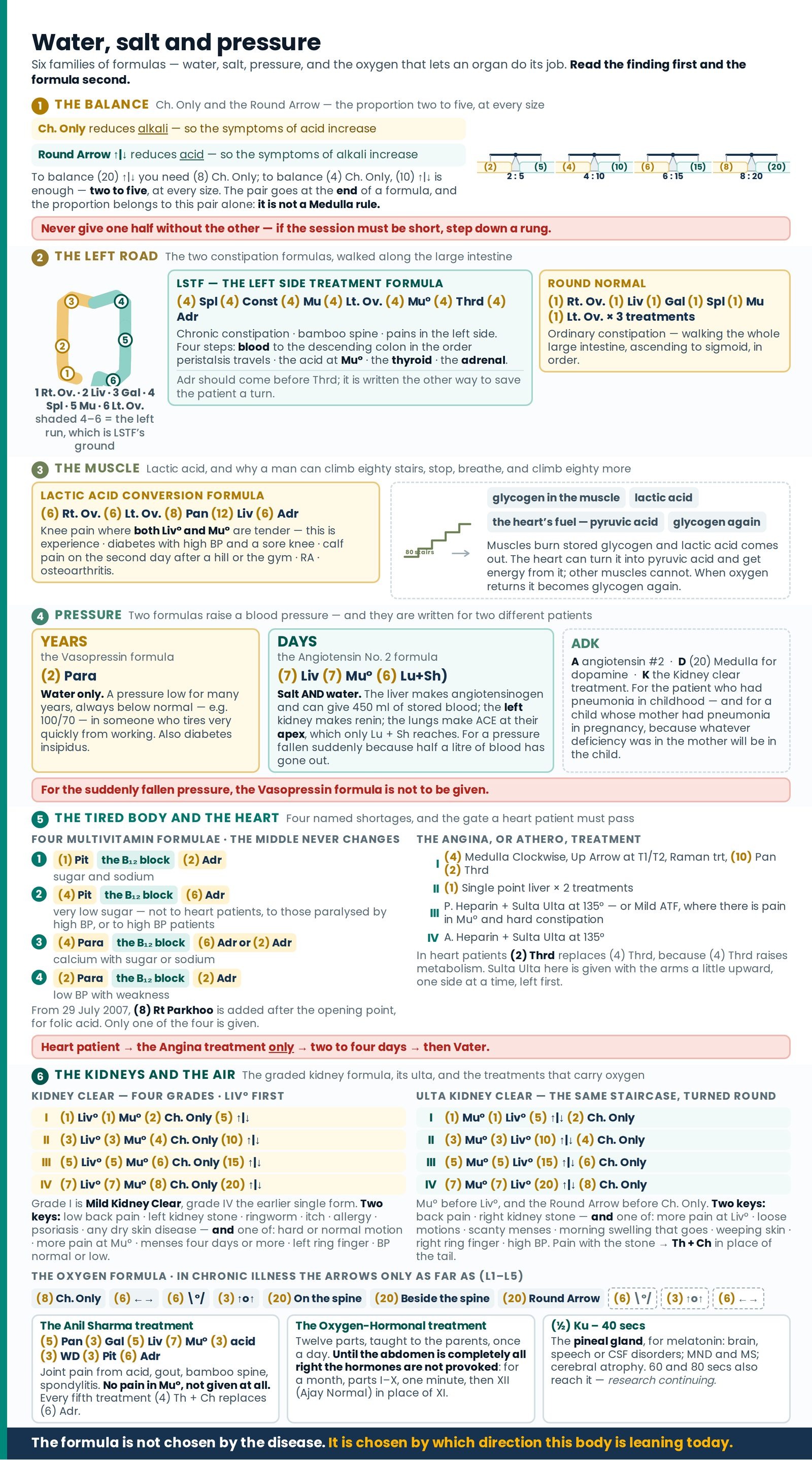
At a glance
Eight figures and one plate — what to study before the test
Questions students ask
1. I am twenty and I still cannot see why the balance pair is not just a tidy habit. What would actually happen if I left it off? You would have given a different treatment from the one on the card, and you would not know which. Ch. Only reduces alkali, so the symptoms of acid increase. Given alone at the end of a formula, that is what your patient takes home — an acid push that nobody diagnosed him as needing. The Round Arrow alone is the same error pointing the other way. The pair exists because the body of the formula has already moved the patient's direction; the tail puts it back. If you are short of time, give a smaller matched pair — two and five — and go home level.
2. I am a retired engineer and the numbers bother me. Why two to five, and not one to one? Because the two things are not equally strong, and somebody measured which. The whole statement is one sentence: to balance twenty Round Arrow you need eight Chest Only, whereas to balance four Chest Only, ten Round Arrow is sufficient. Both of those are two to five. You are not being asked to believe a theory about it; you are being given a conversion rate, the way a recipe tells you that one cup of one thing balances two and a half of another. Learn the ratio and the four rungs write themselves.
3. A housewife here. My husband has high blood pressure and low back pain. Which kidney formula is his? On what you have told me, neither yet — because the finding, not the diagnosis, chooses. Sit him down and check three things: which of the two kidney points hurts more, what his motions are like, and whether the right ring finger is tender to a rub. High BP is in the Ulta list, along with more pain at Liv°, loose motions and weeping skin. But the rule is conjunctive: he needs a complaint from one list and a finding from the other. If the findings do not line up, you have found something worth thinking about rather than a formula worth giving.
4. I am a physician. The Angiotensin No. 2 formula names a cascade I teach to students. What exactly is being claimed? Two layers, and they deserve separate pockets. The physiology is textbook — angiotensinogen from the liver, renin from the juxtaglomerular cells, ACE with its highest activity in the pulmonary circulation, angiotensin II's vasoconstriction, tubular sodium retention and aldosterone release, all within about twenty minutes. Nothing there is idiosyncratic. The claim is that surface pressure applied at three named sites, in that order, stimulates those three organs to run that cascade — and the evidence offered is clinical: immediately after this treatment the shivering of those women stopped and the blood pressure began to rise. Hold the first layer firmly and the second as what it is, an observation with a proposed mechanism. And note how cheap it would be to test: a cuff, a clock, and a written record.
5. I practise in a village. A woman comes giddy after every period. Do I give the Angiotensin formula and leave it there? You give it, and you do not leave it there. Ask how heavy the flow is and for how many days, and send her for a haemoglobin — it is the single cheapest useful measurement anybody could order for that picture. If the flow has been heavy for years, she also needs a gynaecological opinion, because the treatment answers the loss while the loss goes on happening every month. Treat alongside. Never instead. See also → Reading the Reports and When the Hand Must Stop.
6. Why is (2) Para such a small formula? Two presses does not look like a treatment. Because that is what was found, and nothing has been added to it since to make it look more impressive. The account is exactly two applications, a pressure that rose the same day, a second treatment the next day, and a pressure that was still normal when it was checked some days later. Size is not dose in this therapy, and dose is not effect. Compare it with (4) Para, which is only two applications more and provokes a different gland for a different purpose.
7. What is the difference between the Angina treatment and the heparin formulas? Parts III and IV are heparins. The heparins are inside the Angina treatment, not alternatives to it. What the Angina treatment adds is the head and the shoulders: (4) Medulla Clockwise, the Up Arrow at T1/T2, Raman, (10) Pan and (2) Thrd, and then the single-point liver — and it puts Sulta Ulta at 135° alongside the heparins. The heparin work is the clot half of the problem, which belongs whole to The River — Heparin, "The River". The angina work is the segment the heart reports to, and the cholesterol.
8. Someone told me heart patients cannot be given Medulla at all. Is that right? No, and the error is a common one. What is written is a substitution: to heart patients, give only (10) Left Medulla. Side is part of the identity of a point here, not a matter of technique, and a prohibition can bite on one side and not on the other. That instruction belongs to (10) Medulla and travels with every formula containing (10) Medulla; it does not by itself govern the rest of the graded series, each member of which carries its own rules. The Medulla Family takes that apart properly.
9. The Oxygen-Hormonal treatment has twelve parts and I am to teach it to a mother. Where do I even start? You start by teaching her parts I to X and part XII, and you do not mention part XI for a month. That is not simplification — it is the instruction: until the abdomen is completely all right, the hormones are not to be provoked. So for the first month she gives I to X, waits one minute, and gives XII, which is Ajay Normal. When the digestion is right and the coming of UDF has entirely stopped, you teach her part XI and she has the whole of it. A mother learning eleven things in order, once a day, will manage. A mother handed twelve on day one will manage none.
10. I have no science at all. What does "the left kidney filters acid" actually mean I should look for? It means that when the acid side of the body is in trouble, the left kidney point is the one that hurts — and this therapy's whole position is that the two kidneys do not work alike. So on the mat you are not testing chemistry; you are comparing two sore spots. More pain at Mu°, the left, with hard stool and a low-ish pressure, is the acid picture. More pain at Liv°, the right, with loose stool and a high pressure, is the alkali picture. Two fingers, thirty seconds, and the article's biggest decision is made. See also → The Two Kingdoms.
11. The Anil Sharma treatment rotates Th + Ch in every fifth visit. Can I just leave Adr out instead? No — you would be removing the point the formula is built around. The rotation exists because Adr makes the thymus hypo, so immunity would fall if Adr ran uninterrupted; the answer written is to give the thymus back, once in five, in place of Adr. But read the other half too: on that fifth day the thymus prohibitions apply in full, and they are long — pregnancy, polio, inflammatory disease, heart disease, diabetes, RA, autoimmune disorder, kidney disease. If your patient is in that list, the rotation day is not available to him, and that fact goes on his card.
12. Why does this article keep saying Ku reaches the pineal gland when the hand is at the tailbone? Because that is what is stated, and it is stated as an observation with a name attached — (½) Ku – 40 secs for the pineal gland, for melatonin — not as an anatomical claim about a nerve running from one to the other. The honest position for a student is: give the timing that is written, watch what changes, and record it. And note the sentence that stands beside the sixty- and eighty-second timings: research on them is continuing. That is the therapy telling you exactly how much is settled.
Questions patients ask
1. "My blood pressure is 100 over 70 and my doctor says it is fine. So why do I feel like this?" Your doctor is right that it is not dangerous, and it is worth hearing that plainly. What a reading like that does not tell either of us is how you feel doing a day's work on it — and tired very quickly from working is exactly the description this therapy has a treatment for. So I am not going to tell you that a normal report is secretly abnormal. I am going to say that a number can be acceptable and a person can still be running on the low edge of their own range, and that we can work on that and see what changes.
2. "You are pressing my forearms. My problem is constipation." Yes — and the place below and to the left of your navel, where the last stretch of your large bowel sits, is reached from the forearm. Pressure on the arms relieves the region between the navel and below; pressure on the legs relieves above it. It is the same principle by which you tighten a nut at one end of a machine to stop a rattle at the other. Nothing at all is done on the sore part of your belly.
3. "Why do you always ask about my stools? I came about my skin." Because the form of the stool tells me which way your body is leaning today, and that decides which of two very similar treatments you get. Hard and infrequent points one way; soft and frequent points the other. They use the same points in a different order, and the wrong order is not merely less useful — it pushes you the wrong way. One question saves us both a fortnight.
4. "My mother had pneumonia when she was carrying me. Does that really matter now?" It may. The reasoning here is simple: while a child is in the mother's belly, whatever the mother is short of, the child is short of too — so an illness in the mother during the pregnancy can leave its mark in the child. When we know that history, we add three treatments, and what we see is that benefit reaches the patient faster, even when they came to us for something quite unrelated. I cannot promise that in your case. I can tell you it is worth an honest few weeks.
5. "My heart specialist has me on four tablets. Is it safe for you to touch me at all?" It is safe, and it is also bounded, and you should know both halves. We use no medicine and we will not ask you to stop yours. For a heart patient this therapy starts with one particular treatment and nothing else — for two to four days — and only when you are feeling a little better do we go further. And there is a line I will not cross: chest pain that is new, worse, or coming on at rest is not my work. It is an emergency, and I will send you. Say that back to me so I know you have it.
6. "The cramps come in the evening after I have been on site all day. Is it a calcium problem?" It may be salt rather than calcium, and they are told apart by when. Cramps that come as evening comes on, in somebody who has been sweating all day, usually mean salt has gone out through the sweat. Cramps that come in the day and also at night while you are lying asleep point more to calcium. The treatments differ in one step, so it is worth getting right — which means I will ask you to notice for a week exactly when they come, and tell me.
Words used here
| Hindi | English | Neurotherapy code / usage |
|---|---|---|
| पानी (pānī) | Water | What the kidney decides to keep or let go, and what salt carries with it |
| नमक (namak) | Salt | Held back by aldosterone and by angiotensin #2 — and water is held back with it |
| गुर्दा / किडनी (gurdā) | Kidney | Liv° — the right kidney · Mu° — the left kidney, which filters acid |
| बायीं तरफ़ (bāyī taraf) | The left side | The side LSTF is named for and works |
| सख्त कब्ज़ी (sakht kabzī) | Severe constipation | LSTF |
| कब्ज़ (kabz) | Constipation | Const — a front pain point; Round Normal for the ordinary kind |
| उल्टा (ultā) | Reversed, turned around | The prefix: Ulta Kidney Clear, Ulta 1,25 DCC — the same formula with its order turned about, for a limited time |
| घिसाई (ghisāī) | Rubbing | Ch. Only, the arrows, Organ clearance, Medulla Clockwise — a rub, never a still press |
| कुंडली (kuṇḍalī) | Coil | Ku — the point at the last end of the spinal column. (½) Ku – N secs is one press held for N seconds |
| ग्रंथि (granthi) | Gland | Covers endocrine glands and lymph nodes alike |
| सूजन (sūjan) | Swelling | Morning swelling that reduces after some hours is an Ulta Kidney Clear finding; (10) Pan × 3 first, for swelling from the heart or the kidneys |
| दस्त (dast) | Loose motions | Bars Const; selects the ulta side of the kidney family |
| गठिया (gathiyā) | Gout — raised uric acid | The Anil Sharma treatment |
| दाद / खाज (dād / khāj) | Ringworm / itch | Dry → Kidney Clear; weeping → Ulta Kidney Clear |
| मंद बुद्धि (mand buddhi) | Developmental delay | The Oxygen-Hormonal treatment, taught to the parents, at least once a day |
| दंड-बैठक (daṇḍ-baiṭhak) | The traditional squat-and-press exercise | The example used to explain lactic acid: after 25–30 one cannot get up, and after a little rest one can again |
| परखू (parkhū) | To turn onto one's side | Rt. Parkhoo — folic acid · Lt. Parkhoo — the B₁₂ point. Two equal one |
| — | Hypo | Working less than it should — the thyroid, the thymus. Adr makes the thymus hypo |
| — | AT2 · ACE · JG cells | Angiotensin #2 · the lung enzyme that makes it · the kidney cells that release renin |
| — | RTA | Road Traffic Accident — how haemorrhage due to RTA is written in a hospital report |
| — | ADK | Angiotensin #2 · Dopamine, (20) Medulla · Kidney clear |
| — | LSTF | Left Side Treatment Formula |
| — | ITP | Idiopathic thrombocytopenic purpura — a low count of platelets |