Placing the Patient taught you how to put a patient down and how to stand over her. This article is the first page of the atlas proper: the points themselves, in the position in which most of the therapy's daily work is given. Eleven names and their variants — Pan, Gal, Spl, Liv, Mu, Gas Only, Gas 'I', Liv°, Mu°, Const, Dys, WD — account between them for more time on the mat than everything in Seated I — Brain, Medulla, Neck to 24 together.
So learn it the way you will use it: with a patient beside you and the book open on the floor. Every point from here to the end of Uncommon Problems is set out the same way — the code and its full name; a table answering the four questions you ask with a patient on the floor; the variants, each taught as its own thing; the ध्यान दें notes in full at the point they belong to; a plain-words note on what lies under your sole; and a caution panel wherever this therapy itself cautions, with the condition that makes it bite.
Watch


The standing rules of every supine treatment
Eight rules printed once — run them before the first foot goes down
These are written once and are not repeated under each entry — and an entry silent about them is not excusing you from them.
The eight rules that hold for every point in this article
All eight are taught in full in Placing the Patient, "Placing the Patient". Here they are as a check-list to run before the first foot goes down.
1. The position. Supine — laid on the back by rolling onto the side; head flat on the sheet; legs long and propped straight rather than held straight by the patient; arms where you placed them.
2. The pillow. Place the pillow at the proper place as needed — but never under the head, and never under the back. This line is printed along the foot of every page of the supine atlas and governs all of them; its two stated exceptions both concern the head, and the back has none. ▲ Take care
3. The chairs. Set close and square, both your hands equidistant between them, moved again and again as the treatment moves down the limb. Weight equal on both feet and at the centre of your own body, never shifted foot to foot in between, toes never stiffened and never moved during a hold.
4. The load, one foot at a time. For Pan, Liv, Mu, Liv°, Mu°, Gas Only and Gas 'I' — and the same caution applies for WD, Rt. Ov., Lt. Ov., Pit and Para — both feet must never go onto the patient at once. One foot first without pressure; then, with your full weight on both hands upon the chairs, the second foot at its place, also without pressure; and only then, standing quite straight and in full balance, the weight let down. ▲ Take care
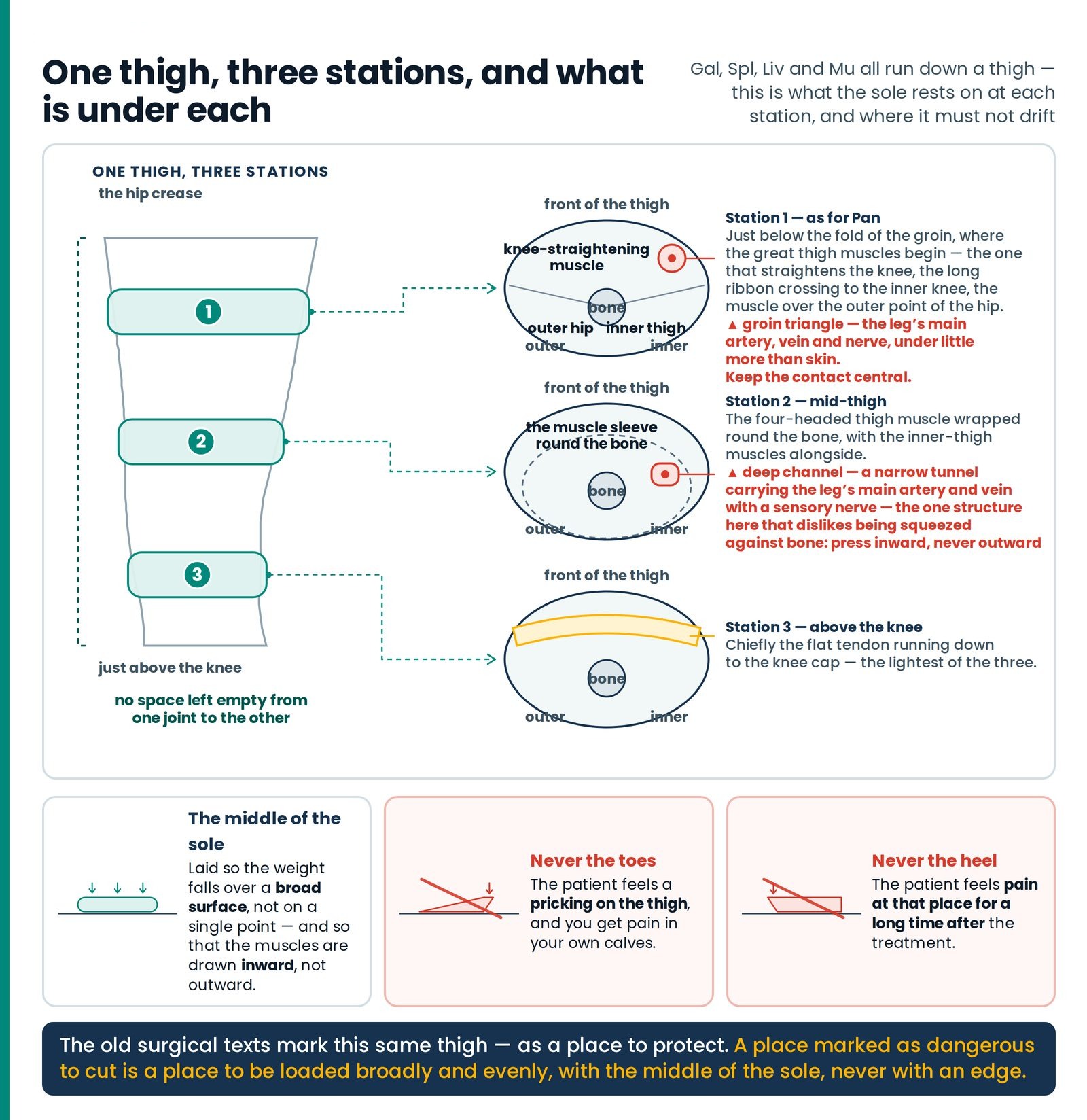
5. The contact. Always from the middle part of the sole. With the toes, the patient feels a pricking on the thigh and you get pain in your own calves; with the heel, the patient feels pain at that place for a long time after. Whatever part is laid on, lay it so the weight falls over a broad surface, not on a single point, and so that the muscles are drawn inward, not outward.
6. The count. 6 seconds and released, at every point in this article unless the entry says otherwise; the number in brackets is the number of applications.
7. The stations. Three places is enough for an ordinary person, but the governing rule is that no space should be left empty from one joint to the other joint — set out in full at its own place later in this article.
- 8. The stance. For Gal and Spl, one foot on the patient: do not bend your knee, press with the middle of the sole, lift the other foot clear of the ground and stand straight. For Liv and its family, both feet on the patient: keep the weight equal on both feet, and as far as possible keep your own knees straight, so that you will not tire. Both sides
Why the map crosses
The point is named for the pain it answers, not the limb it is given on
Settle, before the first point, the question Placing the Patient left open — a student who does not will spend a year quietly doubting the atlas.
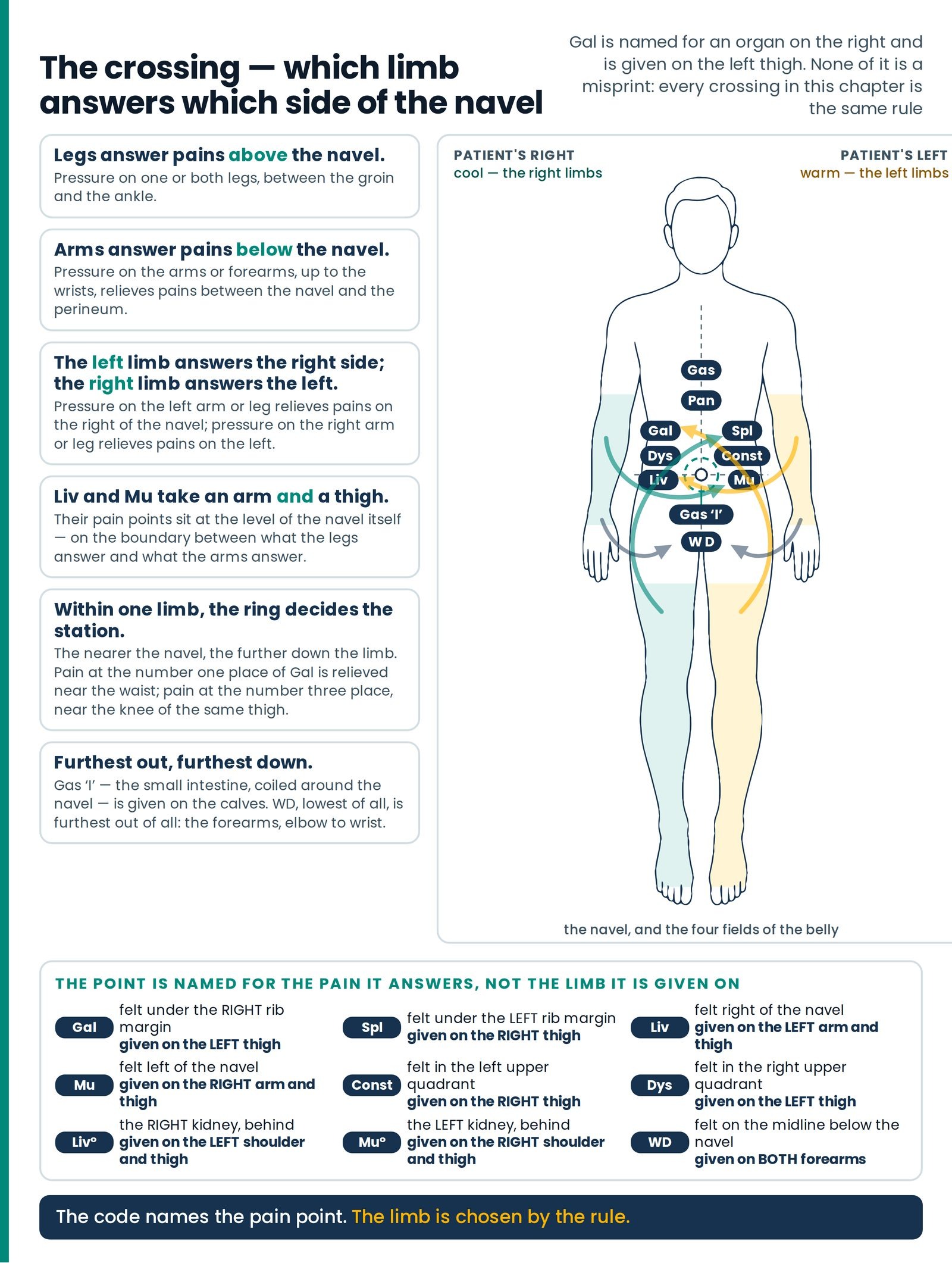
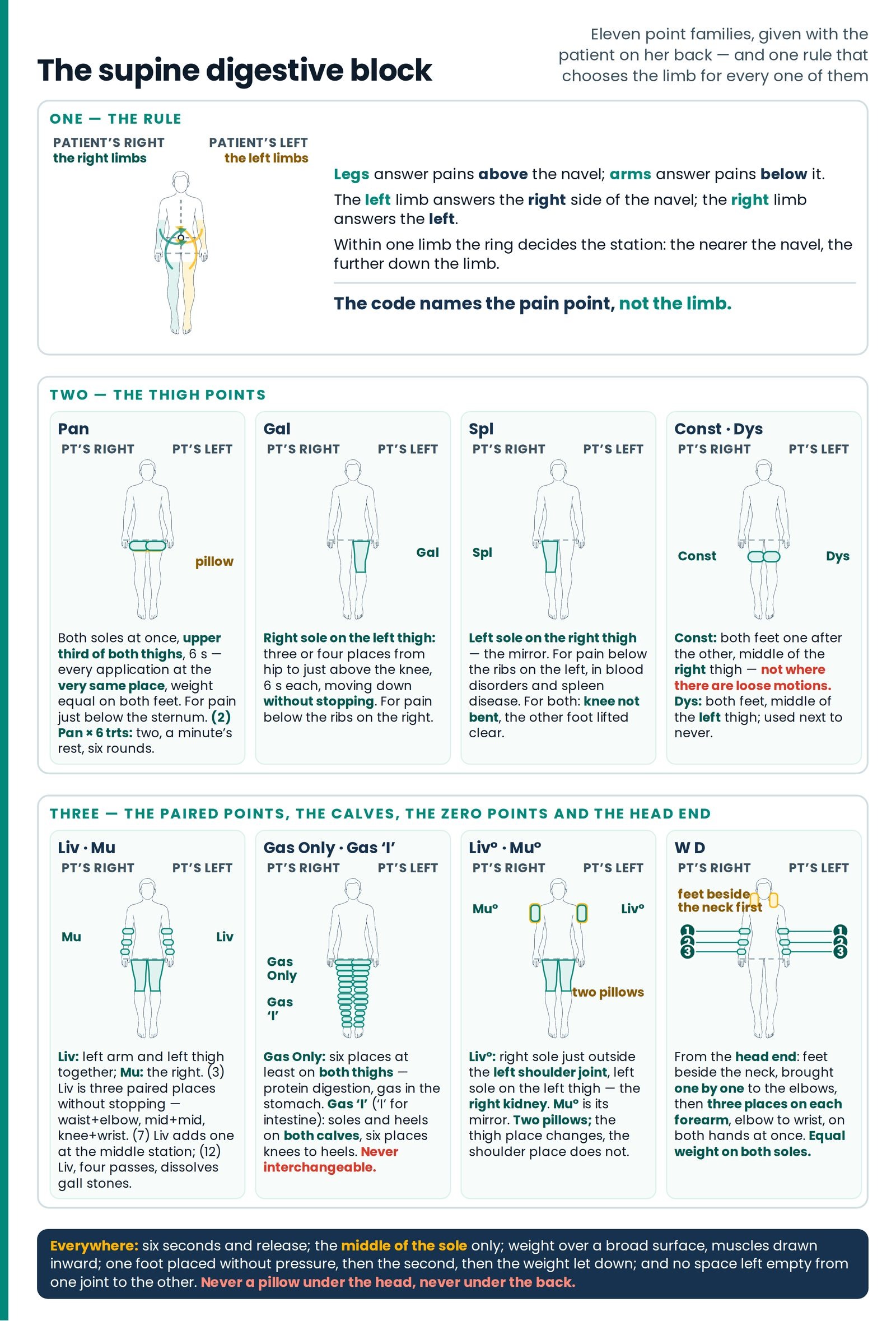
Gal is named for the gall bladder, which lies on the right, and is given on the left thigh. Spl is named for the spleen, on the left, and is given on the right. Liv° is the code for the right kidney and is given on the left side of the body. None of it is a misprint, and none of it is an error of anatomy: every crossing in this article is the same rule, applied without exception. (Figure 16.1)
The rule was taught in The Hand That Heals and mapped in The Navel Speaks First. Repeat it aloud until it is automatic:
The point is named for the pain it answers, not the limb it is given on
Pressure on one or both legs, between the groin and the ankle, relieves pains above the navel. Pressure on the arms or forearms, up to the wrists, relieves pains between the navel and the perineum. Pressure on the left arm or leg relieves pains on the right of the navel; pressure on the right arm or leg relieves pains on the left. Left Right
Now lay the front chart beside it. The Gal pain point lies right of the midline, under the right rib margin — answered from the left thigh. Spl lies left — the right thigh. Liv lies right of the navel — the left limbs; Mu left of it — the right. Const lies in the left upper quadrant — the right thigh; Dys in the right — the left. WD is a midline point below the navel, and so is not given on a thigh at all, but on both forearms.
The code names the pain point. The limb is chosen by the rule.
Once you hold that, the atlas becomes a thing you could almost reconstruct. Liv and Mu take an arm and a thigh together, because their pain points sit at the level of the navel itself, on the boundary between what the legs answer and what the arms answer. Gas 'I' — the small intestine, coiled around the navel — is given on the calves, further down the same limb. WD, lowest of all, is furthest out of all: the forearms, elbow to wrist.
And within a single limb the ring rule decides which station: the nearer the navel, the further down the limb. That is why the Gal entry says pain at the number one place is relieved near the waist on the left thigh, while pain at the number three place is relieved near the knee of the same thigh.
The points on the thighs
Pan never travels; Gal and Spl run hip to knee without stopping
Pan — the pancreas point
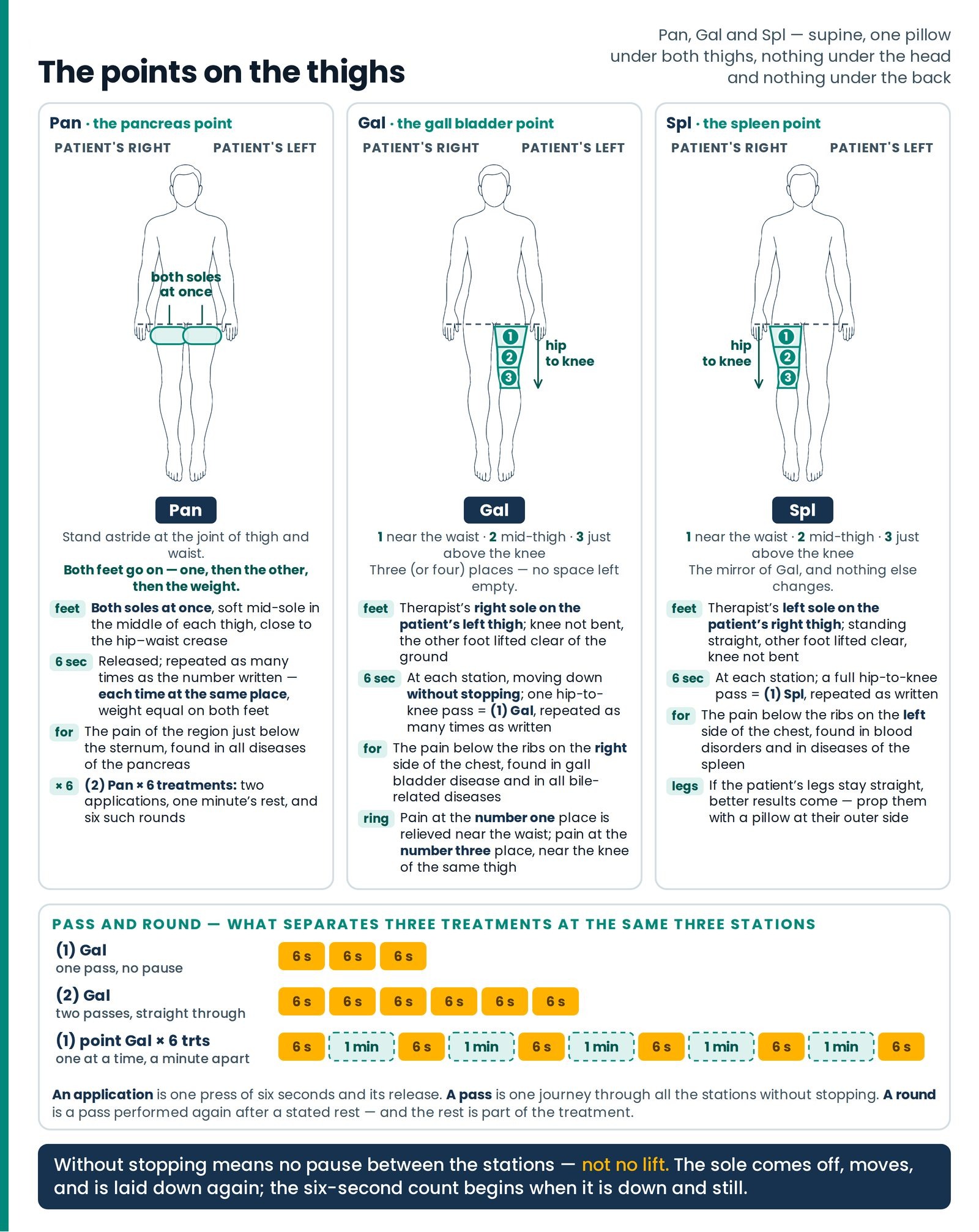
Stand astride the patient at the joint of thigh and waist, so placed that the soft middle part of your sole lies right in the middle of their thigh, and so that the patient feels comfortable. Press on both thighs together for six seconds and release. Do it as many times as the number written — but take care that each time the pressure falls for six seconds at the same place, and that the weight is equal on both feet.
That last sentence is the whole difficulty of Pan. Every other thigh point travels down the limb; Pan does not move at all. (8) Pan is eight presses at one and the same spot, and a foot that creeps an inch lower each time has given something else. (Figure 16.2)
| Patient's position | Supine; one pillow under both thighs, its edge close to the hips; nothing under the head, nothing under the back Supine |
|---|---|
| Where the feet are placed | Both soles at once, soft mid-sole in the middle of each thigh, close to the hip–waist crease — one foot placed without pressure, then the other, then the weight let down Both sides |
| Duration and repetitions | 6 seconds, released; repeated as many times as the number written, each time at the same place, weight equal on both feet 6 sec |
| What it is for | The pain of the region just below the sternum, which is found in all diseases of the pancreas |
The variant. If (2) Pan × 6 treatments is to be given, then press on both thighs twice for six seconds and release; then rest one minute; and do six such rounds. × 3 Read that exactly as it stands: not twelve presses run together, but two, rest, two, rest, two, rest — six rounds of two with a full minute between them, the minutes as much part of the treatment as the seconds.
What lies beneath. Just below the fold of the groin, where the great thigh muscles begin — the one that straightens the knee, the long ribbon crossing to the inner knee, the muscle over the outer point of the hip — with the hip-flexor tendon passing under them to the thigh bone and the hip joint deep beneath. Drift inward from the middle and you are over the groin triangle, where the leg's main artery, vein and nerve lie under little more than skin: which is why the instruction says the middle of the thigh. The pancreas itself lies far off at the back wall of the belly, behind the stomach; nothing in a thigh reaches it. What the point is named for is the sore place under the breastbone by which pancreatic trouble announces itself.
Gal — the gall bladder point
Standing straight, with your right foot on the patient's left thigh, using the soft middle part of the sole, give pressure without stopping at three (or four) places, running from below the waist joint down to just before the knee joint. At each place press for six seconds and release. Doing this from the waist down to the knee is called (1) Gal.
If more than (1) Gal is to be given, then without stopping repeat from waist to knee as many times as the number written.
| Patient's position | Supine, one pillow under both thighs; the therapist standing straight, the other foot lifted clear of the ground, knee not bent Supine |
|---|---|
| Where the feet are placed | Therapist's right sole on the patient's left thigh; three (or four) stations from just below the hip joint to just above the knee Left |
| Duration and repetitions | 6 seconds at each station, moving down without stopping; one hip-to-knee pass = (1) Gal; the pass repeated as many times as the number written 6 sec |
| What it is for | The pain below the ribs on the right side of the chest, which is found in gall bladder disease and in all bile-related diseases |
Choosing the station from the ring. The entry carries its own note — the ring rule in working clothes: if there is pain at the number one place in Gal, it will be relieved by the treatment near the waist on the left thigh; whereas to relieve pain at the number three place of Gal, one must treat near the knee of the same thigh.
What lies beneath. Station one is as for Pan. Station two, mid-thigh, is the four-headed thigh muscle wrapped round the bone with the inner-thigh muscles alongside; deep and inward runs a narrow tunnel carrying the leg's main artery and vein with a sensory nerve — the one structure here that genuinely dislikes being squeezed against bone, and the reason the contact is broad, flat and central. Station three, above the knee, is chiefly the flat tendon running to the knee cap. The gall bladder itself is a small pear tucked under the liver on the right, where the rib margin crosses. (Figure 16.3)
(1) point Gal × 6 treatments
As in the left-hand picture, press on the number one point of the thigh for six seconds and release; then, after stopping for one minute, press on the number two point in the middle of the thigh for six seconds and release; then, after one minute, press on the number three point of the thigh for six seconds and release; then, after one minute, repeat this whole process again. That is, altogether it is to be done six times.
| Patient's position | As for Gal Supine |
|---|---|
| Where the feet are placed | The same three stations on the patient's left thigh, taken one at a time Left |
| Duration and repetitions | 6 s at station 1 → 1 minute → 6 s at station 2 → 1 minute → 6 s at station 3 → 1 minute → the whole process once more. Six times in all 6 sec × 3 |
| What it is for | As for Gal |
Set the two side by side and you have the clearest illustration of what the word point does as a modifier. Gal is a continuous descent counting as one; (1) point Gal × 6 treatments is the same three stations given as six separate events a minute apart. (2) Gal would deliver those same six applications too — and run them straight through without a pause. The spacing is the treatment, which is why the minute cannot be spent tidying the sheet or answering a question.
Spl — the spleen point
Do exactly as for Gal above, but give the pressure with the sole of your left foot on their right thigh. At every place press for six seconds and release. Completing this from the waist down to the right knee is called (1) Spl. Repeat from waist to knee as many times as the number written, pressing six seconds and releasing at each place.
| Patient's position | Supine, one pillow under both thighs; therapist standing straight, other foot lifted clear, knee not bent Supine |
|---|---|
| Where the feet are placed | Therapist's left sole on the patient's right thigh; three (or four) stations from below the hip to just above the knee Right |
| Duration and repetitions | 6 seconds at each station; a full hip-to-knee pass = (1) Spl; repeated as written 6 sec |
| What it is for | The pain below the ribs on the left side of the chest, which is found in blood disorders and in diseases of the spleen |
The stance for both. Gal and Spl share a stance of their own — the one place in the supine atlas where the therapist deliberately puts all of himself onto the patient: do not bend your knee; give the pressure with the middle part of your sole; lift the other foot clear of the ground and stand straight, so that your full weight comes onto the patient. And: if the patient's legs stay straight, better results come — but if the patient straightens their own legs the muscles stay tight and they will be uncomfortable, so place a pillow on the outer side of the legs for support to stop them rolling outward.
What lies beneath. The mirror of Gal — thigh muscle front and inner, the deep tunnel with the leg's main vessels at mid-thigh, the flat tendon above the knee. The spleen itself sits high on the left, behind the ninth to eleventh ribs and under the dome of the diaphragm, and in health cannot be felt at all: a spleen you can feel below the ribs is an enlarged one.
The paired points — an arm and a thigh together
Liv on the left limbs, Mu on the right — both places at the same moment
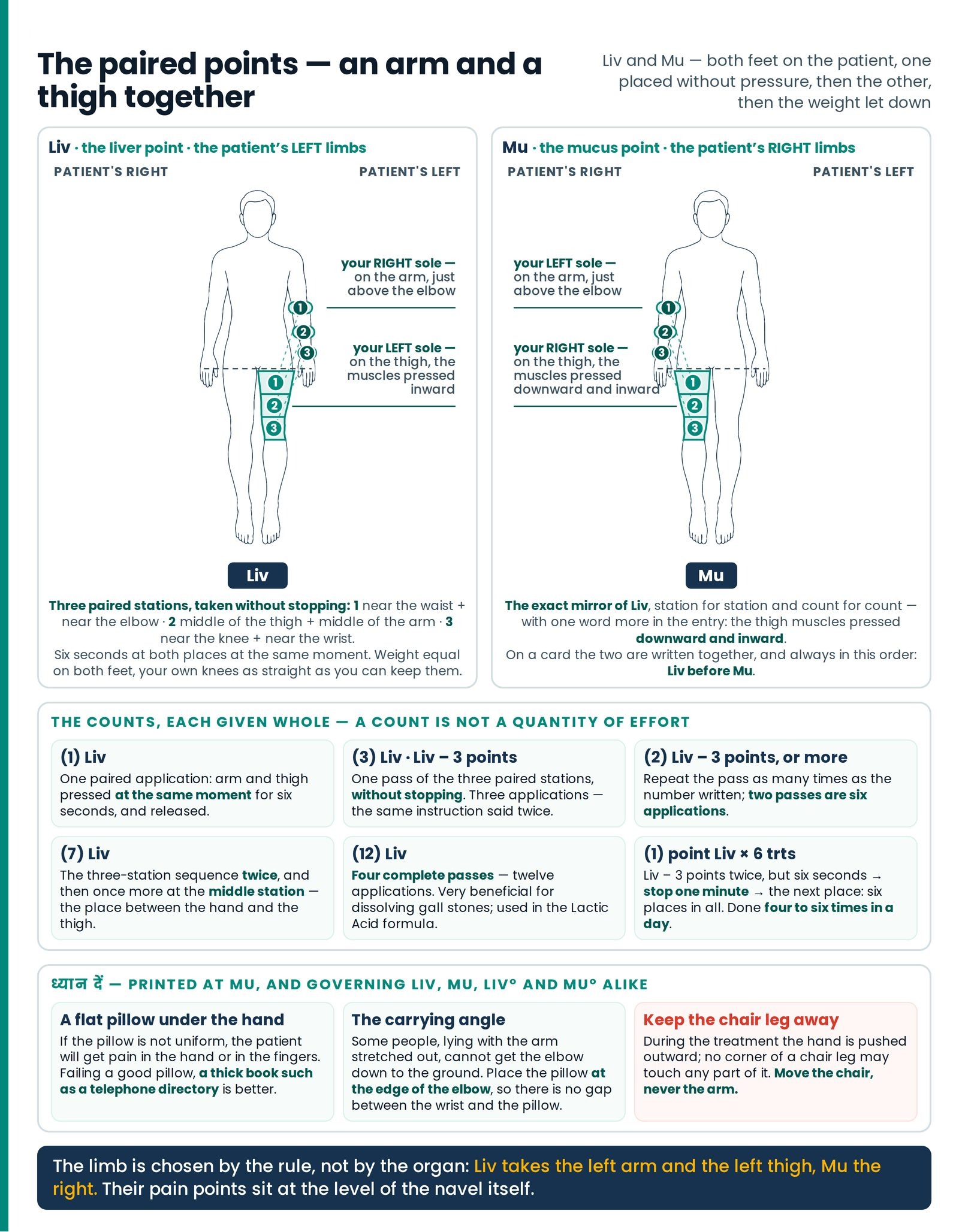
Liv — the liver point
Taking the support of the chairs, place the sole of your right foot on their left hand near the elbow, and the sole of your left foot on their left thigh, so laid that the thigh muscles are pressed inward. Press and release at both places together for six seconds. This is (1) Liv. If a greater number is written, then keep changing the place according to the stations set out below.
Keep the weight equal on both feet, and as far as possible try to keep your own knees straight, so that you will not tire.
| Patient's position | Supine; a pillow under both thighs and a flat pillow under the treated hand; the therapist astride at hip level, supported on both chairs, weight divided between two treating feet Supine |
|---|---|
| Where the feet are placed | Right sole on the patient's left arm just above the elbow; left sole on the patient's left thigh, the muscles pressed inward — one foot placed without pressure, then the other, then the weight let down Left Both sides |
| Duration and repetitions | 6 seconds at both sites at the same moment, released = (1) Liv; for higher counts, move through the stations below 6 sec |
| What it is for | The liver — the stated indication is given under (1) point Liv × 6 treatments below |
What lies beneath — the arm contact. The most nerve-dense square inch in this article, and it decides how the foot is laid. At the front of the elbow is a shallow hollow, and under the skin lie the tendon of the big arm muscle, the main artery of the arm and the median nerve, barely covered; behind the inner knob — the "funny bone" — the ulnar nerve runs in a bony groove with almost nothing over it. At mid-arm the big muscle lies in front and the triceps behind, artery and nerves together down the inner side. At the wrist it is nearly all tendon, the pulse artery on the thumb side and the median nerve dipping into its tunnel. (Figure 16.4)
The thigh contact is as for Gal and Spl, and for the same reason the instruction says pressed inward: a muscle belly sits in a tough sleeve that already packs it toward the bone, so press along that packing and it takes the load as it is built to. The liver itself fills the right upper belly under the dome of the diaphragm, behind the seventh to eleventh ribs; when its covering is stretched it gives a dull heavy ache under the right ribs, felt at the tip of the right shoulder if the diaphragm above is irritated.
Liv – 3 points — that is, (3) Liv — (1) Liv-3 वाला
In this, without stopping, it is to be done at three places: first near the waist and near the elbow; then on the middle of the arm and the middle of the thigh; and finally near the wrist and near the knee. At each place press for six seconds and release.
| Patient's position | As for Liv Supine |
|---|---|
| Where the feet are placed | Three paired stations, upper limb and lower limb together: (1) near the waist + near the elbow · (2) middle of the arm + middle of the thigh · (3) near the wrist + near the knee Left Both sides |
| Duration and repetitions | 6 seconds at each paired station, taken without stopping; one pass = (1) Liv – 3 points = (3) Liv 6 sec |
| What it is for | As for Liv |
Each application counts as one Liv, which is why one pass of three stations is written both ways: (1) Liv – 3 points and (3) Liv are the same instruction said twice. Reading Liv – 3 points as "give Liv three times in one place" is named in The Shorthand, "The Shorthand" as the commonest misreading in the wiki.
The higher counts, each given whole:
(2) Liv – 3 points, or more. Repeat the pass as many times as the number written; two passes are six applications.
(7) Liv. Give the Liv – 3 points sequence twice, and at the end give once more at the place between the hand and the thigh — that is, the middle station. Six applications, then a seventh at station two. Not "seven presses anywhere"; the entry names where the odd one goes.
(12) Liv. Four complete passes of Liv – 3 points — twelve applications. It is the highest single count the atlas gives for this point, and it has a use of its own: it is very beneficial for dissolving gall stones, of which the therapy's own note says, with the hedge left standing, perhaps it works something like cholic acid; and it is used in the Lactic Acid formula. The full account of what each count is for belongs to Each Point in Use, "Each Point in Use"; the formula belongs to Water and Salt, "Water and Salt".
Why a count is not a quantity of effort
At a chemical point the number in brackets is a dose, and different numbers of the same point have been found to produce different effects — from which it is understood that they make different chemicals. So take care that the pressure is exactly six seconds and is given exactly as many times as is written; let there be no mistake in the count. Otherwise either the effect we want will not occur, or, in some rare cases, the opposite effect may occur. 6 sec ▲ Take care
(3) Liv, (7) Liv and (12) Liv are three treatments, not three sizes of one — and a therapist who gives ten because he lost count at seven has not given a slightly stronger (7) Liv.
(1) point Liv × 6 treatments
It is to be done like (1) Liv – 3 points, twice. But at each place give the pressure for six seconds, then stop for one minute, and then give the pressure at the next place. Two such rounds — that is, altogether at six places.
Doing this four to six times in a day is useful in everything from malaria and typhoid to every major illness.
| Patient's position | As for Liv Supine |
|---|---|
| Where the feet are placed | The same six paired stations of two three-station rounds Left Both sides |
| Duration and repetitions | 6 s at a place → stop for one minute → 6 s at the next → through six places. Done four to six times in a day 6 sec × 3 |
| What it is for | "Everything from malaria and typhoid to every major illness" |
Two things deserve saying out loud. The frequency: four to six times in a day is far the highest dose in this article, and the clearest case in the supine atlas of a treatment meant to be taught to the household and given at home between visits.
Mu — the mucus point
Mu is the code for mucus — the membrane lining the whole digestive tract.
Place the sole of your left foot on their right hand near the elbow, and the sole of your right foot on their right thigh, in such a way that the thigh muscles are pressed downward and inward. Now press at both places together for six seconds and release. This is (1) Mu. If a greater number is written, then go on changing the place according to the stations below.
| Patient's position | Supine; pillow under both thighs, flat pillow under the treated hand Supine |
|---|---|
| Where the feet are placed | Left sole on the patient's right hand near the elbow; right sole on the patient's right thigh, the muscles pressed downward and inward Right Both sides |
| Duration and repetitions | 6 seconds at both places together, released = (1) Mu; higher counts move through the stations below 6 sec |
| What it is for | The Mu point — mucus, the membrane of the digestive tract |
Mu is the exact mirror of Liv: Liv takes the left arm and the left thigh, Mu the right arm and the right thigh. Stance and count are the same, with one word more in the Mu instruction — downward and inward — which is kept because it is what the entry says. The two are almost always written next to one another on a card, and always in that order: Liv before Mu. That is not habit but the rule of order — right follows left, the organs on the right of the navel before those on the left, because that is the direction the intestine's own wave travels. Reverse it and you have given a different formula.
Mu – 3 points — that is, (3) Mu — (1) Mu-3 वाला
It is to be given simultaneously on the right hand and the right thigh at three places. First on the thigh near the waist and on the arm near the elbow; then on the middle of the arm and the middle of the thigh; and last near the wrist and near the knee. At each place press for six seconds and release.
| Patient's position | As for Mu Supine |
|---|---|
| Where the feet are placed | Three paired stations: (1) thigh near the waist + arm near the elbow · (2) middle of the arm + middle of the thigh · (3) near the wrist + near the knee Right Both sides |
| Duration and repetitions | 6 seconds at each, in order; one pass = (1) Mu – 3 points = (3) Mu 6 sec |
| What it is for | As for Mu |
The higher counts. If (2) Mu – 3 points or more is to be given, repeat as many times as the number written. If (7) Mu is to be given, then give (1) Mu – 3 points twice, and at the end give once at the place between the hand and the thigh — that is, the middle station.
What lies beneath. Identical to Liv, on the other side. The kidneys, which Mu° will be named for shortly, lie at the back, tucked behind the last ribs in a packing of fat; nothing on the front of an arm or a thigh comes near them.
The two gas points
Gas Only on both thighs, Gas 'I' on both calves — six places at least
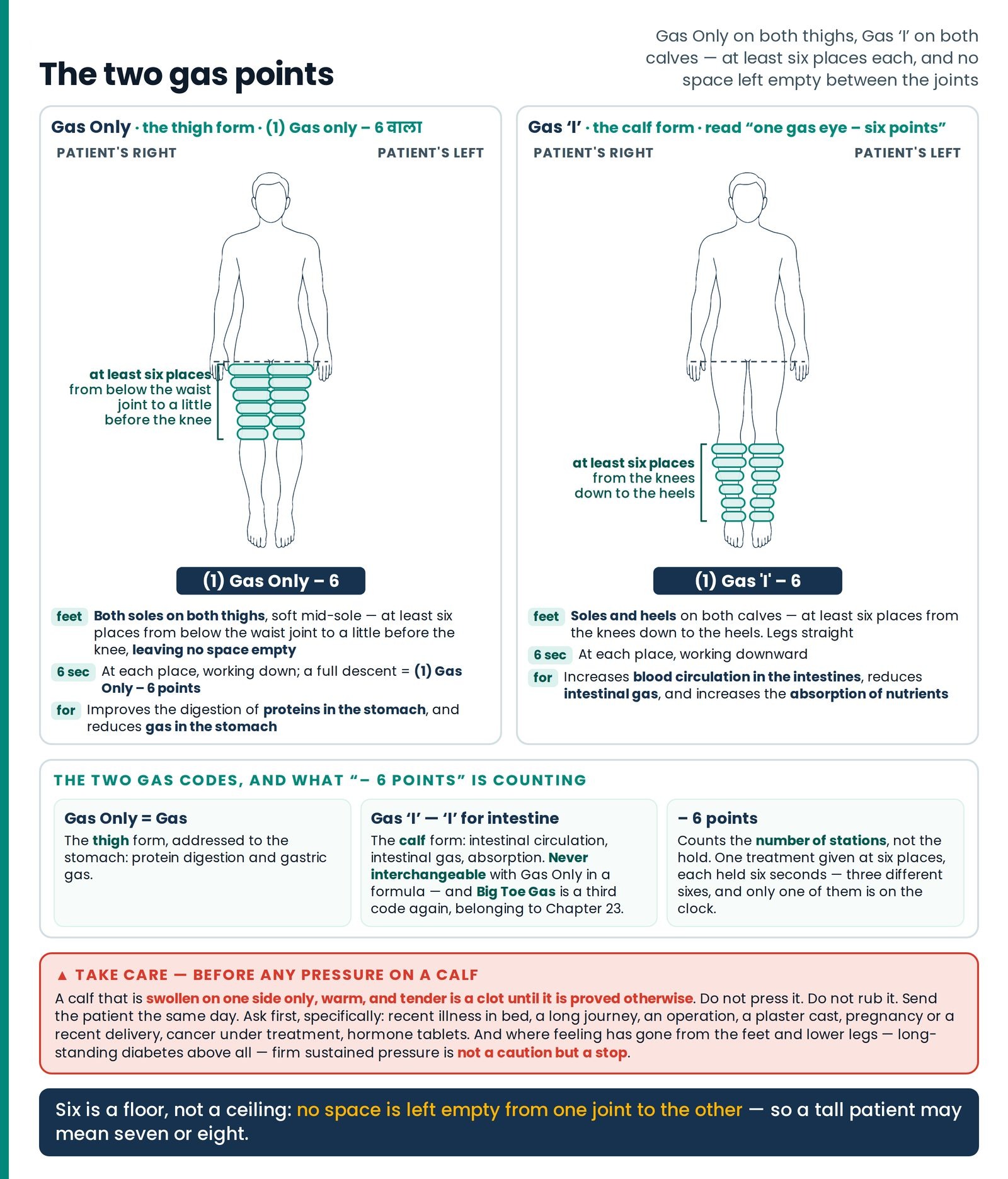
(1) Gas Only – 6 points — (1) Gas only – 6 वाला
With the soft middle part of the sole, press and release on both thighs, from below the joint at the waist down to a little before the knee. Pressure is to be given at at least six places; at each place press for six seconds and release.
| Patient's position | Supine, one pillow under both thighs Supine |
|---|---|
| Where the feet are placed | Both soles on both thighs, soft mid-sole; at least six places from below the waist joint to a little before the knee, leaving no space empty Both sides |
| Duration and repetitions | 6 seconds at each place, working down; a full descent = (1) Gas Only – 6 points 6 sec |
| What it is for | Improves the digestion of proteins in the stomach, and reduces gas in the stomach |
Notice what has changed from Gal and Spl: both thighs together, not one, and at least six stations, not three. Six is a floor, not a ceiling — no space is left empty between the joints, so a tall patient may mean seven or eight. (Figure 16.5)
(1) Gas 'I' – 6 points — (1) Gas 'I' – 6 वाला
Read this aloud as "one gas eye – six points". The 'I' indicates the intestine.
With your soles and heels, on both the patient's calves, from the knees down to the heels, give pressure at at least six places. At each place press for six seconds and release.
| Patient's position | Supine, legs straight Supine |
|---|---|
| Where the feet are placed | Soles and heels on both calves, at least six places from the knees down to the heels Both sides |
| Duration and repetitions | 6 seconds at each place, working downward 6 sec |
| What it is for | Increases blood circulation in the intestines, reduces intestinal gas, and increases the absorption of nutrients |
This is one of the few entries in the supine atlas that names the heel as part of the contact — soles and heels. That is no licence to substitute the heel for the mid-sole elsewhere; and where a treatment does name it, the general rule still governs how it is laid: weight over a broad surface, not on a single point.
What lies beneath. The thigh you already know. The calf is the two-headed muscle that bulges when you rise on your toes, over a flatter, deeper muscle beneath; a vein and a nerve run just under the skin down the middle. Deepest of all are the wide, slow-flowing veins inside the calf muscle itself — and those are why this point, alone in the article, needs a look before it is touched.
The three rules before the "zero" points
The sole only, two pillows, and the hand left where Liv and Mu put it
Liv° and Mu° are given in the same place and the same manner as Liv and Mu, with two changes that the small ring records — the hand contact moves up to the shoulder, and is taken at a single station.
Each is doing a different job. The first is the contact rule of the whole atlas restated where it is easiest to break: a shoulder is rounder and less forgiving than a thigh, and a foot that tips onto heel or toes there has become an edge. The second is positioning, not comfort — the pillow's work is to bring the shoulder joint up to meet your sole rather than let the head of the arm bone be levered forward, and its limit is stated as precisely as its purpose. The third is craft: the hand stays where Liv and Mu put it, so the arm is not re-arranged between points; the powder is practical sense, and a therapist thinking about his own foot is not thinking about the count; and parallel means parallel — turn the big toe in and the load runs onto the inner edge of your sole, turn the heel in and onto the outer.
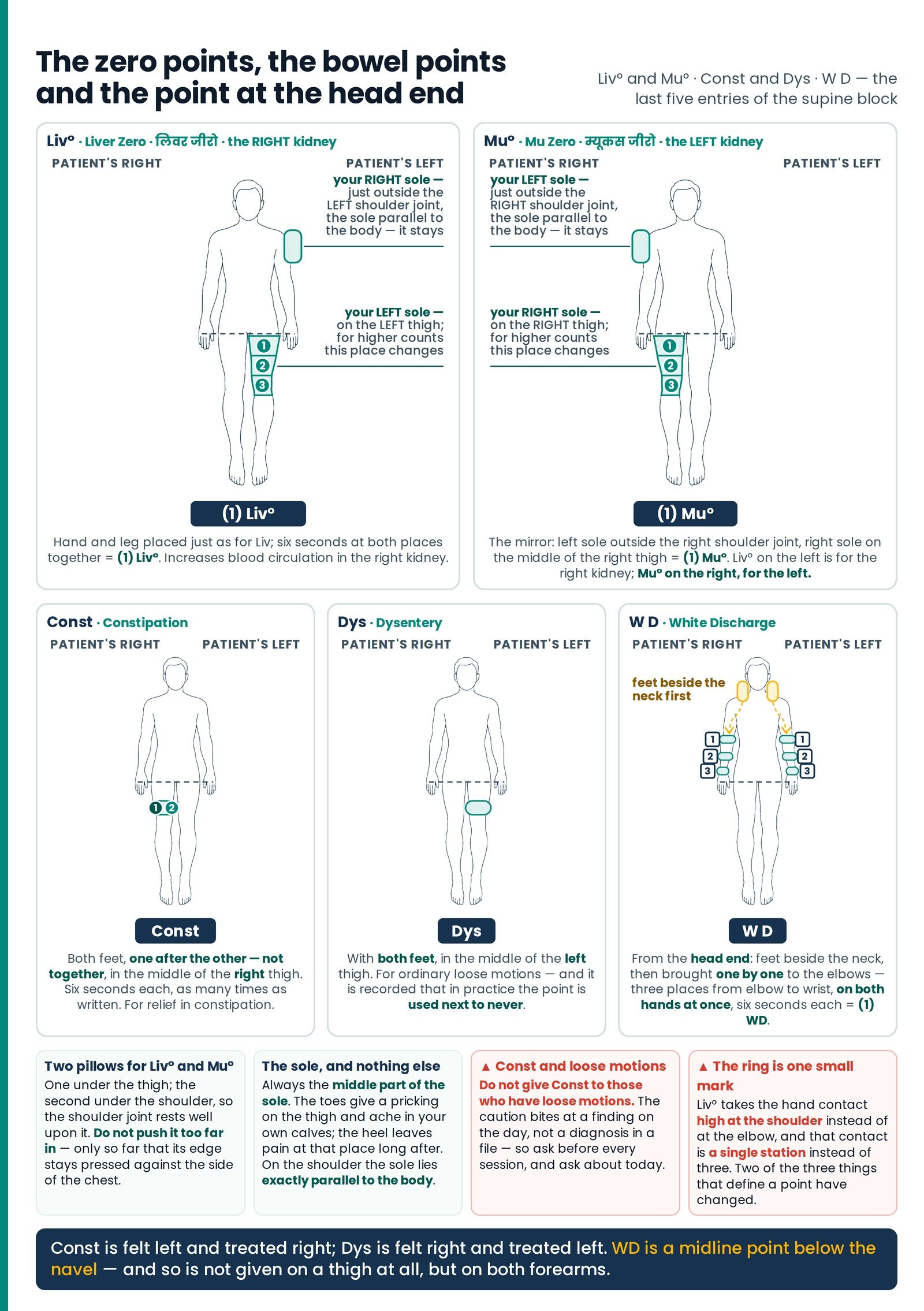
Liv° — Liver Zero (लिवर जीरो)
Tell the patient to keep the hand and the leg placed just as for Liv. Place your right sole just outside their left shoulder joint, and your left sole on their left thigh, and, standing straight, press at both places together for six seconds and release. This is called (1) Liv°.
If a greater number is to be given, then change the place on the thigh turn by turn, but on the shoulder it stays near the joint.
| Patient's position | Supine; two pillows — one under the thigh, one under the shoulder with its edge pressed against the side of the chest — and the flat pillow under the hand, the hand at the same distance as for Liv Supine |
|---|---|
| Where the feet are placed | Right sole just outside the left shoulder joint, the sole exactly parallel to the body; left sole on the left thigh. One foot placed without pressure, then the other, then the weight let down Left Both sides |
| Duration and repetitions | 6 seconds at both places together, released = (1) Liv°; for higher counts the thigh place changes turn by turn, the shoulder place stays near the joint 6 sec |
| What it is for | Increases blood circulation in the right kidney |
What lies beneath. The cap of muscle over the point of the shoulder, and under it the knob at the top of the arm bone with the small cuff tendons fastening onto it, a lubricating sac between the two. Further in, under the fold of the armpit, run the great vessels and nerve cords on their way into the arm — one more reason the contact is just outside the joint and laid flat. The right kidney lies at the back of the body, behind and below the last rib, packed in fat.
Mu° — Mu Zero, Mucus Zero (म्यूकस जीरो)
Press your left sole just outside their right shoulder joint and your right sole on the middle of the right thigh, together, for six seconds, and release. This is called (1) Mu°.
If a greater number is to be given, then change the place on the thigh; on the shoulder it stays near the joint.
| Patient's position | Supine; two pillows, as for Liv° Supine |
|---|---|
| Where the feet are placed | Left sole just outside the right shoulder joint, parallel to the body; right sole on the middle of the right thigh Right Both sides |
| Duration and repetitions | 6 seconds at both places together = (1) Mu°; the thigh place changes, the shoulder place does not 6 sec |
| What it is for | Increases blood circulation in the left kidney |
Read the crossing carefully, because in a hurry it is easy to reverse: Liv° is given on the left and is for the right kidney; Mu° is given on the right and is for the left. The Liv pain point lies right of the navel with the right kidney immediately behind it — so the right kidney is Liv°, answered from the left limbs. (Figure 16.6)
The two thigh points for the bowel
Const on the right, one foot then the other; Dys on the left, and rarely
Const — Constipation (कोंस्टीपेशन — read aloud as constipation)
Placing both feet one by one in the middle of their right thigh, press for six seconds and release. Do it as many times as the number written.
| Patient's position | Supine, one pillow under both thighs Supine |
|---|---|
| Where the feet are placed | Both feet, one after the other — not together — in the middle of the right thigh Right |
| Duration and repetitions | 6 seconds each, as many times as the number written 6 sec |
| What it is for | Relief in constipation |
Dys — Dysentery (डिसेंट्री — read aloud as dysentery)
With both feet, press in the middle of the left thigh for six seconds and release. Do it as many times as the number written. This gives relief in ordinary loose motions.
This is given for information only. In practice this point is used next to never.
| Patient's position | Supine, one pillow under both thighs Supine |
|---|---|
| Where the feet are placed | Both feet, in the middle of the left thigh Left Both sides |
| Duration and repetitions | 6 seconds, as many times as the number written 6 sec |
| What it is for | Ordinary loose motions — though it is recorded that in practice the point is used next to never |
Two differences between this pair are the substance of the instruction. Const is given one foot after the other, Dys with both feet; Const goes on the right thigh, Dys on the left. They are a matched pair on opposite thighs answering opposite quadrants of the belly. And notice that the point is set down here together with the plain statement that it is scarcely ever used: learn Dys so that you can read a card that carries it, and do not go looking for reasons to give it.
The pillow line printed beneath these entries
निम्न उपचारों के लिए जरूरत न हो तो सिर के नीचे तकिया न दें।
For the treatments that follow, if there is no need for it, do not place a pillow under the head. Supine ▲ Take care
The standing supine rule said once more where the therapist moves to the head end, and a pillow up there is in his way rather than under his eye.
The point given at the head end
Feet beside the neck first, then both forearms from elbow to wrist
W D — White Discharge
"White discharge" — that is, white water passing.
Taking the support of the chairs, place your feet on both sides of their neck. Then, one by one, bring them near the patient's elbows, and with the middle part of your soles give pressure on both hands at once at three places from elbow to wrist; at each place press for six seconds and release. This is (1) WD. Do as many rounds as are written.
| Patient's position | Supine, no pillow under the head unless there is need of one; the therapist at the head end, supported on both chairs Supine |
|---|---|
| Where the feet are placed | Both feet first on both sides of the neck; then brought one by one to the elbows; three places on each forearm, elbow → wrist, on both hands at once Both sides |
| Duration and repetitions | 6 seconds at each paired place = (1) WD; as many rounds as are written. Keep equal weight on both soles 6 sec × 3 |
| What it is for | Reduces the pain below the navel and increases blood circulation in the genital organs |
Three things in that instruction are the instruction. The feet go beside the neck — resting there, carrying no weight; the rule about the neck is set out in full for the whole head-end group in The Front of the Body II, "The Front of the Body — II". They are brought to the elbows *one by one* — the loading rule of the article inside an entry, applying to WD exactly as to Pan and Liv. And the weight stays equal on both soles, which the note governing the stations states explicitly for WD: you are standing over a person's head with a foot on each of her forearms, and an unequal load there is felt as a twist at both shoulders at once.
What lies beneath. At the elbow, the hollow in front with the arm's main artery and median nerve close under the skin and the ulnar nerve in its groove behind the inner knob. Through the middle of the forearm, the muscles that bend the wrist and fingers, the pulse artery down the thumb side and a second artery and nerve down the little-finger side. At the wrist, almost entirely tendon over the band that holds the tendons down, with the median nerve passing beneath into its tunnel — the lightest contact of the three, and the one place where a heel or a toe would do real harm. The organs the point is named for lie deep in the pelvis, out of reach of any hand from outside.
ध्यान दें — how many places, and why the number varies
This note is printed once and governs a named list: Gas, Gas I, Gal, Spl, Liv, Mu, Lt. Ov., Rt. Ov. and WD.
While giving all these points, three places is enough for an ordinary person — but this depends on the length of the patient's thigh and the width of the therapist's foot. The main issue is that no space should be left empty from one joint to the other joint.
a. For a tall patient, four places may be enough for an ordinary therapist — but if the therapist is a young child, then even five places may be needed, and that too is correct. b. If it is a very small child, then even two places may be enough. c. This is a matter of experience. d. While giving WD and Pit, keep equal weight on both soles → pay attention to this. Both sides
Note what the instruction actually measures. Not a number of stations, but complete coverage of the segment between two joints — the number being whatever that takes for this foot on this limb. Decide the stations before any weight goes down, and write the number you used on the card.
Two entries in that list — Rt. Ov. and Lt. Ov. — belong with the head-end group and are taught with Pit, Para, Thrd 'P', ONS and TF in The Front of the Body II, "The Front of the Body — II". (Figure 16.7)
Questions students ask
1. I am nineteen and this is the first atlas article I have read. Must I learn all of this before I can be useful? Learn Pan, Gal, Spl, Liv and Mu properly and you can already give the largest part of an ordinary morning's work. Learn them in that order, because it is the order they are almost always written in, and the order carries the rule — right of the navel before left. The variants settle themselves once the parent point is in your feet rather than your notebook.
2. Why does Pan stay in one place when every other thigh point travels? Because the instruction says so — and it also tells you what the point is for: the pain just below the sternum. Gal and Spl run down a whole thigh because they answer a region; Pan answers one place and is given at one place, each application landing where the last one did. If your foot has wandered by the fourth press you have quietly given something else.
3. I am a retired schoolteacher of sixty-six, learning this for my husband. I cannot stand on one leg the way Gal needs. Then say so before you learn it wrongly. That stance is demanding, and it is not the only way you will be useful: pressure may be given with the hand, and for small children, the very weak and anyone with thin bones the hand is the only correct tool. See also → The Child, the Elder and the Frail, "The Child, the Elder and the Frail".
4. I am a physician. What exactly is being claimed when the entry says Liv° "increases blood circulation in the right kidney"? Two things, and they deserve separate pockets. The observation is that this manoeuvre, at this count and in this order, is followed by changes recorded across a very large clinical experience, including at the diagnostic points. The proposed mechanism is a redistribution of blood, lymph and nerve supply. State the first plainly and label the second as a proposal, which is what it is.
- 5. My patient's thigh is short and my feet are large. Three stations overlap badly. Am I doing it wrong? No — you are meeting the reason the rule is written as coverage rather than a number. Overlap is not the fault; a gap is. Take two if two cover it, and write two on the card.
- 6. The card says (7) Liv. Do I count seven presses on each limb, or seven altogether? Seven altogether: a paired application on arm and thigh at the same moment counts as one Liv. And the entry tells you where the odd seventh goes — give the three-station sequence twice, then once more at the middle station, the place between the hand and the thigh. Not at the top, not at the wrist.
- 7. Why is Dys printed at all if it is used next to never? Because an old card may carry it, and a therapist who cannot read a line cannot give the formula it sits in. Learning a point and prescribing one are different acts. See also → Each Point in Use, "Each Point in Use".
- 8. My patient's elbow will not lie flat and there is no proper pillow at the centre. Use what the therapy itself suggests: a thick book, a telephone directory, a folded blanket — anything flat, firm and uniform — placed at the edge of the elbow, so no gap is left between wrist and support and the whole hand comes onto it. What you must not do is give the point with the elbow in the air.
- 9. My senior gives Gas 'I' with the heel and I was taught never to use the heel. Which of you is wrong? Neither, if he is giving it as written. Gas 'I' names the heel as part of the contact — soles and heels, on both calves. The prohibition is against substituting the heel where the mid-sole is prescribed; where the heel is named, lay it broad, not on a single point.
Questions patients ask
- 1. "My problem is on the right. Why are you pressing my left leg?" Because that is how this therapy is built, and it is consistent everywhere: pressure on the left limbs relieves the right side of the abdomen and the right limbs the left, while legs answer above the navel and arms below it. It is like tightening a nut at one end of a machine to stop a rattle at the other.
- 2. "Is my pancreas really being treated through my thigh?" Not touched — nothing outside your body can reach it, and I would not tell you otherwise. What I am doing is pressing, for a set count and in a set order, at a place we have found relieves the very pain you came with, under your breastbone. You will judge it honestly: by whether that pain is less in a fortnight.
3. "My hand ached for two days after last time. Should I have said something?" You should have said something at the time, and I should have asked. That ache almost always comes from the support under your hand or from something touching your fingers, not from the treatment itself. Let me show you where the pillow goes today — and tell me the moment anything is uncomfortable. The treatment loses nothing by being adjusted.
- 4. "I had loose motions since yesterday. Shall I go home?" No — but thank you for telling me, because it changes what I give you today. One treatment in your card is for constipation and is not given to anyone who is loose, and we will leave it out until you have settled. A changed stomach is never a reason to be sent away; it is a reason to be treated differently.
- 5. "Will your foot hurt me? It is your whole weight." It is not my whole weight — my arms carry most of me on these two chairs, and only as much comes down as the treatment needs, spread over the broad middle of my sole rather than driven into one spot. If anything pinches or pricks, say so at once: it means my foot has gone onto an edge, and I will change the angle.
6. "I have white discharge and my neighbour says it is nothing. Is it nothing?" A small amount that changes through the month, with no smell, no itching and no pain, is ordinary and every healthy woman has it. What is not ordinary is discharge that smells, or is coloured or bloodstained, or comes with pain, fever or itching — that needs examining and testing, not simply treating. Tell me which of the two you have, and if it is the second we get it looked at while the treatment continues.
Words used here
| Hindi | English | Neurotherapy code / usage |
|---|---|---|
| पीठ के बल लिटाकर (pīṭh ke bal liṭākar) | Laid on the back — supine | The position of this whole article; Supine |
| तकिया (takiyā) | Pillow | Positioning, not comfort — never under the head, never under the back; two for Liv° and Mu° |
| जांघ (jāṅgh) · पिंडली (piṇḍlī) | Thigh · calf | The thigh carries Pan, Gal, Spl, Gas Only, Const, Dys and the lower half of Liv, Mu, Liv°, Mu°; the calf carries Gas 'I' |
| कंधा (kandhā) | Shoulder | The fixed contact of Liv° and Mu°, just outside the joint, sole parallel to the body |
| कोंस्टीपेशन | Constipation | Const — right thigh, both feet one after the other |
| डिसेंट्री | Dysentery | Dys — left thigh, both feet; used next to never |
| पित्ताशय (pittāśay) | Gall bladder | Gal — given on the left thigh |
| तिल्ली (tillī) | Spleen | Spl — given on the right thigh |
| गुर्दा (gurdā) | Kidney | Never named to an anxious patient: Liv° right, Mu° left |
| — | – 6 वाला / – 6 points | The number of stations, not the hold: Gas Only – 6 points, Gas 'I' – 6 points |
| — | × 6 trts | Six rounds with the stated rest between them, as in (2) Pan × 6 treatments |
| — | Carrying angle | The outward angle at the elbow that keeps some arms off the floor; corrected by a pillow at the edge of the elbow |