- Organs
- Lymph nodes · Spleen · Thymus
Watch

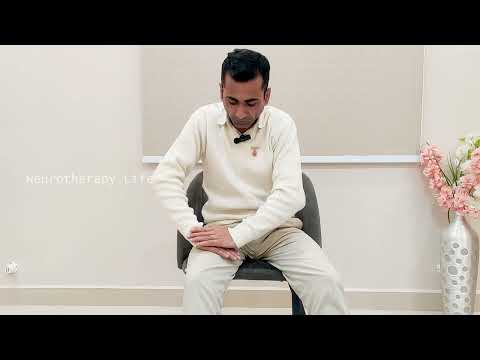
Lymph — the lymph point (लिम्फ)
In appearance this seems like the Pan treatment, and yet it is different from it. It rouses the lymph nodes of the thighs — that is, the ducts that carry the lymph.
Stand on both thighs very close to the groin, so placed that both your heels are very close to one another. Then press both heels downward and inward, hold for six seconds and release. Do it as many times as the number written.
| Patient's position | Supine, one pillow under both thighs Supine |
|---|---|
| Where the feet are placed | Both feet on the thighs, very close to the groin, with both heels touching one another; the toes on the inner side of the patient's thigh Both sides |
| Duration and repetitions | Press both heels downward and inward, hold 6 seconds, release; as many times as the number written 6 sec |
| What it is for | Rousing the lymph nodes of the thighs — the ducts that carry the lymph |
The three differences between Pan and Lymph
They are given a hand's breadth apart on the same thighs and they are not the same treatment. The differences are stated as three, and all three are checkable by eye before any weight goes down.
1. Which part of the foot carries the weight. In Lymph the therapist's weight is on the heels; in Pan the weight is on the middle part of the sole.
2. Whether the heels touch. During the treatment, in Lymph it is compulsory that both heels touch each other; whereas in Pan, if the width of the patient's thigh is greater, there may be some distance between the two heels.
3. Where the toes lie. In Lymph the therapist's toes will be on the inner side of the patient's thigh; whereas in Pan the toes may also be outside the thigh — and that depends on the width of the thigh and the length of the therapist's foot.
The finding that proves the point. If someone has a boil or a pimple on any toe of the foot, or has been injured anywhere on the foot, there will be a great deal of pain in the lymph node of that thigh; and as soon as we rouse that node by our treatment, the pain will reduce immediately. That is a prediction — it says in advance what you will find and on which side.
What lies beneath. Just below the crease of the groin sit the drainage glands of the whole lower limb — including the whole surface of the leg and foot, toes included, which is why the observation above is anatomically exact. A finger's breadth to the inside run the leg's main artery, vein and nerve under little more than skin: which is why the heel is a more demanding tool here than the mid-sole, and why the toes go on the inner side.
From Each Point in Use
The points of immunity
Six points, and the longest list of people who must not have them
Six points, and between them the therapy's whole account of resistance to disease. They are also the family with the longest list of people who must not have them, so read the right-hand column first. (Figure 25.4)
Table 10 — THYMUS, THYMUS + CHEST, ARMPIT, LYMPH, TON 'P' and TON 'T'
| Point and variant | What it is used for | When it must not be used | Notes |
|---|---|---|---|
| (4) Thymus / (8) Thymus | Given to increase the body's disease-resisting power by stimulating the various lymphocytes of the thymus gland. For Bell's palsy — paralysis of the face — for herpes zoster (shingles, नागिन), for septicaemia, for HIV, for viral fever, and for diseases caused by bacteria. If the adrenal is hyper — as when a person goes into coma from an injection of adrenaline — this can be given to correct it | (the prohibitions are printed jointly with Thymus + Chest and apply here in full) | |
| Thymus + Chest — (2), (4), (8) Th + Ch and so on | It is a painkiller — on being struck, or on a sprain, it ends the sensation of pain. It stimulates the filling of minerals into bones and tissues, so that wounds fill up quickly. It also erases old wounds inside the tissues, and the marks of burns from fire or from electricity. Give if the prostate gland is enlarged. Or for fibroid or cyst in the uterus. Useful to dry up excess water anywhere in the body — such as water or pus continually coming from the ear or the eyes. Used to dry up haemorrhage or haematoma inside the brain. For hearing the sound of bells in the ears without cause. In Ménière's disease, where dizziness comes even on turning over in bed: first give (8) Thymus + Chest, and afterwards give (4) Down arrow | Thymus and Thymus + Chest are not to be given to the following kinds of patients. To pregnant women — after giving this, the babies begin to move about vigorously, from which it may be judged that the baby must be experiencing discomfort; so they are not given during pregnancy. In polio or inflammatory diseases, and in heart disease and diabetes, in rheumatoid arthritis and autoimmune disorder — do not give. Also do not give in kidney diseases, because almost all kidney diseases are autoimmune disorders ▲ Take care | In this, the armpits must also be given, without fail. And the Ménière's instruction is an order of two points, not one. |
| (12) Armpits | The armpit contains many lymph nodes; this treatment opens the small blockages within them and so stimulates the function of the lymph nodes. For bacterial or viral illness, and for tonsils, sore throat and pain on swallowing. Also useful in children for earache, and for mild cold and cough | Do not give in lymph node cancer, in polio, in diabetes, or in any autoimmune disorder ▲ Take care | When giving Th + Ch, the armpits must also be given. |
| (1) Lymph / (5) Lymph | Near the waist, in the upper part of the thighs, there are many lymph nodes. By this treatment the small blockages inside them open, and in this way the lymph nodes are stimulated. Given in viral fever, cancer, HIV and the like, to end the infection of virus or bacteria. It raises the disease-resisting power by way of the lymph nodes' B cells, or gamma globulin and other lymphocytes | If there is cancer in the lymph node, do not give ▲ Take care | The same node-cancer bar as Armpit, printed again for the groin. |
| Ton 'P' | It stimulates the parotid glands beside the cheeks, which will fight any virus or bacteria in the mouth or throat — that is, give it if there is infection. Besides this, in prolapse of the uterus — if the uterus moves from its place — this treatment is unmatched for setting it back in its place | But from this there may perhaps be some adverse effect on conception. Therefore do not give it to women who want children. It is also not proven that it prevents conception — therefore do not call it a contraceptive treatment. Research is to be done. Do not give in diabetes, in rheumatoid arthritis and autoimmune disorder. Also do not give in inflammation ▲ Take care | Counts of 12, 6 and 3. |
| Ton 'T' | Given for tonsil infection. Also beneficial for trouble in the throat, or soreness of the throat | Do not give in diabetes, in rheumatoid arthritis and autoimmune disorder, and not in inflammation either ▲ Take care | Ton 'T' is followed immediately by Sangam points. |
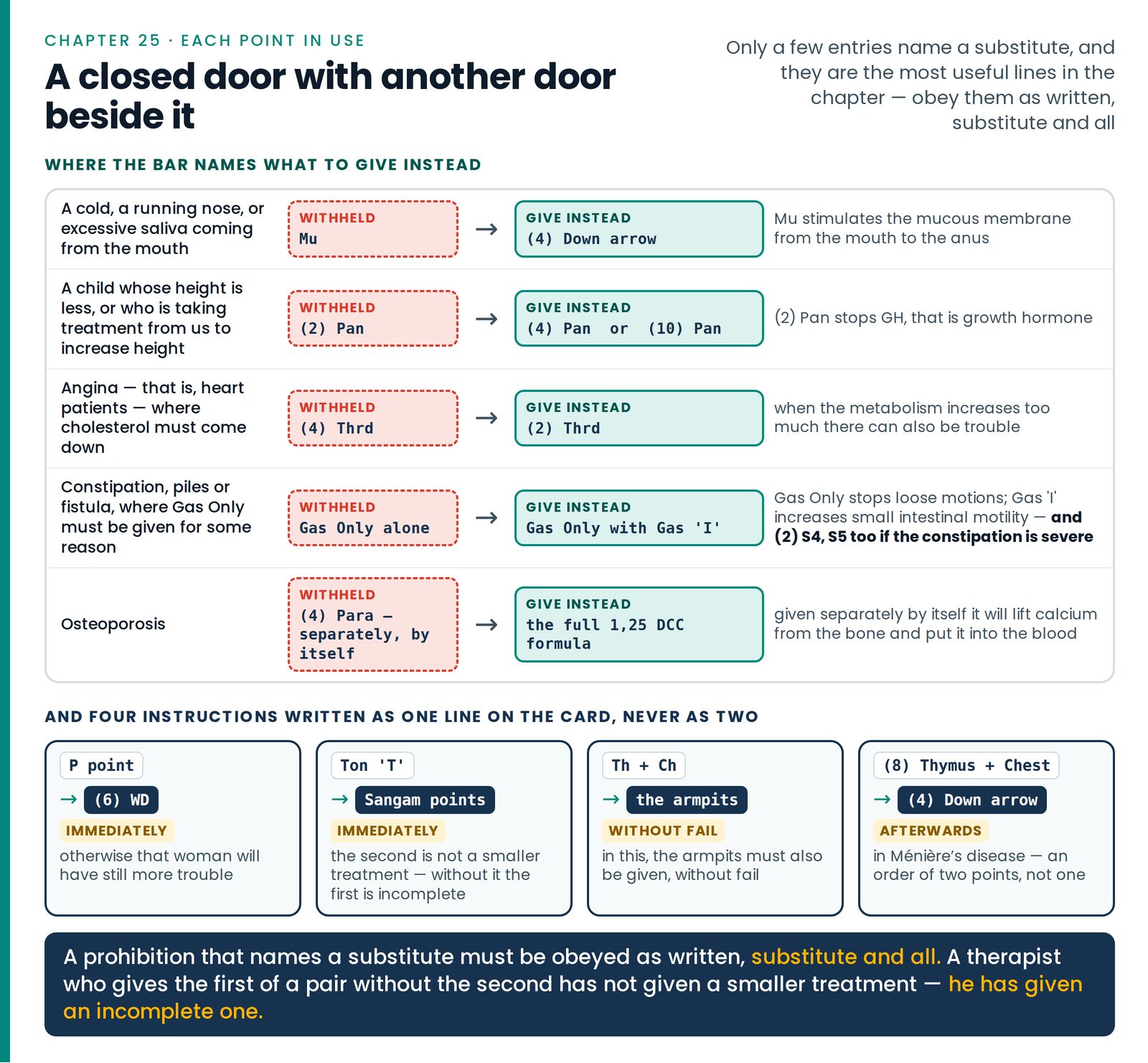
Two instructions in this atlas are written as pairs, and a therapist who gives the first without the second has not given a smaller treatment — he has given an incomplete one.
P point → (6) WD, immediately. With this treatment we give in order to loosen her uterine muscles further. And immediately after giving this treatment, giving (6) WD is necessary; otherwise that woman will have still more trouble.
Two points that must never be separated from what follows them
Ton 'T' → Sangam points, immediately.
Write them on the card as a single line, with no room between them for a telephone call or a change of mind.
Also explained in
- The note that belongs here: (6) Right Swt for bronchial asthma Fire and Swelling
And besides these, in our thymus gland, spleen and lymph nodes there are the special cells of the white blood cells, that is lymphocytes, which maintain our immunity.
- The second river, which has no pump The Body's Own Pharmacy
ymph — the fluid that drains every organ, and why it moves only when you move The therapy's own definition names two fluids, not one: it restores the flow of blood and lymph.
- What this completes Cranial Nerve and Brain Formulas
Part · Given · What it is for I · Endorphin · For pain — to reduce the sensation of pain II · Ptyalin · For saliva — for the digestive system III · (3) Raman · For the peritoneum — so that all the organs work properly IV
- The slowest river in the body Cranial Nerve and Brain Formulas
Lymph has none.
- A long line with conditional omissions How a Formula Is Built
Parts V, VI and VII are (1) Thymus, (1) Lymph and (1) Ton 'T' — the three given to increase immunity.
- Where this leads Fire and Swelling
Only (12) Armpits + Ton 'P'; then Mild — (1) Lymph (1) point Spl (1) Th.
- The three levels The Fire and the Ash
he stomach, the accessory organs and small intestine, and immunity Bad digestion is not one thing, and the work is not aimed at one place.
- The warnings that shape a plan — blocking From Findings to a Plan
Table 2 — The conditions, and the points blocked in each Disease or condition Blocked points Autoimmune disorders, arthritis, inflammation / polio Th · Th+Ch · Lymph · Armpits · Ton 'P' · Ton 'T' · Spl Asthma Spl · Thrd
- VTF (Mild), and the version for chronic disease Fire and Swelling
Table 8 — Card: VTF (Mild) Supine 6 sec × 3 ▲ Take care Written VTF (Mild) → (1) Lymph (1) point Spl (1) Th.
- The two variants, each with its own condition The River — Heparin
Heparin as a built-in step — the point's own prohibitions come with it, unchanged: It reduces immunity.
- The Subclavian treatment Cranial Nerve and Brain Formulas
he ring-finger check that decides whether it is the right treatment This is a new treatment, which is given to provoke the lymphs of the body — that is, the lymphatic system — through the subclavian veins, which are on
- Armpit (आर्म पिट) The Front of the Body II
This rouses the lymph nodes situated in the armpit, and so is useful for increasing the body's immunity.
- Questions students ask The Front of the Body II
What in this article will I actually use in my first year? Lymph, the chest group, Thrd, Lu + Sh and the toe work.
- The adrenal cortex, T6, and the finding of (6) Adr Fire and Swelling
If more is to be given, start again from the top ▲ Take care The rounds × 3 treatments — the whole treatment on three separate occasions, with the rest that Table 8, How a Formula Is Built sets for it The repeat If needed, it can b