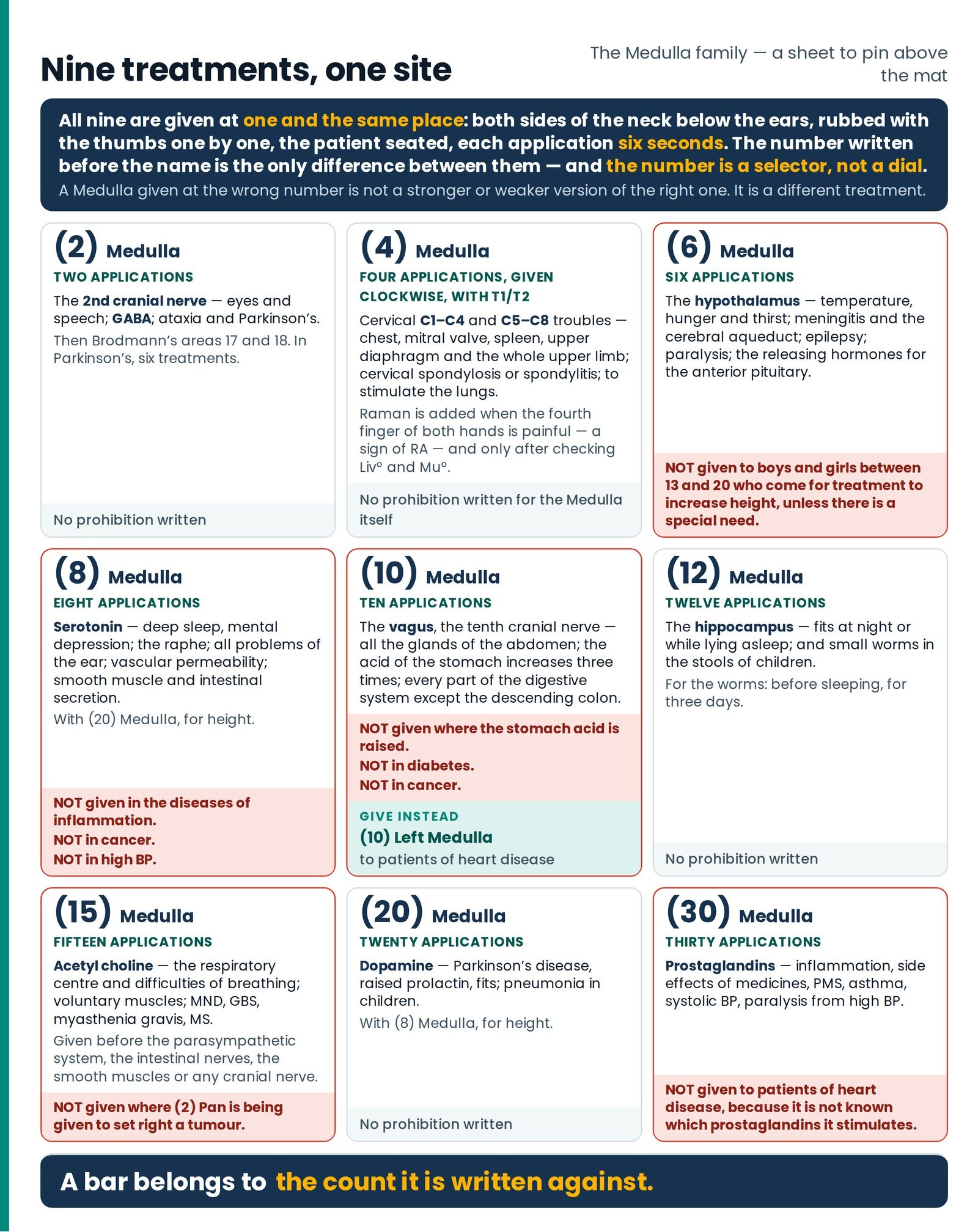
This article is about the largest single family in the whole formulary, and about the strangest thing in it. Nine treatments share one name, one patch of skin, one technique and one six-second unit. The only thing that differs between them is a number. (2), (4), (6), (8), (10), (12), (15), (20), (30). And they are not nine strengths of one treatment. They are nine treatments, with nine different purposes, nine different sets of patients and — this is where students come to grief — nine different sets of things that must not be done.
You have already been handed pieces of this family without being told what family they belonged to. (10) Medulla opened four digestive formulas in Setting the Stomach. (15) Medulla opened UDF in Clearing the Ash. (30) Medulla opened APR in APR — Abdominal Pain, and three times in that article you were told to read the number before you read the point and then sent here for the reason. This is the reason.
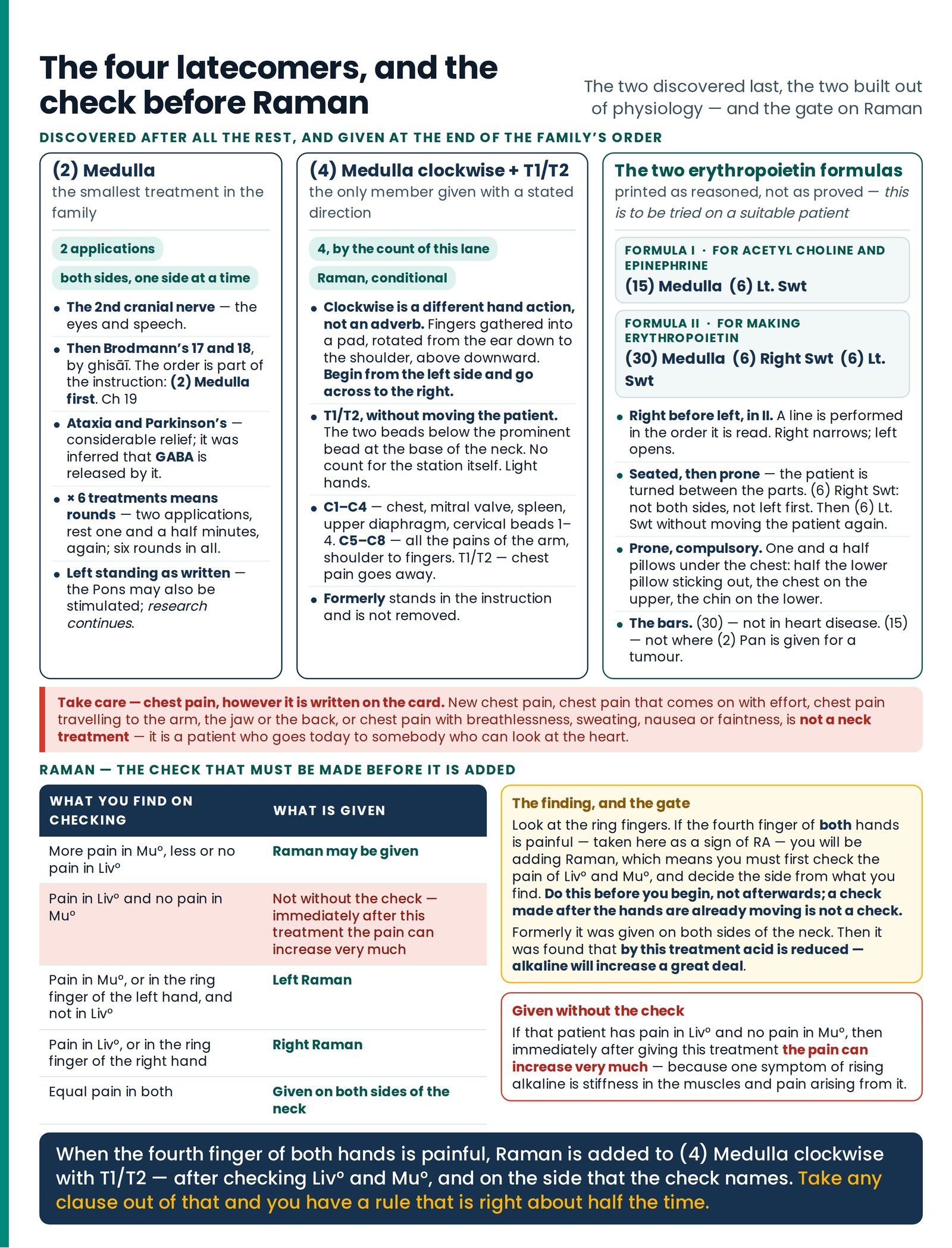
The notation is closed. Every bracket, side prefix, glyph, colon, underline and treatments suffix in this article was taught once and completely in Table 13 of How a Formula Is Built, "How a Formula Is Built". Nothing is explained again. Every written rest — including the one and a half minutes that governs the repeats of a Medulla line — is in Table 8 of that same article, with the reason given for it. If a line will not read, go back to those two tables; that is what they are for.
Watch


How the family began
Two facts about the brain, one patch of skin, and two thumbs
Everything in this therapy starts from one aim: improving the blood circulation of the various glands. As people began to benefit, faith in the work grew, and the range of patients widened. In the early years it was stomach pain and its relatives. Then, as the reputation spread — and it spread on the strength of the service, not on any advertising — patients began arriving who had obtained no special benefit from any other treatment.
The chief among them were the children of the story above. The treatments for setting the stomach improved their bodily movement and their activity, and the parents said so plainly. But the development of the brain showed little change. So the question became a practical one: how does a pair of hands reach a brain from the outside?
Two facts answered it.
The first. The carotid arteries — the arteries that carry blood to the brain — come out of the neck and run up past the side of the ear.
The second. A chief part of the brain is the medulla oblongata, which sits below the part of the brain stem called the pons. Whatever nerves go from any organ to the brain, and from the brain to any other organ, go through this part only. For every kind of work the brain does, the nerves must pass from inside the medulla oblongata. And in the picture of the head, that part lies at approximately that very place where the skin is between the ear and the neck. (Figure 31.1)
So the place chose itself. He rubbed there — ghisāī, with the thumbs, one by one — and in several of those children special differences were found.
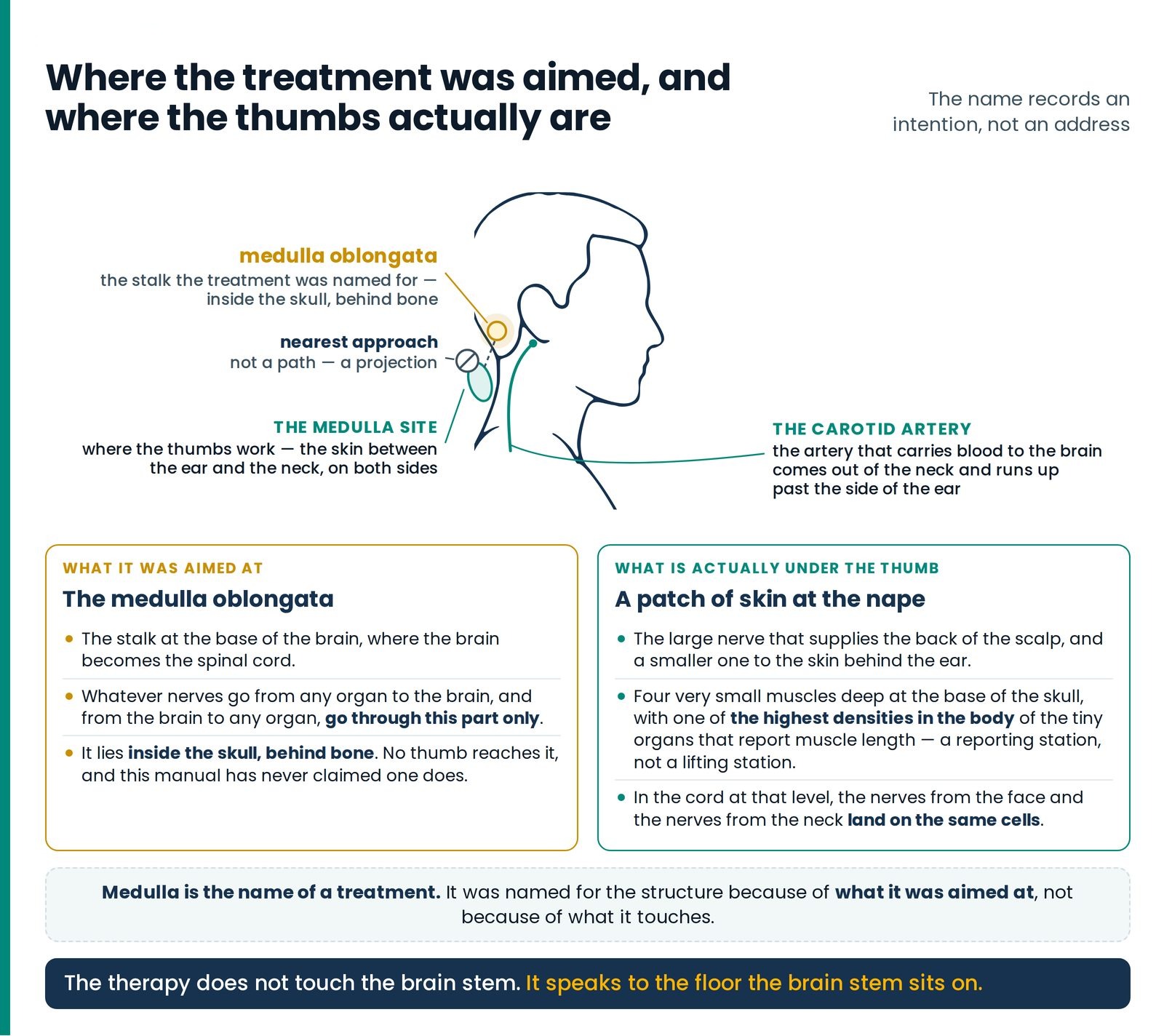
Then came the question of the name. It seemed to him that if the functions of the brain improve from this rubbing, the treatment must be setting right the work of all the nerves that go by way of the medulla — so the treatment was called Medulla.
And then, over years, many different treatments for many different diseases were obtained, and it was found that by doing the work in different numbers on both sides of the neck below the ears, not only the functions of different parts of the brain but the kidney and other parts could be activated as well.
Here is the decision that made this family what it is. Since all these treatments were given at one and the same place, they were all given one and the same name — and a system was made of showing the difference by placing the number before the name.
Why one name, and what the number is doing
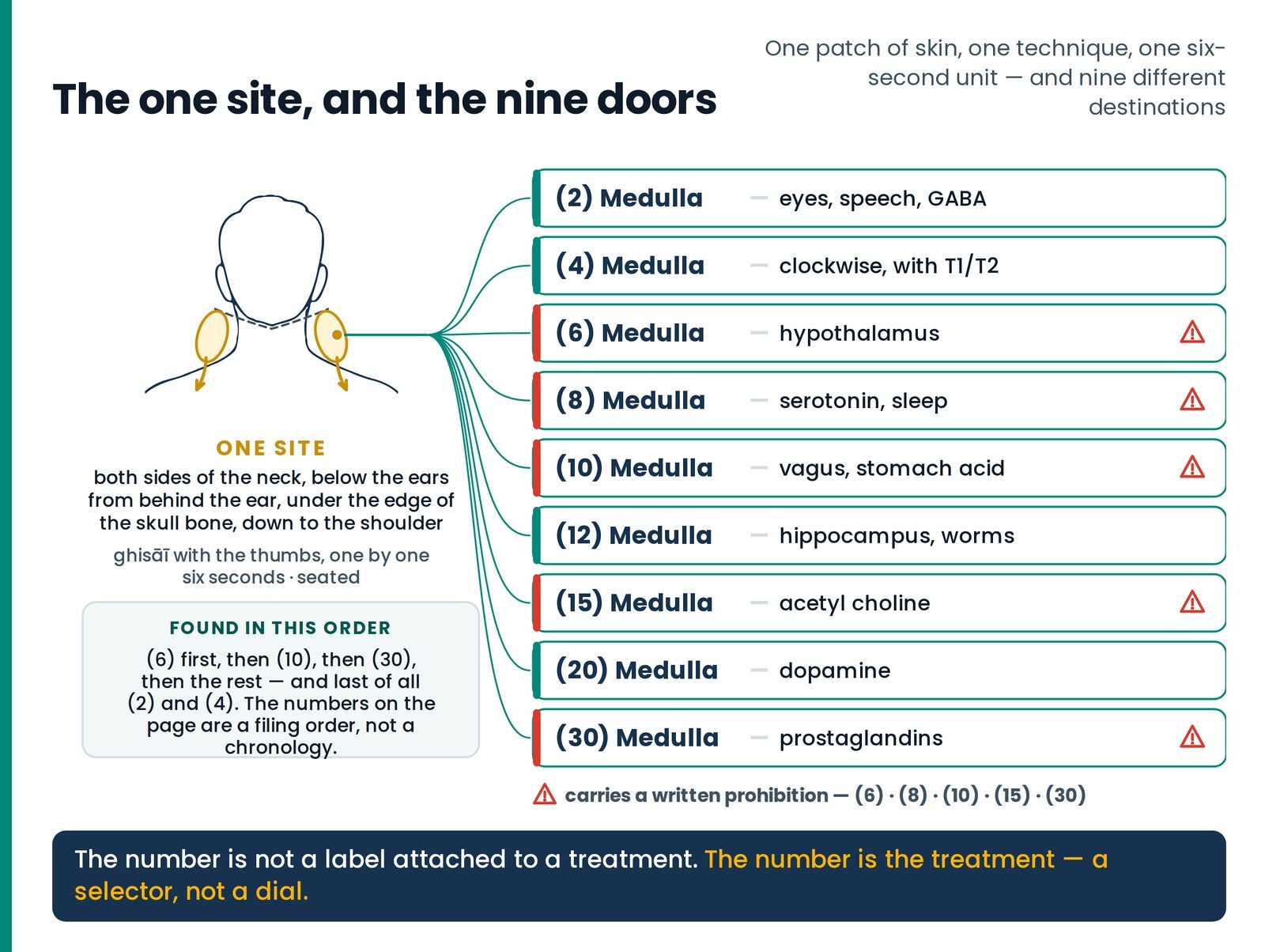
All the Medulla treatments are given at one and the same place — both sides of the neck below the ears, rubbed with the thumbs, one by one. They therefore all carry one and the same name. What distinguishes them is the number written before the name.
Read that as a piece of engineering, not as a piece of shorthand. The therapy could have given nine names to nine treatments. It did not, because the site really is the same and the technique really is the same — and a student who had learned nine names would have learned nine places along with them, which would have been false.
So the number is not a label attached to a treatment. The number is the treatment. (6) Medulla and (30) Medulla are related the way two telephone numbers on one exchange are related: same wires, different house.
The order in which they were found
(6), then (10), then (30) — the page order is filing, not chronology
They did not arrive in numerical order, and it helps enormously to know that.
First the functions of (6) Medulla were discovered. Then came (10) Medulla, then (30) Medulla, and so on. Slowly, by research and practice, it came to be known that many organs of the brain can be stimulated by these treatments. Now many different treatments have been obtained which stimulate the various parts inside the brain and the various cranial nerves — which is ordinarily beyond belief. Apart from calling these treatments a gift of nature, or the grace of Hari, there is no other way in which their effect can be described.
Then, after all of those, the two smallest — (2) Medulla and (4) Medulla — were discovered, and they are given at the end of the family's order for that reason, not because they are least.
So the family grew (6) → (10) → (30) → the rest → (2) and (4), and the numbers here are a filing order, not a chronology. Nothing here was designed. Everything was noticed. (Figure 31.2)
Table 1 — The nine members of the Medulla family
| Formula | Applications | In one line, what it is for |
|---|---|---|
| (2) Medulla | 2 | The 2nd cranial nerve — eyes and speech; GABA; ataxia and Parkinson's |
| (4) Medulla | 4 | Given clockwise with T1/T2 — cervical C1–C4 and C5–C8 troubles, chest, mitral valve, spleen, upper diaphragm and the whole upper limb |
| (6) Medulla | 6 | The hypothalamus — temperature, hunger and thirst; meningitis and the cerebral aqueduct; epilepsy; paralysis; the releasing hormones for the anterior pituitary |
| (8) Medulla | 8 | Serotonin — deep sleep, mental depression; the raphe; vascular permeability; smooth muscle and intestinal secretion |
| (10) Medulla | 10 | The vagus, the tenth cranial nerve — all the glands of the abdomen; the acid of the stomach increases three times |
| (12) Medulla | 12 | The hippocampus — fits at night or while lying asleep; and small worms in the stools of children |
| (15) Medulla | 15 | Acetyl choline — the respiratory centre and difficulties of breathing; voluntary muscles; MND, GBS, myasthenia gravis, MS |
| (20) Medulla | 20 | Dopamine — Parkinson's disease, raised prolactin, fits; with (8) Medulla, for height |
| (30) Medulla | 30 | Prostaglandins — inflammation, side effects of medicines, PMS, asthma, systolic BP, paralysis from high BP |
Read that last column downward and the point of the article is already visible. Serotonin, the vagus, the hippocampus, acetyl choline, dopamine, prostaglandins. Six different chemicals and structures, six different clinical worlds — and the hand does not move an inch between them.
How every member is given
One standing card governs all nine; only the number changes
One card governs all nine. Learn it once; after that, only the number changes.
Table 2 — The standing card for the whole family Seated 6 sec Both sides
| Site | Both sides of the neck, below the ears — from behind the ear, under the edge of the skull bone, down the side of the neck to the shoulder |
|---|---|
| Technique | Ghisāī — rubbing, not pressing; with the soft pads of the thumbs, one by one |
| Position | Seated on a firm chair, feet flat, back supported, hands loose in the lap — or lying down if the patient is very ill or very weak Seated Supine |
| Your stance | On the patient's left side, palm made round over both sides of the neck, both thumbs behind the ears below the bone |
| The count | The bracketed integer is the number of applications. By the convention of this lane, two equals one — the number is given with each thumb. Then the same behind the right ear |
| The order of sides | One side at a time. Right below the ear, then left, unless a side prefix says otherwise |
| Side prefixes | Left Medulla = behind the left ear only. Right Medulla = behind the right ear only. Side is part of the identity of the point Left Right |
| The written rest | Where a Medulla line is repeated, the rest between rounds is one and a half minutes — Table 8, How a Formula Is Built |
| Never | The front of the neck. The great artery to the brain divides low in the front triangle; this work stays behind and above it ▲ Take care |
| Point taught in | Seated I — Brain, Medulla, Neck, "Seated — I" — the hands, the stance, the counting convention and what lies beneath |
The central teaching of this article
The bracket is a selector, not a dial — nine treatments, not nine doses
Now the thing this article exists for, and the thing students get wrong more often than anything else in .
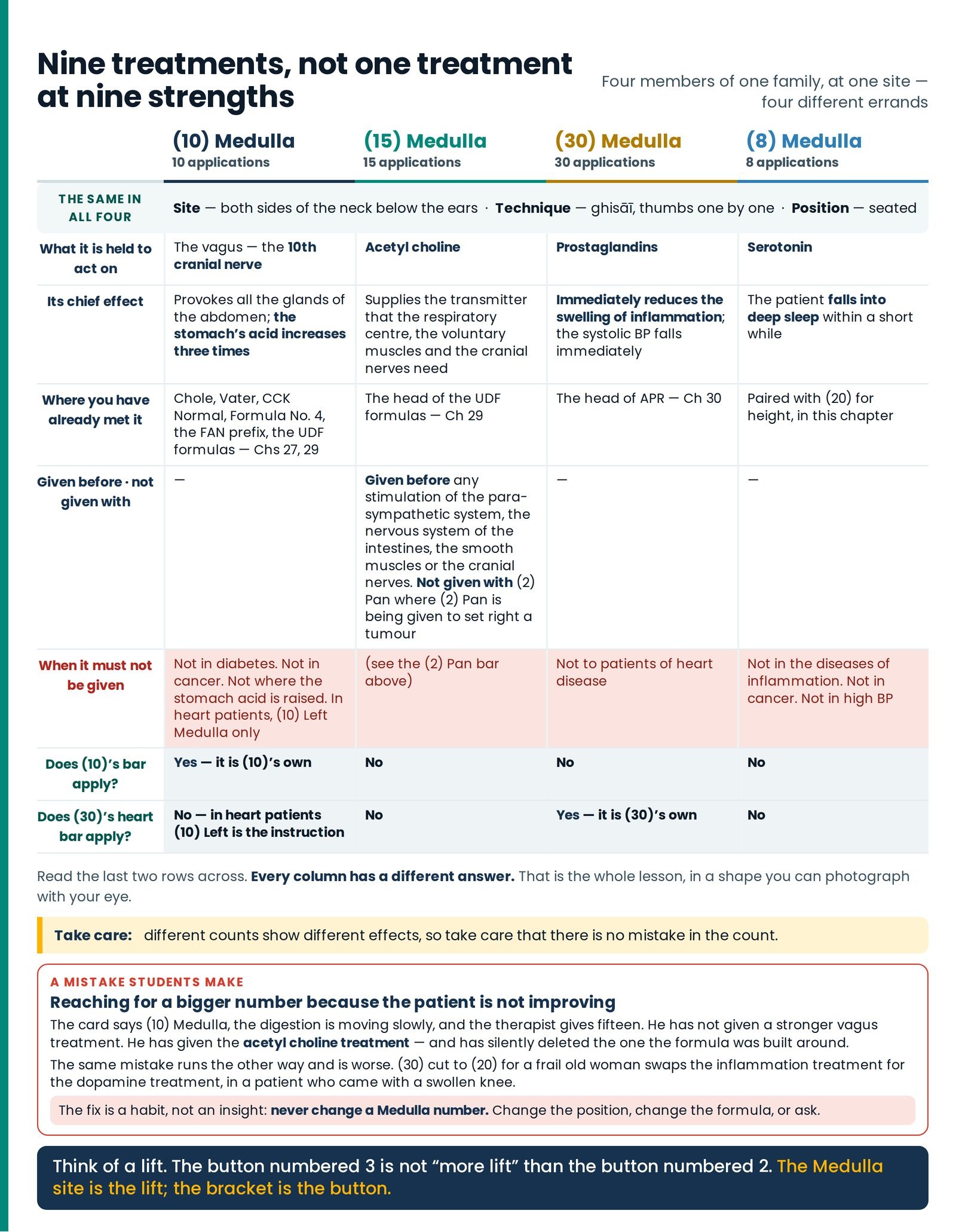
Nine treatments, not one treatment at nine strengths
The graded Medulla series is not one treatment given harder or softer. It is nine different treatments given at one site.
(15) and (10) are different treatments at one site. (15) is the acetyl choline treatment; (10) is the vagus treatment. One prepares the nervous system to be stimulated at all; the other provokes the digestive glands and triples the stomach's acid. They are not five applications apart in strength. They are two different errands.
(30) and (15) are different treatments from (10). (30) stops inflammation through the prostaglandins. (15) supplies acetyl choline. Neither of them raises stomach acid, and neither of them is doing (10)'s work at a different volume.
(10)'s bars do not travel to the others. The prohibitions written against (10) Medulla — not in diabetes, not in cancer, not where the stomach acid is already raised; in heart patients, (10) Left Medulla only — are written against (10). They are inherited by every formula that contains (10) Medulla, and by no formula that does not.
Say the whole thing as one sentence and keep it: the number in the bracket is a selector, not a dial.
Why does this catch people? Because every other number in the therapy behaves the other way round. (8) Pan really is more of the same thing than (3) Pan. (6) Adr really is more than (4) Adr. A student spends the whole of learning that a bracket is a dose, arrives at the Medulla family, and applies the habit — and the habit is wrong here, and only here, and dangerously.
An analogy that sticks. Think of a lift in a hospital. The button numbered 3 is not "more lift" than the button numbered 2. It takes you to the third floor, which is Obstetrics, while 2 is Radiology. Pressing 4 because you are in a hurry does not get you to Radiology faster; it gets you to a different department, where nobody is expecting you. The Medulla site is the lift. The bracket is the button.
Read the last two rows across. Every column has a different answer. That is the whole lesson, in a shape you can photograph with your eye. (Figure 31.3)
How to read a Medulla code on sight
Four questions, and a boundary at twelve
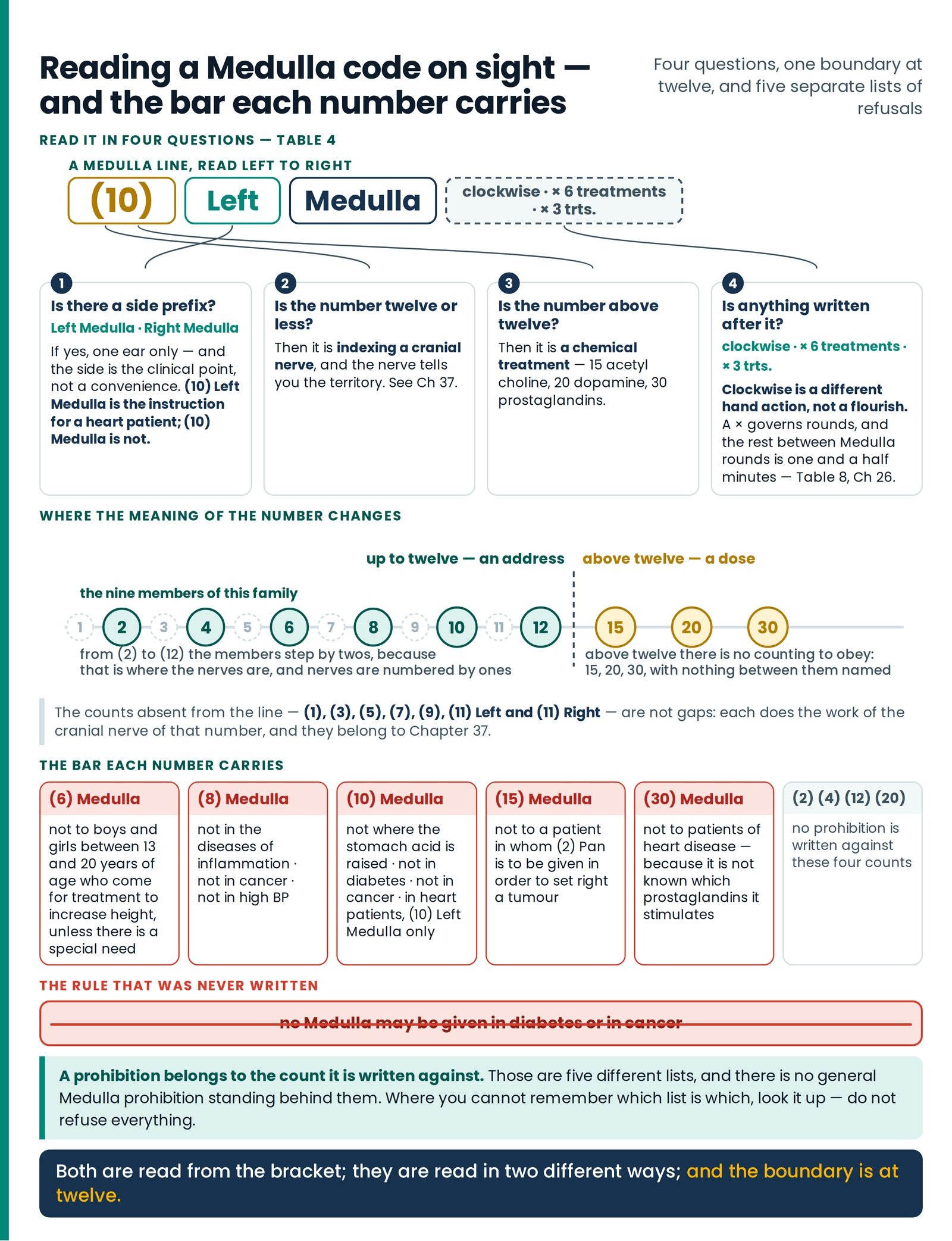
There is a system in the numbering, and once you see it the whole family stops being a list to memorise.
What a Medulla number means, and where its meaning changes
From (1) to (12), the number indexes a cranial nerve.
After trying these treatments on many patients it became certain that they do the same work as the cranial nerve of that number does. (2) for the second — the eyes. (10) for the tenth — the vagus. (11) for the eleventh — the shoulder. The number is an address.
Above (12), the number no longer indexes a nerve, because there are only twelve. (15), (20) and (30) stimulate chemicals instead: acetyl choline, dopamine, prostaglandins. The number there is simply the count that was found to produce that effect. It is a dose.
The therapy does not blur the two, and neither should the student. A card reading (9) Medulla is asking for the work of the ninth cranial nerve. A card reading (20) Medulla is asking for dopamine. Both are read from the bracket; they are read in two different ways; and the boundary is at twelve.
That is the naming system, and it explains the two oddities a student notices on day one. (Figure 31.4)
Why the family skips. The nine members here are (2), (4), (6), (8), (10), (12), (15), (20), (30). Nothing at (1), (3), (5), (7), (9), (11). The gaps are not gaps: those counts exist, and each of them does the work of the cranial nerve of that number. They simply belong to the cranial-nerve index, which is a different teaching with a different structure, and they are set out whole in Cranial Nerve and Brain Formulas, "The Twelve Messengers". This article takes the nine that grew up as general treatments in their own right.
Why the steps get bigger at the top. From (2) to (12) the members step by twos, because that is where the nerves are and nerves are numbered by ones. Above twelve there is no counting to obey, so the steps are 15, 20, 30 — the three counts found to do those three pieces of work, with nothing between them named.
(6) Medulla — the hypothalamus treatment
The first one found — and the one withheld from a child who came about height
This is the very first Medulla treatment that was obtained, and everything else in the family descends from it.
Table 5 — Card: (6) Medulla Seated 6 sec Both sides
| Written | (6) Medulla |
|---|---|
| Applications | 6, both sides of the neck below the ears, one side at a time |
| Site, technique, position | The standing card — Table 2 Seated |
| What was found on giving it | 1. If the body temperature is below normal, it can be raised. 2. Those who feel no hunger or thirst begin to feel hunger or thirst immediately after the treatment. 3. Patients who had brain trouble on account of meningitis truly did benefit. 4. Patients of epilepsy — mirgī — and of paralysis also benefit |
| The inference drawn | That the hypothalamus can be stimulated by this treatment — after which it was applied wherever the hypothalamus has a function, and considerable success was obtained in it |
| The reasoning about the brain's water | The hypothalamus forms the wall of the brain's 3rd ventricle. In meningitis there is a blockage in the 3rd ventricle, on account of which the CSF — the fluid inside the brain — cannot pass into the 4th ventricle. So this treatment is thought to be able to open the passage called the cerebral aqueduct, which lies between the 3rd and the 4th ventricles |
| Its use on the glands | For the hypothalamus to make releasing hormones such as TSH.RH and FSH.RH for the anterior pituitary, from which TSH, FSH and so on will be released. By (6) Medulla we can give orders to the anterior pituitary — which is what we use for setting right the diseases of the endocrine glands |
| Its use on pain | It stops the messages coming from the sensory nerves, so that the sensation of pain is not allowed to occur. The chemicals called endorphins also do this work |
| What the index adds | To increase hunger, thirst and body temperature, and to reduce the pains of the body. Through the anterior pituitary we can stimulate the thyroid gland, the ovaries or testes, prolactin, growth hormone and the adrenal cortex. It perhaps controls the muscles of the eyes by means of the 6th cranial nerve, and can also correct some kinds of double vision |
| When it must not be given | Not to boys and girls between 13 and 20 years of age who come for treatment to increase height — unless there is a special need for it ▲ Take care |
| Point taught in | Seated I — Brain, Medulla, Neck, "Seated — I" |
Four of the uses below are not yet settled, and the therapy says so plainly. They are printed here exactly as they stand, because a student who is shown only the finished parts of a teaching learns to distrust the whole of it on the day he finds an unfinished part for himself.
(6) Medulla — the further uses, which are to be tried on suitable patients
To stimulate the part of the hypothalamus called the mamillary bodies. The function of the mamillary bodies is the overall control of GIT activity — that is, of the workings of the stomach and the intestines — including at least some of the processes at the time of eating food, such as stimulating the licking of the lips with the tongue while eating, and the process of swallowing. (These nuclei are also described as a chief relay station for impulses relating to smell — they are needed in order that a smell be felt from the nose up to the brain.)
In the brain's medulla oblongata there is a place from which the nerves of one side of the brain cross over to the other side of the body. If there is any blockage in it, that ought to be set right by this treatment. This is called the crossing point of the pyramids.
In the hypothalamus there is a part called the optic chiasma, in which the fibres of the inner side of the retina cross from one side of the brain to the other.
Besides these, it appears that by this treatment we can also stimulate the 6th cranial nerve, by which we can set right disturbances arising from the eye muscles called the inferior oblique and the lateral rectus. Perhaps this may be useful in correcting some kinds of squint ??? Patients of this kind have not come to us in large numbers. This fact is to be tested on patients later on.
And then the passage that ought to be read aloud in every classroom, because of what it costs the man who wrote it.
One last thing about that card is worth a sentence, because it is the kind of detail that tells you how carefully a list was made. Temperature, hunger and thirst are not a random three. Deep in the middle of the brain sits a region no larger than an almond which is the body's thermostat, its appetite switch and its thirst meter all at once — three small clusters of cells, a few millimetres apart, doing those three jobs. It is why a fever takes your appetite with it. Anyone naming the hypothalamus at all would have to name those three, more or less in that order — and this list does.
(8) Medulla — the serotonin treatment
Deep sleep within a short while — and three refusals with their reasons
On giving (8) Medulla the person begins to fall into deep sleep within a short while. From that one observation the whole of the rest follows: the treatment is held to stimulate serotonin, the chemical necessary for bringing sleep.
Table 6 — Card: (8) Medulla Seated 6 sec Both sides ▲ Take care
| Written | (8) Medulla |
|---|---|
| Applications | 8, both sides of the neck below the ears |
| Site, technique, position | The standing card — Table 2 Seated |
| What is observed | The person falls into deep sleep within a short while |
| What it is held to act on | Serotonin — made in several places, chief among them the hypothalamus, some parts of the CNS, and the enteric neurons of the intestine |
| What serotonin governs | Mental depression — from a shortage of serotonin a person may have sadness, or sleeplessness, and so on |
| The raphe | Serotonin is made not in the medulla of the brain stem but in the part called the median raphe. So by (8) Medulla we can stimulate the brain's raphe, and whatever disease arises from a disturbance of the raphe can be set right by this treatment |
| On the vessels | If we need to increase vascular permeability — the traffic of things inside the blood vessels — then (8) Medulla is to be given |
| On smooth muscle | It helps in the contraction of smooth muscles and increases the secretions of the intestine. Wherever we need to increase the work of smooth muscles, (8) Medulla is to be used |
| Given with | (20) Medulla, for height — dopamine and serotonin both increase the secretion rate of growth hormone |
| What the index adds | For all problems of the ear; and for serotonin, necessary for bringing sleep and for correcting extreme sadness. By it we can correct every disease of the raphe region between the medulla and the pons |
| When it must not be given | Not in the diseases of inflammation. Not in cancer. Not in high BP ▲ Take care |
| Point taught in | Seated I — Brain, Medulla, Neck, "Seated — I" |
Four things about serotonin decide how this treatment is used, and two of them decide when it is refused.
What controls its release. Several factors, chief among them stress; not sleeping at the right time; the quantity of glucose in the blood; and exercise. If there is a disturbance in even one of these, serotonin will not be released in the proper amount. Will (8) Medulla give benefit in the treatment of diabetes? This is to be tried.
What growing children need. For growing children, both dopamine and serotonin are necessary. That is the sentence sitting behind the height instruction under (20) Medulla.
What it does at a wound. When haemorrhage occurs, serotonin is released from the platelets, which constricts the blood vessels at that place, so the flow of blood there is reduced. In this way serotonin helps the work of the platelets and helps in healing. So will (8) Medulla give benefit in Injury treatment? This is to be tried. The Injury formula itself, with its substitutions, is Fire and Swelling, "Fire and Swelling".
And what it does to inflammation. In inflammation serotonin acts like histamine, and increases inflammation.
(Haemorrhage is an abnormally large flow of blood inside or outside the body. Blood passing out of the body is external haemorrhage; occurring inside the body it is internal haemorrhage, and when that blood collects inside the body it is a haematoma. Smooth muscles are those controlling involuntary actions, found especially in the stomach, the intestines, the lungs, the urinary bladder, the uterus, and inside all blood vessels and the ducts of the glands.)
Three further notes travel with this member and belong to it.
Where else serotonin is found. Besides the places above, in the hypothalamus, in extra neural tissues and in the gastro-intestinal tract. It inhibits the production of pancreatic juice. Perhaps this is why some people complain of indigestion after sleeping immediately after food?
The banana. Serotonin is found in bananas. This is precisely why Guruji tells people to eat the inner white layer of the banana peel, so that there is no shortage of serotonin in our body.
And one question left open. Whether serotonin is made in the pineal gland is not settled in the physiology this therapy works from — there is no mention of it there. This is to be looked into. The question is left standing here exactly as it stands there.
(10) Medulla — the vagus treatment
The acid of the stomach three times over, and the bar every formula inherits
You have been using this one since Setting the Stomach. Here is the whole of it.
Table 7 — Card: (10) Medulla Seated 6 sec Both sides ▲ Take care
| Written | (10) Medulla · in heart patients, (10) Left Medulla Left |
|---|---|
| Applications | 10, both sides of the neck below the ears |
| Site, technique, position | The standing card — Table 2 Seated |
| What it is given to do | To stimulate the vagus nerve — the tenth cranial nerve — which stimulates all the glands of the abdomen |
| Its chief effect | The acid of the stomach will increase three times |
| The claim it settles | People say that undigested food comes in the stools because of insufficient chewing. This is not so. It happens because the acid of the stomach is low — which we can improve with (10) Medulla |
| Its one written exception | (10) Medulla has no effect on the descending colon. On the descending colon it is the S,4,5 treatment that has an effect — keep this in mind |
| What the index adds | By means of the vagus nerve it stimulates every part of the digestive system except the descending colon. It contracts the lungs. It reduces the fast rate of the heart |
| When it must not be given | We do not give this to those whose stomach acid is raised. It should not be given to cancer patients. And the standing bar: not to patients of diabetes and of cancer ▲ Take care |
| The substitution | To patients of heart disease, give only (10) Left Medulla Left ▲ Take care |
| Where you have met it | The FAN prefix, Chole, Vater, CCK Normal, Formula No. 4 — Setting the Stomach; the UDF formulas, where it is compulsory alongside Gas Only — Clearing the Ash |
| Point taught in | Seated I — Brain, Medulla, Neck, "Seated — I" |
Three things in that card do real work, and each of them has a article behind it.
The exception about the descending colon is not a footnote. It is the reason the CCK Normal formula ends where it ends, and the reason the therapy reaches for (2) S4, S5 whenever the target is the last stretch of the large bowel. The vagus reaches the gut a long way and then stops; below that stopping place the supply comes from the sacral nerves, and the sacral nerves are reached at S4, S5.
The compulsory pairing. In the UDF formulas, (10) Medulla and Gas Only together are what the formula is. Gas Only raises the blood supply in the stomach; (10) Medulla provokes the whole digestive system through the vagus; and the two together further increase the stomach's acid, from which pepsin's work will be good and the digestion of proteins will be done well.
And the bar is inherited, not re-argued. Every formula that contains (10) Medulla carries (10) Medulla's prohibitions with it, whether or not they are reprinted on that formula's card.
(12) Medulla — the hippocampus treatment, and the worms
Two unconnected effects, reported without being joined
Two quite different kinds of effect have been seen from this one treatment, and the therapy reports both without attempting to join them together.
Table 8 — Card: (12) Medulla Seated 6 sec Both sides
| Written | (12) Medulla |
|---|---|
| Applications | 12, both sides of the neck below the ears |
| Site, technique, position | The standing card — Table 2 Seated |
| First effect — fits | In patients who get fits at night, or while lying asleep, the fits become very much fewer, or stop altogether. In the brain there is a part called the hippocampus, which plays an important role in controlling fits — so the inference is that by this treatment an improvement can be brought about in the working of the hippocampus |
| Second effect — worms | In children in whose stools small worms of ¼ʺ to ½ʺ are seen: give this treatment before sleeping, and on the very next morning a great many worms have been seen coming out in the stool |
| How long, for the worms | Give it in this way for three days, and all the worms come out |
| What the index adds | It provokes the hippocampus. To correct fits that come during sleep, or immediately after rising from sleep. It immediately kills worms or germs in the stomach or the intestines |
| Timing that is part of the instruction | For the worms, before sleeping — not at any convenient hour. The instruction names a time of day, and the result reported depends on it |
| Point taught in | Seated I — Brain, Medulla, Neck, "Seated — I" |
How the second of those two uses became known is not explained, and the therapy does not pretend to explain it; it is set down as one more instance of the grace under which the whole family was found.
The detail worth noticing is the timing. The treatment for the worms is not twelve Medulla for a child with worms. It is twelve Medulla, before sleeping, for three days. Strip the timing out and you have removed the instruction, not simplified it — which is Rule 4 of this wiki working on a single line: the context carries the meaning.
(15) Medulla — the acetyl choline treatment
Not the strongest member but the first — given before the others
This one was not reasoned out. It was stumbled on, in an emergency, and reasoned backwards afterwards.
Some patient had difficulty in breathing — { from food poisoning, or from some other cause ??? }. (15) Medulla was given, and that patient obtained relief at once. Only then did the reading follow: that in the medulla there is a respiratory centre, necessary for breathing, and that it works when acetyl choline is released from the brain. From which the inference: (15) Medulla must make or stimulate acetyl choline.
After that inference, wherever acetyl choline was needed (15) Medulla was given — and wonderful results began to come.
Table 9 — Card: (15) Medulla Seated 6 sec Both sides ▲ Take care
| Written | (15) Medulla · in some formulas with a side prefix, (15) Left Medulla — How a Formula Is Built, Table 13 Left |
|---|---|
| Applications | 15, both sides of the neck below the ears |
| Site, technique, position | The standing card — Table 2 Seated |
| What it is held to do | To make or stimulate acetyl choline |
| Breathing | If there were no acetyl choline in the medulla oblongata, the lungs would not work. Especially very good for those who say that their breathing stops and starts while sleeping at night |
| Food poisoning | If the vessels are not properly cleaned after eating, the bacteria called Botulinum can breed. On eating such contaminated food these bacteria stop the respiratory centre from working, and the patient can die from being unable to breathe. Such patients have been seen to obtain great benefit from (15) Medulla |
| Its place in a sequence | Give (15) Medulla before stimulating the para-sympathetic nervous system, the nervous system of the intestines, the smooth muscles and the functions of the cranial nerves — this brings still better results. Its contribution is chiefly important for the functions of the digestive system |
| Voluntary muscle | Necessary for the working of the voluntary muscles. In MND and GBS, great benefit has been obtained from (15) Medulla × 6 treatments × 3 |
| Myasthenia gravis | Arises from a deficiency of acetylcholine receptors; one symptom is the drooping of the eyelids by themselves. Such patients have been seen to obtain great benefit — which proves that it truly stimulates acetyl choline, or increases its production |
| MND and MS | On giving it, for some while so much strength increases in their muscles that those who see it are astonished at how the wonder occurred |
| On sweat | It stimulates the sweat glands — so it is beneficial for those who do not sweat at all. Perhaps there will be benefit from it for pimples too. This is to be tried |
| On saliva | When acetyl choline is released from the sympathetic nervous system, more saliva is released, and from the intestines a chemical called vaso active intestinal peptide, on account of which the blood vessels of the salivary glands dilate. Those whose mouths go dry will benefit. In the UDF formula we give (15) Medulla; one further benefit of that is that the saliva will be released properly |
| On prostaglandins | Acetyl choline and epinephrine both stimulate prostaglandins |
| On the fuel of the body | By the effect of acetyl choline, proteins, fats and carbohydrates are converted into a chemical called acetyl-coenzyme A, which is the precursor for making fatty acids and sterols |
| What the index adds | Acetylcholine — to stimulate the muscles, and in respiratory diseases, especially those who feel at night as if the breath stops for some time |
| The standing rule it carries | Before doing the treatment of any cranial nerve whatever, (15) Medulla × 1 treatment gives greater benefit |
| When it must not be given | Not to a patient in whom (2) Pan is to be given in order to set right a tumour ▲ Take care |
| Where you have met it | The head of the UDF formulas — Clearing the Ash; erythropoietin formula I, in this article |
| Point taught in | Seated I — Brain, Medulla, Neck, "Seated — I" |
Two further pieces belong to this member, and the second of them sends you to another formula entirely.
The fat and the bile. This is the newest of the findings attached to (15) Medulla. Acetyl choline is made from an amine called choline, which is found in lecithin, a chief constituent of bile. If bile is not made properly, fats will not be digested properly. Therefore in those who have difficulty digesting fats — perhaps acetyl choline is not being made properly in their bodies. Such a thing too is possible! That is: those in whose body acetyl choline is not being made properly will be fully cured only by improving the digestion of their fats as well — a matter to attend to while treating patients of MD, DMD or MS.
And if choline is to be made, then we must give the New Gal treatment. That is an instruction with a formula on the end of it, and the formula is not in this article.
There are some other functions of acetyl choline for which (15) Medulla is to be given and tested on suitable patients. The therapy says so in those words and leaves the list open. It is left open here too.
(20) Medulla — the dopamine treatment
Parkinson's, prolactin, fits — and the one claim a blood test can check
Table 10 — Card: (20) Medulla Seated 6 sec Both sides
| Written | (20) Medulla |
|---|---|
| Applications | 20, both sides of the neck below the ears |
| Site, technique, position | The standing card — Table 2 Seated |
| Parkinson's disease | After giving this treatment, patients of Parkinson's obtained tremendous benefit — from which it was inferred that it stimulates the part of the brain called the substantia nigra, where dopamine is made |
| What dopamine is | Largely an inhibitory chemical, which acts in the basal ganglia. Its function is to stop the unwanted movements of the limbs. It is also made in other places and sent to the hypothalamus and the limbic system — and in those other places dopamine perhaps performs a stimulating function |
| Prolactin | A second function of dopamine is to inhibit prolactin. By that same inference, when (20) Medulla was given to those women in whose bodies the quantity of prolactin was raised, their prolactin levels were seen to fall |
| Breast size | Many women whose breasts are larger in size than normal have been seen to reduce by this same treatment. Perhaps the reason is that from a rise in prolactin the breasts increase in size |
| Fits | Since dopamine stops the movement of the limbs, (20) Medulla is therefore given in the treatment of fits as well, from which many patients have been seen to obtain benefit |
| Height | Dopamine and serotonin both increase the secretion rate of growth hormone — that is, for increasing height, both (20) Medulla and (8) Medulla should be given |
| What the index adds | Dopamine — Parkinson's; pneumonia in children; or women in whom the quantity of prolactin has increased |
| Its relative in another family | (12) Gas 'I' works like (20) Medulla — see the section at the end of this article |
| Point taught in | Seated I — Brain, Medulla, Neck, "Seated — I" |
Three notes before this card is left.
Read the height line against the (6) Medulla caution once more. (20) and (8) given to a child for height; (6) withheld from a child for height, between the ages of 13 and 20. Three counts at one site, two pushing one way and one held back for fear of pushing the other. The therapy states both without apology, and so does this wiki.
Pneumonia in children appears only in the index, not in the running account. It is carried here whole, because an indication that appears once is still an indication, and a student who meets it on a card three years from now should have met it here first.
And notice the shape of the prolactin claim. It is the only place in this family where the therapy reports a blood test moving — their prolactin levels were seen to fall — rather than a symptom easing. That makes it, of everything in this article, the claim most easily checked, and therefore the one most worth recording carefully.
(30) Medulla — the prostaglandin treatment
The longest count, the widest list — and a refusal reasoned from not knowing
The longest count in the family, and the one with the widest list of uses. About how the inspiration for it came, the therapy says only that it is difficult to say anything other than divine grace.
Table 11 — Card: (30) Medulla Seated 6 sec Both sides ▲ Take care
| Written | (30) Medulla |
|---|---|
| Applications | 30, both sides of the neck below the ears — the longest application in the family |
| Site, technique, position | The standing card — Table 2 Seated |
| Its chief effect | It immediately reduces the swelling of inflammation |
| Polio, and the hot knee | Immediate relief to patients of polio, and where along with knee pain there is also heat and redness |
| The Mu point | Pain at the Mu point on the left side of the navel is understood as inflammation in the intestines; such people may also pass mucus (āv) in the stool. From this treatment, immediate benefit is obtained in both the pain and the mucus |
| Side effects of medicines | A very large hand in ending them. Where a patient says that since an operation or an injection some years ago a swelling or a pain arose that was not there before, even a pain years old is finished in one or two treatments |
| Bites and stings | If there is itching from the poison of a scorpion or snake bite, or on account of any herb, it also finishes that |
| PMS | Heaviness in the breasts before the monthly period. After 1 or 2 treatments this pain or heaviness ends so completely that it is beyond belief |
| Autoimmune disorders | In rheumatoid arthritis and multiple sclerosis, great benefit is obtained. In such disorders prostaglandins stimulate the T-suppressor cells, from which benefit occurs in diseases like MS |
| Asthma | From prostaglandins the bronchioles relax. In asthma the patient obtains immediate relief — an experience proved on many patients |
| Blood pressure | From the (30) Medulla treatment the systolic BP falls immediately |
| Paralysis | Very useful — especially of paralysis which has occurred on account of high BP |
| When it must not be given | Not to patients of heart disease ▲ Take care |
| Where you have met it | The head of APR — APR — Abdominal Pain; erythropoietin formula II, in this article |
| Point taught in | Seated I — Brain, Medulla, Neck, "Seated — I" |
From the several signs above, it seemed that this treatment stimulates certain kinds of chemicals called prostaglandins, or improves their functioning. And so the physiology of the prostaglandins becomes, for this member alone, the therapy's own index of further uses.
In the bodies of animals there are 14 kinds of prostaglandins, whereas in the human body there are 13 kinds, which have different names. They are made in several places in the body, and they work near the very place where they are made.
What the prostaglandins are, as this therapy holds them
Prostaglandins A and E — these lower the BP. Prostaglandin F — raises the BP.
Prostaglandin E₂ and Interleukin #1, both meeting together, bring on fever. (Interleukin #1 is a chemical which stimulates the working of neutrophils, macrophages and lymphocytes.)
Prostaglandins cause the blood vessels of the kidneys to dilate, and expel salt and water through the kidneys, from which high BP will fall.
Prostaglandins E₁ and I₁ can perhaps prevent the GFR — the glomerular filtration rate, that is the speed of filtration inside the kidneys — and the flow of blood inside the kidneys from falling.
That last line is the reason a treatment named for inflammation sits in a family that also claims to activate the kidney.
And then the refusal, which is the most quietly impressive sentence in the article.
The further uses, according to what the prostaglandins do
These are set down as the uses that may follow from the physiology. Some are reported as done; some are reported as reasoned; and where the therapy marks one as untried, the mark stays.
On the small vessels, and purpura. Prostaglandins suddenly strengthen the inner wall of all the small vessels — the capillaries — of the body. Excellent use was made of this in the treatment of purpura. In this disease, in places under the skin, by themselves or on even the lightest pressure, capillaries burst anywhere, from which haemorrhage occurs — blood comes out of the vessels and collects in the surrounding tissues. The inference was that this could be set right by prostaglandin treatment, because prostaglandins can make the inner wall of the blood vessels strong. When (30) Medulla was given to the patient, he immediately had the benefit that on pressing, that place did not go blue, as it used to before —
— from which it was proved that (30) Medulla stimulates the prostaglandins in the body in some incomparable way.
Table 12 — The further uses of (30) Medulla, from the functions of the prostaglandins
| What the prostaglandins do | What follows for (30) Medulla |
|---|---|
| They have a considerable effect on the nervous system | Perhaps this is why in nervous-system diseases such as MND and GBS patients obtain great relief from it |
| They act on the pupil | If the pupil of the eye is dilated, it can become small |
| They inhibit the production of cholesterol | Those whose blood cholesterol is raised will benefit |
| They prevent the aggregation of platelets and the process of unwanted clot formation in the blood | It is for this very reason that this treatment gives benefit in MS, multiple sclerosis |
| If there is any disturbance inside the RBCs producing a defect in them, the prostaglandins correct them and make them normal | In this way it is of use in diseases of RBC disturbance |
| They protect from gastric ulcer — from wounds or blisters in the stomach | The index likewise names ulcer in the stomach among its uses |
| At the time of intercourse, the seminal vesicles of men — the sac in which semen is stored — and the vagina of women make prostaglandins in greater quantity | Great benefit in conception — the instruction is given whole in the panel below |
| At the time of birth the membranes of the fetus make prostaglandins in large quantity, which by increasing the capacity of the uterus to contract help the child to be born by normal delivery | We have found that a few hours after giving (30) Medulla, the spasms of labour pain come and the child is born by normal delivery. Beneficial also for those women in whom, after doing an ultrasound, it was found that the child's head in the uterus is not in the right direction. (Dystocia = difficult labour) |
| When the child comes out, from the place where the placenta separates some prostaglandins are released which are vaso-constrictors — perhaps so that too much blood should not leave the body | (and see the line that opens the next page) |
The infertility instruction, given whole
Those who come to us for the treatment of infertility should be given the other treatments in the clinic; along with that, teach the treatment of (30) Medulla to both, and tell the husband and wife to give it to each other, so that benefit may come quickly.
Three parts, and all three are the instruction. The clinic treatments are not replaced — they continue. Both partners are taught, not one. And the timing is part of it: the husband before, the wife immediately after.
This is also, in the whole formulary, the clearest instance of the therapy handing its own work to the household. A treatment of the nape, requiring no instrument, no medicine and no undressing, taught to two people who will give it to one another at home, for a purpose neither of them wants to discuss with a stranger. That is the design of this therapy showing itself.
And one more use, left open where it stands: so perhaps benefit may also come from giving (30) Medulla after delivery as well — this is to be tried on a suitable patient.
The two erythropoietin formulas
Two members, one point from another chapter, and one stated purpose
Here the family stops being a list of single treatments and becomes a formulary in its own right — because here two members are combined with a point from another article, and the combination is given a stated purpose.
The reasoning comes first. Acetyl choline and epinephrine both stimulate prostaglandins. And prostaglandins, norepinephrine and epinephrine together increase the production of erythropoietin — which is what gives the message to the bone marrow to make RBCs, the red cells of the blood.
So: when, because the kidney is not working properly, there is a shortage of RBCs in the body, then by stimulating all these organs we can produce erythropoietin. Its formula would be like this — and this is to be tried on a suitable patient.
Table 13 — Card: the two erythropoietin formulas Seated Prone 6 sec Left Right
| Formula I, written | (15) Medulla (6) Lt. Swt |
|---|---|
| What formula I is for | For acetyl choline and epinephrine |
| Formula II, written | (30) Medulla (6) Right Swt (6) Lt. Swt |
| What formula II is for | For making erythropoietin |
| The order of the sides in II | Right before left. A line is read left to right and performed in the order it is read — Table 13, How a Formula Is Built |
| The reasoning behind the parts | (15) Medulla supplies acetyl choline; (30) Medulla supplies prostaglandins; Swt provokes the adrenal medulla, from which epinephrine and norepinephrine come. Prostaglandins, norepinephrine and epinephrine together raise erythropoietin, and erythropoietin tells the bone marrow to make red cells |
| Position | Medulla seated Seated ; Swt prone Prone — the patient is turned between the parts |
| The compulsory rule of the prone position | One and a half pillows under the chest — half the lower pillow sticking out, the chest on the upper, the chin on the lower ▲ Take care |
| The status of both | This is to be tried on a suitable patient. They are printed as reasoned, not as proved, and they are given here in that condition |
| The bars each part carries | (30) Medulla — not to patients of heart disease. (15) Medulla — not where (2) Pan is being given for a tumour ▲ Take care |
| Points taught in | Medulla — Seated I — Brain, Medulla, Neck; Swt, Lt. Swt and Rt. Swt — Face Down, "Face Down" |
Notice what formula I and formula II share, and where they part. Both end at Lt. Swt. Both are built on one piece of physiology. Formula I raises the two things that stimulate prostaglandins. Formula II raises the three things that together raise erythropoietin. One is the ingredient; the other is the dish. And they differ in exactly one place — the Medulla count — which is the whole argument of this article compressed into a single line of a single card.
(2) Medulla — the smallest member
Two applications, the eyes and speech, and Brodmann's areas after
After all the above treatments, the (2) Medulla and (4) Medulla treatments were discovered. So they are given here, at the end of the family's order.
Table 14 — Card: (2) Medulla Seated 6 sec Both sides
| Written | (2) Medulla |
|---|---|
| Applications | 2, both sides of the neck below the ears — the shortest treatment in the family |
| Site, technique, position | The standing card — Table 2 Seated |
| What it stimulates | The 2nd cranial nerve — cranial nerve number two, which comes out from the eyes and goes back as far as behind the forehead |
| What follows it | After the (2) Medulla treatment, doing ghisāī of Brodmann's area numbers 17 and 18 has been seen to give great benefit in problems of the eyes and of speech. The order is part of the instruction: (2) Medulla first |
| Who has benefited | From (2) Medulla, patients of ataxia and of Parkinson's have obtained considerable relief |
| The chemical reasoning | Four kinds of neurotransmitter are released from the retina — acetyl choline, dopamine, GABA and indolamine. From this it was inferred that GABA is released by (2) Medulla. The chief work of GABA is that it stops the unnecessary movements of the limbs, the hands and the feet |
| In Parkinson's | With this very thought, patients of Parkinson's disease were given (2) Medulla × 6 treatments — and the shaking of their hands was immediately much reduced. So it is perhaps evident that the (2) Medulla treatment stimulates GABA × 3 |
| The rest between rounds | Where a Medulla line carries a ×, the written rest is one and a half minutes — Table 8, How a Formula Is Built |
| What is still open | It is also being thought that by this same treatment the Pons part of the brain can be stimulated. Further research into this is continuing |
| What the index adds | For the eyes and for speech; to provoke GABA |
| Points taught in | Medulla — Seated I — Brain, Medulla, Neck, "Seated — I"; Brodmann's areas 17 and 18 and their ghisāī — Seated II — Face, Jaw, Ear, Sinus, "Seated — II" |
Three remarks, and this member is done.
The two-step order is the treatment. (2) Medulla, then the rubbing at the back of the skull. Not the rubbing on its own, and not the rubbing first. Where a card writes them together, they are one treatment in two moves.
× 6 treatments means rounds, not applications. Two applications, rest, again — six rounds in all, with one and a half minutes between them. A therapist who reads it as twelve applications run together has given something else entirely.
And the last line stands as written. Further research into this is continuing. It is not tidied here, and it is not to be tidied by any later article.
One word on the card needs explaining before you meet it on a patient. Ataxia means the movements have lost their aim. The strength is there; the intention is there; what has gone is the smooth steering between the two. A person with ataxia reaching for a glass will reach past it and correct, past it and correct, like a man trying to write in a moving bus. It is not weakness, and it is not the shaking that happens at rest.
(4) Medulla — the clockwise treatment, with T1/T2
The one member with a direction, and the one with a conditional third part
The last member, and the only one in the family given with a stated direction of the hand.
(4) Medulla, in its original form
Formerly this treatment used to be given in this way: (4) Medulla clockwise + T1/T2 — by which relief was seen in the following symptoms:
the troubles of the cervical nerves C1–C4 — pain of the right and the left chest
mitral valve pain, spleen pain, pain of the upper part of the diaphragm
pain of cervical beads number 1 to 4, and
by giving T1/T2, right and left chest pain goes away
the pains which come because of disturbance of the cervical nerves C5–C8 —
all the pains of the arms, elbow, hand, wrist, palm, fingers and so forth are removed.
And the addition, with its condition: if, along with this treatment, the Raman treatment is also given, then the pain of the fourth finger of both hands used to go — which we take to be a sign of RA (rheumatoid arthritis).
Table 15 — Card: (4) Medulla clockwise with T1/T2 Seated 6 sec Both sides
| Written | (4) Medulla clockwise + T1/T2 · with Raman added under the condition below |
|---|---|
| The three parts, in order | (4) Medulla, clockwise → T1/T2 → Raman, conditional. Given as one pass — the panel above Seated |
| What part one is credited with | The troubles of C1–C4 — pain of the right and the left chest; mitral valve pain; spleen pain; pain of the upper part of the diaphragm; pain of cervical beads 1 to 4. And the pains that come from disturbance of C5–C8 — all the pains of the arms, elbow, hand, wrist, palm, fingers and so forth |
| What part two is credited with | By giving T1/T2, right and left chest pain goes away |
| When part three is added | When the fourth finger of both hands is painful — and only after checking Liv° and Mu° ▲ Take care |
| What part three is credited with | The pain of the fourth finger of both hands used to go — a finding we take to be a sign of RA |
| What the index adds | For spleen and mitral valve pain and for chest pains. For cervical spondylosis or spondylitis. And to stimulate the lungs |
| The word *formerly* | It stands in the instruction and is not removed. This is how the treatment used to be given; in this therapy the older form of a treatment is printed beside its successor and is not an error — Table 13, How a Formula Is Built |
| Points taught in | Medulla — Seated I — Brain, Medulla, Neck; the clockwise rotation of the neck — Seated I — Brain, Medulla, Neck, Neck Clockwise; Thoracic T1/T2 — Seated I — Brain, Medulla, Neck; Raman — Seated I — Brain, Medulla, Neck; the indications and precautions of T1/T2 — Each Point in Use |
Three things in that card need saying plainly.
Clockwise is a different hand action, not an adverb. Everywhere else in this family the thumbs glide downward; here the fingers are gathered into a pad and rotated, and it is the action taught as Neck Clockwise in Seated I — Brain, Medulla, Neck, performed at the Medulla count. A therapist who reads clockwise and gives four ordinary downward strokes has given (4) Medulla and not (4) Medulla clockwise, and the two are not the same instruction.
The list of symptoms is not a jumble. Read it as a map of the neck and it falls into three tidy groups. C1–C4 are the nerves of the top of the neck, and the chest, the mitral valve, the spleen and the upper part of the diaphragm all report in at that level — which is why a treatment given at the nape is credited with a pain the patient feels under the ribs. C5–C8 are the nerves of the arm, and their list is simply the arm written out from the shoulder to the fingertips. And T1/T2 are the two beads where the chest begins. Three groups, three parts of the treatment, one card.
And the RA sign is a sign, not a treatment. Pain in the fourth finger of both hands — the two ring fingers, symmetrically — is read here as a sign of rheumatoid arthritis. The instruction attached to it is to add Raman, and the result reported is that the finger pain used to go. What that finding also does is tell you what you are looking at, and that is worth more than the relief.
Raman — the check that must be made before it is added
Find the pain at Liv° and Mu° first; the finding names the side
Raman is a treatment in its own right, and its hands, its six-second lift, its slow release and its five or six easy breaths are taught in Seated I — Brain, Medulla, Neck, "Seated — I". What belongs here is the gate: the reason it may not simply be added to (4) Medulla because the ring fingers hurt.
Why Raman is checked before it is given
Formerly the Raman treatment was given on both sides of the neck. Then it was found that by this treatment acid is reduced — that is, alkaline will increase a great deal.
So that treatment should be given only after checking the pain of Liv° – Mu°, and is to be given to those who have more pain in Mu° and less or no pain in Liv°.
Table 16 — Which Raman to give
| What you find on checking | What is given |
|---|---|
| More pain in Mu°, less or no pain in Liv° | Raman may be given |
| Pain in Liv° and no pain in Mu° | Not without the check — immediately after this treatment the pain can increase very much ▲ Take care |
| Pain in Mu°, or in the ring finger of the left hand, and not in Liv° | Left Raman Left |
| Pain in Liv°, or in the ring finger of the right hand | Right Raman Right |
| Equal pain in both | Given on both sides of the neck Both sides |
Nowadays a division has been made into Left Raman and Right Raman, as that table sets out. And the therapy's own closing line on it is left exactly where it stands: further experience will make it understood. (Figure 31.5)
So the full instruction for the addition, said as one sentence: when the fourth finger of both hands is painful, Raman is added to (4) Medulla clockwise with T1/T2 — after checking Liv° and Mu°, and on the side that the check names. Take any clause out of that and you have a rule that is right about half the time.
The rule that precedes every cranial-nerve treatment
Supply the transmitter first, then stimulate — (15) Medulla × 1
After the nine members of this family come a further set of treatments about which, after trying them on many patients, it is certain that they do the same work as the cranial nerve of that number does. Those belong to Cranial Nerve and Brain Formulas, "The Twelve Messengers", which teaches them one by one.
But one rule governs all of them, and it belongs here, because it is a rule about a member of this family.
What is given before any cranial-nerve treatment
Take note. Before doing the treatment of any cranial nerve whatever, giving (15) Medulla × 1 treatment will give greater benefit.
(Give acetylcholine before any stimulation of SNS or PSNS.)
Read the parenthesis. It is the reason, and it is the most precise line in the article. Acetyl choline is the transmitter used at the relay station of both nerve systems — the one that speeds the body up and the one that calms it down. Whichever of the two you intend to stimulate, the message has to pass through a cholinergic handover on its way. So the rule says: supply the transmitter first, then stimulate.
Say the anatomy of it once, plainly, because popular accounts get it wrong. Every automatic nerve in the body runs in two legs, with a relay station in between, and at that relay station — in both systems, the alarming one and the calming one — the chemical used is acetyl choline, without exception. Only after the relay do the two part company: the calming side goes on using acetyl choline all the way to the organ, while most of the alarming side switches to adrenaline's relative for the last leg. So all automatic nerve traffic whatsoever passes through an acetyl choline handover.
And notice what this does to (15) Medulla's position in the family. It is the only member carrying a standing instruction to be given before other things — before the parasympathetic system, before the nervous system of the intestines, before the smooth muscles, before any cranial nerve. That is why it heads the UDF formulas, and why it heads erythropoietin formula I. It is not the strongest member. It is the first member.
Where this family ends and the index begins
Nine treatments here; the cranial-nerve index belongs to Chapter 37
The family you have just learned is nine treatments that grew up in their own right. Beside it stands something else: a complete index of Medulla treatments, running (1) through (12) — with (11) split into (11) Left and (11) Right — each entry claiming the work of the cranial nerve of that number; and then a short second table for (15), (20) and (30), headed by the note that apart from the cranial nerves, these Medulla treatments provoke the actions of other chemicals.
That index, and the twelve cranial nerves one by one, and the polarity rule that decides side, belong to Cranial Nerve and Brain Formulas, "The Twelve Messengers", which teaches them whole. They are not taught twice. What belongs here is the boundary — and the parts of the index that add something to the nine members of this family. Those additions have been carried into the cards above, and they are collected once more below so that nothing is lost between the two articles.
Table 17 — What the index adds to the members of this family
| Member | What the index adds |
|---|---|
| (2) Medulla | For the eyes and for speech; to provoke GABA |
| (4) Medulla | For spleen and mitral valve pain and for chest pains. For cervical spondylosis or spondylitis. And to stimulate the lungs |
| (6) Medulla | To increase hunger, thirst and body temperature and to reduce the pains of the body. It provokes the hypothalamus, from which releasing hormones will come out and will provoke the anterior pituitary to make its own hormones — by which we can stimulate the thyroid gland, the ovaries or testes, prolactin, growth hormone and the adrenal cortex. It perhaps controls the muscles of the eyes by means of the 6th cranial nerve. It can also correct some kinds of double vision |
| (8) Medulla | For all problems of the ear, and for serotonin, necessary for bringing sleep and for correcting extreme sadness. By this we can correct every disease of the raphe region between the medulla and the pons |
| (10) Medulla | This, by means of the vagus nerve, stimulates every part of the digestive system except the descending colon. It contracts the lungs. It reduces the fast rate of the heart. To patients of heart disease, give only (10) Left Medulla ▲ Take care |
| (12) Medulla | It provokes the hippocampus. To correct fits that come during sleep or immediately after rising from sleep. It immediately kills worms or germs in the stomach or the intestines |
| (15) Medulla | Acetylcholine — to stimulate the muscles, and in respiratory diseases, especially those who feel at night as if the breath stops for some time |
| (20) Medulla | Dopamine — Parkinson's; pneumonia in children; or women in whom the quantity of prolactin has increased |
| (30) Medulla | Prostaglandins — inflammation, side effects of medicines, ulcer in the stomach, asthma or breathing troubles and so on. Do not give to heart patients ▲ Take care |
The counts absent from that list — (1), (3), (5), (7), (9), (11) Left and (11) Right — are the cranial-nerve treatments proper, and they are Cranial Nerve and Brain Formulas's, entire. Between smell and the shoulder there is a great deal to learn, and it is taught there in one place rather than scattered here. Complete and detailed information about the functions of the cranial nerves has been given at the end. (Figure 31.6)
One further thing belongs to the boundary and to nowhere else, so learn it here. The rest between the rounds of a Medulla line is one and a half minutes, and the instruction establishing it is written of the cranial-nerve Medulla treatments: all the Medulla treatments of those tables are to be given three times at an interval of one and a half minutes. When you meet × 3 trts. on a Medulla line, that is the interval it is asking for. Table 8, How a Formula Is Built.
Reading the last three rungs
Up to (12) the number is claimed to index a structure — the cranial nerve of that number, doing that nerve's work. Above it, the number is simply the count that was found to produce an effect on a chemical: acetyl choline at fifteen, dopamine at twenty, prostaglandins at thirty.
The therapy marks that change itself, with a line of its own between the two tables: apart from the cranial nerves, the following Medulla treatments provoke the actions of other chemicals. It does not blur the two, and neither should the student. When you are asked what a Medulla number means, the honest answer has two halves, and you give the half that matches the number on the card.
(12) Gas 'I' works like (20) Medulla
Two points, two families, one errand — dopamine
The last thing this article owes you is a promise made back in the atlas, and it turns out to be the neatest illustration in of what a formula family actually is.
Gas 'I' is not a Medulla. It is a point on the calves, in the digestive group, with a dose ladder of its own — (3), (6), (9), (12) — and the reasoning that built that ladder, beginning with a Parkinson's patient whose tenderness was at Gas 'I' and whose trembling eased when it was given, is taught in full in Correcting the Two Kingdoms, "Correcting the Two Kingdoms". It is not repeated here.
What is taught here is the sentence that joins the two families.
The equivalence, with its context
(12) Gas 'I' is given in Parkinson's disease to produce dopamine. It works like (20) Medulla.
Two points. Two families. Two positions — one supine at the calves, one seated at the nape. One errand: dopamine.
And the reason there can be two is the reason this therapy keeps giving: in our intestines there are enteric neurons, and those neurons make, in smaller quantity, the very same chemicals that are made in larger quantity in the brain. So a chemical the therapy wants can sometimes be asked for at the head and sometimes at the gut, and the two requests are for the same thing.
Table 18 — Two points, one errand Seated Supine
| (20) Medulla | (12) Gas 'I' | |
|---|---|---|
| Family | The Medulla family — this article | The Gas family — The Front of the Body I · Setting the Stomach · Correcting the Two Kingdoms |
| Where | Both sides of the neck below the ears Seated | Down the calves Supine |
| Position | Seated | Supine |
| What it is given for | Parkinson's disease; raised prolactin; fits; pneumonia in children; with (8) Medulla, height | Parkinson's disease — to produce dopamine |
| Held to act on | Dopamine, by way of the substantia nigra | Dopamine, by way of the enteric neurons of the intestine |
| The relation | — | It works like (20) Medulla |
| Its own bar | (see the card above) | Gas 'I' increases small intestinal motility, so it is not given if there are loose motions — and that bar governs the whole Gas 'I' family, not this count alone ▲ Take care |
| Its own warning about the clock | The count is the treatment — Table 2 | Six seconds only at every point. If nine seconds is given at every place, (6) Gas 'I' can become (9) Gas 'I' — the ladder's own warning, Correcting the Two Kingdoms 6 sec |
Why this matters in practice, and not only as a curiosity. A bar on one of the two does not bar the other. A Parkinson's patient with loose motions cannot have (12) Gas 'I'; he can have (20) Medulla. A Parkinson's patient who cannot be seated — too weak, too unsteady — can have the Medulla work lying down, which is expressly allowed, or can have the calf work instead. Knowing that two roads reach one place is what lets a therapist keep treating when one road closes.
Two numbers that look alike on two cards are not a rule
A student who has read Correcting the Two Kingdoms carefully meets a second set of paired numbers there — 8 against 20, and 4 against 10 — in the balance between Ch. Only and the Round arrow, and sooner or later concludes that (8) Medulla and (20) Medulla must balance one another too, or that (4) and (10) are a matched pair.
They are not. Those proportions belong to a different pair of points entirely, with a different logic, and that pair is one of the four inseparable pairs established in How a Formula Is Built — (8) Ch. Only with (20) ↑|↓. The formula they belong to, and the acid-and-alkali balance they strike, are Water and Salt's, whole.
In the Medulla family, (8) and (20) are given together — for height, because dopamine and serotonin both increase the secretion rate of growth hormone. That is a partnership, not a balance, and it has nothing to do with the other pair beyond a coincidence of arithmetic. Two numbers that look alike on two different cards are not a rule.
Two more from the mat
A teacher's tremor, and a mason's shoulder older than his shoulder
At a glance
Two figures, one wall poster and one plate — what to study before the test
Questions students ask
"I have learned every other bracket in this wiki as a dose. Why is this family different?" Because everywhere else the bracket counts out more of one thing, and here it selects which thing. There is no trick to it and no rule that predicts it; you simply have to know that the Medulla family works this way and that the others do not. The mental habit that protects you is a small one: when you see the word Medulla, read the bracket as part of the name, the way you read the 30 in a bus number. Nobody thinks bus 30 is a stronger bus 10.
"I am sixty-one and my memory is not what it was. Must I hold all nine?" No. Hold four, and look the rest up without embarrassment. The four you will meet almost every week are (10) — the vagus, in the digestive and UDF formulas — (15) — acetyl choline, which opens them — (30) — inflammation, which opens APR — and (20) — dopamine. The other five arrive attached to a particular patient and stay because of that patient. The cards in this article exist precisely so that a therapist can check rather than guess. Checking is not a weakness. Guessing is.
"My father is a doctor and he says nothing at the back of the neck can reach the hypothalamus. What do I say?" Say he is right about the anatomy, and say it without flinching — the medulla and the hypothalamus are inside the skull, and no thumb reaches either. Then say the second true thing: the treatment was named for what it was aimed at, and this wiki has never claimed otherwise. What the thumbs genuinely lie on is among the most densely reporting tissue in the body, and the nerves of the face and the nerves of the neck arrive on the same cells in the cord — which is why the neck refers to the head at all. A name that records an intention is not a claim about geography. See also → Seated I — Brain, Medulla, Neck, "Seated — I".
"If (30) Medulla stops inflammation and (8) Medulla increases it, can I give them on the same day?" Ask a better question first: why would you? Each is given for a purpose, and the purposes are opposite. If your patient has inflammation, (8) is barred outright — do not give (8) Medulla in the diseases of inflammation — and that settles it. If your patient has no inflammation and needs the sleep, (8) is what is written. The two are not a pair to be balanced against one another; they are two answers to two different questions, and only one of the questions is being asked by the person on your mat.
"In our village there is nobody who can do a prolactin test. Do I still give (20) Medulla?" Yes, where it is indicated — Parkinson's, fits, trembling — and you treat the patient in front of you, not the report you cannot get. But be exact about what you then know and do not know. Without the test you may say her periods returned and the discharge stopped, and those are real observations you should write down with dates. What you may not say is her prolactin came down, because you did not measure it. Claim what you saw. See also → The Record That Shows the Truth, "The Record That Shows the Truth".
"The card says (12) Medulla kills worms. Should I stop the child's tablet?" Never. You do not stop anybody's medicine, in this therapy or out of it — and worms of that kind have a quick, cheap and reliable cure which also deals with the rest of the household, as your treatment does not. Give the (12) Medulla before sleeping for three days if that is what the card says; tell the family to wash the bedding hot and cut the child's nails; and let the tablet do its own work. Alongside, never instead of.
"Why is (4) Medulla printed with the word formerly in front of it? Is it out of date?" No. In this therapy the older form of a treatment is printed beside its successor, not deleted, because the older form is still a complete instruction and because a therapist who meets it on an old card three hundred miles away needs to be able to read it. Formerly tells you the history of a line, not its validity. Table 13, How a Formula Is Built, sets out the whole generation convention.
"Both my patient's ring fingers hurt. Do I just add Raman?" Not yet. The finding tells you to consider Raman; what tells you whether you may give it, and on which side, is the check at Liv° and Mu°. If there is pain at Liv° and none at Mu° and you give it anyway, the pain can increase very much immediately afterwards, because rising alkali stiffens muscle. So: find the two points, decide left, right or both by Table 16, and then give it. Fifteen seconds of checking is the whole difference. And note the second thing the finding has told you — symmetrical ring-finger pain is taken as a sign of RA, which is a diagnosis somebody ought to be making. See also → The Stiffening Joint, "The Stiffening Joint".
"I am a physiotherapist. Is there anything in this family I could actually measure?" More than in any other article of this wiki, and you should. The family holds site, technique, hold duration and position constant and varies one number — which is very nearly the shape of a proper dose study. The claims that name a measurable outcome are the ones to record: systolic BP falls immediately after (30); deep sleep within a short while after (8); prolactin levels were seen to fall after (20); the shaking of the hands was immediately much reduced after (2) Medulla × 6 treatments. Take the reading before and after, on an instrument rather than an impression, with the date beside it. A hundred such records, honestly kept, are worth more than any argument.
"A patient tells me she gets (10) Medulla from her daughter at home for her digestion. She has diabetes. What do I do?" Stop it today, gently, and explain rather than scold — the daughter learned it somewhere and meant well. (10) Medulla is not given to patients of diabetes, and that bar is inherited by every formula containing the point, including a household one. Then give the family something in its place: the parts of her treatment that carry no such bar, written out in her own language, with the numbers large. A therapist who only removes things loses the family. A therapist who removes one thing and replaces it keeps them.
"How do I remember which members carry a prohibition?" Do not remember the list; remember the reason, because in this therapy the reason is the memory hook. (10) raises stomach acid and stirs many organs at once — so not where acid is already high, not in cancer. (8) acts like histamine in inflammation and narrows vessels — so not in inflammation, not in high BP. (30) stimulates prostaglandins and nobody yet knows which ones — so not in the heart. (6) may raise the hormone that holds growth back — so not in a teenager who came about height. (15) puts that same hormone down — so not where that hormone is the treatment. Five mechanisms, five refusals. Learn the mechanism and the refusal comes with it.
"I am a housewife and my husband has Parkinson's. Guruji taught families to treat at home. May I give (20) Medulla?" You may be taught it, and in this therapy families are taught — that is not a loophole, it is the design. But be taught it properly, by somebody who watches your hands, and take three things away with you in writing: the number, the site, and how you count. The commonest harm in home treatment is not force; it is a number that creeps upward over weeks because more felt like kindness. And tell whoever is treating him in the clinic exactly what you are doing at home, every time it changes.
Questions patients ask
"You are rubbing my neck. My problem is my stomach." Yes — and the nerve that runs your stomach, your intestines and the glands of your belly comes down from the brain and passes through the neck on its way. What I am doing here is asking that nerve to do its work better, and the effect shows up in your belly, not under my thumb. This is not a neck massage; it is a counted treatment aimed somewhere else.
"Why do you count out loud? It makes me nervous." I will count quietly if you would rather, but I will keep counting. In this treatment the number is not how long I work — it is which treatment I am giving you. Ten is one treatment and fifteen is a different one. If I lose the count, I stop and start that side again from one, because there is no way to mend a lost count. It looks fussy. It is the whole treatment.
"Can you do more of it? It helped, so more should help more." It does not work that way here, and I would rather you understood why than simply took my word. The number tells my hands which treatment to give, not how much. If I give you more, I have not given you a bigger helping of the thing that helped — I have swapped it for something else, made for a different problem. So the answer is more days, not a bigger number.
"My son is fifteen and short for his age. My neighbour's boy had this treatment for his fits and grew. Can my son have the same one?" Not the same one — and this is exactly why it is worth asking. Several different treatments are given at that same place, and they do different things. One of them we deliberately do not give to boys and girls between thirteen and twenty who come to us about height, because there is reason to think it might work against the very thing you want. There are two others that are given together for height. Let me examine your son properly first, and then I will tell you which of them we are using, and why.
"I have heart trouble. Does that mean you cannot treat me at all?" It does not. It means two particular things. One treatment at that place we will not give you — because we do not yet know enough about what it stirs up, and I would rather refuse than risk it. Another we will give you on one side only, the left, which is how it is written for patients like you. Everything else goes on as normal. What I need from you is the name of every tablet you take and every doctor you see; nothing I do replaces them, and I will not ask you to change any of them.
"The last therapist said thirty and you are saying ten. One of you is wrong." Very likely neither of us is. Thirty and ten are two different treatments given at the same spot on the neck — thirty for swelling and inflammation, ten for the digestion. If your complaint then was a hot, swollen knee and your complaint now is your stomach, then you have had the right one both times. If you still have both complaints, tell me, and I will tell you which we are treating first and why.
"Is this safe for my mother? She is seventy-eight and frail." The treatment itself is a light rub at the side of the neck with the soft of the thumb — there is no pulling, no twisting and no jerk anywhere in it, and that is deliberate. With a frail patient I will also seat her more carefully, or lay her down instead of sitting her up, which is allowed and is often better. What I need from you before we begin is the list: her tablets, her sugar, her heart, her cancer history if there is one, and anything a doctor has ever said about her neck.
"My wife and I have been trying for a child for three years. Somebody said you teach a treatment we can do at home." There is one, and I will teach it to you both — but I want to be clear about where it sits. It is given alongside the treatments you will have here, and alongside whatever investigation the two of you are having, not instead of either. Both of you learn it; there is a particular order and a particular timing, and I will write it down. And one plain thing: if neither of you has yet been properly examined for this, that comes first, because three years is long enough and the two of you deserve an answer, not only a treatment.
Words used here
| Hindi | English | Neurotherapy code / usage |
|---|---|---|
| घिसाई (ghisāī) | Rubbing — a stroking action, not a still press | The action of every Medulla treatment: soft pads of the thumbs, one by one, from behind the ear down the side of the neck |
| मेडूला | The medulla oblongata — the stalk at the base of the brain | Medulla; the treatment is named for it and is given at the skin between ear and neck. Point in Seated I — Brain, Medulla, Neck |
| मन्द बुद्धि (mand buddhi) | Slowness of mind in a child | The patients whose parents' report led to the first Medulla treatment |
| गिनती (gintī) | The count | The bracketed number before Medulla — the selector, not the dose |
| दोनों तरफ़ | Both sides | Both sides of the neck below the ears; one side at a time, right then left |
| बाईं तरफ़ / दाईं तरफ़ | Left side / right side | Left Medulla · Right Medulla · (10) Left Medulla · (6) Right Swt Left Right |
| मिरगी (mirgī) | Epilepsy — fits | Benefit from (6) Medulla; fits at night from (12) Medulla; fits also from (20) Medulla |
| भूख–प्यास | Hunger and thirst | Raised by (6) Medulla, felt immediately after the treatment |
| नींद | Sleep | (8) Medulla — the person falls into deep sleep within a short while |
| उदासी | Sadness, low mood; extreme sadness | (8) Medulla, through serotonin |
| पेट का तेज़ाब | The acid of the stomach | (10) Medulla — increases it three times; barred where it is already raised |
| कीड़े | Worms — the small ¼ʺ to ½ʺ worms of a child's stool | (12) Medulla, before sleeping, for three days |
| साँस रुकना | The breath stopping and starting in sleep | (15) Medulla |
| पसीना न आना | Not sweating at all | (15) Medulla stimulates the sweat glands |
| मुँह सूखना | Dryness of the mouth | (15) Medulla — more saliva is released |
| कँपकँपी | Trembling, shaking of the hands | (20) Medulla; (2) Medulla × 6 treatments; (12) Gas 'I' |
| सूजन | Swelling, inflammation | (30) Medulla reduces it immediately; (8) Medulla is barred in it |
| आँव (āv) | Mucus in the stool | With Mu point pain on the left of the navel — both relieved by (30) Medulla |
| दवा का असर | The side effect of a medicine | (30) Medulla — even a pain years old finished in one or two treatments |
| माहवारी से पहले भारीपन | Heaviness in the breasts before the period — PMS | (30) Medulla, 1 or 2 treatments |
| दिल के मरीज़ | Patients of heart disease | (30) Medulla not given. For (10) Medulla, (10) Left Medulla only ▲ Take care |
| शुगर | Diabetes | (10) Medulla not given ▲ Take care |
| कैंसर | Cancer | (10) Medulla not given. (8) Medulla not given ▲ Take care |
| घड़ी की दिशा में | Clockwise | (4) Medulla clockwise — fingers gathered, rotating from ear to shoulder, left side across to right |
| छल्ले वाली उँगली | The ring finger — the fourth finger | Pain in both is taken as a sign of RA, and calls for Raman after the Liv°–Mu° check |
| रामन ट्रीटमेंट | The Raman treatment | Reduces acid, raises alkali. Left Raman · Right Raman · both sides — decided at Liv° and Mu° |
| डेढ़ मिनट का ठहराव | The written rest between rounds | One and a half minutes between repeats of a Medulla line — Table 8, How a Formula Is Built |