The Fire and the Ash — Digestion and Undigested Food
Watch


The finding a patient makes for herself, and never mentions
What UDF is, the words we use, and the fire and the ash
Every other finding in this wiki is one you go and get. This one the patient has already made, many times — and never told anyone, because nobody ever told her it meant anything.
What UDF is
UDF stands for Un-Digested Food in the stools.
It means what the words say: that some part of what was eaten leaves the body in its original shape, or in its original colour, recognisable as the thing it was when it went in.
Over six decades, after questioning more than one lakh patients, the finding is this: patients of almost all old — that is, chronic — diseases confirm, once asked properly, that one or another of the following is seen in their stool in its own shape or its own colour:
the seeds or the skins of tomato, brinjal, or lady's finger — bhindī, okra
the grains of chana, chickpea; matar, peas; or groundnut
the leaf of coriander, curry leaf, spinach — pālak — or fenugreek, methī
the raw pieces of carrot or beetroot from a salad
the mustard, the cumin and the other things put into the tempering — the taḍkā
Some of it is visible to the naked eye without any looking for it at all.
The observation on which the rest of this article stands: patients with almost all major disorders have poor digestion — and they are invariably accompanied by UDF.
Some people hold that the coming of undigested food is not in itself any disease, and that one should not be frightened by it.
It is true that this is not any disease. The coming of UDF only indicates that whatever has been eaten, the body is unable to digest it.
UDF is not itself a disease
But if this is ignored, then this same thing later becomes the root of diseases.
Why anything at all should be recognisable
The hen and the marble, the three works of the acid, and no drink with food
Food entering the mouth undergoes a very complicated process, at the end of which it is completely transformed. It follows — and this is the hinge — that after such a process the shape and appearance of the thing eaten ought to change. Anything leaving the body should not appear in the form in which it went in.
This has been put to many doctors, and the reply is generally the same: that undigested food in the motion is natural, has no connection with any disease, and happens because the food was not chewed properly. Guruji proves, and stands by the claim, that it is not so.
In the feed given to a hen, marble powder is deliberately mixed, so that the shell of the egg is made strong. She can do this because she has the capacity to digest marble.
In the stomach of a healthy human being an acid is prepared — hydrochloric acid — which is harsher even than the acid used to clean drains, and which can work upon every hard object.
The hen and the marble
Whatever has been eaten, its form must change in that fierce acid — whether he has chewed it or has not chewed it.
So if anything at all is seen undigested in the motion, it means the proteins are not digesting properly.
It could not even change the colour
In those people in whom the skin of a tomato, or a piece of carrot or beetroot, appears in the stool in its natural colour or in its own shape — of them the finding is this: that the acid of the stomach, or the enzymes of the intestines, have not had even this much effect upon the food that they could at least change its colour.
So this means that those secretions are not being made in the right quantity, or in the proper concentration.
The acid has three separate offices, and each fails independently when the acid is short.
First — it kills what came in with the food. That acid is so fierce and harsh that no virus and no bacterium can remain alive in it. It is a bactericide and destroys the germs found in contaminated items of food.
Second — it lets pepsin begin. Only after the fierce acid has come out will the enzyme pepsin appear and begin the work of digesting proteins. Pepsin can work properly only when the pH of the gastric juices is 3 or less. At a higher pH, pepsin will not even be released — and the acid must be secreted in the proper quantity and in the proper concentration for the pH to fall that far.
Third — it opens the gate to the liver. The food leaving the stomach is acid-laden. When it goes into the duodenum, the first part of the small intestine, the hormone secretin will be made only if the pH there is below 4.5 — and secretin provokes the liver to send bile, which digests ghee, oil and the other fats. If secretin is not made, the digestion of fats too can be spoiled.
The three works of the stomach's acid
So the stomach's acid should be very harsh indeed.
Nothing drunk with the food
One should not drink water, or cold drinks, or anything else along with food — so that the acid of the stomach is not quietened.
The acid works by its concentration, and anything poured in beside it works against that concentration. Stated as a cause, the rule runs the other way too: undigested food in the stool can happen because of drinking water or soft drinks in between while eating food.
From a tomato skin to a disease
Proteins, amino acids, and the vicious cycle that starves every gland
What can the skin of a vegetable in a pan have to do with rheumatoid arthritis? Look again at List A — the items you will read aloud to a patient a few pages from now. Some are vegetables, some leaves, some seeds. What have they in common? They are all made of proteins.
What the skins are telling you
When the skins of vegetables and the rest appear in their original form in the stools, it means the body is unable to digest proteins. In such a person protein digestion is severely compromised.
The preliminary digestion of proteins begins not in the mouth but in the stomach, under pepsin — which needs the acid. The final digestion of proteins takes place in the duodenum and the jejunum, under the enzymes of the pancreas and the intestine.
The body runs on three kinds of chemical, and each has a one-line definition worth holding. (Figure 9.1)
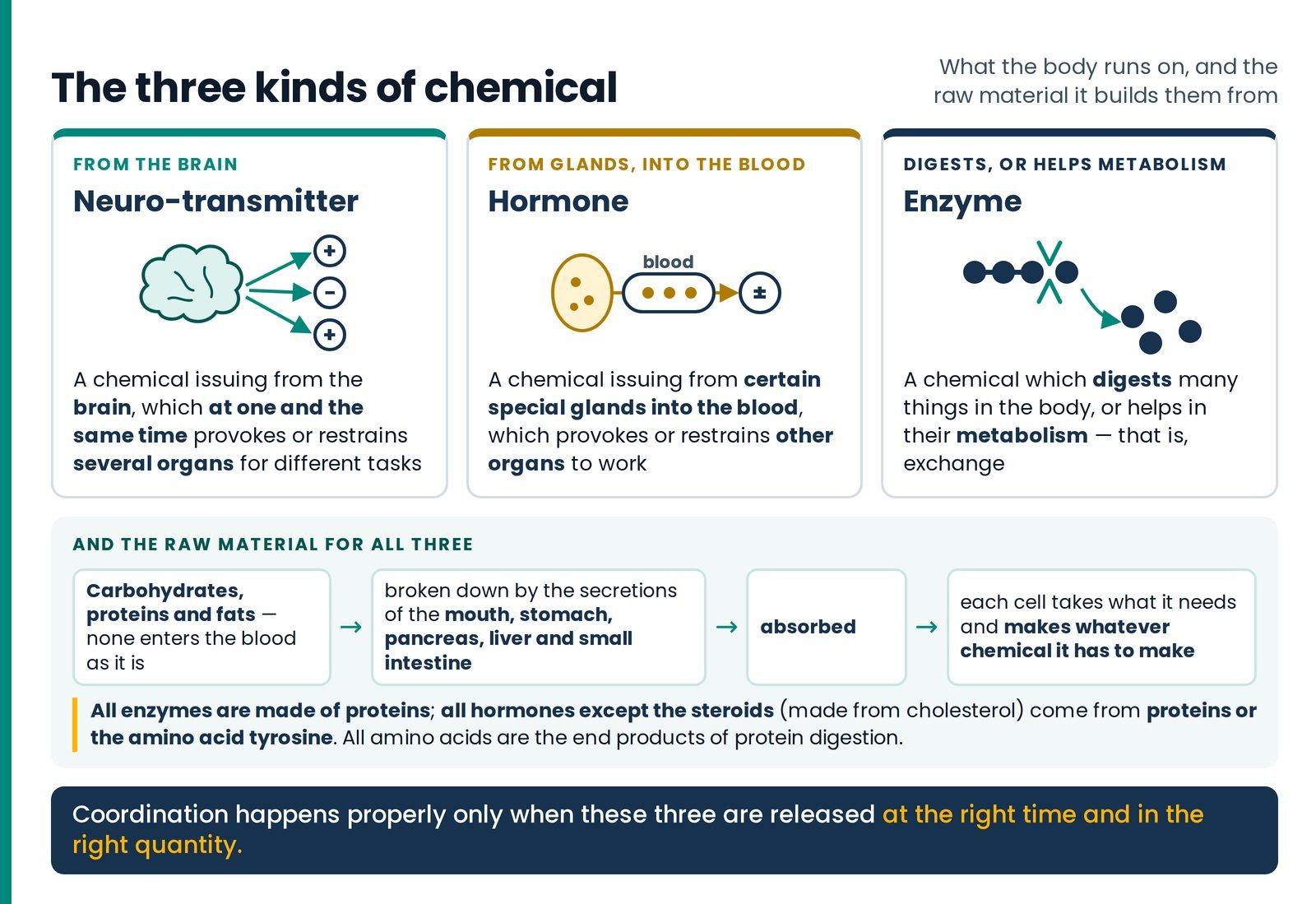
Coordination happens properly only when these three are released at the right time and in the right quantity. If one falls short the organs that keep watch make considerable effort so that no effect falls on the working of the body, and for some years they succeed — but when the quantity becomes rather too much or too little, they take the form of disease.
Such a body can be supplied two ways: from outside, as medicine, which is the way allopathy and some other systems have adopted, and in which side effects may occur because the body does not easily let foreign things inside; or by provoking the body's own glands, which is the work Neurotherapy does. And the raw material is the same in either case — carbohydrates, proteins and fats, none of which enters the blood as it is, each broken down by the secretions of the mouth, stomach, pancreas, liver and small intestine and then absorbed, so that each cell may take what it needs and make whatever chemical it has to make.
Why protein digestion decides everything else
Reason one — the chemistry of hormones and enzymes. All enzymes are made of proteins, which are made of amino acids; and except for the steroid hormones, all other hormones are derived either from proteins or from the amino acid tyrosine. All amino acids, tyrosine included, are the end products of protein digestion.
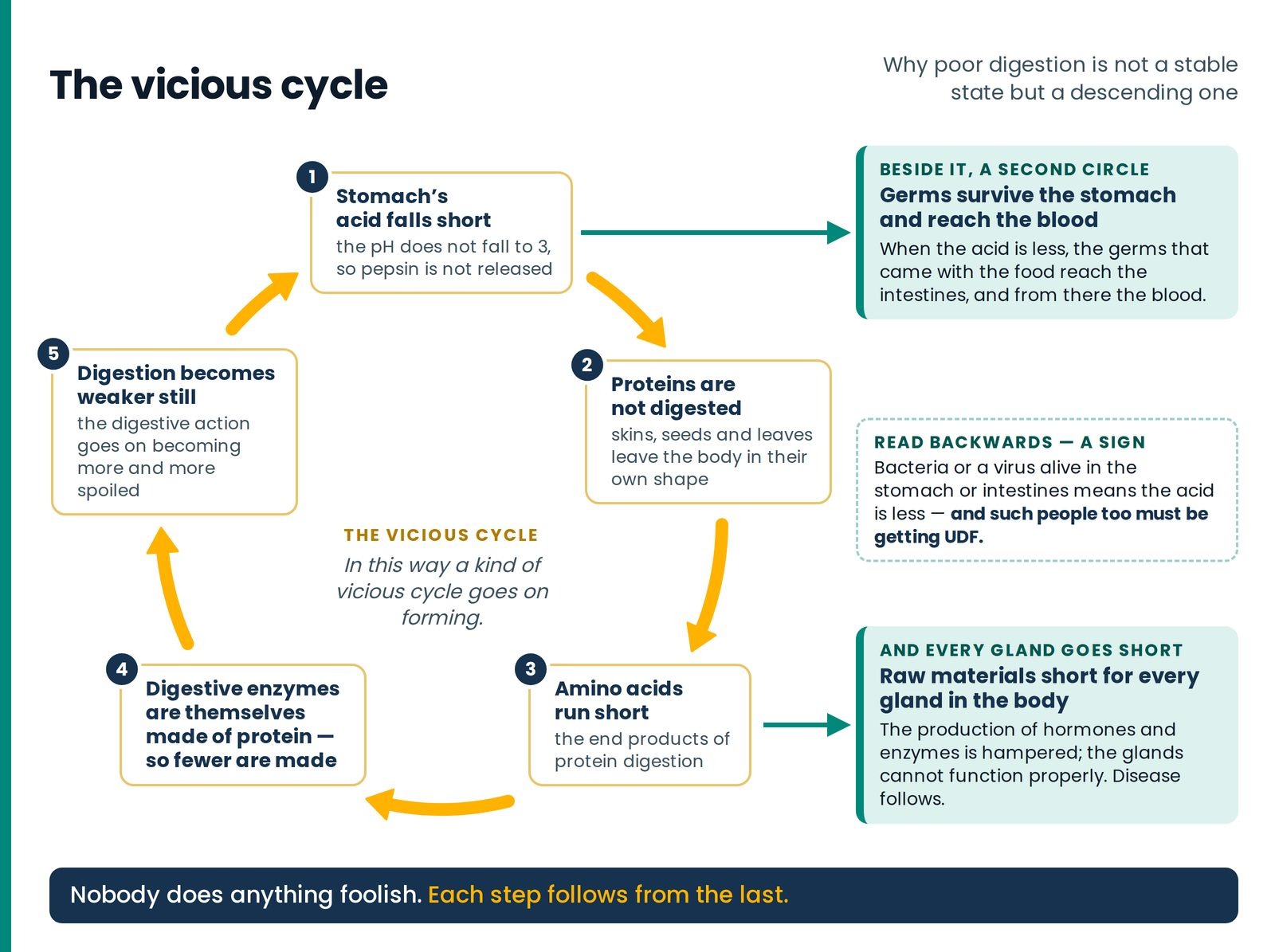
So if certain proteins are not digested, the body soon has a deficiency of those amino acids; if a number go undigested, a number of amino acids run short. In the absence of the raw materials, the production of hormones and enzymes is hampered. The glands cannot function properly. Disease follows.
The steroid hormones are the exception, made from cholesterol — which the liver makes when fats are digested, and from which the liver then makes bile, which in turn helps digest fats.
Reason two — and this is the trap. The digestive enzymes and hormones are themselves made of proteins only. A lack of certain amino acids will in time affect their production — which again causes poor digestion of proteins. This is the vicious circle.
The vicious cycle, stated whole
The chemicals of the digestive system itself are also made from proteins.
If some proteins do not digest properly, then in the end the digestive enzymes too will not be made properly, from which the digestive action goes on becoming more and more spoiled. In this way a kind of vicious cycle goes on forming. (Figure 9.2)
Beside it runs a second circle. If the stomach's acid is weak, any germ that comes in with the food can easily get inside the blood — because in fierce acid bacteria and viruses cannot remain alive; when the acid is less, the germs that came with the food reach the intestines, and from there the blood.
Read backwards, that is a diagnostic sign: if bacteria or a virus remains alive in someone's stomach or intestines, understand that his stomach's acid is less, or is not being made — and such people too must be getting UDF.
Reason three — the energy account
Say we have money in a bank. Add some daily and withdraw a portion for use, and the situation is healthy; withdraw without adding and it is an overdraft, which the manager may permit occasionally — but if he permits it for long periods, the bank will have to close down.
So with the body. We get energy from food, and when only a part of it is spent on the day's activities we feel energetic and lively. To get energy from food, the key factor is proper digestion and assimilation. But the amount of energy required to process food through the alimentary canal depends on the type of food eaten, and processed food requires far greater energy for digestion than raw food; and if the person is always under stress and tension, his digestive system never gets a chance to work properly, which itself contributes to the state of UDF.
In the absence of proper digestion, the energy obtained from food becomes progressively less and less than the energy required to digest it, so the person starts feeling lethargic and tired, especially after eating.
The best remedy in such cases is fasting. If hungry, such a person may eat raw food, along with a bare minimum of easily digestible carbohydrates. Instead, most people eat as before, straining the body's meagre energy resources further — and this lays the foundation for disease.
The liver's reserve, and why it runs out
Even where there is a shortage of some proteins in the food, the liver of a healthy person makes several amino acids — the non-essential amino acids, because it is not essential to obtain them from food. The liver goes on making them according to need, at the right time and in the right quantity.
It is only because of this wonderful capacity of the body that we do not fall ill at once even when the digestive system is out of order, and are able to get free quickly from small ailments.
But when, through wrong habits and wrong eating and drinking, illnesses come again and again, this capacity keeps on diminishing — and the body begins to become the victim of great diseases. When the liver does not function properly, this capacity is reduced, and then the body enters the diseased state.
The three levels
The stomach, the accessory organs and small intestine, and immunity
Bad digestion is not one thing, and the work is not aimed at one place.
The three levels
The problem of UDF is solved in Neurotherapy from three levels, for which there are several kinds of UDF formula. They work in the following manner —
Level one — the stomach. They increase the blood circulation in the stomach, from which the discharge of hydrochloric acid, pepsin and the other secretions of the stomach increases.
Level two — the accessory organs and the small intestine. Seeing the patient's condition, according to the need they increase the blood circulation in the various parts of the gall bladder, liver, pancreas and small intestine, so that the digestion, absorption and metabolism of proteins and nutrients happens properly.
Level three — immunity. They increase immunity — the disease-resisting power — so that there is protection from germs.
By all these means the production of the body's hormones and chemicals improves, and the repair of cells and tissues and the other maintenance and protective functions receive promotion.
Read them the other way round and they describe how digestion fails — the acid going first, the digestion behind it starving for want of what the acid was to start, and the germs the acid used to kill walking through the door it was holding. (Figure 9.3)
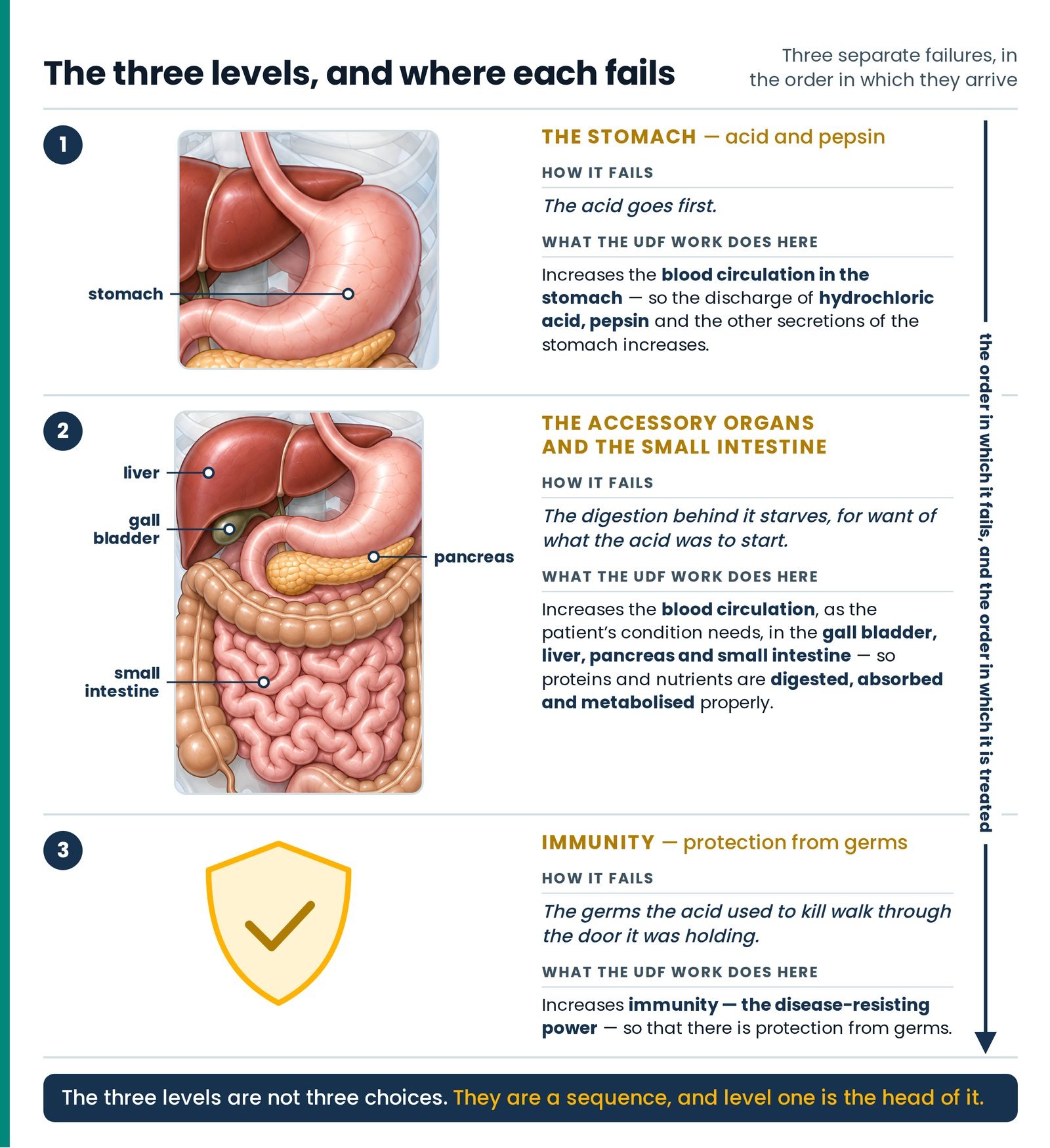
Table 2 — The three levels, and how each is recognised
| Level | What has failed | How you recognise it at the mat |
|---|---|---|
| One — the stomach | Blood supply to the stomach is reduced, so hydrochloric acid and pepsin are not made in proper quantity or proper concentration | Pain at Gas · food coming out in its own shape or colour · little hunger felt · in a baby, milk vomited as milk, not as curd · repeated stomach infections, nothing being killed on the way in |
| Two — the accessory organs and the small bowel | Blood supply short to the gall bladder, liver, pancreas and small intestine, so digestion, absorption and metabolism are all poor | Pain at Pan, Gal, Liv · pain at the B₁₂ and FA points, or both · lines or scratches on the tongue · fats not tolerated · deficiency pictures that persist through every tablet |
| Three — immunity | The disease-resisting power is low, so germs that should have been killed at the stomach are not dealt with anywhere | Infection or inflammation in several places at once · the patient who catches everything · long-standing inflammation with no source anyone can find |
One consequence of level three explains why immunity work sits inside a digestive treatment: when someone gets UDF, there will be infection in a great many organs of his body — and the treatment given for it has been found to put right infection and inflammation wherever in the whole body it may be.
What protein digestion requires
Primary factors — signals from the tenth cranial nerve, the vagus; proper secretion of hydrochloric acid and pepsin from the peptic glands in the stomach; proper secretion and action of histamine, pepsin and the hormone gastrin.
Secondary factors — the presence of acetylcholine as neurotransmitter; proper working of the duodenum and the small intestine; proper functioning of the exocrine pancreas.
And the rule governing the first group: hydrochloric acid will be produced in the stomach only in the presence of ALL THREE — acetylcholine, histamine and gastrin.
From which the design of the treatments follows: the first and most important requirement is to stimulate the production of hydrochloric acid in the stomach. Every formula built for UDF, whoever builds it, must include some treatment that does this.
What poor blood supply to the abdomen costs
UDF is always associated with pain at Gas, signifying poor blood supply to the abdomen — and so poor or insufficient blood flow to one or more areas of the abdominal aorta and the mesenteric arteries. This leads to:
a. Improper digestion and metabolism of proteins — which means the amino acids necessary to build and repair tissues are not available.
b. Non-availability of raw materials for the various glands, and so deficiencies of their chemicals. If there is a deficiency of chemicals to the brain, it culminates in various types of neuro-muscular disorder. If there is a deficiency in T₃–T₄ or in PTH production, it causes disorders of the thyroid gland or of calcium metabolism respectively.
The different versions of the UDF treatment improve the digestion, absorption and metabolism of proteins and nutrients by increasing blood supply to specific parts of the abdomen. Hence there is proper production of hormones, and the maintenance of tissue with the building activities that go with it gets a great boost.
Finding it in the patient
Gas, Liv and Rt.Ov, the B₁₂ and FA points, and the midline band
The methods by which the condition of the internal organs is established
The pain points around the navel.
Pain at the B₁₂ and folic acid points.
The nature of the stools.
And in women, the menstrual history is an additional and a very valuable tool.
The information from all of these has to be correlated to arrive at a proper diagnosis.
Pain at the B₁₂ or folic acid points is one of the major tools of this diagnosis.
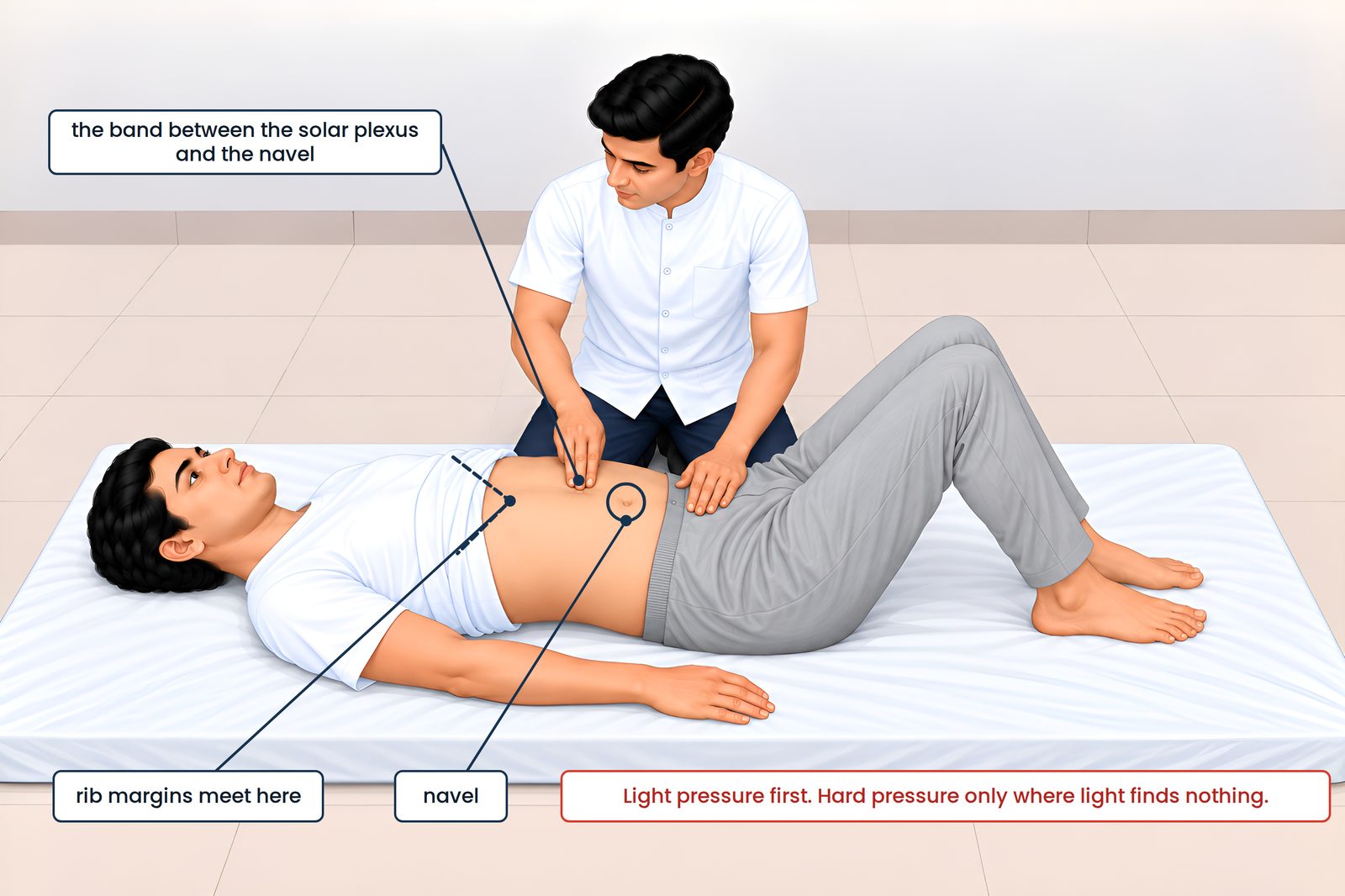
Generally such patients have pain or hardness in the region of Gas, Liv and Rt.Ov, in addition to pain in Liv°.
In some the pain is apparent even without palpation. In others it appears only when one presses hard in the region vertically between the navel and the solar plexus.
In addition, some feel pain at the points of either B₁₂ or folic acid or both, usually on palpation.
The pain points of the UDF patient
Women with pain at Liv° usually have scanty or delayed menses.
And then the sentence that makes the whole questionnaire necessary: it is a separate matter that they will never have peeped inside the latrine to see what the motion is like. But if you explain the importance of it and tell them to observe, the very next day they will come and say — yes, undigested food is seen in the motion.
The questionnaire
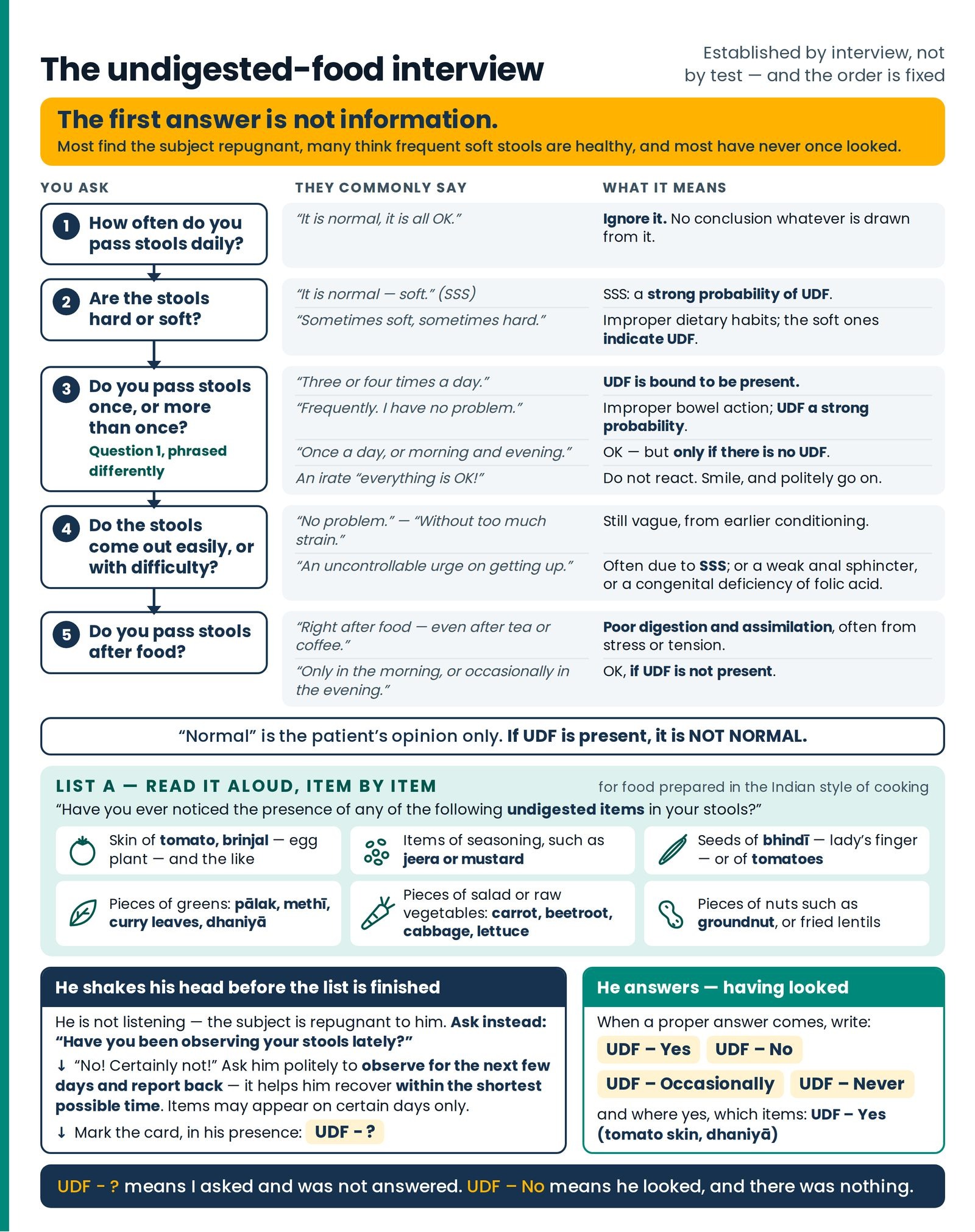
Five questions in a fixed order, List A read aloud, and the card
Why the patient's first answer is not information
In many instances the patient's answer does not reflect the true state of the body. The average patient, male or female, because of social custom, does not like even the mention of any talk about stools or defecation — the exceptions being when he has real difficulty passing them, or passes them so often that he becomes exhausted from dehydration.
Worse, many people hold that constipation is bad for health, whereas passing semi-solid stools, or passing stools frequently, is in their opinion a sign of normal health.
So the patient may answer whatever comes to mind, without giving thought to the matter — not because he wishes to lie, but because he wants to evade the topic.
The trained therapist must learn to distinguish between a correct answer and an answer given just to put an end to the talk.
Three obstacles, each defeated differently: shame, by asking in the same unhurried tone as every other question; a false norm, by never accepting the word normal; and inattention, by the second question — have you looked? The order of the questions below is doing work, so do not rearrange it. (Figure 9.5)
The list is read aloud, item by item, in the patient's own kitchen vocabulary, watching the face as you go.
(This list applies to all people eating food prepared in the Indian style of cooking.)
List A — the items to ask about
Skin of tomato, brinjal — egg plant — and the like.
Items of seasoning, such as jeera or mustard.
Seeds of bhindī — lady's finger — or of tomatoes.
Pieces of greens such as pālak, methī, curry leaves or dhaniyā.
Pieces of salad or raw vegetables such as carrot, beetroot, cabbage, lettuce.
Pieces of nuts such as groundnut or fried lentils.
The tongue and the curd
Lines and a coating on the tongue; milk vomited as milk or as curd
When undigested food comes, and to whom
Teething, weddings, the febrile child — and acidosis too
The ages and occasions at which UDF appears
UDF can come to anyone at any age.
In small children it comes for the first time when the teeth are coming out. After a certain age it begins when the child has eaten some odd or unsuitable thing, or when his liver is becoming weak.
It will often be seen that a few days after UDF appears in the motion, the child gets pain in the stomach or the head, or fever, for a day or two. And if jaundice — pīliyā — came in childhood, its effect remains upon the liver for many years.
In grown persons, UDF often begins in those days when they eat irregularly or without limit — the common example being eating at parties or weddings, on other people's insistence, even when there is no hunger.
The coming of fever, and what it is telling you
The coming of fever indicates that the liver needs rest for a few days.
A white layer-like coating appears on the child's tongue. At that time hunger is not felt.
Patients with the symptoms of alkalosis — pain at Liv° — have poor production of hydrochloric acid, and so usually have UDF. Does that mean patients of acidosis will not?
No. UDF may appear even in patients of acidosis — those with pain at Mu°. One should understand that the acidity of the blood is a different thing from the acidity in the stomach. The two may exist at the same time, but not necessarily always.
And this changes with age. A younger person usually complains of acidity and has pain at Mu° with the other signs of acidosis. As people age they tend to have more pain at Liv°. And sometimes an older person, because of poor water consumption, shows pain at Mu° and yet has UDF — meaning his stomach's secretion of hydrochloric acid is poor.
Does UDF belong only to the alkaline patient?
Never decide that a patient cannot have UDF because his flank finding was on the left. Ask everybody.
The diseases in which undigested food is found
The chronic and idiopathic conditions, and treatment never to be stopped
Table 3 — The diseases and conditions in which undigested food is found
| Where the list stands | The conditions named |
|---|---|
| The major disorders associated with UDF | Fits · idiopathic scoliosis · high BP · stammering · Parkinson's · osteoporosis · osteoarthritis · hypo- and hyper-thyroidism · hormonal and vitamin-deficiency disorders · severe anaemia |
| From Guruji's diary, 19 April 1990 — "Undigested food is one of the main causes for the following diseases" | Full body pains, joint pains, back ache — especially chronic back ache with no known cause · rheumatoid arthritis · hepatitis B · cancer · AIDS · lumps and lipomas in the body in several places · depression · knee pains · degeneration of bones and joints · multiple sclerosis · idiopathic rickets · deformity of bones · bamboo spine |
| The fuller list of the old diseases in which patients report it | Fits · cancer · AIDS · psoriasis · lumps all over the body · extreme fatigue · IBS · osteoporosis · hepatitis B · RA-positive · idiopathic rickets · rheumatoid arthritis · idiopathic scoliosis · idiopathic Parkinson's disease · eczema and other skin disorders · hypo- or hyper-thyroidism · aches and lumps in many parts of the body · bamboo spine — ankylosing spondylitis · deformity of bones, that is, bones becoming crooked |
Before the name of a disease, idiopathic means that the proper cause of why the disease came is not known — and notice how many such names stand in those lists. One further observation belongs with them: most skin disorders are accompanied by loose stools and UDF, so a therapist meeting eczema or psoriasis asks about the stool before she asks about the cream.
How the undigested-food work is held to benefit each family of disorder
Full body pains, joint pains, degenerative disorders, degeneration of bones and joints, chronic back ache, knee pains, rheumatoid arthritis.
Most pains improve with exercise, which improves the circulation; this treatment increases circulation to specific parts and makes available the necessary raw materials, carried by the blood to each and every part of the body.
Hepatitis B. If hydrochloric acid of proper strength were available in the stomach, would it not have destroyed the virus? And a lack of the requisite amino acids to manufacture antibodies may be another reason. Both are corrected by this treatment.
Cancer, AIDS, lumps and lipomatous growths in several places. Cancer is an abnormal protein, so anything which improves protein metabolism will benefit the patient. In AIDS, one reason for poor immunity is the lack of raw materials such as amino acids for the manufacture of lymphocytes and antibodies. Lipomas are due to improper fat metabolism and are also a form of abnormal protein.
Depression, Parkinson's disease, multiple sclerosis and other neuro-muscular disorders. In depressive patients the production of serotonin — the neurotransmitter associated with sleep — is hampered because of the non-availability of raw materials, and the same is the case with the other neuro-muscular diseases.
Idiopathic rickets, deformity of bones, bamboo spine. All are associated with calcium metabolism, and so are benefited for the reasons given above. Hormonal and skin disorders — as explained above for PTH and the thyroid gland.
The rule: the digestion is corrected first
The UDF work before the disease, and the order where Liv° is tender
Since the food, drink and manner of living of all people are not the same, one and the same treatment will not apply to all patients — which is why different kinds of treatment have been made for correcting UDF in patients of different tendencies.
The undigested-food work is the first stage of the treatment
The view is this: in old diseases — whatever the disease may be — the treatment for correcting UDF should be the very first stage of the treatment.
And it has been seen that when undigested food stops coming in the stool, from that alone a miraculous improvement is seen in the patient's disease. After that, on giving the other treatments according to the condition of the body, the results have been found to be better still.
From the diagnostic end the rule reads: the very first treatment one should give to such patients is to correct this tendency. Any treatment which does so is nicknamed a UDF treatment; it corrects the digestive system and thereby brings substantial relief from the present ailment — irrespective of whatever that ailment may be.
Here is the reasoning laid bare. Every gland builds its chemicals out of the end products of digestion. The end products of protein digestion are the amino acids. The amino acids are released by pepsin. Pepsin will not work above a pH of 3. The pH will not fall below 3 unless hydrochloric acid is made in the proper quantity and concentration. The acid will not be made unless the blood is reaching the stomach. So whatever you intend to treat, the raw material for it comes from a stomach — and the digestion is treated first not because it is the loudest complaint, but because nothing else you do can be built out of nothing.
The recapitulation
Improper digestion — of proteins mainly, and to a lesser extent of fats — is the root cause of all diseases.
The reason: the raw materials of all the glands are made by the body only from the end products of digestion. Without them the glands cannot produce their chemicals in correct quantity, and hence all sorts of disorders set in.
Dr. Krishnamurthy Jalihal, MBBS, is a founder member of Gulbarga Medical College who worked forty years as an anaesthetist with well-known surgeons in large hospitals in Karnataka, retired from allopathic practice, and from 2002 onwards has practised only this therapy. This is how his centre is run.
The ten-day rule as it is practised at one centre
The method followed meticulously at that centre, irrespective of the ailment, is this: patients are told, right at the time of their registration on the first day, that it is mandatory that they must come for the first ten days at a stretch, without break, to set their digestive system in good working order.
For those ten days or thereabouts they are given only the treatment for UDF 6 sec , along with the appropriate Muscle Relaxation Treatment (MRT) in extreme cases. Afterwards, depending upon their ailments, a further treatment schedule is prescribed.
The experience: "By the end of the first ten days a majority of their symptoms have been totally alleviated, even though no specific treatment was given exclusively for THAT ailment for which they had approached us. Not only that: in a number of chronic cases, relatives have informed us that the patient's disposition has become remarkably better, irritability drastically reduced, just within ten days." One family put it as families do: "Earlier my father used to get irritated over every small matter. But after only two or four days of your treatment, father's irritability went out completely."
Three things are worth taking from that. The rule is announced at registration, before any examination and before hope has been raised. Ten days at a stretch, without a break. And the outcome that convinced them was not the one they were measuring. Give it to a patient as exactly what it is, never as a guarantee.
It comes back
A recurring event, checked and put right every four or five months
UDF treatment is not a one-time affair
The appearance of UDF is a recurring event, owing to a person's habits and diet. So it has to be periodically checked and corrected as and when necessary. After correcting UDF, the other treatments to correct the body's condition are to be given.
Stated more strongly: the coming of UDF does not end so easily, because it happens on account of the person's eating and drinking and irregular way of life. It is not the case that after some days of treatment it will be finished for ever. It will be beneficial to have it checked and put right every four or five months.
In most cases the UDF treatment is only a starter. Further treatments to stimulate the glands specific to that disorder are also necessary at a later date, after the problem of UDF is resolved.
Fasting, food, and the soil
The eight-day fast, live food, the soil, and three yoga practices
What to do as soon as anything undigested is seen
As soon as we see anything undigested in the motion, the very first thing we should do is change our system of food.
It is best that we immediately keep a regular fast for eight days, under the guidance of some trained person of naturopathy.
If that cannot be done, then at the very least make this rule: eat only after hunger has been felt.
And instead of cooked food take live food — sprouted grains, plenty of the juice of fresh seasonal fruit, salad and the like: things the body can digest easily and from which it obtains the necessary vitamins and minerals.
Along with this, keep taking the treatment.
For the ordinary overload — the wedding, the plate accepted out of politeness — the remedy is immediate: keeping a fast afterwards for a day or two is the best remedy. During a fast the body gets time for its internal repair, and it soon begins to become well.
The soil
One more chief cause of UDF is today's system of agricultural production.
At present, artificial fertilisers such as urea, and pesticides, are used for crops in excessive quantity. After eating that crop, those chemicals go inside our body and spoil not only our digestive system but our immunity as well.
There is a second ill effect. For some years it appears that the earnings are increasing — but in the long term it is harmful, because from it the fertile power, the productive capacity of the earth, keeps decreasing, which will prove harmful for the coming generations.
What a person with land can do
Those big people who have their own land should use natural manure on at least some part of it.
And whenever a birthday or other auspicious occasion comes in the family, they should give the crop grown from that land as a gift to the other members of the family and to friends.
From this, awareness of such crops and of health will gradually be built up in people's minds, and a taste will be created for returning in the direction of our ancient agricultural method — which was beneficial for the whole of society.
Recording it, and watching it change
UDF - ? and UDF – Yes, and the order in which things improve
The whole value of this finding is that it moves, and that both of you can see it move — so it must be written in a form that lets a change be seen.
Two bodies, read as this article teaches
A teacher whose knees were treated last, and a baby’s milk
A figure and a poster
The undigested-food interview, drawn as one sheet
Questions students ask
- 1. I am nineteen and I cannot ask this question without blushing. How do I get it out? Ask it in the same voice you used for the last question and the next one. The patient takes her cue from you: drop your voice or apologise and you have told her the subject is shameful. Use the kitchen words — have you ever seen the skin of a tomato, whole?
2. I am sixty-two, learning this for my family. Everyone in my house has seen tomato skin at some point. Is everybody ill? The finding is never used on its own. It is one of four things you correlate — the pain points around the navel, the B₁₂ and folic acid points, the nature of the stools, and in women the menstrual history. A woman with no complaints, no tenderness, good hunger, one easy motion a day and a clean tongue is not a patient. The same finding with tenderness at Gas, three motions a day, no hunger and nine years of joint pain is the head of a chain.
- 3. I have no science at all. What is an amino acid, in words I can keep? Bricks. Protein in food is a wall; digestion knocks it down into loose bricks; the body carries them away and builds what it needs — an enzyme, a hormone, a repair to a knee. If the wall never comes down you own a wall and you need bricks.
4. I am a physician, and visible plant residue in stool is not, in my training, a sign of maldigestion. What is being asserted? Two things, worth keeping in separate pockets. The observation: patients with chronic disease, questioned in the manner this article sets out, report visible food residue at a rate the tradition has found remarkable across an enormous clinical experience, and doing the digestive work first is followed by improvement in complaints that were not treated. The explanation offered: that the residue indicates gastric acid and pepsin insufficient to complete protein digestion. State the first without leaning on the second — and your red flags stay yours.
5. If UDF is corrected first in every chronic case, am I giving everybody the same treatment? No. Since the food, drink and manner of living of all people are not the same, one and the same treatment will not apply to all patients — which is why several kinds of UDF treatment exist for patients of different tendencies. What is the same for everybody is the order. See also → Clearing the Ash, "Clearing the Ash".
- 6. My patient's UDF cleared in eight days and came back in the fourth month. Did I fail? No — you watched it behave exactly as described. It is a recurring event owing to habits and diet, and it is checked and put right every four or five months. Say that on the first day and its return becomes a scheduled service rather than a disappointment.
- 7. Why is immunity part of a digestive treatment? Because the first work of the acid is to kill what came in with the food. A stomach not making acid is a gate standing open, and the germs that pass it reach the intestines and from there the blood — so a person with UDF is expected to have infection in several places, and the treatment is built to deal with it wherever it is.
8. I practise in a village where nobody will discuss this with me — I know their families. Ask the household rather than the individual: a mother will tell you about a child and a wife about the cooking, and neither conversation is embarrassing. Then mark UDF - ?, treat what you find with your hands, ask again in a week, and let the improvement do the persuading. See also → The History That Cannot Mislead You, "The History That Cannot Mislead You".
Questions patients ask
1. "Everyone says undigested food in the motion is normal. Why do you make such a thing of it?" Because of what digestion is. Food that goes through the whole process should not come out looking like itself. When beetroot comes out still red, whatever should have worked on it did not manage even that much. It is not a disease in itself, but it tells me your digestive power is low — and that matters for the complaint you came about, because your body repairs itself out of what your digestion releases.
- 2. "But I chew my food properly." I believe you, and it makes less difference than you would think. A hen has no teeth at all, and she is fed marble powder so her eggshells come out strong — she digests stone. In a healthy stomach there is an acid harsher than what we use to clean drains, and chewed or not chewed, that acid should change what it meets.
- 3. "Why should I look? It is disgusting." Nobody enjoys it, and I would not ask if it were not useful. For three or four days, glance before you flush and notice whether you can see food you recognise — a tomato skin, a leaf of dhaniyā, a whole grain of chana. It will not appear every day, so do not decide after one look.
4. "I came about my knees. Why are you spending ten days on my stomach?" Because your knee is repaired out of the same materials as the rest of you, and those materials are released by your digestion. If the digestion is short, the knee gets what is left over — which is why treating the knee alone gives relief that wears off in days. Set the digestion right first and the knee work holds. You will very likely notice other things improving in those ten days that you never mentioned to me.
5. "I have cancer and I am on treatment. My relative says I should stop it and take only this." Your relative loves you and is wrong, and I want to be completely clear. Do not stop, do not delay, do not reduce anything your cancer doctor has given you. What I do here works alongside that treatment, never instead of it — and I would like you to tell your doctor you are coming to me. If you ever feel like stopping his treatment on account of mine, tell me first.
6. "Should I do the eight-day fast? My cousin did it." Not on my say-so. A long fast is a real intervention and does not suit everybody — it needs care in diabetes, in pregnancy, for children, for anyone frail or already losing weight, for kidney and liver conditions, and for anyone whose medicines are timed to meals; where it is done, it is done under the guidance of somebody trained for it. What you can begin tonight without any risk: eat only when you actually feel hungry, and drink nothing with your food.
Words used here
| Hindi | English | Neurotherapy code / usage |
|---|---|---|
| अनपचा खाना (anpachā khānā) | Undigested food | UDF — Un-Digested Food in the stools; the finding of this article |
| जीभ (jībh) | Tongue | Lines mean the same scratches inside the intestines; a white coating with no hunger |
| दही (dahī) | Curd | The curd test — milk vomited as milk, not as curd, means no acid is being made |
| उपवास (upvās) | Fast | A day or two after over-eating; eight days only under a trained person of naturopathy |
| — | Pepsin · HCl | Pepsin needs a pH of 3 or less; hydrochloric acid is what takes it there |
| — | Secretin | Made only if the duodenal pH is below 4.5; it provokes the liver to send bile for fats |
| — | Gas · Pan · Gal · Liv · Rt.Ov · B₁₂ · FA | The front pain points of the UDF picture — The Navel Speaks First |
| — | ALTF | Alkali Treatment Formula — given only after the UDF work, and only if Liv° is still tender. Correcting the Two Kingdoms |