- Part of
- Digestive system · Lymph and immunity
Watch

Spl — the spleen point
Finding it. The mirror image of Gal, under the left rib margin. Left
What is beneath. Not the spleen — that sits further back and higher, under ribs nine to eleven, and in health cannot be felt at all. Under your finger here are the stomach, the bend of the large bowel under the spleen, and the great apron of fat over the intestines.
Why the name. Because in diseases connected with the spleen, pain or stiffness is found here — an observation about tenderness, not a claim that you are touching a spleen.
Spl — the spleen point
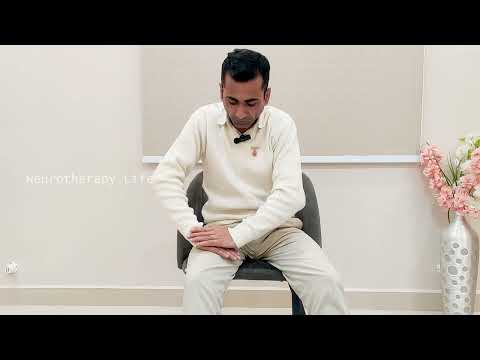
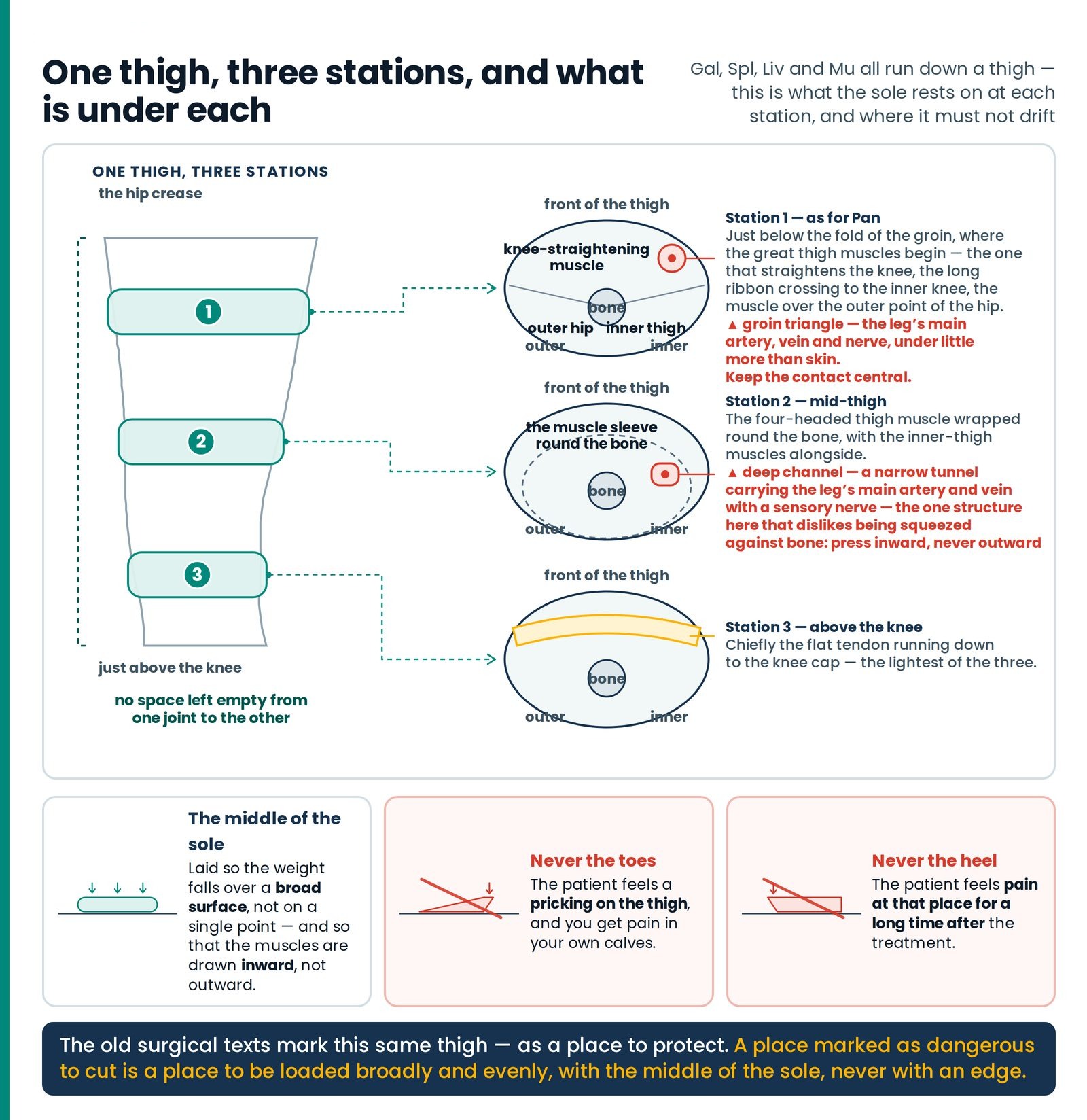
Do exactly as for Gal above, but give the pressure with the sole of your left foot on their right thigh. At every place press for six seconds and release. Completing this from the waist down to the right knee is called (1) Spl. Repeat from waist to knee as many times as the number written, pressing six seconds and releasing at each place.
| Patient's position | Supine, one pillow under both thighs; therapist standing straight, other foot lifted clear, knee not bent Supine |
|---|---|
| Where the feet are placed | Therapist's left sole on the patient's right thigh; three (or four) stations from below the hip to just above the knee Right |
| Duration and repetitions | 6 seconds at each station; a full hip-to-knee pass = (1) Spl; repeated as written 6 sec |
| What it is for | The pain below the ribs on the left side of the chest, which is found in blood disorders and in diseases of the spleen |
The stance for both. Gal and Spl share a stance of their own — the one place in the supine atlas where the therapist deliberately puts all of himself onto the patient: do not bend your knee; give the pressure with the middle part of your sole; lift the other foot clear of the ground and stand straight, so that your full weight comes onto the patient. And: if the patient's legs stay straight, better results come — but if the patient straightens their own legs the muscles stay tight and they will be uncomfortable, so place a pillow on the outer side of the legs for support to stop them rolling outward.
What lies beneath. The mirror of Gal — thigh muscle front and inner, the deep tunnel with the leg's main vessels at mid-thigh, the flat tendon above the knee. The spleen itself sits high on the left, behind the ninth to eleventh ribs and under the dome of the diaphragm, and in health cannot be felt at all: a spleen you can feel below the ribs is an enlarged one.
From Water and Salt
Why the spleen and the ovary, when the trouble is in the bowel?
A point's name is a postal address, not a description of the parcel
A natural question arises. To cure constipation, why are Spl — the spleen — and Lt. Ov. — the left ovary — being stimulated? Constipation has come about because the movement of food in the alimentary canal is very slow, and both of these are outside the alimentary canal.
Here is the thing to attend to. By our points we increase the blood circulation in the various parts of the abdomen all around the navel. Each point's name has been given by keeping in mind the chief organ in that region. But when we give that point, it will increase blood flow not only in that organ, but in all the organs that are in that region.
In the region above and to the left of the navel the chief organ is the spleen — but the left terminal part of the transverse colon and the upper part of the descending colon are there too, and when Spl is given, blood flow increases in all three. In the same way Mu removes the pains of the left side of the navel: besides the small intestine, the middle part of the descending colon is there, so it is stimulated as well. And Lt. Ov. takes out the pain of the region below and to the left of the navel, where besides the ovaries or testes there is the terminal part of the descending colon and the sigmoid colon.
What a point's name means, and what it does not
In this formula the point Spl has not been given in order to stimulate the spleen, but rather for that part of the large intestine.
This is one of the most freeing ideas in the whole formulary, and it disposes of a great deal of student anxiety. A point name is a postal address, not a description of the parcel. You are not pressing a spleen; you are increasing the blood supply to a region that happens to contain a spleen, and also contains two lengths of colon that nobody thought to name a point after.
An everyday version: you open the tap in the kitchen and the pressure drops in the bathroom, because you did not turn on "the kitchen" — you drew from a pipe that serves both rooms. Blood is that pipe.
Table 4 — Why each point of LSTF is given
| Point | The reason it is in the formula |
|---|---|
| Spl | To stimulate the terminal part of the transverse colon and the upper part of the descending colon |
| Const | Whenever there is constipation, there is pain at this point — so, to take that pain out |
| Mu | To stimulate the middle part of the descending colon, and to increase lubrication in the intestines, so that the residue of stool moves forward easily |
| Lt. Ov. | To stimulate the terminal part of the descending colon and the sigmoid colon |
| Mu° | To reduce acidosis — because when acid is high, constipation will certainly occur |
| Adr | To reduce inflammation in the intestines. By this, acid will also be reduced |
| Thrd | Because one main cause of constipation is the thyroid gland working too little |
Also explained in
- The liver and the spleen Each Point in Use
In all serious or long-standing diseases — kidney disease, enlarged spleen, enlarged heart.
- VTF (Mild), and the version for chronic disease Fire and Swelling
Only The breastbone alone — three rubs a side, no pressure at all, no rub on the return The rounds × 6 treatments — the whole line performed as one round, six rounds in all, with the rest Table 8, How a Formula Is Built sets for it
- The causes of constipation, and the cure What the Bowel Tells You
Left · The lower descending colon, the sigmoid colon and the rectum Between them, the whole left-hand run of the pipe from the bend under the spleen to the anus.
- (4) Medulla — the clockwise treatment, with T1/T2 The Medulla Family
Formerly this treatment used to be given in this way: (4) Medulla clockwise + T1/T2 — by which relief was seen in the following symptoms: the troubles of the cervical nerves C1–C4 — pain of the right and the left chest
- The back pain chart The Navel Speaks First
Locate these points by anatomy, never by the side of the page: spleen and Mu° on the patient's left; liver, Liv° and appendix on the patient's right.
- What you are actually pressing over The Navel Speaks First
Four fields hold the whole map: the upper field, rib margins to navel — liver, gall bladder, stomach, duodenum, pancreas behind them, spleen far back on the left; the middle field around the navel — small intestine, twen
- Questions students ask The Navel Speaks First
You call Spl the spleen point, but nobody can palpate a normal spleen there.
- Questions students ask What the Bowel Tells You
Why is Spl in a constipation treatment? The spleen has nothing to do with the bowel.
- The note that belongs here: (6) Right Swt for bronchial asthma Fire and Swelling
And besides these, in our thymus gland, spleen and lymph nodes there are the special cells of the white blood cells, that is lymphocytes, which maintain our immunity.
- The Subclavian treatment Cranial Nerve and Brain Formulas
In the fetal stage — that is, in the child in the mother's womb — along with the liver and the spleen, the lymph nodes also make some blood.
- The front chart, complete The Navel Speaks First
(Figure 6.8) Table 1 — The pain points of the front chart Code Full name — organ or symptom Where it lies, by feel Pan Pancreas The pit of the stomach — the soft dip at the bottom of the breastbone, where the two rib mar
- The master list — every treatment point, by the position the patient is placed in The Shorthand
Code Full name / Hindi Where it is taught in this wiki Pan Pancreas The Front of the Body I Gal Gall bladder The Front of the Body I Spl Spleen The Front of the Body I Liv Liver The Front of the Body I Mu "Mu" — the mucous membrane code The Front of the Body I Gas Gas — the thigh form (Gas Only) The Front of the Body I Gas '
- The revision — Gal and Spl taken out of an inflamed abdomen APR — Abdominal Pain
The spleen makes WBCs and antibodies.
- The order of treatment Cranial Nerve and Brain Formulas
Smallest toe Left Right ovary / testis, appendix 8 Spl Middle toe Right Spleen 9 Mu Third toe Right Descending colon, left of the navel 10 Lt.