The Two Kingdoms — Acidosis and Alkalosis
Watch


The question the two flanks answer
One tender flank sorts six patients in ten: acidic or alkaline
Everything so far has been preparation. The Navel Speaks First gave you the map — where Mu° and Liv° lie in the soft gap between last rib and hip bone, why they carry disguised names, what the small ring above the line does. The Educated Hand gave you the hand — how to press so that you find what is there instead of manufacturing it, how to grade from − to ++++, and why a pair is read one member against the other. This article tells you what the answer means.
The first step in diagnosis
The first step in diagnosis is to identify which of the pain points around the abdomen are exhibiting pain, and to what degree. In many cases the patient is not aware of any pain in that area until it is brought to her attention by the therapist.
Looking, over a lifetime's practice and more than a million patients, for a common factor among all the findings, this was found:
In more than 60 out of every 100 patients, pain in either Mu° — read as Mucus Zero — or Liv° — Liver Zero — is almost always present.
From this, patients are classified into two main groups, acidic or alkaline, according to which of their kidneys is sluggish:
Mu° tender, on the left Left → the left kidney is sluggish → the patient is read as acidic.
Liv° tender, on the right Right → the right kidney is sluggish → the patient is read as alkaline.
This is the first step in diagnosis — to check which kidney is sluggish.
Notice how much that one finding does. Six patients in ten arrive carrying a fact about themselves that they do not know and that two fingers and ten seconds will produce. A sign found in everybody would sort nobody from anybody; this one is worth having precisely because it is absent in the rest — and where it is absent you have learned something real, and go on to the front points and the history instead of forcing a reading the body has declined to give.
Sluggish has a precise meaning here, and it is not diseased. A sluggish kidney is one not receiving a proper supply of blood for the greater part of the day. The commonest reason is the least dramatic: most people are not straight, and a body habitually bent one way has its structures on that side compressed for ten or twelve hours a day, for decades.
Think of a well-used mattress: nobody damaged it, but one person slept on the same side of it every night for ten years and now there is a dip that will not come out. We do the same to ourselves — the bag on one shoulder since school, the shop chair that has always been like that, the child carried on the same hip.
What is actually meant by acid and alkali
pH 0 to 14, blood held at 7.36–7.44, and the two ends of the scale
Before the two columns, the plain chemistry — because a student who has never been taught it will nod along and understand nothing, and a student who has been taught it will find the rest of the article obvious.
The pH of a liquid, and the pH of blood
The pH of any liquid is a measure of its acidity or alkalinity.
It is measured on a scale from 0 to 14.
Water, being neutral, has a pH of 7.
As a liquid becomes more and more acidic, its pH value goes on decreasing towards zero. Strong acids typically have a pH of 1 or less. Strong alkalis typically have a pH of 10 or more. In other words: the lower the pH value, the higher the acidity of the liquid — and the other way about.
The normal pH of blood is in the range of 7.36 to 7.44, its mean pH being 7.4 — meaning that blood is slightly alkaline with respect to water. A number of control systems are at work in the body to maintain this pH strictly within this range.
In the case of blood, a pH below 7.36 is considered acidic, and a pH above 7.44 is considered alkaline.
If the pH of blood goes down to 6.8, a person will go into coma from acidosis, which may even be fatal. A pH above 7.8 will result in death from muscular spasm and tetany, from severe alkalosis.
Read those last two sentences twice. They teach three things.
First, the range separating comfort from catastrophe is astonishingly narrow. From 6.8 to 7.8 is the whole of it — one unit on a scale of fourteen — and inside it sits the ordinary band of 7.36 to 7.44, narrower still. Your body will let your temperature wander through the day, your blood sugar climb after a meal, your blood pressure swing between sleeping and running for a bus. It will not let this number move.
Second, look at how each end kills. The acid end brings coma — the body slowing, dulling, shutting down. The alkaline end brings muscular spasm and tetany — the body clenching, gripping, firing without being asked. Hold those two pictures as you read the symptom table, for you meet them again in gentler form: slack muscle against spastic, a gland running slow against a gland running fast. The extremes are the columns written large.
Third — and be honest about this — a person walking into your centre is not at either extreme. Anything approaching those numbers is a hospital emergency, not a patient waiting his turn on a mat. What your fingers read is a direction of tendency, not a measured derangement of the blood.
The rule of dilution
Add water and an acid weakens; the colon takes water away
Now the single idea on which the rest of this article stands. It can be demonstrated on a kitchen shelf and it takes one sentence.
The rule of dilution
Take a beaker of any strong acid and slowly add water to it. It becomes diluted and progressively less acidic — that is, it is moving in the alkaline direction.
Conversely, any fluid from which water is removed becomes less alkaline — that is, more acidic.
Add water and the acid weakens. Take water away and it strengthens. Everything that follows in this article rests on that rule.
Every kitchen in India already knows it. A spoon of tamarind pulp stirred into a whole vessel of water is barely sour; the same spoon in a small cup makes your eyes water. Nothing was added to the tamarind and nothing taken from it — only the water changed. The strength of a thing dissolved in water is a property of the thing and how much water is with it.
Now carry the rule of dilution into the belly, and follow it the whole way along.
The journey along the large intestine
When chyme enters the beginning of the ascending colon it is a very watery fluid, on account of the various secretions poured onto it — from the pancreas, from the liver by way of the gall bladder, and from the intestinal enzymes besides.
By the rule of dilution it follows that the contents of the caecum, the beginning of the ascending colon, are highly alkaline.
As the chyme proceeds upwards it is progressively drained of water, becoming sludge-like in the process — so that the contents at the beginning of the transverse colon are only weakly alkaline.
As it crosses the epigastric region and passes to the left of the transverse colon, more and more water is absorbed by the colon, making the contents of the descending colon progressively more and more acidic — especially as it nears the sigmoid colon.
Finally, at the rectum and the anus, the faecal matter is extremely acidic — most of all if it is almost totally devoid of water, as is the case in severe constipation.
Picture the cloth at the ghat. It goes into the river soaked and heavy and comes out streaming. Wrung once, the water runs off it in a rope; wrung again, it only drips; spread on the hot stone, by evening it is stiff enough to stand up on its own. Nothing was added to the cloth; water was taken away, four times over, and at each stage it became a different object. The colon does exactly that along its length — which raises the only question that matters for a therapist: what decides how hard the wringing is? (Figure 8.1)
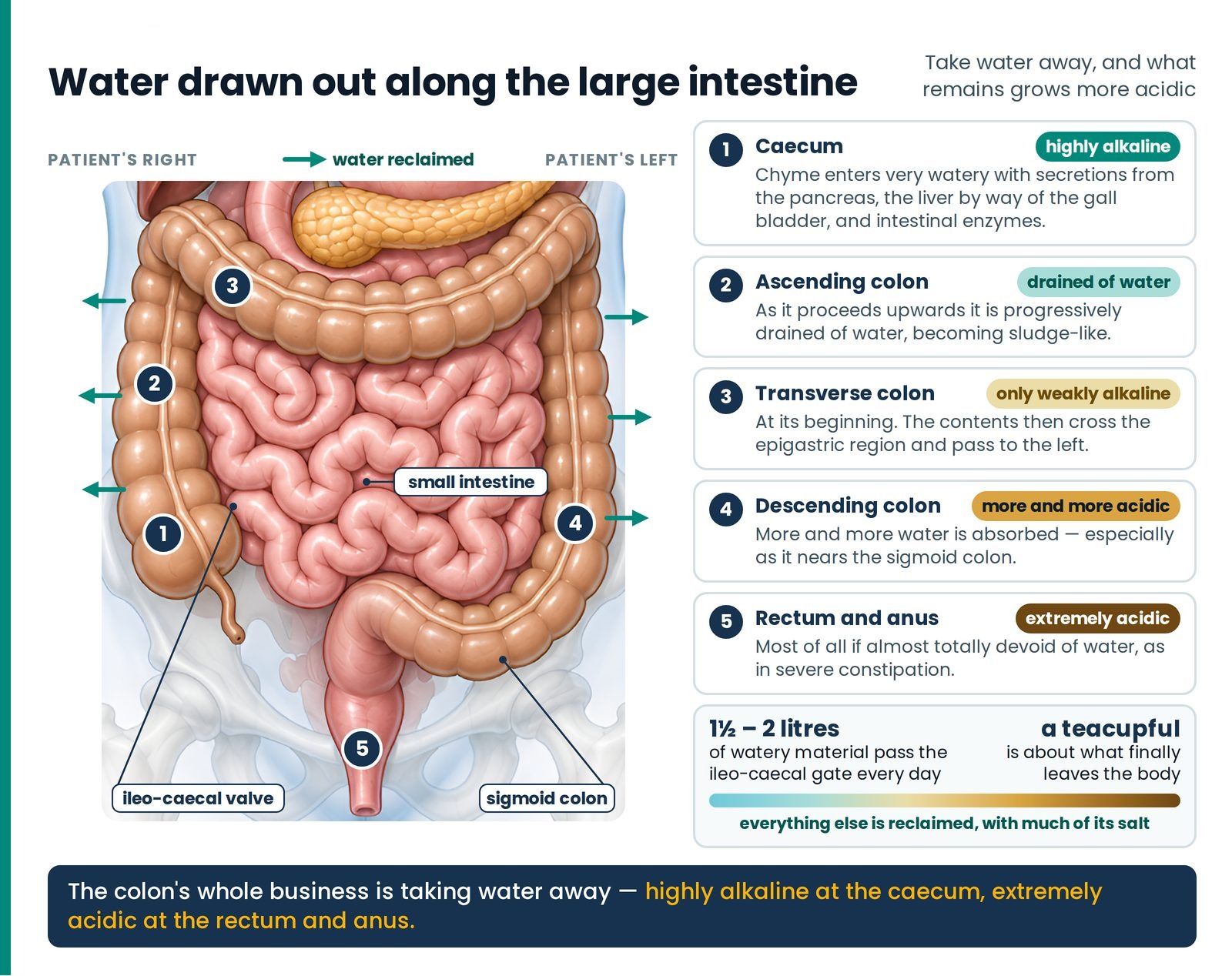
Water in decides water out
Two litres lost a day; drink too little and the exits shut
Water in decides water out
An average person loses almost two litres of water a day — through sweat, through urine, and in expired air, the breath you can see on a cold morning. This quantity must be replenished on a daily basis, for which he must consume at least an equal amount of pure water.
If one does not consume enough water, the body reacts by first stopping water excretion from all the exit points it has — one of which is the anus. The others fall away with it: poor secretion of sweat, of urine, and of saliva.
The consequence is unavoidable. Shutting the exit at the anus tends to make the faecal matter more and more tight — that is, more acidic — around the rectum and anus, these being the exit points.
Thus, if an individual consumes very little water — even though he may be consuming other types of liquid — he is more likely to suffer from constipation. And it is inevitable that this will be accompanied by acidity in the large intestine, especially the descending colon and the rectum.
No other drink can be a substitute for water.
From all of which follows the rule you will use for the rest of your practice: by reducing acidity and by stimulating the descending colon, constipation can be cured. And conversely, by reducing acidity, many of the symptoms accompanying a disorder can be relieved — especially if the disorder is accompanied by constipation.
That last sentence is the hinge of the whole article. It is why a therapist may treat a stiff neck by working on a bowel, why a patient who came about one thing finds three things better, and why the acid direction, once identified, gives you a lever long enough to move complaints that look unrelated.
Ask before you advise. How many glasses of plain water, honestly, on a working day? — then, because everybody overestimates, tell me what you drank yesterday, from waking. Then: what colour is the urine first thing? And be exact about what counts. Tea is not water. Coffee is not water. Buttermilk is not water. A cold drink is emphatically not water; it is sugar carried in water. The instruction is pure water, in the quantity lost, every day.
The two directions, symptom by symptom
Table 1 row by row: slack and dry against tight and wet
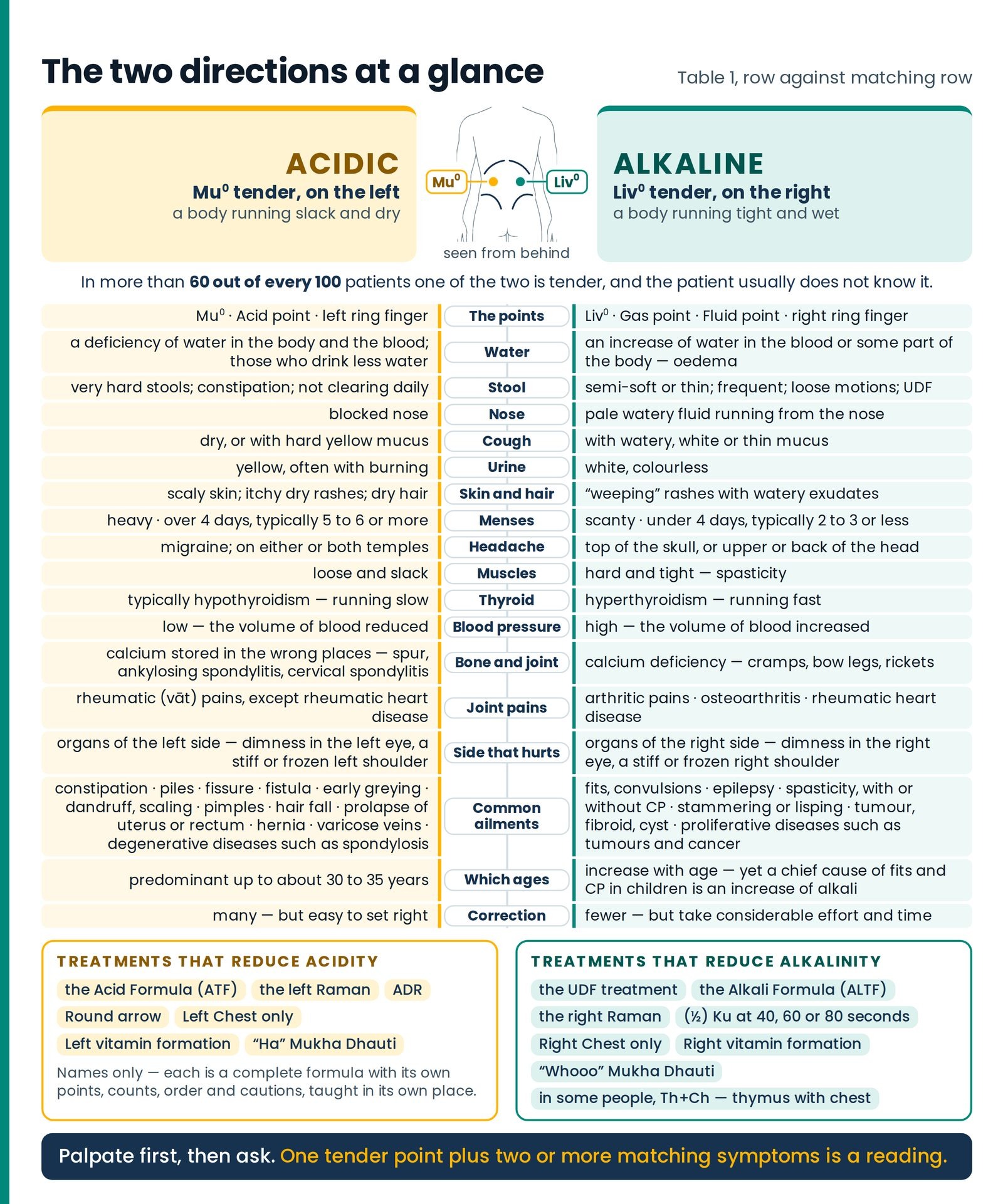
What follows is the working heart of this wiki, and every article after it leans on it somewhere. It is the fruit of original and continuous observation over more than half a century and something close to a million patients. Read it as two columns of one page, row against matching row.
Table 1 — The complete picture of the two directions
| Typical picture of the ACIDIC patient Left | Typical picture of the ALKALINE patient Right | |
|---|---|---|
| The points | Pain at the Mu° pain point and at the Acid point · pain in the ring finger of the left hand Left | Pain at the Liv° pain point, at the Gas point and at the Fluid point · pain in the ring finger of the right hand Right |
| Water | Arises from a deficiency of water in the body and the blood; found in persons who drink less water | Arises from an increase of water in the blood or in some part of the body; swelling — that is, oedema |
| Stool | Very hard stools, with constipation; the bowel not clearing daily | Semi-soft or thin stools; frequent stools, coming again and again; loose motions; UDF — undigested food in the stool |
| Nose | Blocked nose | Pale watery fluid running from the nose |
| Cough | Dry cough, or cough with hard yellow mucus | Cough with watery, white or thin mucus |
| Urine | Yellow urine, often with a burning sensation | White, colourless urine |
| Skin and hair | Scaly skin; itchy dry rashes; dry hair | "Weeping" rashes with watery exudates |
| Menses | Heavy bleeding · menses longer than 4 days — typically 5 to 6 days or more | Scanty bleeding · menses shorter than 4 days — typically 2 to 3 days or less, sometimes coming for only a day or two and then stopping |
| Headache | Migraine · headache normally on either or both temples | Headache normally on the top of the skull, or in the upper or back part of the head — sometimes radiating over the whole head or the whole forehead |
| Muscles | Muscles become loose and slack | Muscles become hard and tight — this is called spasticity |
| Thyroid | Typically hypothyroidism — a gland running slow | Hyperthyroidism — a gland running fast |
| Blood pressure | Low BP — because the volume of blood is reduced | High BP — because the volume of blood is increased |
| Bone and joint, I | Disorders in which calcium is stored in the wrong places between the bones — spur; ankylosing spondylitis, that is bamboo spine; cervical spondylitis | Calcium deficiency disorders — cramps, bow legs, rickets |
| Bone and joint, II | Rheumatic pains — vāt pains — except rheumatic heart disease | Arthritic pains · osteoarthritis · rheumatic heart disease |
| Which side hurts | Pains predominantly in the organs of the left side of the body — for example dimness in the left eye, stiffness in the left shoulder, a frozen left shoulder Left | Pains predominantly in the organs of the right side of the body — for example dimness in the right eye, stiffness in the right shoulder, a frozen right shoulder Right |
| Common ailments | Constipation; piles, that is haemorrhoids; anal fissure; fistula, that is bhagandar; premature greying of the hair; dandruff and scaling; pimples; alopecia and falling of the hair; prolapse of the uterus or of the rectum; hernia; varicose veins; and degenerative diseases — those that eat away bone or tissue — such as spondylosis | Fits and convulsions; epilepsy, that is mirgī; spasticity with or without cerebral palsy (CP); stammering or lisping; tumour, fibroid, cyst; and proliferative diseases — those with a tendency to grow — such as tumours and cancer |
| Which ages | Predominant up to about 30 to 35 years, when most people are found to have pain at Mu° and to get the diseases of acidity | With increasing age the diseases of alkali begin to come. But it is not always so: a chief cause of fits and CP in children is an increase of alkali |
| How readily corrected | Many diseases and symptoms may appear from it — but they are easy to set right | Fewer in number — but they do not get right easily; to correct them takes considerable effort and time |
| The matched treatments | Treatments that reduce acidity Left : the Acid Formula (ATF) · the Raman treatment, the left Raman · ADR · Round arrow · Left Chest only · Left vitamin formation · "Ha" Mukha Dhauti | Treatments that reduce alkalinity Right : the UDF treatment · the Alkali Formula (ALTF) · the right Raman treatment · Ku — the (½) Ku at 40, 60 or 80 seconds · Right Chest only · Right vitamin formation · "Whooo" Mukha Dhauti · and in some people alkali is also reduced by Th+Ch, thymus with chest |
What the table's own footnotes carry
Four notes travel with that table and each is a teaching in itself. They are set out here in full, because a note that is skipped is a note that gets a patient treated wrongly.
UDF stands for UnDigested Food in stools. It sits in the alkaline column and means literally what it says: the patient can see in the pan the very food she ate — the seeds of tomato or of bhindī, okra, coming through whole; the leaves of spinach, methī, dhaniyā, curry leaves, recognisable; groundnut, gram, peas, corn passing out exactly as they went in. The Fire and the Ash teaches it completely — the questionnaire that draws it out, the three levels of it, the tongue and the curd tests.
Why a gland runs slow on the acidic side. Muscle tone affects the effective working of any gland — so poor muscle tone, which travels with the acid direction, will automatically cause a gland to become hypo, that is, to work less. The thyroid is where you notice it first. This is not a separate phenomenon needing a separate explanation; it is the same slackness at a different door.
Why prolapse and hernia sit in the acidic column. Prolapse means any organ shifting from its designated place and entering into some other organ or place. If the muscles remain loose, an organ will shift from its own place. Slackness automatically sets the stage for herniation, for prolapse of the uterus, for prolapse of the rectum — again, the same slackness at different doors.
The treatments in the last row are names only, for now. Each is a complete formula with its own points, counts, order and cautions, taught in its own place. What you need from that row today is the shape of the thing: once the direction is known, a matched family of treatment is waiting for it — the left-sided work belonging to one direction and the right-sided to the other.
Two rules that govern the whole table
What makes a reading, and what makes a guess
All the symptoms will not be found in each and every patient.
Nobody arrives with a whole column: four of the sixteen rows is an ordinary patient, eleven is rare enough to be worth remembering.
But it has been found that in a majority of patients, in addition to having pain at the Mu° or Liv° pain point, they will have a combination of two or more of the symptoms listed.
So: one tender point plus two or more matching symptoms is a reading. One symptom alone is a hint. And the anchor is always the point — the symptoms are the company that finding keeps, not the finding itself.
One pair of rows deserves saying out loud, because it is the observation from which the whole classification grew. Pains on either side of the navel are accompanied by opposing symptoms. In patients with high BP, pain is felt above the right hip, just in front of the right kidney, often with whitish watery urine. In patients with low BP it is felt on the opposite side, often with yellow concentrated urine that may produce a burning sensation. Two sides, two pressures, two colours of urine — which corroborates that high BP is predominantly a condition of the alkaline direction and low BP one of the acid.
Carrying the table in your head as two temperaments
Sixteen rows is more than anybody memorises by repetition. Learn the table as two temperaments and the rows can be reconstructed rather than recalled. (Figure 8.2)
The acidic body has gone slack and dry. It holds things too long and squeezes them too hard: the stool sits and is wrung until it is stone; the nose is blocked rather than running; the cough has nothing in it, or brings up something hard and yellow; the urine is dark and stings; the skin scales and the hair goes white early; the period runs past four days because nothing closes properly; the muscles have no spring, so glands under-perform and organs drop from their places. Its illnesses are those of wearing down — and where calcium moves it moves into the wrong places and sits there like scale in a pipe.
The alkaline body has gone tight and wet. It passes things too fast and grips too hard: loose frequent stools with food unfinished; a streaming nose; a wet white cough; urine pale as water; a period over in two days; muscles that cramp and clench; a gland running fast. Its illnesses are those of overactivity and of things that grow where they should not.
Slack and dry against tight and wet: that is the whole table in six words.
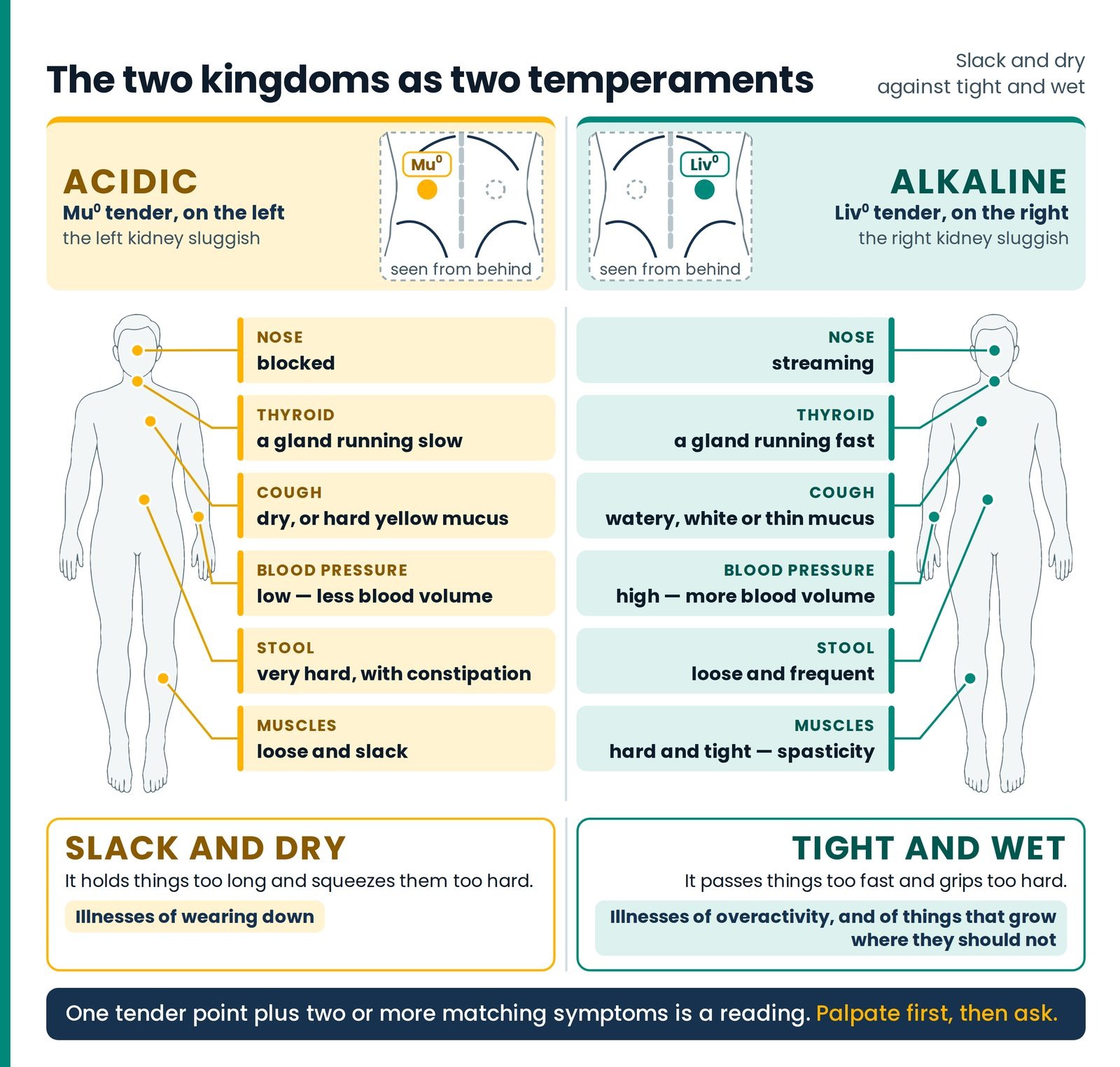
What travels with each direction
Six families of the acid side, and the smaller alkaline picture
The two columns have been described in far more detail than a table can hold, and a therapist who knows the detail recognises a direction across a room. The acid side first, under six heads, then the alkaline.
The six families of the acid direction
One — the consequences of a deficiency of water.
Symptoms appear on the intestine, nose, hair, skin and the other organs of excretion: hard constipation and the diseases connected with it — piles, bavāsīr; fissure, a splitting around the anus; fistula, bhagandar · blocked nose; dry cough, or cough with yellow thick phlegm · yellow urine with burning · redness of the eyes and itching, from dryness in the tear glands · pimples, acne, blackheads on the face · falling of the hair, dandruff or scaling, the hair going white early · drying of the skin, warts or moles, allergy, psoriasis.
Two — the things that fall out of place. In each of these, pain has been found at Mu°: prolapse of the rectum, the rectum coming down from its place; prolapse of the uterus, the womb coming down from its place; hernia, an organ shifting from its fixed place and entering inside some other organ or part. Three different diseases — but one thing is common to all three: they occur because the flesh-muscles have become loose.
Three — the two diseases of the blood vessels. These too come only because the flesh-muscles have become loose, one chief cause of which is acidity. Varicose veins, the blue veins — varicose means to swell up: because the muscle of the vessels and of their valves becomes loose, a fault comes into them and they swell easily. And low BP: when the muscle of the vessels becomes loose the pressure will be less, and because of the deficiency of water the volume of the blood will be less — from both these causes together the BP goes down.
Four — the glands that run slow. When acid increases in the blood, experience has shown that the muscles become loose. For any gland's secretion to come out properly the muscles around it must contract properly; if they are loose, the contraction and therefore the secretion will not come properly — that gland will be hypo.
Five and six — the two opposite things that happen in bone and joint. In some people the joints or bone wear away, which is called degeneration: rheumatism, vāt rog; cervical spondylitis, swelling in the beads of the neck; lumbar spondylitis, swelling in the beads of the waist. In others, calcium is deposited between the bones or the joints: bamboo spine, ankylosing spondylitis; and spur, a bone growing outward.
And where there is pain at Mu°, these are found with it: pain in the joints without cause; headache, often near the temples, called migraine; and ulcer — sores — in the stomach or the duodenum.
Read the fourth head again. It opens into the most useful chain of reasoning in the acid column.
The thyroid, the master craftsman
One chief gland of the body is the thyroid, which looks after the body's metabolism — cayāpacaya. We may call it the chief mistrī, the master craftsman, without whose order or supervision the other glands and organs will not work properly; and all the functions of the digestive tract depend on the thyroid gland.
Watch the chain. When the thyroid works less, digestion will not be proper → the motility of the intestines will not be right → the residue reaches the large intestine very late → having sat there longer, more water is taken back from it → from which that person gets hard constipation.
When the thyroid works less the T₃ and T₄ hormones do not come out in the right quantity, and two chief symptoms may be seen: in children, very hard constipation, and mental dullness — manda buddhi — can also occur; in women, menses coming before the date, or more flow in the menses.
When such a condition lasts for years the quantity of T₃ and T₄ becomes very much less than normal, and it is then called hypothyroidism — one chief indicator of which is that the quantity of TSH also rises.
Backward is how you will use that chain at the mat. A woman of forty with hard constipation, a period that comes early and heavy, dry skin, hair on the comb and a tender Mu° has not brought you five complaints. She has brought you one chain, and you can name its links out loud — which does more for a patient's confidence than any promise.
The alkaline direction produces fewer conditions, and they are harder to shift. Its picture is smaller and sharper.
The chief symptoms and diseases of the alkaline direction
The chief symptoms — the first thing to check being the pain at Liv°: pain at Liv° and in the ring finger of the right hand Right · running of the nose · loose motions, dast · very little flow in the menses, or flow coming for a day or two and then stopping · pain in the upper or the back part of the head · pain in the organs of the right side of the body Right .
The chief diseases and conditions: fits or convulsions, that is attacks of trembling · epilepsy, mirgī · spasticity, the muscles becoming stiff · CP, cerebral palsy · HBP, high blood pressure · cancer, karkarog · tumour, fibroid, cyst · stammering or lisping, haklānā yā tutlānā.
And now the refinement that separates a therapist who has understood the two kingdoms from one who has memorised a table.
The alkali that only looks increased
It may be that the alkali which appears increased in a patient is in reality normal — and appears greater only because the quantity of acid in his stomach is less.
How would you know? On checking such people there is often pain at the Gas point as well, and on asking, it is found that undigested food comes in that patient's stool.
What that means is this: the flow of blood in his stomach is not sufficient, from which hydrochloric acid is not being made in the proper quantity, from which the proteins will not be digested properly.
When there is pain at the Gas point, it tells us that the circulation of blood in the stomach is reduced, because of which hydrochloric acid cannot be made properly and there will be indigestion. Such people feel little hunger.
Some people have pain at Mu° but not at Gas. Some have pain at both. The two findings are not the same finding and must be recorded separately.
This changes the order of the work. Even where there is pain at Liv°, the alkali formula is not the first thing given: the undigested-food work comes first, and only if pain remains at several points afterwards does the alkali formula follow — and in a great many patients the symptoms of alkali reduce at once from the stomach work alone. That ordering belongs to Correcting the Two Kingdoms · Clearing the Ash; what belongs to you today is the diagnostic half. When you read a patient as alkaline, always ask about undigested food and always check Gas.
The acids that are dissolved in the blood
Amino, uric, lactic, carbonic, folic and keto acids, and the kidneys
Students ask what acid in the blood refers to. The answer is precise, and it is why the kidney sits at the centre of this system rather than the stomach.
The acidity of the blood is not the acid of the stomach
The acidity of the blood is a different thing from the acid of the stomach.
The stomach's acid is hydrochloric acid, and it occurs only in the stomach, not in the blood.
In the blood several acids are dissolved, and together they maintain its acidity:
The acid · Where it comes from
Amino acids · For them to be formed in the right quantity the digestion of proteins must be proper — for which the stomach's acid must be made in the right quantity, and that will be made only when the flow of blood in the stomach is proper
Uric acid · Its metabolism is chiefly the liver's responsibility. If the liver does not work properly the quantity of uric acid rises above normal — a chief cause of gout, gaṭhiyā, and of pain in the joints
Lactic acid and carbonic acid · Increase when the respiratory system does not work properly
Folic acid · Named among the acids dissolved in the blood that maintain its acidity
Keto acids · Increase in diabetes — a chief cause of acidity in diabetic patients
To balance all of these, bicarbonate ions must come out from the kidneys at the right time and in the right quantity.
That table ties the acid direction to four organs — the stomach, whose blood supply decides whether protein is digested at all; the liver, which handles uric acid and therefore a great many joint pains; the lungs, which govern the two acids that rise when breathing is poor; and the kidneys, which must send out the body's own antacid on time and in quantity. It is also why a patient with joint pains and a raised uric acid gets work aimed at his liver.
The two kidneys do not work alike
Left kidney for acid, right for alkali: the side is the finding
Everything so far has rested on a proposition that deserves to be stated on its own, because it is the least ordinary claim in this article and the one on which the whole classification turns.
The asymmetry of the two kidneys
Both kidneys do not work identically.
A sluggish left kidney — evidenced by pain at Mu° — increases the acidic tendencies of the blood. Left
A sluggish right kidney — pain at Liv° — increases the alkalinity of the blood. Right
And read as an instruction rather than an observation: when we provoke the left kidney by means of the point named Mu°, relief comes in the symptoms of acidity; when we work by means of the point named Liv°, that provokes the right kidney, and gives benefit in the diseases of alkali.
Which is why it is said: the left kidney filters most of the acid — that is, reduces the acidity of the blood — and the right kidney reduces most of the symptoms of increased alkali.
A therapist who records only "low back tender" has recorded nothing usable. The side is the finding. And notice the reach of it: just by correcting the acidity or the alkalinity, a number of symptoms can be relieved simultaneously, because they were never separate symptoms — which is why a patient who came about constipation mentions in the fifth week that her hair has stopped coming out, and believes it a coincidence.
Can this be established beyond doubt?
A fair question, and one this therapy has never dodged. A man comes with water running out of his nose — an hour of it every morning, as in spring catarrh or nasal allergy. On asking, his stools are slightly semi-solid: two rows of the alkaline column. On examination, pain at Liv° and no pain at Mu°. Stimulate the right kidney by way of Liv°, and the nose stops running. That can be shown again and again.
But is it proof? A running nose also stops on its own, and a patient who expects to improve very often does. Improvement after the right treatment is consistent with the claim; it does not establish it.
So recall a science class from school. You are handed two bars of iron and asked whether both are magnets.
Repulsion is the surer test for magnetism
If the two pieces of iron attract each other, that does not conclusively prove that both are magnets — the same result is obtained if one of them is a plain unmagnetised bar, since a magnet pulls an ordinary nail just as happily.
But if they repel each other, it establishes beyond doubt that both are magnets indeed.
Repulsion is the harder prediction. Only one arrangement of the world produces it; attraction is produced by several.
Now apply it to the man with the streaming nose. Suppose you stimulated Mu° in place of Liv° — the left kidney instead of the right. He would shortly be in need of a thick napkin. Not no improvement: worse. That is a prediction which could fail in public, and a prediction that can embarrass the person making it is worth incomparably more than one that cannot. It would establish beyond doubt that the two kidneys function differently indeed.
And then, in the very next breath, comes the instruction not to do it.
A system that wanted only to impress you would have printed the demonstration and left out the prohibition. It is there because of the sentence that governs everything else in this wiki.
The least tribute a practitioner can pay is to remember that at all times. Look closely at four of its words: knowingly or otherwise. Most codes forbid the harm you meant to do; this one also forbids the harm you did not see coming — a far harder standard, and a better one. Or otherwise is why a Neurotherapist knows her cautions by heart, asks about the wrist broken last winter before pressing near a floating rib, and asks what a patient puts in her mouth for health rather than what tablets she takes.
The whole article recaps in one line, worth writing inside the cover of your notebook: the first step in diagnosis is to check for pain at Mu° and Liv°, to ascertain whether the patient is acidic or alkaline. (Figure 8.5)
Palpating the pair, and the first visit
Compare Mu° and Liv°, confirm by reversing, then the seven steps
You already know how to press: slowly, with the flat pads of the fingers, straight inward, watching the face and not the hand, grading what you find from − to ++++ by the depth at which the going stops being easy. The Educated Hand taught all of it. What is added here comes from one fact — the finding at this pair is a comparison, not a measurement. You are not asking does the low back hurt, but which of two identical places hurts more. (Figure 8.3)
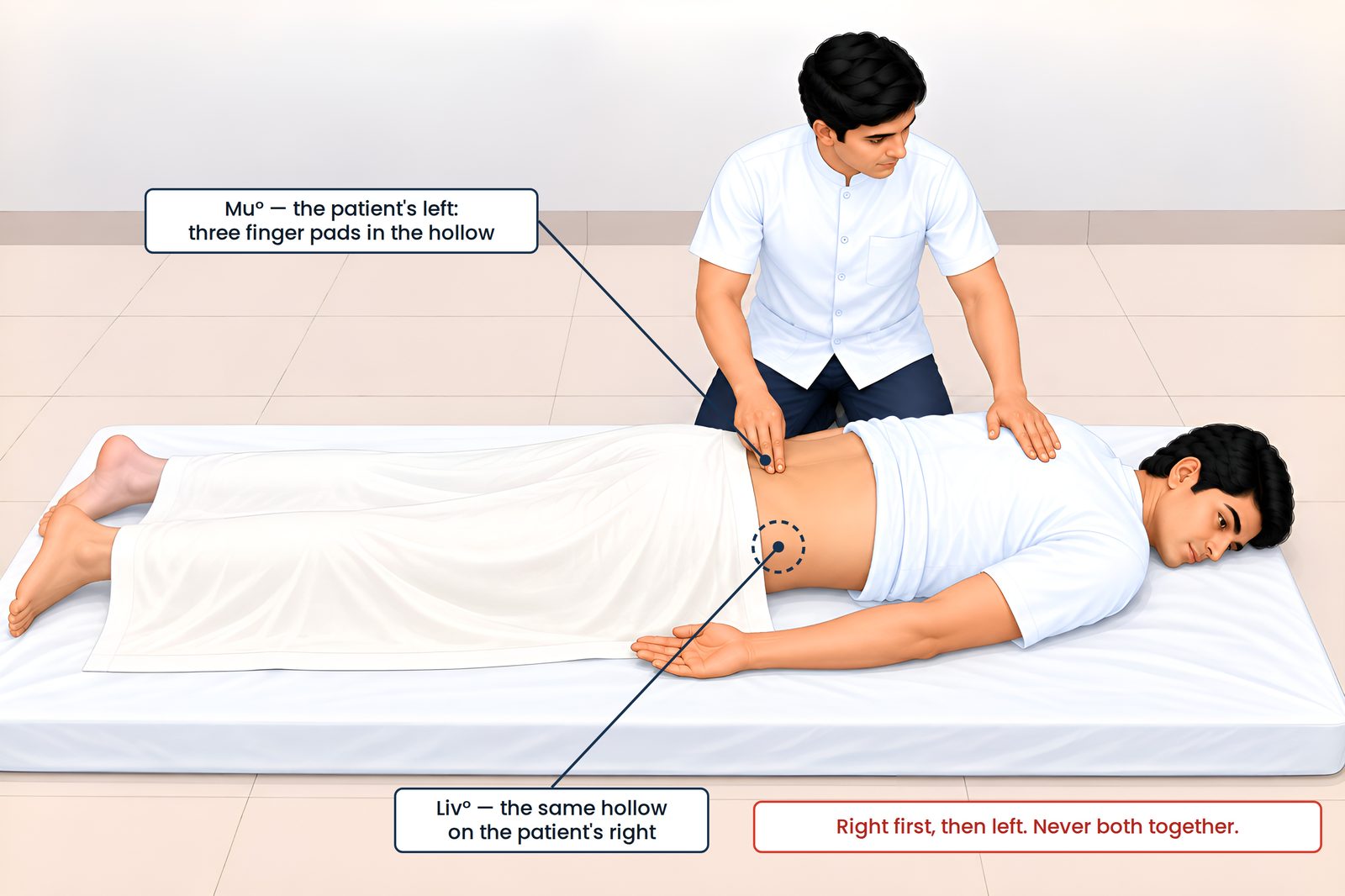
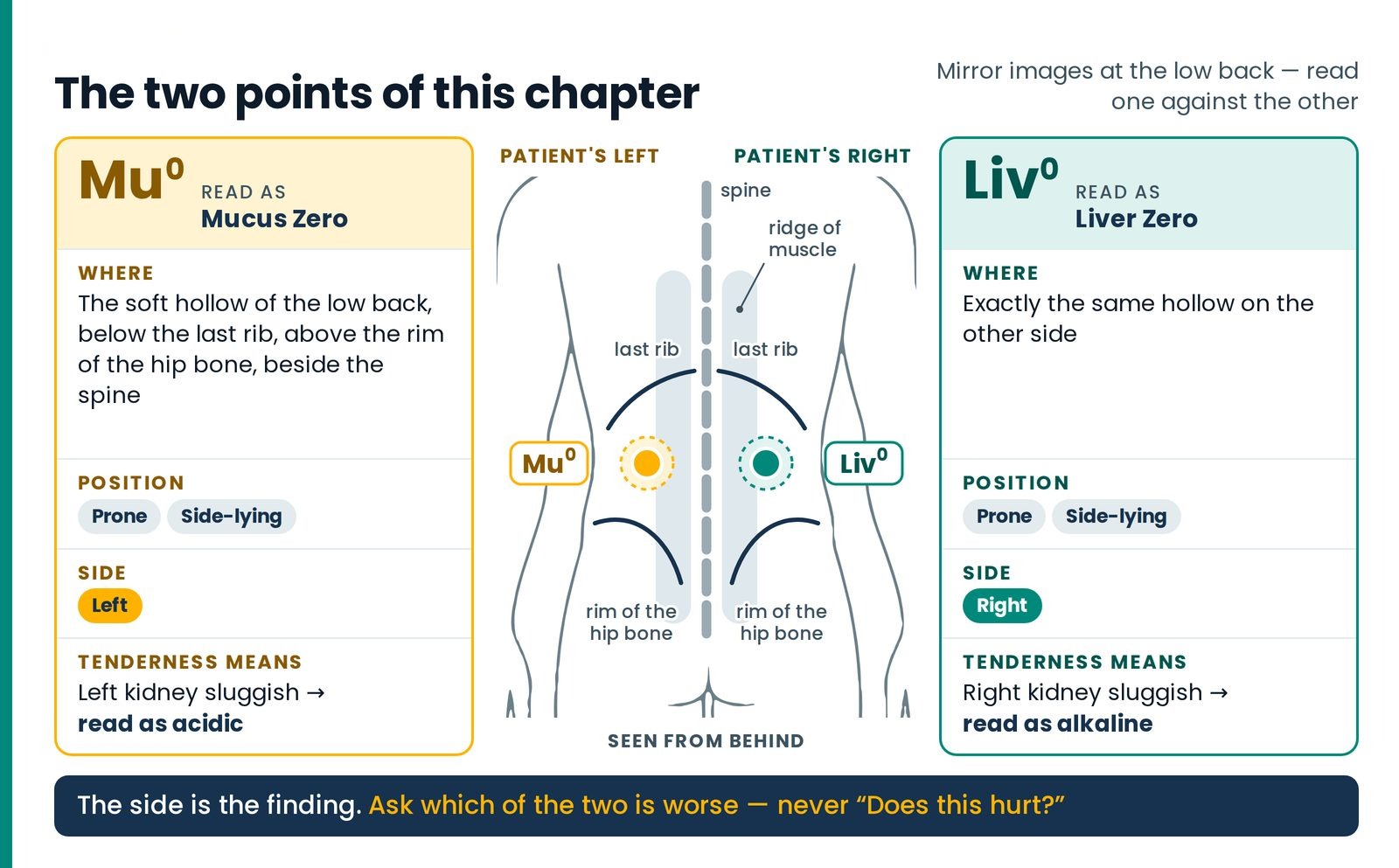
One warning above all others at this pair. Press firmly enough and you can produce pain in the low back of a perfectly well person — and if both sides hurt you have learned nothing, because you have two pluses and no comparison. If both sides remain equally tender after the reversal, the honest entry on the card is *no finding* — worth more to the next therapist, and to you in a month, than an invented answer that reads well today. (Figure 8.4)
One last caution sounds like a technicality and is not. Removing the tenderness at Mu° or Liv° is not, by itself, the same as correcting the direction: for curing the acid or alkaline state, simply taking away the pain at the point alone is not enough. The point is the signal, not the disease, and it very often clears before the picture does. A therapist who stops when the flank goes quiet has treated the warning light and left the engine as it was.
Two bodies, read as this article teaches
Two composite cases: a slow acidic body and a swinging alkaline one
At a glance
The two directions at a glance, on one page
Questions students ask
1. I am nineteen and just beginning. If six patients in ten have pain at one of these points, what about the other four? Then you have learned something real about those four: their story is not being told by the kidneys. Never force a reading and never invent a tenderness. Write no finding, go on to the front points, take the history more carefully, and let the picture come from there. A therapist who can write no finding without embarrassment will be trusted with the difficult patients; one who always finds something will not.
2. I am sixty-eight and took up study late. I find symptoms of mine in both columns. Which am I? Commoner than the table makes it look — in chronic cases especially, mixed symptoms and mixed pains are found. Do not count symptoms. Ask which point is tender, let the point break the tie, then see how many symptoms keep company with that side. And be ready for the answer to be different in three months.
3. I run a house and have no science at all. Does "acidic" mean there is acid inside me? A good question, not a foolish one. Your blood is held very tightly between 7.36 and 7.44 and does not turn acidic while you are doing the shopping. Here acidic names a direction — a set of tendencies found to travel together, rather like saying somebody has a dry constitution. It describes which way a body is leaning, not a measurement in a test tube.
4. I am a physician, uneasy about a model in which two kidneys of identical structure behave differently. What exactly is being claimed? Two things, worth keeping in separate pockets. An observation: tenderness at the left flank keeps company with one cluster of complaints and the right with another, across an enormous clinical experience, and working the corresponding side is followed by improvement in that cluster. And an explanation offered for it — one kidney under-perfused, with habitual asymmetric posture proposed as the mechanism. State the first without leaning on the second.
5. I practise alone in a village. No laboratory, no reports. Can I still use this article? Yes — it needs two fingers, a mat, a quiet room and a careful history. What you must have instead of a laboratory is a referral list you know by heart: fever with a painful loin, blood in the urine, new bleeding with stool, unexplained weight loss, a new lump, a headache unlike any she has had before. See also → When the Hand Must Stop, "When the Hand Must Stop".
6. My patient says nothing hurts at either point, but she flinches when I press. Which do I believe? The flinch — but check it first. Some patients, especially older women raised never to complain to a stranger, will not report pain. Watch the face and the breath, then press the other side and ask which is worse, which a stoical patient answers honestly because it is not a complaint. If the flinches are equal, record no finding — and record hardness separately from pain, since hardness without pain is the more objective of the two.
7. Why is it said that acid conditions are easy and alkali ones are not? Because that is what long experience has found, and a family deserves to hear it at the outset. Many diseases arise from acidity and they are easy to set right; those arising from alkali are fewer in number but do not get right easily, and take considerable effort and time. The parent of a child with fits should hear that on the first day, in those words.
8. If a patient is alkaline, why would I ever start with work aimed at her stomach? Because the alkali may only look increased. If her stomach is not making its acid properly, the alkaline side reads high although it is normal — and the giveaway is undigested food in the stool together with tenderness at Gas. Correct the stomach and in many patients the alkali symptoms reduce at once, before any alkali work is given. See also → The Fire and the Ash, "The Fire and the Ash".
- 9. How long before I can trust my own fingers at these two points? Faster than you fear, if you palpate everybody — including the well people in your own house, so that you learn what an untender flank feels like. Most students learn tenderness before they learn normal, and then everything feels abnormal for a year.
Questions patients ask
1. "You are pressing my back, but my problem is my nose." That is not a mistake, it is the method. In this therapy those two places are connected, and the connection runs through the kidney lying under my fingers here. This spot tells me which way your body is leaning, and the way it is leaning explains the nose. If I treated only the nose you would feel better for a few days and we would be back here in a month.
2. "Am I acidic? Does that mean there is acid in my blood?" Not in the sense you are imagining. Your blood's acidity is held very tightly and is not wandering about. When I say the acidic side I mean the direction your body is leaning — the dry side, where things sit too long and are squeezed too hard: hard motions, blocked nose, dry skin. It is a description of a pattern, not a laboratory result; if a doctor tests it he will very likely find it normal, as it should be.
3. "My doctor did all my tests and says everything is normal. Then what is this pain in my back?" Then that is good news worth having: the things those tests look for have been ruled out. A normal test does not mean nothing is wrong with you — it means nothing that this test measures is wrong. What I find here is not a disease of the kidney; it is a place tender to a firm press, which tells me something about how your body is working. Your reports and my finding answer two different questions.
4. "How much water should I drink? Somebody told me four litres." Somebody tells everybody four litres. For most people about two litres of plain water spread through the day replaces what is lost through sweat, urine and breathing; tea, coffee, buttermilk, juice and cold drinks do not count. But first: are you being treated for your heart, your kidneys or your blood pressure, and do your ankles or face swell in the morning? If so, ask your doctor what quantity suits you — that decision is his.
5. "Last time I felt wonderful. Today, after the same treatment, my whole body is aching. Did you do something wrong?" Something changed, and it is worth understanding rather than worrying about. Your body was leaning one way last week and we corrected it. This week it was not leaning the same way, and the same treatment again has pushed it a little past the middle — and one of the first things that shows is exactly what you describe. It is correctable today, and I am going to examine you again from the beginning rather than repeat anything. That is why I examine every single time, even when you are doing well and in a hurry.
6. "My Ayurveda doctor says I have too much pitt. You say I am alkaline. Both cannot be right." Both can be right, because we use different words for different things. In everyday speech pitt usually means acidity of the stomach; in the classical texts it means a hot, sharp, fast-moving principle; and here acidic and alkaline mean which of two directions your body is leaning in. Please go on with whatever he has advised — I am not asking you to stop anything — and let us see what changes.
Words used here
| Hindi | English | Neurotherapy code / usage |
|---|---|---|
| गुर्दा (gurdā) | Kidney | Never named to an anxious patient: Mu° left, Liv° right |
| तेज़ाब (tezāb) | Acid | The Acid point is the anti-acidity point, named for what it corrects |
| पित्त (pitt) | Bile; in speech, acidity of the stomach | Not this article's acidic reading — the hurried, over-hot picture sits closer to the alkaline column |
| पानी (pānī) | Water | About two litres daily of pure water; no other drink substitutes for it |
| कब्ज़ (kabz) | Constipation | Const — a front pain point; leads the acidic picture |
| दस्त (dast) | Loose motions | Leads the alkaline picture |
| वात रोग (vāt rog) | Rheumatic pain | Acidic column — except rheumatic heart disease, which sits opposite |
| मिर्गी (mirgī) | Epilepsy | Alkaline column, with fits, spasticity and CP |
| चयापचय (cayāpacaya) | Metabolism | Looked after by the thyroid — the body's chief mistrī |
| चूर्ण (churan) | Digestive powder | Ask about it by name — patients do not count it as medicine |
| — | pH | 0 to 14; water 7; blood 7.36–7.44, mean 7.4, slightly alkaline |
| — | Chyme · ileo-caecal valve | Partly digested food once past the stomach · the one-way gate into the caecum |
| — | UDF | UnDigested Food in the stool — alkaline-column finding; The Fire and the Ash |
| — | ATF · ALTF | Acid Treatment Formula · Alkali Treatment Formula — Correcting the Two Kingdoms |