Watch


How a formula gets built, watched from the inside
Four questions asked before a hand was laid on anybody
Before LSTF itself, watch it being made, because this is the clearest view anywhere in the formulary of how a sequence comes into existence.
One chief reason for the success of this therapy is that Guruji goes to the depth of how every function in the body takes place. Where some organ is not working properly, he studies every aspect of it intensively — and then he stimulates the organs in that very order which sets right the body's own way of working. It is precisely because of this that patients get benefit immediately.
In that same series comes this treatment for severe constipation, made keeping every aspect of the problem in mind. This formula is suitable for everybody. Follow the line of thinking in four steps.
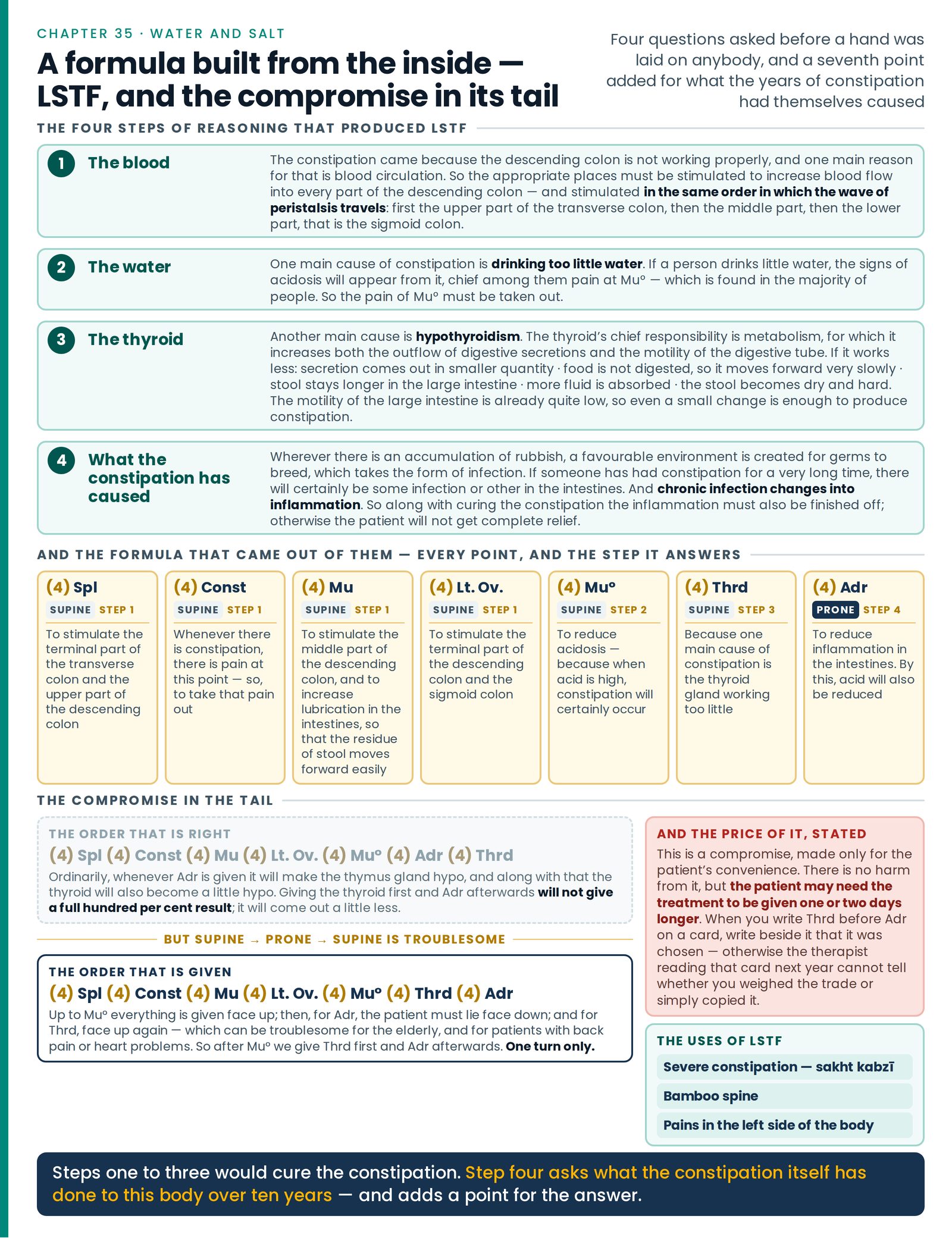
The four steps of reasoning that produced LSTF
1 — The blood.
The constipation came because the descending colon is not working properly, and one main reason for that is blood circulation. So the appropriate places must be stimulated to increase blood flow into every part of the descending colon — and stimulated in the same order in which the wave of peristalsis travels in the intestine: first the upper part of the transverse colon, then the middle part, then the lower part, that is the sigmoid colon, in that order.
2 — The water. Then the other causes must also be set right. One main cause of constipation is drinking too little water. If a person drinks little water, the signs of acidosis will appear from it, chief among them pain at Mu° — which is found in the majority of people. So the pain of Mu° must be taken out.
3 — The thyroid. Another main cause of constipation is hypothyroidism. The thyroid's chief responsibility is metabolism, for which it increases both the outflow of digestive secretions and the motility of the digestive tube. If the thyroid works less, digestive secretion comes out in smaller quantity; food is not digested in the intestines, so it moves forward very slowly; stool and waste stay in the large intestine for a longer time; more fluid is absorbed from the large intestine; and the stool becomes dry and hard. Note that the motility of the large intestine is already quite low, so even a small change in motility is enough to produce constipation. So in the treatment of constipation the thyroid gland must certainly be stimulated.
4 — What the constipation has caused. Wherever there is an accumulation of rubbish, a favourable environment is created for germs to breed, which takes the form of infection. If someone has had constipation for a very long time, there will certainly be some infection or other in the intestines. And chronic infection — an infection which stays for a long time — changes into inflammation. So along with curing the constipation the inflammation must also be finished off; otherwise the patient will not get complete relief.
Read step four twice. Steps one to three would cure the constipation and any competent formula-builder would have stopped there. Step four asks a different question — what has the constipation itself done to this body over ten years? — and adds a point for the answer. That is the whole difference between a formula that relieves and a formula that finishes.
The result was named the Left Side Treatment Formula, LSTF, because it improves the working of the organs of the left — the bāyī — side. It is given to those who have chronic constipation, that is, constipation of very long standing. In it every single part of the left side of the body has been stimulated, in a specific ordered manner, in keeping with the peristalsis — the motion — of the large intestine.
Table 3 — Card: LSTF, the Left Side Treatment Formula Supine Prone 6 sec Left Right ▲ Take care
| Written | LSTF → (4) Spl (4) Const (4) Mu (4) Lt. Ov. (4) Mu° (4) Thrd (4) Adr |
|---|---|
| What it is for | Severe constipation (sakht kabzī) · Bamboo spine · pains in the left side of the body |
| Positions, in order | Supine for steps 1–6 Supine → prone for step 7 Prone . One turn only |
| Step 1 — (4) Spl | Supine; the sole across the left upper quadrant, under the left costal margin, six seconds a station. For the terminal part of the transverse colon and the upper part of the descending colon Left 6 sec |
| Step 2 — (4) Const | Supine; left upper quadrant, ring 2, over the descending colon and splenic flexure. Whenever there is constipation there is pain at this point — so, to take that pain out |
| Step 3 — (4) Mu | Supine; left of the navel, ring 2. To stimulate the middle part of the descending colon, and to increase lubrication in the intestines, so that the residue of stool moves forward easily in the large intestine |
| Step 4 — (4) Lt. Ov. | From the head end; the therapist's left sole, three stations elbow → wrist on the patient's right forearm, the other foot beside the ear. To stimulate the terminal part of the descending colon and the sigmoid colon Right |
| Step 5 — (4) Mu° | Supine; the left kidney code, single station, hand contact high at the shoulder. To reduce acidosis — because when acid is high, constipation will certainly occur Left |
| Step 6 — (4) Thrd | Left arm only: elbow → shoulder → elbow → shoulder. Four equal one. Because one main cause of constipation is the thyroid gland working too little Left |
| Step 7 — (4) Adr | Prone; fingers gathered, both palms very close together at the T6 bead. To reduce inflammation in the intestines. By this, acid will also be reduced Prone |
| The order rule inside it | The colon is worked in the direction peristalsis travels — transverse, then mid-descending, then sigmoid |
| The compromise in steps 6 and 7 | Physiologically the adrenal should come before the thyroid. It is written the other way for the patient's comfort — see the box below |
| What it inherits | Spl — not in cold, allergy or asthma, where it does harm; nowadays not in cancer; not in diabetes or other autoimmune disorders. Const — not to those who have loose motions. Lt. Ov. — not in cancer, because cancer arises from excess oestrogen; not to children being treated to increase height, since oestrogen and progesterone hasten the closure of the epiphyseal line. Mu° — do not stimulate it in kidney failure or kidney cancer; those who have pain only at Liv° — do not give it to them. Thrd — not in bamboo spine or spur and the like, because these diseases have come from increased calcium; not in asthma, where the cough increases; (4) Thrd not to heart patients, because when the metabolism increases too much there can also be trouble. Adr — it reduces immunity, so not in septicaemia, AIDS, HIV or cancer; it reduces acid and raises alkali, so not in high blood pressure ▲ Take care |
| Points taught in | Spl, Const, Mu, Lt. Ov., Mu° — The Front of the Body I, "The Front of the Body — I"; Thrd — The Front of the Body II; Adr — Face Down, "Face Down"; indications and bars point by point — Each Point in Use, "Each Point in Use" |
Notice the collision in that last row and do not smooth it over. LSTF is given for bamboo spine; and Thrd is not given in bamboo spine, because that disease has come from increased calcium. Both sentences are printed, both are correct where they stand, and neither cancels the other. What the therapist does with such a pair is what a therapist is for: read the whole patient, and if the two instructions meet in one body, the bar written against the point is the one that decides that point. Nothing in this wiki asks you to give a point to a patient it is written against.
Why the spleen and the ovary, when the trouble is in the bowel?
A point's name is a postal address, not a description of the parcel
A natural question arises. To cure constipation, why are Spl — the spleen — and Lt. Ov. — the left ovary — being stimulated? Constipation has come about because the movement of food in the alimentary canal is very slow, and both of these are outside the alimentary canal.
Here is the thing to attend to. By our points we increase the blood circulation in the various parts of the abdomen all around the navel. Each point's name has been given by keeping in mind the chief organ in that region. But when we give that point, it will increase blood flow not only in that organ, but in all the organs that are in that region.
In the region above and to the left of the navel the chief organ is the spleen — but the left terminal part of the transverse colon and the upper part of the descending colon are there too, and when Spl is given, blood flow increases in all three. In the same way Mu removes the pains of the left side of the navel: besides the small intestine, the middle part of the descending colon is there, so it is stimulated as well. And Lt. Ov. takes out the pain of the region below and to the left of the navel, where besides the ovaries or testes there is the terminal part of the descending colon and the sigmoid colon.
What a point's name means, and what it does not
In this formula the point Spl has not been given in order to stimulate the spleen, but rather for that part of the large intestine.
This is one of the most freeing ideas in the whole formulary, and it disposes of a great deal of student anxiety. A point name is a postal address, not a description of the parcel. You are not pressing a spleen; you are increasing the blood supply to a region that happens to contain a spleen, and also contains two lengths of colon that nobody thought to name a point after.
An everyday version: you open the tap in the kitchen and the pressure drops in the bathroom, because you did not turn on "the kitchen" — you drew from a pipe that serves both rooms. Blood is that pipe.
Table 4 — Why each point of LSTF is given
| Point | The reason it is in the formula |
|---|---|
| Spl | To stimulate the terminal part of the transverse colon and the upper part of the descending colon |
| Const | Whenever there is constipation, there is pain at this point — so, to take that pain out |
| Mu | To stimulate the middle part of the descending colon, and to increase lubrication in the intestines, so that the residue of stool moves forward easily |
| Lt. Ov. | To stimulate the terminal part of the descending colon and the sigmoid colon |
| Mu° | To reduce acidosis — because when acid is high, constipation will certainly occur |
| Adr | To reduce inflammation in the intestines. By this, acid will also be reduced |
| Thrd | Because one main cause of constipation is the thyroid gland working too little |
The compromise in the tail, stated with its price
Adr before Thrd is right; Thrd before Adr is given — and the cost is named
The two orders set side by side, and what each costs, are in Table 7 of How a Formula Is Built, where this passage is used to teach what a compromise is and why one that is not written down stops being a compromise and becomes a mistake. It is not repeated here. What belongs to LSTF is the practical consequence: when you write Thrd before Adr on a card, write beside it that it was chosen — otherwise the therapist reading that card next year cannot tell whether you weighed the trade or simply copied it. (Figure 35.2)
The Round Normal Formula
Breadth for the everyday case — the whole bowel walked in order, three times
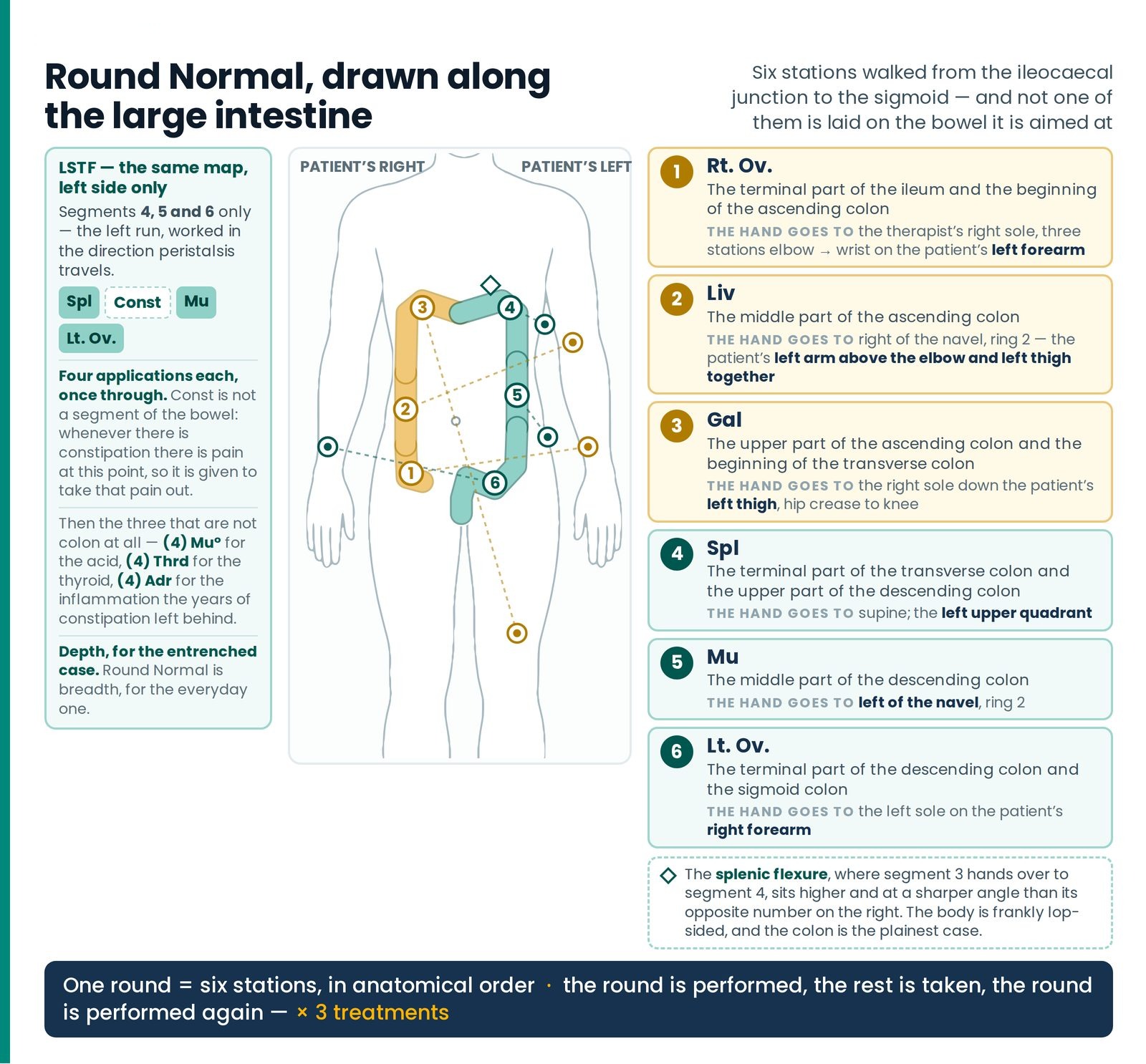
LSTF works the left run, deeply, for a constipation of many years. Round Normal works the whole run, lightly, three times over, for the ordinary kind. (Figure 35.3)
Round Normal
(1) Rt. Ov. (1) Liv (1) Gal (1) Spl (1) Mu (1) Lt. Ov. × 3 treatments
This too is a very good formula for ordinary constipation. The difference in it is that not only the descending colon, but all the parts of the large intestine from the ascending colon right through to the sigmoid colon, have been stimulated in order.
Table 6 — Card: the Round Normal formula Supine 6 sec Left Right × 3
| Written | Round Normal → (1) Rt. Ov. (1) Liv (1) Gal (1) Spl (1) Mu (1) Lt. Ov. × 3 treatments |
|---|---|
| What it is for | Ordinary constipation |
| Position | Supine throughout — the patient is not turned at all Supine |
| Step 1 — (1) Rt. Ov. | From the head end; the therapist's right sole, three stations elbow → wrist on the patient's left forearm. The terminal part of the ileum and the beginning of the ascending colon Left |
| Step 2 — (1) Liv | Supine; right of the navel, ring 2 — left arm above the elbow and left thigh together. The middle part of the ascending colon |
| Step 3 — (1) Gal | The right sole down the patient's left thigh, hip crease to knee. The upper part of the ascending colon and the beginning of the transverse colon Left |
| Step 4 — (1) Spl | Supine; left upper quadrant. The terminal part of the transverse colon and the upper part of the descending colon Left |
| Step 5 — (1) Mu | Supine; left of the navel, ring 2. The middle part of the descending colon |
| Step 6 — (1) Lt. Ov. | The left sole on the patient's right forearm. The terminal part of the descending colon and the sigmoid colon Right |
| The round and the rest | The six steps are one round. The round is performed, the rest is taken, the round is performed again — three rounds in all. The rest between rounds is Table 8, How a Formula Is Built × 3 |
| Why the order is rule five | Round Normal is one of the therapy's own examples of a formula built beyond the five rules — made by experience, but provoking in accordance with peristalsis. How a Formula Is Built |
| What it inherits | Rt. Ov. — also makes 20% oestrogen, so not in cancer; not to children being treated to increase height. Liv — not in liver cancer. Gal — not in leukaemia, blood cancer or other diseases arising from a raised white cell count; not in asthma, where this point increases the trouble; not to those passing little urine. Spl, Mu, Lt. Ov. — as Table 3 ▲ Take care |
| Points taught in | All six — The Front of the Body I, "The Front of the Body — I" |
Table 7 — Why each point of Round Normal is given
| Point | Segment of the large intestine it is aimed at |
|---|---|
| Rt. Ov. | The terminal part of the ileum and the beginning of the ascending colon |
| Liv | The middle part of the ascending colon |
| Gal | The upper part of the ascending colon and the beginning of the transverse colon |
| Spl | The terminal part of the transverse colon and the upper part of the descending colon |
| Mu | The middle part of the descending colon |
| Lt. Ov. | The terminal part of the descending colon and the sigmoid colon |
Read that column straight down and you have walked the whole large bowel from the ileocaecal junction to the sigmoid without missing a segment. The name is well chosen: it is a round — a circuit — of the normal stations, in anatomical order.
Table 8 — LSTF and Round Normal side by side
| LSTF | Round Normal | |
|---|---|---|
| For | Chronic constipation, of very long standing | Ordinary constipation |
| Territory | The left run only, plus three systemic points | The whole large intestine, ascending to sigmoid |
| Dose at each station | Four applications | One application |
| Repeats | Once through | × 3 treatments |
| Positions | Supine, then prone for Adr | Supine throughout |
| The shape of it | Depth, for the entrenched case | Breadth, for the everyday one |
A composite of many such patients makes the point about how LSTF is chosen. Devidas Karmakar, 67, a retired postmaster of Bardhaman, came with "gas" and a stiffening back and did not mention constipation at all; asked directly, he said motions came every third or fourth day, with force, in hard small pieces, and had done so since his service days. He did not count it as an illness. He counted it as his nature — which is what every patient does with a symptom they have lived with for thirty years, and which is why the question has to be asked rather than waited for.
On the abdomen he was very tender at Const and at Mu°, less at Mu, and almost not at all at Liv°. His spine moved as one piece and his chest barely expanded on a deep breath. His thyroid panel mattered — the thyroid is one of the four legs LSTF stands on and his had never been checked — and his films of the sacroiliac joints mattered, because the way that spine moved raised the question of bamboo spine, which changes what may be given. An ultrasound done four years earlier changed nothing.
He was not given Round Normal. Thirty years is not ordinary constipation; the stool was hard and scanty; Const was the loudest point on the abdomen; and Mu° was tender, which is the acid side and is LSTF's second step of reasoning stated out loud in a single finding. LSTF was given in the taught order, with Thrd before Adr and a note on the card saying that the order had been chosen. The first four days brought a daily motion, which astonished him more than anybody. In the second week the daily motion held while the abdominal tightness came back each evening — and nothing was added, because the fourth step of the reasoning, the inflammation left behind by years of constipation, was already in the formula and was left to do its work. By the fifth week he was bending to his shoes.
Then, in week six, the films came back reported as bamboo spine. LSTF is written for bamboo spine; Thrd is written against it. He was not given the point anyway, and he was not abandoned either: the bar on the point was honoured, the rest of the sequence stood, what had been gained on the bowel was held, and he was told plainly that a report naming that disease is a reason to be under a physician for it and to stay under one.
Three things in that account are worth carrying. Nobody reports a symptom they have decided is their nature — how often, and what does it look like found in one minute what six years of consultations had not asked. The four steps of reasoning are a checklist: blood to the left colon, the water and the acid, the thyroid, and what the years of constipation have themselves caused. And a formula's indication and a point's prohibition can name the same disease; when they meet in one body, the bar on the point decides that point, and it does not decide the formula.
The Lactic Acid Conversion formula
(6) Rt. Ov. (6) Lt. Ov. (8) Pan (12) Liv (6) Adr
Table 9 — Card: the Lactic Acid Conversion formula Supine Prone 6 sec Left Right ▲ Take care
| Written | Lactic Acid conversion formula → (6) Rt. Ov. (6) Lt. Ov. (8) Pan (12) Liv (6) Adr |
|---|---|
| Positions, in order | Supine for steps 1–4 Supine → prone for step 5 Prone |
| Step 1 — (6) Rt. Ov. | From the head end; the therapist's right sole on the patient's left forearm, three stations elbow → wrist, the other foot beside the ear. The pair is ordinarily given right first Left |
| Step 2 — (6) Lt. Ov. | The left sole on the patient's right forearm, three stations elbow → wrist Right |
| Step 3 — (8) Pan | Supine; both thighs together, soft mid-sole on the upper third of each Both sides . One of the two most painful points in the patient the formula was made for |
| Step 4 — (12) Liv | Supine; right of the navel, ring 2 — the highest count in the formula. (12) Liv is also the count very beneficial for dissolving gallstones; perhaps it works something like cholic acid |
| Step 5 — (6) Adr | Prone; fingers gathered, both palms very close together at the T6 bead. Added because inflammation was suspected Prone |
| What it is said to do | To help in some direction with the conversion — the interchange — of lactic acid. That word is the therapy's own: this is an inference, arrived at by reading after the result |
| What it inherits | Rt. Ov. — not in cancer (it also makes 20% oestrogen); not to children being treated to increase height. Lt. Ov. — not in cancer, because cancer arises from excess oestrogen; not to children being treated to increase height. Pan — raises alkali, therefore not in fits, convulsions or seizures (the Heparin exception belongs to The River — Heparin and to that family alone); never to schizophrenia patients, in whom giving Pan causes them to hear voices in the ears. Liv — not in liver cancer. Adr — it reduces immunity, so not in septicaemia, AIDS, HIV or cancer; it reduces acid and raises alkali, so not in high blood pressure ▲ Take care |
| Points taught in | Rt. Ov., Lt. Ov., Pan, Liv — The Front of the Body I; Adr — Face Down; indications and bars — Each Point in Use |
What lactic acid actually does — the story to tell a patient
Why a man stops on a landing: he is fetching oxygen, not resting his legs
First, what the work of lactic acid in the body is. If we are doing daṇḍ-baiṭhak or heavy exercise, then after twenty-five or thirty repetitions one cannot get up — and then, after resting a little while, one can do them again. In the same way, climbing stairs, after seventy-five or eighty steps one suddenly cannot lift a step; but after pausing for a few moments and breathing hard, one can climb further. Why is this?
The cycle, in the order it happens
The carbohydrates in our food — rice, chapati and so on — after being digested all become glucose and reach the blood. There the glucose is stored in the muscles in the form of glycogen. The energy the muscles of the arms and legs need for any work is obtained by burning this stored glycogen, and during that process a chemical called lactic acid comes out of the muscles.
When there is heavy exercise, the accumulation of this lactic acid in the blood increases. Now, the muscles of the heart also require glucose in order to work. But if the quantity of lactic acid in the blood rises, acidosis can result from it, because of which the muscles will go slack, and harm can come to the body.
So that this should not happen, the muscles of the heart have the capacity to change the raised lactic acid in the blood into pyruvic acid and to obtain energy from it. This is a self-protective process for saving the body, which prevents acidosis in the blood even when the quantity of lactic acid rises.
As soon as the quantity of oxygen in the body rises, it is the property of lactic acid that it will convert back into glycogen, from which strength returns to the muscles. In this way the cycle keeps going.
Now put the stairs into that cycle and the whole complaint explains itself.
In the first forty or fifty stairs climbed, the quantity of oxygen in the muscles and in the body goes on decreasing. After that, to climb another twenty-five or thirty stairs, the heart takes its energy from lactic acid — that is, at that moment it is lactic acid that is helping us. But the other muscles of the body do not have this capacity, to get energy from lactic acid. After that we shall not be able to lift even one step, because the knees do not get enough oxygen through the blood, so the muscles of the knee will tire from lack of oxygen. Then, on taking some breaths and getting oxygen, the lactic acid that is in the blood will change into glucose, and the knees will obtain energy, by which we can climb the rest of the stairs.
That is why a person stops on a landing, breathes, and goes on. He is not resting his legs. He is fetching oxygen so that a chemical can be turned back into fuel.
When somebody says they went on a climb some days ago, or walked a very long way, or went to the gym after a long gap, and that since returning they have pain in their knees or calves — then if this treatment is given to them, immediately after the treatment the pain of their knees or calves goes away. And they say that life has come back into their knees.
Now you tell me: if, on giving this treatment, so many patients begin to feel good, then would you not agree that this treatment helps in changing lactic acid back into glycogen in the body?
Table 10 — The chief uses of the Lactic Acid formula
| The finding | The instruction |
|---|---|
| Knee pain, especially where there is pain at both Liv° and Mu° | Give the Lactic Acid formula. "This is experience" |
| Diabetes with high blood pressure, and knee pain | Diabetes is a disease of acid — in it the patient often has pain at Mu°. High BP is a disease of alkali — in it there is often pain at Liv°. So a patient with both diseases will often have both points tender, and this treatment gives benefit in the knee pain |
| High blood pressure | Oestrogen and progesterone are both vasodilators — they widen the blood vessels. Perhaps this too is one reason why Rt. Ov. and Lt. Ov. give benefit in high blood pressure |
| Pain in the calves on the second day after heavy exercise, a hill climb, a long journey, or the gym after a long gap | Understand that that pain came from a lack of oxygen in the muscles, for which this treatment is a sovereign remedy |
| RA — rheumatoid arthritis, whose chief sign is pain in both ring fingers | Give the treatment. The recognition and treatment of rheumatoid arthritis belong whole to The Stiffening Joint, "The Stiffening Joint" |
| Osteoarthritis — pain in the back, knees and other joints in older people, especially those joints on which the body's weight falls | They have got benefit from this treatment |
Row two of that table is worth dwelling on, because it is a small masterpiece of this therapy's way of thinking. A patient arrives with two named diseases and a sore knee. Nobody treats the knee for diabetes. But diabetes is an acid disease and shows at Mu°; high blood pressure is an alkali disease and shows at Liv°; a patient with both will be tender at both; and both Liv° and Mu° tender is precisely the finding that selects this formula. The two diseases did not have to be treated. They only had to be read as a pair of pain points.
Two formulas in this therapy raise a blood pressure. They are not alternatives. They are written for two completely different patients, and one of them is forbidden to the other's patient. Everything in this part is aimed at making that distinction automatic. (Figure 35.5)