Reading the Reports — Which Investigations Change Your Treatment
Watch



The one question, and why it comes first
Does this change what I do? Two answers, and the words we use
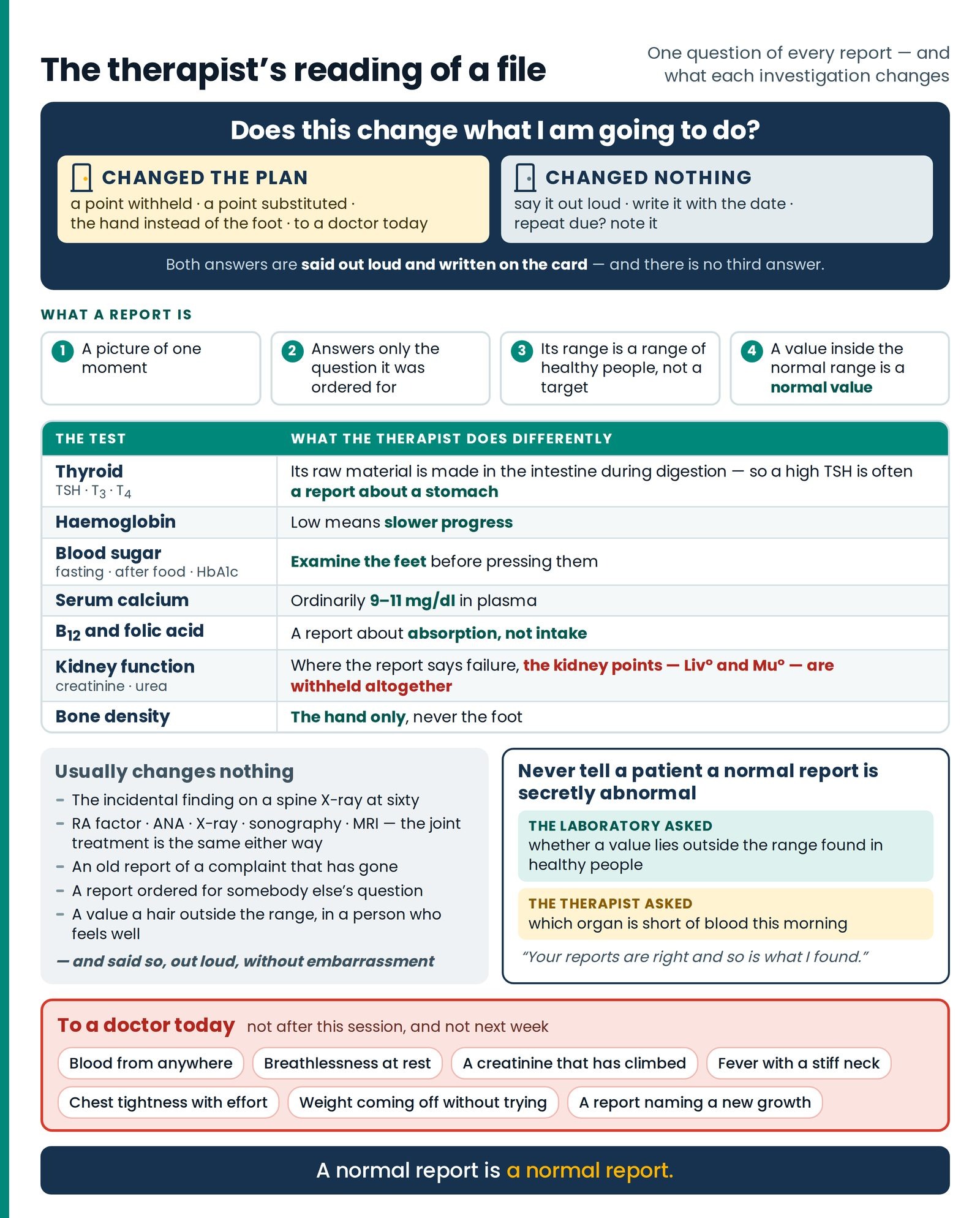
A student who has learnt fifty points is still defeated by a folder, because he reads it looking for something to know. The therapist reads a folder looking for something to do differently. (Figure 12.4)
The question asked of every report, every time
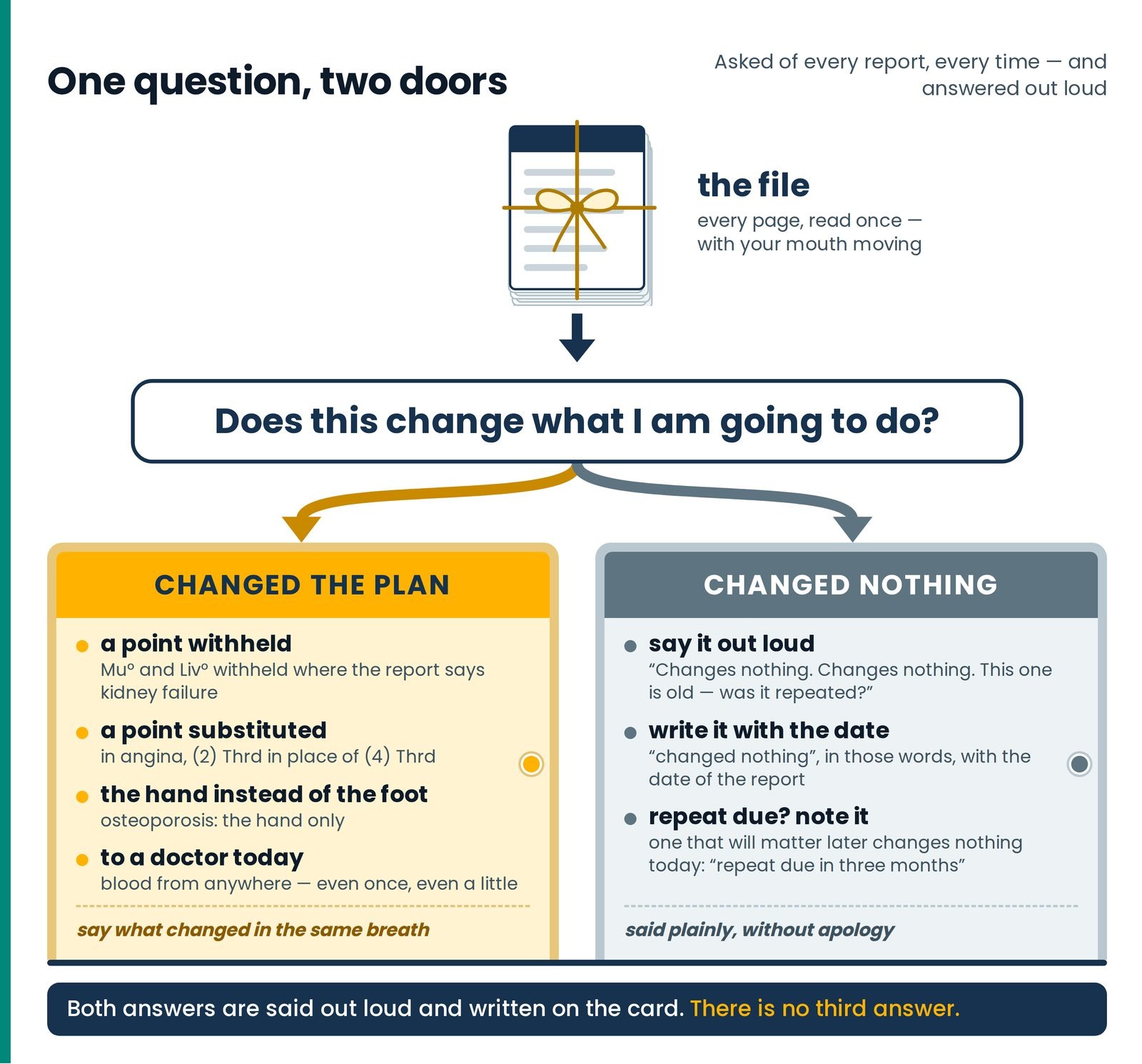
Does this report change what I am going to do — or does it not?
Two honest answers, both said out loud and written on the card.
1. It changed the plan — and you say what changed in the same breath: a point withheld, a point substituted, the hand used instead of the foot, the patient sent to a doctor before the mat.
2. It changed nothing — said plainly, without apology, and written in those words with the date of the report.
There is no third answer. A report you have not decided about is a report you have not read. One that will matter later changes nothing today: write repeat due in three months.
It does not ask what the disease is called — this therapy does not treat a name — but whether your hands will do something different at ten o'clock because of a piece of paper. Usually they will not, and saying so is the mark of a therapist (The Hand That Heals). (Figure 12.1)
Where this therapy stands towards modern investigation
Neurotherapy has its own distinctive methods of disease-identification and diagnosis; and along with that, it keeps in coordination with the knowledge obtained from modern investigation — such as the testing of blood, or a picture taken by X-ray, and so on.
Its own methods — the pain points, the grading, the bowel, the tongue, the undigested food, the history — are the diagnosis, and are sufficient for it. Coordination is not obedience and not competition, and it runs both ways.
What a report is, and what it is not
A picture of one moment, the normal range, and sugar and BP first
Five things every report is, and one thing no report is
1. It is a picture of one moment.
Some values swing through a single day — sugar most of all, and any value taken during fever, infection or fright.
2. It answers only the question it was ordered for. "They checked everything" means "they took a lot of blood".
3. Its range is a range of the healthy, not a target. Neither inside nor outside means cured or doomed.
4. A value inside the normal range is a normal value. Not "borderline"; not "low normal, which is really low". If a therapist may move the line where the laboratory drew it, the line means nothing — and neither does anything else that therapist says.
5. It is read to inform a treatment — never to make a diagnosis, never to award a name, never to contradict the person who ordered it.
And no report is an instruction to your hands. The instruction comes from what you find; the report tells you which findings to be careful with.
Investigation is expensive too — one blood panel can be a week of somebody's wages — and a report is never ordered to show a patient that you are thorough.
Sugar and BP come first for a reason that has nothing to do with numbers: a diabetic's foot may have lost its sensation, and a foot that cannot feel cannot warn you. ▲ Take care
The investigations that change what you do
Thyroid, haemoglobin, sugar, calcium, B₁₂, kidney and liver reports
Learn the right-hand column; the rest of this section is explanation.
Table 1 — What each investigation measures, and what it changes
| Investigation | What it measures, in plain words | What the therapist does differently |
|---|---|---|
| Thyroid — TSH, T₃, T₄ | The gland that sets the speed of everything; TSH is the pituitary's shout at it | Reads a hard constipation as a thyroid constipation; digestive work first; takes on the caution list of the thyroid points |
| Haemoglobin | How much oxygen-carrier is in the blood | Expects a slower response; works for the raw materials and the red cell; refers a very low figure |
| Blood sugar — fasting, after food, HbA1c | Sugar this morning; sugar over three months | Examines the foot before pressing it; lets the day's bowel choose the day's plan |
| Serum calcium | Calcium dissolved in the blood — not calcium in bone | Chooses between the two directions of the calcium work, and obeys the caution on each |
| Vitamin B₁₂ · folic acid | Two vitamins whose absorption depends on stomach and intestine | Treats an absorption problem, not an intake one; in a child, checks the mother's points |
| Kidney function — creatinine, urea | The waste the kidneys should clear | Withholds the kidney points where the report says failure. The most plan-changing page in a file |
| Liver values, cholesterol, uric acid, white cells | The liver and its drains; and two things the liver is responsible for | Chooses the liver work; withholds Liv where a cancer in the liver is named, and Gal and Spl where the count or the disease forbids them |
| RA factor · ANA · X-ray · sonography · MRI | One joint marker; bone; a picture of soft tissue | Usually nothing — the joint treatment is the same either way. Occasionally names a level your fingers had found, or a thing you cannot feel |
| Bone density | How solid the bone is | Changes your own body: the hand, never the foot ▲ Take care |
The thyroid
What a thyroid report is saying
The thyroid sets the speed of the body — the master craftsman, without whose order the other workmen do not get on. All the functions of the digestive tract depend on the thyroid gland.
When the thyroid works less, T₃ and T₄ come out in less than the right quantity; after years of it the quantity in the blood is far below normal and it is called hypothyroidism, and one chief indicator is that the quantity of TSH also rises — because TSH is the order sent to the thyroid from the pituitary. A high TSH is the sound of the body shouting at a gland that is not answering.
And the part that belongs to this therapy: the thyroid gland's basic chemical is tyrosine, an amino acid, which is made in the intestine during digestion. If digestion is not right it will not be made; so T₃ and T₄ will not be made either, and TSH will rise in the blood. If digestion were right, thyroid function would remain right, and we would not fall ill.
So a thyroid report is very often a report about a stomach — and it re-reads a symptom: when the thyroid works less, the residue reaches the large intestine very late, and that person gets hard constipation, so in the treatment of constipation we must certainly stimulate the thyroid gland. Thrd raises metabolism by T₃ and T₄ and is extremely good for diabetes, heart disease and kidney disease, because these diseases come from hypothyroidism; its full list of uses belongs to Each Point in Use. What belongs here is the caution list a report puts into your hands.
Haemoglobin
Low haemoglobin is a shortage of the oxygen-carrier. Lying down, the blood such a person has is enough for the involuntary work; but on setting to work she needs more oxygen and cannot get it, and because sufficient oxygen does not reach the brain she feels giddy — with shivering, clenching of the teeth, speech stopping, and a falling temperature and pulse. Where the menstrual flow is excessive, ask what is behind it: if there is hypothyroidism, or calcium or haemoglobin is low, or a cyst or fibroid in the uterus or ovary, then bleeding is greater — and all these disturbances we can correct (Treating Women). And the haemoglobin of rheumatoid arthritis patients remains lower than normal, and when haemoglobin is low, sufficient oxygen will not reach the tissues.
What a low haemoglobin changes
The pace you expect, said at the start rather than explained in week four. Where the work goes: the red cell is made on an order — erythropoietin — from the kidney, so in chronic diseases Mu° is given to make erythropoietin, which will stimulate the bone marrow to make red blood cells, and the liver point is given in kidney failure and other chronic diseases to stimulate erythropoietin so the red cell count does not fall too low. And what is asked about: the periods, the stool, the gums, the piles — blood from anywhere, even once, even a little, goes to a doctor this week ▲ Take care , as does a very low figure with breathlessness at rest (When the Hand Must Stop).
Blood sugar
Fasting and after-food are photographs; the three-month figure is a memory. The session changes first: look at the feet before you use them — where sensation has gone, a patient cannot tell you that something is too much. ▲ Take care Then the day's plan follows the day's body: a diabetic who normally has constipation will be given a different treatment on the day when he has loose or semi-solid motions — and both treatments will be found to be effective in reducing his blood sugar. Neither was aimed at the sugar. And a point comes into play: (10) Pan stimulates insulin and is given to maintain the body's sugar level, and in heart disease or obesity to reduce triglycerides — chiefly where diabetes or heart disease arises from hypothyroidism. Where sugars climb with nothing changed, retake the history: the commonest answer is a tablet quietly reduced. We use no medicine and we do not tell anyone to stop theirs (The History That Cannot Mislead You).
Serum calcium
The word calcium makes everybody think of bone. The bones are the warehouse; the blood is the shop floor; the report counts what is on the shelves this morning.
The two directions of calcium
The quantity of calcium in the plasma should ordinarily be from 9.00 to 11.00 mg/dl.
Below 9 mg/dl: the muscles cannot work properly — and the glands cannot send out their secretion unless the muscles beside them work, so a low calcium slows glands with nothing wrong with them. If there is an extreme deficiency, even the heart can fail. To prevent it, PTH — parathormone, from the parathyroid gland — tells the osteoclasts to take calcium out of the bones and put it into the plasma.
Above 11 mg/dl: from the thyroid gland calcitonin comes out, which tells the osteoblasts to put that excess calcium into the bones, and the parathyroid stops the intestine and the osteoclasts from taking up any more, and lets calcium go out through the urine.
Calcium is absorbed by way of the hormone 1,25 DCC, and for that the presence of PTH is essential (Correcting the Two Kingdoms); if the kidneys become spoiled, 1,25 DCC will not be made, and those patients can get osteoporosis, in which the bones become so hollow that they cannot bear even a little pressure.
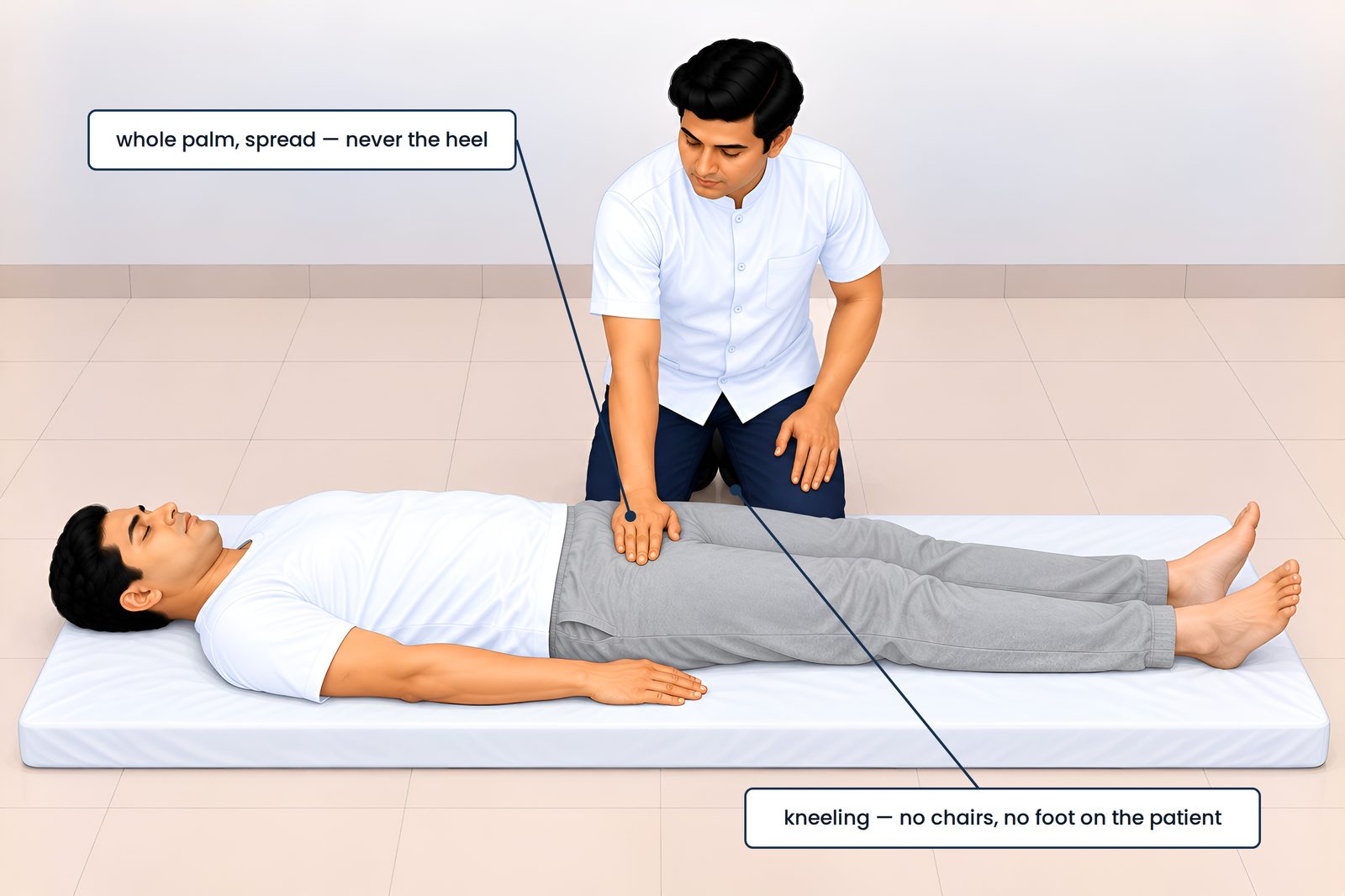
If there is osteoporosis, there will be deficiency of calcium in the blood too — because calcium is not being absorbed. However many calcium tablets one eats, that deficiency will not be made up: if the intestine is not working properly, calcium will not be absorbed and will not reach the blood. Correct the intestine and even a disease like osteoporosis can be cured. In the other direction, if calcium in the bones becomes excessive, we stimulate the parathyroid gland, which draws calcium out of the bones into the blood; along with it we give Heparin, which increases blood circulation, and by that increase the calcium raised in the blood is properly broken down and passes out of the body — by which relief comes in such diseases as ankylosing spondylitis or kidney stone. (Figure 12.2)
Vitamin B₁₂ and folic acid
Why a low B₁₂ is a report about the stomach
For the absorption of vitamin B₁₂ it is necessary that intrinsic factor be made in the stomach; only then, on reaching the ileum, will vitamin B₁₂ be stored in the liver. Otherwise the enzymes of the stomach and the intestine will digest it — that is, finish it off.
The stock of vitamin B₁₂ in the liver lasts five to six years, so if someone has symptoms of vitamin B₁₂ deficiency, it means that for several years it has not been getting stored in his body — and for intrinsic factor to be made properly the blood circulation in the stomach must be proper, for which we give Gas Only.
A man who eats well and shows a low B₁₂ has not been eating badly for five years. His stomach has not been taking it in. These are reports about absorption, not intake.
The deficiency has a face you see before any report: fatigue; blackness between the joints of the fingers; numbness of the feet on sitting a long time; anaemia; mouth ulcers; weakness of the nerves, the ear or the eye. Folic acid has its own family — megaloblastic anaemia, the neural tube defects, cleft lip and cleft palate, and pain at the folic acid point in a hole in the heart: ASD, VSD, PDA — with the rule that if in pregnancy the mother has a deficiency of folic acid, these defects can occur in the child (Vitamin and Gene Formulas).
A small child cannot answer; the mother can
Small children, if their pain points are checked, will not be able to say whether it hurts or not — but their mother can speak about her own pain points, can she not? And during pregnancy, whichever vitamin the mother is deficient in, the child too will certainly have a deficiency of those same things.
So in children's diseases, before deciding the treatment, always check the mother's B₁₂ and folic acid pain points, and if during pregnancy the mother had a deficiency of vitamin B₁₂ or folic acid, treat the child for that same thing — and only then will there be great progress in the child's treatment.
Kidney function
If you learn to read one report properly, learn this one — the only page in an ordinary file that will make you withhold a treatment.
What creatinine and urea are
They are waste, made all day by an ordinary working body and removed by the kidneys, which filter the blood as a sieve holds back what should not pass. When the flow of blood inside the kidneys is less than is needed, the kidneys will not be able to filter the blood properly, and there will be an accumulation in the blood of unwanted things like urea and creatinine, from which harm will come to the body.
A raised creatinine is not a disease of creatinine. It is a report that the sieve is not clearing — and the body's own answer to it, which helps to maintain the GFR, the flow of blood inside the kidneys, is taught in Water and Salt, "Water and Salt".
The coma case — a value that removed one station from a formula
A patient lay unconscious, and the treatment given was (8) Pan · (1) Gal · (2) Acid · (4) Lt. Ch. Only — in which Gal was given and Mu° was not given, because both his kidneys were spoiled, on account of which his creatinine was greatly raised. Given twice, the blood's pH changed from 7.32 to 7.4 and he came out of the coma. (Ordinarily a patient goes into coma at pH 7.1, and on its becoming pH 6.8 death occurs.)
The lesson is not the pH. It is the clause in the middle: Mu° was not given, because the creatinine was greatly raised — and the formula still worked.
Liver values, cholesterol, uric acid and the white cells
The liver reports are read because the liver decides three of the file's other values. If the liver does not work properly, accumulation of cholesterol begins and it settles on the inner walls of the arteries, from which the arteries slowly become narrow and disorders in the heart and kidneys are born — by correcting the function of the liver, this therapy keeps the level of cholesterol correct. And the chief responsibility for the metabolism of uric acid belongs to the liver: if the liver does not work properly, uric acid rises above normal — a chief cause of gout, or of pain in the joints, which makes the sour parhez a thing you will not compromise on (Food as Medicine).
That line is also a reading list: of the whole folder, the pages that most often earn their place speak about those three.
The reports that change nothing, and the discipline of saying so
The spine film at sixty, the odd exception, and the report as diagnosis
Saying it is hard for reasons that have nothing to do with medicine: the patient paid for it, believes it explains everything, and "this changes nothing" sounds, to an untrained ear, like a man who could not read it. Say it anyway.
The incidental finding on a spine X-ray in a person of sixty
A man of sixty brings a film of his lower back. The report names narrowing between two bones, roughening at the edges, a little bone grown where there was none. Every word is accurate. Almost none of it is news — that is what a sixty-year-old spine looks like, in people with pain and in people with none.
A finding present in bodies with the complaint and equally present in bodies without it does not explain the complaint. So: changed nothing — unless the film names a level your fingers had already found, which is two independent instruments agreeing (one instrument round the room twice is worth nothing — The History That Cannot Mislead You); or unless it names a thing on the caution lists, since spur and bamboo spine have come from increased calcium, and points that raise calcium into bone are therefore withheld. ▲ Take care
The same holds for an old report of a complaint that has gone, a report ordered for somebody else's question, and a value a hair outside the range in a person who feels well.
One exception teaches the rule. A knee hot to the hand, red and swollen, but with no pain at Mu°, whose film may read "OA of the knee": within one or two treatments both the heat and the swelling are reduced by G. Heparin — but this treatment is not to be given to those patients who have heart disease ▲ Take care . What chose it was not the X-ray.
A scan is read the same way, and occasionally names a thing you cannot feel. A prolapse of the uterus seen on sonography decides a treatment after which (6) WD is necessary — otherwise that woman will have still more trouble ▲ Take care (Treating Women); a blockage in the Ampoulla of Vater, which congeals the bile, can be detected by having an ultrasound done (Setting the Stomach); a hole in the heart, with its size in millimetres, gives something measurable to watch — in one child, after five to six months the sonography showed the hole reduced from 9 mm to 4 mm (Vitamin and Gene Formulas). And keep the old films: in a spina bifida patient treated for months, in the X-ray something faint began to appear at the place of L5–S1.
What is missing from the file, and how to ask for it
Asking through the doctor, as caution, for what would change the plan
Two truths sit behind this, both the therapy's own. Much has been proved by experience but it has not been possible to establish it by laboratory tests, because such tests are very expensive. And the reports are not always released: in some places the hospitals will not even give us the reports of tests that were done. That is an institution's rule, not hostility — and the patient may ask for their own records where you may not.
The findings that stop a session
The report and signs that send a patient to a doctor today
And one working rule: in the gap after each formula, ask the patient how they are feeling. If their trouble increases after any point or formula, immediately take the opinion of the chief therapist as to whether the treatment should be changed — and write this clearly on the card, so that in future that point is not given again.
Writing a report onto the card
One line per report: date, value and range, changed or not
A report not written down did not happen. Six weeks later, when a repeat arrives, you must be able to lay the two side by side.
The patient whose report is normal
Two questions, two instruments — and “RA hai”, never “RA positive”
Now the rule this article exists for — the one you will be tempted to break when a patient says "but my report is normal" and you have found four tender points and know you are right. (Figure 12.3)
Never tell a patient that a normal report is secretly abnormal
A normal report is normal.
Not "technically normal", not "they say normal but I can see it is not".
It is untrue — the value was inside the range, and you have no instrument that measures it better. It is unkind — you are taking away the one piece of good news the patient has and replacing it with an anxiety only you can relieve.
And it is unnecessary, which is what students miss: your finding does not need the report to be wrong, because you are not reading the same thing. The laboratory asked: is this value outside the range found in healthy people? You asked: which organ is short of blood this morning? Two questions, two instruments, two answers, and no contradiction between them at all.
We call those patients RA patients in whose blood test report these words are written — RA Antigen Positive or Rheumatoid Factor – Positive. (The factor is also positive in hepatitis, syphilis, liver cirrhosis, SLE, scleroderma and in acute bacterial or viral infection — so positive does not by itself name the disease.) After seeing the report we write on our card the date of the report and, in front of it, RA positive — or ANA positive, where that is what it says.
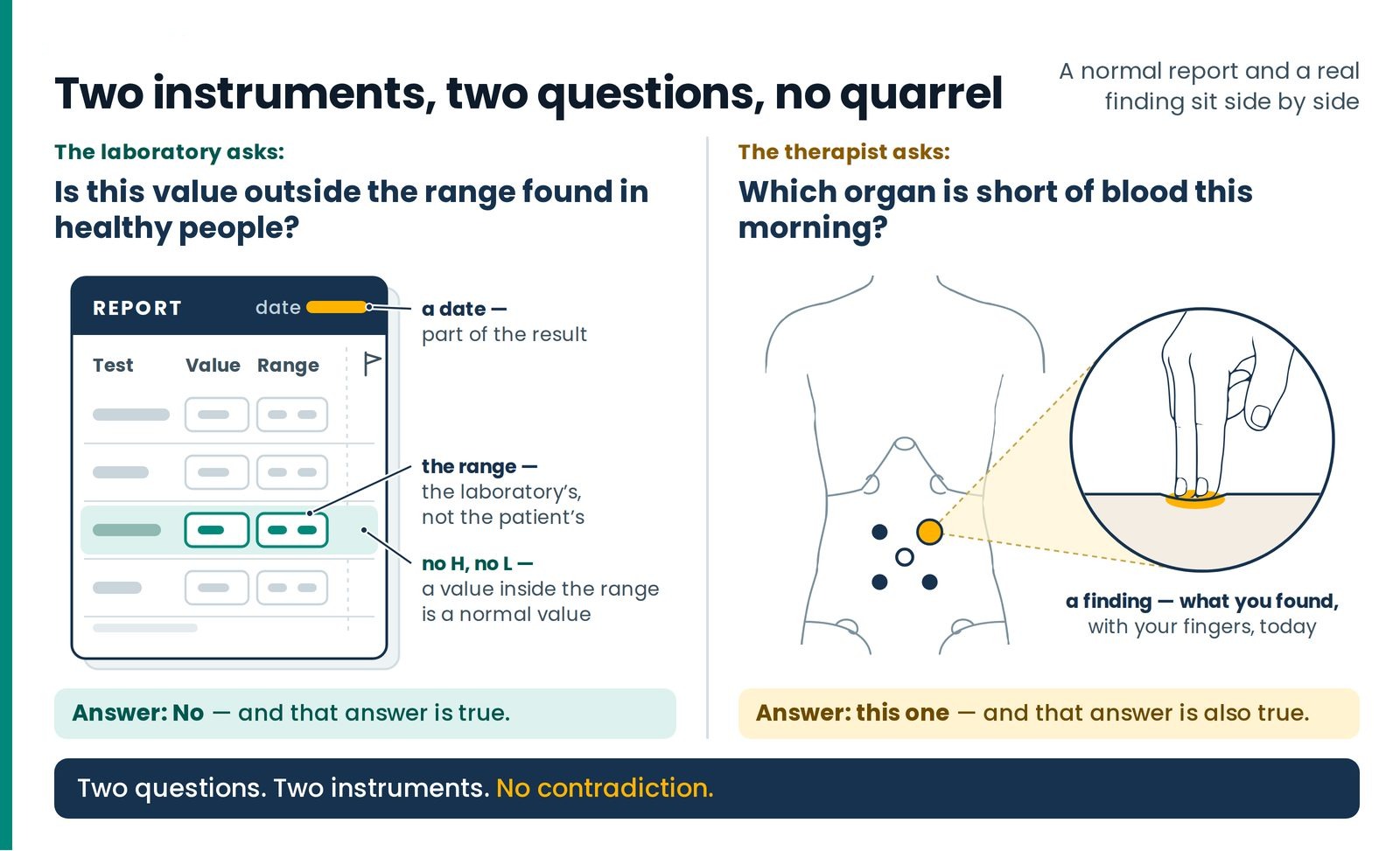
Now the finding that belongs to us. Take the middle joint of the ring finger of both hands between your thumb and first finger, press them at the same time, and ask in which hand the ring finger has more pain. All RA patients had a great deal of pain at that joint in both hands. Record Lt. 4ᵗʰ ⁺⁺⁺⁺ or Rt. 4ᵗʰ ⁺⁺⁺⁺, or ⁺⁺⁺/⁺⁺ for less. Left Right
Then the discovery: those who had joint pain but whose blood report was found RA negative had the very same pain in the ring finger, and the same treatment took their pain away — pain in the ring finger is an indicator that this person may perhaps get RA later on. So where a patient has joint pain and either has no report, or the report says RA negative — but we find pain in both ring fingers — we write on that patient's card: "RA hai", there is RA.
"RA positive" and "RA hai" — a rule about what may be written
Remember that on that patient's card, RA positive is not to be written. ▲ Take care
Whether there is a report or not, the treatment of both is one and the same.
That convention holds the ethic of the article: the therapist has a real finding, records it, treats — and does not write down a laboratory result the laboratory did not give. It is the model for what you say: not "your report is wrong", but "Your report is negative, and that is true and it is good news. What I found is a tenderness in one joint of both hands, which tells me which treatment will help you. It does not argue with your blood test."
The same shape covers the back. There are patients with pain on both sides of the waist in whose X-ray report of the back it is written NAD — No abnormality detected. They are not imagining the pain, the film is not lying, and the treatment for them — the Pure Folic Black formula — was arrived at from the pain points, not from the picture.
Talking to the patient's doctor
The one-page letter: findings, figures, dates and one question
The patient is standing between two people who have never spoken to each other, carrying messages in both directions she does not fully understand. That is an unfair position for a sick person, and it is easily fixed.
Three things are gained. The patient stops being a messenger; decisions are made by whoever is entitled to make them — when the complaint has gone entirely she goes to her own doctor and asks, "Now I have no pain at all — must I still take the tablets in the same quantity?", and the doctor himself tells her what to do (The History That Cannot Mislead You, When the Hand Must Stop). And the repeat report comes back to you. This therapy keeps one such pair in its record: a patient whose scan reported a few ischaemic foci in both frontal lobe white matter, and whose scan a week later reads "Essentially Normal Study." What makes that worth anything is not the recovery but that somebody else wrote both reports, on dated paper.
Questions students ask
- 1. I am nineteen and have never seen a blood report. Where do I start? With the right-hand column of Table 1 and nothing else. You do not need to understand a report; you need to know which handful of results change a treatment, and there are about ten.
- 2. I am a retired bank manager, sixty-seven, learning this for my wife. May I read her reports? Read them — a family member is often the only person who has ever laid six years of reports side by side in date order. What you may not do is diagnose from them, tell her a normal one is secretly abnormal, or change any medicine.
- 3. I have no science at all. Is TSH really "the pituitary shouting"? A gland in the head sends a chemical order to the thyroid; when the thyroid does not deliver, the order is repeated more strongly, and the strength of that order is what TSH measures. A high TSH means a thyroid under-delivering, not one over-working.
4. I am a physician. What exactly do you claim to be doing with our reports? Three narrow things. Safety — a few results contraindicate particular pressures, kidney failure being the plainest. Selection — a few tip the choice between otherwise equally reasonable formulas. Follow-up — dated values in your handwriting are the only outcome measure we did not generate ourselves. We do not order investigations, interpret them for a patient, or adjust medication.
- 5. I work in a village. No laboratory within sixty miles, and my patients could not pay anyway. The examination is the diagnosis here. What you need instead of a laboratory is a referral list you know by heart and the discipline of When the Hand Must Stop — knowing what makes you stop.
- 6. A patient brings a folder six inches thick. Must I read all of it? Yes, once, at the first visit, and never again — fifteen minutes with your mouth moving. Afterwards you keep one page of your own: the reports block on the card.
- 7. What if I genuinely cannot understand a report? Say so: "I do not read these; your doctor does. What did he say about it?" The answer is the most useful sentence in the file.
- 8. A patient's report improved dramatically under my treatment. May I say the treatment did it? Say what happened and let the listener draw the conclusion: "This report is March, this one is May, and here is what we did in between." The claim you attach is the only part anybody argues with.
Questions patients ask
1. "My doctor says all my tests are normal. So why do I feel like this?" Then that is good news worth having: the things those tests look for have been ruled out. A normal test does not mean nothing is wrong with you; it means nothing that this test measures is wrong with you. Much of what troubles people is organs working sluggishly rather than organs damaged, and a blood report is not built to show that. What I can tell you is what I find with my hands — and it does not argue with your report at all.
- 2. "You found pain in four places. Does that mean my reports are wrong?" No. Your reports are right and so is what I found — they answer two different questions. Your laboratory asked whether certain values sit inside the range found in healthy people; I asked which organs seem short of blood this morning. Nobody has made a mistake.
- 3. "So should I get more tests done?" Not on my account. I do not order tests, and I would not want you spending money to satisfy my curiosity. If I ever need something, I will write one line to your own doctor and let him decide.
- 4. "The X-ray says my spine is degenerated. Isn't that the whole problem?" It is a real photograph, honestly reported. But a spine of your age looks much like that in people with pain and in people with none, which is why it does not by itself explain why you hurt. What I go by is what your body is doing this morning — and that can change.
- 5. "You wrote something on my card about my fingers. What does it mean?" That when I squeezed the middle joint of both your ring fingers, the left one hurt a great deal. It is a sign I go by when choosing a treatment for joints — my own note about my own finding, not a blood test result. Your blood test said what it said, and I have written that separately, with its date.
Words used here
| Hindi | English | Neurotherapy code / usage |
|---|---|---|
| रिपोर्ट · जाँच (ripōrṭ · jāṁch) | Report · test | Read to inform a treatment, never to overrule a doctor; one line per report on the card. A therapist never orders an investigation |
| सामान्य (sāmānya) | Normal | A value inside the range is a normal value; never called "secretly abnormal" |
| थाइरॉइड (thāirŏiḍ) | Thyroid | Thrd; T₃ and T₄ from the gland, TSH the order sent to it; raw material tyrosine, made in the intestine |
| कैल्शियम (kailśiyam) | Calcium | 9–11 mg/dl in plasma; Para for PTH; below 9 the muscles cannot work |
| गुर्दा (gurdā) | Kidney | Liv° right kidney · Mu° left kidney — nicknamed so the word kidney need not be spoken over the patient |
| — | Creatinine · urea · NAD | The waste the kidneys clear — raised, the kidney points are withheld ▲ Take care ; and No abnormality detected, within the limits of that test |
| — | RA positive · "RA hai" | The first is copied from a blood report with its date; the second is your own finding from both ring fingers, written where the report is negative or absent |